Dark Souls 3’s Brigand Twindaggers or How I Stopped Worrying and Learned To Love Status Effects

It is February 2022, my dudes, and you know what that means. Elden Ring is around the corner and there was absolutely no way I wasn’t going to just talk about Fromsoft games all month. I want to share an interesting experience I found while playing Dark Souls 3 as it pertains to a specific weapon found in the game, the brigand twindaggers. This is less a breakdown of this weapon’s moveset or particular attributes and more a little anecdote about how the daggers won me over once Dark Souls 3 had sold me on using status effects on my weapons, and the subsequent analysis that followed.

In RPGs with character customization I love to bring in my own stock of characters to populate the world, and there are some old standbys I revisit frequently, such as a thief who wields a pair of daggers, whom is often my player character in Fromsoft games. If at all possible, I will deck out my characters in their appropriate gear. I kind of like the RP side of RPG that way.

In Fromsoft’s Bloodborne, an action RPG that preceded Dark Souls 3, there is a weapon called the blades of mercy, a sword that can transform into a pair of daggers. I often refer to this weapon as a lawnmower – it absolutely shreds enemies to pieces with a massive amount of damage output. It scales incredibly well with Bloodborne‘s equivalent of the dexterity attribute, and its moveset is a flowing, seamless series of rapid strikes. Its the most satisfying to use pair of daggers in any of Fromsoft’s games to that point, so I had high hopes and expectations when it was revealed that Dark Souls 3 would have, as a new feature, paired weapons – weapons that come in a set, made specifically for dual wielding. I went over the game with a fine-toothed comb when I got it, clamoring to find a pair of daggers. Surely if paired weapons were a thing, I’d find dual wield knives.

And so I found them, and it quickly became difficult to contain my disappointment. Compared to Fromsoft’s previous outing with dual wielded daggers, these brigand twindaggers had a slower moveset with a much longer startup, and tremendously pathetic damage by comparison. They didn’t even scale that well with dexterity. I tried to like them, and tried to use them throughout my first play-through, I really did. In the end, there were just so many better speedy weapons, whose damage scaled so much better, that I could really not justify using the daggers any longer. I ended up embracing my inner edgelord and used a paired katana and wakizashi, two japanese style swords, as their damage output was insane compared to the daggers.

I had a blast on my first playthrough of Dark Souls 3, but I always regret not making a player build I was satisfied with involving the daggers. It didn’t feel true to my player character to not have him using knives, and I wished the knives were better. They didn’t really need to be though, after some experimentation, I would discover I just needed to change my approach. It started when I saw a player versus player showcase of the brigand twindaggers. The very skilled video author was destroying human opponents, seemingly with ease, utilizing the weapon I had condemned as largely useless. His secret? The daggers were enhanced with a bleeding effect. The Dark Souls series has always had weapon status effects, special attributes that can be applied to weapons to make them debilitate enemies in specific ways, applied if enemies are hit enough times rapidly. Primarily, this takes the form of bleed weapons and poison weapons.
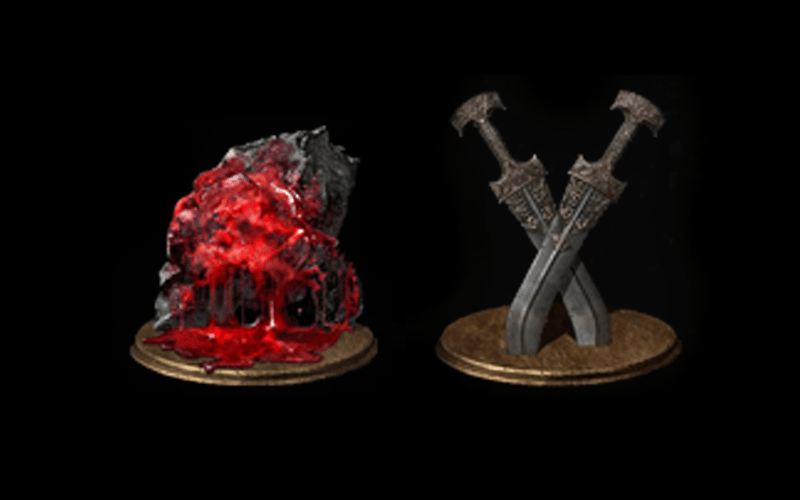
On two pedestals, side-by-side, sits a jagged stone covered in a shiny oozing red liquid, dribbling onto one pedestal. On the other, a pair of curved knives crossed over each other.
Like peanut butter and jelly.

Enhancing a weapon in Dark Souls always modifies its base damage and damage scaling in some way. Status effect weapons on the whole tend to deal a lot less base damage as a tradeoff, and so I’d often shy away from them not just in Fromsoft games but in RPGs in general. It just felt like it was an unnecessary extra step, compared to simply dealing more damage directly. But I wanted those daggers to work, so I gave it a try. In Dark Souls bleed is a status effect that builds up by hitting your target repeatedly, and when it’s built up completely, the victim loses a large chunk of their health to a hemorrhage, all at once. It’s a rather cool mechanic that gives the player a smaller micro-goal to achieve while fighting enemies, that is, quickly building up bleed, in addition to just fighting. It makes for an interesting playstyle and when I tried it out, I found I was having a ton more fun than before. Even when modified, the daggers still deal similar damage to their sharpened variant, and yet now acted as a powerful poison or open wound delivery system.

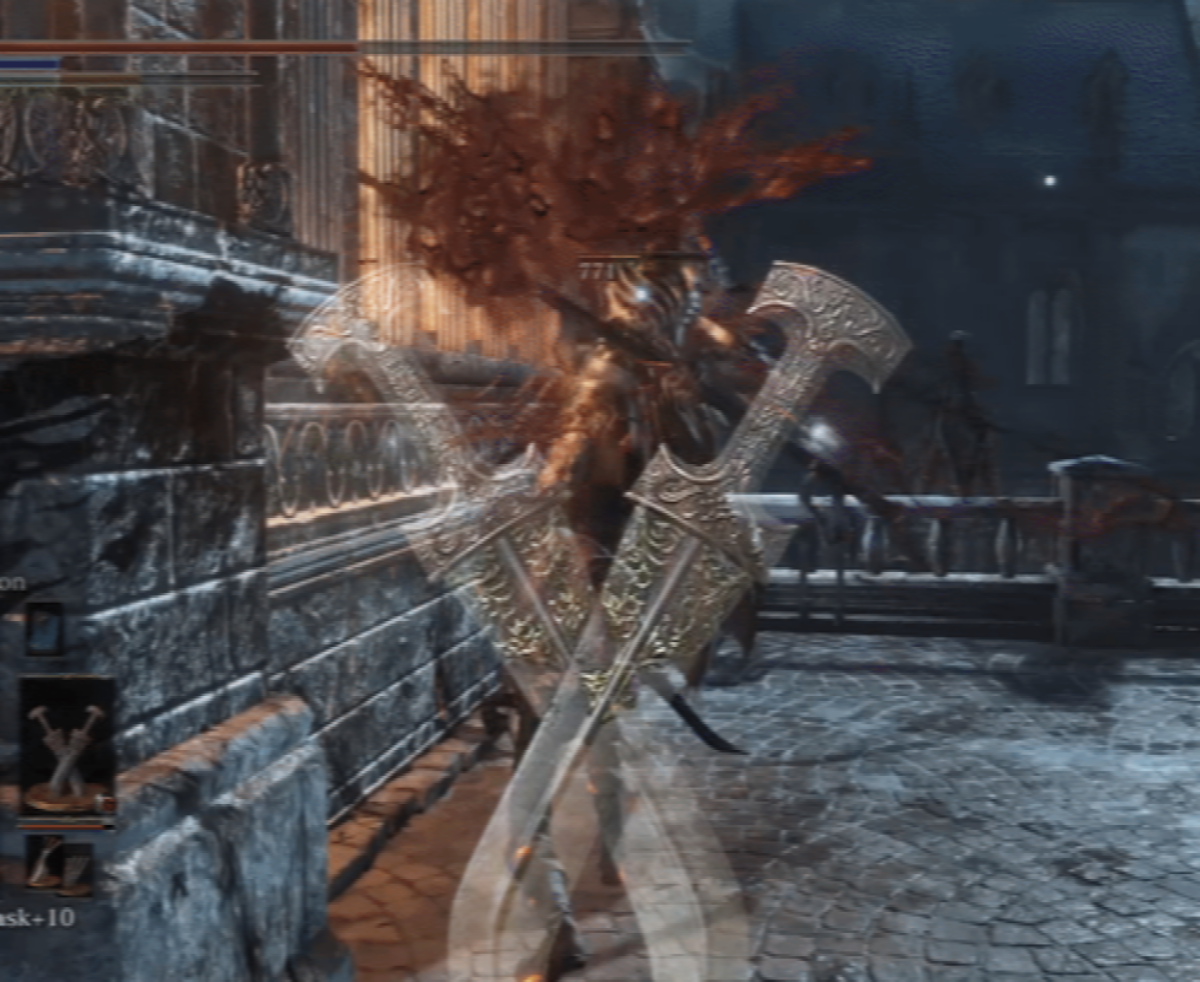
An undead wrapped in tattered garb thrashes two daggers at a frostbitten undead ghoul, in a snowy medieval city. The ghoul gushes blood as they are struck. After several hits, the ghoul's health indicator suddenly takes a large amount of damage.
See how quickly enemies vulnerable to bleed pop like balloons? It’s a great time, all round.

Status effects in Dark Souls 3 just work. Astounding. But why is this such a pain point for me in so many other RPGs? What is it about Dark Souls 3 in particular that makes it work? I think I’ve identified a few factors that majorly contributed to my enjoyment of using bleed and poison variants of the brigand twindaggers. First off…

It Works

Yeah okay so this one is a little self explanatory. Players aren’t likely to use a game mechanic that doesn’t work, obviously. It goes deeper than that though, players aren’t likely to use a game mechanic that isn’t effective. Every enemy in the game could be vulnerable to bleed, but if it only did a piddly pathetic amount of damage nobody would care enough to go that route. Thankfully bleed is very effective, and can often kill enemies even faster than raw damage. It was also seen fit to make nearly every enemy in the game vulnerable to bleed, a very wise decision. Some are resistant to it, some weak to it, but only a handful are completely invulnerable to bleed. Was this point even worth mentioning? Yeah I think so. Each of these points is something I’ve seen failed in many many games before. There are tons of games where status effects are simply unreliable to the point of near-uselessness. What good is a poison effect if it takes a dozen tries before it actually sticks? What’s more, what is the point if the poison is super hard to apply, but it barely does anything as a result? By then I could have just beaten by opponent to death with a stick. Floundering around with weak status effects feels terrible, and they need to be at least as viable as the more straightforward option.

It Works On Bosses

I cannot stress this one enough. Nothing will make me drop a combat mechanic which requires a time investment more definitively than seeing it is ineffective against boss encounters. Often in combat centric games bosses are the height of the combat system, pushing it to its limit where the most fun to be had is, or even the central axis about which the rest of the gameplay turns. If a combat mechanic breaks down in a boss fight, as a player I often feel as though it’s not worth my time. Status effects work on bosses in Dark Souls 3, generally, or at least frequently enough that I never find myself despairing at the futility of using them.

It is so strange to me that so many RPGs see fit to make bosses immune to status effects. On the one hand I can see the perspective – status effects tend to be very powerful in certain contexts, especially when they are not direct damage dealers, like disables or other utility effects, and one does not want to trivialize combat encounters. And yet. If one has been relying on a certain game mechanic, they begin to take ownership of it as a playstyle. They feel clever or powerful for utilizing it. Taking it away at the most crucial encounter feels awful. There are ways to design around the brute force method of just making bosses immune. Perhaps bosses are merely resistant, and incur a diminished form of status effects applied to them. Perhaps bosses have the ability to remove their own status effects under the right circumstances, or perhaps they last less time. Perhaps status effects are balanced as such to simply be generally useful, but not overly powerful against bosses. I think it’s rarely ever wrong to let players think around a problem, and removing a strategic tool such as status effects from their arsenal, when they can be employed elsewhere feels like player punishment.

In Dark Souls 3, applying a bleed effect deals a flat chunk of damage to enemies, usually enough to kill lesser foes. On bosses, it’s merely a nice step toward their defeat, but not an utter showstopper by any stretch. For bosses that may be felled too quickly if they are bled out repeatedly, it was decided they would be resistant to bleed effects. You can still get that extra damage, and it’s not that hard to do, it just takes a little longer, and the balance is kept that way. There are some enemies and bosses which are immune to bleeding, but not nearly enough to make me question the status effect’s efficacy, and what’s more it contributes to the overall fiction of the game, which has to do with my next point.

Strong Feedback

Dark Souls 3 has very strong audio-visual feedback for when you’re wailing on an enemy. Blood shoots out in exaggerated sprays along with a crunchy *squelch*ing sound with each strike of your weapon. Against armor, you can hear the rattling clang of steel on steel. This is obviously good design from a gamefeel standpoint, but it also provides the very useful advantage of illustrating what can and cannot be inflicted with a status effect. Hitting stuff that can be bled tends to use that exaggerated blood graphic I mentioned, but things that are resistant or immune will show less blood when struck, or none at all.
A well-armored women swings a wrist-mounted blade at a cage full of reanimated corpses. Blood shoots out when it is struck, and after several hits, an explosion of blood gushes from it.
A cage full of reanimated corpses? Can the cage bleed? Kind of ambiguous, except that it shoots blood off when hit. Okay so it can be inflicted with bleed!

I’ve mentioned that some enemies are immune to status effects and how that enhances the fiction of Dark Souls 3. What I mean by that is, it is effectively intuitive what enemies can and cannot bleed. Bulbous fleshy beasts, dripping and shambling undead, living creatures. Things that obviously have blood, are all vulnerable to the bleed effect. Things like enchanted empty suits of armor, a giant tree, skeletons. These things obviously do not have blood, and thus do not bleed. It seems like a simple trick not to miss, but yet again I’ve seen this very concept done poorly too often. Consistency is key. The player shouldn’t have to guess, or at least not guess blindly whether or not their combat tools will even work. Obviously you can’t bleed a skeleton, but obviously you can bleed a giant rat. Design the game so players can trust their own eyes and ears, and the play experience will feel much more seamless. Immunities and resistances should have logical reasoning grounded in the rules of the real world, even if the game takes place in a fantastic one, so your player has a hint of familiarity with which they can decipher the rules of your game.
We’ll have to come up with some other clever solution to deal with the skeletons

Conclusion

So I guess my takeaways from this experience are twofold: certain weapons can be satisfying to use in how they fulfill certain gameplay niches. The brigand twindaggers are an excellent status effect tool in how they apply effects quickly through rapid hits. My other takeaway is that a lot of games could do status effects in a much more satisfying way that makes them feel powerful and useful, something a lot of the designs I’ve seen are often too bashful about. They can be a viable alternative gameplay style all their own, you just need to put in the legwork to make sure this gameplay style feels strong and effective. Locking it out of boss fights makes it feel like a lesser, illegitimate gameplay style, an afterthought. Players should be able to discern the applicability of status effects with audio and visuals alone, without having to consult a wiki. Overall, I think status effects can be underappreciated in games mostly because they so often could be implemented better. When games get it right, I think it’s worth giving a closer look to see exactly what went right. Status effects in Dark Souls 3 were fun enough to use, and strong enough to completely reverse my opinion of an entire weapon’s implementation.
An undead wrapped in tattered garb thrashes two daggers at a giant armored mage wielding a flaming staff. in a snowy medieval city. The mage gushes blood as they are struck. After several hits, the mage's health indicator suddenly takes a large amount of damage.

Such weapons inflict lacerating damage. Most effective with sharp or spiked weapons…
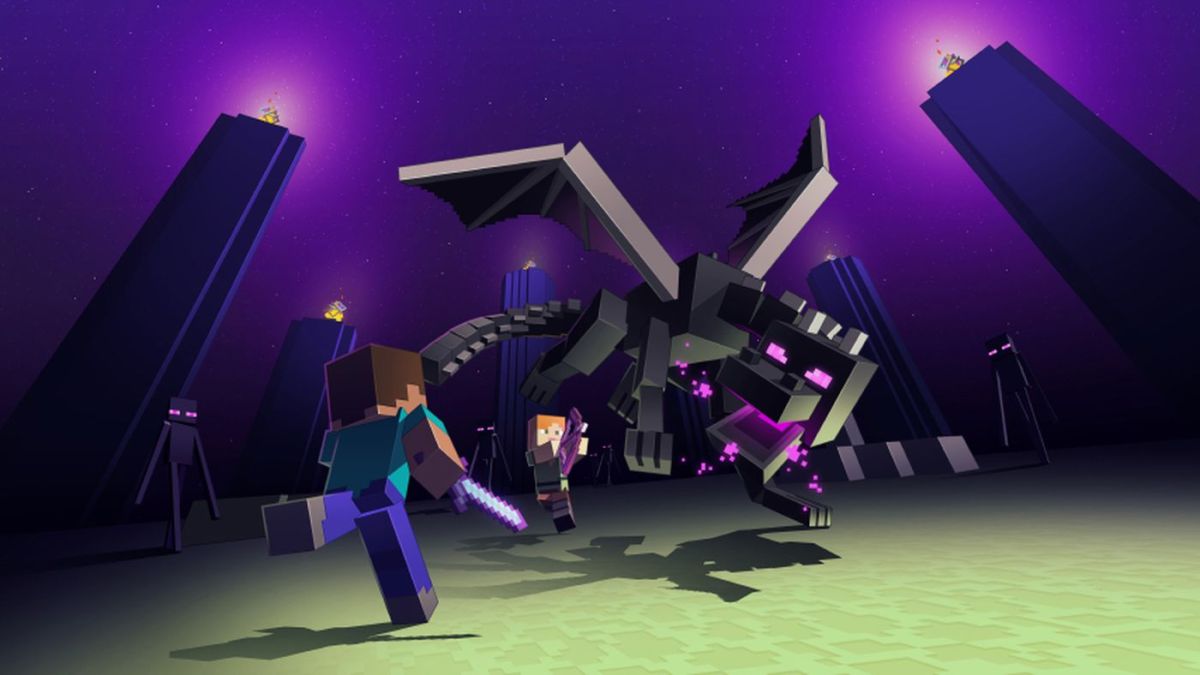
Boss Breakdown: The Ender Dragon

I had one of those weeks. You know the type. An update for worldwide phenomenon Minecraft, survival-based multiplayer sandbox game in which all the world is cubes that can be deconstructed and rebuilt as the player desires with enough energy and time, came out recently. So some friends decided to boot up a new multiplayer server, and there goes all of my free time for the week. We just accomplished Minecraft‘s nominal win condition for its survival mode, the condition which triggers the game’s strange credits sequence; killing a creature known as the Ender Dragon.

Minecraft is a game that, by its very nature does not lend itself to a win condition at all. Even in survival mode, at its core Minecraft opens itself to players defining their own goals and aspirations. Perhaps you wish to build a tall, imposing tower, or a glass city under the sea. Maybe you just want to explore and find beautiful landscapes, or dig into an enemy stronghold and steal their treasure. Maybe you want to raise animals, or start a zoo, or automate the production of gunpowder. All of these things are possible in the game, and none of them really have anything to do with, nor contribute to, the process of killing a dragon, at least not directly. Minecraft isn’t really a combat game, you see. Sure, it has combat in it, and there’s even some nuance to how it works, but it isn’t exactly a challenging set of deep mechanics one is naturally predisposed toward mastering, especially when Minecraft is so rewarding towards its other forms of play, such as digging, landscaping, crafting, and building. All that aside, it was decided Minecraft would have an overriding game-defined goal.

So met with the quandary are we, how does one design a boss for a game in which, A: combat is barely involved, and B: is primarily a game of non-combat mechanics like traversal, building, and uh, mining and crafting. The Ender Dragon is an interesting example of this idea in practice. There are a lot of cool ideas the design of the Ender Dragon utilizes to make it interesting within the context of Minecraft’s unique suite of sandbox game mechanics. If I were to make an appraisal of its overall success in this regard, I’d say the Ender Dragon is… okay. It is at once somewhat convoluted yet also simplistic, and more than a little janky. I’ll get into a little more detail, but overall the fight is fun, and though I don’t think it is the utmost pinnacle of this idea, it is one of the most popular – Minecraft is played by millions, and is in a unique position to examine this idea of boss fights or boss-fight like gameplay engagements for games that are not primarily about combat.
From a first person perspective, a person stands atop a high obsidian pillar, while shooting arrows at a black dragon made of cubes, who flies and circles in the distance. Another minecraft guy stands atop a second nearby pillar and shoots fire arrows at the dragon.

The Ender Dragon encounter is primarily a player-directed boss fight, meaning that the pace and rhythm of the fight is directed by the player, rather than by restricting rules of the boss’s environment. The player directs their interaction with the environment, rather than the other way around. The Ender Dragon is a large black winged beast that breathes fire and flies around an isolated island in an empty void. Her behavior consists of several states which she cycles through, with a preference for certain states over others depending on the status of the structures surrounding the outer edges of her boss arena, called End Crystals. The dragon will dive at players occasionally, and being buffeted by her wings can send players careening off into a lethal fall if they’re not careful. Whilst circling above, the dragon will launch fire balls that leave pools of deadly fire-like substance that persist for some time. Minecraft does not have extremely robust combat mechanics as I mentioned, and dodging usually just means moving to where the danger is not. The fire pools can be irritating, still, them lingering encourages players to dig and build around persistent obstacles.

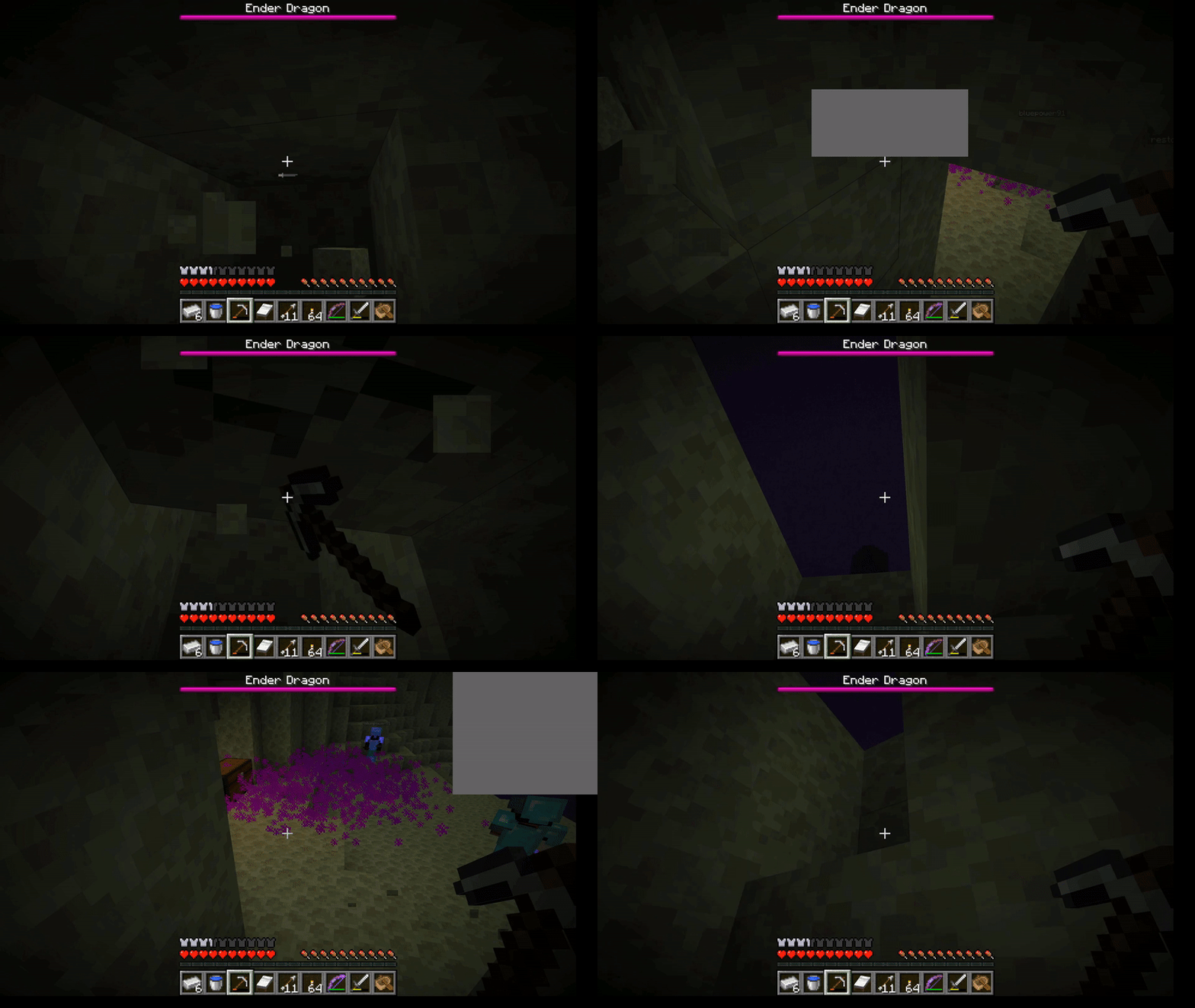
From a first person perspective, a person digs into the side of a stone wall with a pickaxe, then further up to reveal purple sky above the dug hole. Outside the whole, several blocky minecraft guys scramble around a pool of purple fiery gas.
Burying yourself underground is a viable strategy, like some sort of gopher or marmot

So essentially what’s going on, is that these Ender Crystals want to be destroyed. Some can be sniped with projectiles, but some have protection that needs to be dug through, and to do that you need to build a scaffold up to their elevated location. If you don’t destroy these, the dragon stays in the air and restores her health. The design is suggesting the player utilize their building skills to solve the problem, which is good. Building is one of Minecraft‘s most fun and robust features, so it’s good to lean into for a boss fight. It’s a little straightforward though, there isn’t much developed knowledge of building technique needed to build up to these crystals. What’s most restrictive is simply the intimidation factor of the dragon, and outside of that there’s not much to it, as far as the end crystals are concerned.

Another strange quirk of this fight is the presence of many Endermen monsters in the area. Endermen are some of the strongest, most deadly, and most aggressive enemies in the game, but only when provoked. They can be provoked by attacking them, or by centering one’s camera on theirs. The Enderman’s relatable aversion to being perceived translates to a need for avoiding eye (camera) contact with them. I can’t speak too much for others’ strategy, but I always find myself look down at my feet during this encounter, as though my character is just really embarrassed to be there. It’s strange challenge – having to be wary of where your camera is pointing, not just where you character is standing. It does fit with the dragon being an Ender Dragon, as the Enderman monster, which can be encountered outside this fight, and isn’t all that uncommon in the overworld, always abides by this eye-contact rule. It does give the player another plate to spin, but it may feel claustrophobic and a little artificial to some. I can’t help but wonder how this fight might be improved if the designer can rely on the player having full freedom of motion with their camera.

From a first person perspective, a person shoots a bow and arrow at a black dragon made of blocks, flying around in circles below. The person stands atop a tall obsidian pillar.

In the bottom left corner of the display, a dialogue states that several allies have been killed by Endermen.
The Endermen live up to their name

One of the things I find most commendable about the design of the Ender Dragon is how open to various forms of problem solving it is, and how it accounts for the many methods a player might used to dethroning it. Minecraft offers players a huge number of tools with which to solve problems as they explore the world. For instance, the dragon usually is flying around the sky, out of reach of Minecraft‘s most common weapon, the sword. It can, of course be shot with range weapons such as arrows, but the dragon will also frequently land to rest after the End Crystals are dealt with, making it vulnerable to melee attacks. This is one solution. Since the dragon will land and stay stationary for a time, it’s also possible to load up her roost with explosives and set them off like a trap.

From a first-person perspective, a person runs up to a roosted Black dragon made of cubes and places a white bed on the ground, which then promptly explodes in their face, catapulting them into the sky.
Yup. Working as intended.

The dragon’s fire can be dangerous to those walking across her arena’s surface. Of course, Minecraft, being a game about building and digging, it’s totally possible to dig a safe series of tunnels under the arena to move around, or build up cover to protect from the dragon’s fire balls. Climbing up to reach the End Crystals poses another challenge, one that can be tackled in several ways. Shooting the crystals with projectiles is possible, but some are encased in shields that need to be removed. Building up to them with blocks is an option, or placing water (which can inexplicably be swam up in Minecraft) also works. Gravity is an ever-present threat in this encounter, so it’s wise to have some way to address it. Careful use of water can break any fall, or enchantment to one’s boots renders great falls less lethal, or you can drink a potion to fall more slowly. The point is, in Minecraft there are a myriad of ways to approach any given problem, and the dragon neatly accommodates nearly all of them.

From a first person perspective, a person is falling down the side of a tall obsidian pillar. As they approach the ground, they dump a bucket of water onto the side of the pillar, whose contents miraculously breaks their fall. The person then eats a slab of steak.
The tools of dragonslaying: steak, a four poster bed, and a bucket of water

The existence of the crystals is evidence of this. They exist apart from the dragon, at stationary, elevated points. If you want to destroy them up close, they require you to reach their elevated location, likely with building. Building during a dragon attack is a pretty compelling idea, and having to build up to your target seems like a natural fit for a boss fight in Minecraft. There is some inherent risk and reward to how one approaches building up to them. You can build straight up, or try for a more cautious staircase, or perhaps build up to one crystal, then create a bridge to the others.

Another advantage of Minecraft‘s immense suite of problem solving tools is how it frames the fight against the dragon. It is a difficult undertaking, even with a group of friends cooperating. There are a lot of hazards to look out for, so preparation is key. Minecraft is, in a lot of ways a game of preparation. Each night, hostile monsters will appear and overwhelm the unwary, but a solid roof over your head, and an ample supply of food will get you through. Bigger challenges in Minecraft harbor greater risks, and protective enchantments, armor, potions, special food, animal companions, building materials, etc. can all lighten the load. There’s a special sense of camaraderie when all of your buddies convene at a central location to swap enchanted bows and arrows, high-quality armor, and buckets of water in preparation for a great adventure. The Ender Dragon’s accommodation for all these varied modes of tackling problems is one of the best parts about it, regardless of other shortcomings. It’s the context and framing of this boss fight, I think, that creates its greatest moments.

Blocky minecraft guys in armor run around an enclosed space made of gray bricks. There are boxes, chests, and supplies piled around the room. One guy runs up a staircase at room's center and repeatedly crouches and stands.
Just messing around is truly the essence of this game

Whether Minecraft players wanted it or not, the Ender Dragon is the unambiguous overriding goal of a Minecraft ‘playthrough’, its final boss. Is the Ender Dragon a culmination of the skills and knowledge a Minecraft player accrues during their journey to the End? Well, kind of. The levels of preparation and supplies gathering players can engage in is huge in scope. There’s all sorts of stuff you can gather and build to prepare for this fight, and gathering/building is one of the most fun things you can do in the game. In my opinion, the experience is only heightened when a group of friend communally pool their resources to maximize the chances of success. The fight itself is a little convoluted, with the disparate Ender Crystal targets, apart from the dragon itself, but also somewhat dead simple in the very limited suite of behaviors the Ender Dragon can actually engage in. Having to utilize building or similar methods to reach the Ender Dragon’s crystal weak points is compelling and fits with Minecraft’s gameplay, although it’s a somewhat blunt and simplistic implementation. I find the Ender Dragon’s overall design commendable in a lot of ways, and I do look forward to the challenge as a fun communal activity with friends, but it feels under-designed in several ways. Sometimes putting a dragon boss fight into a game like Minecraft feels like hammering a square peg into a round hole. Still, I think there’s a lot to praise about and learn in regards how to approach these sorts of challenges in games that don’t primarily utilized combat as a central game mechanic.

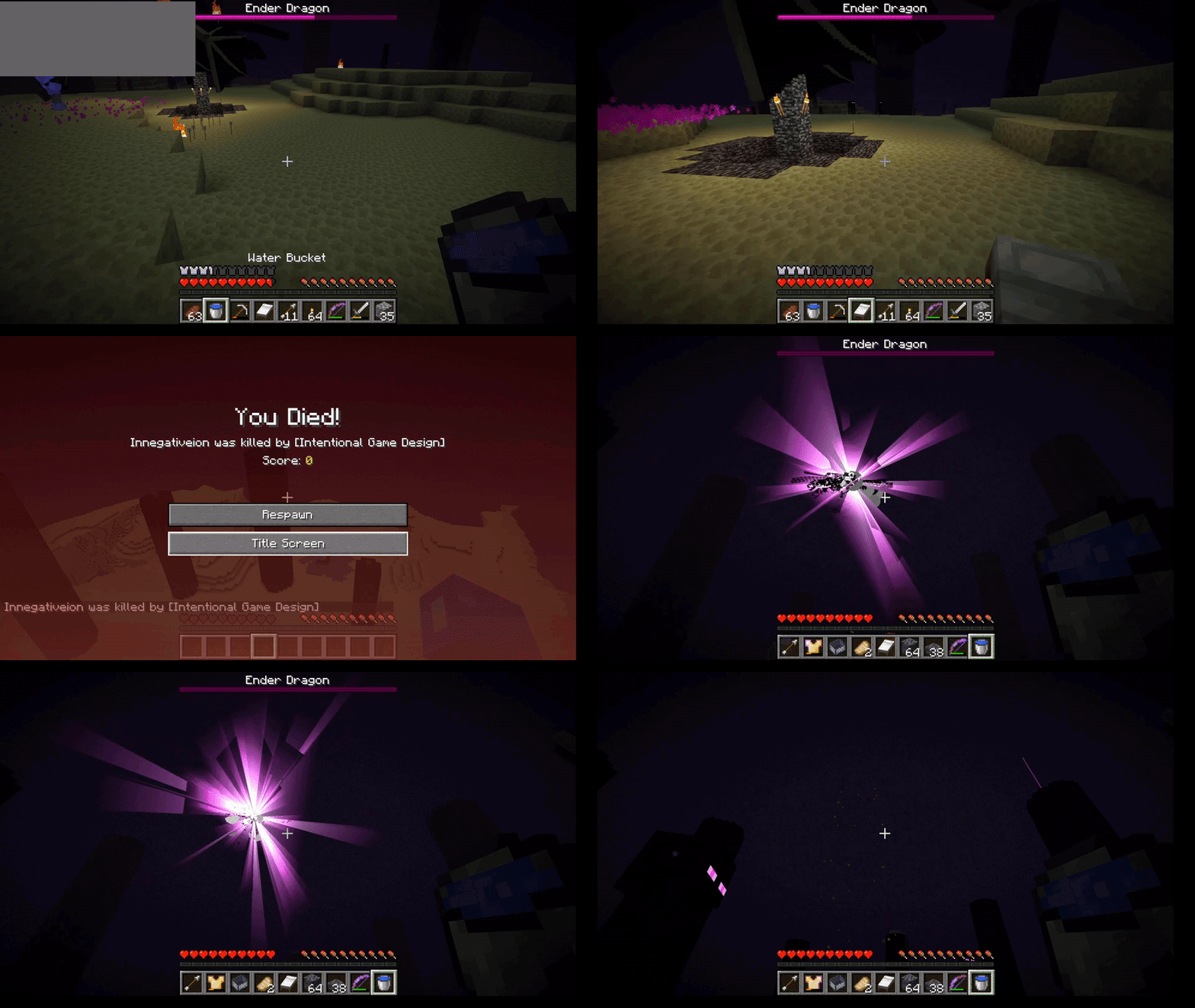
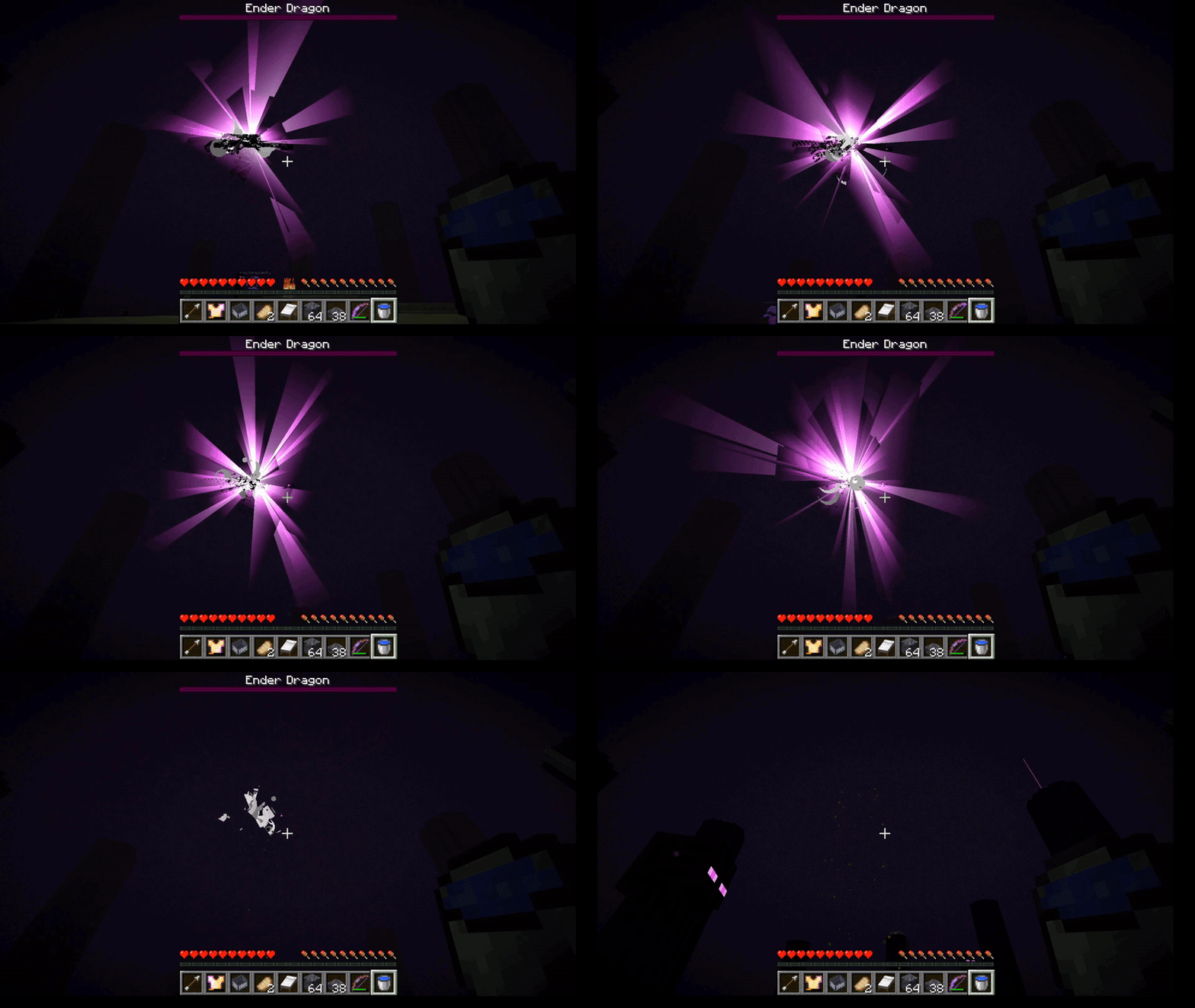
A black dragon made of cubes slowly rises into the air as it disintegrates, a purple light emanating from it, then it explodes.

And the game was over and the player woke up from the dream…
If Your Game Needs a ‘Skip Animations’ Button It’s Too Slow

I notice a lot of people turn off battle animations in Pokémon games. It’s kind of wild this is even something they considered right? I mean it makes sense on the surface, RPGs like Pokémon can be time consuming and people often play it on the go, or lead busy lives. But let’s take a step back here. We’re streamlining by cutting out the battles? Isn’t that, like, most of the actual game of Pokémon? To be clear I don’t think people are wrong to utilize this feature, I use it too. But why has it come to this? Why does the central gameplay mode of Pokémon have to be so time consuming it becomes tedious to the point of cutting its art assets out of the equation? I think this is really something happening within the game itself – if your game needs a ‘skip animations’ option to be playable by enough people to warrant the existence of a ‘skip animations’ option, well, the title’s right there. Options aren’t bad. It’s not that the option is there that bothers me, it’s that so many people, myself included, feel compelled to use it. Perhaps there’s a greater issue here. Pokémon games’ combat is turn-based. The player can take all the time they need to formulate a strategy each turn, but once their choice is locked in, the battle plays out before them. They aren’t directly participating so there’s no stress or pressure on the player tied in with the speed of the game… unless waiting long periods of time stresses you out.

I want to head this all off with some proposed solutions to the problem I’m about to describe in greater detail. I don’t want to come off as overly negative, but rather constructive. I love Pokémon dearly, but I feel as though it has at times struggled to meet the expectations of its own success. Personally I feel as though it is showing its age now more than ever in a number of departments. There are techniques that have been employed by Pokémon‘s contemporaries that allow combat, even turn-based combat, to be very breezy and flow seamlessly. One of my favorites is one employed by the popular Persona series of RPGs, a franchise that, lord knows, started out as a slooooow and ponderous combat experience in 1996. Lessons were learned from this, though, and by 2008, Persona 4 was establishing one of the smoothest and most appealing turn-based combat systems in the business, an advantage that would serve the explosively popular Persona 5 well eight years later.

A gray-haired Japanese high school student stands in a dreamlike space resembling both a castle and TV set, with a distorted background.

Several monsters resembling giant mouths stand before him. He crushes a crush in his hand and an ethereal samurai warrior appears before him. The warrior shoots a bolt of lightning at one of the monsters.

This scene plays out a second time, except the samurai appears much more quickly and the lightning attack resolves faster.
The saved time doesn’t seem like much, but it adds up over a full length game!

In Persona 4, whenever the player uses the same move on multiple turns in succession, the animation for that move is sped up, and the action is truncated. The player just saw this animation in its entirety seconds earlier, after all, there’s no need to run it into the ground. This simple consideration drastically eases the repetitiveness of spamming the same move in turn-based combat, something you might find yourself doing often in Pokémon. In Yakuza: Like a Dragon, when an attack fails to connect with a character, the information is conveyed visually and the action transitions very rapidly to the next step of the turn. The word ‘MISS’ is barely on screen for a second, as the game does not dwell on and minor things. I’m sure I can think of more, but techniques for keeping turn-based combat flow smoothly aside, Pokémon just really has a problem with the structure of its attack animations in general. To be clear, I mean the special effects like lightning that occurs when a move is used, not the motion of the pocket monsters themselves, though that’s its own can of worms. They just tend to be far too long, and often could communicate the same level of awe, excitement, dread, or wonder in half the time or less.

Several men and women are brawling an ubran Japanese market street. A thug takes a swing with a knife at a man in a red suit, but he stage-falls onto his back, dodging the attack. A second thug takes a swing with a baseball bat at a woman, but she backpedals and the attack misses.
What the attack missed? Okaythatscool moving on.

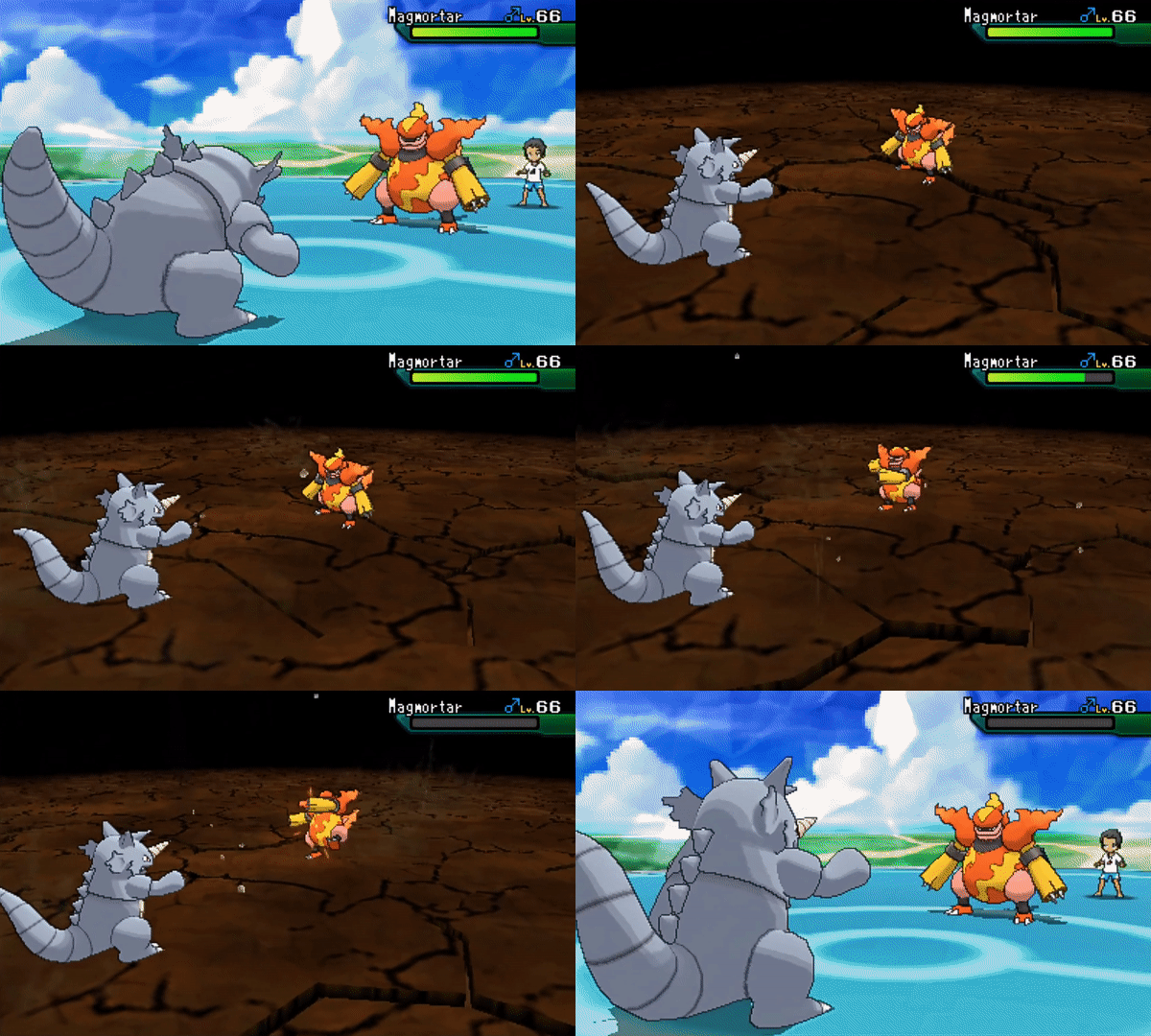
It occurred to me while watching The Pokémon Company’s recent animated short Bidoof’s Big Stand with a friend. How striking and appealing the (admittedly truncated) battle scenes were in this 3D animation! So much character and charm. Compare this animation for the move ‘earthquake’ in 2016’s Pokémon Sun and Moon to the same move in Bidoof’s Big Stand.

It’s not perfect. The earthquake move in Bidoof’s Big Stand for one could probably communicate a bit more force and impact before I’d ship it in a game, but that could be accomplished without inflating its screen time, easily. The fighting in the animated short exaggerates its action in ways Pokémon games probably never could given that their battle animations must be generic and prefabricated to be used by hundreds of interchangeable creatures, but I must insist that Pokémon as a game franchise can get closer to this level of dynamism and flow. It could be as simple as a baseline speed pass for each battle animation. Maybe earthquake doesn’t need to be on screen for a full five seconds. Maybe thunder doesn’t need as much anticipation as it’s getting. Maybe the transitions between turns could be faster. Game animation has a lot of conventions of minimizing anticipation and downtime, making visuals as reactive and instant as possible, and this is for good reason. The benefits extend to all sorts of interactive systems, not just action-y or real-time ones.

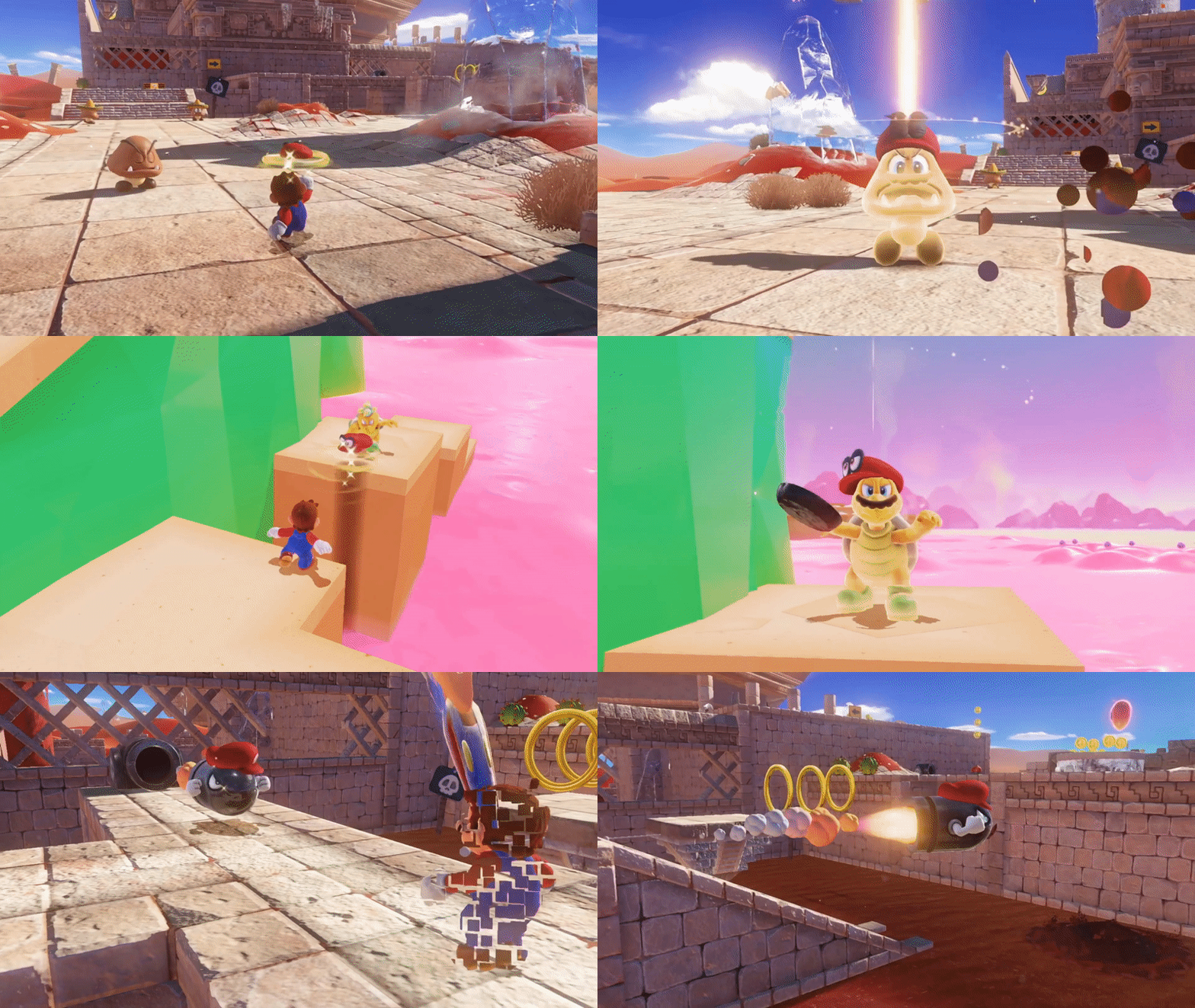
In a desert environment, Mario throws his cap at a goomba, a brown mushroom monster. As his hat lands on the goomba's head, mario becomes ethereal and zooms into the goomba's form, 'capturing' it. This takes place over the course of 1.5 seconds.

A similar scene plays out as mario 'captures' a bipedal turtle and an anthropomorphic bullet.
Games have been condensing exciting visual effects into smooth, seamless transitions for decades. Mario’s ‘capture’ visuals looks just as impressive as any five-second-long pokémon move, easily.

The difference in timing between the in-game earthquake and Bidoof’s Big Stand is staggering to me. I feel as though the Bidoof’s Big Stand earthquake communicates the idea of an ‘earthquake’ just as well, if not better, than its in-game counterpart, in less than half the time! A difference of three seconds might not sound much on paper, but bear in mind that in a pokémon game, you’ll be seeing moves like this, on average, about six times per battle, at minimum. Small increments in moment-to-moment gameplay like this matter. More likely you’ll see moves like this play out repetitively dozens of times per battle, over the course of hundreds of battles that take place in your standard Pokémon game. Arceus help you if we count all the redundant narration about status and field effects that pauses the battle to re-explain itself every turn. This is so much dead air to add to a game, it’s no wonder Pokémon‘s ‘skip battle animations’ feature has become so popular. And why shouldn’t it? I know I use it. I mean, I want to enjoy Pokémon‘s battle animations, many of them are genuinely a joy to watch, but I can usually really only muscle through a chunk of the game before turning them off for long periods of time. They just hamper the flow of the game too much for me.

I believe that games are greater than the sum of their parts. Games can have great music, great writing, great animations, or even great gameplay, but it is only in the confluence of these things, in varying balances, that the true strength of games as a medium comes out. I hate having to skip Pokémon‘s battle animations to avoid feeling burnout. I want the game’s various bits of art to come together beautifully. So, it begs the question, is there something perhaps less essential than the visuals themselves that can be cut out to improve the flow of Pokémon‘s battles?

And that brings us… To the Battle Dialogue.

Pokémon‘s Battle Dialogue is one of many idiosyncrasies Pokémon has brought forward through its many generations. It’s a small window at the bottom of the screen that essentially narrates what’s going on in battle.

A pokémon will take part of an action, this action will resolve completely, and then the Battle Dialogue will narrate it, before any reaction to this move takes place. The result is an incredibly stilted and lifeless visual accompaniment to Pokémon‘s otherwise excellent battle system that so often holds it back. Take the pokémon move ‘self-destruct’ for example. It’s an old classic from the original gameboy Pokémon games. In the following scene, you will witness the literal events of a clay doll monster violently bursting into a fiery explosion, causing its opponent to become so injured it can no longer stand. See how these events are visually translated, in a way that only Pokémon can.

The pokémon claydol, a many-eyed idol-like monster is tackled by its opponent manetric, a yellow and blue canine. The claydol then uses self-destruct, causing an explosion to emanate from its body. Several seconds later, the claydol faints. Several seconds after that, the manetric faints.
What on earth did I just witness.

I hope my point is becoming clearer here. Thanks to the strange reverence held for the Battle Dialogue, which is always given visual priority, there is no sense of real presence to these creatures, no impression of cause and effect. It’s more like the pokémon are pantomiming their moves. Pokémon has, over the years, become more and more attached to the idea of making their collectible monsters and their world feel real and inviting, like a place you could actually visit. Newer Pokémon games have featured Pokémon pet simulator mini-games, wider areas of exploration, and a more complete impression of the world the games take place in. The problems with Pokémon‘s visual presentation, especially in its battles, feels utterly antithetical to this design goal to me. I know there are certainly technical and production limitations that are causing issues like this, but I felt compelled to bring it up anyway as these issues can never be fixed going forward if they aren’t given voice, and moreover perhaps us other developers can learn something from it. It’s a topic I don’t see discussed much among the *ahem* many other popular topics in Pokémon *ahem ahem* discourse.

What if, perhaps, we entertained the idea of eliminating the Battle Dialogue altogether? Now, it isn’t as though it serves no purpose. Pokémon derives much of its success from being friendly to the young and casual as well as appealing to the hardcore and diehard. The Battle Dialogue inarguably conveys information in a clear and unambiguous way, all the while reinforcing the rules of the game through its constant narration, but is it really the best and only solution for accomplishing those things? Surely, at the very least, longtime fans would woefully miss iconic phrases like “It’s super effective!”. Perhaps, but streamlining Pokémon‘s visual information could mean repackaging iconic visuals in new and exciting ways. Perhaps “It’s Super Effective!” could live on as a visual or particle effect itself, not just plain text. Yes, big changes like this may be a hard sell at first, but if Nintendo’s other recent output the likes of Breath of The Wild or Bowser’s Fury has taught me anything, is that nothing need be unassailably sacred, and sometimes fans are just waiting to fall in love with something new, even if they don’t know it yet.

When all’s said and done I don’t think my vision for a faster, breezier version of Pokémon battling is the only ‘right’ choice. But I do think Pokémon could stand to peek at its peers’ homework from time to time and modernize the way it presents itself a bit. Some of the things that greatly harm the pace of Pokémon are entirely inventions of a game designed for an 8-bit calculator of a console. Some of these things I feel the franchise has outgrown entirely, and some could be re-contextualized in a more modern way. There’s some considerations in art direction to be made too that could smooth out some of these rough edges. In this article I proposed removing or rearranging a lot of things, but honestly much of this could still remain optional. I just think it’s emblematic of an issue that could be assuaged through design rather than blunt force, if a lot of people are choosing to turn off the thousands of man-hours that went into making your game look appealing.

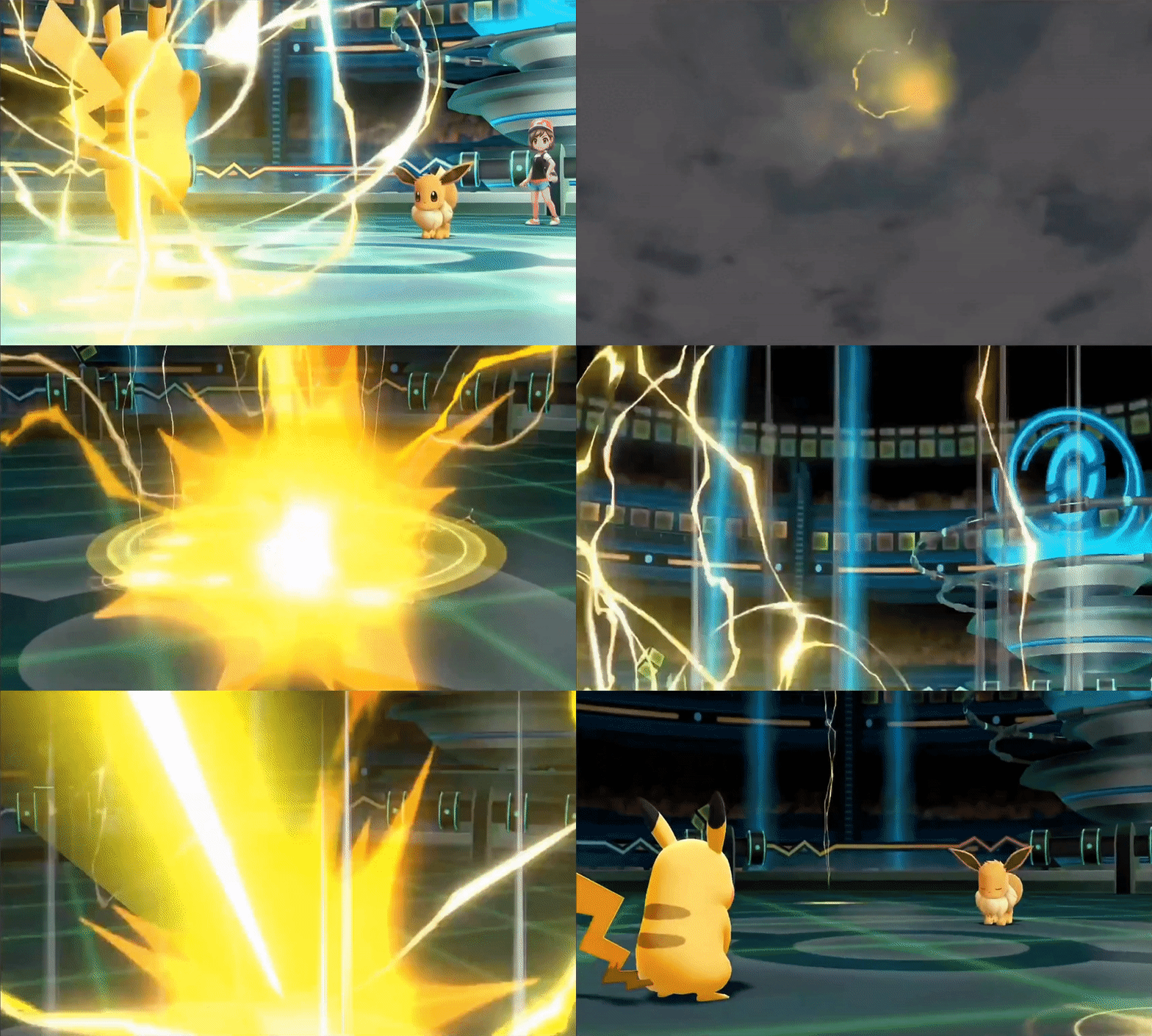
The pokémon pikachu, a yellow mouse, shoots lightning into the sky, which roils in the clouds before falling onto pikachu's opponent, a small brown fox-like pokémon called eevee, in a column of lightning.

The same scene plays out again, but this time edited down with bits and pieces of the animation sped up.

It runs agilely as if on wings…

Dota 2’s Dark Willow: Effective Audio-Visual Feedback, and Mechanical Synergy

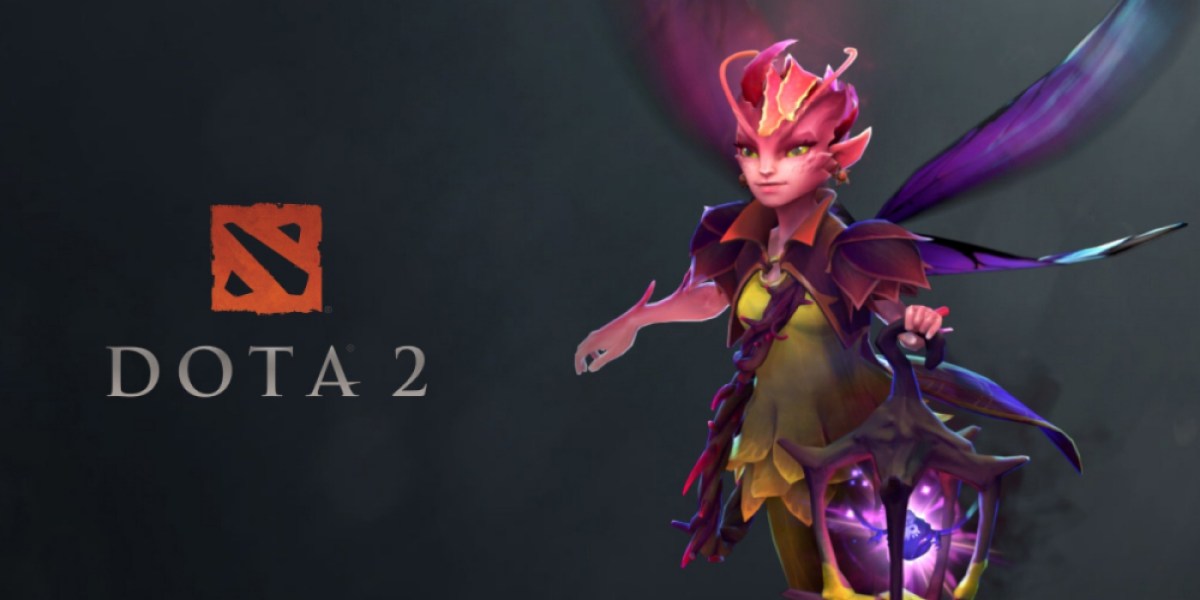
Dota 2 is a game of the genre MOBA, Multiplayer Online Battle Arena. In simpler terms, it’s a team-based game with a focus on combat and strategy. It’s played from a bird’s eye view, and features a number of colorful fantasy heroes to choose from. Dark Willow, the mischievous, slightly sadistic thieving fairy is my personal favorite, and I wanted to just jot down my thoughts on how effectively her abilities are communicated through audio-visual feedback.

Birds eye view of a tropical rain forest. A fairy glides down a pathway. 

Text chat: 
Someone says "usually pick turbo just to dark willow"

I respond "That was my plan"
“Let’s have some fun, shall we…”

Audio-visual feedback is as it sounds; the fairly basic concept that important information should be communicated to players implicitly through their senses, and that things like affirmations of success or confirmations of failure should be communicated in this way. For example, if a player character swings a sword, that sword swing should make a distinctly different sound whether it misses its target, strikes an enemy, or strikes a wall. It should probably look distinctly different in each of those cases as well.

Dark Willow has five abilities. Bramble Maze allows her to sprout a circle full of equally spaced bramble bushes at a distant location. Enemies will have only a narrow space to squeeze between the brambles, and if they touch one they are rooted to the spot and damaged. Shadow Realm allows Dark Willow to hide in a shadow form, immune to most attacks, then burst out with a powerful shadow attack. The longer she is hiding, the stronger the attack, so long as the ability does not wear off first. Shadow Realm can later be upgraded to fire a barrage of shadow attacks. Cursed Crown is a curse Dark Willow places on a target, causing it and nearby allies to be stunned exactly four seconds after the curse is cast. Bedlam causes Dark Willow’s wisp minion to orbit her, firing destructive magic at nearby enemies. Terrorize projects the wisp to a distant location, causing any enemies at that location to be terrified and sent running toward their base.

Birds eye view of a tropical rain forest. A number of heroes do battle in a river. A series of blue concentric circles indicates where a bush full of brambles is about to sprout. When the circles are lined up with enemy heroes, the brambles rise up and capture them.
Here you can see me line up exactly where the brambles should be placed, so I can catch multiple targets, thanks to the handy previsualization UI.

A lot of Dark Willow’s power as a hero comes from the synergy between her various ability mechanics. Bramble maze does a great deal of damage and holds foes in place, but they have to touch the brambles for this to happen. Luckily, Dark Willow has the ability to force enemy movement in the form of Terrorize, clever of use of which can cause enemies to flee in terror into her brambles. Cursed Crown is a strong stun that can disable multiple opponents but only if they are standing together, which is why Terrorize, in conjunction with Bramble Maze, is so effective at sticking enemies together. Dark Willow can dish out immense damage with Bedlam, but only if she gets close, and she is not very durable herself. Luckily, Shadow Realm renders her immune to most dangers, which she can use in conjunction with Bedlam. The fact that Shadow Realm can cap off this combo with a burst of damage is a nice compliment to the more sustained damage of Bedlam, which can be more easily reacted to.

Birds eye view of a tropical rain forest. A fairy sneaks up from the trees on a man made of lightning. A bramble sprouts beneath him and captures him. The fairy flies up with her wisp, which tears him apart.
Clever use of synergized game mechanics can make your player very powerful

Because it is so important to coordinate your various abilities together like this, it is essential the player can develop a seamless feel for how the various timings, cast ranges, and nuances of her abilities work, without having to look at a detailed explanation. That’s where audio-visual feedback is essential for making gameplay mechanics like this synergize in an effective way that’s satisfying and fun for the player. Dark Willow’s Shadow Realm is an excellent example of this.

Birds eye view of a tropical rain forest. A fairy is surrounded by shadows before a red circle begins to glow around her feet. It becomes more distinct over time.
The red aura around Dark willow becomes more and more distinct as the shadow realm attack becomes ‘ripe’ for unleashing.

First off, Shadow Realm is kind of a complicated ability when you break it down. When its button is pressed, Dark Willow becomes subsumed in shadow and immune to most enemy attacks, which is easy enough to understand. However, during this period Dark Willow is also charging up an attack. This shadow attack reaches the peak of its potency after 3.5 seconds of charging, but the ability itself ends after 5 seconds. So there is a period of 1.5 seconds in which it is optimal to use Shadow Realm’s attack competent. That’s a little unintuitive, or rather it would be if not for the audio and visual considerations. After 3.5 seconds of Shadow Realm, Dark Willow is surrounded by an additional visual effect: a red circular aura that surrounds her and gives the impression of peak power. As soon as Shadow Realm begins, a distinct and almost melodic humming sound begins to emanate from Dark Willow, it gives a sense of building power and changes over time. Its intensity crescendos after exactly, you guessed it, 3.5 seconds. The humming then peters out for the remaining 1.5 seconds, giving a strong impression of when the attack should be dealt.

Birds eye view of a tropical rain forest. A fairy becomes surrounding in shadows as a wizard is caught in a bramble patch. A wisp flies around the fairy and attacks the wizard, before the fairy throws her own projectile, but it fails to kill the wizard.
Here, I crucially missed the shadow realm cue, and my attack fails to kill my target. Entirely my own misplay, but emphasizes the importance of those cues.

This sort of feedback is also helpful for those opposing Dark Willow. Without having to count, any player can get a pretty good idea of when Dark Willow is most likely to release her shadow attack. Giving easy access to this sort of information is conducive to a healthy competitive game, allowing complex strategies to form. Knowing what your opponent is capable of, if not necessarily what they intend to do, you can act and react to game events as they occur. Acting and reacting is the core of competitive gameplay. If each player doesn’t have the right information to available for them to utilize, there is no counterplay, there is no game.

Curse Crown is a very interesting example of this concept. It counts down, loudly and with a visual timer represented by four icons for each of the four seconds in the countdown, but this countdown is a strategic benefit to both Dark Willow and her victim. The victim will know that standing near allies when the countdown pops means putting those allies in danger. Dark Willow will be eagerly awaiting for her victim to become stunned and helpless, so she can unleash her most powerful offense. The strong visual feedback makes for a better experience for both the victim and user of the spell. By giving both parties this important information as a readily apparent graphic and audio cue, they can both formulate plans to deal with the respective obstacles to their goals, which is itself the fun of the game.

Birds eye view of a tropical rain forest. A fairy sends a wisp out to scare a giant lizard man, who flees in terror. Where the lizard man stood, a zombie comes back to life, and chases the lizard man together with the fairy.
With terrorize, enemies are driven off of my allies, and with shadow realm, I can further pursue and subdue them.

As the victim is stunned, Dark Willow may try to line up a Bramble Maze on them, to further damage and disable them. Typically, you’d want to place the brambles in the enemy’s path, so they move into the bush themselves. If they are stuck in place though, one can carefully line up the bramble to appear beneath your target’s feet, thanks to a convenient target-preview interface that will shadow the Dark Willow player where exactly they brambles are going to appear. For the opponent’s part, the brambles are distinctly shaped, leaving little ambiguity as to where it is and is not safe to walk.

As you may have gleaned, Dota 2 can become fairly visually loud, with ten individual heroes all throwing out impressive and explosive spells like this. That’s why it’s so important to keep a distinct visual not only for each ability, but a distinct visual style for each hero as well. It should be unambiguous when it is Dark Willow in particular using her spells, so that enemies and allies have a fair amount of information with which to react. Dark willow’s visual effects are uniformly composed of dark violets and maroons, evocative of shadowy undergrowth and wild flowers, which is also thematically relevant to her character as a dark fairy. Big and important abilities that can completely shift the tide of battle, such as Terrorize, tend to be louder and more immediately noticeable, in proportion to their power.

Birds eye view of a tropical rain forest. A large number of heroes do battle. A fairy throws increasingly powerful projectiles at a lightning man. When the lightning man falls, a friendly zombie is frozen in ice, and his allies are forced to attack him. This ends when a fairy sends her wisp to terrorize nearby enemies. Afterward, the fairy turns to throw her projectiles at a fleeing wizard.
In an extended battle, there’s LOTS to keep track of, so knowing the visual and audio cues becomes an essential skill. It’s better to make that learning curve as painless as possible. It may be hard to track Dark Willow in all this mess at first, but look out for her midnight color scheme.

Audio-Visual Feedback is one of those things you really have to nail, if you’re game’s to be any good, honestly. If a lot of important information is moving around in your game and it doesn’t reach the player in a prompt and unintrustive way, it can severely hamper the experience. Dota 2 is pretty good at it, considering all the challenges of keeping things clear and readable that comes with the MOBA genre. Dark Willow is a particularly strong example, and perhaps that’s one of the reasons I was drawn to her and her playstyle.

The aftermath of a green explosion in an open plain is overlaid with the words 'Radiant Victory'. In response to someone asking 'why did you mid' I respond 'so wed win, like this', to which someone responds 'like milk'.

A scoreboard follows.

You thought you were winnin’?

How To Fight Things in Three Dimensions: Zelda’s Z-Targeting

Can’t believe I haven’t done one of these on this topic yet. The Legend of Zelda: Ocarina of time is rightfully revered for how it set the tone for what action and adventure games could be in what was the relatively new frontier of polygonal 3D games in 1998. Moving to 3D comes with a whole host of problems, though, especially when it comes to active combat. Our real three dimensional space is very complicated, and abstracting that to a computer program can have some disorienting results if not done with care. One of Zelda‘s most notable contributions to the craft, I think is the Z-Targeting system. “Z-Targeting” is the name for Ocarina of Time‘s 3D targeting system which would let the player focus the game camera’s attention on a single point of interest by tapping the “Z” button. It gets plenty of mention, but honestly I feel like sometimes this one innovation doesn’t get praised enough. It kind of set the standard for how real-time gameplay involving two moving bodies works even to this day. There are also a lot of little things that helped this first iteration of a 3D targeting system work remarkably well, despite its age.

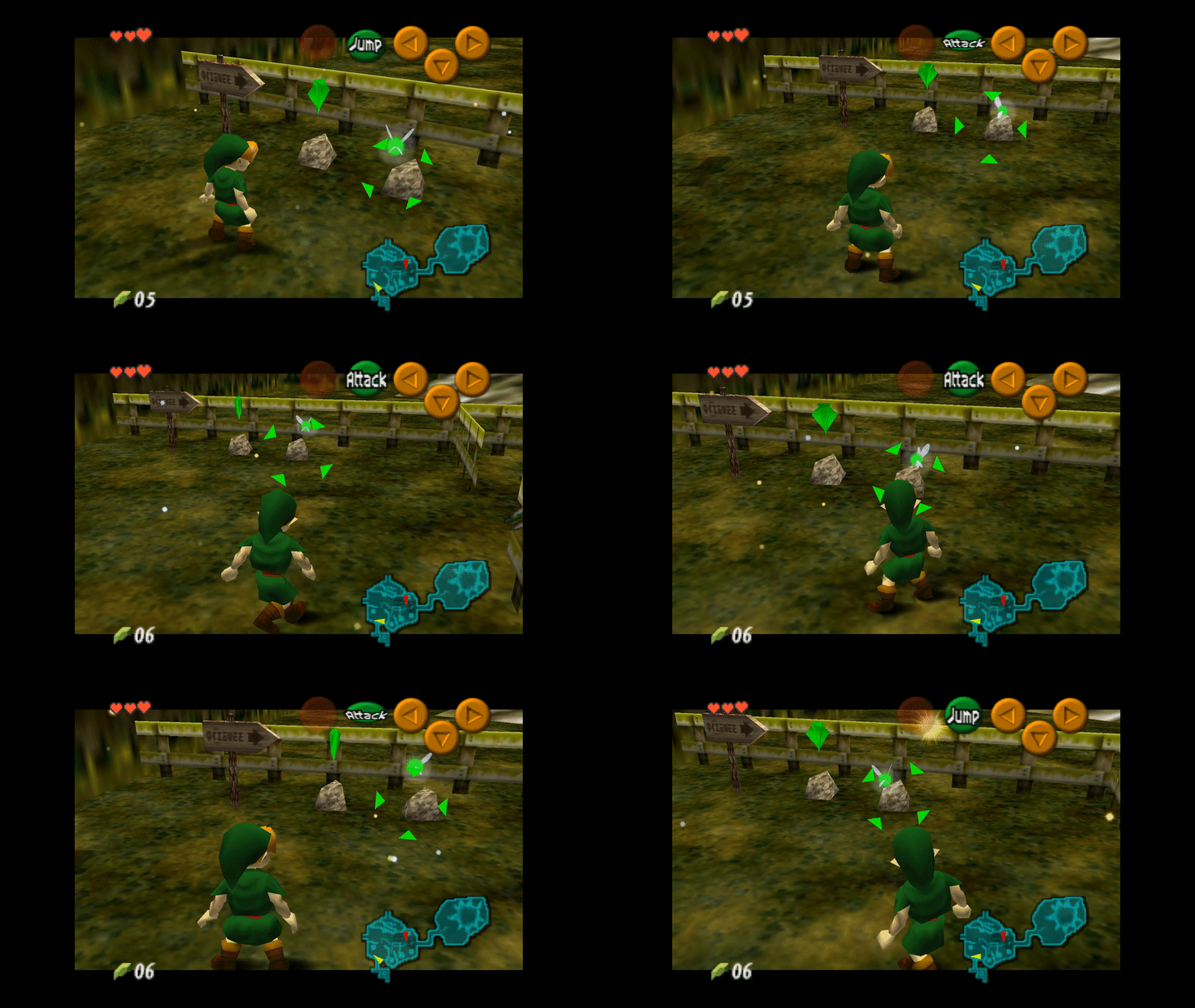
Child Link (The Legend of Zelda: Ocarina of Time) strafes to the left and right while a targeting crosshair focuses on a rock in a grassy forest. The rock remains center-camera, while Link shifts to either side of the camera.
The rock was very patient with me during the filming of this clip.

Notice in the image above how the camera smoothly and automatically situates Link to one side. You may have heard of the rule of thirds, an stylistic concept in art for generating compelling composition. By dividing an image into thirds and placing the subject of your art into the first or last of those thirds helps emphasize their importance, and draws the eye. It also frames the remaining, more open two thirds as a point of interest to the subject, a place they might be looking or going. Link is the subject in this scenario, and the camera essentially enforces the rules of thirds while Z-target is active. It’s not only very aesthetically pleasing, and helps draw the player into the drama of a good sword fight, but it’s very functional. But ensuring Link and the target occupy opposite ends of the screen, then it becomes very rare that Link himself will obscure his target from the player sitting on their couch. In this way essential information conveyed by your target, like an incoming attack, isn’t accidentally hidden from the player. This diagonal framing also helps keep the spacial relationship between Link and his target clear and unambiguous, which as I’ve mentioned elsewhere, is essential to satisfying combat.

This mechanic of making Link’s position relative to his target unambiguous is very strictly upheld. The camera will eagerly clip into walls to ensure the target remains properly framed, but this isn’t a problem as obscuring geometry will often not be rendered, so the camera’s over-commitment to framing is actually an advantage. It’s very intuitive. In an interview with the game’s general director, Toru Osawa, it was said that the system was inspired by a ninja and samurai themed performance. A ninja attacked with a sickle on a chain which was caught by the samurai. The ninja moved in a circle around his opponent as the chain connecting them was pulled tight. It seems drawing an invisible and unbreakable line between two entities helped the developers visualize how this new system would work. Link will always circle around his target in-game, and inputs on the controller are changed during a Z-target to reference the subject of the target. Moving Link “Left” means he will move clockwise around his target. “Right” means he will move counterclockwise around his target. It is as if Link is moving on a 2D plane, but bent and wrapped around the target. This abstraction expands into a rather robust system.

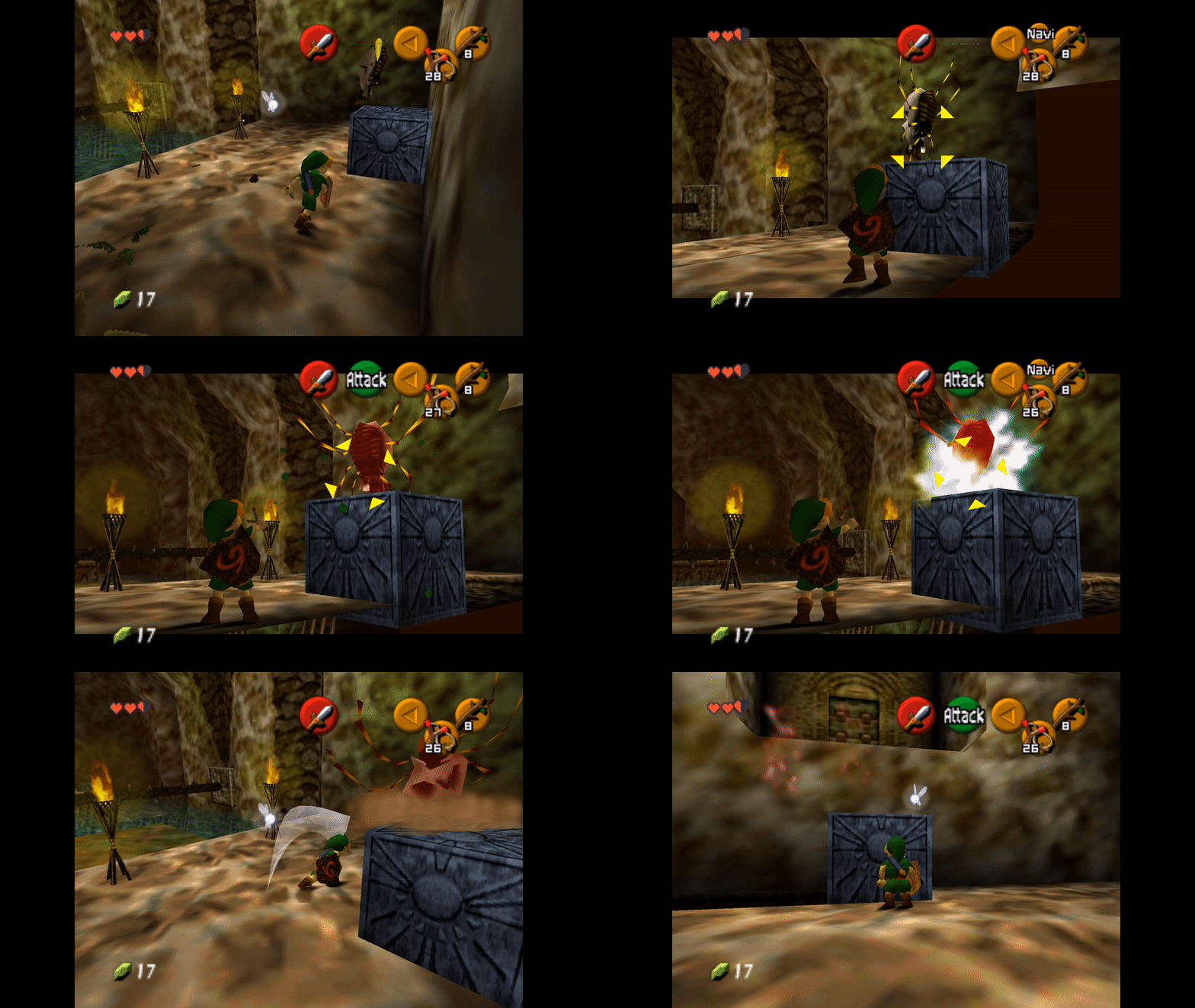
Child Link (The Legend of Zelda: Ocarina of Time) sidles up to a wall while a targeting crosshair focuses on a giant spider. The camera moved through the nearby wall, but the wall fades from view as this happens, allowing Link to see the spider's underside, which he shoots with his slingshot.
With the spider conveniently framed by the camera, even through this wall, Link is able to sneak a shot in to hit its vulnerable underside.

Another thing I noticed while playing Ocarina of Time recently is how movement during Z-targeting relates to the input of the gamepad controller. I’ll give you an example. While a Z-target is active, Link can do a quick side-step or back flip to avoid enemies. Holding the control stick back, toward yourself, when you press the action button will initiate a back flip. Holding the control stick to the left or right will initiate a side-step when the action button is pressed. So it seems the game is tracking Link’s relative facing direction to the camera for the purposes of his evasive jumps. If Link is facing perpendicular to the camera, or in other words, if his shoulder line forms a right angle with the plane of the game screen, then a “right” or “left” input on the control stick is considered “back” for the purposes of evasion. You can see this illustrated below:

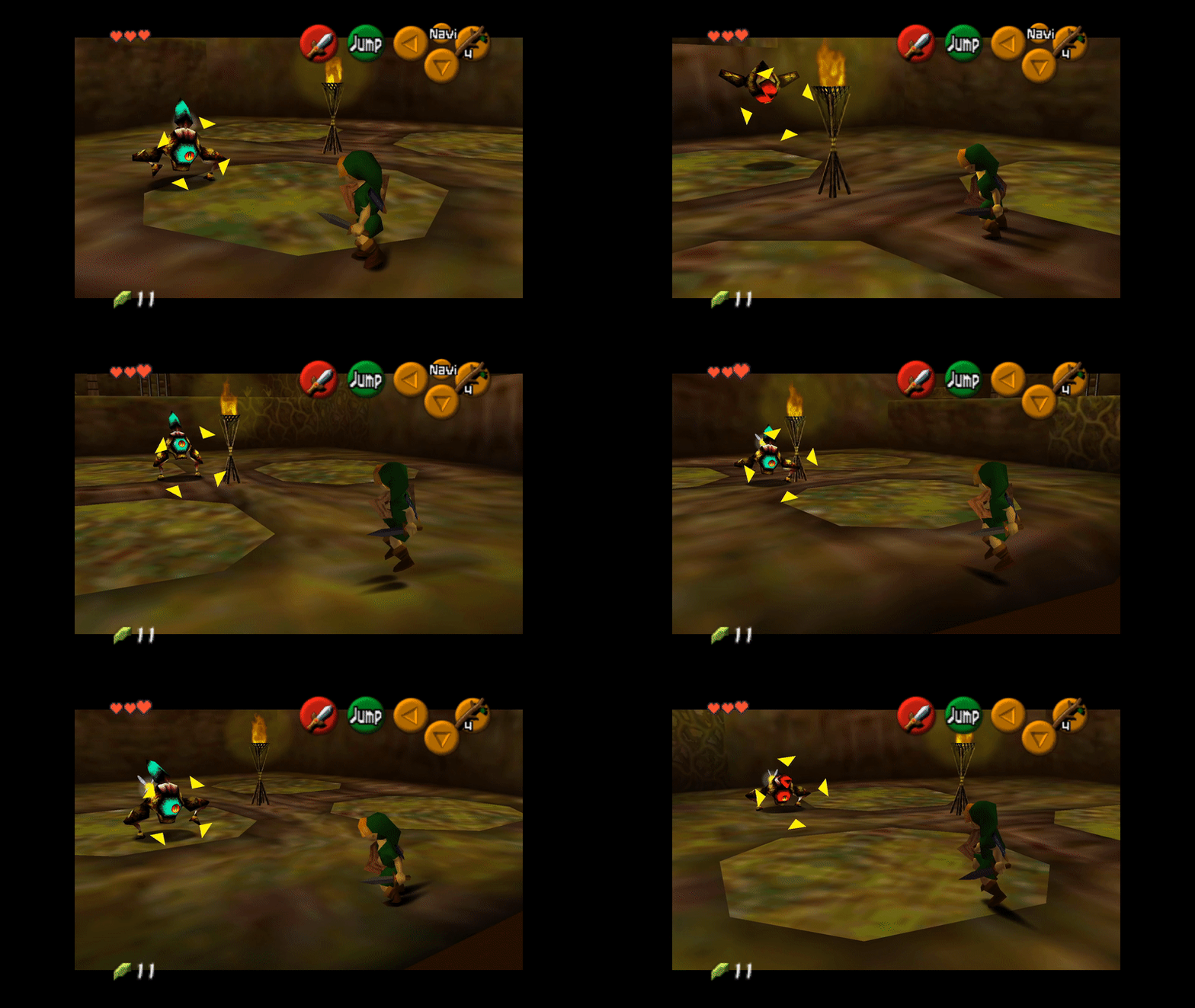
Child Link (The Legend of Zelda: Ocarina of Time) hops to the side repeatedly in a naturalistic wooden interior. A targeting crosshair focuses on a giant cyclopic bug. When Link is almost side-on to the camera, he does a back flip.
During this clip, I am holding only the “right” direction, but Link eventually back flips anyway.

In this above clip, I am holding “right” on the control stick throughout. Once Link’s angle to the camera becomes too extreme, he no longer side-steps, and instead back flips. However, Link’s stride never changes. “Right” on the control stick is always considered to be Link’s right, relative to his current standing position, for the purposes of calculating what direction Link should be running. I can imagine a couple of reasons this might be. Changing Link’s continuous move direction on a dime would be very disorienting for the player. Link’s stride is not really changing in the previous clip, only the player’s angle of observation, so it’s unintuitive to think that a change in input is required to keep that stride in any scenario. The evasive jumps, however, are discreet units of movement and thus are not jarring when their operation changes based on camera position. Further, if Link were to side-step while side-on to the camera, it would be difficult to tell if he had done much of anything. By changing it to a back flip, the feedback of Link making an evasive move is maintained.

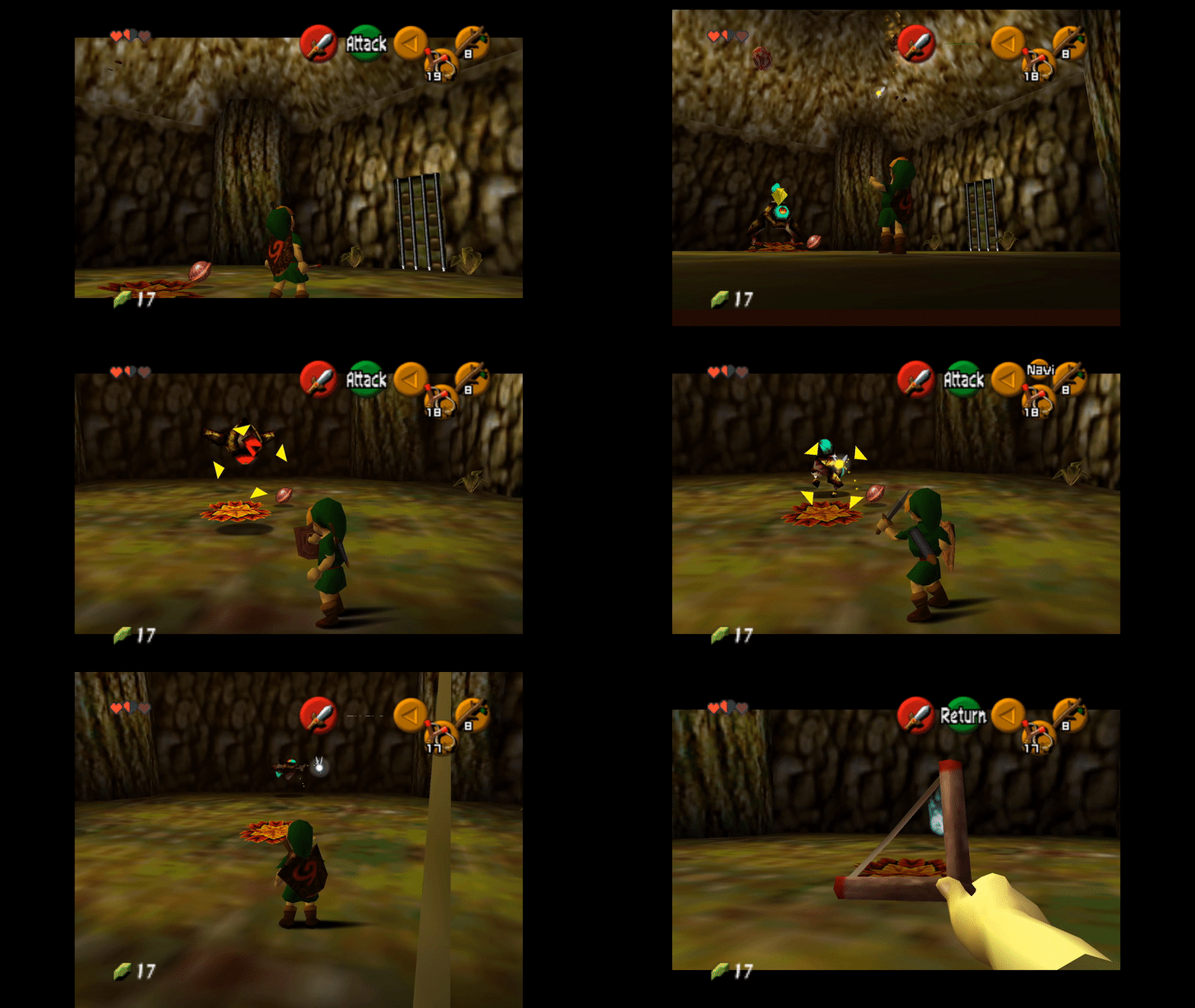
The Legend of Zelda: Ocarina of Time, being the first 3D Zelda game, obviously utilizes its verticality in ways that previous Zelda games could not. Zelda is a series well known for an arsenal of unique weapons and tools for solving puzzles and dispatching enemies. Iconic tools like the boomerang and hero’s bow are very compelling. It would have been a drastic admission of defeat to not translate such things into the first 3D Zelda. They have some hefty inherent problems, though. Control sticks are, frankly, not best suited for precision pinpoint aiming compared to a computer mouse, a gyroscope, or a photonic motion sensor. Ocarina of Time still offers the option of manually aiming projectiles through a first-person perspective, which is convenient for solving puzzles, but not ideal for most combat encounters. The Z-Targeting system rather elegantly solved this problem as well. The drawback is that the player doesn’t do much aiming at all when utilizing their bow and arrow in combat, which could be argued as part of the skill set of playing the old Zelda games, but in trade Ocarina gets the advantage of keeping airborne enemies in focus and keeping the use of projectiles in combat practical. Zelda combat is typically more about understanding the best tool for the job than skillful execution anyway, so I think it was a savvy decision to enable ranged combat in this way.

Child Link (The Legend of Zelda: Ocarina of Time) shoots a strange giant egg off of a ceiling, in a naturalistic  wooden interior, using his slingshot. He then stabs a nearby giant bug with his sword, then shoots it as it runs away.
There was an intent focus in this game on making your tools practical and functional, even if they’re not always the most complex or involved.

So many modern games utilize an automated camera or targeting system that can be traced directly back to Z-targeting, so I felt it deserved its own appreciation post here. The mechanic is unintrusive, fit-for-purpose, artistically sound, and practically seamless. It even has its own little diegetic explanation of your partner fairy, Navi acting as the source of your target’s focus. You might notice her dancing around targeted enemies in the clips I’ve provided. Helps reinforce her as an important partner to Link, even in spite of her infamous chattiness. Honestly, after looking into it, there are some features that even some modern targeting systems don’t do as well as Ocarina of Time. There have been perhaps more elegant, more robust, and even more interesting targeting systems since, but it’s absolutely astounding how much Zelda nailed it on its first try, and set the stage for the iteration of 3D navigation for many years to come.

Child Link (The Legend of Zelda: Ocarina of Time) pursues an elephant-sized cyclopic insect as it climbs up a wall in a dark cavern. Link aims up at it with a targeting crosshair focused on it, then shoots its eye with his slingshot.

Time passes, people move. Like a river’s flow, it never ends…

Sonic’s Famous ‘Health’ System, The Rings

Sonic The Hedgehog is an exquisite corpse of a franchise with a history as deep, interesting, and confusing and some of earth’s mightiest empires. You could fill volumes on the ins and outs of this thing. I cannot deny, I love this weird little rodent and his weird little world immensely. Yes, I’m as excited as anyone for Sega’s next absurd windstorm of a Sonic title, despite all the, uh, feedback, I’m about to unleash. Sonic has had some very high highs for me, and it’s a series that does certain things in gameplay that have never quite been captured elsewhere. There’s a laundry list of things people like to complain about in regards to this series, and I’d probably agree on most fronts too. Instead of the usually suspects, though, I want to complain about something I haven’t seen brought up before. It’s something that’s been with Sonic since the beginning, actually.

I don’t know if this is something that only bothers me. Perhaps that’s why I feel the need to get this jotted down and explore my feelings about it, but the Sonic The Hedgehog franchise’s rings system is weird, right? In Sonic The Hedgehog, and near every sequel and spinoff to that game since, rings have acted as the primary collectible – a sometimes currency, sometimes score counter, and almost always a barrier against the failure state. While rings in Sonic games frequently have some use within the game that make them valuable, their primary purpose is to prevent a Game Over. When Sonic is hit by an enemy or obstacle, he’ll lose all the rings he’s collected, spilling them out into game space, where they can be re-collected. If Sonic is again hit without any rings, the failure state engages, and Sonic is returned to the last checkpoint.

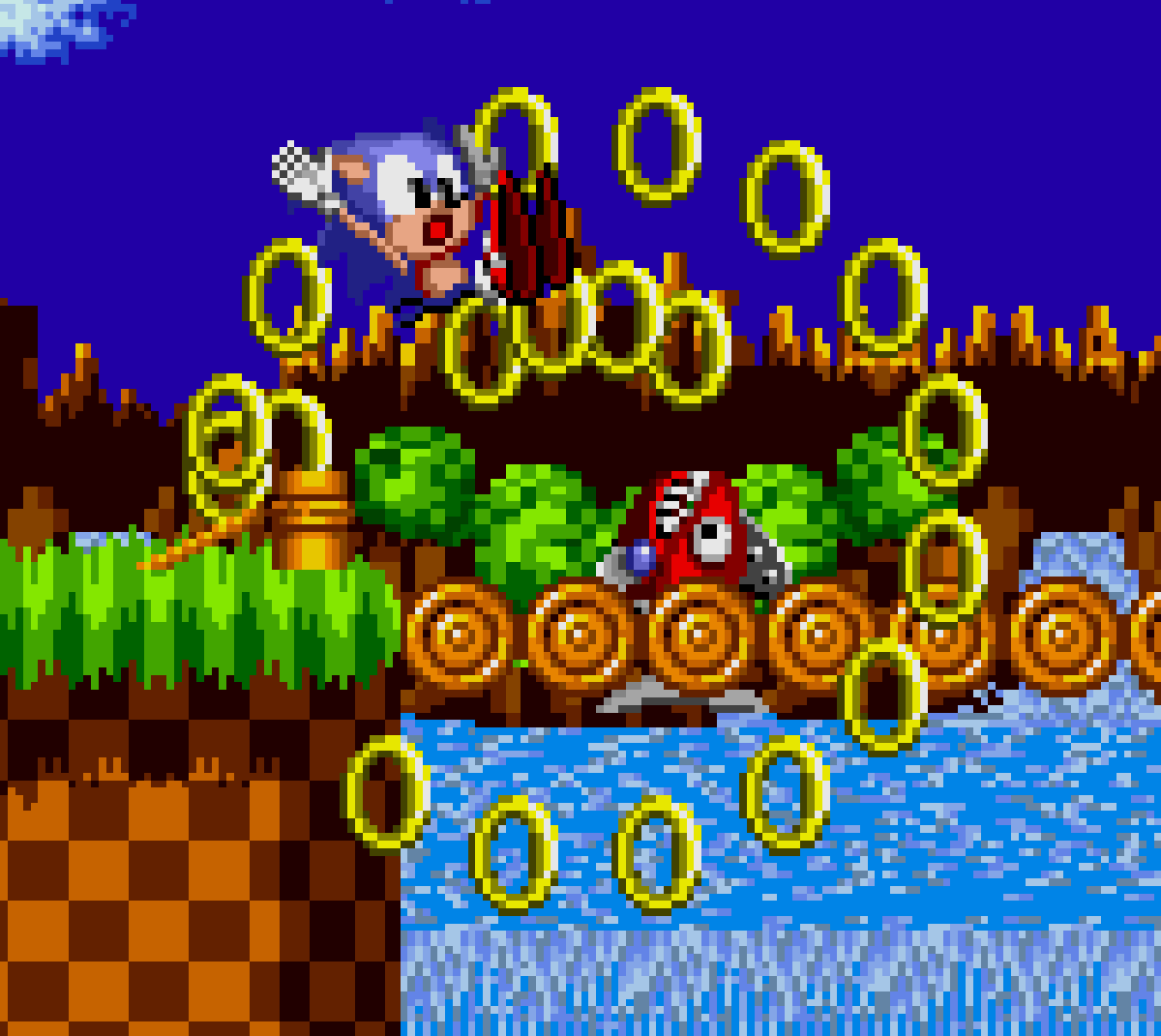
Grassy Cliffs. Sonic The Hedgehog walks into a beetle robot, losing rings, which scatter out in a circle from him. Sonic then destroys the robot by spinning into a ball. (Sonic The Hedgehog)
Gameplay this week sourced from Evolution of Sonic getting hit and losing rings (1991-2021)

To elaborate on what bothers me about this system I went and tried to elaborate on what makes a compelling health or damage system in general. To me, there are three things to guide the design of a successful player health system. A successful health system may include one or all of these. First, the health system provides a balance knob by which the designer may tune how many mistakes a player can make before incurring a greater failure state like a Game Over. It makes for a pretty simple tool to balance the game. If it’s too hard, players can simply be given more health or ways to restore their health. Furthermore, this balance can change as the player collects upgrades and gets stronger, or encounters more deadly enemies. It’s good for tuning the interest curve. Secondly, health systems can create a sense of tension or danger, to shore up the threat of the player’s opposition. Instant death makes for threatening enemies too, but that little bit of anticipation a more graduated health system provides, as the player slowly watches their strength wane with each hit they incur, it exaggerates and emphasizes that danger. Third, health systems can be used to incentivize players in interesting ways to guide the gameplay, by tweaking how it is that players regain or maintain their health through specific behaviors. Doom 2016’s glory kills, which reward aggression when the player is low on health, comes to mind.

So how does the blue blur do on all of these fronts? Well, the ring system is rather limited in that having rings only prevents Sonic’s defeat through a single mistake, before more rings have to be collected. In this way it doesn’t do much for balance. By virtue of how the system works, rings are always available when you get hit, unless you’re over a bottomless pit and will just die from the fall regardless. Rings are also plentiful enough in the world that tense moments of danger are few and far between. This is a good thing in a sense, Sonic is a game about flow and freedom, less one about oppression or danger. The result, though, is often that getting hit is just annoying – a disruption to that flow- more than anything else. Sonic gets a lot of its somewhat undeserved reputation of excessive simplicity from this. It’s hard to fail (instant death traps aside), and very easy to get annoyed.

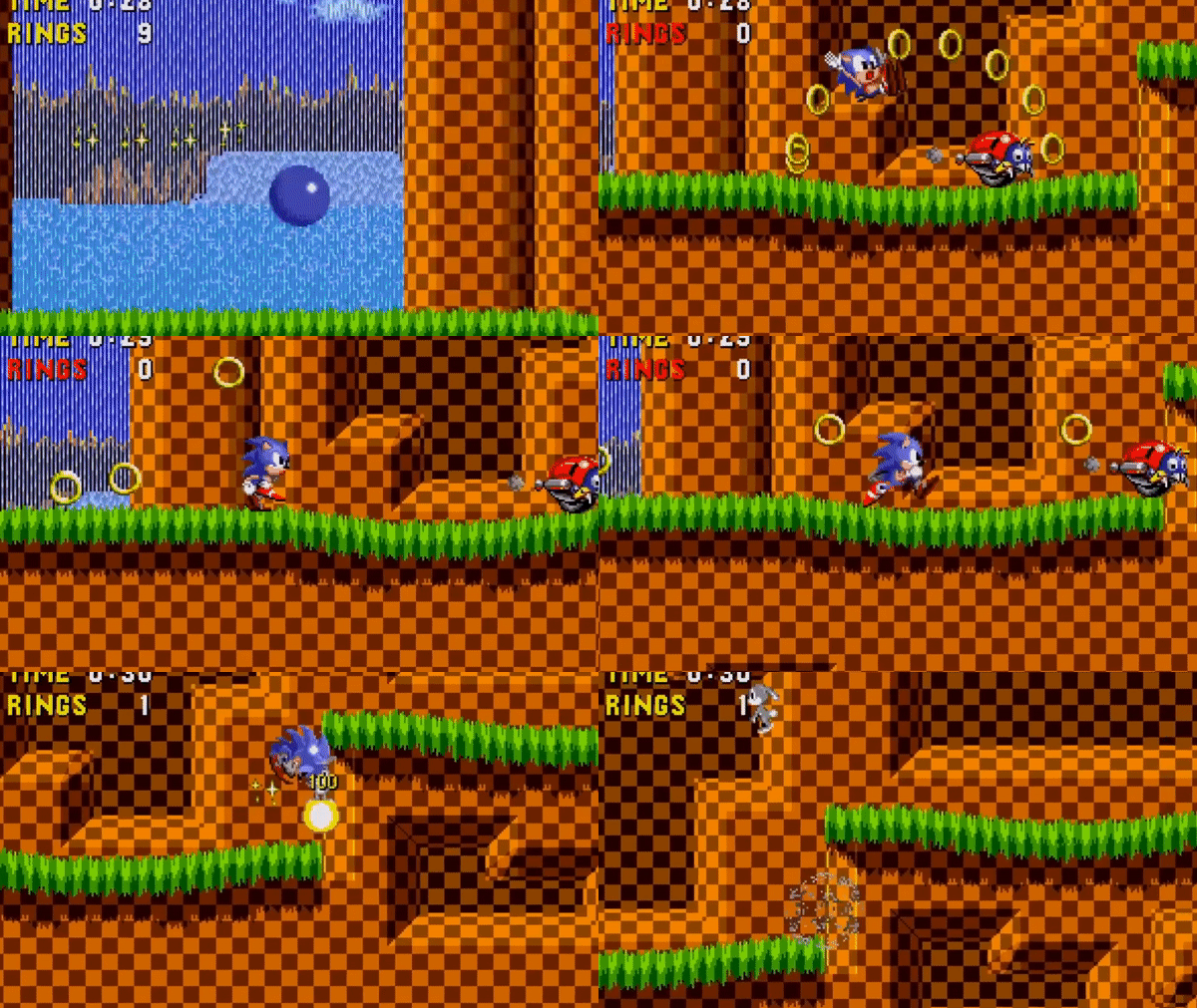
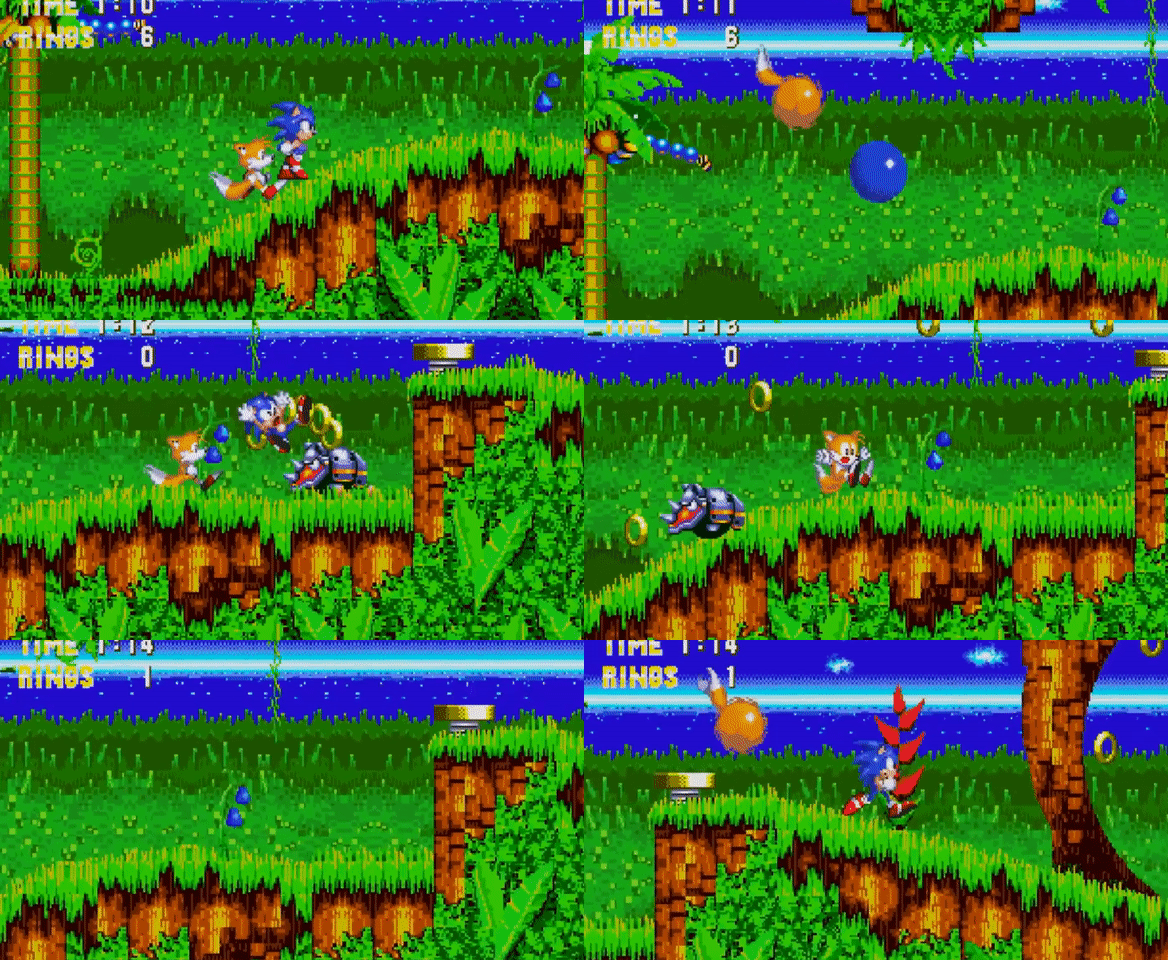
Grassy Hills. Sonic The Hedgehog walks into a moving robot and loses rings, which fall into the foreground and off the screen. (Sonic The Hedgehog 2)
I feel like this ‘scattering rings everywhere’ thing works better in the 2D games, generally. With one less axis to worry about, it feels less restrictive.

Finally, rings are indeed a highly incentivizing aspect of Sonic games, especially those of which have a store in which rings can be exchanged for prizes, although this brings up an important point. I feel as though rings are desirable more for their excellent audio-visual design and feedback. It’s fun simply to hear and see the cheery, shiny sound and sparks of collecting them, and watching the ring counter go up, rather than for any practical gameplay reason. The reason for this is that collecting an excess of rings does very little to contribute towards the player’s success. Sure, having a certain minimum number of rings makes it far less likely you won’t be able to pick up another ring before it disappears, once the player gets hit. However, there is a maximum number of rings that can actually be displayed on screen before any excess rings simply evaporate. You get no real advantages having 200 rings over having 20 rings. So, Sonic‘s health system doesn’t do much to incentivize interesting gameplay. On the contrary, actually, since having a single ring can theoretically keep Sonic alive indefinitely, the player isn’t really incentivized to learn about their obstacles or enemies because getting hit doesn’t have much of an impact or consequence. Some Sonic games have attempted to address this, by having Sonic only lose a fraction of his ring total on hit. The results are a similarly toothless health system, in which hoarding large numbers of rings essentially trivializes any threat enemies could possibly pose, without addressing any of my other issues with the system.

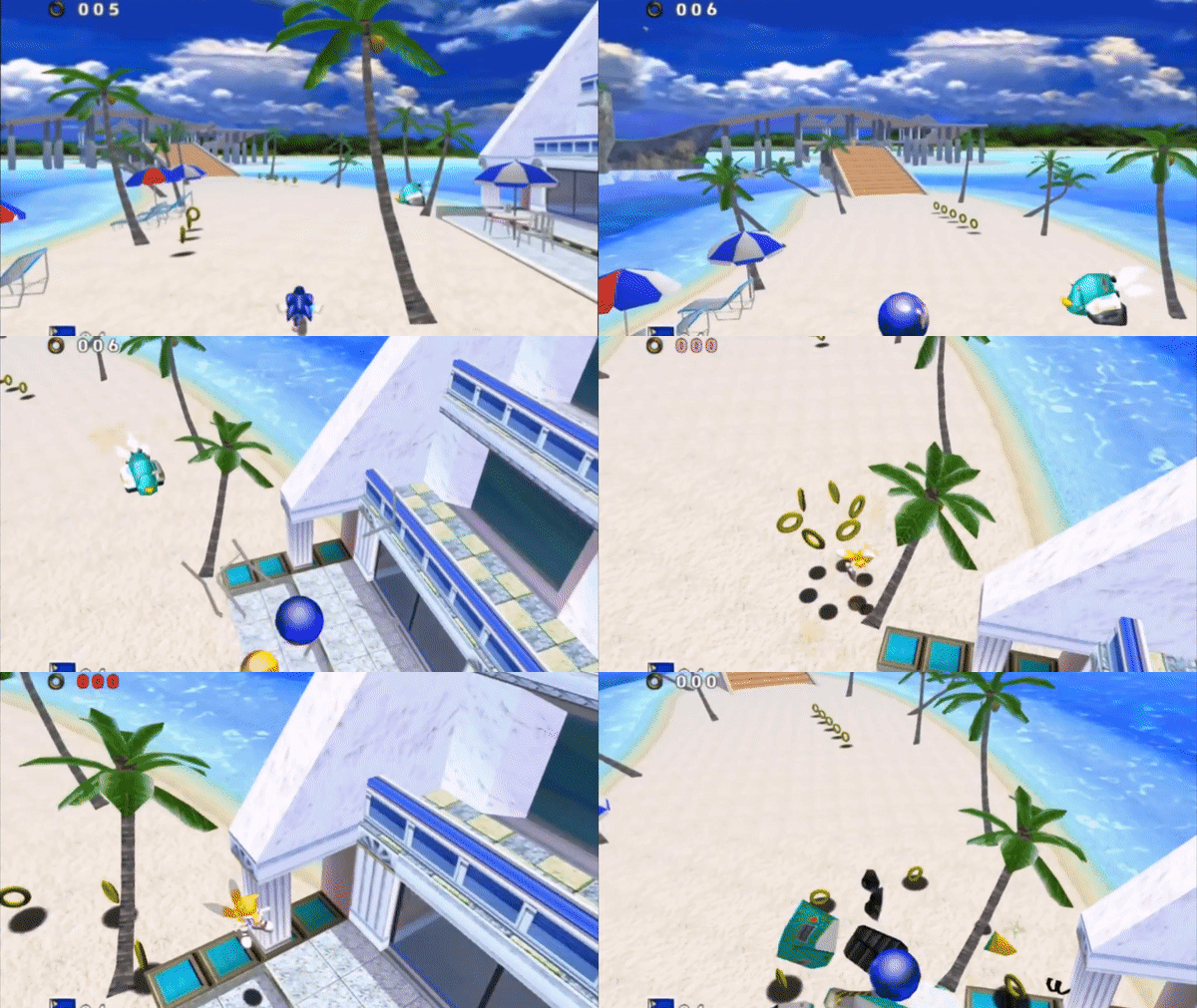
Sunny Beach. Sonic The Hedgehog dashes through the air, but is hurt by a tank-like robot, losing rings which scatter on the ground. (Sonic Adventure)
Stop to pick them up, or ignore them and keep going. Kind of just pointless or disruptive.

One thought I’ve had on it is how starkly getting hit in this game kills momentum. I get it, it’s kind of the point. In lieu of a persistent tracker for how many mistakes the player makes, getting hit simply means halting forward motion, which means you don’t hit that all important state of flow that makes Sonic games so enjoyable. That annoyance is your incentive to get better at avoiding obstacles. At the same time though, if that’s what we assume the player wants – to go fast- then it is odd that rings are scattered around the player when they’ve bit hit at random, or in the case of the 3D games, in every direction on the floor. Surely, we only want to incentivize the player to go in one direction – forward. If a player wants to re-collect some of their lost rings, as they surely would, then they can’t immediately continue their forward momentum where they left off, they have to take a moment to mill about collecting the rings. It’s just a bit odd. Elsewhere in Sonic games, free-floating rings are used as signposts to guide that sense of forward momentum for the player. If you see a path of rings, it’s generally a clear and safe path forward to gaining speed.

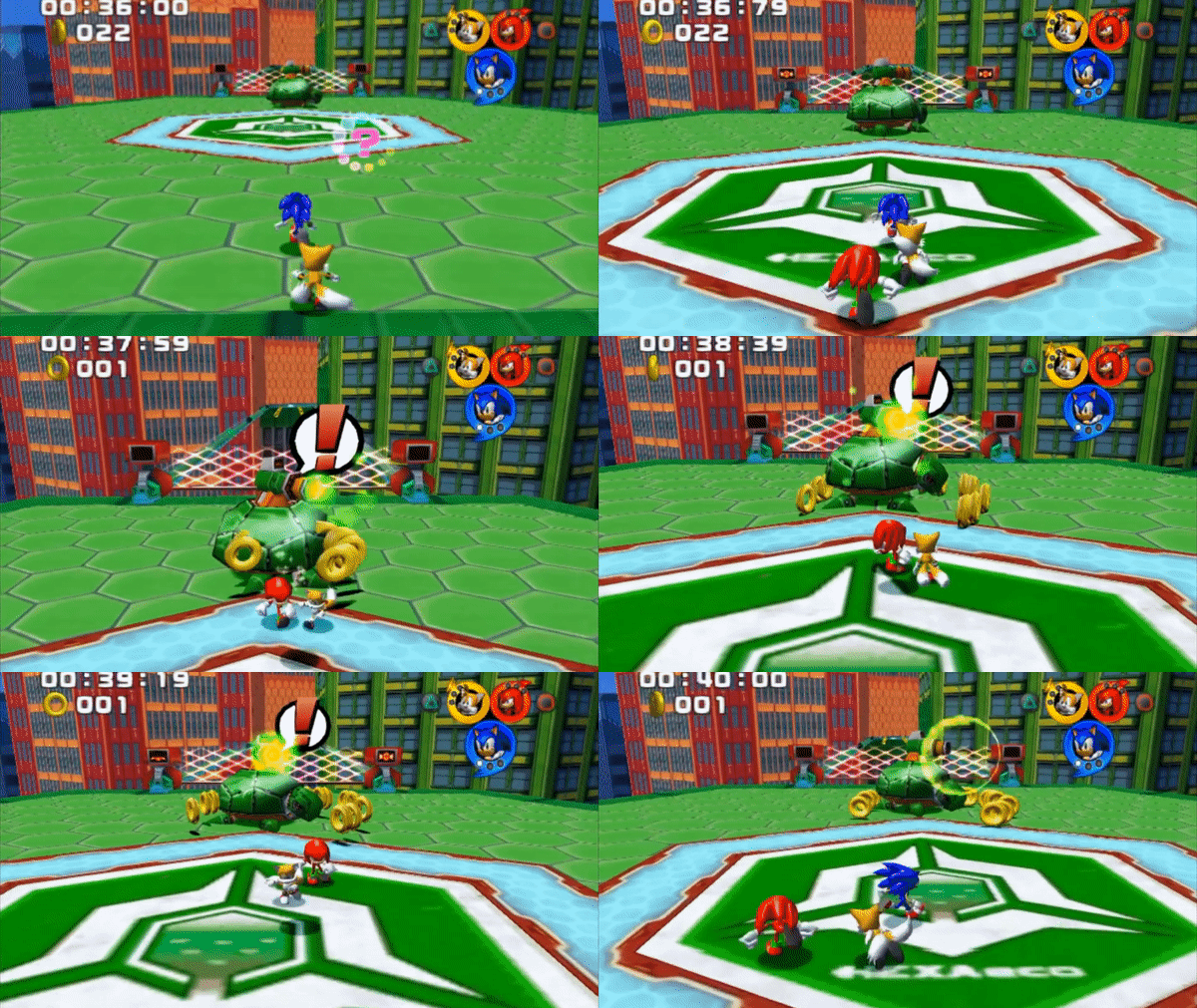
Sci-Fi cityscape. Sonic The Hedgehog, Knuckles, and Tails run into a robot turtle, getting hurt and scattering rings on the ground. (Sonic Heroes)
Sonic Heroes loves to kill forward momentum. It’s basically its favorite thing.

Losing rings normally does not create much of a sense of tension for me either. Getting hit in a Sonic game rarely creates any palpable danger for Sonic, outside of falling into instant death pits. This all-or-nothing approach makes enemies in Sonic games rather toothless, until they aren’t in very specific scenarios, which can often feel cheap – as though the difference between losing some rings and having to start over is outside of the player’s control. You lose any sense that dangerous things in the world are actually dangerous, and more like the environments are dangerous in a way that’s almost arbitrary.

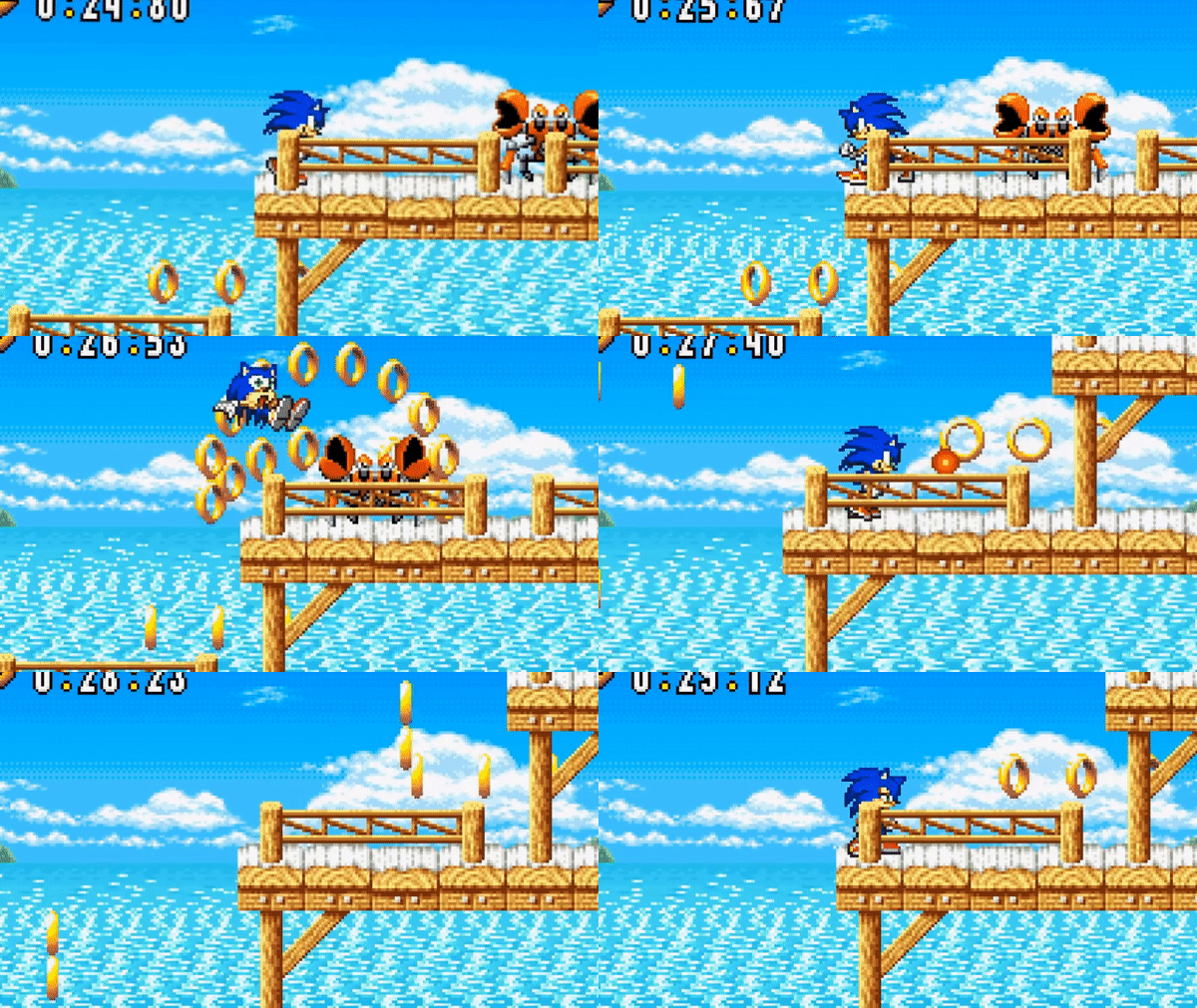
Beach Pier. Sonic The Hedgehog walks into a robot crab, getting hurt and scattering rings everywhere. (Sonic Advanced)
Are we really expecting the player to double back and chase those rings here?

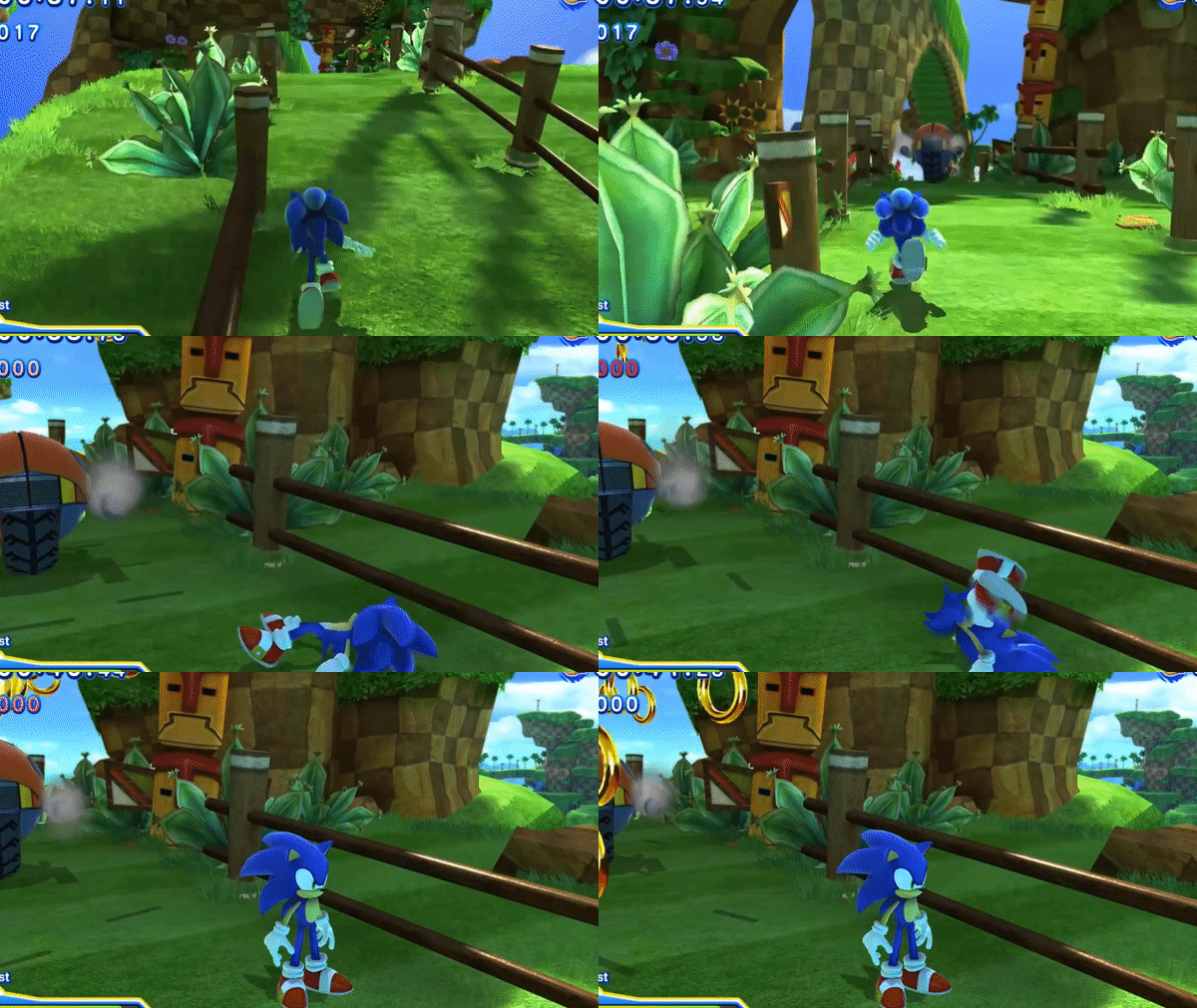
What if, instead of spraying rings in every direction, when Sonic is hit, rings fly out ahead of Sonic relative to the direction he’s moving, so that when it comes time to re-collect rings, Sonic needs to keep moving forward in the direction he was going? He needs to regain his lost speed to regain what was lost. First of all this make sense. If Sonic is losing speed and letting go of his rings at the same time, they should logically pour out in front of him as they retain their previous speed. That’s a secondary concern, but not an unimportant one. I think making the rings behave realistically that way could contribute to keeping the gameplay flow even when Sonic gets hit, which is my primary concern here. The main thing this would accomplish is keeping the re-collection of lost rings as a harmonious part of simply playing the game, which is to say, running forward. Sonic is all about doing things while running forward – defeating enemies while running, avoiding traps while running, and yes, collecting rings while running. In this scenario not only is there a greater challenge, a greater uncertainty of re-collecting what was lost that calls on player skill, but it’s far less disruptive, not requiring the player to behave in a less fun and interesting way as punishment for being hit. On the contrary, your punishment for being hit is a momentary increase in intensity and demand of skill, or in other words, a heightening of tension.

Grassy Hills. Sonic runs into a beetle robot, getting hurt and scattering rings a small distance ahead of him. (Sonic Generations)
When I say ‘fly out ahead of sonic’, I mean send the rings into the distance, so you have to like, build up speed and run after them. Maybe we could even ease up on the ‘knock Sonic on his ass’

Sonic is as inseparable from his rings as Mario is from his coins, which was the point, of course, when Sonic was invented in the 90s. Sonic was meant as a counterpoint to Mario, to stand out as different. He’s younger, faster, and has an attitude. His game is about speed, and his collectibles serve as health, in a way. It’s certainly novel enough to have survived about a billion iterations on Sonic games, but I’ve never totally understood how it fits in a game that’s about speed. Everything good that I love about the Sonic franchise is somewhat apart from this one odd yet oddly persistent gameplay mechanic. The classics like Sonic can provide a useful lens to see how certain design goals can be successfully executed. However, I’d never want to design something in a way just because that’s how it’s always been done. The weird ring system has its advantages, like near any mechanic in the right circumstances, but I’m still skeptical it’s the best solution for what Sonic is and could be.

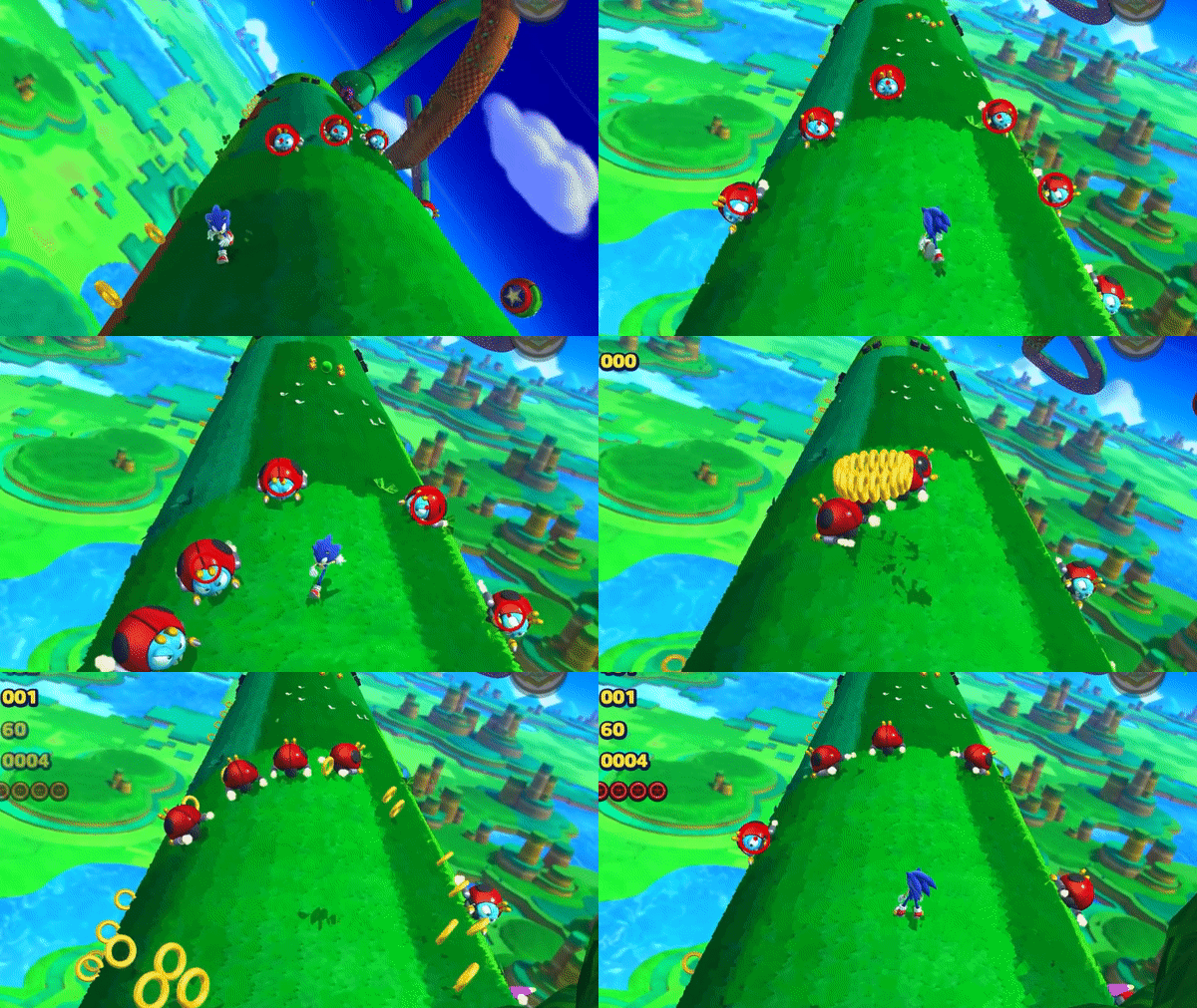
Grassy tube-shaped planetoid. Sonic The Hedgehog walks into a beetle robot, getting hurt and scattering rings in a circle around him. (Sonic Lost World)

Don’t give up on the sun. Don’t make the sun laugh at you…

Yes, that is a real Sonic quote.

The Iterations of Luigi’s Mansion

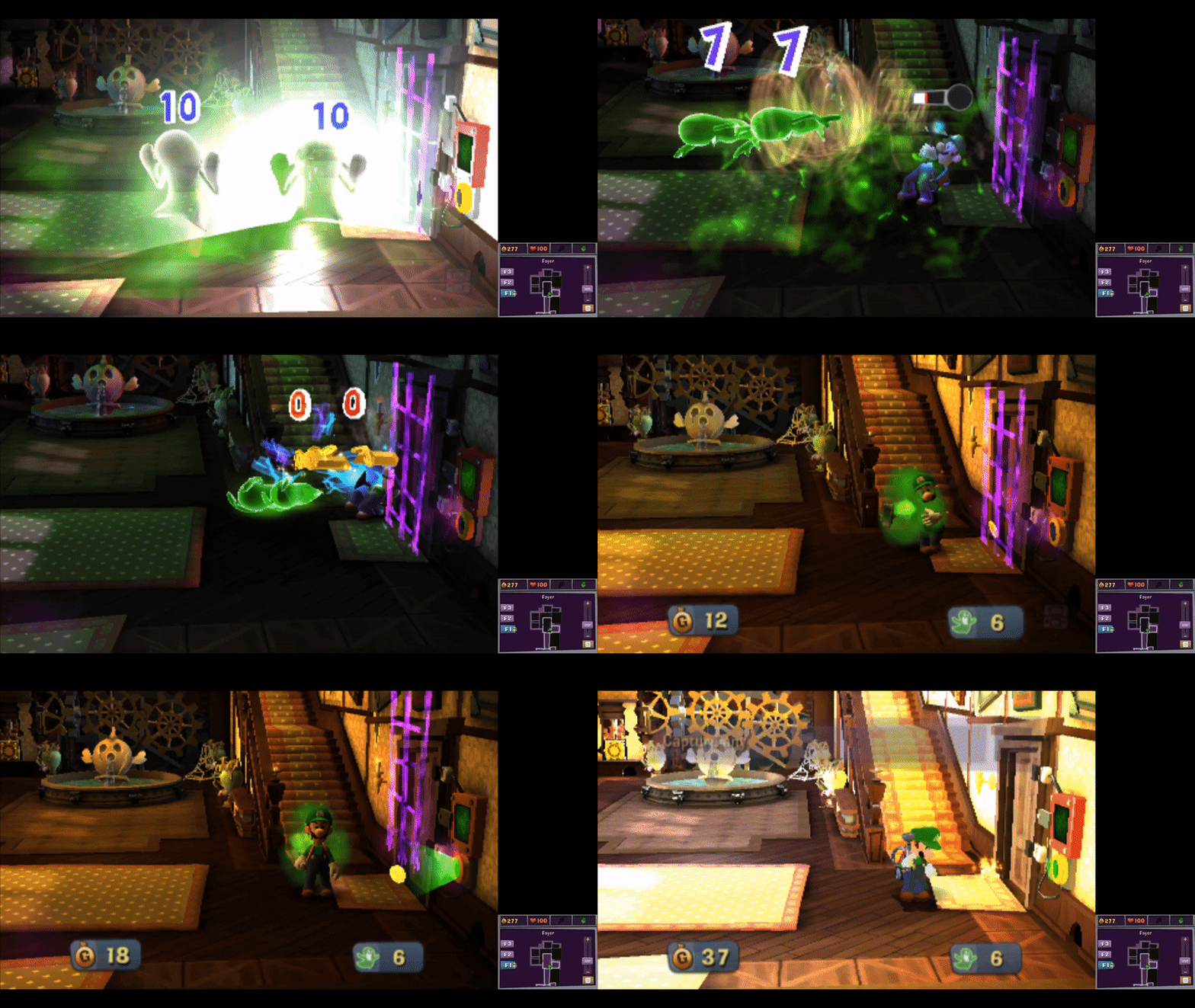
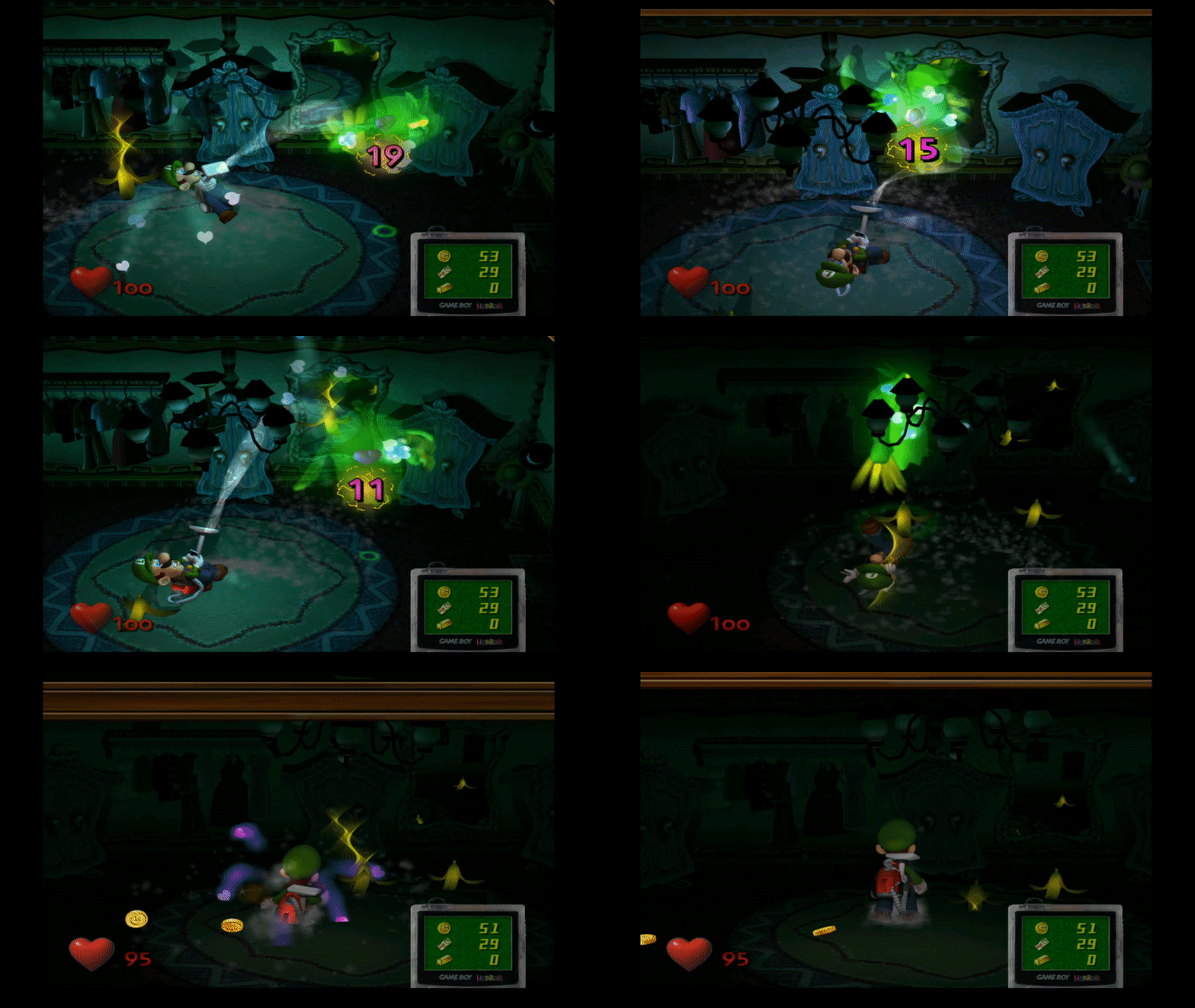
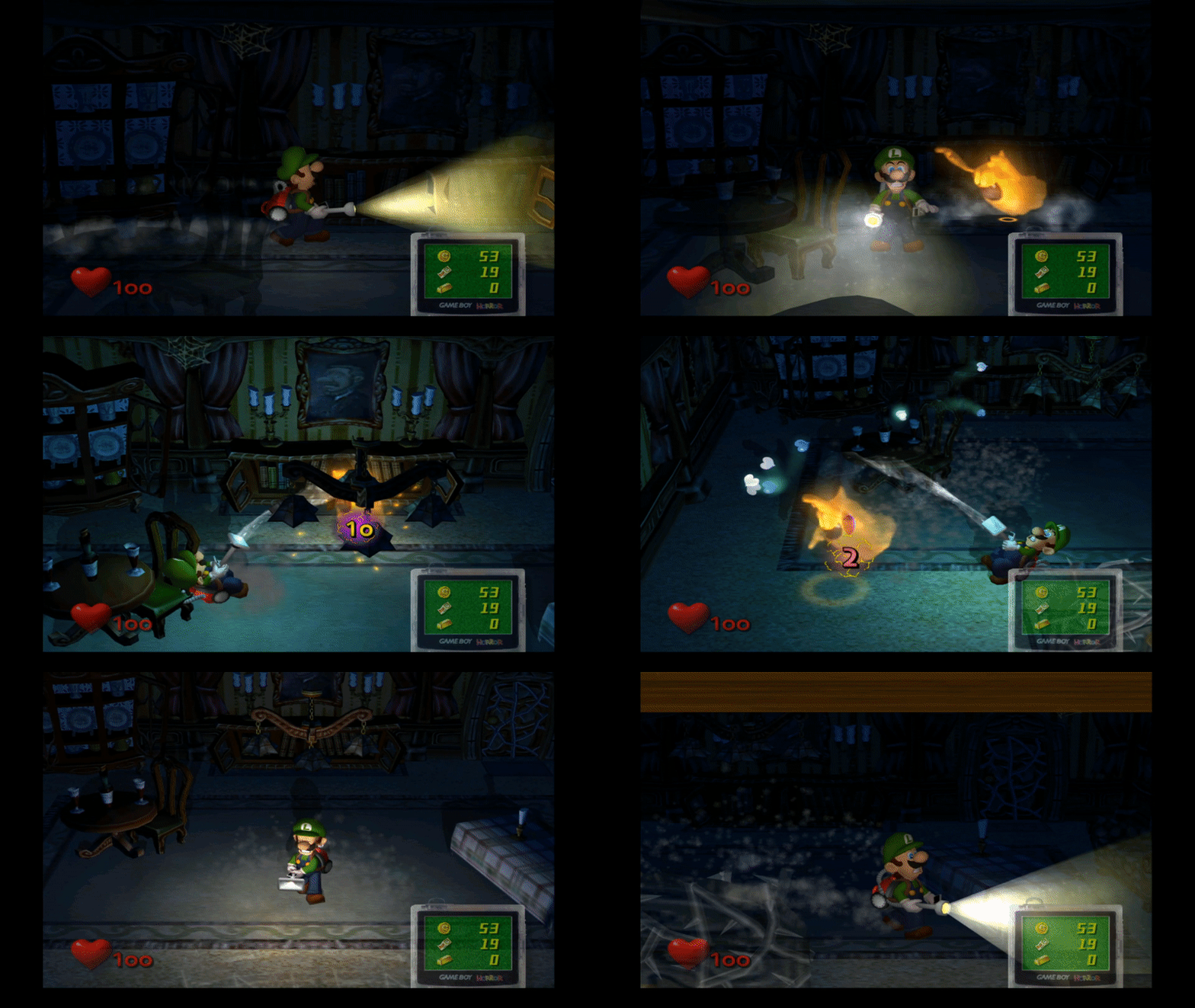
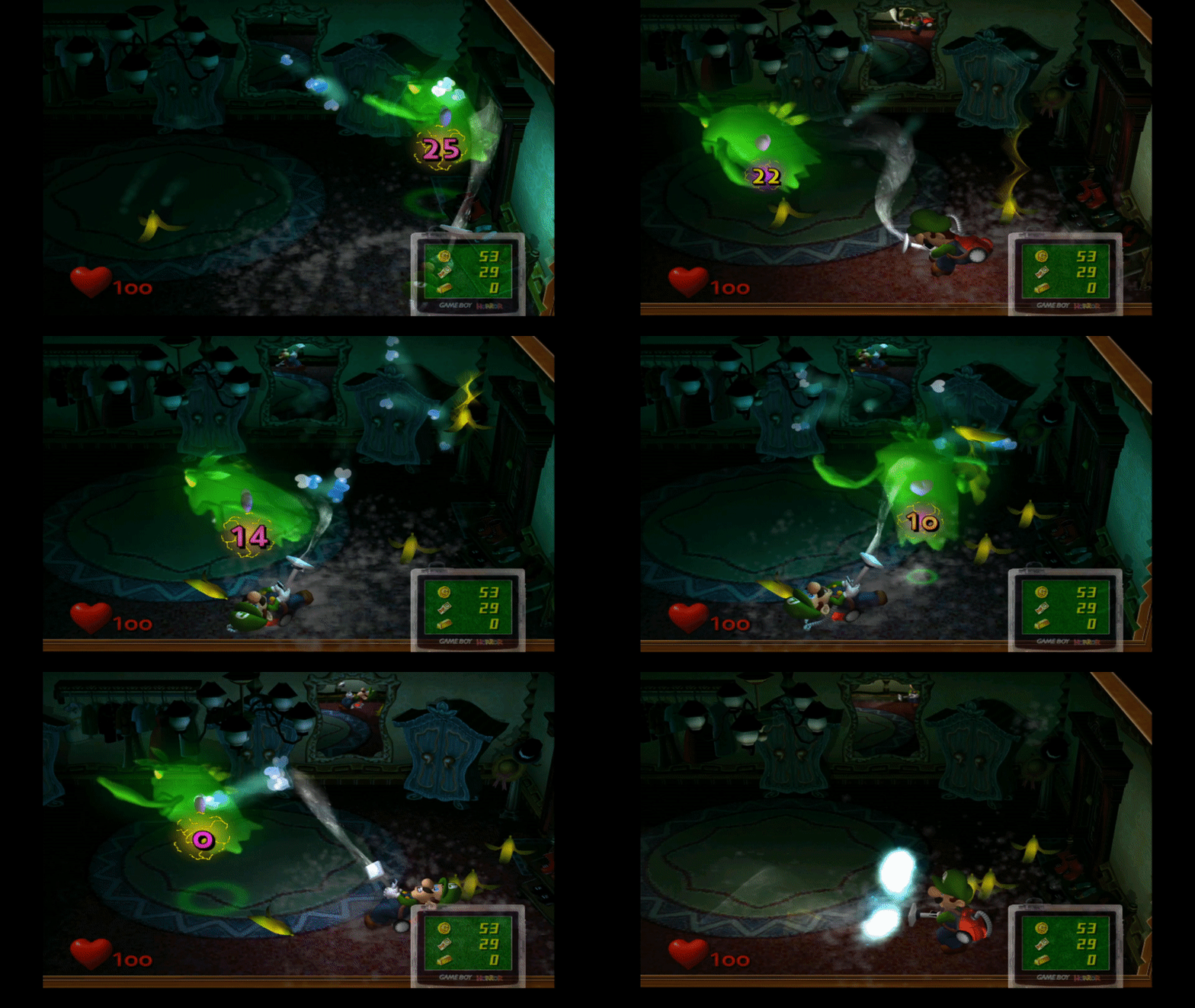
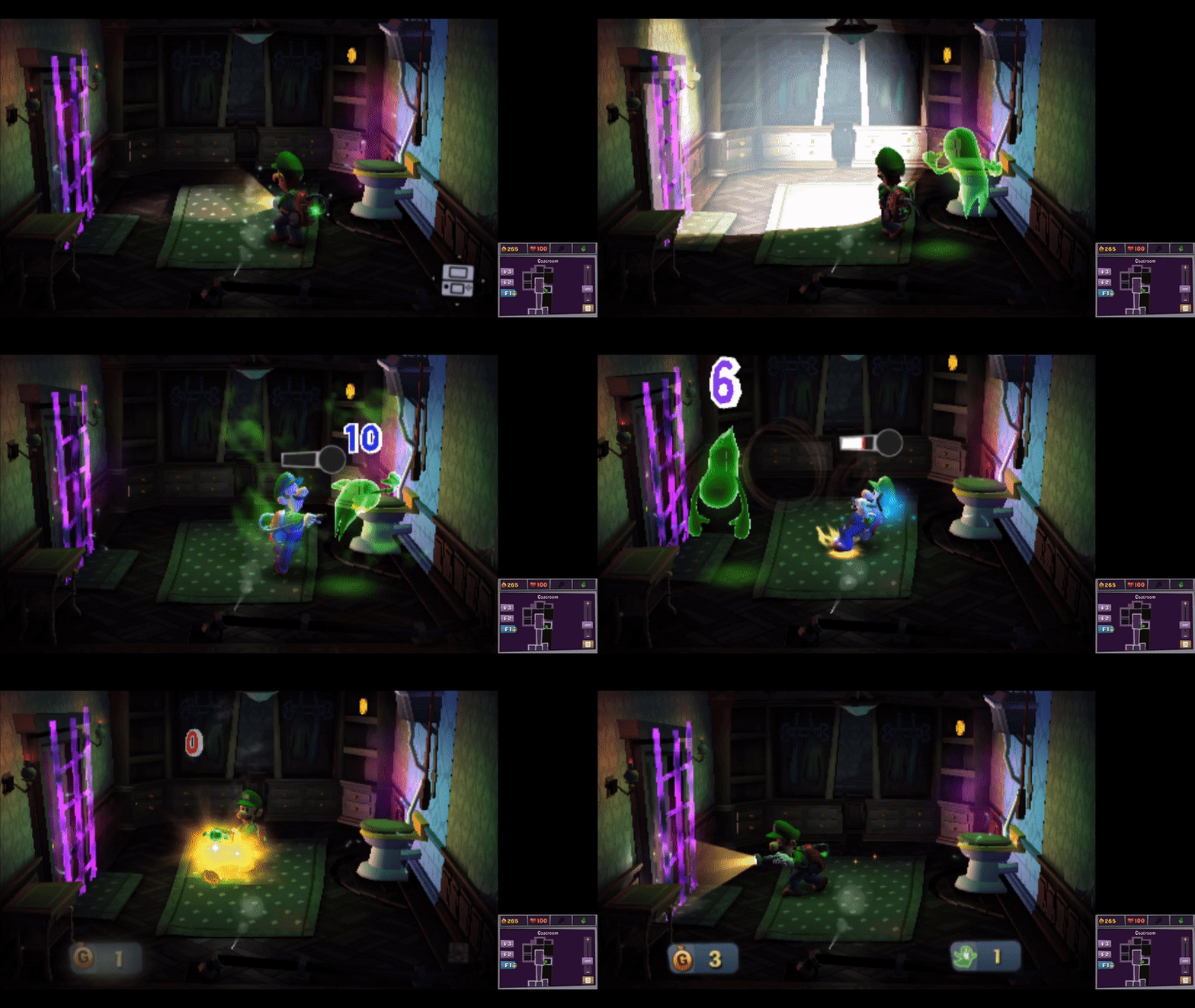
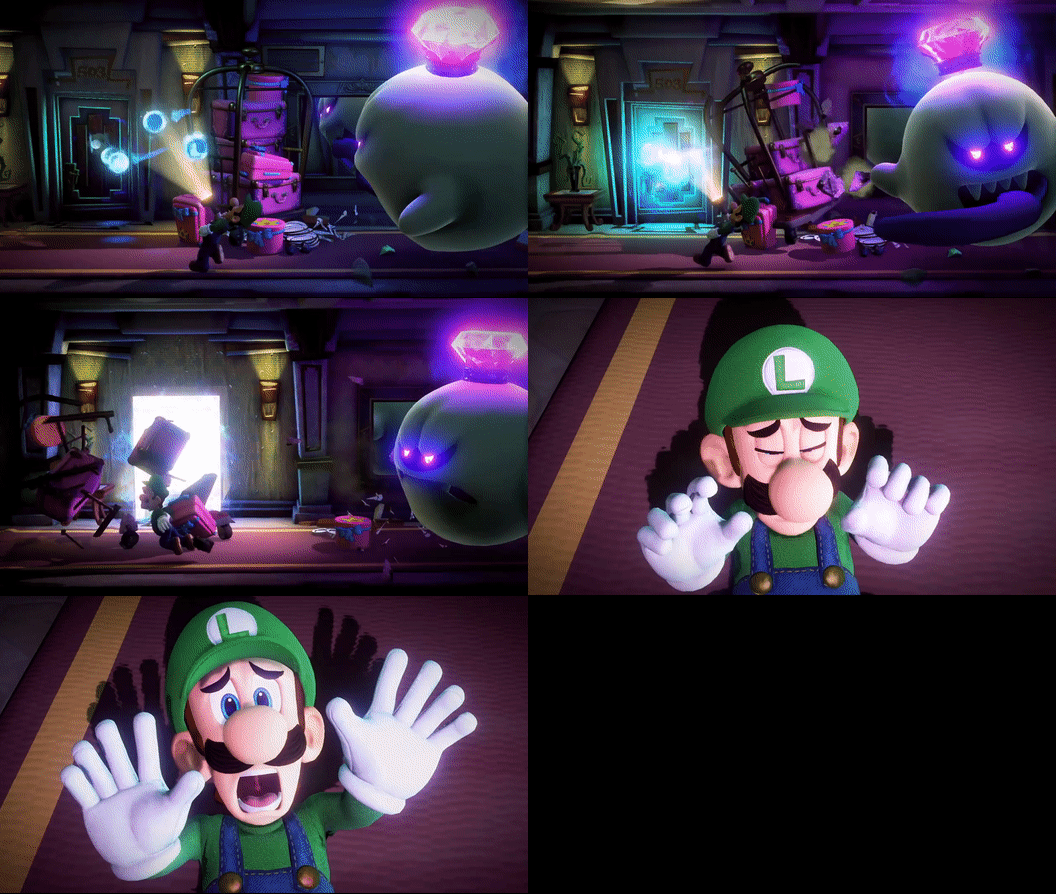
Alright to finish off Spooky Month I’ve got to talk about the spookiest game franchise there is; Luigi’s Mansion. It’s the superlative. There is no other. That’s science. Luigi’s Mansion is an action adventure game (does that mean anything?).. Luigi’s Mansion is a spooky ghost-catching action game centered around methodically exploring a creepy mansion whilst engaging in periodic encounters of high-action ghost-hunting that punctuate the gloom. It released in September 2001 for the Nintendo GameCube, received a sequel in March 2013 titled Luigi’s Mansion: Dark Moon for the Nintendo 3DS, and a second sequel, Luigi’s Mansion 3, in October 2019 for the Nintendo Switch. All the games’ action plays similar on the surface, involving a lot of running around, bumping into things while you fight ghosts in a tug-of-war scenario. They’ll drag you around the room, and you’ll suck them up by the tail with a vacuum cleaner. The player can lean Luigi around in different directions to have a limited control of his movement while the ghosts try to escape his vacuum. Leaning away from the ghosts drains their energy faster, and poor movement control might let the ghost escape. The combat of Luigi’s Mansion is easy to grasp and instantly satisfying. What I’m interested in though, is how the simple systems were iterated on in its followups. In particular, why I found the combat of Luigi’s Mansion 3 so blase so often.

The game doesn’t look that bad for being over 20 years old. At least I didn’t use the 3DS version.

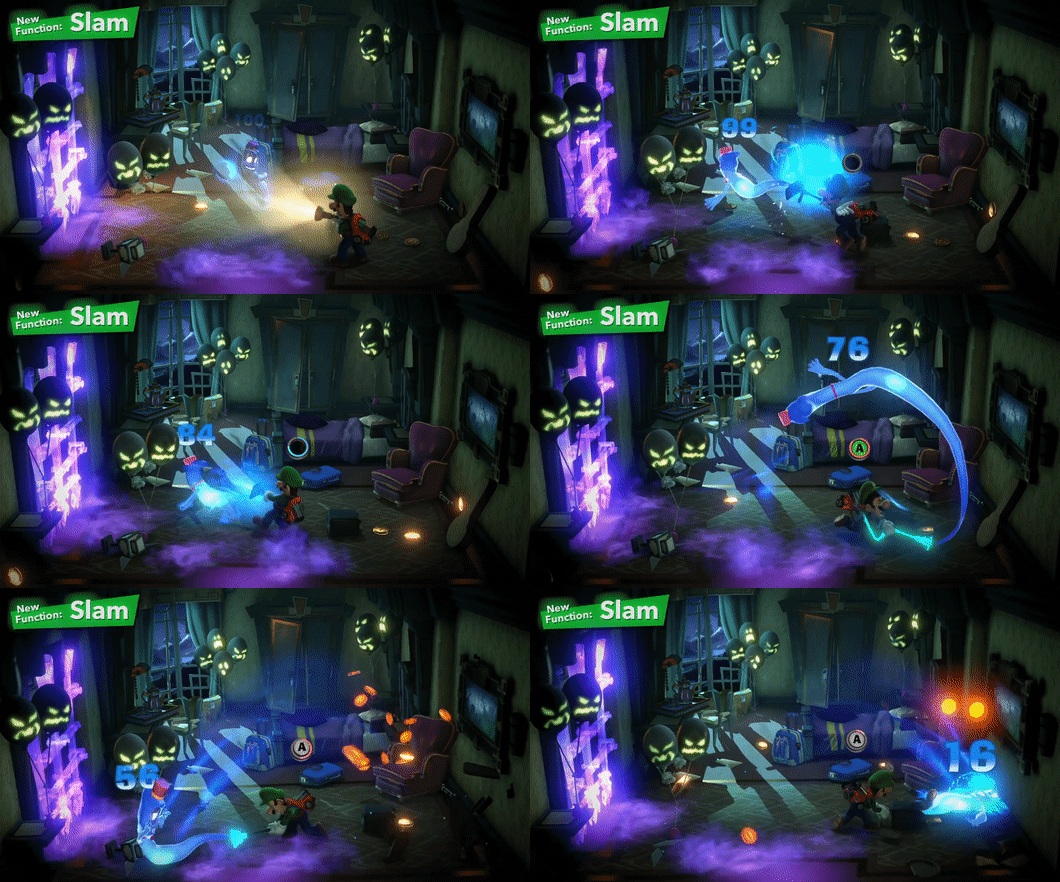
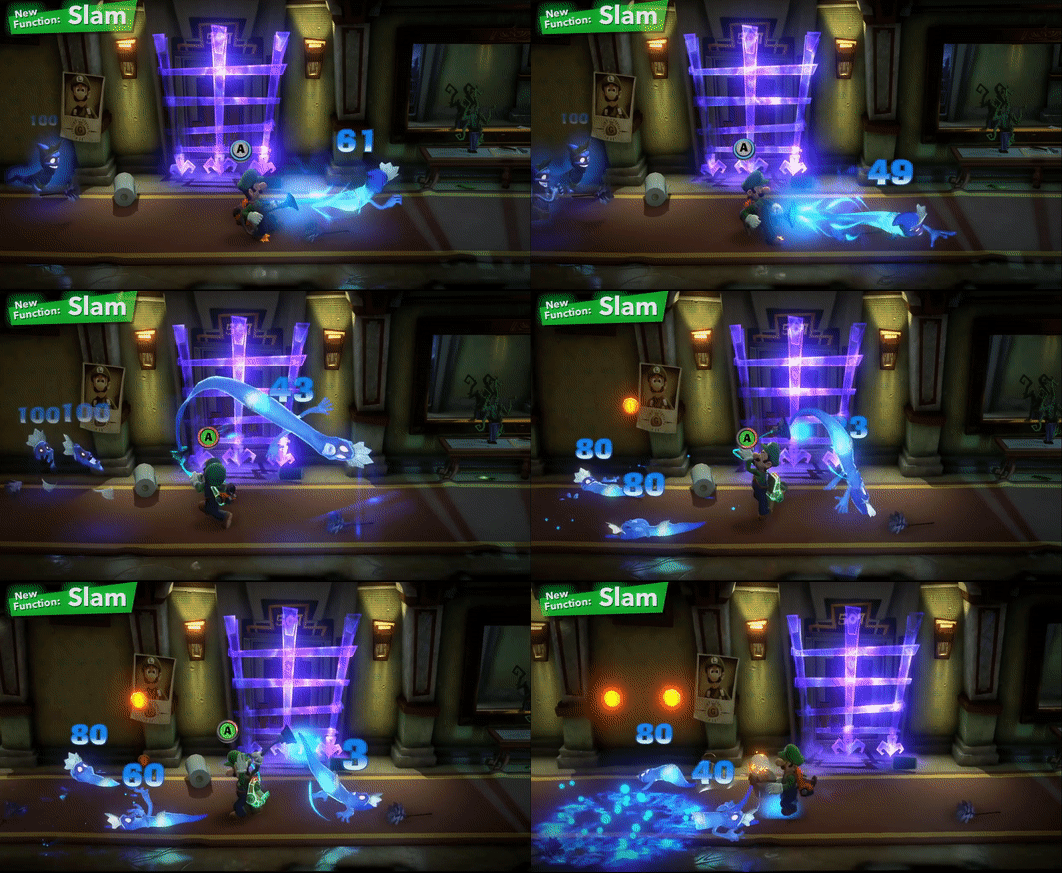
Aha, yes. Plot twist, I actually think the combat in Luigi’s Mansion 3 is pretty weak in comparison to its predecessors. The games play mostly the same, and there aren’t that many elements in play here, relatively speaking, so it shouldn’t be too difficult to suss out what’s going on here. Luigi’s Mansion 3 introduced a mechanic called the slam to Luigi’s arsenal, which allows him to, after vacuuming a particular ghost for a short time, repeatedly slam the ghost into the ground, in any direction, stunning and damaging other ghosts while annihilating his main target’s energy. It quickly becomes a one-size-fits-all solution to any ghost altercation outside of boss fights, and isn’t an especially engaging mechanic on its own.

My brain cells preparing to critique one of the Nintendo Switch’s most critically acclaimed games

Luigi’s Mansion 3 was never going to miss out on its well-earned popularity for lack of a more considered difficulty curve. Being too easy isn’t exactly the problem I have. Luigi’s Mansion 3 was always going to be popular because it is one of the most lavishly produced, polished, and animated Mario games of all time. I don’t really think Luigi’s Mansion 3 has bad combat. On the contrary, I think one among the many reasons for Luigi’s Mansion 3‘s notable anticipation was due to its less talked about predecessor’s proof of concept. It showed that the off-beat, frankly weird gameplay of Luigi’s Mansion was a formula with staying power that had room to grow as a robust system. Indeed, Luigi’s Mansion: Dark Moon doesn’t quite get the credit it deserves for what it contributed to the notoriety and design ethos of Luigi’s Mansion. Luigi’s Mansion 3‘s combat has its basis in Dark Moon and works well enough as a result. Dark Moon is where most of the changes to the formula came from and they are for the most part, positives.

The strobulb is Dark Moon‘s first prominent addition. Where in the first game, sweeping one’s flashlight over a ghost’s exposed eyes was sufficient to stun it and open it up for being captured, Dark Moon requires an active button press. The light will flash brightly, and anything caught in its cone will be stunned. The strobulb can also be charged up for a wider flash that is less likely to miss its mark, and has the added bonus of hitting many more ghosts at once. The original GameCube game made stunning ghosts in this way passive – simply sweeping the light over them is sufficient. Speaking of passivity, I liked the way the first two games in this series made defeating ghosts such a concerted effort. They would drag Luigi about the room, possibly ramming him into obstacles. The player’s own control input was the only thing stopping them. Admittedly this aspect of being dragged around a room began to be de-emphasized in Dark Moon, and that trend continued in 3.

Finished in a flash … *cough*

On the flip side, Dark Moon added the power surge ability, which would let Luigi deal extra damage to a ghost he had been focused on for a certain amount of time, uninterrupted. Adding this simple additional button prompt helps keep the player feeling like an active participate, among other advantages like rewarding skilled play. The slam move is an iteration of the power surge, whereas now pressing the button after focusing on a ghost will slam it into the ground for massive damage, and this can be repeated multiple times on one charge. The move is so powerful and repetitive I often found myself passively clearing rooms of ghosts without thinking much of it.

That’s not to say that passively oriented gameplay is inherently a negative. There’s plenty of passive gameplay in Luigi’s Mansion anyway. It’s an atmospheric piece about slowly creeping through an abandoned estate. If action is half of what you do, the other half is kind of just wandering around, albeit in a extremely realized world dripping with personality. The point is, the action could stand to have some active engagement to accentuate and contrast the more low key exploration. I think something that made the original GameCube game’s spooks stand out as so, well, spooky was how legitimately threatening ghosts could be, and how that threat made a real intrusion upon the quiet tension of Luigi’s nervous wanderings. Luigi’s reactions are telling me that I should be elevating my heart rate when ghosts appear, after all. The ghosts need to pose a legitimate threat.

Ghosts’ erratic movements can reposition Luigi into obstacles if you’re not careful

Luigi’s Mansion 3 is not lacking for interesting boss fights that feel legitimately threatening, but while bosses are often a highlight of their games, moments that stick out as particularly exciting or memorable, they’re not what you’re going to be doing in an adventuring game like Luigi’s Mansion 80% of the time. If most of what you do is fighting mooks, or if even half of what you do is fighting mooks, fighting those mooks may as well be fun, or at minimum engaging. I found the slam ability’s overwhelming power and utility distracting from this. I wasn’t engaging the core Luigi’s Mansion experience like I used to. I missed those chaotic tugs of war. What’s more, the animation for this maneuver just looks… wrong. I did mention this is among the most lavishly animated Mario games ever, and it completely is. There’s some real talent and attention to detail on display here, so it’s kind of confusing how strange the transition is on this loop of Luigi slamming the ground. The way he’s leaning his weight around just doesn’t make much visual sense. It looks much more like he’s supposed to shift from slamming on one side to the other, yeah? The natural motion here would be for him to swing the grappled ghost over his head. This is fairly obvious if you go out of your way to alternate what side of Luigi you’re slamming the ghost on.

The biggest problem, though, is in how powerful the slam move is, relative to how easy it is to use. The power surge mechanic in Dark Moon only served to accentuate and accelerate the flow of gameplay as it happened. An enemy with a piddling 10 hp is probably going to be captured by a skilled Luigi pretty quickly regardless, so the addition of the power surge mechanic would let a skilled player skip that extra 5 hp at the tail end of the engagement – we all knew they’d get through it no problem anyway. In this way it’s a reward for skilled play that keeps things smooth and flowing, but it doesn’t overtake the game’s main combat mechanics, it merely augments them. The slam, on the other hand, functionally replaces the combat of Luigi’s Mansion as it had existed up to the point of Luigi’s Mansion 3. It’s not a extra tool that augments gameplay, it’s a sledgehammer that is overwhelmingly more powerful than engaging with the game’s other tug-of-war mechanics. More often that not, the goals of struggling in a ghostly suction-y duel are shuffled aside for the goal of simply reaching the point where you can start slamming which, while rewarding in its own way, gets awfully repetitive in how readily available it is. It begins to homogenize the combat encounters of the game.

The slam animation loops really awkwardly, and IT DOESN’T SUCK UP GHOSTS WHAT?!

I have to touch on the fact that when defeating a ghost using the slam, it does not, I repeat, does not, get sucked into Luigi’s vacuum. Defeating ghosts in Luigi‘s Mansion near-universally results in the ghost’s malleable body getting all smushed into the mouth of the device, before disappearing into it with a satisfying slurp and *pop* sound. Delightfully expressive flails of panic from the victimized ghosts accompany. It’s the punctuation of ultimate victory over your foe. The cherry on top. The fullest realization of the fantasy of Luigi’s Mansion– being a ghost hunter. Any and all dark spirits no matter their might may be laid low before the great equalizer of an overcharged vacuum cleaner. There’s little more satisfying than that in the game. The idea that the most powerful move in Luigi’s Mansion 3 is also the only way to dispense with ghosts without that oh so sweet final animation of a ghost being sucked away into oblivion is utterly baffling to me. How is a ghost even destroyed? Is that not the point? They’re already dead, so you need to capture them with a device, right?

Ahhh, that feels better

This may seem like a minor point, but I cannot under-emphasize the importance of nailing the aesthetics of your game to work in concert with its mechanics. Would Luigi’s Mansion be as fun if everyone and everything were replaced with featureless blobs? No, I don’t think so. I don’t think its as fun if it’s missing even this one crucial animation and sound effect. Destroying ghosts just doesn’t feel right compared to capturing them in this setting. Imagine your favorite tense or emotional scene from your favorite dramatic game, or movie. Now imagine it set against the backdrop of this music. I just cannot reconcile the incongruence here. If you defeat a boss ghost with Luigi’s slam ability, the ghost-getting-sucked-into-a-vacuum-cleaner animation plays in its entirety, because of course it does. Why is this not the case for regular ghosts, whom you will be encountering far more often? It throws off the whole vibe of the game, so I have to physically restrain myself from using the most powerful tool in Luigi’s arsenal if it would finish off a foe, and that feels terrible.

Ahhhh, one more for good measure. So satisfying

Now if this sounds pretty harsh, don’t worry, because this is the part where I shower praise on the slam mechanic, as it is not a bad concept by any stretch. One of the greatest strengths of Luigi’s Mansion is its slapstick and cartoonish aesthetic. Action in these games quickly becomes outlandish and comedic as kitchenware flies off of shelves, vases are smashed, and tablecloths go whipping about in the scuffle. The thought of a struggle with Luigi escalating to the point that he’s literally slamming stubborn ghosts over his head like he’s hammering a tent peg into the ground is inherently hilarious, and perfectly congruous with the game’s general feel. Having this big and bombastic move to build up to gives every encounter a concurrent goal alongside simply ‘defeat all the ghosts’. It does potentially offer an interesting choice between slamming ghosts or simply sucking them, were it rebalanced to make the latter method more viable. The addition of an attack specifically for dealing with large crowds of ghosts also fills a niche in Luigi’s moveset that could allow for a far more varied and interesting array of encounter designs.

There are so many possibilities. Ghosts that wear armor which needs to be slammed into pieces before they can be properly captured, ghosts that can only be captured after they’ve been slammed into water, ghosts that only take damage if other enemies are slammed into them, rooms full huge numbers of ghosts that are best dealt with using the slam to thin out their tanks. The list of goes on and on. If it were just a little less frequent, if it were just a little less powerful, if it didn’t replace the more seamless power surge ability, and if it were just a little more in line audio-visual-wise with the rest of the game (by which I mean, allow the slam to suck up regular ghosts like it does bosses), I’d probably be over the (dark) moon for this addition to Luigi’s repertoire. The point is, the slam is a potentially excellent addition that fumbles in the execution.

Personally, I think a slam in this scenario would’ve been a bit excessive

What’s frustrating about this, is that Dark Moon had already figured out how best to implement this. In the game, there are instances where the power surge technique can charge up to multiple levels, by spending more uninterrupted time connected to a particular ghost. In essence, by proving you are able to keep up with a ghost for a longer period of time, you are rewarded with a great amount of damage you can ‘skip’. A longer charge yields greater damage, but also requires making a meaningful decision as to whether hanging out for a little longer for a little extra damage is worth it. Why not implement the slam in a similar way? After suctioning a ghost for a short period of time, you could power surge to get some extra damage. Useful for quickly dispatching small ghosts, or for pumping the damage on a ghost you’re not totally sure you can hang onto much longer. If you can, however, stay connected for a decently long period of time, you can instead slam them for much greater damage, and the added bonus of stunning and damaging other nearby ghosts. This implementation would be a lot less repetitive by making the slam more specialized, requiring a greater investment of time and risk to perform. By specializing the slam more, you improve the flow and perceived speed of the game, because Luigi’s tug of war action with the ghosts is no longer being constantly interrupted. The slam now acts as a crescendo to more gradual and engaging interest curve within each combat encounter, while most of the benefits of the previous version of the slam remain intact with the power surge as a replacement.

Right. I’ve gone on and on about the changes to the combat formula of Luigi’s Mansion that I didn’t care for. To be clear, I did not dislike the game. It’s gorgeous, funny, and engrossing with an abundance of creativity on display. Its polish is outstanding in almost very way, but it could’ve have been even better if all of its gameplay was as overachieving. That’s the ultimate takeaway I have here. Luigi’s Mansion 3 has almost all good ideas, but not all of those ideas are executed as superbly as they could be. The way the slam ability ironically beats the game’s own combat mechanics over the head distracts from the combat’s other strengths, and moves the game away from those strengths. Luigi’s Mansion 3 deserves a lot of praise for bringing one of the Mario franchise’s weirdest entries back into the limelight and to a bigger audience than ever before. I just hope they keep iterating on its quirky gameplay and don’t forget what great ideas all of its games brought to the table. I hope a new surge in its popularity doesn’t mask the fact that no game is perfect, and Luigi’s Mansion still has room to grow. Forgetting that, would be the spookiest fate of all. Happy Halloween everybody!

What do they feed you Mario Brothers anyway… Gullible Soup?

Boss Breakdown: Metroid Fusion’s Nightmare

In honor of Spook month, I wanted to analyze the design of Metroid Fusion‘s arguably spookiest boss, Nightmare. Certainly a spooky name. I’m fascinated by gameplay that leaves a lasting impact on people, experiences that are remembered long after the game’s last play session. Nightmare seems to be one of those special few bosses that everyone remembers, if they’ve played the game he debuted in. There’s something viscerally haunting about Nightmare in particular that sticks with you. In a game full of terrifying encounters with predatory aliens on an isolated space station, he manages to stand out as this weird, horrific science experiment gone wrong.

In Metroid Fusion you play as galactic bounty hunter Samus, once again finding herself in the unenviable position of being trapped in isolation with ravenous alien monsters that want to eat her face. Unfortunately for them, wanting to eat Samus’s face is the leading cause of death in the Metroid universe, so the player and Samus will team up to claw their way through the abandoned space station to recoup Samus’s gear, destroy the monsters within, and blow the place to kingdom come.

To give a quick rundown of Samus’s capabilities, for those who have not played Metroid Fusion, Samus primarily does a lot of running, gunning, and jumping. Samus can jump high into the air and, at this point in this game, perform the space jump – where she can gain extra height in mid-air as much as she likes, so long as the jump button is pressed just as Samus begins to fall from the previous jump. Think a standard double jump, except with no limits. An infinite jump, a space jump, if you will. She can make herself a smaller target by curling into the morph ball form, with which she can also roll around in tight spaces. Samus can shoot horizontally in basically any position except the morph ball form. She can also aim vertically while standing or jumping, but diagonally upward or horizontally while running as well. Her primary weapon is a beam that can be charged up while moving then released for extra damage, and she has a limited stockpile of missiles she can fire in place of her beam. They do about as much damage as a full charged beam, but have expendable ammo.

Very ominous, the way you keep turning your sprite renderer on and off

It’s hard to describe what exactly Nightmare is. He’s some sort of awful military experiment with gravity manipulation. It a bio-mechanical monstrosity hooked up to a gravity device, and perhaps some sort of life support apparatus, sealed within with an ominous mask. He has very limited animation, with basically only a few details on his arms and *ahem* face to distinguish him. He kind of just stares in one direction and floats around, but visually it works because of the kind of character he is. He’s pretty horror-themed, with his thousand yard unblinking stare and immovable stance in one direction reinforcing this sort of awful, emotionless terror-machine.

The Nightmare boss fight is made up of three distinct phases that seamlessly transition from one to the other linearly as the Nightmare creature takes damage. As is often standard for 2D action games, Nightmare’s behavior pattern is actually rather simple once you break it down. In the first phase, Nightmare will only do two things. First, he’ll fire a salvo of laser projectiles that move horizontally in a line from his arms. Several are fired at once, forming an obstacle that is just high enough for Samus to be able to jump over, if they’re fired near the ground. This is complicated by the second thing he does; he will track Samus’s vertical position with his own, levitating up and down to match her “y” position on the screen. It’s not one-to-one though, Nightmare overshoots Samus’s position, and if she quickly changes her vertical place, Nightmare will have to take a moment to reorient itself as a result.

This movement creates the sense that Nightmare is an intelligent predator going out of its way to aim its deadly lasers at Samus, although in truth they aren’t aimed as such. Nightmare is repositioning its entire body to fire at Samus. This overshooting vertical motion is a simple and effective way to convey the illusion of intelligence in enemy AI. An enemy that perfect lands its shots every time, with no room for error is even simpler to implement, but it’s not very satisfying to fight against. By having Nightmare overshoot, he seems more alive, with the capability of making error, while staying motivated and on target – he tries to shoot Samus, but does not do so perfectly. Once the player can properly manipulate Nightmare’s movement, they can defeat him much more easily. One could even say that Nightmare’s movement is an extension of the player’s own as Samus. It’s always a response to how she moves, that is then disrupted by the lasers which fire on their own time, beyond the player’s control. Having mechanics interact like this instantly multiplies the number of situations that are possible, and this simple interaction alone drives the entire first phase of the fight.

There’s one more complication, however. Nightmare is immune to Samus’s weaponry on most of his body, vulnerable only at one specific weak point – his gravity device. Dodging Nightmare’s attacks in the first phase is not a terribly daunting task, as again his movement is totally lead by Samus. The position of his weak point forces you to try to manipulate him in a certain way, though, and this may put Samus in harm’s way. It’ll be easier to understand how this work by understanding how Nightmare is shaped:

Very definitely NOT shaped like a friend

As you can see, Nightmare is made up of these four primary parts, very approximately outlined here. None of the areas marked in green can take damage, but the red gravity device can. So now first phase is a game of landing your shot in that small space between his arms, which will otherwise block your fire. Seems difficult, but is thankfully alleviated somewhat by a beam upgrade Samus will have by this point in the game, which makes her shot very wide, so damaging Nightmare requires a precision, but not pinpoint precision shot from Samus. This also means hitting Nightmare is much easier with the charge beam than with missiles, ensuring the player is taking some time to charge up, and therefor interacting with Nightmare’s attack pattern as the fight goes on, none of his mechanics can go ignored. To access this weak point, Nightmare needs to be high enough in the air, and thus the ladder on the back wall Samus can use to goad him into exposing himself. This little scenario will also give the player ample time to observe and learn about how Nightmare’s movement works. If the player can successfully repeat this cycle a few times, Nightmare will activate his gravity field, and we enter phase 2.

Shaped like an enemy, even

Nightmare’s gravity field makes Samus heavier, causing her jump to get a lot less airtime, and her running movement to be a lot slower. At the same time, Nightmare will be encroaching on Samus slowly, characterizing a very off-kilter and haunting vibe. Nightmare does not track Samus’s position here, but rather simply bobs up and down a short distance. This happens rhythmically and regularly. He notable stays in his higher position for a longer time than his lower position, designed such so that the player has time to aim a beam shot at the gravity device. His lasers now fire only two at a time, so Samus’s shorter jump can clear them, but they follow their own regular timer that is desynched from Nightmare’s movement, meaning they can fire at any vertical “Y” position, so the player will have to duck or jump the lasers on the fly. This shift to a more reaction-focused mechanic reinforces a sense of being on the backfoot, of the terrifying creature closing in you, literally forcing you into a corner.

Similar pattern, new context

The method of attack remains the same here, but it’s re-contextualized, as Nightmare now moves of his own accord, meandering around like a zombie, rather than following your lead. He reminds me of a horror-movie monster, the way he sort of just vaguely shambles toward you. The fight remains simple, but the distortion of the environment, the ooze dripping from his eyes, and the ominous humming of his gravity device, along with the subtle shift of the mechanics toward reaction-based gameplay really sets the mood. The aesthetics do a lot of work here, creating a building tension going into the third face, er, I mean phase, which starts with..

AAAAAAH DIE DIE DIE DIE DIE DIE DIE DIE DIE DIE DIE DIE DIIIIE

HOLY mother of god what IS that!? Augh, yes his mask comes off to reveal this grotesque melting abomination once you’ve destroyed the gravity device. At this point Nightmare will gradually move toward you, firing lasers in a new much more aggressive pattern, forcing Samus off the ground. If Samus tries to jump over Nightmare, he will fly off screen then back on in an attempt to ram her. Nightmare is responding to Samus’s movements again. It’s more obscure and aggressive, but still predictable. Once you understand that bosses like Nightmare are only responding to their circumstances (aka you, The Player), you can predict how they’ll react and use that to your advantage, and this applies to pretty much any AI enemy. Incidentally, this is largely how competing against real people in games works, too, although they might be a bit smarter than Nightmare. At any rate, he’s now vulnerable to missiles, so blast his exposed face to smithereens. It’s a lot easier to damage him in this phase, so it’s simultaneously cathartic as his increased aggression continues to build tension. The extra room and freedom to move about more of the arena creates a sense of a shift in tone. Samus is now in a position of greater power, and Nightmare a position of greater desperation, to match his screeching unmasked face.

Oof

It’s worth going over here a kind of ‘soft’ phase 4 for Nightmare. Nearly every boss in Metroid Fusion, once defeated, releases its Core X, a parasitic creature that contains some of their power. Samus must defeat this as well, before she can breathe a sigh of relief. The Core X is a pretty simple floating target that can be taken down with a few missiles. Beam attacks don’t damage it, but they do release some health and ammo restoring items. The Core X’s behavior is to simply follow Samus’s current position, and move towards her to ram her. You’ll notice it uses that same ‘follow but overshoot’ technique Nightmare employed, except in both the horizontal “x” and vertical “y” positions. If you know to look for it, you’ll see this mode of movement in AI design everywhere. I always found these Core X encounters a very interesting kind of denouement to boss fights, where there’s still some danger, but not nearly so much, as the heightened tension eases out. It’s a pretty satisfying cap off to hard encounters, and not many games do anything similar. It’s unique.

Wobble wobble wobble

It seems to be the case that Nightmare’s design is intended to exercise all of Samus’s mobility options. The presence of a ladder on the back wall gives the player easy access to the air above Nightmare for some evasive space jumps, certain Nightmare attacks are best evaded by Samus’s famous morph ball, and a command of Samus’s ability to fire diagonally while moving gives a huge advantage in this fight. Nightmare is one of the first bosses in Metroid Fusion that really pulls together a lot of Samus’s various capabilities, and, even though he’s rather simple and straightforward, he does a great job of it. He marks the beginning of the endgame sections of Fusion, and can be a bit of skill check for people, so they may very well get stuck on him for a time. This coupled with the outstandingly horror-filled atmosphere that follows from his horrific design, reinforced by AI behavior reminiscent of a lumbering horror villain, and you’ve got a recipe for an extremely memorable encounter.

This thing is out of control. Hurry before it destroys the entire station…

Smash-ifying Kingdom Hearts

What’s that, an excuse to talk about Kingdom Hearts again? Yeah so you may have heard that Super Smash Bros. Ultimate is receiving its final playable character for the foreseeable future. I’ve long had a huge admiration for the way the Smash team is able to adapt characters from their home franchises while retaining the charm and feel of that source material. It’s why your Mega Mans (added 2014) in Smash feel more like they stepped right out of the game Mega Man than Sonic (added 2008) feels right out of Sonic. Especially in more recent years, a prominent design goal of new Smash fighters seems to be matching the experience and feel of playing the game that fighter first appeared in. In this case, KINGDOM HEARTS! Yeah, I’m a bit of a fan, so I’m just gonna gush for a minute about how Sora’s been ported from an action RPG into this platform fighting game, and analyze some of the choices that were made to do it.

Sora is the protagonist of Kingdom Hearts, a 2002 3D action RPG in which he fights using magical abilities and an enormous key. Super Smash Bros. Ultimate is a platform fighting game, a genre essentially invented by Smash Bros. itself, in which multiple fighters compete in a 2D fighting arena with lots of platforms and aerial space. Naturally, the 3D spaces of Kingdom Hearts, such as Sora’s attack swings, had to be mapped onto a 2D plane, and you can see that was done pretty much one-to-one. Sora’s attacks feel familiar in terms of reach and timing to his original game. So immediately, you can tell somebody is a huge fan of the first Kingdom Hearts game. Although other entries in the franchise are represented through costumes, and a couple of Sora’s attacks, the lion’s share of his moves are evocative of the debut in Kingdom Hearts specifically.

The three hit combo is one of the most fundamental aspects of Kingdom Hearts. It’s a game filled with disney characters, and as such was initially marketed to a younger audience, so one of Kingdom Hearts‘s chief design goals is the ease of accessibility to its combat. Sora’s combo attacks home in on and reliably stun enemies in his original game. Lots of action games have very complicated series of specific button inputs necessary to make your player character do cool stuff and feel really powerful. 90% of attacks in Kingdom Hearts will be triggered by one, maybe two buttons simply pushed in succession, the idea being that the minimum knowledge and prowess necessary to make Sora feel cool and powerful should be very easy to achieve, so players of all skill levels can, at least, feel cool and powerful even if they aren’t ready for the game’s toughest challenges yet. This is a design philosophy Smash and Kingdom Hearts share in common. Several of the newest fighters added to Smash have felt a bit more complicated than earlier entrants, especially as guest fighters from more traditional fighting games were added. I think it’s significant that the decision was made to make Sora notably simple to pick up and play, without any of the complicated inputs or resource management of other new Smash fighters.

The Super Smash Bros. attention to detail really comes through in each of these new fighters. I think my favorite detail in Sora’s moveset is the aerial 3 hit combo. Stringing several attacks together from just one move like this is not something Smash fighters are normally able to do, at least not in this particular way, it’s unique to Sora. Aerial combat in Kingdom Hearts is essential. Square Enix had never really moved into the 3D space before the way they did with Kingdom Hearts, incorporating a full range of movement both horizontally and vertically. Kingdom Hearts goes out of its way to fully utilize these dimensions by giving Sora a powerful jump, and the ability to attack anywhere in the air. Gravity is just a gentle suggestion, in Kingdom Hearts. With access to the 3D space around a target, this would let the player jump into a variety of attack angles to really push what was possible in this combat system. This is true of all fighters in Smash Bros., probably to accomplish the same thing. In Kingdom Hearts 1 in particular, as opposed to its sequels, short-hop combos, in which the player would jump the minimum height and quickly hit an enemy with aerial attacks, would result in a much faster combo that can sneak through in more situations. It was a powerful and common technique you could use to push your skills in the game further, so I was absolutely delighted to see an adaptation of this highlighted in the Smash presentation, used in the exact same way.

Sora’s smash attacks borrow from various attacks he’s used throughout the series. His down smash is the finishing leap from Kingdom Hearts 2, which would replace your combo finisher on command, and propel enemies into the air for further combos. Sora’s up smash is the Ripple Drive from Kingdom Hearts 1, albeit without its magical effects. Sora lifts his keyblade above him to damage an area of foes around him. The Smash version actually retains this ability to hit multiple enemies at once.

Sora’s specials are all direct references to attacks from Kingdom Hearts 1. The magic available, firstly, all behaves as it does in that debut game. Firaga is a repeatable, spammable, almost rapid-fire series of small projectiles. Thundaga is a vertically-oriented series of lighting strikes that can clear out a wide area. Blizzaga is a shotgun-pattern spray of particles, although it curiously did not freeze enemies in the original. The notable thing about Sora’s magic in Smash Bros. is the way it rotates, which was not a feature of the original game. This rotation does, however, reflect the way that Kingdom Hearts is menu controlled. Yeah. Kind of odd for an action game, but all of Sora’s actions outside of running and jumping are operated by selecting them from a menu in the corner of the screen. Yes, even attack is a menu item, and so was magic. Each spell could be chosen from an expanding sub-menu, which is what this rotation of spells in Smash represents. A few of the other DLC smash fighters do this, using a similar but not quite the same mechanic to represent something from the original game when it was not feasible to lift it directly to Smash, like with the Persona fighter Joker, whose rage meter does not feature in his home title. It does, however, somewhat reflect the themes of Persona 5 – rebellion and defiance.

The Sonic Blade (actually a move Sora learned from Cloud Strife of Final Fantasy VII, fun fact.) allowed Sora to dash across the battlefield repeatedly, piercing enemy defenses and clearing out crowds of enemies. In Smash, this move has been given an aerial component, probably for a couple of reasons. First off, the original Sonic Blade was notable mainly for how it would zigzag across enemies, hitting them at multiple angles in a row. On a 2D plane, you can’t really convey this without, well using both of the two dimensions, so Sonic Blade has to go up now. The second reason reinforces the overall design of Sora in Smash, which is the archetype of an air fighter. Smash, along with many other fighting games, utilizes certain models for its fighters, or archetypes, such as fighters that are heavy and difficult to move, fighters that can quickly close distance, or fighters that are dangerous to cross with in the air. Sora falls into the latter category, and this too is a reflection of his original game, which included a lot of fighting mid-air, where Sora was able to home in on enemies like a bird of prey. In addition to reasons I’ve mentioned such as the full utilization of 3D space, there are also segments in which Sora can literally fly, and all the fighting takes place in the air! So making Sora a huge aerial threat fits perfectly. Sonic Blade in Super Smash Bros. can be directed manually by the player, which is technically possible in Kingdom Hearts, just not with the control stick – You’d have to change your lock-on target mid-attack to change Sonic Blade’s trajectory, but they thought of that! Smash Bros. features the blue lock-on indicator from the original game when chasing down a fighter! See what I mean about that attention to detail?

Speaking of air fighting, Aerial Sweep and Hurricane Blast are among the tools in Sora’s toolbox from his debut game that made air fighting so powerful. Sora’s attack combo is set and invariant until he levels up through experience. Once he does, he can unlock new abilities that extend or modify his attack combo. Arial Sweep and Hurricane Blast are both such modifiers. The Kingdom Hearts modifiers operate in an interesting way, where they may only activate when Sora and his target are in certain positions relative to each other. For example, Hurricane Blast, an attack in which Sora spins his keyblade vertically like a pinwheel around his body, activates if Sora attacks an enemy at a lower elevation than him, while midair. Aerial Sweep activates if Sora is grounded, and attempts to attack an enemy at a significantly higher elevation, without jumping. Kingdom Hearts combo modifiers were so compelling because, while they tended to deal more damage with more advantageous hitboxes than regular attacks, they needed to be set up with careful positioning, making the player change the way that they play as they level up, and think more critically about the game space. Super Smash Bros. is a game almost entirely about critically engaging with the game space, so both Hurricane Blast and Aerial Sweep are situated appropriately in Sora’s moveset to reflect their uses in Kingdom Hearts. Hurricane Blast can close distance with foes beneath sora, and Aerial Sweep does the same for foes above.

Finally Sora’s got his counter. He takes a defensive stance, and if an enemy hits him during that short window of time, Sora retaliates with an attack of his own. It’s a common mechanic in Smash, but I can see why it’s so oft used. Fighting games are inherently games of prediction, and some of their most exciting interactions are between players pulling one over on each other by anticipating an attack and turning it against the attacker. It just makes sense to include a mechanic specific to that sort of interaction, even if it is perhaps somewhat overused for various fighters. This kind of had to be in Sora’s kit, though, as it’s one of the primary methods for defeating the more difficult foes of Kingdom Hearts. Sora even had an ability specific to it that would increase his attack speed and restore magic points when he successfully countered. Countering is so integral to Kingdom Hearts that Sora can even convert a blocked attack of his own into a counter in his original game through the clash system, although Smash has its own system for handling clashing attacks between two fighters, so it wouldn’t make sense to give Sora the advantage over everyone else on that front.

So yeah I couldn’t be more chuffed. One of my favorite video game heroes from one of my favorite games is now.. in another of my favorite games, a celebration of all things video game. I pretty much just wanted to geek out over how incredible the translation to Smash fighter has been for Sora, and hopefully I pointed out something or other that you didn’t notice before. Now if you’ll excuse me, I’ve got some labbing to do…

Colors weave into a spire of flame…

Blazblue: Characterization Through Play

If you’ve ever been in a literature class you may know the basics of how characterization is generally conveyed – how a character acts, how a character speaks, how other characters act and speak in response. Typically this is done through audio and visuals, you can see and hear all these things play out to get an idea of a character’s personality and vibe. Games, of course, have their own interactive advantage. There’s a way to characterized that only games are capable of. The way a character plays, the way the systems and mechanics that make up their utility incentivize and reward certain methods of play can also be tools of characterization. There’s personality in a playstyle.

I’ll be using as a case study Yuuki Terumi from the traditional 2D fighting game Blazblue, as I think this character is a particularly acute example of what I’m talking about. A fighting game, specifically a traditional 2D one, if you didn’t know, is a game about pitting two fighters, each controlled by a player or an AI, against each other in a relatively small arena, with nothing but their fists (or swords) and their wits. First guy to die loses. A game more or less similar to Blazblue you may have heard of is Street Fighter. Fighting games can get pretty heady with strategies and counter-strategies, feints, double-fake-outs, predictions, counter-predictions, etc. There are a lot of moving parts and a lot of interesting player behaviors that go into a fighting game match, so there’s also a lot of room to explore game mechanics to characterize these behaviors.

I’ll try to give the simplest explanation for the rules of fighting games to define our terms here. Each player (or AI) picks a fighter from a roster of unique combatants. They try to hit each other without being hit in return. Landing a hit generates meter, a special resource that can be spent on special, powerful maneuvers. Getting hit also generates meter, but slightly less, while you lose HP. When your HP reaches zero, you’re out.

Just a game about two dudes kickin’ each others asses. There’s a purity in the simplicity of it

Games are defined by their rules, and so it is with playable characters. Even in the most open-ended game one cannot do anything in the play space. You’ll always be limited by what your play avatar or player character is or isn’t capable of. Given this inherent fact, the design of what can or can’t be done in a game defines the game’s character. When you’re assuming the role of Pac-Man, you play a hungry guy who loves fruit, is wary of ghosts, but is also quick to turn the tables on those ghosts when he gets the upper hand. Well, that’s all that Pac-Man is capable of, which is exactly the point. It’s extremely rudimentary in the case of Pac-Man, but this basic idea of characterizing through play can be expanded far in a lot of directions. When a player is incentivized to behave a certain way in a given play space, it characterizes their play, which can reflect on the character they are playing.

So how does Blazblue accomplish this in this case of Yuuki Terumi? Characterization begins with first impressions, and the first you’ll get of Terumi is his appearance, so let’s have a look.

Good God. He looks like a used car salesman half-heartedly dressed in a voldemort costume cobbled together at the last minute from miscellaneous articles found in a party city. He is impossibly cool. I will never achieve a fraction of this man’s sense of style. LOVE this guy. So there’s not a lot to go on here without further context within Blazblue‘s world. Some people might have that context, but many won’t, picking up the game mostly interested in some fun fighting game versus action without delving into the story mode. We get the sense from his posture that Terumi is perhaps a shady, underhanded fellow. He wears a suit, but loosely, maybe it’s just a facade of professionalism. The bright yellow cloak with wicked black patterns on it is a lot more striking and threatening, maybe even villainous.

Terumi is what’s known in fighting game communities as a rushdown character, meaning to succeed he generally wants to get in an opponent’s face, put up an oppressive offense, and not let up. Let’s take a look at some of Terumi’s basic moves to see how they reinforce this playstyle.

Nothing but his fists, his wits, and an absurdly large collection of knives

Basically everything Terumi can do, is either fairly short-ranged, or physically moves his character forward, toward the opponent. The game is trying to gently nudge all Terumi players to behave in a certain way – close in on your foe quickly, and use the tight space to your advantage. “Attack, attack, ATTACK!”, the game seems to say. Playing rushdown is all about keeping your foe guessing to get around any potential defenses they may mount against you. In a word, you’re manipulating your opponent into making mistakes, never giving them a moment to breathe. You want to make them seem stupid. You want to be dancing circles around them. Aggression and manipulation. It’s a pretty elegant abstraction of Terumi’s proclivity for psychological torment. It all paints a pretty vivid picture of a man that thrives off of schadenfreude, who feels superior, who’s powerful and knows it. I mean how often do you see curb stomping as a gameplay mechanic? Absolutely brutal.

I want to evilly cackle just watching this

One of Blazblue‘s primary mechanics is drive. It’s a special form of magic attack unique to each fighter, providing a unique mechanic that individualizes each character’s play style. Differentiation like this is great for making each fighter feel different, which is further great for your game’s variety and long term interest. It’s also excellent for characterization, with each drive mechanic reflecting on the characters’ various personalities. In Terumi’s case, his drive is called Force Eater, and its unique mechanic is as follows. Normally, as I mentioned earlier, each of the two fighters on screen build up meter when they deal or receive damage – more meter in the case of the dealer than the receiver. However, when Terumi deals damage with his Force Eater, he steals all of the meter his opponent would have generated through received damage, for himself.

It’s pretty intuitive that taking anything from a player that feels rightfully theirs makes things personal, and that’s the idea. Terumi breaks the almost sacrosanct understanding that taking damage refunds a resource as a consolation, but nothing is sacred to Terumi. It’s a subtle thing. Your opponent may not even notice that you’re stealing from them, but as a Terumi player you’ll know. You feel like an absolute bastard for doing this and it’s great. This is your primary method of generating meter, and how you fuel your play as Terumi. To be Yuuki Terumi means taking from others to survive. If you follow the game world’s narrative definitions that meter = magic = the soul, then Terumi eats away at his opponents’ souls to fight them. Pretty apt. The end result of all this is that Yuuki Terumi can generate a dizzying amount of meter in a very short amount of time, which further reinforces the next point I want to discuss, his supers.

Watch the respective fighters’ meter (the number in each bottom corner) when Terumi just kicks his opponent vs. when he uses his green drive attack

In traditional fighting games like Blazblue, a super is a big, stylish, spectacle-rich attack that deals a lot of damage at the cost of some of your meter. It’s the big haymaker attack that you gradually build up to. Most characters in Blazblue have two normal supers to choose from, sometimes three, and rarely even four. Terumi has SIX. In fact, most of his versatility as a fighter comes from his supers. Tools that some more specialized characters might have, like counters and and ranged attacks, are only available to Terumi through his supers, requiring him to spend meter to use them. So not only is Terumi a power-hungry soul eater, but he also delights in spending enormous amounts of that magical energy he siphons, burning through it like it’s nothing, unleashing a deluge of power other characters struggle to scratch the surface of. Because Terumi can generate so much meter so easily, you as a Terumi player are almost always flooded with the stuff. You cap out at 100 meter, and money in the bank does nothing for you, so it’s most efficient to be spending it frequently. This promotes an extremely aggressive playstyle, which is good, because Terumi is an aggressive guy.

Terumi’s words drip with venom, and also everything else he does

You’ll notice a lot of growling, sneering, and jeering coming from Terumi. He’s constantly berating, insulting, and taunting his opponents. He clearly doesn’t think much of them and wants them to know it. Gameplay is the core of what we’re talking about here, but gameplay has to work in concert with audio and visuals – all three are essential to the overall experience. The animation does a lot of heavy lifting here too, as you may have noticed. It can communicate some nuances of Terumi’s character that don’t quite come out through gameplay alone, such as the elegant yet slippery, almost dance-like way he moves, like a snake. There’s also a lot of snake imagery here. Okay yes, the snake thing isn’t all that subtle. Terumi = snake.

Yes, this is a thing you can actually do to people in this game. You monster

Feeling superior isn’t just a kick for this guy, it’s like an obsession, or a need. It’s as if he’d disappear in a puff of green smoke if ever a single person in a room with him wasn’t made to feel lower than a worm. He’s powerful, and he knows it. From his unassuming form he can unleash a torrent of magic that puts others to shame, and he loves doing it. He’s cruel, sadistic, and aggressive. He doesn’t want to just stomp you into the dirt, he wants to machine-gun stomp you a thousand times per minute until you’re a red paste on the ground. The game treats you like a bloodthirsty sadist, so that’s what you become to play Terumi. Blazblue is so effective at this, I often find myself repeating caught up in Terumi’s rapturous celebration of his own ability when I land a particularly nasty combo. It’s all in good fun, of course. Of course. Is this that “role playing” I’ve heard so much about? They should make games about that kind of thing.

“DAMN I’m strong!”

So how do you make your player feel like Spiderman.. or Batman, or Pac-Man or whoever? Build systems that incentivize behaviors reflective of Spiderman. Construct your gameplay mechanics around these behaviors so that a player will naturally be inclined toward doing things that Spiderman would do, and back up these behaviors with coordinated audio and visuals that promote feeling the way that Spiderman would feel. If your gameplay mechanics are built well, if they’re fun, you can even give players a reason to have fun roleplaying. Becoming a character within a narrative is something you can only do with a game, so make it fun to become your game characters for a time and make an experience players can’t have anywhere else.

Stand up! I’m not satisfied yet…