Splatoon’s Salmon Run: Fine-Tuned Machine of Industry

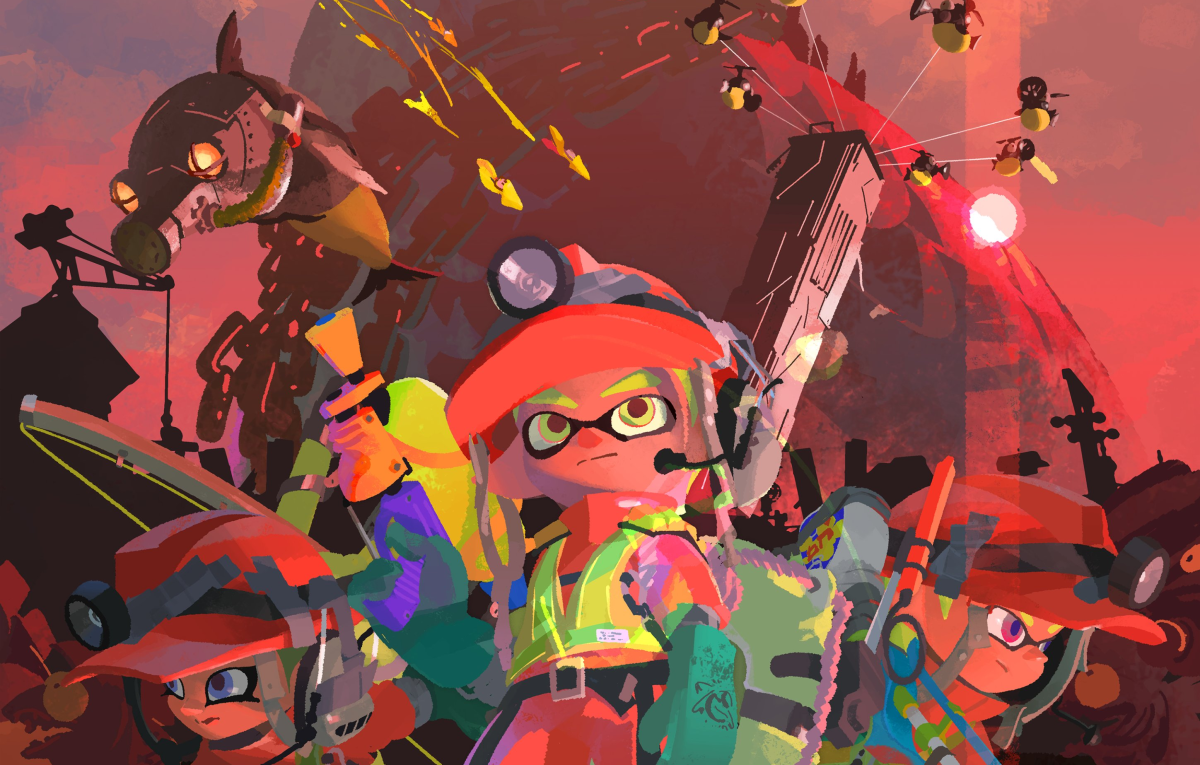
Got Splatoon on the brain, so that’s what I’m gonna talk about today. The game’s preeminent horde mode, added in Splatoon 2, and expanded in Splatoon 3, to be specific, Salmon Run. So essentially I adore Salmon Run, it’s some of the most fun I’ve had with a horde mode in a game, that is, a mode in which waves of enemies hound a team of players in hordes, as the players are tasked with holding them off. In Salmon Run, four plucky young squidkids and octoteens are on the clock to collect golden salmon eggs for their employer. Each run is divided into three waves of increasing difficulty, which can take a number of different forms at random. During each wave, hordes of minor salmonids of a small, medium, and large variety will hound the players, and occasionally larger ‘boss salmonids’ will appear. They are more dangerous and harder to take down, but each drop a number of golden salmon eggs, which then must be carried, one at a time per player, back to a centrally located basket to meet each wave’s quota of golden eggs. Fulfill that goal, and you progress to the next wave. I’m going to go over my perspective on the various elements that make Salmon Run work so damn well. It starts with the maps the game mode takes place on.

A Space Where Moments Happen

Salmon Run maps seem pretty simple on the surface. Smaller than Splatoon‘s versus maps, and usually approximately circle or square shaped. They all hold a few interesting features in common, though. For one, they all feature a large amount of elevation variation. This is important, as most salmonid cannot directly climb walls like players can, and thus will have to path around and through the level’s various ground passages. That’s important too, those passages. The heavily varied elevations create a lot of corridors and enclosed spaces. These enclosed spaces can lead to players getting trapped with enemies, in dangerous situations. That’s the point, Salmon Run maps tend to be less open to facilitate this up-close encounters, to really engage the players with how their enemies move and operate. Strategy becomes essential to keep yourself from being cornered. All this creates exciting ‘Moments’ of high action, that keep Salmon Run interesting.

Speaking of being cornered. Ever notice how all the Salmon Run maps are similarly shaped? Specifically I mean, if we are to assume they are basically the shape of a square, then three of their ‘sides’ are always exposed to the water, where salmonid always spawn from. The fourth side, is not.
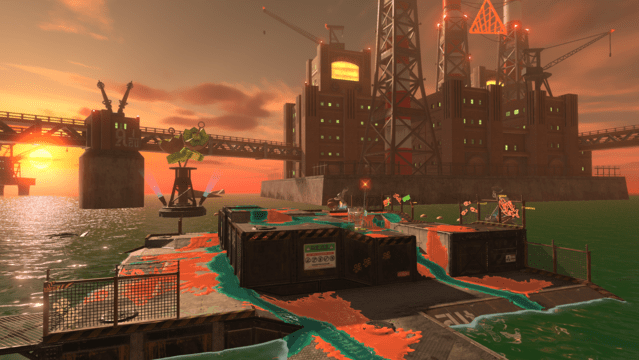
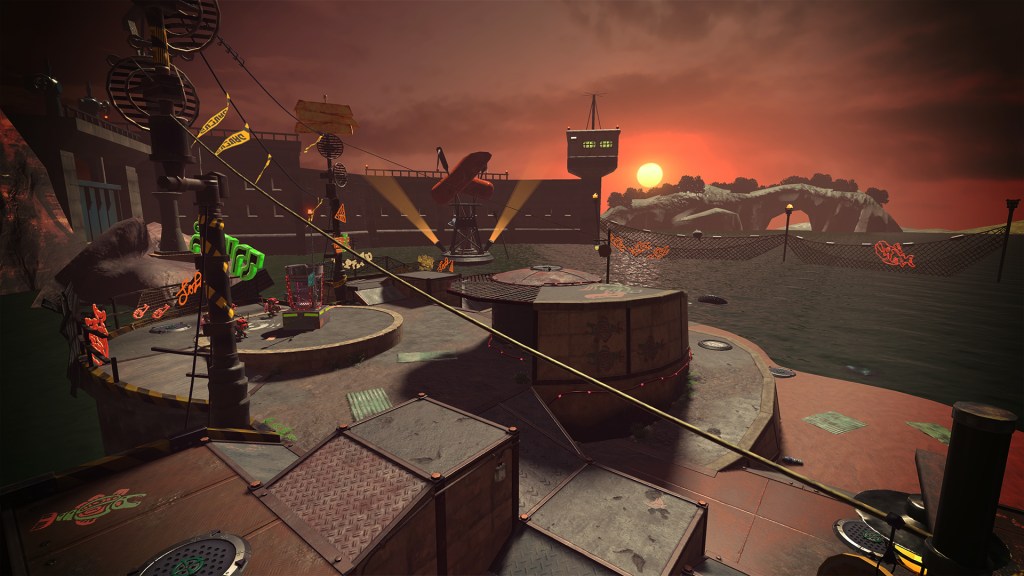
This will cause salmonid, again always approaching from the beachheads, to surround players as they navigate, but never directly from behind, as that would feel unfair. So the minor salmonids; tiny small fry, player-sized chums, and larger imposing cohawks, all walk toward players at a moderate speed, usually in lines and clumps, then try to melee attack. The damage dealt by each, and the damage each can incur before being dispatched is proportional to their size. It might be one’s inclination to largely ignore the unruly masses and focus solely on bosses, but this would be a mistake, especially as that aforementioned difficulty scale begins to skyrocket. There is one wall for players to back up against in the face of the coming forces, but they also must keep an eye out for flankers, constantly. peripheral attention becomes essential. Reacting for flanks is another of these exciting ‘Moments’. Waves of high danger follow waves of control, forming Salmon Run’s interest curve.

Game is Hard

So one thing that a cooperative experience like Salmon Run needs is longevity – something for players to latch onto so they keep coming back. One way Salmon Run achieves this is through an adaptive difficulty system. Based on how frequently a player is winning at Salmon Run, an invisible difficulty scale will begin to go up for them. Higher difficulty scales mean more frequent salmon spawns, and higher egg quotas. The higher scales demand more and more efficiency of the players.

So, cleverly, Salmon Run starts out very forgiving, allowing players of any skill level to begin to succeed and claim their rewards for the game mode. What I find commendable is how unrestrained the upper echelons of this scale is. A lot of the fun of horde mode comes from the horde- tons and tons of enemies coming at you all at once. Through grit and determination, you can overcome.
An octopus girl is surrounded by fireflies as she picks up a golden egg with a net. She swims through blue ink to escape a frenzied mosh pit of enraged salmon, who flail at her with frying pans. She swims frantically away.
More like Salmon RUUUUUUUUUUN

Salmon Run also includes a lot of wrinkles and surprises, such as the special event waves, where the rules of the game are tweaked slightly. For example, high tide might shrink the play area, making the next round very claustrophobic. What is all this for, then? Well, like the level design which emphasizes situation awareness, every aspect of Salmon Run from its maps, to its enemies and bosses reinforces specific fundamental skills in the Splatoon player’s toolkit. Players are randomly assigned weapons they are forced to use, reinforcing general adaptability and understanding of the game’s mechanics. The maps are laid out to reinforce situational awareness and navigation skills. Specific bosses reinforce specific weapon-handing skills. As the game’s difficulty ramps up, so does the speed of the game, and the skills needed for mastery are further and more rapidly drilled into the player.

Entity Cramming

“Entity Cramming” is a term originating from Minecraft, a game which allows a very large number of entities like players, enemies, and animals to coexist in a very small space. Salmon Runs can get very cramped, very fast. Especially at higher difficulties with very high spawn rates, or during high tide, at which the viable play space shrinks. There is a need to combat the problem of overpopulation in a small space, to keep the game running smoothly and feeling fair. A lot of salmonid bosses possess some way to impede player movements or player attacks, or both. Even beyond that, with too many enemies present, it would become unfeasible for four meager squids to fight back, which would create an overwhelming and unfair disadvantage for the minor mistake of acting just a little too slow or inefficiently. There’s also the random chance that bosses might occupy the same relative space.

To combat this, salmonid bosses represent an inherent risk-reward factor. With many of them bunched up, there is great risk to approach them, but many slamonid bosses represent an opportunity to clear wide swathes of salmon all at once. There are bomb salmonid, for example, which explode and deal damage to their allies when defeated. When enemies are bunched up, players with wide-reaching area-affecting weapons can take out multiple of them at once. All bosses explode into friendly ink, which is toxic to some salmonid. The new Slammin’ Lid boss, added in Splatoon 3, will utterly crush any salmonid beneath it, bosses included, if it is goaded to use its slam attack.
An octopus-girl in a slopsuit approaches a green UFO piloted by a fish. The UFO hangs over two giant fish with bombs strapped to their heads. The UFO flashes, them falls directly onto the giant fish like a rapid hydraulic press, crushing them utterly into an explosion of orange ink.
Good Cod that is satisfying

So with this built-in risk-reward for salmonid bosses, it’s never too daunting when they team up. With a clever and careful approach, bosses can be used as weapons to take out other bosses! So while difficulty scaling leads to huge hordes of enemies, it also creates this rubber-banding effect where huge hordes of enemies can actual mean an increase in overall efficiency, where you’re dispatching two or three bosses at once, along with their smaller minions, rather than just one. At high levels of play, golden egg collection can skyrocket to huge profits.

Teamwork Teamwork Teamwork!

The real key to excelling at Salmon Run is efficiency, and efficiency is teamwork. It is virtually impossible to accomplish some of this game mode’s higher-end challenges without utter mastery and knowledge of your role on the team. The randomly assigned weapons ensure each player accels and struggles with some specific task. Long ranged precision weapons can take out unshield bosses from a distance with ease. Heavier wide-area weapons can dispatch crowds of small salmonid *much* faster that snipers can. Some weapons can defeat salmon from safety whereas others have to get up close and personal.

Later on efficiency becomes to important, that if you are ever swimming around with a full tank of ink ammunition, you are kind of a liability. My advice to ace Salmon Run? Always be doing something, whether its clearing small enemies or ferrying eggs. Rescue teammates as quickly as possible – four sets of hands outperform two or three. Everyone has a role to fill, even if that role is just moving eggs around, because you’re weapon is ill-suited to the current event wave. In Splatoon 3, a new event wave called the Tornado was implemented to highlight this. Large quantities of eggs spawn far away from the basket, so the four players must form an assembly line of sorts to taxi them across enemy territory. Kind of reflects the rough work environments that the game uses as its horde mode backdrop, huh? In fact, there’s a lot of parallels to game development in general..
An octopus girl in a slopsuit swims back and forth across blue ink, each time grabbing a golden salmon egg in a net, and hurling it up a ledge to a friendly squid kid, to whom it is handed off.
Pictured: The Production Pipeline

The Main Event: The Bosses

The bosses in Salmon Run are fun, inventive, visually creative, goofy, funny, and irresistibly compelling. They all fill specialized niches in the gameplay, and each reinforce a skill for the player. They all have specific rules for how best to deal with them. There’s a lot, so I’m going to rapid-fire-style review them in a series of mini boss breakdowns and see how they fit into this scheme, with a little more detail given on the new bosses added to Splatoon 3‘s Salmon Run.

Steelheads are giant salmon with bombs in their heads. They arm the bombs for a moment, then throw them as a player approaches. They teach precision aiming, as their weak point bobs about while it’s vulnerable. They also reinforce reactiveness to bombs and ground hazards – a common danger in Splatoon.

Steel Eels demand the skill of tracking moving targets, their weak point constantly on the move, and occasionally blocked by their own shield-like bodies. Terrain navigation is crucial here too, as getting sandwiched by one against another enemy or wall means death.

Scrappers, or Jalopies, as I like to call them, teach the skill of flanking. They always turn to face attacking players, and they are shielded from the front. Using teamwork, one player can distract or stun from the front as they other takes them out. This is one of the ‘kiteable’ bosses, which can be lured by the player to be very close to the basket when they die, leaving eggs right there. Retrieving golden eggs past salmonid enemy lines

Stingers are of a class of salmonid bosses I call ‘globals’, as they can damage players from anywhere on the map. Stingers use a long-range beam unimpeded by terrain. Stingers teach players a hierarchy of needs for the game. It’s near-impossible to kill every enemy as they spawn. Just reaching your egg quota and surviving is paramount. You have to triage your attention to what’s most important. Stingers are important. You’re excelling when you put out fires before they happen, and addressing Stingers quickly is a good example.

Maws can also be kited to the basket for easy eggs. They teach how to swim away while placing a bomb, which generally kills them. A surprisingly practical skill, as bombs cost a lot of ink, but swimming replenishes it. Efficient!

Drizzlers are a global salmon which create damaging rain that also ruins friendly turf. They teach lining up shots, and maintaining relative positions between player and enemy, as they are most easily dispatched by deflecting their projectile back at them. Lining this up is strict, to aim well!

Flyfish. Ooooh Flyfish. Perhaps most infamous of all salmonid. They are hovering mobile missile vehicles which periodically fire squid-seeking missiles at players who must be moving to avoid them. This is global. They are easily one of the most dangerous bosses to keep alive, so a great marker of Salmon Run mastery has become one’s ability to safely and efficiently take them out. Taking them out quick is a true marker of friendship between allies. They teach precision use of the grenade sub-weapon, as you must land a grenade in its open missile launchers after it fires. Twice. Once for each launcher. It also teaches patience, and the truth of your own mortality.
An octopus girl in a slopsuit swims through green ink to throw a grenade into the open missile launcher of a hovercraft being piloted by a salmon, just as its second missile launcher as been destroyed in a similar way by a friendly squid kid nearby.
Any man who can one-cycle a flyfish with me, I would trust with the life of my child.

The Slammin’ Lids (god I love that name) are one of two new Salmonid that seem to be purposed to teach one of the two new movement options in Splatoon 3. The lids are easiest to kill by baiting out their slam attack, then mounting them while they’re on the ground, to kill the pilot. The easiest way to do that, is by using the new Squid Roll, which allows rapid turning while swimming through ink. They are also one of the best example of the entity cramming solutions in Salmon Run, as I’d shown earlier. Their main threat is the impenetrable shield they produce beneath themselves, which can obscure lines of fire while they pump out small salmonid to shore up the enemy forces. They aren’t high-priority targets, but can become dangerous if they take up advantageous positions.

The Fish Stick is a toward carries by a rotating contingent of salmon. The stick is easily dispatched using the new Squid Surge, which allows one to rapidly ascend a vertical surface. The Fish Stick fills a new niche in the game mode, which is the use of the player’s wall-scaling abilities, and introduces an enemy that is itself terrain that can be inked. What’s really interesting is that the Fish Stick’s terrain remains in play even after it’s defeated and its eggs are retrieved, opening new strategic options for players. This can be a double edges stick though, as while the extreme vantage is usually safe, some salmon like the maws or dreaded fly fish can use its small surface area to trap players.

The Flip Flapper is a salmon dressed like a dolphin which drops rings of enemy ink where it is about to dive. Filling in this ink with friendly colors before it lands, stuns it and renders it vulnerable. I love this thing because it teaches the teamwork of efficient ink coverage. Nothing worse than teammates who waste time inking something you’ve already inked. Working together, these dolphin wannabes are no challenge, but they also serve Entity Cramming well, as they are very weak to the splatter from other enemies nearby being killed.

Big Shots are tough guys with lots of health that stay on the sidelines. I think what these guys are meant to teach is how the AI operates and reacts to player movement. You see, the Big Shot is a global who uses a machine at the beach to launch wave-generating projectiles toward the basket. Very inconvenient. What is, convenient, though is that the player can use the same device to launch golden eggs toward the basket. Toward, not in, mind you. Another player still has to be there to cash the eggs. If they don’t, salmonid will come in and snatch them up, making the players’ efforts a waste of time. What’s more, is that spending too much time on the beach, which I might remind you is where salmonid come from, can mean quickly becoming overrun by enemies, and trapping you in a place which is very dangerous and inconvenient to reach. Teaches teamwork and restraint.
And octopus girl holding a bathtub uses it to throw green bubbles at a giant salmon on the beach below who is fiddling with a wood-chipper like machine, and is then exploded into green ink. An allied squidkid below loads a golden egg into the machine, which is then launched across the field of view.
Couldn’t have gotten better footage of that egg being thrown by the Big Shot if I’d planned it

There are a few more event-specific bosses, but that was a lot, I think, so we’ll leave it at that.

EMERGENCY!
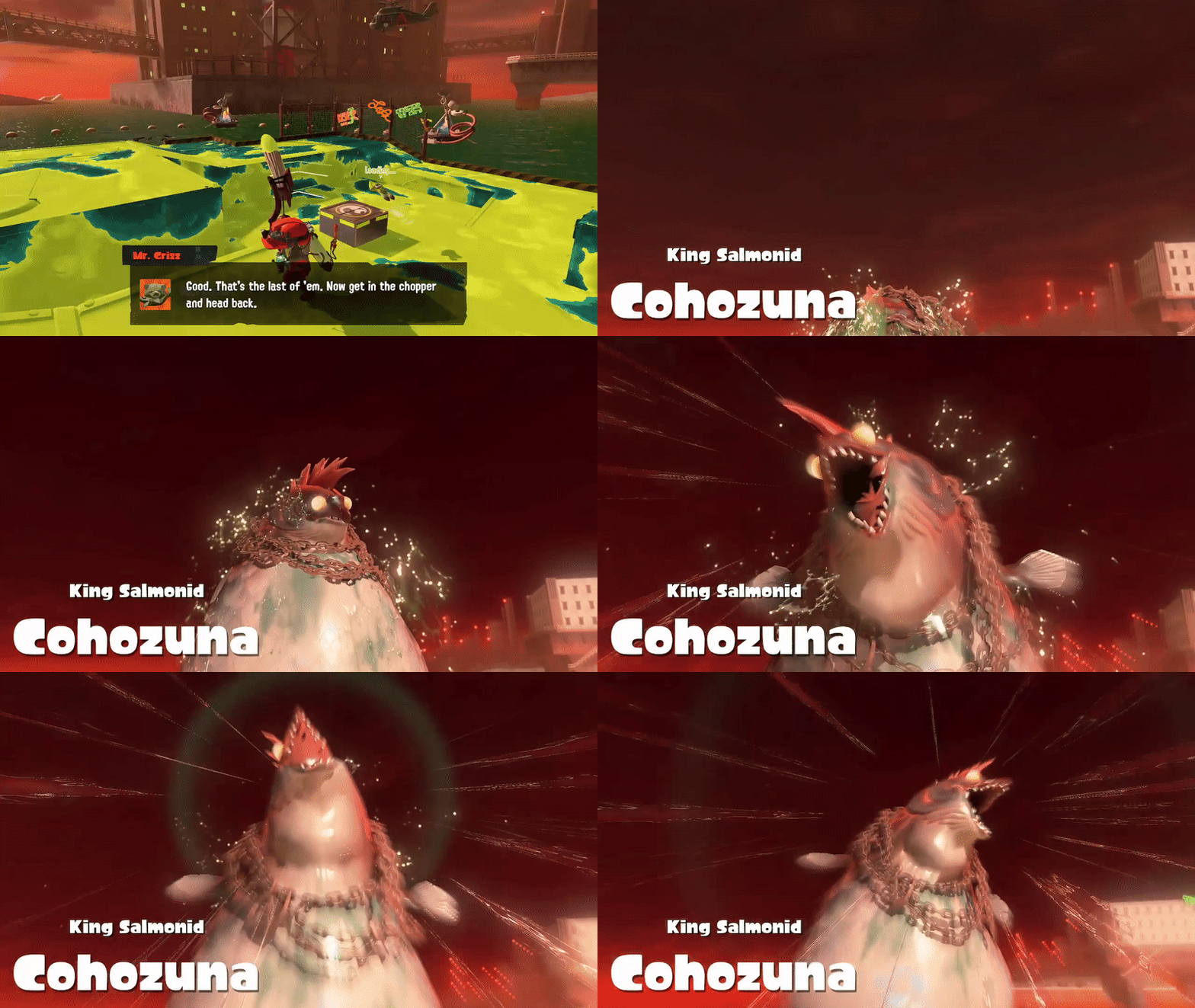
Octo-girls and squidkids are celebrating, only.. "EMERGENCY!" appears in orange text. Suddenly, a GIANT, like 30-60 foot tall salmon appears, and roars like godzilla. "King Salmond Cohozuna" appears in white text.

JUST KIDDING! They couldn’t have a sequel without upping the ante a little, right. At (slight) random, after winning a few Salmon Runs, the new King Salmonid Cohozuna will appear. You have a mere 100 seconds to send him back to the briny deep in order to secure the special fish scale rewards he provides. Really, there isn’t much to him or his AI beyond standing as a suitable final challenge to really test the player’s mastery over all these bosses and systems. His implementation is pretty clever, though.

He has a LOT of health, so normal weapons will simply not do enough damage to vanquish him on their own, not in the time allotted. To beat him, you’ll have to leverage golden eggs, which can, in this bonus boss round, be thrown with zero ammunition cost. They deal massive damage to him, and the only way to get them remains the same: defeat the boss salmonid that accompany him. You’ve only got 100 seconds, your team, one special weapon, and the ink your back, so I hope you’ve been practicing your aim and reaction time.

He seems to prefer to follow the last player who damaged him, so he can be tanked somewhat. He’s not that dangerous on his own. He’s slow, and only has two real attacks. One where he belly flops right in front of him – so keep somewhat at a distance. His other is a jump, which does heavy damage where he lands. Be ready to move. Other than that, it’s his health and his bulk that is the challenge. The team needs to work together to get enough eggs to bring him down, while positioning him such that he is not a threat to the team, and such that he is not covering vital resources with his body. It’s a stiff challenge, but if you really push your self and put a full understanding of all the little things Salmon Run has been teaching you, it’s very doable. A suitable finale to any work day.

A giant 30-foot-tall salmon flops toward an octopus girl wielding a an automatic ink-gun. He is being pelted from the sides by golden projectiles. He turns around, then bursts into green ink in a fantastic explosion. A squidkid declares "Booyah!" as the four cephalopod teammates, now friends, celebrate.
That’s teamwork!

The Cohonclusion

Where. That felt like a gauntlet. We all get through okay? Yeah so I love Salmon Run, to reiterate. It’s got so many little clever design considerations to acutely tune the experience and promote active thinking while playing. Sure, it’s great fun to goof around in with friends, but even at a casual level, enough exposure to the game mode will gradually train certain behaviors that make you better at it. I think that’s a sign of some absolutely excellent game design, that deep consideration of incentives and how minor tweaks to Splatoon‘s gameplay setup will reinforce certain behaviors. Salmon Run is also just where some of Splatoon‘s considerable creativity comes to the fore. I mean “Slammin’ Lid”? An eel made of shower heads that forms an impenetrable wall of showering ink? A mothership that is a warehouse container full of smaller crates that deploy salmon? Come on. This stuff is gold.
An octopus girl swims across orange and green into into a torrent of orange produced by  allied weapons. She is showered with golden eggs as salmon burst around her. She grabs one and throws it into a large basket.

DO YOUR JOB!
Thoughts on Multiversus: Sticking Out In Well-Explored Territory

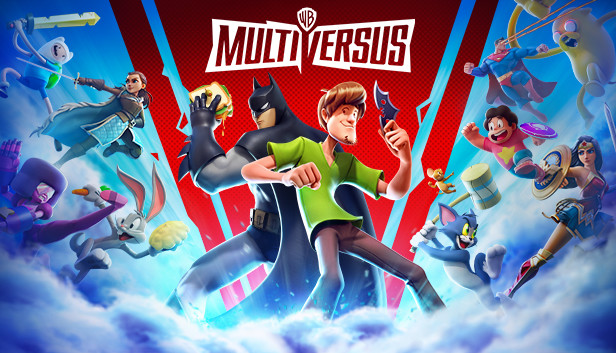
I’ve spent a few hours playing Warner Brothers’ answer to Nintendo’s Super Smash Bros. this week. Yeah, Warner Brothers. Seemingly also an answer to, uh, I guess Viacom’s Nickelodeon All-Star Brawl. (MultiVersus developed by Player First Games and Nickelodeon All-Star Brawl developed by Fair Play Labs and Ludosity). It’s funny video games’ premiere crossover game has met its competition lately from the television and film industry. Or maybe not quite competition. I’ve had a lot of fun playing MultiVersus, and it definitely gives me some of the same chaotic, good vibes of a good Smash Bros. session, but it also feels distinct in some key ways. MultiVersus has been pulling some impressive concurrent player numbers and seems to have drawn a great deal of positive attention. I think there’s a lot of interesting stuff going on here, so these are more or less my first impressions and initial thoughts on the matter.

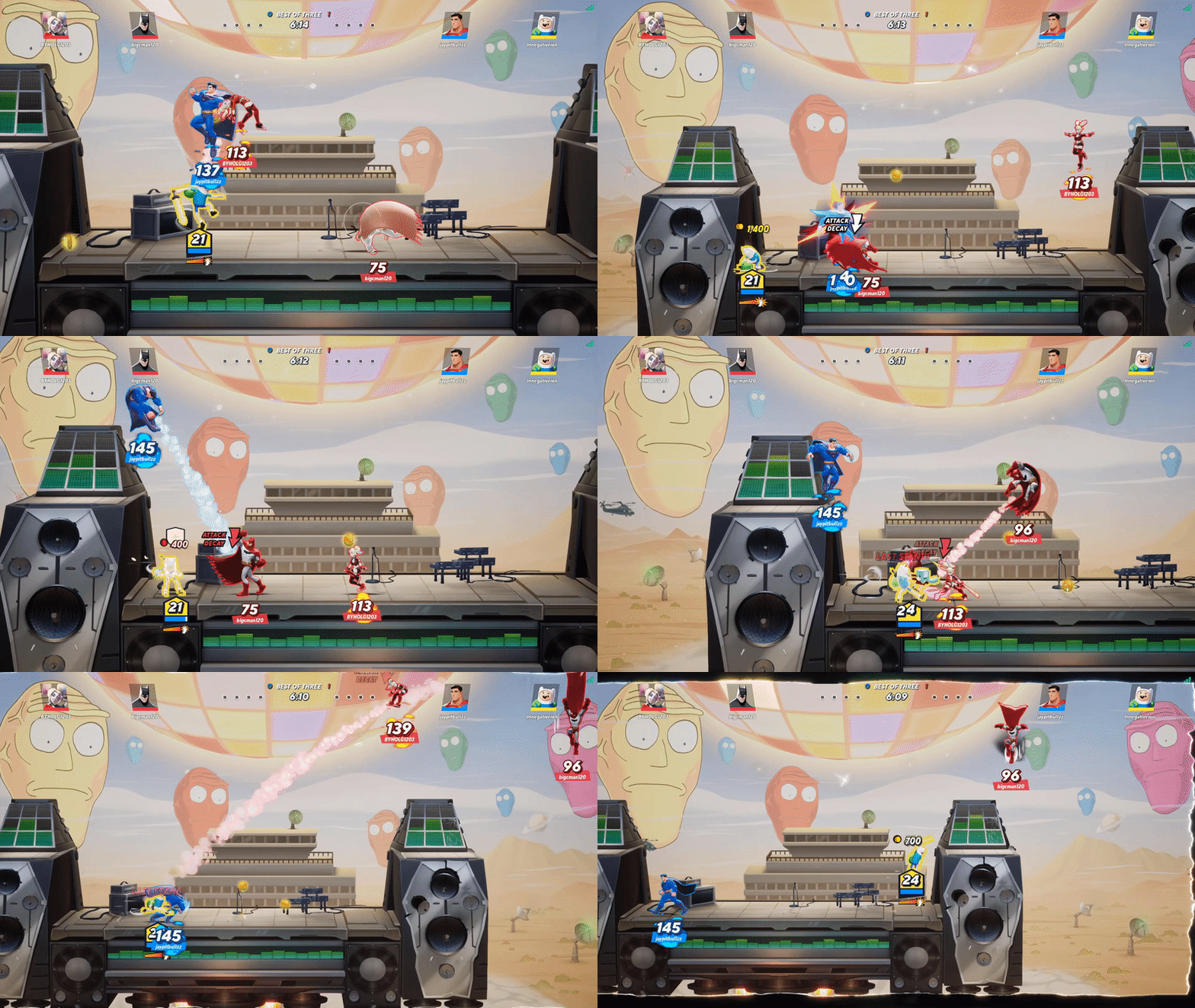
Finn and Superman team up to fight Batman and Harley Quinn on a concert stage from the show Rick and Morty
Ah yes, the classic matchup. Superman, Batman… Harley Quinn… and Finn The Human from Adventure Time

Drawing People In

I think of lot of MultiVersus‘s initial success can be attributed to some very savvy distribution and marketing decisions on their part. The game dropped with an absolutely delightful fully animated short featuring some of the more surprising inclusions to the game. Fighting games are complicated beasts, and as crucial as their nuances may seem to the enthusiast and designer, it’s often the case that an audience is found by virtue of aesthetics or indeed, character roster. Smash Bros. has earned its reputation as mechanically deep and irrepressibly fun to play, but lots of games are like that – Smash is so huge because it has a singularly unmatched roster of characters. The absurdity of Arya Stark defending Bugs Bunny from a batarang may be matched only by the absurdity of the Iron Giant rolling up alongside actual Superman. MultiVersus starts strong with a trailer that features a great deal of the character roster, including surprising editions with devoted pre-baked fanbases, in out-there abnormal team-ups and head-to-heads.

The aesthetic of this game is just appealing too. Not too fancy on graphical fidelity, but the game has a soft, round, inviting look to it and all of its characters. The models are animated well and look quite appealing from the middle-distance a player is going to seem them in the heat of battle. The inclusion of not just voice acting, but the legitimate, genuine article original voices for much of the cast is a huge appeal for me personally. As much passion as Nickelodeon All Star Brawl clearly had, I struggled to maintain an interest in the game when it was eerily silent, without the iconic voices that helped make its cartoon fighting cast stars in the first place. Their post-launched inclusion in an update was much appreciated, but the production values of that game, likely on the basis of budget, simply don’t compare to the push Warner Bros. has clearly given to the development of MultiVersus, financially speaking.

Maybe it’s not that surprising that TV and film companies see opportunity in the crossover fighter space. Original characters, regrettably, just don’t have the kind of draw that legacy characters do for a genre like platform fighter, that has traditionally only maintained a few active games. Even then, Smash is arguably the only one that’s achieved mainstream appeal. When Sony last challenged the throne with PlayStation All-Stars Battle Royale in 2012, they struggled to populate the game’s roster with characters that are as instantly marketable as Superman, Batman, Bugs, Adventure Time‘s Jake The Dog, Tom and Jerry, and, uh, Lebron James. Warner Bros., obviously, owns a lot of properties, so they’ve got an inherent edge in that marketability by way of character roster. Selling on the merits of your character roster is essentially selling on the merits of your game’s possibility for play. When someone sees the Iron Giant – it primes their imagination for what is possible in your game, because even if you don’t know the Iron Giant, he’s a big terrifying metal man with jet boosters. It gets a potential audience excited in a way the presence of something more abstract like a “wave dash” never could. Not that mechanics are unimportant to retaining your audience, but more on that later.

The Iron Giant, a massive robot, picks up and throws Shaggy from Scoobie Doo, before jumping on him in a grid-lined empty arena.
I always knew shaggy could totally take The Iron Giant in a fight. Now I can prove it.

Next to consider, the game is free. Now I have a lot of personal issues with some of the particulars of the game’s monetization strategy, but it cannot be denied that playing the game, at bare minimum, costs not a penny. That’s something MultiVersus has over its contemporaries and seems a natural fit for fighting games. Free-to-play gained a lot of notoriety among business types for its wild success on behalf of games like League of Legends, games about battling between champions chosen from a huge roster of distinct characters sporting unique abilities. A high-skill-ceiling game that rewards intimate knowledge of the game’s intricacies, experimentation with multiple characters, and an understanding of how all the different characters interact. Yeah, a fighting game also seems a good fit.

Finally, with modern netcode and full cross-platform play support, MultiVersus has a refreshingly smooth online experience. For all of its popularity and quality in other areas, Smash Bros. has never been able to say that for itself. I cannot understate how delightful it is to be able to install a game on multiple platforms, pick it up where and when I choose, carrying all of my game progress between machines, and play with any of my friends who are all using their preferred devices. It really makes online games without this feature feel… a little archaic. Honestly, this is the form online gaming always should’ve taken since its inception.

“Platform Fighting Games”

With all that tertiary stuff going for it, it’s no wonder MutiVersus has retained such a player base and media presence in the last few days. People are loving it. A game can’t be carried by media presence alone though and I can confirm that the game is, indeed, fun to play. MultiVersus is a “platform fighting game” like Smash Bros. before it. Smash is certainly the most famous and successful of these, but there have been more platform fighting games than you might think. In addition to the recent Nickelodeon, there’s been a number of indie games following the formula like Brawlhala and Rivals of Aether, and also weird stuff you might’ve never heard of like DreamMix TV World Fighters, developed by Bitstep and published by Hudson, a crossover fighting game featuring the likes of Bomberman and Optimus Prime. Really.

I think one reason platform fighting games haven’t had the same presence as traditional fighters like Street Fighter or Dragon Ball FighterZ, despite one of the genre’s advantages being its beginner-friendly nature, is the ever-present shadow of Super Smash Bros. No other platform fighter has been near as successful as of now, to the point that “platform fighters” were once “smash clones” much as first-person shooters started their history as “doom clones”. But, as with Doom I think there’s been a period of experimentation with with these Smash Bros. off-shoots that have tested the water of what can be done to distinguish oneself from Smash while remaining familiar enough to draw in the players looking for platform fighting games. How much do you change? How much do you keep? Player First Games’ answer? Not too much, but just enough.

Platform fighting games are by nature more beginner friendly than the traditional variety of fighting game, with a greater degree of freedom of movement baked-in, and less reliance on complex minimally-visible mechanics. Multiversus well leans into this strength, even in some ways better than Smash. For example there are much more robust control customization features, allowing you to do things like separating combo moves and charged moves to two different buttons, or swapping what moves are mapped to neutral button presses and directional button presses, among others. Movesets are somewhat limited, even, which could potentially be a mark against it for some, but really does make the game simple to pickup and play. I’d go as far to call it somewhat button-mashy. You may find success just throwing attacks out there. I think there’s some depth to be found here though, the game seems much more naturally suited combo strings that Smash, allowing plays to intuitively juggle their opponents and give chase. And although things can get a little chaotic and hard to read, the action does remain readable if you concentrate, I’ve found, and just a little getting used to if you’re coming from Smash.

There’s a lot familiar here to platform fighter veterans. Characters have their standard attacks, which change depending on directional input, as well as four special attacks likewise influenced by direction. Taking damage makes you more vulnerable to being launched by enemy attacks, and getting launched past the game’s boundaries results in a KO. The ringout KO with ramping knockback from damage is one of Smash’s most elegant inventions, I think. It’s such a natural fit for a fighting game with platforming because it makes one thinking about their standing position within space. Most fighting games exist on an abstract flat plane, with implied impenetrable barriers on either side. The terrain is not a concern there. In platform fighters, where the player’s relationship to the terrain is as important as their relationship to their opponent, a win condition involving the ejection of your opponent from the terrain is brilliant. Some other platform fighters like PlayStation All-Stars Battle Royale have had win conditions that just did not work for me, because they de-emphasized this player relationship to the battle arena in a way that made the platforming capabilities of the characters feel somewhat redundant. MultiVersus knows what to crib from its contemporaries.

Finn the human teams up with Superman to fight Batman and Harley Quinn on a floating concert stage from the show Rick and Morty. Finn digs BMO the living calculator from his backpack, then holds BMO up as he karate chops Batman and Harley Quinn into the distance.
Finn’s down-special operates like a simpler version of Hero’s from Smash

It’s also a little different though. Weird and unique decisions like giving Finn the Human from Adventure Time the ability to charge his attacks while moving keep the game fresh. Most characters have such small interesting unique mechanics, in addition to bigger and noticeable ones. On a broader scale, this game has some intense aerial mobility. Every character practically plays like Sora from Super Smash Bros. Ultimate, flowing nimbly through the air at high speeds. In Smash, players are allowed two jumps and a recovery attack to stop themselves from falling off the arena. In MutliVersus, you can use a recovery twice, air-dodge twice, then climb up an vertical surface. They really didn’t want people falling off the stage by accident. In free-for-all mode, the edges of the play area draw in, making the safe ground smaller when the round’s timer nears its end. It’s a pretty elegant way to prevent camping, an often reviled somewhat bad-faith way of playing, which I think is quite clever, especially in a ‘just for fun’ party mode like free-for-all. I always appreciate fighting games that encourage engaging the enemy and utilizing the fighting mechanics, rather than just turtling up or running away.

Another unique and rather clever angle the game has is that it’s 2v2 focused. Now this is a mechanic that I think does come across somewhat in building your initial audience, because it has such an overriding effect on the game’s design and, like the character roster, is something that can spark a general audience’s imagination. Some people play games for the experience of being a support role for their friends. These people, I’d say, are less likely to play traditional fighting games, but the presence of characters with a support-specific focus like Wonder Woman or Reindog might be appealing to them. You can really feel the way the game wants to encourage team-play too. The presence of cooldowns, a rarity in Smash Bros., encourages teams coordinating their available resources and the timing of their most valuable moves. Having support roles in a fighting games allows MultiVersus to do things that Smash simply doesn’t, carving its own niche.

Superman and Finn The Human from Adventure Time team up to fight with Wonder Woman and Steven Universe. Superman's ice breath slows so Finn can followup, and Stephen creates a barrier with his shield for Wonder Woman.
Superman’s ice breath slows so Finn can followup, and Stephen creates a barrier with his shield for Wonder Woman

The game also just makes some design decisions for their fighters that just seems very… not Smash, not necessarily in a bad way. Smash is far from creatively stifled but it does have a little bit of a brand, and that’s fine. It’s nice to see its contemporaries establish their own brand though! Some of the wacky stuff characters can do feel like things Smash didn’t really start doing until the later downloadable characters of Super Smash Bros. Ultimate. When I see the Iron Giant enormously stomping around the battlefield in MultiVersus I can’t help but think of the years hand-wringing online discourse had about the inclusion of “too big” space dragon Ridley from the Metroid series as a fighter in Smash. He got in anyway (and I will go to my grave being smug about that), but at quite a modest relative size. I love the depiction of Ridley in Smash, he’s practically perfect. Iron Giant though, I think is going to be a very memorable fighter in his own right, because the developers of MultiVersus feel so unrestrained by tradition, while respecting the foundations that were the inception of the genre they’re iterating on.
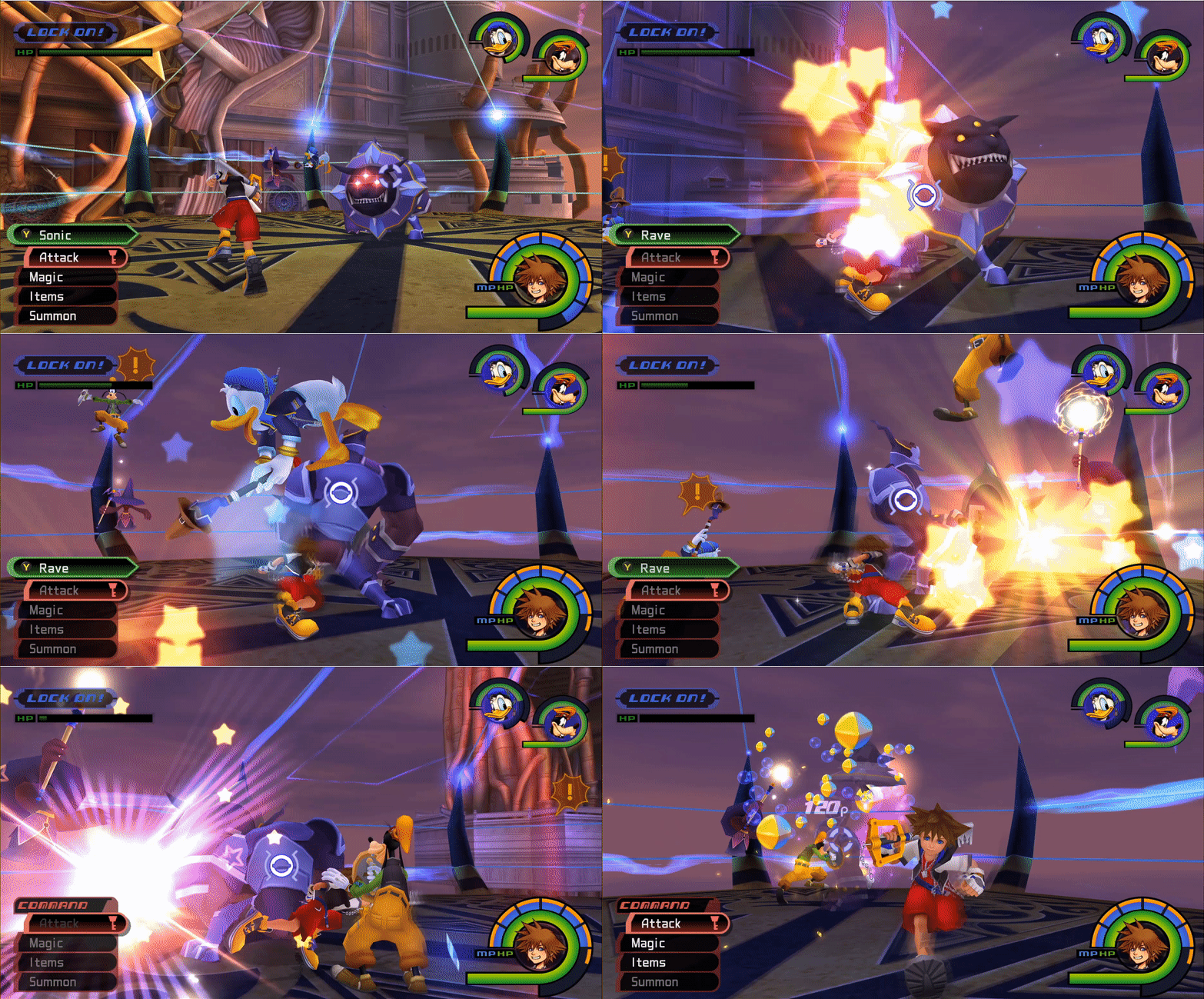
There’s a lot more to see and learn about MultiVersus. I’m sure there’s an encyclopedia’s worth of knowledge yet to be discovered about combo strings, frame data, tier lists, and other such silliness, but on first blush the game is a blast and is doing a commendable job of setting itself apart from obvious comparisons. It’s production values are exceptional, its roster is absolutely wild and it’s free… more or less. My issues with monetization are the biggest sticking point for me. I don’t know if I want to talk about that here, though. At any rate, I’ve had platform fighters on the brain and wanted to get my thoughts out there.

Two Finn(s) The Human, Batman, and Wonder Woman duke it out in a 2D bat-cave themed arena. The Finns slash their swords, Batman throws punches, and Wonder Woman bashes with her shield as gouts of steam erupt from the ground.

Mathematical!

How Sonic’s Spin Dash Got Iterated Out of Existence

I must admit I have a bit of a bee in my bonnet about Sonic The Hedgehog. That was a sentence. The three-dimensional variety Sonic in particular. It is a topic I could wax about for ages, especially in light of recent promotions for the, as of this writing, still upcoming Sonic Frontiers. Promotions which have given me some thoughts. One such thought was ‘they really still haven’t brought back the spin dash’. 

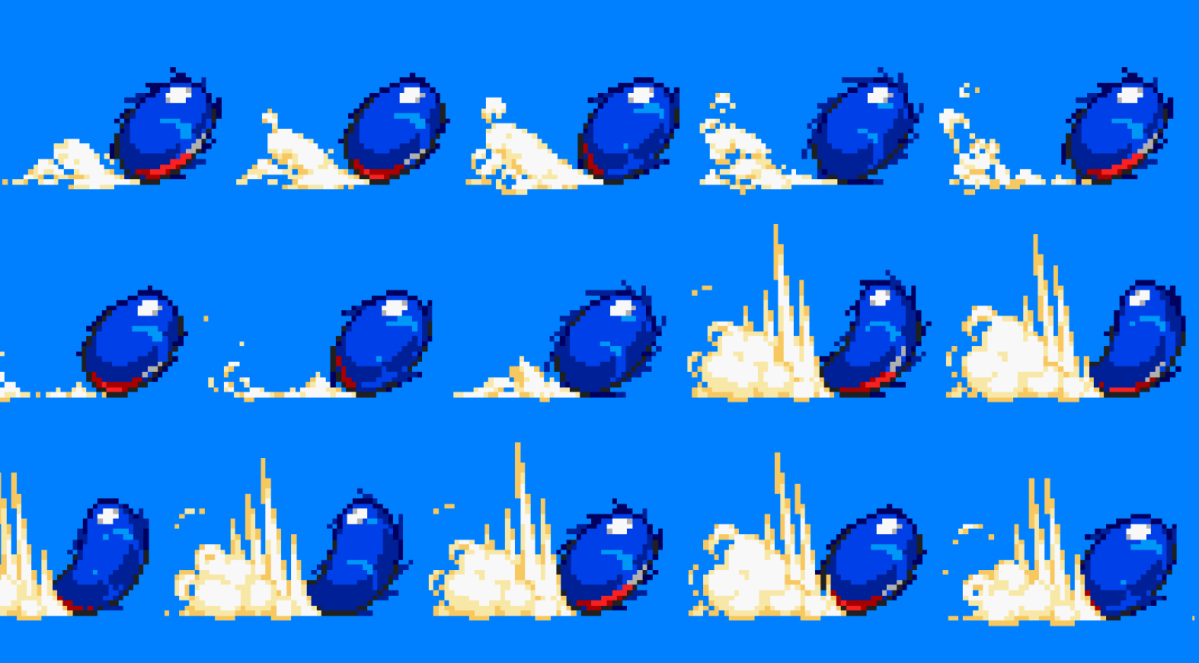
What is the spin dash? If you’ve ever heard of Sonic The Hedgehog you probably know, but it is a special move that Sonic can do by rolling into a ball and spinning to charge up energy, then launch himself real fast in one direction. Terribly simple, terribly elegant. 

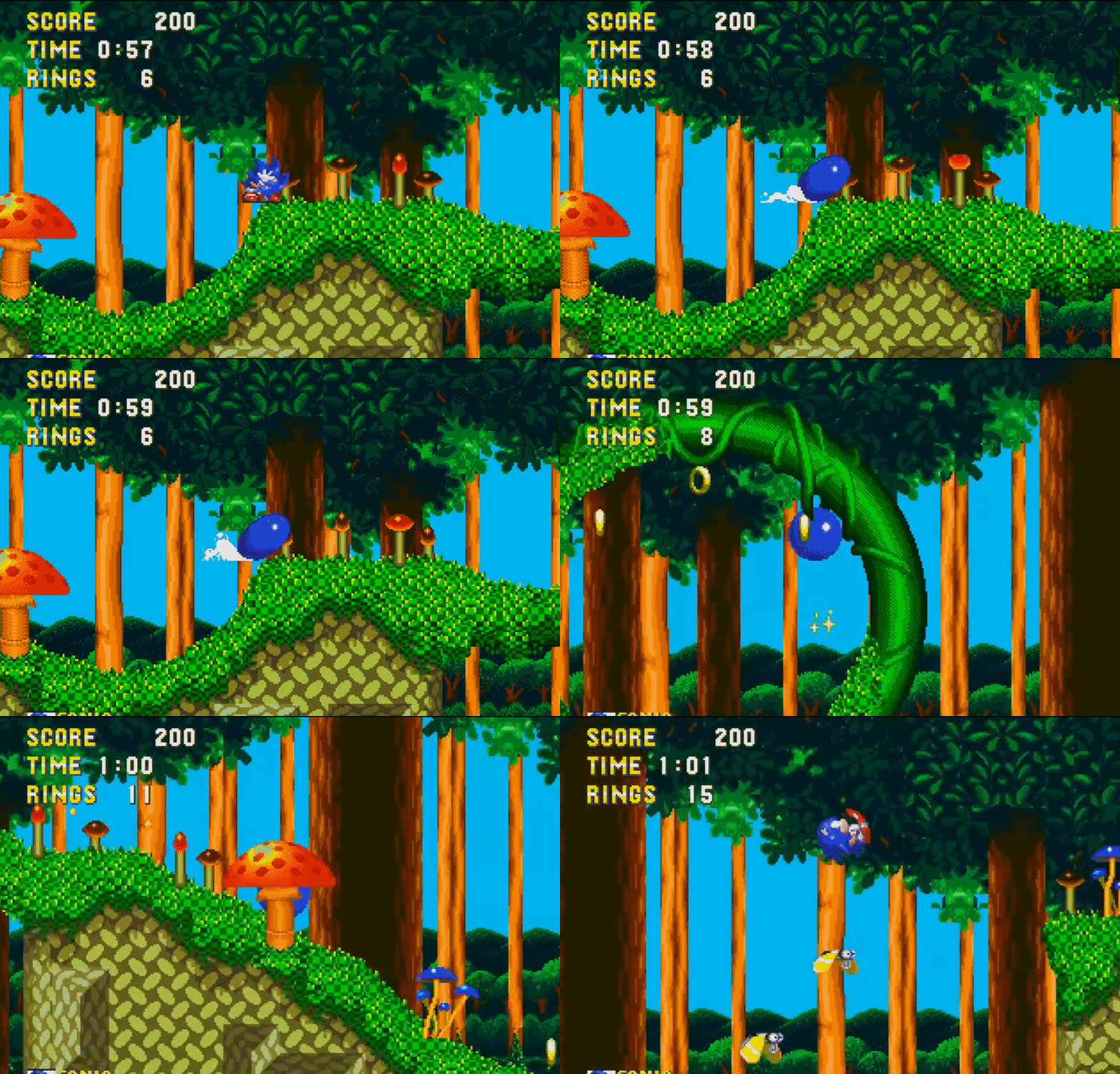
Sonic the Hedgehog from Sonic 3 rolls into a ball then blasts off at high-speed across a vine suspended in a lush green forest.
Spinning and Dashing from the beginning

One of the bottomless yawning abysms which haunt discourse around Sonic as a series of mechanical systems is what values, exactly, make the games fun, and which should be the focus in a given design system. ‘Momentum’ is a word that’s thrown around a lot, and I generally agree it’s an essential component to the gameplay formula of the blue hedgehog. Building momentum is an angle Sonic has explored a lot through his games, but I’d argue that from the beginning, Sonic Team has understood that maintaining momentum is a lot more interesting than building momentum. Sonic The Hedgehog for the Sega Genesis, the debut, introduces us to the spin dash. Titular super speedy player-controlled hedgehog, Sonic is able to roll up into a ball, spin rapidly in place like the wheel of a revving race car, then take off with near-instant acceleration to a great speed. In Super Mario Bros. 3 Mario has to run a good few seconds as the player holds down the dash button to reach top speed. This requires space, it requires time, it’s generally not something you can do on a dime. Sonic Team did not want Sonic crossing long stretches while not running at super speed. The super speed is the draw after all, it’s the fun part. Ideally, the player should be given methods to reach that state of fun as readily as possible if high-paced action is the goal. Even as the spin dash fell by the wayside this value never seemed to go away. The ‘boost formula’ games, as they’re called (Sonic Unleashed, Sonic Colors, Sonic Generations, Sonic Forces), none of which feature the spin dash in the same prominence as the older games, still feature a way to rapidly build speed to a maximum level, but more on that later. 

The spin dash is also a rather compelling bit of fiction. Sonic is a hedgehog, you may have heard, an animal known for rolling up into a ball to bear the quills on its back. Sonic is also super speedy, so combining these ideas creates the rather visually appealing idea of a character rolling up like a wheel in place and peeling out in a particular direction. Sonic isn’t the flash or quicksilver. He doesn’t just run fast, he rolls faster than fast. It’s one of his most distinguishing features. Mario jumps. Doom Guy shoots. Sonic rolls. The maneuver is so synonymous with Sonic that the promotional phrase “Sonic spin dashes onto the Nintendo Switch” preceded a trailer for a game in which Sonic cannot spin dash. 

Or at least, I assume the spin dash is absent. As of this writing Sonic Frontiers has not shown footage of such a feature, and the move hasn’t prominently featured in a 3D Sonic game in years. At the very least this suggests it’s not very central to gameplay. It wasn’t always this way. The classic 2D Sonic games practically built its levels around its use. One of the most versatile techniques it affords by virtue of being an on-demand burst of speed is jumping out of a dash to achieve a huge amount of air time. Similarly, spin-dashing up ramps can send Sonic to great heights he cannot otherwise reach. Secrets, alternate paths, and bonuses are all available this way. The spin dash has always been a tool of exploration. 

You can understand the confusion. You would think any Sonic game would prominently feature his best move. Abstractly, the spin dash is synonymous with not only Sonic but also the very act of play within the Sonic series, so foundational was it to the games’ very identity. It is like Mario’s ability to jump. Well, Sonic can jump, but likewise Mario has near-always had a dash mechanic. Nobody who scrutinizes the mechanics of games would mistake a Mario Jump™ for Sonic’s though, and likewise you could never mistake Mario’s dash for a spin dash. 

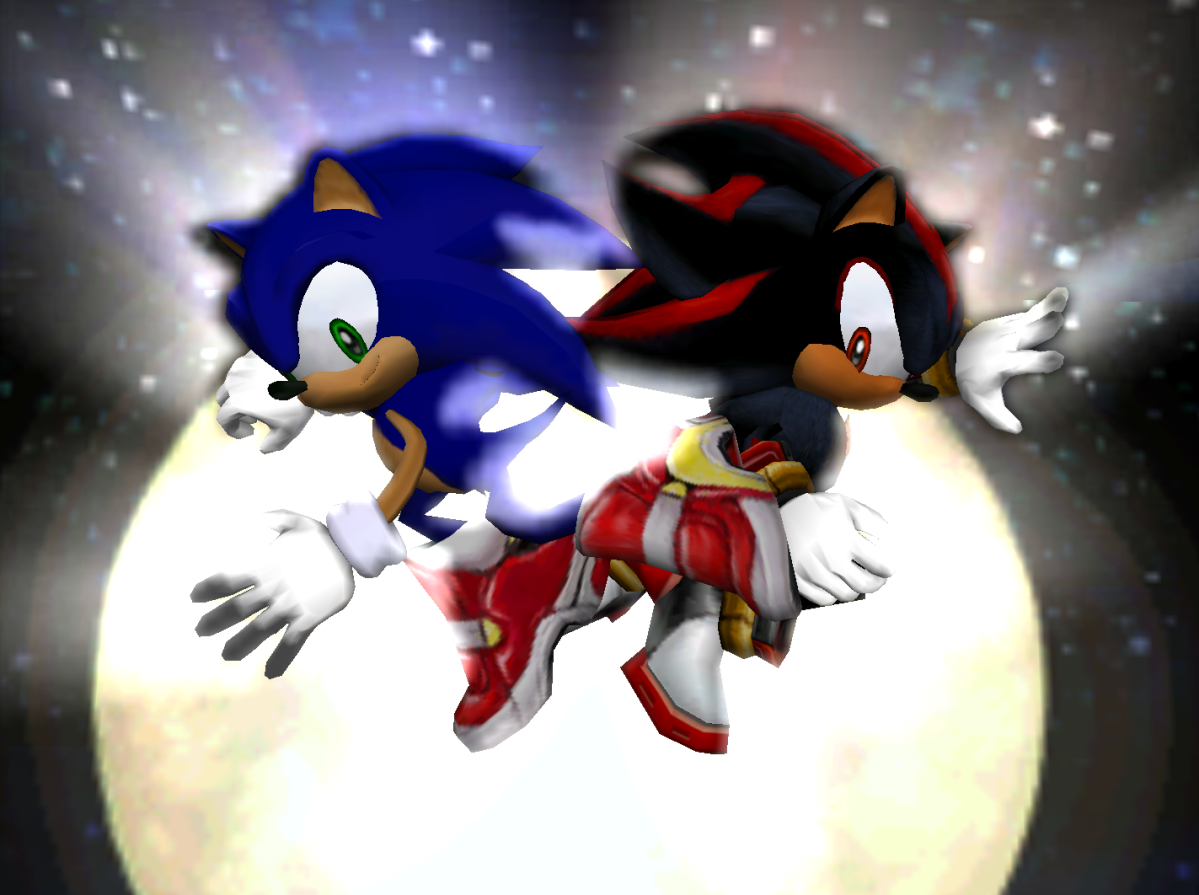
Sonic the Hedgehog from Sonic Adventure 2
Gosh I miss it here.

Sonic’s first 3D games leaned into this angle. Jumping out of a spin dash remains a viable and valuable way to navigate levels in interesting and unconventional ways, really embodying the idea that Sonic can go anywhere. Not only that, but 3D adds the wrinkle of allowing the player to precisely plan where Sonic is going to be catapulted. During a spin dash’s charge time, Sonic is totally stationary but his rotation can be controlling for some precision maneuvers. Having a mechanic that halts movement like this may seem backward at first but it’s implementation gives more of a slingshot-like impression. It’s is more of a reorientation than a halt. Like redirecting a bolt of lightning. In combination with Adventure and Adventure 2`s character physics system, which allows momentum to carry or bounce Sonic along surfaces, the spin dash’s sudden dizzying speed can accomplish some truly magnificent feats of traversal. Manipulating and redirecting Sonic’s momentum this way is an extremely compelling game system onto itself. It adds a skill-based bit of nuance to Sonic’s kit where it was needed, as 3D Sonic has historically had to make concessions to automation in certain areas, to keep players on track when running at high speed, and thus the skill ceiling is hidden in little details like these. The spin dash is what gives Sonic’s mode of play the methods for player expression and exploration that gives a platform game its longevity. Watching any speed run of Sonic Adventure 2 will give you an idea of what I mean, like this one by Talon2461 for SGDQ.

In a verdant green tropical rainforest, Sonic the hedgehog from Sonic Adventure 2 spins into a ball before launching himself off a ramp through the air and onto a tree, which he runs up vertically along its trunk.
This is the sort of insanity I feel like a lot of Sonic games are missing

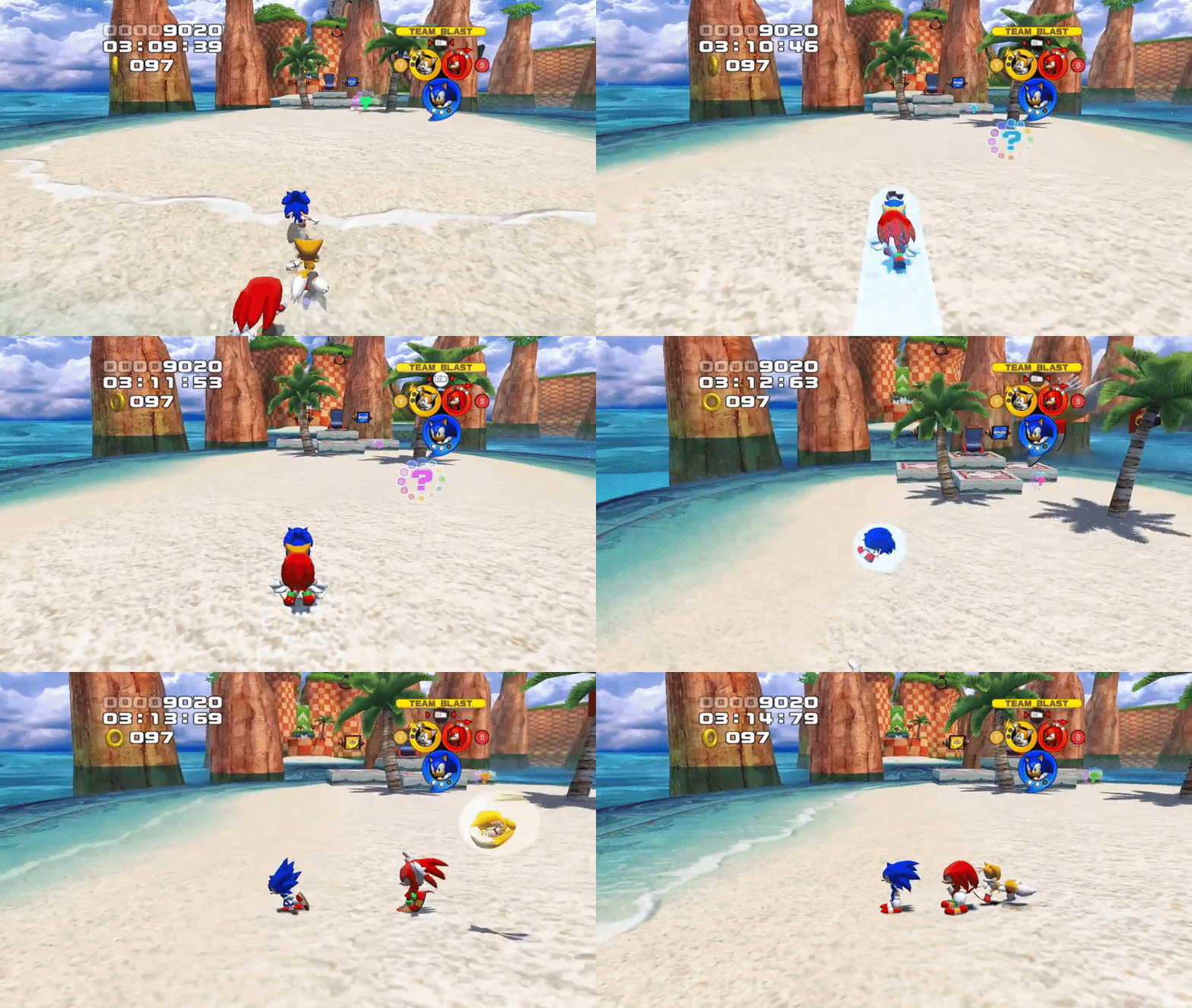
Sonic Heroes does not feature the spin dash in name, though it does represent the first step toward eventually phasing it out of headliner Sonic games. Sonic Heroes dubs its variant of the spin dash as the rocket accel. Fancy. The differences between this version and the adventure permutations are rather pronounced. I think the big distinguishing factor for me is in the immediacy of the rocket accel, or rather… the lack thereof. Its rather slow and sluggish startup puts its use niche in a completely different category as compared to Adventure’s spin dash. The spin dash is used for precision and traversal – it interacts with the physics of each respective game such that it can be used to navigate the terrain in interesting ways. The rocket accel is by contrast mostly restricted to the ground, as jumping in Sonic Heroes heavily stymies your momentum. The mandatory ramp up time for rocket accel, which forces Sonic to move forward for its duration, makes it unwieldy and imprecise, not suited to the surgical feats of propulsion that the spin dash was capable of in Adventure. And thus, you cannot design levels for a mechanic that isn’t there, and exploration becomes de-emphasized in the games from here on out.

Sonic, Tails, and Knuckles from Sonic Heroes are at a tropical beach. Sonic rolls into a ball as Tails and Knuckles push him from behind, a light briefly envelopes him as he rockets off ahead, but his speed is cut down when he jumps into the air.
Unable to stop moving during the startup, and with little effect on momentum

From there, the next iteration of the spin dash features in one of the many oddities of the Sonic series, the 2005 game Shadow The Hedgehog. Here it makes its most minor appearance to date – once again it seems as though levels are not being designed with the possibilities of the spin dash in mind, and its inclusion consequently feels almost like an afterthought. One of the advantages of the spin dash was initially the ability to launch one’s player character like a projectile to defeat enemies along a chosen path, but Shadow The Hedgehog is a game that perplexingly immerses itself in sprawling shootout scenarios, with guns everywhere. An alternative to projectiles seems rather redundant – were that the gunplay of Shadow were near as nuanced as Adventure‘s spin dash, but alas. 

About the actual mechanics and physics of the Shadow spin dash, it’s back to being a little more like it was in Adventure, with a stationary startup animation and the ability to precisely turn toward your desired trajectory, although only “precise” to the level that anything in Shadow The Hedgehog could be described as “precise”. The startup for this one is terribly sluggish, however, taking up to nearly two full seconds before a full-powered spin dash can be performed. The turn rate of the startup is incredibly slow, making any “precision” you can glean from it come at the cost of something very disruptive to game flow. One of the main advantages of the spin dash is how it can be used to quickly plan a trajectory. What’s more, Shadow’s basic acceleration is so potent in this game that the spin dash isn’t really needed for quickly getting up to speed either. And finally Shadow, being built on essentially the same engine as Sonic Heroes, shares its momentum-killing jump, so the aerial utility of the spin dash is lost as well. As a child I found myself hardly ever using what used to be my favorite move in the speedster hedgehog playbook. 

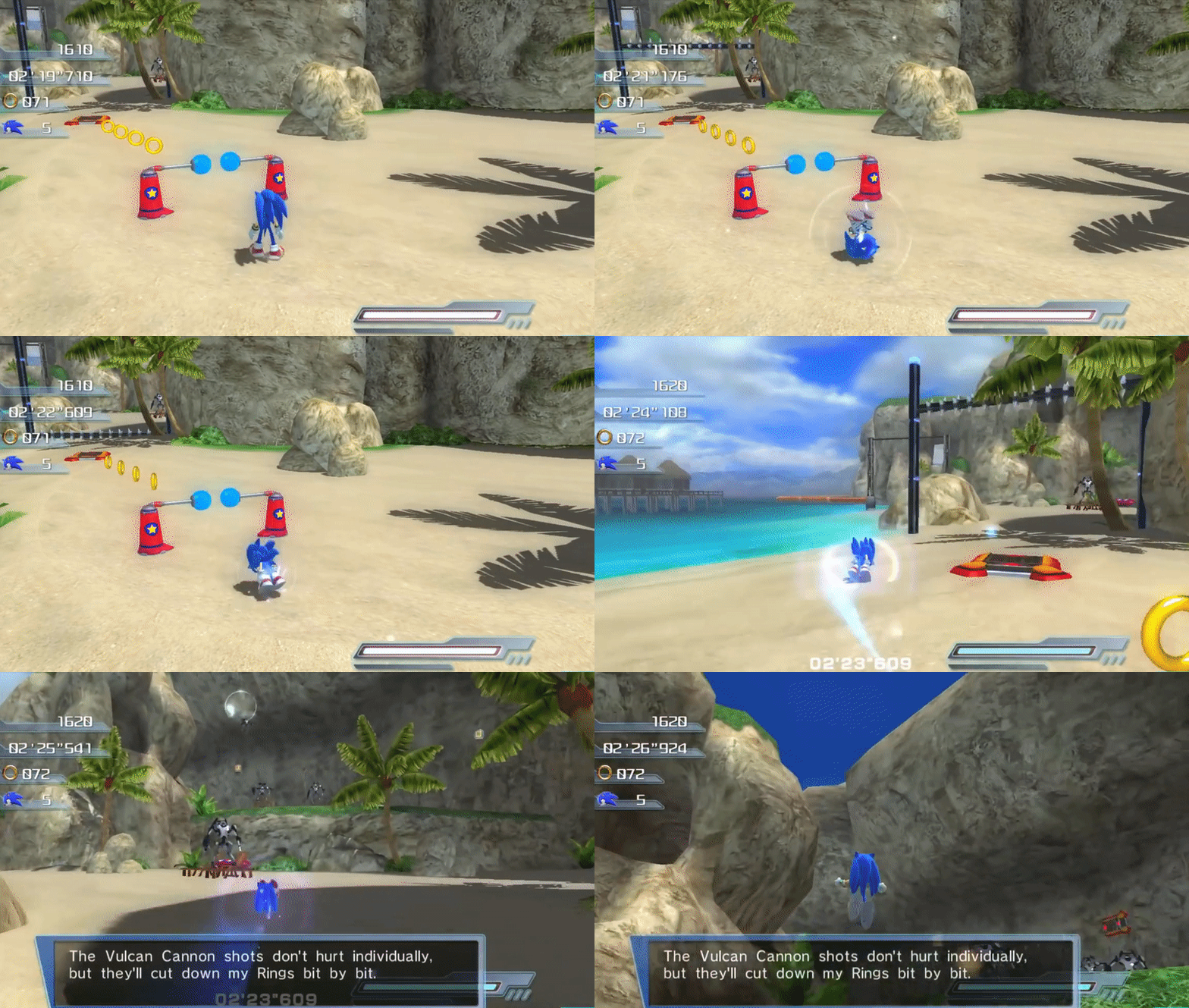
Sonic The Hedgehog from 2006, colloquially Sonic 06 is infamous for its disagreeable player interface and wonky movement systems, but how does its spin dash handle? Well, not great. Like everything else in this game, it is so bizarrely disconnected from every other component of Sonic’s moveset, it hardly has a use case. It is based on the Adventure mechanic, but it does not fulfill the same advantages. For one, you cannot jump while dashing out of a spin dash. The game simply will not allow it. The jump button does nothing while Sonic rolls around (at the speed of sound). Rotary function has been restored, turning Sonic while he revs up the spin is no longer painfully slow, but the dash itself doesn’t reach a particularly impressive top speed. So the poor mechanic is still missing its once great utility.

Sonic the Hedgehog from Sonic the Hedgehog (2006) rolls into a ball with an intense pulsing light around him on a beach, before launching out toward some hostile robots.
No precision, no utility, and no OOMPH

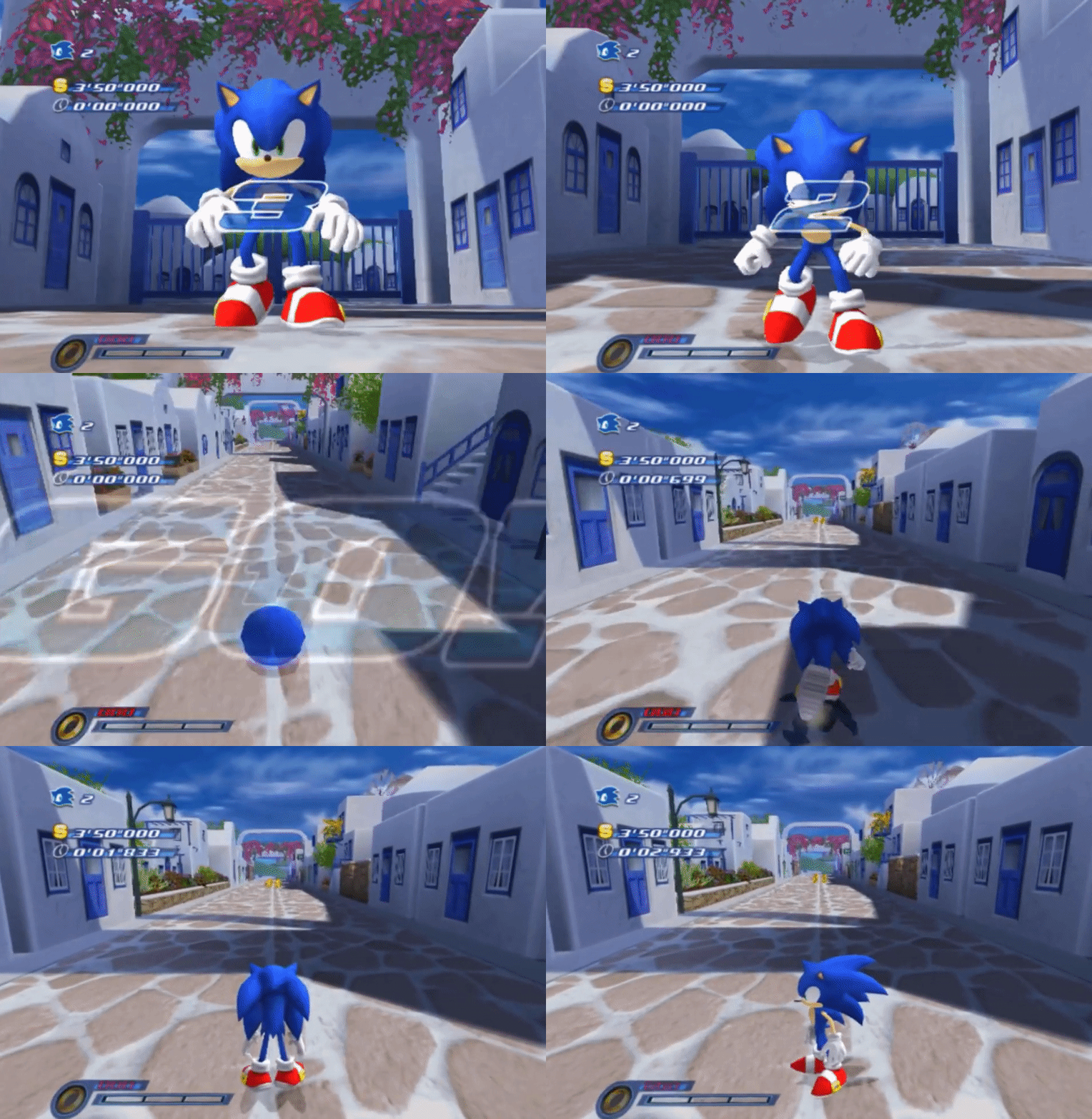
Starting with Sonic Unleashed, the series begins to de-emphasize traditional precision platforming in favor of high speed, almost race car-like tracks of long linear terrain, with a peppering of obstacles, but very little of the exploration that characterized the Adventure Games in favor of a more narrow approach. No disrespect. What these games, the “boost games” do, they do very well, usually. They’re not platform games in the same way traditional Sonic games are though, and as such the spin dash simply didn’t fit. There’s no real reason to ever stop, or sharply pivot in these games. Forward is your chief concern. They handle the maintaining of momentum in their own way. Some of the less standardized Sonic titles such as Sonic Lost World would continue to feature the spin dash, and its position in the 2D and ‘classic’ Sonic games is quite enshrined. Sonic Colors, Sonic Generations, and Sonic Forces however, essentially follow Unleashed‘s lead and decentralize the need for a spin dash in any 3D settings. They are all mechanically competent games, though focused away from certain qualities of Sonic I’d like to see return. On the other hand, it leaves Sonic the character in an odd place where he lacks one of his most memorable abilities which stylistically played off his status as a rodent that rolls into a ball. Sonic has spikes on his back, but in these boost games he mainly dispatches enemies by running headlong face-first into them. Mega Man has a cannon on his arm, so it’d be a bit odd if he never used it to shoot anything, and it’s a bit odd that while Sonic can roll into a ball and go fast, he can’t roll into a ball to go fast. 

Sonic the Hedgehog from Sonic Unleashed gets ready during a racing countdown, then rolls into a ball briefly before slowing to a stop.
This can hardly be described as the same mechanic

I cannot hide that the apparent lack of the spin dash in Sonic Frontiers is deeply disappointing to me. One would think, in a game that apes so much from its open world contemporaries, that interesting and nuanced methods of exploration would be a chief concern in designing Sonic’s move system for this game. The boost games don’t care much for physics-based momentum or complex acrobatics, and they seem to be the blueprint for Sonic Frontiers as well. There’s a fundamental incongruence, though, in dropping a move system designed for running down long, straight corridors into an open world map. There’s a lot that concerns me about that game to tell the truth. The spin dash in particular though was such a natural fit to the expansion of Sonic’s field of traversal to three dimensions that any iteration upon it since Sonic Adventure 2 has only served to make Sonic less suited to his environment. By the time Frontiers began development, the spin dash was so far fallen from its former importance to the hedgehog’s gameplay that I’m not sure it was even in a position to be executed well were it included. In an ‘open zone’ concept game, as they’re calling it, I cannot help but feel as though the ability to stop and start with a precision speed boost on a dime would be invaluable for a game that puts increased emphasis on exploration. “Imagine if you could just see a landscape on the horizon, and run straight there” I’d see people say day after day, every time the speculative discussion of open-world Sonic came up. That’s the appeal. Do you want to know what the Sonic game mechanic is for fulfilling such an experience? You know already it’s the spin dash. After such a long time of distancing Sonic’s more exploration-heavy roots, I had truly hoped that an open-world Sonic would reconsider the design context of this once-ubiquitous ability. Perhaps the spin dash can be unlocked in some capacity, but that still leaves it as a niche in the design, not a central defining mechanic like it used to be. Sure a regular old dash is still present, but hopefully I’ve illustrated to you why the spin dash is so much more than that. 

Sonic the Hedgehog from Sonic Adventure 2 nimbly launches himself across great gaps of water, from scaffolding to scaffolding on a metal harbor platform, rolling up each time to build speed before each launch.

Rolling around at the speed of sound…

Final Fantasy 7 Remake: Active Time Battle Finally Comes Home

There was a lot that impressed me about the Final Fantasy VII Remake, released 2020. For me, it set the standard for the full revitalization of an old game. Or rather, it would be if it weren’t only part one, a game that covers a fraction of the story of the original. Repackaging the story of one game into several full-sized, full-priced games, re-imagining the combat systems completely, expanding and rewriting the story. These are all controversial decisions, though they are assuaged somewhat by the existence of Ever Crisis, another full remake of Final Fantasy VII that is a more traditional, more faithful remake using updated assets. Indeed, there are so many interesting questions surrounding this game one could discuss. For now, let’s talk about the changes to Remake‘s combat systems, what experience they’re trying to accomplish, and why they are the way they are.

A girl in a plush animal-shaped hood and a stoic man with a staff team up to beat the ever-loving-stuffing out of an ostrich-like carnivorous bird.
ATB: The gentleman’s method of abstracting physical altercations with wildlife

One feature of Remake‘s combat that I find most interesting is the presence of the ATB bar. For those unfamiliar, Final Fantasy has employed at various points since its fourth installment the Active Time Battle system, or ATB for short. For the folks who may have been riled by Square Enix’s recent efforts to bring Final Fantasy more into the realm of action games, and deployment of increasingly arcane systems combining action with turn-based combat, rest assured that this is not a new trend. They have been trying to do this since the 90s. In its traditional use, the ATB bar is a timer that counts down to when a player character can act in battle. The faster that character’s speed stat, the more often they can act. When action is not possible, characters stand idle. So essentially, it’s a traditional turn-based combat, but with the wrinkle of an active timer.

At the heart of the ATB system’s ambitions, successes, and failures, I think is this tension a lot of combat-oriented games experience between their action elements and strategic elements. There advantages in verisimilitude, theoretically, as a real-time element brings with it less abstraction, but also a loss of many of the advantages that turn-based represents.

Turn-based games are inherently strategic in their foundation. The benefit of having combat play out over an indefinite amount of time is giving the player the space to make informed and meaningful decisions to gain an advantage over the opposition, which is where the challenge in turn-based combat comes from. Enemies need to be powerful enough to require critical thinking and problem solving in order to be engaging. Problem solving and critical thinking requires time to think. On the other hand, action combat is often all about twitch reaction, muscle memory, and being present in the moment as developments unfold around you. This is why you often finding me describing real-time game systems as ‘action’ ones. Now, action games can and often do have strategic depth as well, but the strategy of a game like soccer exists on a different state of mind than a game like chess.

There is an inherent friction between these ideas that can crop up in any system that aims to combine the two experiences. If action is meant to be all about the pressure of events happening in real-time, when do you get the time to develop your strategy? If that space for critical thought and puzzle-solving is needed for a turn-based game to have its strategic depth, how do you provide that space without disrupting the flow and rhythm of an action game?

In the ATB system’s early uses, the main advantage I can see is its ability to offer variable turn frequency through the speed state. It’s an interest dimension to scale character power, not one that is super frequently employed in turn-based games. Usually enemies and players only get one turn each, in even ratio to one another. Allowing that ratio to change can create some very interesting scenarios. There are disadvantages though. Personally, I love taking my time to formulate the perfect strategy and course of action in any given situation in a turn-based game. It’s a big part of the draw for me. The ATB system, which allows enemies to continue acting in spite of the player, demands that one keep taking actions or quickly become overwhelmed. Older Final Fantasy games would often have a mode to address this, but the wait mode of of old Final Fantasy is effective the same as regular old turn-based, kind of defeating the purpose. I believe Final Fantasy VII Remake has an optional mode akin to this, though I would argue Remake’s combat is a fuller realization of ATB’s design goals regardless. The argument that the wait mode represents a lack of confidence in the ATB systems early on is stronger I think, when one examines Final Fantasy X, a game in which the speed stat still exists in the form of agility, but represents the frequency of turns for an actor within a non-real-time system. Static turns are simply queued up in an ordered list, with faster characters getting more turns. The real time element here, was unnecessary, and therefor not included.

A girl in a plush animal-shaped hood teams up with a stoic man wielding a staff to pummel a leopard-like monster. Time stops after a moment while a UI element is navigated, after which both characters unleash powerful flashy moves.
In FFVIIR, real-time actions fuel strategic resources, which fuel combat advantages

What are those design goals then? Well going by the nomenclature it seems the Active Time Battle systems was meant to make turn-based combat more actively engage the player with its time-sensitive elements. Final Fantasy, like Dragon Quest before it, utilize turn-based combat akin to the tabletop games that inspired them. Turn-based combat was developed as a way to create an abstract representation of combat for the safe environment of a game. There aren’t a lot of practical ways to really play out hitting each other with swords while gathered around a table, without this layer of abstraction. Nowadays, I think there’s a lot of appreciation for the unique experiences possible only through a sophisticated turn-based system. I get the sense that even in the 90s, all the way up to now, some at Square Enix felt as though the turn-based system imposes limitations on what the combat can be, and imposes a barrier between the player and being immersed in the game’s world.

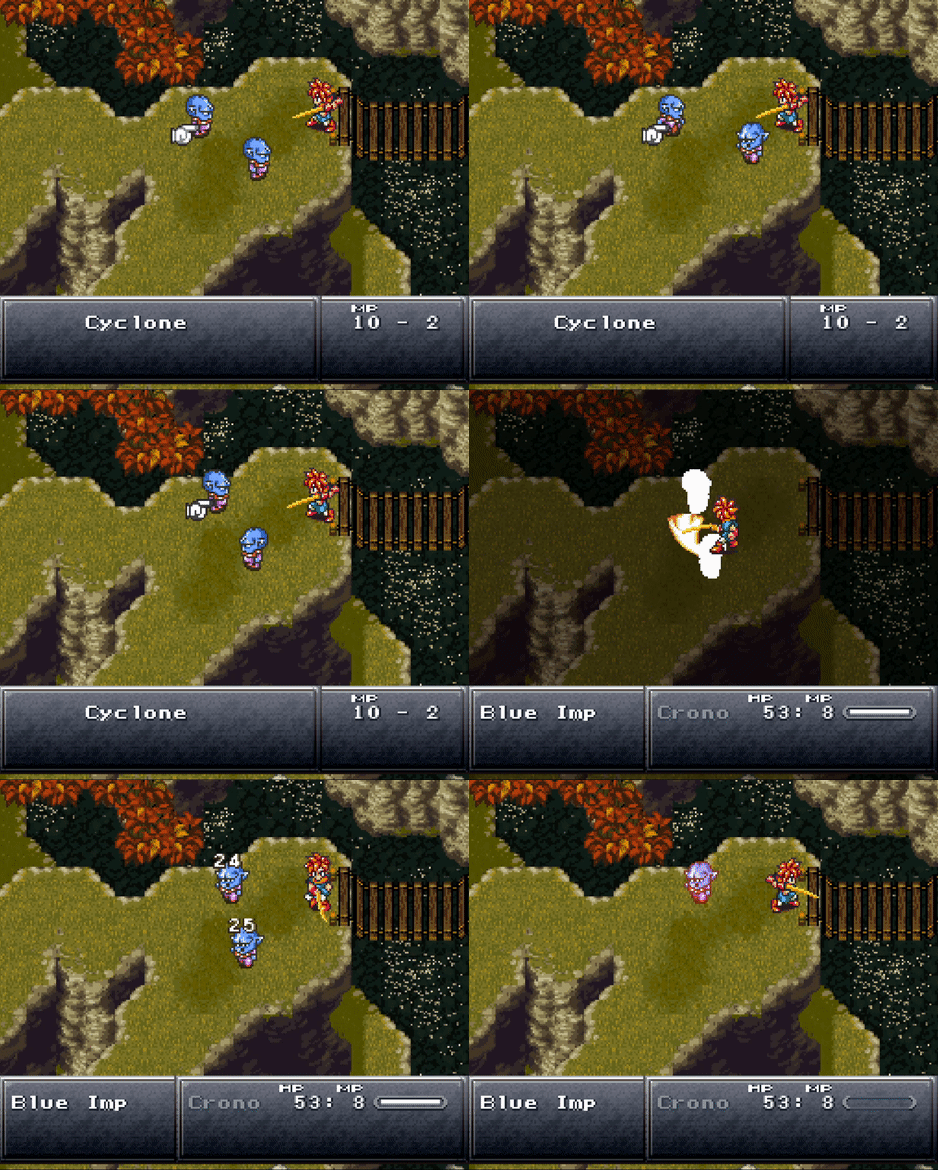
I think that last point is debatable, but what isn’t, so it seems to me, is that the ATB system wants the player to feel more pressured, with a more present sense of danger and action playing out in real-time. The problem for me, is that the simplicity of the ATB system feels like somewhat of a half measure. It’s a little at odds with the strategic systems of Final Fantasy combat, but also doesn’t fully create a sense of urgency or action for me. It’s kind of just a turn-based combat systems where you jump through a few extra hoops. The first real exception to this for me… is… not Final Fantasy VII Remake, which would come a lot later. Chrono Trigger is a vary notable instance of a game taking the ATB system and pushing it in an interesting direction.

A red-haired swordsman is accosted by a pair of blue goblins. One kicks him. The swordsman then spins his blade around in a cyclone, hitting and dispatching both goblins at once.
Wait for the opportune time to use the right move, and this real-time element makes a lot of sense

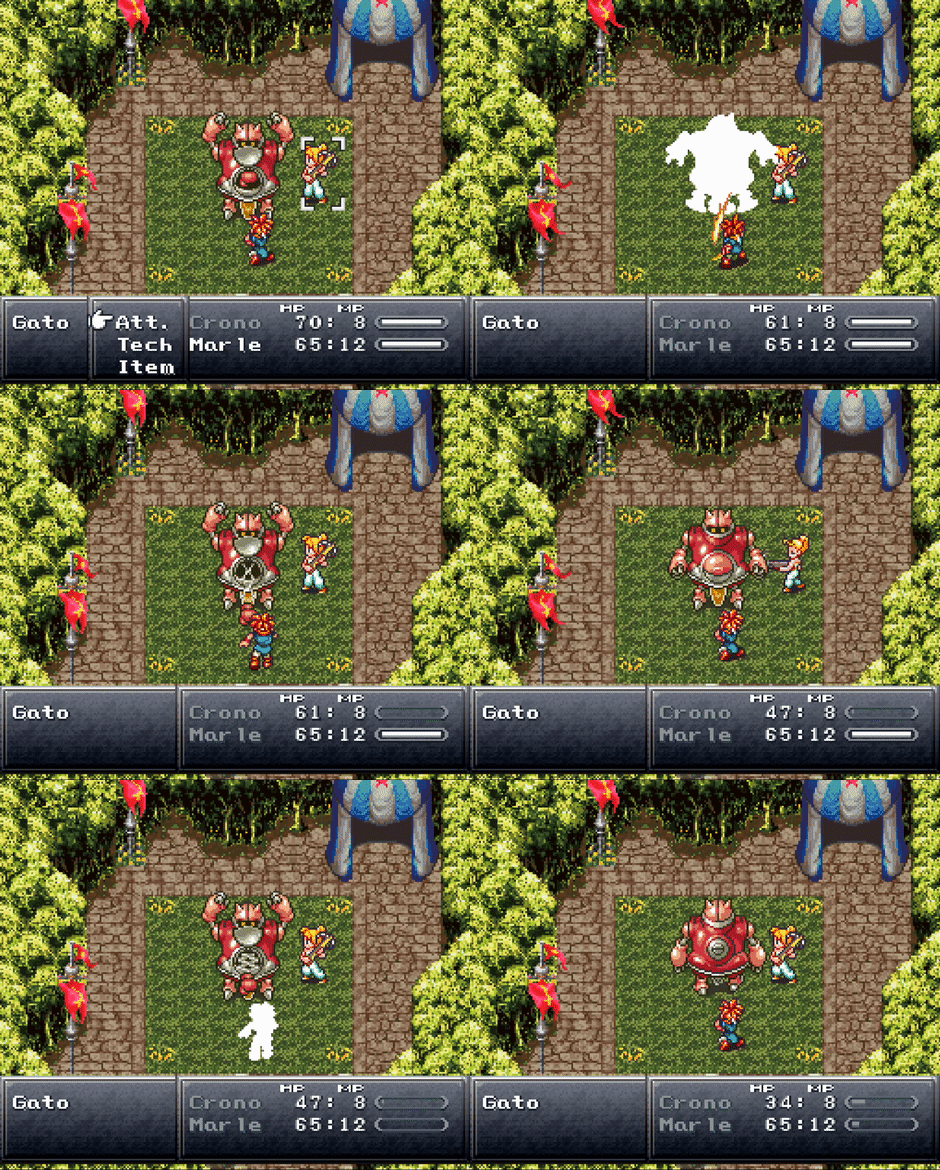
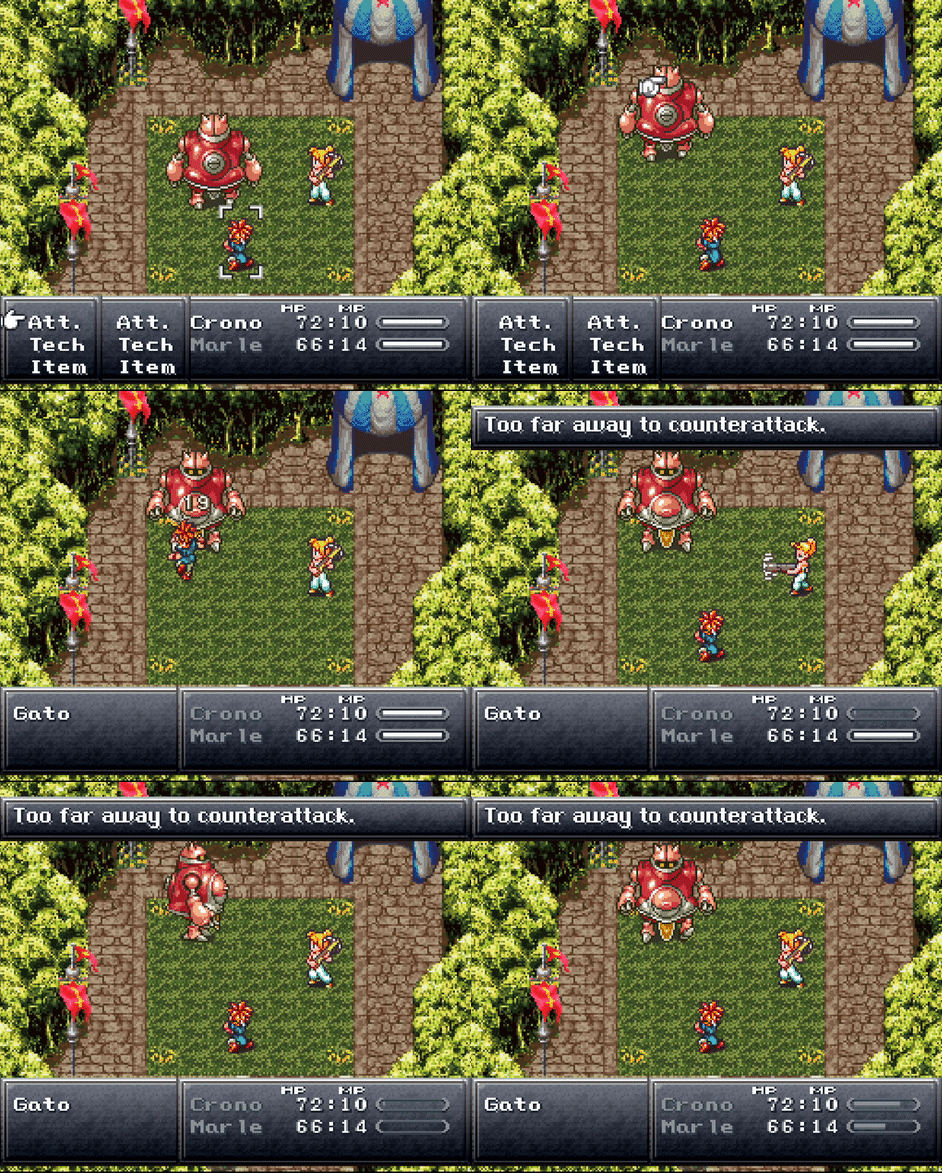
The key for what makes the ATB system work for me in Chrono Trigger is the importance of player and enemy positioning. Some of the Final Fantasy games had shades of this, but it was very digital and binary. IE: If you’ve ambushed enemies you have an advantage, if they’ve ambushed you, they have the advantage. In Chrono Trigger though, the relative position of enemies is analogue, constantly changing, and an ever-present strategic element. This element is often just a small, simple detail. For example, when several enemies are close together, you may be able to hit all of them at once with a single special attack, but not if they’re spread apart. If an enemy is too close to the player character when attacked, they may immediately respond with a counterattack. That sort of thing.

This simple extra dimension was like a missing link for me. Real-time is only one element of what makes action games engaging. In a traditional turn-based game. Things such as multi-hit attacks and counters are often very static and abstract. A multi-hit attack might always hit three enemies, or always hit enemies adjacent to one another, though they never move. In Chrono Trigger, and games influence by it, enemy positions are organic and ever-shifting, a natural and intuitive extension of the world. This ingredient alone makes the ATB bar make sense, as the dynamics of battle change in real-time along with the turn order. As I’ve often said elsewhere, relative position and spacing management on the part of the player is also an essential element. Chrono Trigger had a great commitment to holistic nature of its world. There are no random encounters. There are no battle transitions – the combat takes place in the same physical space it is initiated in. And, of course, battles occur in real-time. The game works to minimize abstraction in the broad strokes to make the game as seamless and cohesive as possible. Chrono Trigger brings these elements together in the context of a turn-based game, and was the last real evolution of the ATB system, in my opinion… until…

Well okay, there are a couple of other Square Enix games I want to talk about that finally lead us to where we are today with Final Fantasy VII Remake, but first I’ll finally talk about Remake. Remake‘s primary conceit in its combat is that you can run your player characters around a 3D space and directly command them to attack in real-time, taking after the likes of a Kingdom Hearts or Devil May Cry. While not as robust a system as those, Remake‘s action makes for an effective stopgap of realism to reinforce what is being represented by the more abstract strategic decision making that takes place between – the action forms an important bedrock of context. Kingdom Hearts is another series that initially attempted to marry turn-based combat’s strategic elements to an action system, but ultimately fell head-first into the symbolic dream-ocean of full-on action game by its first sequel. The wrinkle for Remake, though, is the player’s ability to pause the action at any time to assess the situation and execute specific commands for the party members, commands which are invariably a lot more powerful than the standard real-time attacks.

A lot of games have tried this ‘stop and go’ sort of combat. Most prominently I think of old CRPGs like Baldur’s Gate, Planescape: Torment, or Dragon Age for a more recent example. These games take direct inspiration from Dungeons and Dragons or are indeed, even licensed games tied to the property. Weirdly though they’d often not employ turn-based combat at all, unlike the actual tabletop game they’re based on, almost as if turn-based is this inherent limitation to be overcome. I wonder if the developers at Square Enix ever played these games, or were inspired by their indifference to turn-based combat, haha. Suffice to say I think turn-based combat has almost always been underappreciated for its merits in many spheres of video game development. What made combat for a game like Dragon Age a little dull for me, was in how the real-time segments and paused segments, the player characters’ capabilities are exactly the same. So ultimately, I just felt like I was disrupting whenever I needed to pause the game to line up a spell, and since all characters are only indirectly controlled through commands, I never felt fully engaged during real-time either.

A girl in a hood shaped like a plush animal summons mystic runes around her to launch magic attacks at a soldier. Her partner, a stoic man with a staff, dashes up alongside the soldier at the same time she does, to do a combination attack.
Satisfying action, satisfying strategy, but most importantly the two modes support one another

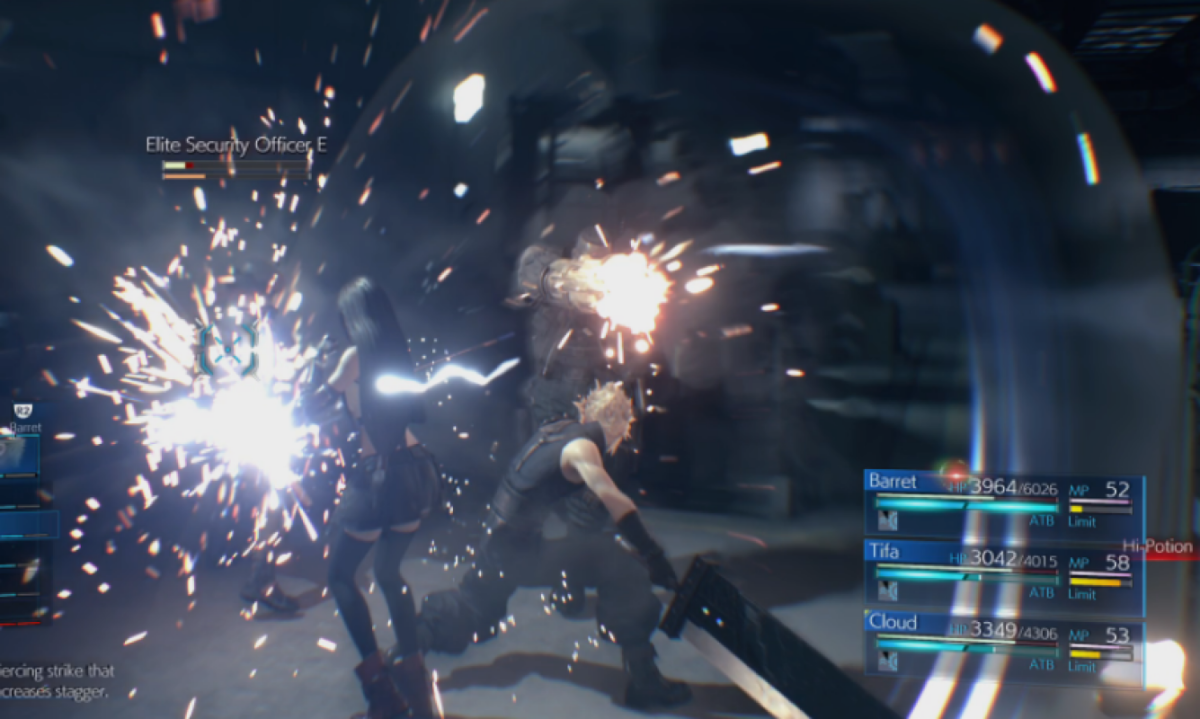
This is where Final Fantasy VII Remake really accels, I think. It’s built on the solid foundation of an action game, with a full suite of direct control for the player, from blocking to dodging to parrying. And you’ll need those options, as the enemies take full advantage of their freedom of movement while the game is un-paused. Engaging with this action system builds up your ATB gauge, no longer a mere function of time, it is a function of engagement with the core systems. At certain thresholds of ATB, you can command a party member to unleash a powerful attack, and are given the ability to pause the action to carefully consider how and where to employ these ATB abilities. This pausing never disrupted the flow of the game for me, because they’re always big moments I was building to – rewards for effectively playing the game. The barrier between what can be done during real-time, and what cannot be, also very effectively delineates the two modes, so I never felt as if one is intruding on the other. I have to pause the game to heal a party member, or to unleash a skull-cracking dive kick. These actions are not something I can just do on the fly. They require strategy and consideration, so their presence within a pause sub-mode of the game feels natural. The ability to pause is a godsend too, as the player characters each have very intricate combat mechanics unique to them that, when used in tandem with careful consideration, can have some devastatingly powerful results.

Cloud, Tifa, and Barret from Final Fantasy 7, beat the stuffing out of a soldier in a sci-fi wearhouse. The action pauses mid-fight, in dramatic slow-mo fashion, then the beatdown resumes.
It’s also all very pretty to look at.

Another key to this is the stagger system, which is also an ongoing iterative system featured in many Square Enix games. It creates a long-term goal in any given combat encounter that the player can build up to. By using the right moves at the right times, enemies can be staggered, opening them up for massive damage. A balance of micro-goals and long-term goals is essential to a compelling combat system. From not getting hit, to setting up an enormous combo. It’s these interlaced interest curves, build ups and releases, that keeps combat from getting stale.

This makes for a sophisticated system of setups and payoffs, where every party member is instrumental in stringing together combination maneuvers. Cloud can easily set up a stagger on an enemy with his powerful counter attacks in real time and big sword strikes from the command menu. Meanwhile, Tifa can empower her abilities by stringing together a series of strikes. At the same time, Barret, who can take a lot of punishment, is safe to set up some buffs like haste to increase the party’s speed. Once the target is staggered, Tifa can unleash her built up power to fully exploit in the enemy’s weakness, and Cloud can finish them off once they’re low on health. The fantasy that Remake really delivers on for me is twofold; One, it creates this delightful scenario of being able to pause and survey a complex battlefield, almost like stepping into a freeze-frame of an action movie, owed to how well the real-time segments of the game operate in isolation to create impressive spectacle and compelling scenarios. I can survey these wild combat engagements with a strategic, discerning eye without fear of reprisal. Secondly, the way all of the character’s complex mechanics mesh together creates for me the sense that they are a real, team, working together to accomplish incredible things they could not do alone.

Cloud, Barret, and Tifa team up against soldiers in a futuristic warehouse. Barret, a man with a gun for an arm, casts a spell empowering Tifa, a woman who then punches a soldier dozens of times in a second, before the action pauses again, then resumes as Tifa knocks him over with a dropkick.
Buff up, wear down the target, knock em down. Just as planned!

This schema didn’t appear fully formed in Remake from thin air or divine inspiration, though. Many might not realize Final Fantasy has been trying to achieve this awakening of the ATB system’s dream for years. I can think of three major stepping stones of this journey: Final Fantasy XIII, Final Fantasy XIII: Lightning Returns, and Final Fantasy XV. All three of these games have bits and pieces of the puzzle that would make up the combat system of VII Remake, each containing the germ of an idea that you can see grow into what we have today.

XIII established party-wide strategic command overlaid upon action that exists in a different mode from that strategy. There’s been a lot of criticism over the lack of player engagement for this in-between mode, but the basis of VII Remake started as far back as this game. It became an example how combing two modes of play without disrupting pacing could work, although the quality of the pacing of XIII‘s combat is debatable. The later sequel Lightning Returns did away party dynamics, but intimately explored the stagger system, and how indirectly controlling player characters in real-time could work.

XV was an interesting beast. The result of an overlong development time, branched off from a very different design concept that leaned more on action gameplay. XV shows signs of its troubled development, but I think none is more prominent than the combat system. It isn’t bad, per say, but it feels very underdeveloped. A lot of the ideas that shine in VII Remake exist here in a sort of primordial form. Optional wait modes exist alongside a limit-action systems that puts emphasis of enemies positioning, and party-wide combination attacks. Everything is just a little off. A lot of those micro-goals I mentioned don’t feel as though they are totally in-sync, and long-term goals within combat aren’t totally clear. Nothing quite meshes like it feels as though it should, but all the ideas are there. Whether you actually like these games or not, the long and short of this is that Final Fantasies XIII, XIII: Lightning Returns, and XV walked so VII Remake could run.

The old lessons from Chrono Trigger live at the heart of Final Fantasy VII Remake as well, with the relative positions of enemies and party members in 3D space determining how actions resolve. A big sword swing might hit a dozen enemies at once if you’re careful about positioning! This is taken further than Chrono Trigger even, with the ability to finely control exactly where each party member is standing, and a third dimension to play around with. It’s an intricate dance of set ups, payoffs, and strategic positioning wrapped in a solid-as-stone action game bedrock crafted by old hands when it comes to hack-and-slash ARPG gameplay.

A girl in a plush animal-shaped hood, wielding a giant ninja star, runs up to a group of giant ratlike monsters. The action pauses for a moment, then resumes as she places a magic rune on the ground, which sucks in all the rat monsters, dispatching them all at once.
Real-time danger is the risk one can weight against the reward of advantageous positioning

So Final Fantasy VII Remake does not have turn-based combat, and that is an understandably big loss for some people. What it is not, however, is a turn-based combat system trying to masquerade as a hybrid of action and strategy. Rather, it is the realization of that decades long dream to create an engaging hybridization of strategy and action RPGs. It is at last, finally, the ATB system come home. It is the design goals set way back then finally pushed to their apex, at least so far. Fully realized, the ATB can shine in accomplishing what it’s struggled to do for years. I’m also pretty impressed, and thankful, that a second completely differently imagined remake of Final Fantasy VII is due in the form of Ever Crisis, which seems to retain the old combat system, as a companion piece to Remake. Remake‘s redone combat aims to capture its predecessor’s strengths in a heightened form. It’s a brilliant system to build off of in that regard, and has become one of the biggest reasons I remain very excited for the future installments of Final Fantasy VII Remake.

A blonde young man with a huge sword, an unarmed, long-haired woman, and a large man with a gun for an arm team up to battle soldiers in a futuristic warehouse. Time slows to a crawl as a menu of options is manipulated in a game UI. When time resumes, the party teams up to unleash devastating attacks on the soldiers.

Attack while its tail is up! It’s gonna counterattack with its laser…

Kingdom Hearts ‘Floatiness’ and Gamefeel

Alternatively: “What The Heck is ‘Floatiness’ and Is It Ruining Kingdom Hearts? I Settle it Forever

‘Floatiness’ is the extremely scientific term that parts of the Kingdom Hearts fan community have adopted to refer to a sort of shift in how some of the more modern and spin-off Kingdom Hearts games feel to play, as opposed to their predecessors. I’ve seen this term come in and out of vogue when it comes to in-depth and armchair analysis of Kingdom Hearts‘s combat, but it’s always fascinated me. I’m going to try to define what this somewhat nebulous term is specifically referring to, and how it’s been supposedly creeping its way into one of my favorite action RPG franchises. What causes floatiness in particular? What is the greater context of design which is causing whatever this ‘floatiness’ is to happen? Perhaps this exercise can help us explore the often imprecise art of ascertaining gamefeel in general. I certainly hope so.

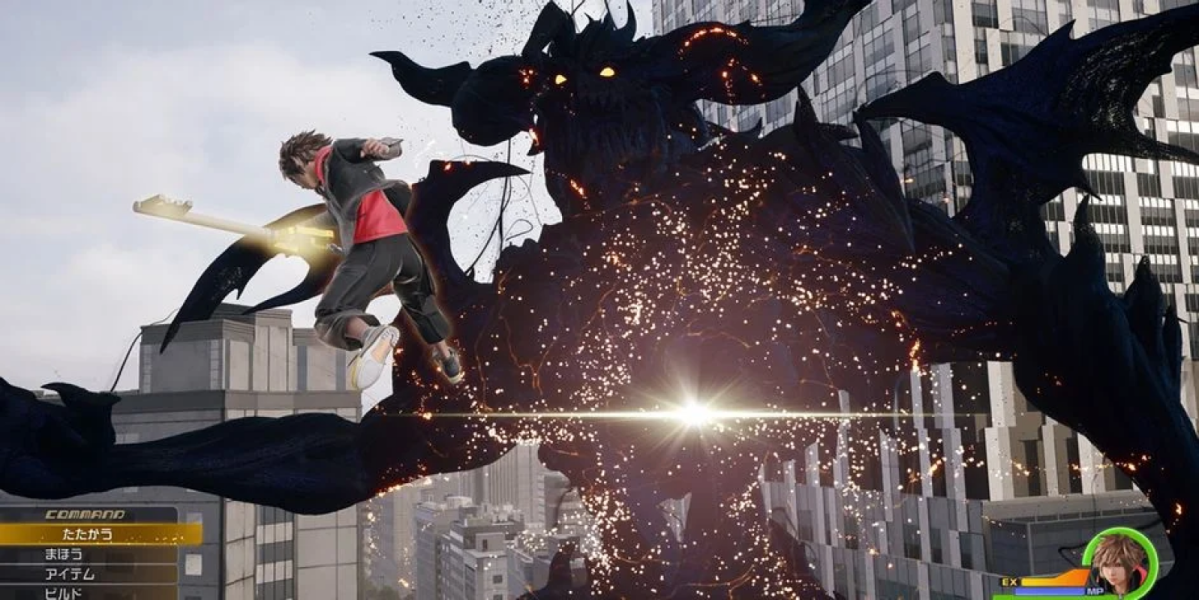
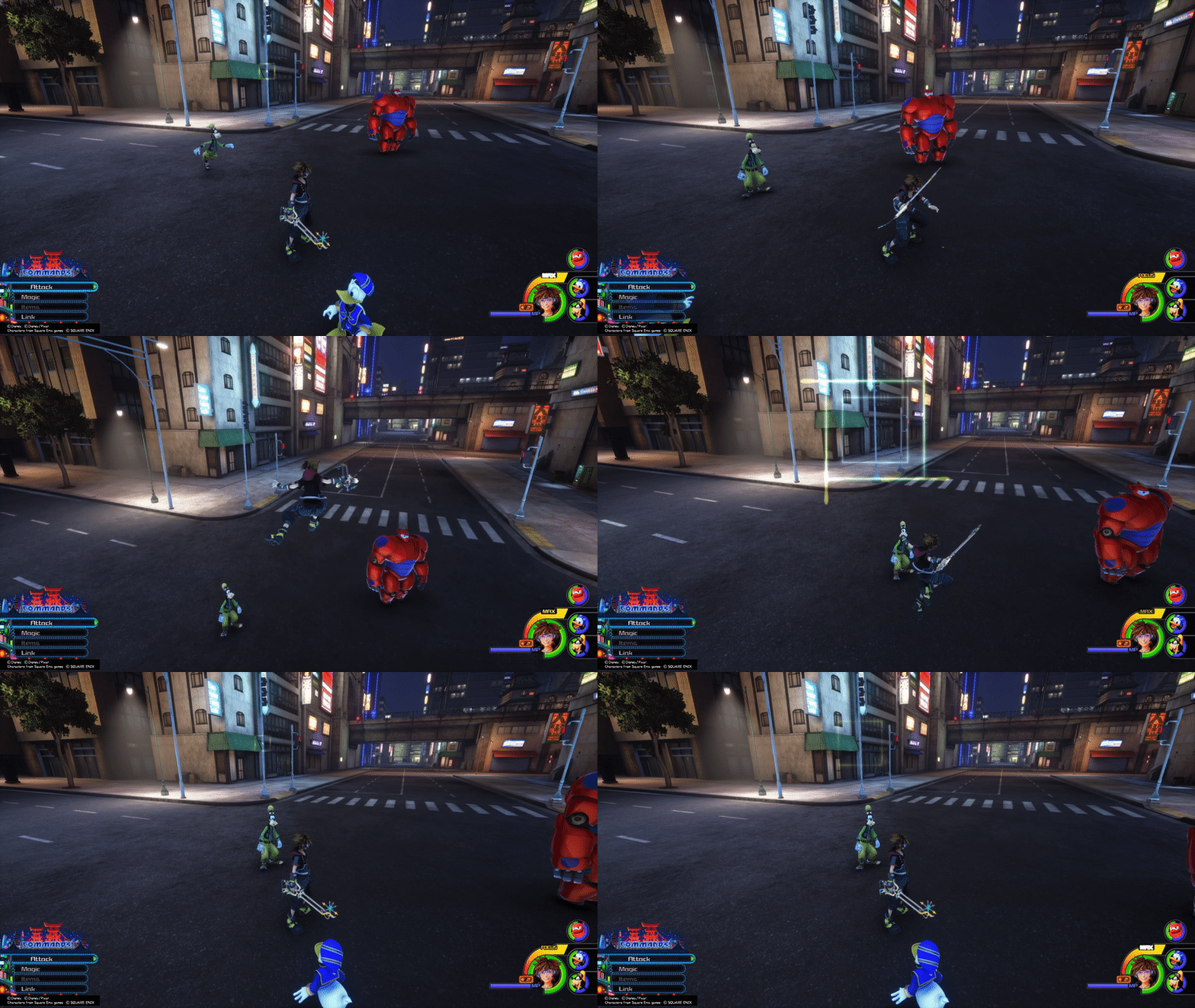
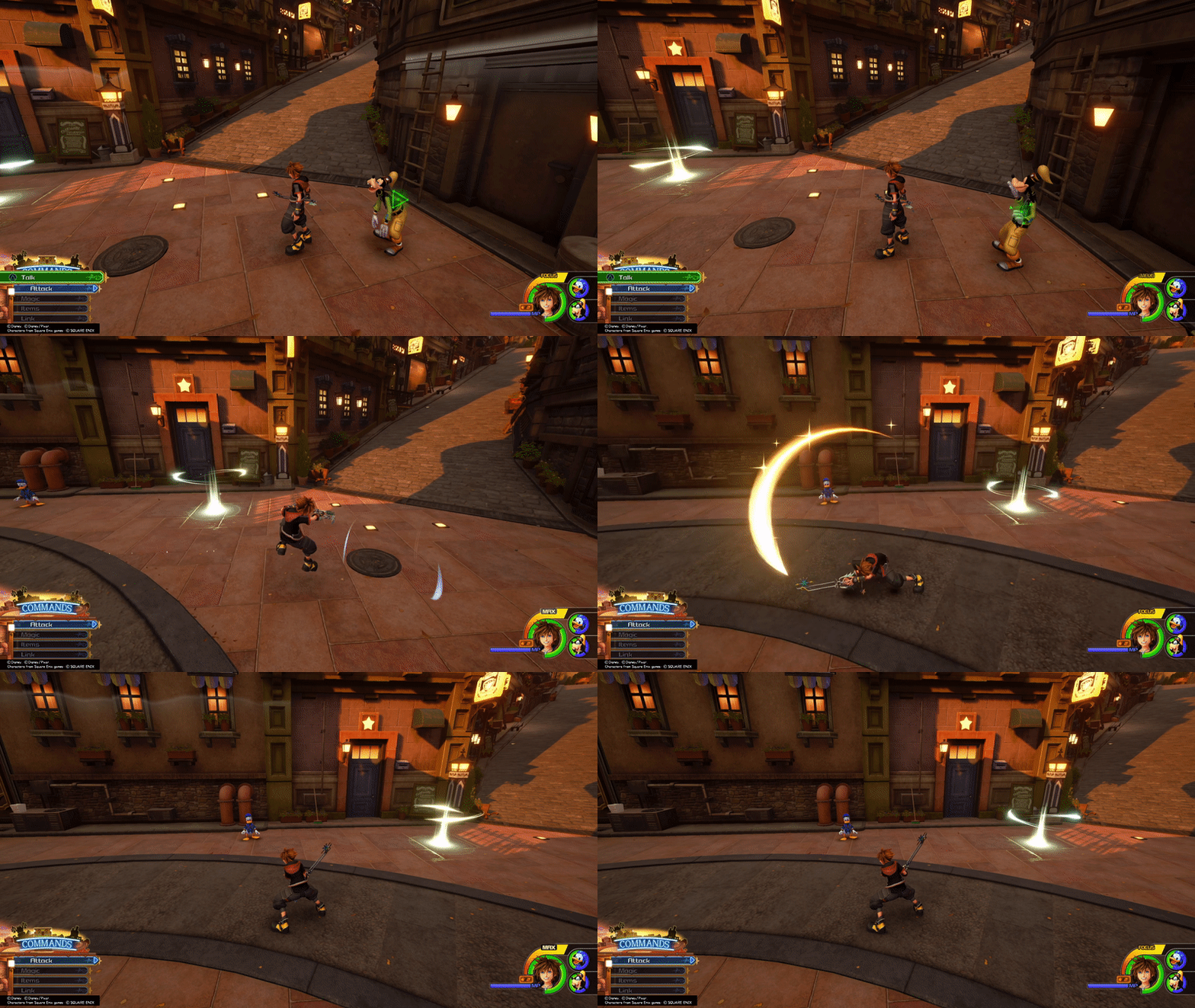
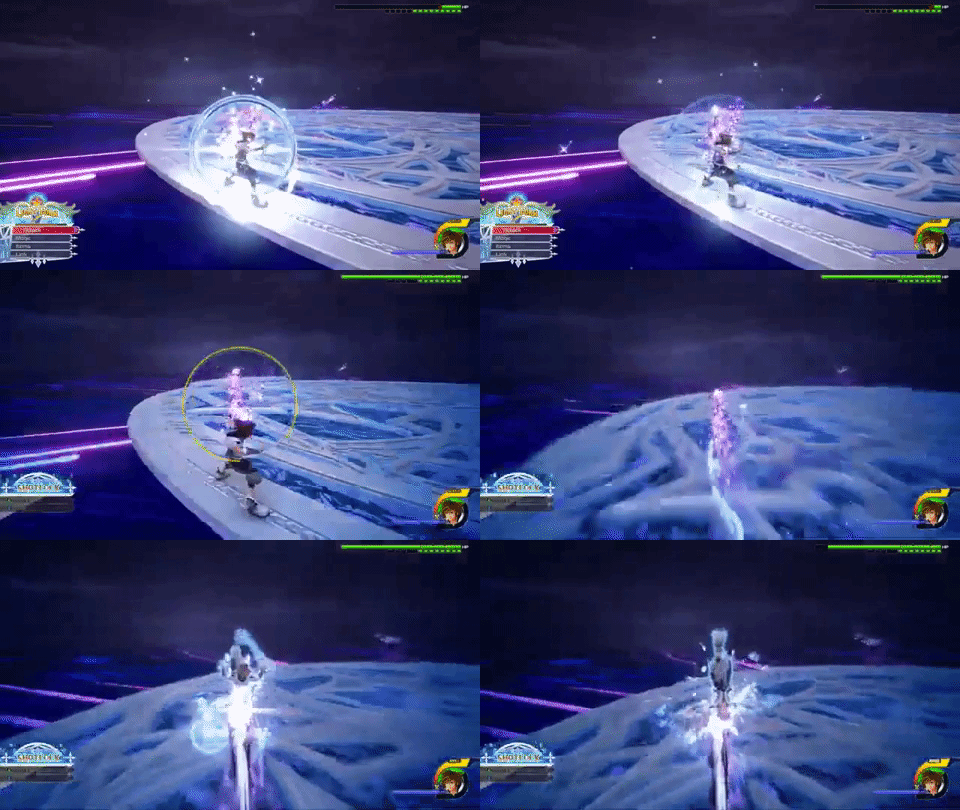
Sora, spiky-haired protagonist of Kingdom Hearts III spins his key-shaped sword around quickly, then slashes with an uppercut at the air in the dimly lit streets of San Fransokyo. He then jumps and does the same motion elevated about 15 feet in the air before falling back to the ground.
Pictured: Floatiness?

First off, we’ve got to define it, this floatiness. Informally, it is reported as the sensation that the Kingdom Hearts player character lacks weight, impact, and to my interpretation, immediacy, or some combination thereof. For those unaware, Kingdom Hearts is a series of action games with a particular emphasis on exaggerated, superhuman feats of acrobatic melee combat, favoring style, spectacle, and emotive action, akin to combat-heavy anime and manga. All that while immersed in a fantasy world full of Disney characters, Final Fantasy characters, and a unique dream-like fictional mythology of its own. Trying to define this term will be much of what this article is seeking to accomplish.

With combatants consisting primarily of magical swordsman and dark wizards, while borrowing aesthetically from classic Disney animation, Kingdom Hearts offered its players a combat system increasingly free of the bounds of gravity, allowing its player characters to bound meters into the air at a time, maintaining that airtime through continued swinging of their sword, with a cartoonish sort of physical logic.

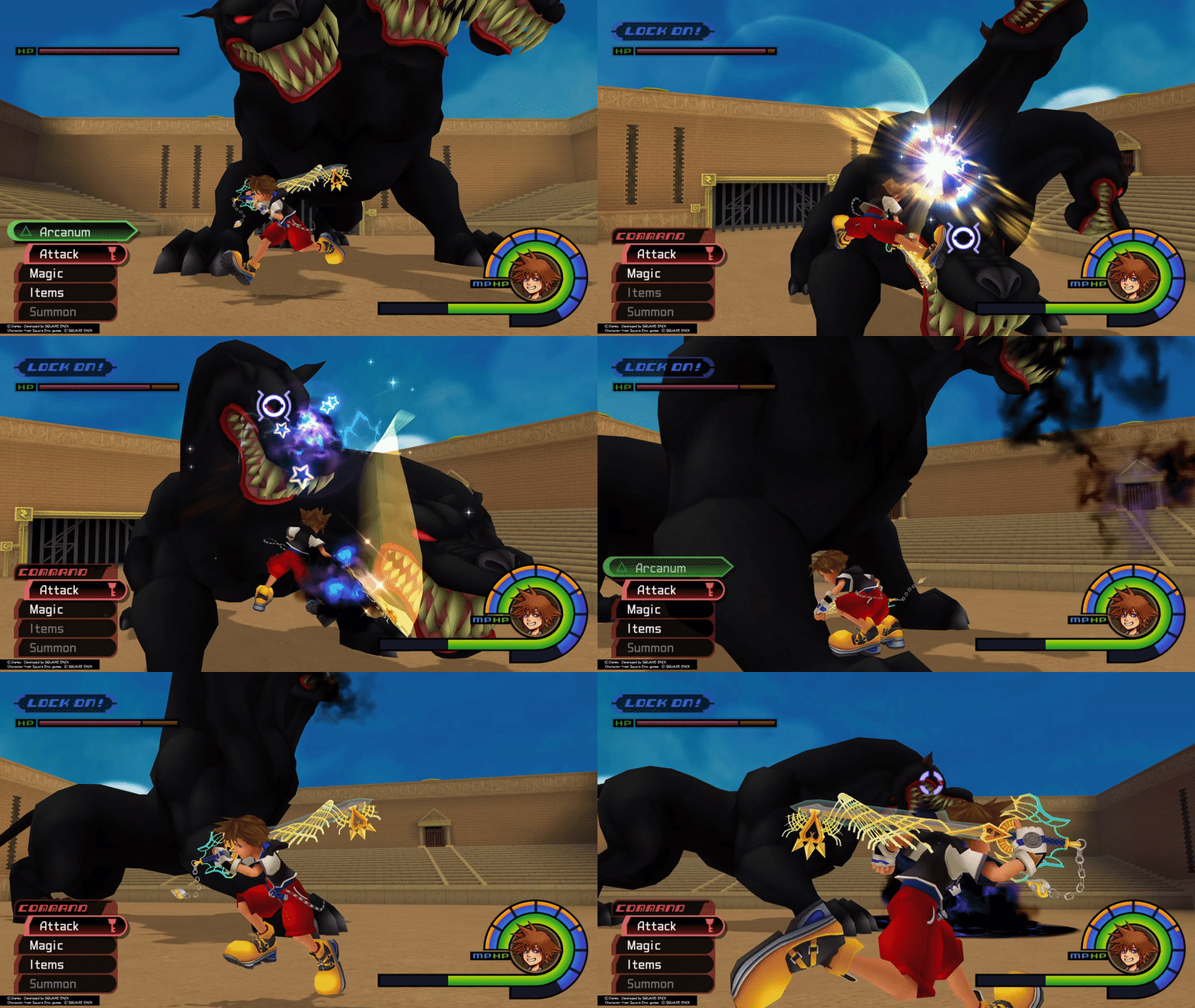
So, all this in mind, I set out to compare the gamefeel of several Kingdom Hearts games in my own experience to try and get a better idea. To make this process somewhat more precise, I investigated what is by my estimation one of the key metrics in determining the gamefeel of an action combat system – the timing of the primary attacks. Every action in a game as visually rich as Kingdom Hearts and its sequels has a startup time and ending lag. The former is the real-time between the player’s button input and the resolution of the action they’ve input, the latter is the real-time between the resolution of the action, and when the player’s next input can be resolved. For example, if a player character is to swing a big hammer, they’ll push the swing hammer button. As their avatar lifts the hammer with a grunt and struggle to convey its weight, we have our startup time, and as he pulls the hammer back to his side after the big swing, we have our ending lag, with the avatar unable to run or jump while resetting the hammer, in this example.

Sora from Kingdom Hearts II swings his keyblade at a volleyball in elaborate spinning arcs, launching the ball further into the air with each strike, and Sora continues after it, ascending higher and higher before falling back down.
Trust me it… it does feel very responsive.

Now imagine the hammer is a comically oversized key and you have a pretty good idea of what we’ll be measuring. Floatiness became an almost absurdly hot-button topic among Kingdom Hearts diehards due to its relationship with the much anticipated Kingdom Hearts 3. As the successor to the beloved Kingdom Hearts 2, and first numbered entry in the series for a period of thirteen years (though by no means the only Kingdom Hearts game to release in that period), a lot of anticipation was placed upon what the game would feel like to play. Its gamefeel, so to speak. Kingdom Hearts 2 has stayed in many people’s hearts as an all-time favorite action game due to the smoothness of its combat system, as any fan would tell you. So comparisons were inevitable. The stakes were high.

Kingdom Hearts 3, despite being the best selling entry in the series, gained a healthy amount of criticism from long-time fans in regards to its gamefeel. Floatiness was oft invoked. The developers seemed to take feedback from hardcore fans seriously, as the game would be later patched in key ways to increase speed and fluidity of the gameplay. More on that later. So what’s the truth? Has floatiness ruined Kingdom Hearts forever? Are we doomed to forever circle the drain of game design discourse without knowing what on earth we’re actually talking about? I’ve spoken to friends who know how to use a computer and they allege that numbers are involved here, believe it or not. So I’m afraid I have no choice but to deploy the diagram.

Data World

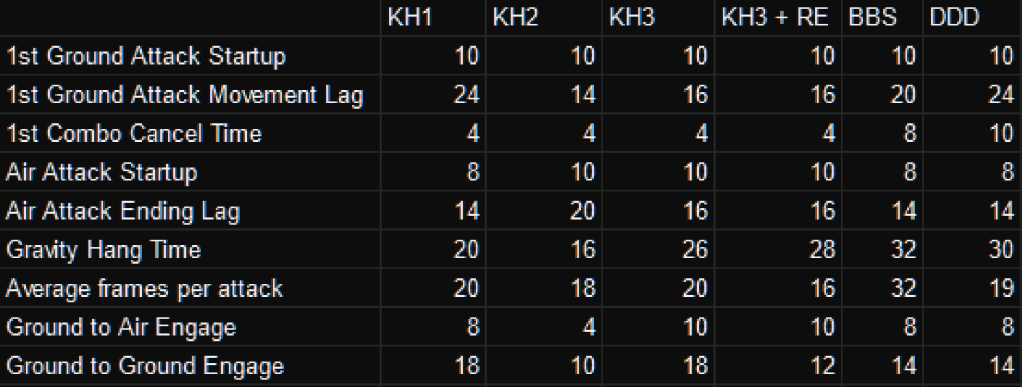
A 2 axis chart. A list of parameter such as "1st ground attack startup time" make up the Y axis. The different Kingdom Hearts games being tested make up the X axis. KH2 seems to be the fastest game judging by data, with KH1 shortly behind it. KH3 is in the middle range, behind KH1. BBS and DDD are nearly tied for slowest game.
So beautiful and horrible all at once!

First let’s define some terms. All footage I used for this analysis is from the Final Mix, 60fps versions of the games, captured on a Playstation 5. All values are measured in animation frames. For the sake of consistency, in each game I tested the animations of main player character Sora or his closest equivalent (In Birth By Sleep the resident Sora-like character is named Ventus, but he’s close enough and for our purposes we’ll consider him a “Sora”). The games I will be looking at are as follows:

Kingdom Hearts

Kingdom Hearts 2

Kingdom Hearts 3 pre-“Remind” patch

Kingdom Hearts 3 post-“Remind” patch

Kingdom Hearts: Birth By Sleep

Kingdom Hearts: Dream Drop Distance

“Startup” here is defined as the time between Sora beginning an attack and that attack “resolving”, here defined as the moment his weapon crosses in front of his body. “Ending lag” is the time between an attack resolving and when Sora can move again, no longer committed to the attack. “Cancel Time” is the time it takes before Sora’s first attack can be interrupted to perform his second combo attack. “Gravity Hang Time” is the amount of time between an aerial attack beginning and when Sora reaches his maximum falling speed. More on that later. “Engage” here means the time between inputting an attack and when sora can strike a distant enemy from a neutral position.

So these results are pretty much in line with what I expected going into this project. KH2 is the fastest game, KH1 is second fastest. BBS and DDD are dead-last, KH3 is about in the middle, while KH3 with its post-launch patch just a little bit faster than that.

Some surprises:

Every KH game seems to have the exact same startup time for the first most basic attack of a combo. Seems like they’ve been pretty happy with this one from the word ‘go’ and consistently on from there.

KH1’s movement lag from a grounded attack is insanely long, as long as DDD’s. KH2’s is way faster, and nearly the same as KH3’s.

KH1, KH2, and KH3 all cancel their first attack into an attack combo incredibly fast at just four frames, another astonishing level of consistency, although BBS and DDD combos take twice as long or more to come out.

KH2’s biggest advantages in speed are its gravity hang time, and time to engage enemies. KH3’s gravity hang time actually got worse with its post-launch patch, though not noticeably, and this has to do with a new attack added in the patch that has a longer animation in general.

BBS and DDD don’t do too badly in the enemy engagement department, better than KH1 and KH3 pre-patch, even. KH2 is still the champ here, but this fast engage time might be a saving grace for BBS and DDD.

There is a lot to talk about, so I’ll drop the chart here again real quick, just because I know you all wanted to look at it again.

A 2 axis chart. A list of parameter such as "1st ground attack startup time" make up the Y axis. The different Kingdom Hearts games being tested make up the X axis. KH2 seems to be the fastest game judging by data, with KH1 shortly behind it. KH3 is in the middle range, behind KH1. BBS and DDD are nearly tied for slowest game.
Even more beautiful.. and horrible the second time!

Okay, So What Is It?

What’s what? Oh! Floatiness. What is ‘floatiness’? My hypothesis going into this was that it’s tied up with the aforementioned startup and ending lag statistics, which would have a huge impact on the speed of the game. Kingdom Hearts: Birth By Sleep, Kingdom Hearts: Dream Drop Distance, and to a lesser extent Kingdom Hearts 3 are somewhat known among hardcore fans as the ‘floatier’ games, the former two by far the most guilty. I had presumed that in gathering my data, it would bear out that those two games would have the higher numbers when recording the delays, lag, and hang time. Kingdom Hearts 2 would be the fastest game, only slightly faster than Kingdom Hearts, and Kingdom Hearts 3 would fall somewhere in the middle. Indeed this was the result. So. Case closed? Shorter periods of loss of character control equals better combat? Probably a little more nuanced than that.

Golden calf Kingdom Hearts 2 absolutely has the advantage over its successors and predecessor when it comes to attack commitment. Its startup times, ending lag, and combo speed are universally faster across the board. But… they’re not that different from KH1 and KH3, even pre-patch. Almost immediately when I started this experiment, replaying each of the games side-by-side I came to realize the nuances of how gravity works in each game.

The Gravity Situation

As the Kingdom Hearts series progressed, aerial combat became more prominent. I always imagined in my head that the first Kingdom Hearts game was “the more grounded one”. And it kind of is. In the first game, attacking launches Sora high in the air toward aerial targets, and repeated attacks can keep him airborn somewhat. Kingdom Hearts 2 pushed this much further, with far more automated and accurate tracking on enemies, pushing Sora high into the air with each attack. I was kind of shocked to find that in Kingdom Hearts 2, the game I associate most with air combat, gravity is much more powerful than it is in any other game. With a delay of only 16 frames in KH2, compared to KH1’s 20, and double that at 32 frames in BBS, KH2 by far is the most beholden to gravity when the player is not attacking. This makes gravity a function of the player’s inaction. Never are they airborne without making it a conscious decision. In BBS and DDD, being strung up in the air against your will is almost the norm. There is a huge delay between aerial attacking and being affected by gravity.

I think this is a major piece of the floatiness puzzle too. Being on the ground in these games naturally gives you a lot more options. You have access to your dodge roll. You are able to more precisely place yourself for things like blocking, or jumping out of the way, or lining up the right attack. Simply, being in the air is advantageous in some ways, but also a lot more risky. In the less ‘floaty’ games it feels as though being airborne is always a conscious choice, whereas the others place you there in spite of the player, and leave Sora hanging in a risky position for far longer than a player might intend. The ability to get back to the ground quickly gives finer control over the player’s risk vs. reward, and the game forms a more solid and consistent relationship with that risk vs. reward.

Gamefeel Good

The title of this article mentions gamefeel, so I’m going to take a moment to discuss that. Like ‘floatiness’ this term is a little hard to pin down, so, uh, how about wikipedia. They seem to know everything.

Game feel (sometimes referred to as “game juice“) is the intangible, tactile sensation experienced when interacting with video games. The term was popularized by the book Game Feel: A Game Designer’s Guide to Virtual Sensation[1] written by Steve Swink. The term has no formal definition”

Wikipedia Article on Game Feel

Well that was absolutely no help whatsoever. Wikipedia cites input, response, context, aesthetic, metaphor, and rules as the features a game can change to influence gamefeel, and this seemingly comes from Mr. Swink as well. It’s as good a place as any to start, so let’s see how this applies to our floatiness dilemma.

I don’t want to get too into the weeds with these, so I’ll limit my observations to response, metaphor, and rules. Suffice to say I think KH does pretty universally well in the input and aesthetics department. Context is a bit more nuanced, but again, trying to limit our scope here.

Let’s be a little contrarian and try to make at least a very small part of this gamefeel equation tangible. We’ve already broken down that there seems to be a correlation between the delay between action and reaction in Kingdom Hearts, and the popular perception of how well the games feel to play. KH1 and KH2 are beloved with their snappy reaction times, KH3 is well liked but garnered a lot of fan feedback. BBS and DDD are liked but not necessarily for the fluidity of their combat, and I rarely see gamefeel cited among their strengths. The data easily illustrates the importance of response time as a variable.

The metaphor at play here is how the timing of attacks translates to what the game is trying to convey. The main thing the mechanics of KH is trying to convey is melee combat. All these varying measures of time and attack resolution and ending lag etc. is all metaphor for the physicality of swinging a sword at a guy. A real person cannot instantaneously move their arms, the sword has startup time and ending lag in real life. That’s why these time gaps are there in the first place. It wouldn’t be a very fun game if you pressed the attack button and just instantly won. So as in a real, actual battle, you have to consider how your various actions leave you open to counterattack. On the other hand, one can go overboard with this, as in real life you’re also trying to minimize your vulnerabilities, and a swordsman is not going to be flashy at the cost of leaving himself open to a hail of enemy attacks. These are things people intuitively understand, and so players bring with them preconceived notions of how entities should behave in these situations.

Sora from Kingdom Hearts 1 blocks an attack from a dark ball with a mouth. Immediately, he counters with a series of fast strikes in the air. He loses altitude with each strikes, and ends his combo standing on the ground.
Pictured: Gamefeel??

Drill even further down and you get to the rules of the game itself. Enemies are attacking you, while you’re trying to attack them. If you are locked into an animation you are unable to deploy any defense to stop them, and so we have a game. Risk, and reward. However, if the player’s control feels disconnected from how these rules operate gamefeel is thrown off. In Birth By Sleep and Dream Drop Distance, attacking creates great gaps of no-player time, where inputs on your controller mean nothing. You are vulnerable to attack, and a passive observer in the world. This disconnect throws off both the player’s relationship to response and to the rules of the game, as overly long and committed attacks can become more of a liability than an asset. In KH1 and KH2 throwing out attacks is almost always fun and satisfying, and usually rewarding. It’s often a lot more burdensome to do so BBS and DDD. BBS and DDD have other methods of dealing damage besides the basic attack, but since the basic attack is so pivotal in the main series, a lot of players are thrown off by how minimized it is in these spin off titles, which primarily utilize the command deck instead.

The Command Deck

So why is Birth by Sleep and Dream Drop Distance so damn slow compared to their peers? Well these two games share two very important elements in common. First, they were each developed for a handheld family of systems. Second, they share the game design system known as the command deck. These two points of similarity are very much entwined.

Kingdom Hearts and its two numbered sequels utilized the ‘command menu’, a little persistent menu in the corner of the screen that can be navigated in real time to select whether you want Sora to attack, use an item, or cast a magic spell, essentially. 90% of the time you will be spamming the attack button. The command menu was meant to evoke the strategic decision making of a turn-based Final Fantasy game, but re-tuned for an action combat context. Ultimately contextual combo modifiers became a much greater source of player expression in gameplay, and the strategic applications of the command menu are limited. However, it remains an elegant way to give the player a lot of options without bogging the game down with too many buttons.

When Kingdom Hearts went handheld it rethought its combat. Suddenly, we’re dealing with a much smaller screen, and the camera had to be pulled in on the player character to compensate. As a result, enemies can much more easily hit you from off-screen or sneak up behind you. Consideration was clearly given to a system that better fit playing on the go, where deep concentration on twitch-reaction may not be as viable or palatable. The command deck was the answer, a cooldown-based system where actions are selected from a rotating list and can be used at any time. Now the flow of combat is dictated by these ability cooldowns, and the regular attack combo was made to be more slow-paced, flashy, less freeform, and yes, more floaty so as act more like a stopgap to using the command deck, rather than the main form of attack itself. The command deck has a lot of advantages such as the ability to customize your attack loadout in a much more granular way, but it also has its own host of problems, which I won’t get into here.

The point is, Birth by Sleep and Dream Drop Distance are deliberately slower games made so because they were designed to be played on the go, and utilize entirely new systems that weren’t designed with KH1 or KH2’s speed and flow in mind. Because KH3, BBS, and DDD share a lot of development talent though, it seems like a lot of the design philosophy of these handheld games bled over into KH3’s headliner console game, which was jarring for a lot of people.

Okay So… Is This Bad?

In my opinion, one of Kingdom Hearts‘ greatest strengths is the immediacy and responsiveness of its gameplay. A fine degree of control gives the player a much wider spectrum of possibilities in any given scenario, and this is what leads to a creative space within gameplay for players to express themselves through the gameplay. This fluidity also allows disparate gameplay mechanics such as movement and sword attacks to blend. Kingdom Hearts 2 always feels as though its many, many mechanics are in a harmonious conversation with one another. Engaging a ground enemy can be converted into an aerial assault, which can flow into a strategic repositioning, etc.

So yes, I think it weakens Kingdom Hearts‘ identity somewhat when some of the more experimental entries in the series have dabbled with slowing down the combat and making its pieces more discrete. The particulars are a bit beyond this already enormous article, but I did want you to understand my motivations for trying to understand how and why Kingdom Hearts 2 feels so different to play than a game like Kingdom Hearts: Birth By Sleep.

Sora from Kingdom Hearts 2 slashes at a volleyball, sending it bouncing into the air.
Up… and Down

Kingdom Hearts is a series about ridiculous anime battles between magical wizards wielding baseball bat-sized keys as weapons. People fling themselves through the air to attack one another. It’s not realistic, but it exists within the heightened reality realm of animation. Its primary inspirations are, after all, some of the animation greats, including Disney of all things. Animation works to heighten reality because it has an understanding of its underpinnings. Even if people can jump twenty feet in the air, there still has to be a since of presence and weight. It has to give the impression that some sort of underlying laws of physics are at play even if they aren’t one-to-one to our own laws of physics.

Despite appearances, it wasn’t a magic genie spell that made KH2 so satisfying to play. It was hard work, clever planning, likely some very precise number tuning, and likely a whole lot of playtesting. I want to know the nitty gritty of what made Kingdom Hearts one of the smoothest action games in existence, what distanced it from that, and what brought it closer to that esteem once again. Because you see, there are still those Kingdom Hearts 3: Remind post-launch changes to talk about.

Kingdom Hearts III And The Combo Modifier

In Kingdom Hearts, Sora has a very basic attack combo, with little by way of alternate options for the player, at first blush. You press the attack button, and sorry does the next hit of the combo. Rinse, repeat. The wrinkle though, is that Sora can gain abilities which cause his attack combo to behave differently depending on where Sora is standing relative to his target.

Kingdom Hearts 2 pushed this contextual combo modifier idea much further, with hosts of new options that allowed the player to flex mastery over the system through mastery of manipulating these contextual attacks. They did things like make engaging enemies faster, extending the combo, increasing the power and range of combo finishers, among other things.

Kingdom Hearts 3 launched with its share of combo modifiers, but they lacked the breadth and applicability of KH2’s abilities, and they did little to speed up combat overall. That is, until it was patched in anticipation of the Kingdom Hearts 3: Remind DLC. Numerous combo modifiers were added which increased the overall speed of Sora’s basic combo attack and made the game feel overall more responsive. I don’t think the Remind DLC gets enough credit for just how much it improved, and it’s kind of refreshing how in tune it is with popular feedback. Real people playing your game can tell you a lot about that mystifying, all-important yet elusive gamefeel.

Airstep is Literally a Game-Changer

Kingdom Hearts as a series has done a decent job with teaching players about its systems and how they work. Some of the more advanced mechanics that deepen higher-level play are a bit more obscure, but usually reaching a baseline level of competency at core systems is pretty straightforward. Kingdom Hearts 3, however, I found stumbled at instilling the importance of oce of its most important new mechanics, the airstep. The airstep allows the player to manually aim the camera toward a distant foe, and fling Sora at them at high speed for a relatively quick engage across a huge battlefield. This was obviously done to compensate for the much larger environments featured in KH3 as compared to older games, but utilizing this move frequently and often, even in close quarters, really does change the way the game is played.

Airstep can cancel out of nearly any other action, you see. In terms of making the game more fluid, or moreover in terms of giving the player fine control over their actions, the airstep affords an enormous amount of power and precision to determine the pace of fights in Kingdom Hearts 3. This along with the ability to cancel combo finisher attacks, which was added in the Remind DLC update, makes the whole combat a lot more cohesive and much more fluid than you might initially expect based on the raw frame data. Speaking of which, the frame data was improved in that update as well! The fact is that this latest iteration evolved the combat in a lot of interesting ways that I don’t want to see abandoned in favor of just making the series going forward exactly like everything that came before.

Sora from Kingdom Hearts 3 blocks an attack, before the camera zooms in on his enemy, Sora then zooms to their location in a flash of light.
Here Sora is sent at the boss straight out of a guard, exploiting an opening in an exciting way

Kingdom Hearts Is Doing Fine, Actually (But It Can Do Better)

So yeah, when people say Kingdom Hearts 3 feels ‘floaty’ as compared to Kingdom Hearts and Kingdom Hearts 2 the evidence is there. Attacks are less responsive and more of a commitment, generally, and gravity is turned off more liberally. You will literally find Sora floating more without direct player intervention. However, the frame data differences, discounting the gravity aspect, are minor at best. It’s really that gravity delay that accentuates the small differences to give a pretty stark impression. Birth by Sleep and Dream Drop Distance are so far afield of the gamefeel of the main series games that it’s clear there was no intention of recreating those mobile games for KH3’s release. The developers have further made it clear their intention to deliver an experience their longtime fans can enjoy with the changes made to the Remind DLC.

In fairness, it had been 13 years since a main Kingdom Hearts game had been made when KH3 was released in 2019. With just a few tweaks I feel they were able to bring it up to parity with KH and KH2 in terms of fluidity. It’s not the tightly wound, exceptionally blisteringly fast experience of KH2 precisely, but do remember that KH2 was developed only three years after the original, so the developers were coming right off the back of designing an already exceptional combat system. The experience was fresh. From where I stand I don’t think the future of KH is in any danger. Three years on from KH3 as of the time of writing this in 2022, and KH4 seems to be around the corner, poised to improve in ways reminiscent of how KH2 improved.

The Kingdom Hearts 4 reveal trailer doesn’t actually show any basic attacking in favor of mostly displaying the new movement options, and any gameplay it does showcase is subject to a lot of change to begin with, but what it does show looks pretty snappy and responsive to me. I’ll let you be the judge. The KH team learns quickly, and their intentions for this series’ gameplay have been made clear vis a vis the Remind DLC update. They understand the data I’ve so painstakingly gone to lengths to describe and how it affects gameplay, clearly. The KH3 update was so precision built for improvement it’s kind of astonishing. And, with KH4’s refocus on ‘reality’ as an aesthetic, I would not be surprised if a little more gravity came back to the party to polish the combat system even further into something really special.

Sora from Kingdom Hearts stands on a floating platform with a shield-wielding enemy, and rapidly dashes at and through them, holding out his keyblade.

Whatever you’re talking about, I don’t care…

Sonic vs. Shadow Boss Breakdown: A Case Study

It’s April 2022, I just came back from the movies, and it’s got me in a Sonic mood. Sonic Adventure 2 was Sonic’s second major 3D outing and personal favorite of mine, warts and all. The big gimmick of this game was ‘hero versus dark’, or in other words two concurrent stories centering on our familiar heroic blue hedgehog Sonic, and the new dastardly red and black hedgehog Shadow, who has all the same powers that Sonic has!

The Sonic and Shadow showdown that’s built up across the game’s story was always a highlight for me as a child. It’s aesthetically and narratively well-realized, a great moment of tension and catharsis for one invested in the wacky world of Sonic. So it works on a number of levels. Taking an older and more analytical eye to it though, it is far from an ideal example of boss design in motion. Like much of Sonic Adventure 2, it has its share of flaws. So for this boss breakdown, I’m going to approach things a little differently, and go through an alternating list of the boss design’s pros and cons, trying to glean where this boss succeeds and where it falls short.

Sonic the Hedgehog stands in a long starship-like hallway. He is surprised when Shadow the Hedgehog walks up from behind him and begins to speak "You never cease to surprise me blue hedgehog. I thought that the capsule you were in exploded in space." 

Sonic replies, "You know, what can I say... I die hard!"
The motion-captured cut scene animations are still pretty comically bad, though.

First, a quick overview. The player takes the role of Sonic or Shadow, depending on which story path they chose. Their opponent is whatever hedgehog they’re opposed to. In either case, the fight is identical, as both characters share identical movesets as players and as AI bosses. The two hedgehogs run along an infinitely long looping pathway suspended in outer space. Pieces of it fall out from under them if they run too slowly. If the enemy boss hedgehog falls off the path, they teleport back to the stage ahead of the player’s position. If the player does the same, they fall to their death. The enemy will occasionally use a homing attack on the player, which can be deflected by jumping, which produces a protective spin-shield on the hedgehog. The enemy can do the same, however, meaning most homing attacks will be deflected unless the player can make an opening in the enemy’s defenses.

These openings, as far as I can tell, take three forms. First, if the player lags behind the enemy by too great a distance, the enemy will come to a halt, and launch a screen-wide super attack, which can be avoided with a well timed jump. During this moment, the enemy is vulnerable to attack. Second, if the player runs too far ahead, or the enemy falls off of the arena, they teleport back onto the road ahead of the player, after which they are vulnerable for a brief moment, although this window of vulnerable seems to narrow as the boss’s health gets lower. Finally, timing an attack such that it hits the boss in the short window of time they are on the ground after landing from a jump, they are vulnerable.

With that out of the way, let’s get to some of the particulars.

Pro: We Framed The Camera

So Sonic Adventure 2 (and a lot of 3D Sonic games of this era for that matter) has a bit of a reputation with its camera. So this one might come off as somewhat of a backhanded compliment, haha. To be fair, I think the direness of the state of SA2‘s camera is often vastly overstated, when compared to other 3D cameras of the time, or even other Sonic games. Point is, sharp turns and elaborate level geometry could be let’s say… challenging for the hard working early 2000’s 3D camera, so Sonic Team played to their tech’s limitations and its strengths and placed this boss fight on a seamless, infinitely long straightaway.

With no turns, nor obstructions, the player always has a clear view of the action and the goal- defeating that enemy hedgehog. This has the added bonus of creating a series of dynamic set pieces visually between Sonic and Shadow’s fight, with the camera being centered on the highway path.

Sonic the Hedgehog outruns Shadow. A moment later, Shadow teleports in front of Sonic in a flash of green light.
Nothing but you, me, and the cinematic cameraman following behind us

Con: Rings, Rings Everywhere

Someone once did a write up on Sonic The Hedgehog’s traditional health system that utilizes its collectible coins. This system has a lot of flaws, in my eyes. The simple version is, that because having even one ring on Sonic has nearly as much advantage as having a billion rings, while having zero rings leaves Sonic in a drastically more vulnerable state, it is very difficult to build a consistent level of challenge with this health system. The battle between Sonic and Shadow takes place on an infinitely long looping pathway. It would be very possible, even likely, that most players upon taking a hit from Shadow or Sonic simply kept running, missed picking up their rings, and were left with a crushingly difficult unreasonable encounter.

This is obviously not desirable in a game marketed to children, and so to counter this eventuality, it was decided that the infinite path contain infinite rings. This is also a problem. So long as you keep collecting these readily available, plentiful rings, it is essentially impossible to lose this boss fight that is an alleged death battle between super powered titans. It doesn’t matter how many times Shadow strikes Sonic with a chaos spear, or how often Sonic homing attacks Shadow. If the player can collect more rings, and they can, they’re in no danger. It kind of takes the wind out of the tension-sails when you realize this.

Pro: The Game Does Not Tell You What To Do

There’s a certain appeal to to the idea of just being placed in an arena with a hostile opponent and… going at it. No rules, no holds barred, no ifs ands or buts. Of course, there are rules, such boss designs simply give the impression that the player can control the pacing of the fight, and can achieve progress against the opponent with mechanisms entirely driven by their own ability, not by arbitrary timers or enemy behavior tables. Someone once did a write up on the subject using The Legend of Zelda as an example.

When fighting Sonic or Shadow it is not initially entirely clear how one is meant to deal damage to them. They have a health bar indicating damaging them is the goal, but not much else. There’s very little indication of the boss’s weakness. The player’s standard methods of attack up to this point, homing attacks or the spin dash, have no effect in most situations. For a final confrontation, this makes sense. Shadow and/or Sonic stand as an imposing ultimate challenge with no clear exploitable point. It’s up to the player to decide how best to approach the enemy supersonic hedgehog, as their opponent has all manner of ways to deflect incoming attacks, such as rolling into a ball, homing-attack the player in retaliation, or using one of their screen-wide super attacks. This bare-knuckle brawl kind of boss design works well in establishing the tone of two co-equal rivals finally duking it out and giving it their all. If Shadow or Sonic had a big glowing ‘attack this to kill me’ button somewhere it would certainly diminish the effect.

It’s also worth mentioning, this is the second such encounter between Sonic and Shadow. The first, in an enclosed square arena, is a lot less exciting to play and talk about. I bring it up because it does begin to engender some of the concepts of how to fight the enemy hedgehog that you see here, but that fight also suffers from not being entirely clear on its mechanics, so the player will likely not have learned a definitive approach to fighting Sonic or Shadow by this point.

Sonic the Hedgehog repeatedly homes in on Shadow the hedgehog, but Shadow rolls up in midair to protect himself, deflecting the attacks.
Standard methods of attack don’t work. Figure out a way past his defenses!

Con: The Game Does Not Tell You What The Heck To Do

Yeah okay, so there are advantages to unstructured boss fights, but Shadow and Sonic’s weakness does exist, and it is largely arbitrary. The game gives little to no indication at all how best to damage the boss, and as a result, even for players who’ve defeated this boss before, it may not be entirely clear how they did it, and reproducing those results may require a lot of fiddling around with the boss’s behaviors. There is a method to consistently damaging Shadow or Sonic in this encounter, but to get there you really have to do some meandering experimentation. The investigative nature of this isn’t without its fun but it does feel kind of weird and incongruous, like a puzzle whose pieces fit together, but do not form a picture of anything.

Why is it, for example, that Shadow will only use his super move ‘chaos spear’ when Sonic has let him run far ahead down the path? Why does he stop dead in his tracks when chaos spear is used, leaving him vulnerable? This might have made a lot more sense if Shadow had a special animation to indicate he had to slow down to concentrate when using chaos spear, which would also explain his vulnerability and why he’d wait until he got some distance from Sonic before using it, but the player is left to essentially fill in these blanks themselves. Given the loose, fiddly nature of the boss’s behaviors, it’s also very possible to simply mash buttons and attacks against them until the encounter is won. Combined with the ring systems, there’s really no way to enforce a failure state to dissuade this, which in my eyes is an issue. The player should feel like they accomplished something even it’s an easy, so the possibility of a largely accidental victory is undesirable.

Sonic the Hedgehog and Shadow the Hedgehog repeatedly roll up into balls and bounce against each other, until Sonic lands on shadow's head and he dies
I can barely tell what happened here, and this is my gameplay footage

Pro: Forward Momentum

Sonic’s the name and, you may have heard, speed’s his game. If that’s the case it’s kind of wild that a ton of Sonic boss battles have nothing to do with the aforementioned. The premise of Shadow the hedgehog as a character is that he’s a dark mirror to Sonic the hedgehog, capable of all the same feats of speed and agility. Since that’s the big selling point here, we want our boss fight to illustrate that, thus the long straightaway.

Infinitely looping paths along which to run whilst fighting a boss would eventually become a halmark of the Sonic the Hedgehog franchise. It was actually kind of a rarity at the time of Sonic Adventure 2, though. The advantages are obvious. With an unobstructed pathway Sonic is free to run at full blast, the most fun thing to do in a Sonic game, while Shadow matches the speed, and the spectacle of a high-speed superpowered battled is nearly realized right there. Bits of the looping pathway collapse, leisurely, as they are cycled off-screen, gently encouraging the player to not stop running, keeping the pace of the fight breezy. It all works very well to construct the scenario they were going for.

Sonic Adventure 2 also iterated on the lightspeed dash, in which Sonic can quickly move across a path of rings with a well-timed button press, which gives an excellent and rewarding avenue for expressing player skill. Stringing together dashes along the many paths of rings is a blast.

Sonic zips across a series of paths made of gold rings at incredible speeds.
God I love this game

Con: The Enemy Is Not Proactive

I did praise this boss for being rather player-driven, allowing the player to decide the pace of the fight. However, the fact that the boss will do very little to actually attack you is a major problem for me. Shadow and Sonic are in a dire situation involving the fate of the earth and an orbital laser beam capable of blowing up half the moon. Things need to be tense, and the danger needs to run high. The hedgehog being controlled by the AI, though, just doesn’t feel especially desperate to kill the player. They will happily run alongside you, but never really do much to harm you unless you position yourself in a specifically vulnerable spot. The enemy homing attack is especially easy to deflect. If you run too far behind they’ll do that super attack I mentioned earlier. I feel as though a lot more could’ve been done to establish that the boss is very motivated to defeat you, and I would’ve included some more regular attacks and obstacles that the player has to maneuver to keep up. A lot of what makes running fast in Sonic, after all, is the satisfaction of skillful execution in avoiding hazards.

Pro: Timing and Execution

As unclear as the ‘rules’ of the boss’s behavior are, they do exist, and executing on them can be a lot of fun once you understand them. One of my favorite strategies for damaging the boss is to hang back, causing them to use their screen-wide super, then rush ahead and use the ring-dash to dash straight through the vulnerable enemy. These interactions are actually very compelling, requiring a reasonable bit of skill and control to execute on. It’s actually so fun to land hits on the enemy hedgehog once you understand what is actually going on in their behavior table, that it makes it even more frustrating that a lot of this is not clearly communicated.

Shadow the hedgehog stops running for a moment to shoot orange energy projectiles at Sonic, but Sonic dodges them and homes in on Shadow to damage him.
Baiting the enemy into an attack and retaliating does feel pretty good.

Pro Again: Aesthetics

Alright this article has been pretty critical of my blood brother Sonic Adventure 2, so I’ll end with one last pro that’s less to do with the gameplay design, but still an essential feature. If you didn’t know, aesthetics deal with all the principles of beauty, not just visuals. It’s an overall feel. A style, if you will. And man, does this game have style coming out of its comically large cartoon hedgehog ears. Shadow and Sonic are under-lit with an eerie green light that accentuates the alien environment and makes Shadow look positively menacing. The techno-electronic music blares with strange bell samples with some of the edgiest lyrics you’ve ever heard in your life. You can see the earth frames against the black sky. Meteorites and pieces of the space colony zip by as you run across this collapsing sci-fi highway. The fight has a lot to be desired in terms of gameplay depth, once you really deconstruct it, but it is an absolute juggernaut of presentation, for the year it debuted. Sonic has always done spectacle well, and the promise made by this game’s marketing: an epic showdown between an unstoppable force and an immovable object in the form of two equal superpowers of opposing worldviews, is fully realized through the aesthetics. Aesthetics can elevate an experience, and Sonic Adventure 2 leans into this hard.

Sonic the Hedgehog runs alongside the menacing Shadow the Hedgehog as "Shadow" is spelled across his image. The two speed down a scifi highway amidst meteorites and space colony towers against the black of space.
This is one of the coolest things ever produced and I will entertain no dissent on the subject

It’s been a lot of fun reliving this fight, one of the longest-held in my memories, with the benefit of many years of design knowledge. The ‘rival’ fights in Sonic Adventure 2, in which the boss is a player character from the opposite story path, were heavily limited in what they could do, as they exclusively utilize the player character assets, animations, movement systems, etc. That said, it’s clear that this climactic battle was trying really hard to do a lot with a little. Not everything about it is stellar, but I think it’s still commendable they managed to make a pretty fun boss encounter that at least heavily delivers on the narrative promises of the game, if nothing else. I still find so much value in looking back at design of games like Sonic Adventure 2 that shaped my childhood, even with all of their flaws.

Sonic The Hedgehog celebrates over the unconscious defeated body of Shadow the hedgehog, standing on a sci-fi skybridge in the black of space, surrounded by inverted skyscraper-like structures.

That blue hedgehog again, of all places…

Difficulty as Narrative Design – The Emotions That Might Happen When You Fight Sans

I’ve had some stuff on the brain lately, in regards to difficulty’s place in design, which is what tends to happen when you play Elden Ring for so many hours straight. I’ve also been replaying Toby Fox’s Deltarune with a friend, another game that uses difficulty in interesting ways. I’ve had this thought for a while, to do a write up about how difficulty can be, and is, deployed in design to affect the greater experience. This article contains major spoilers for Undertale and mild spoilers for FromSoftware’s Elden Ring.

To be unambiguous here – difficulty is a very nuanced and at times personal subject in design that touches on a host of other things such as game balance, technical depth, general play enjoyment, and of course accessibility. These are very complex subjects that deserve their own discussions. What I’m specifically focusing on in this article is how difficulty can be deployed with purpose, and often has more relevance to the overall design than is often attributed to it, as a simple measure of player competence for the purposes of challenge. I wanted to look at an example of a game where difficulty is an intimate part of its narrative design, where the reactions it illicit is very much a product of how difficulty is utilized.

The idea that difficulty in gameplay can be a narrative tool should be fairly straightforward to grasp when looking at a couple of examples. In Elden Ring, all of your primary boss characters are demigods, children of gods, who once fought over the shards of the titular ring. The demigod Radahn fought his half-sister Malenia to a standstill. Radahn is oft touted as the strongest of all demigods – he holds the stars in stasis by his own power – he takes an entire platoon of elite soldiers in gameplay just to take down! This assertion that Radahn is the strongest remains more or less unchallenged for some time. There are harder bosses, but none that require so much backup to defeat, nor any nearly as hobbled with injury as poor Radahn.

There is a secret and hidden boss, however, another demigod called Malenia, who is still alive. When Radahn is found, Malenia’s power, the same power that has scarred the landscape around Radahn has left him ‘divested of his wits’, and fighting like a wild animal. Malenia, however, is more or less totally lucid, angrily awaiting the return of her missing twin brother and liege lord, Miquella. Malenia has never been in better form – there was nothing stopping her from taking Radahn’s shard of the Elden Ring and yet she did not, so clearly she has no interest in ruling. Indeed her dialogue reinforces the notion that she fought only for loyalty to her brother’s ambitions.

Two warrior women face each other in a lush cavern filled with white flowers. One has red hair and is in golden Valkyrie garb, with a sword. One is in a blue hood, with a spear. The Valkyrie ascends into the air and swings her sword with such ferocity it creates white-hot slashes of air in a blurring flurry around her. The blood-hooded woman runs and rolls around the attacks.
I can practically feel the hairs being shaved off the back of my neck.

Any who’ve fought Malenia will tell you, the idea that Radahn could stand a chance against Malenia in combat, is laughable. They could tell you entirely because of how demanding of a boss she is, how difficult she is tells you the entire story. There’s no possible way she left her encounter with Radahn in defeat, or even in a draw. Her swordsmanship is deadly and near insurmountable, and she hides an even greater power beyond that. She defeated him, and he was left without his senses. She must have left because her brother, the real aspirant to the Elden Ring, went missing. The player will know this intuitively, through experience. They lived it. They will feel it in their bones. Radahn could not have defeated Malenia, and the rest of the story follows. Without Miquella, there would be no reason to collect Radahn’s shard. If you’ve explored the world of Elden Ring thoroughly, this line of thinking is vindicated, as you’ll know Miquella underwent a sudden and shocking disappearance, followed by an extended and secretive absence.

A woman in a blue hood runs her spear through the chest of a taller woman with red hair and golden Valkyrie garb, the stabbed Valkyrie falls onto her back in a pool of blood as the spear is removed.
Difficulty is a marker of power in games, and examining power is essential in stories of conflict

If you’ll indulge me to invoke the first of two quotes from Bennett Foddy, designer of Getting Over It With Bennett Foddy, a notoriously difficult game.

The act of climbing, in the digital world or in real life, has certain essential properties that give the game its flavor. No amount of forward progress is guaranteed; some cliffs are too sheer or too slippery. And the player is constantly, unremittingly in danger of falling and losing everything.” – Bennett Foddy

All that said, difficulty is not just a mechanical gameplay consideration. Like all aspects of a game, it is an essential part of the cumulative experience. I am of the opinion that if an obstacle within your narrative is meant to be threatening, formidable, out to kill our dear player character, then the player should get the sense that this force is threatening and formidable. To trivialize it, or deny the sensation that there is an opposing force trying to halt the player’s forward motion, is to render the narrative dishonest, and rob it of its power. If conflict is about power, than difficulty is one of the most genuine ways power can be communicated in an interactive system. This isn’t to say that every game needs extreme challenge, or even that every game with conflict is necessarily trying to create the aforementioned sense of opposing force. This is but one type of experience you might seek to create, a goal your art may aspire to. In fact, this is just one way to deploy difficulty as a mode of narrative design. That brings us to Undertale.

The skeleton Sans stands in a black void, above a battle UI overlay. He says "ready?" then suddenly unleashes a barrage of bones and laser beams to attack the player, represented by a red heart-shaped cursor.
“No.”

In Undertale, the story is persistent – and any runs of the game, even when reset, are remembered and color the experience of playing Undertale going forward in little ways. Death and resetting is diegetic, meaning the player character is literally dying and coming back to life at a previous point in time, within the game’s fiction. In this way failure is kind of inherently tied to the narrative. Undertale comes packaged with a few predefined paths to play that present themselves based on how the player tackles obstacles. Killing monsters casually as they come to confront you will result in one of several ‘neutral’ endings, in which the player’s human character escapes the world of monsters, which is left in varying states of disarray as a result. The ‘pacifist’ run will see the player avoiding lethal violence, and reaching out the hand of friendship to major characters to achieve the best world for everyone. The ‘no mercy’ run is the third and most obscure path, in which not only is lethal force deployed against all obstacles, lethal force is deployed against every potential obstacle, wiping out all monsters in the underground.

To do this, the player has to spend an inordinate amount of time trawling around for enemies to fight. Every single one needs to be killed for the No Mercy ending to hold true. This process is long, repetitive, somewhat dull, and even grueling at times. And yet, it remains an immensely popular way to play this already immensely popular game. There is a purpose to all this consternation, though. I think it pretty noncontroversial to say Undertale‘s ultimate message is one of nonviolence – that the best way to solve conflict is through open communication and a curious, empathic heart. The No Mercy run exists as a counterpoint to this message, to prove its efficacy. Killing everything in Undertale is a pain, frankly. It takes a lot of effort but not necessarily the kind of effort a player seeking challenge might be after. More of that exists along the less violent story routes. No, Undertale is instilling through the avenue of frustration that ‘the easy way out’ isn’t always easy, and while ‘the high road’ isn’t always easy either, it’s a heck of a lot more fun than willful cruelty, which is a continuous and conscious effort on the part of the abuser.

And yet, most playing through will persist. They have buy in, and as Undertale expects, most will be curious enough to want to know what happens next, not in spite of the frustration, but perhaps even because of it. One of Undertale‘s most infamous features is the normally comedic, friendly, and jovial character Sans, who is a bit of an internet meme. There’s a lot of reasons for that, but I think one of them has to be his sudden transformation into the game’s greatest and most stubborn challenge. The boss battle against Sans, with one other exception, is the only real challenge in the No Mercy run, with all other opposition crumpling like paper before the player. The player has not had a ramp up in difficulty in this point, and Sans comes out of the gate swinging with one of the most demanding gameplay experiences in modern popular interactive media. No punches pulled here, Sans is meant to be a brick wall of a boss, one that will have to be worn down with patience if it’s to be cleared at all.

Sans the skeleton stares you down from a black void with a battle UI overlay, as the player's heart-cursor, now blue, jumps across platforms littered with bones.
I have SO MUCH patience right now, you wouldn’t believe. Oh god the patience I have.

Fans of Undertale have such a personal relationship with it, and given its immense popularity that is quite impressive. The player at this point, is acting as an agent within the narrative, separate and apart from their controlled character, Frisk, who ambiguously is either mind-controlled by the player, or influenced by the player subtly to act or fight. Sans tries everything he can to appeal to the player to start over, to do anything but follow through on the path they’re on. He pleads, he appeals to humanity, he threatens, and he even cheats. After each failure, Sans comes up with some new unique dialogue with which to taunt and belittle you for trying. The player can come back as many times as they want to try again, so words and his ability to act as an immovable object are Sans’s only real forms of power over you. The ironclad stubbornness of this encounter, the unerring, unflinching confidence in its unreasonableness makes it feel real, like Sans is a thinking actor specifically trying to get under your skin, and make your goal unreachable, and that is what makes it feel personal.

Sans the skeleton says, "sounds strange, but before all this i was secretly hoping we could be friends. i always thought the anomaly was doing this cause they were unhappy. and when they got what they wanted, they would stop."

He then fires a bevy of skull-shaped laser cannons at the player's red cursor.
Oh. Kind of makes me feel bad I’m trying so hard to kil- OH GOD LASERS

Sans isn’t trying to kill you – he knows that is beyond his power. He’s trying to wear you down, to frustrate you, to bore you, whatever it takes to make you give up on your killing spree, and maybe start over, or even give up. The story was very carefully set up to make this a legitimate way to cap off the narrative. In Undertale, the story is persistent – and any runs of the game, even when reset, are remembered and color the experience of playing Undertale going forward in little ways. In Undertale, giving up and starting over is a legitimate and designed-for chapter of the narrative.

The skeleton Sans sends an onslaught of bones and laser beams at the player's heart-shaped cursor, turned blue now. After a moment he sends the blue heart careening into a deadly maze of bones as it flies against its will to the right side of the screen.
What a reasonable amount of garbage that can instantly kill me, on the screen, all at once

Giving up can mean a new beginning, a world where the player is not a force for destruction and misery, but a force for change and friendship. Whenever I play Undertale, I love to play the part of the sinister player destroying the world and its inhabitants for callous entertainment (and in a way, I truly am that), but then our protagonist, Frisk, overtaken by sorrow after killing Sans, is able to wrestle back control and ease me into a more peaceful, and ultimately more fulfilling world. I’ll play a No Mercy run just up until I’ve killed Sans, and no further. I’ll then roleplay the regretful monster, the powerful demon whose lost everything, and has no more mountains to conquer. From there I return, back to the beginning of the game, anew with a desire to learn and try again. Undertale makes failure an avenue for learning and improving at the game yes, but also a potential narrative moment of fulfillment.

I love this scenario. It creates a full arc for me, as the will and intention of the player character Frisk, to go through. It’s a rich narrative that unfolds entirely through gameplay that I get to be a part of. That’s the real magic of difficulty in games for me, it’s something entirely unique to the medium, a level of interactivity other forms of art simply cannot achieve. Sans is blisteringly difficult, to the point that he may even feel antagonistic to the human behind the screen. But the game isn’t trying to punish you, nor look down on you, it’s trying to play with you. It is a game, after all. It is interactive theater, a stage show where you are the star. And maybe just maybe you’ll get something valuable out of the experience.

Death and rebirth, trying and overcoming—we want that cycle to be enjoyable. In life, death is a horrible thing. In play, it can be something else.“-Hidetaka Miyazaki

You are meant to be along for this emotional ride through joy, through sorrow, through fear, through love, through distress, and yes, through frustration. It’s a frustrating thing to be denied passage, to face an opposing force that’ll do everything in it’s power to stop you. If the art is to be evocative, it may be necessary to instill that sense of frustration. I will deploy the second of two Bennett Foddy quotes, as I admire the way he puts it;

What’s the feeling like? Are you stressed? I guess you don’t hate it if you got this far, feeling frustrated. It’s underrated. An orange, a sweet juicy fruit locked inside a bitter peel. That’s not how I feel about a challenge. I only want the bitterness. It’s coffee, it’s grapefruit, it’s licorice.” – Bennett Foddy

Sans the skeleton sleeps, standing up, in the center of a screen with a battle UI. A red heart-shaped cursor moves over to the UI button labeled "FIGHT". A slashing effect moves toward Sans, but he slides out of the way and begins to speak, but is cut off by a second attack, which leaves a violent gash across his chest.
Frustration and loss isn’t just a roadblock to joy and catharsis, it’s an essential part of the whole.

Frustration is not the opposite of fun. I think the runaway success of games like Dark Souls, Elden Ring, and Undertale, games that very much use frustration as feature of their storytelling, are strong evidence of this. There are hosts of games that follow similar patterns. When you play and watch people play difficult games as much as I do, you begin to notice that not only is frustration not a deterrent to the fun for most, it often accompanies the highest highs of player’s positive emotional reactions. Art is not a vehicle for merely delivering joy and nothing else. Life is a rich tapestry of a variety of emotions, and if art is to speak truth, then I think it’s worth considering how best to accurately reflect that. I’ve been talking a lot about feelings and emotional reaction, and I can’t overstate how subjective such things can be. You’re walking a fine line when utilizing traditionally negative emotions such as frustration to tell a story. As I said before, difficulty is a very nuanced and complex topic and this is just one aspect of it, one feature of difficulty to consider when configuring the shape of the experience you want to create. Difficulty can be used to tell and legitimize interactive narrative in a very profound way. That said, not all games need to, and by no means should they, take the same shape. Knowing how best to achieve the goals of your design starts with understanding your goals, and understanding the tools at your disposal.

Sans the skeleton sleeps soundly, standing up, in the center of a screen with a battle UI overlay.

You have something called ‘determination.’ So as long as you hold on… so as long as you do what’s in your heart… I believe you can do the right thing…

The Evolving Boss Design of Elden Ring: Godrick The Grafted

Yes, yet another FromSoft post. In my defense, Elden Ring, 2022’s action RPG release, and FromSoftware’s foremost foray into the open world game format is impossibly large, and has proven just as impossible to keep out of my head. Boss battles, with their big climactic set pieces and heightened sense of challenge have always been FromSoft’s bread and butter when it comes to their contemporary era of action games. It seems these games are constantly pushing the envelope of how grotesquely deadly these big baddies can be. The opening boss battles of Elden Ring are a strong showing, coming in with all the bombast, shock, and awe that I’ve come to expect, but I did notice something – a subtle shift in the design for the likes of Margit The Fell Omen and the first major ‘chapter boss’, so to speak, Godrick The Grafted. This new design direction seems to carry forward with the rest of the bosses of the game, so I really wanted to talk about it.

In a castle courtyard, a huge man made of many limbs grotesquely frankenstein'd together swings his axe above his head, summoning gusts of wind upon which he rings up into the air, then slams his axe down on a thief, who dodges out of the way.

For those unfamiliar, combat in FromSoft RPGs generally can be broken down like this; The boss has a pool of attacks and moves from which they will select their action, reactive to the player character’s position relative to themselves. A dragon may swing its tail if the player is behind them, or breath fire if the player is standing at a distance, and such. In response, the player has a number of options including blocking with their shield, moving out of the way of the attack, or avoiding damage with the dodge roll maneuver, which gives the player a brief window of invincibility. The dodge roll is very very powerful, and potentially frees up a hand that would otherwise be occupied with a shield, so the player can two-hand a more powerful weapon, or offhand a second weapon. As such, the dodge roll is traditionally the player’s greatest tool of avoiding harm while they look for punishes, brief windows in which a boss cannot counterattack. These punishes happen when the end of a boss’s action animation precludes them from taking another action for a brief moment. The recoil of swinging a huge axe, for example.

Traditionally, FromSoft RPGs like Dark Souls and the like have a very powerful strategy when it comes to fighting bosses – getting behind them. Though even as far back as Demon’s Souls, many enemies were equipped with back-facing attacks meant to dissuade players from becoming too comfortable back there, the caveat was generally that these back-facing attacks were a lot more manageable than many of the front-facing ones, so circle strafing enemies remained a pretty dominant strategy in most situations, all the way up to Dark Souls 3, with some exceptions, but we’ll get to that.

When I first fought the major boss Godrick The Grafted I found myself failing and dying. A lot. To be expected of the infamously difficult FromSoft RPGs, right? Well sure, but Godrick is a very early game boss, so I had to rethink my approach. Surely the first major boss couldn’t be that difficult. Godrick’s fight is split into two phases, though both operate generally the same. He has a large pool of attack options, but I’ll mention some of the most common ones. First he has what I’ll call his basic attack combo, which he prefers to use on players that are standing medium-close to him, in front of him. It starts with a very slow axe swing to teach players to rely on their eyes for dodge cues, not just prediction, as aggressive predictions tend to result in early dodge rolls that are punished by such slow attacks. He’ll then follow up this axe swing with a series of swipes of his arms and axe, using a combo of variable length. If the player disengages, the combo stops at two attacks, but continues for up to four attacks if the player stays close.

In a castle courtyard, a huge man made of many limbs grotesquely frankenstein'd together brings his axe down on a thief, who ducks and dodges toward the arc of the axe swing, avoiding harm, but getting hit by the grotesque man's swinging arm, just as the thief is standing up.
The hitbox of this move is designed very specifically to catch players getting too close.

This attack presented a bit of a problem for my muscle memory. The dominant strategy of old in Dark Souls was to ‘dodge through’ enemy attacks. If you got the timing right, the invincibility of the dodge roll could carry you through the hitbox of an enemy sword swing, and the best way to do this would be to dodge into the arc of the swing, toward the direction it’s coming from. This minimizes the time your player character and the enemy hitbox intersect, making a successful dodge more likely. This results in a lot of getting behind enemies and proverbially hugging them up close. Try this on many of Godrick’s moves, however, and he’ll have a hasty response.

The better maneuver is to out-range Godrick, and dodge away from him as he attacks, dodging or moving toward him only to punish his openings, although these can be difficult to judge at first because he has so many followups. Remember how I said his basic attack has a variable length? Many many of Elden Ring‘s baddies have followups like that, contingencies to account for the different places the player might be standing to avoid harm, so sometimes what you think is a punishable opening on a boss is simply not.

In a castle courtyard, a huge man made of many limbs grotesquely frankenstein'd together wildly swings his axe at a thief, as the thief sprints away, out of his reach.
Dodging this attack with rolls is theoretically possible, but so high-risk as to be ill-advised

Godrick’s ‘big swing’ attack, as I like to call it, happens when he rears up his axe with both hands slowly, giving the player ample time to reposition themselves in response. This attack has five very large swings, some of which hit in nearly 360 degrees. They’re also very deadly, making standing up close to him equally as deadly. This attack is very punishable, but only at the end of its run. Godrick has a lot of attacks like this, such has his whirlwind, which not only nudges players away in a circle around him with a bit of damage, but is immediately followed by one of two attacks that very difficult to distinguish without the full picture, and dodging the wrong one could mean taking a big hit. A lot of Godrick’s and many Elden Ring enemies’ moves are like this. They are of variable length, and potentially can sweep the player up in a very long combo. It’s not that getting behind a boss is impossible, it’s just not very safe.

Another feature worth mentioning, is the stagger system, somewhat borrowed from Sekiro. All enemies have an invisible value that is diminished when they take a hit, but constantly regenerates over time. If this value hits a certain minimum, the enemy will stagger, and become open to a critical attack. Due to its nature, and the many variables that go into it, this value can be somewhat unpredictable, especially as it is not displayed anywhere, unlike in Sekiro. Previous FromSoft RPGs had systems like this, though they were less powerful, only allowing an extra hit or two when enemies stagger, rather than a chance for big damage. Since the exact moment a boss will stagger is so unpredictable, the best thing to do is to just keep up the pressure, to increase your likelihood of getting a stagger, which naturally makes Elden Ring combat more aggressive and high-tension.

In a castle courtyard, a huge man made of many limbs grotesquely frankenstein'd together leaps into the air riding on a whirlwind and slams his axe down, but his target, a thief, dodges out of the way, then stabs his exposed body several times, causing the hulking man to gush blood, and fall onto his knees.
Whenever a stagger does occur, it creates a rewarding moment of catharsis

Frequently, if you do manage to get behind Godrick he’ll roll out of the way, and quickly prepare another attack. This often results in taking a hit, and disrupts your ability to consistently damage Godrick, meaning you’re less likely to stagger him with this route.

In a castle courtyard, a huge man made of many limbs grotesquely frankenstein'd together rolls away from a thief as the thief positions himself behind the hulking man. As he finishes rolling, the man swings his arms at the thief.
Godrick is quick to respond to unfavorable positioning.

So what’s going on here? Why do the bosses in Elden Ring feel so different? I think I know. It seems to me that a major design goal for the bosses of Elden Ring ties into that verisimilitude I talked about when discussing Sekiro. FromSoft wanted fights in this game to feel more genuine, to reduce the friction between the gameplay and narrative of a life-and-death fight. In a real fight, you’d expect there to be a lot less dancing around opponents and a lot more squaring up, staring them down face-to-face, standing opposite one another as you trade blows. As such, everything about Godrick’s boss design makes him equipped to enforce that scenario. Getting behind him is dangerous, standing too close is dangerous, all defined by Godrick’s particularly designed behavior.

In a castle courtyard, a huge man made of many limbs grotesquely frankenstein'd together takes his own battle axe and slams it into his other arm, screaming all the while, before succeeding in cutting it off, the end of his arm landing bloodily in the foreground.
Extremely normal behavior.

Between a much broader repertoire of tools at his disposal for hitting players at any angle, the ability to quickly reposition himself, and a much more unpredictable, variable moveset that adapts in length and reach to player positions in real-time, fighting Godrick the old way is much less viable. When players have to rethink their approach, they’ll likely come to a similar conclusion I did; the safest place to fight Godrick is in front of him, at a decent distance, where they can see his attacks clearly, and where dodging is less likely to be a death sentence. Compare Godrick to an early boss from the first Dark Souls game.

A rotund demon in a crumbling ruin swings a mighty hammer at a thief, he dodges the swing and rolls behind the demon with ease. The demons stands there for a moment, then swings his hammer feebly in front of him, unable to reach the thief.
Godrick would have killed me three times by now.

Notice how completely unable the asylum demon is to respond to my parking behind his rump. The Asylum demon does have an attack that can reach behind him, but it is exceptionally easy to dodge, with a huge slow windup. Also, it’s only just the one. Outside of trying to butt-stomp the player, the asylum demon really has no options. He can’t reposition himself either. Godrick, on the other hand, can… slam the ground to create a large earthquake in a circle around him, quickly whip up a whirlwing that knocks nearby players way, jump into the air to reposition himself and attack simultaneously, roll away to a more advantageous position, initiate his 5-hit super combo, etc.

Sped-up footage of a thief continuously circling around a large demon, standing behind him as the demon fumbles to try and attack the thief, in an old dimly lit ruin.
Yep, it pretty much just goes like this.

The old way of fighting bosses in Dark Souls was, and still is, fun. Some of the most fun I’ve had in a video game, but FromSoft isn’t a developer to rest on their laurels. The evolution of their boss design seems to be working more and more to create a believable experience with a strong sense of weight and presence. Verisimilitude is a major priority, but not only that, there are a lot of important advantages to designing bosses this way. For one, the player will be able to admire and appreciate the art of the boss they are fighting a lot more from a nice, framed, middle-distance shot, than from standing between their legs (depending on the boss, and the player, I guess..). The clearer framing also makes reading enemy telegraphs a lot clearer and easier. If a player is rightfully standing behind a boss because it’s the safest approach, camera zoomed up way close, they might understandably become frustrated by attacks they cannot see, and won’t determine the reason, succeeding by their strategy in the end, but having less fun in the process. Since so many of a boss’s attacks are triggered by the player position, having the player spend so much time in an awkward position may result in them not even seeing the boss’s coolest most impressive attacks, diminishing the entire set piece.

It seems FromSoft has been working toward this goal of the ‘squared off, face-to-face’ boss battle as a default for a long time. As far back as Dark Souls 2, we saw evidence of this. It is very popular to complain about the enemies’ ability in that game to track the player’s position with their attacks, meaning the enemy’s entire model actively rotates to align itself with player position, making circle strafing a weaker strategy. This worked to an extent, but also was pretty transparently artificial. People really just don’t move that way, spinning on their heel to align the swinging of their arms in a way that defied physics, so much so that my friends and I had taken to calling the process the ‘ballerina twirl’. Bloodborne reduced the ballerina twirling quite a bit, making up for it by giving the player a tool which made squaring up with bosses a lot safer – an extremely powerful frontal parry. Since the player needed their enemies to attack them from the front to succeed in a parry, it became a much more desirable spot to stand. The backstab of Bloodborne, being so slow, also meant circling around was suitable for stealth, but less suitable for active combat. Dark Souls 3 introduced a lot of the standard for how attacks are shaped in these games; big sweeping things that sometimes make as much as 360 degrees around the boss a danger zone. That game also introduced a lot of the adaptability and variability of enemy move-sets that made them more equipped to react to players constantly trying to get behind them.

This new design direction seems to have culminated in Sekiro, which was developed alongside Elden Ring. In Sekiro, parrying is everything, so enemies had to constantly be positioning themselves and the player into a squared off position. A lot of strategies employed to accomplish this seem to have carried over to Elden Ring, adapted to account for the lack of a strong parry, of course. The behavior of Sekiro‘s largest bosses is rather reminiscent of Elden Ring bosses. I can’t say I dislike this new direction FromSoft is taking its boss design. Godrick is a fun and exciting challenge, and one I actually got to see visually in its full glory! Just while recording footage for this post, I was struck by how consistently beautiful and exciting the action looked in motion, so by my estimation the efforts to make fights in Elden Ring feel more genuine, worked.

A hunched, cloaked figure gently caresses the face of a skewered dragon carcass in a castle courtyard. A close up of the figure reveals a six fingered hand.

…And one day, we’ll return together …to our home, bathed in rays of gold…

Boss Breakdown: Bloodborne’s Blood-Starved Beast

You step into a large chapel overgrown with sickly vines and eerily empty, save for one hunch-over figure at the back, nearest the chapel shrine. It stalks toward you like an animal as its boss music kicks in, and you’re introduced to its name: Blood-Starved Beast. The Blood-Starved beast is a mid-game boss in FromSoft’s action RPG Bloodborne. Though technically optional to complete the game, Blood-Starved is centrally located, and gatekeeps one of the game’s major features; the chalice dungeons. It is thus likely to be a boss that most players encounter toward the start of Bloodborne‘s mid-game. This malnourished and emaciated figure fights with the ferocity of a starved predator, and its design backs up this idea while also serving appropriate functions within the overall experience of Bloodborne.

A hunter in a long black coat and tricorn hat pushes through a wall of fog into a run down stone chapel, lined with columns and torches. A lone figure, on all fours, slowly trudges toward the hunter from the distant shrine of the chapel.
FromSoft really knows how to set the scene

My philosophy when it comes to design, and especially in regards to big set-piece combat encounters like this is to reinforce the overall feel and experience of the game. It’s one of the reasons I so admire FromSoft’s design ethos overal.. Bloodborne, at this point in its story, is a visceral gothic horror about hunting horrible, bloody beasts. It’s gritty, it’s guttural, and it’s dangerous. The blood-starved beast begins to reinforce Bloodborne‘s overall aesthetics and feel from the moment you see its visual design. It’s a hunched-over, somewhat skeletal, feral humanoid figure with large portions of its skin bloodily peeled from its back, and draped over its head like a shawl. It’s a gruesome sight that reflects the environments and tone of Bloodborne. It fights with a hunter’s aggression, homing in on the player with a ravenous intent, keeping the fight high-intensity. The Blood-Starved beast is a quintessential representation of Bloodborne‘s hunt. It’s bloody, it’s animalistic, brutal, and imminently deadly.

A hunter in a long black coat and tricorn hat runs at a semi-humanoid skeletal beast, who charges at him on all fours, before wildly swiping at the air with large claws.
This thing’s animations and attacking pacing create a frantic sense of danger

Blood-Starved’s sense of danger is essential to making its fight come together. It needs to feel as though this thing could rip out your throat at any moment, a violent, unstable, rabid animal. This is most embodied in its grab attack, which does a huge amount of damage and can potentially kill a player outright. Highly lethal attacks like this are a favorite of FromSoft’s design to establish the threat of their enemies, and keep them oppressive. The ever-present looming promise of an attack that can potentially outright end the fight in a game over keeps the player on their guard, and shores up the tension. That said, such attacks can feel cheap and unfair if not handled carefully. If an attack is extremely deadly, best practice is keep it predictable and telegraphed, so if the player does fail to avoid it, they don’t feel as though they were blindsided, and the mechanic remains one of skill in the player’s mind, not a random vector of bad luck. The Blood-Starved Beast assumes a very particular posture, it’s normally gyrating and animated movements become still, and focused, it’s arms almost exactly shoulder-width apart in an even stance. This stance really stands out once you know to look for it, rewarding close observation of the boss, which is a standard for FromSoft enemy encounter design, something they are very much always looking to reinforce.

A hunter in a long black coat and tricorn hat strikes a vaguely humanoid skeletal beast with an overhead swing of a large battleaxe. The beast reels, but then assumes a steady, wide stance, before leaping at the hunter, who barely dodges out of the way.
After the first axe strike, you can see the beast assume this very still, square stance, a clear telegraph for its deadly grab attack, seen here missing the player.

On the more usual and rote side of things, the Blood-Starved Beasts’s primary attacks almost exclusively are aimed in front of it, and they have very little player tracking, meaning just a bit of movement will move the player out of danger. If the player moves too far away, however, the beats will initiate a Dashing attack that covers a lot of ground, to reset the neutral positions of the fight. These patterns, while predictable and simplistic, create the very strong spacial dynamics of the fight.

Blood-Starved’s quick attacks and short response time make it dangerous to approach, and risky to engage in close combat. As an early-to-mid-game boss, Blood-Starved functions to help really cement the player’s skillset and prepare them for the steeper challenges that are to come, and it does so by emphasizing Bloodborne‘s parry mechanic, in which players shoot an oncoming attacker with a firearm just before being hit, stunning the enemy and preparing them for a visceral counter-attack. It’s a powerful option that can carve through enemy health bars quickly, and will remain useful throughout the rest of the game, so Blood-Starved really pushes the player to master this. Its attacks are fast but reactable, wide-reaching but mostly short-ranged, perfect for being parried by the player’s firearm. If the player utilizes the parry and visceral attack, the difficulty of the Blood-Starved Beast can be curbed to a great degree, rewarding mastery of the skill.

A hunter in a long black coat and tricorn hat is attacked by a vaguely humanoid skeletal beast who swings with its immense claws horizontally, striking the hunter just as he blasts the beast with a flintlock pistol. The beast reals from the gunshot, so the hunter grabs it by the neck, and violently rips out a gush of fluid, sending the beast flying onto its back.
Even though the player takes damage here, he is able to rally all of his health back thanks to a well-timed, aggressive parry, while grievously harming the boss to boot.

Later on in the fight, The Blood-Starved Beast will start to string a long series of attacks together. With a maneuver like this, the beast is more likely to get some licks in, to give players more opportunity to leverage the health-restoring rally system, which rewards reprising attackers. It also punishes a lack of attention paid. Once the attack begins to hit a player, it is not difficult to disjoint with a dodge so the remaining hits miss, but being caught unaware could mean quickly and drastically losing health. There is one more feature to this attack though, which is that, since it’s a rapid series of strikes it makes parrying it very easy. A lot of times FromSoft will employ rapid attacks like this that seem very intimidating, but realizing how parrying works – that it requires player input to intersect with a certain part of an enemy’s attack animation, means knowing that if you try to parry one of these rapid attacks you are very likely to succeed, as the enemy’s ‘vulnerable’ animation is flashing past over and over again, and it only needs to be snagged by your parry attempt once. As I supposed this boss is meant to greatly reinforce the use of Bloodborne‘s parry, I suspect this is one of the primary reasons for the presence of this attack, a reliable parry opportunity. It’s a powerful attack, but it can be turned against the beast, with an equal and opposite counter.

At the same time, Blood-Starved maintains the standard formula of FromSoft’s boss design through a moveset that reinforces spacing and timing. If the player is unable to master the parry mechanic, Blood-Starved is surmountable through diligent use of spacing. Fast yet telegraphed melee attacks make engaging with it directly from the front infeasible without parrying, so circling around behind can be effective. The boss’s preferred response to this is to create distance between itself and the player, which effectively sets up for it’s leaping grab attack or dashing slash attack, both of which require precise timing to avoid. This makes the boss feel proactive and responsive to the player’s actions, while ensuring player’s are unlikely to escape the battle without seeing their enemy’s most deadly attacks. Circle strafing it is an effective tactic, but not one that carries no risk. In a game that relies so much on its atmosphere, this illusion of a thinking and responsive agent behind enemy AI is essential.

A hunter in a long black coat and tricorn hat steps to the side as a vaguely humanoid skeletal beast tries to bite him. He responds with a strong vertical swing of his battle axe.
The best mainly will attack forward and in front of itself, making circle-strafing very effective

Once The Blood-Starved beast has taken significant enough damage, it will begin the first of two phase transitions, marked by a screeching roar it lets loose. Starting in phase 2, its attacks will now apply poison to the player. The addition of poison to the fight accomplishes two things. One, it ramps up the tension and danger of the encounter. If you’re hit by the beast too many times, even if you’ve got enough healing to recover from the damage, you’ll be poisoned and a constant ticking clock will hang over you. This punishment effectively sets the standard of how often the player should expect to successfully dodge boss attacks without incurring major disadvantages in the future, establishing their expectations accordingly. Secondly, the building of a slow poison encourages a more aggressive playstyle, which is one of Bloodborne‘s chief design goals and hallmarks, which sets it apart from its more slow and calculating predecessors, Dark Souls and Demon’s Souls. Players in high-intensity situations will often try to ‘turtle-up’, so to speak, avoiding direct encounters so-as to preserve their resources and maximize safety. This is somewhat the opposite of Bloodborne‘s strengths as an action game, so FromSoft went to great lengths to reward proactive behavior.

A hunter in a long black coat and tricorn hat fires his pistol repeatedly at a vaguely humanoid skeletal beast as it mills about on the floor. After a moment, it screams and rears up, a cloud of toxic mist emanating from its body and its wounds.
The poison is mechanically functional in gameplay, but also very stylish and intimidating

The presence of the poison’s ticking clock communicates that your resources will be depleted if you don’t return a good amount of strikes that the Blood-Starved Beast can dish out to you, complemented by Bloodborne‘s rally system, which restores health if player damage is followed quickly by successful attacks against enemies. Blood-Starved serves as an excellent tool for engendering a more aggressive playstyle that matches the frantic and gritty nature of Bloodborne’s encounters. Phase three sees this pushed further, with clouds of poison now spewing from the beast’s wounds in all directions as it attacks. Spacial awareness becomes even more pivotal, and reliance on just one strategy becomes dicey. Players who can utilize a variety of approaches based on the situation, and do so proactively and aggressively, will find the final phase of the Blood-Starved Beast much smoother.

If a player is too risk-averse or simply not yet up to playing very aggressively, there are alternative solutions to besting the beast for the more strategically-minded. ‘Antidotes’ are plentiful from the carrion crow enemies that dot the level leading up to Blood-Starved Beast, and keeping them handy can put off the pressure from poison, if you find a moment to take one in-between dodging attacks. The pungent blood cocktail, a common item meant to distract the bloodthirsty minor beasts players can encounter, appropriately, works on the Blood-Starved Beast. It will become distracted if one is thrown, and clamor after the small traces of blood within. It’s really refreshing to see that kind of flavorful ingenuity that relies on knowledge of the game’s fiction be rewarded that way. Purely from a gameplay perspective, it might not be obvious that an item like that would work, but from a narrative standpoint it makes perfect sense. Anyway, I always appreciate these little alternate routes to victory in difficult games. Thinking around a problem is as impressive a show of skill as tackling it head on, and players should be encouraged to do so. Reward experimentation.

Blood-Starved is an extremely effective mid-level fight, I think. It’s rather straightforward with its only real gimmick coming in the form of the poison, which as I explained, fits rather well in what the beast’s design utility is. That is, the beast is at home in Bloodborne‘s oppressive atmosphere, with its oppressive combat style, and helps to reinforce a lot of Bloodborne‘s combat fundamentals leading up to the more advanced challenges that await afterward. Players who find themselves able to fight aggressively, and reliably perform parries, counters, and sidesteps, will find themselves well equipped for what comes after. You might say the Blood-Starved Beast is a ‘skill check’ in that way. Designs that focus on both teaching the player abstract technical concepts while engrossing them in the atmosphere of the world is what FromSoft does best in its boss design, and I think the Blood-Starved Beast is pretty emblematic of that.

A hunter in a long black coat and tricorn hat is struck multiple times by a vaguely humanoid skeletal beast, then backs away. He injects himself in the outer thigh with something, then dodges out of the way as the beast tries to bite him.

Hunters are killers, nothing less…

Rethinking ‘Health’ as Game Mechanic: Sekiro’s Verisimilitude

Talking about Sekiro again. Sekiro is a ninja action game by FromSoftware, that involves a lot of sneaking around and backstabbing, but nearly as much sword-to-sword clashing and front-stabbing as well!

A ninja in a red coat and scarf attacks a spearman in an old-japanese-style interior. The ninja is stabbed, but blocks the followup attack, breaking his opponent's guard before stabbing him through.
That beautiful yellow bar there, that’s the posture bar. Love that thing. We’ll get to that.

Verisimilitude! A big word, and one of my favorite ‘game-designerisms’. What exactly does it mean? So if realism is invocation of the real, of reality upon your fiction, verisimilitude in the context of game design is the invocation of what seems real, or rather feels right to give the impression of reality. That distinction might seem fuzzy, but it’s very important. What makes a game realistic is an adherence to the facts of the subject you are simulating, from an objective standpoint. What gives a game strong verisimilitude is a respect for the experience of what you’re trying to depict. In the latter case, it is more important that the gameplay feels right than it is for the game to be objectively close to reality. A horse’s hooves are expected to make a certain sound in television and movies, but this sound is often expected to be the sound of clapping coconut shells, instilled in audiences after many years of the sound effect’s prominence in television and movies. As you can see, creating a fulfilling sense of verisimilitude involves a complex balance of player expectations and affordances. This becomes even more complex, as these things tend to be, when you involve the dimension of interactivity. In Sekiro, I want to talk specifically about the verisimilitude of the game’s sword fighting.

I think one of the things I respect most about Sekiro: Shadows Die Twice is the design’s willingness to reevaluate even the most fundamental assumptions of action games. The health bar, for one, is ubiquitous in such games. But, if you think about it, ‘health’ as a gameplay mechanic is a little weird, right? There is an arbitrary number representing your opponent’s closeness to death. Maybe the enemy will pull out some stronger ‘desperation moves’ when their health gets low, but so long as it isn’t zero, they can fight as well as they ever have. When that last HP or ‘hit point’ is depleted though, POOF! Their body’s ability to sustain its own weight goes up in smoke and they crumple like their bones have suddenly turned to sawdust. The HP mechanic exists for a reason, it works well. The suspension of disbelief needed to accept this abstraction of how fighting capability works is easy enough to achieve such that most players will not question it, in return for the fun gameplay that HP pools provide. Sekiro wants to go a step further though, and bring the abstraction of their combat closer to a cinematic realization of an idealized sword fight.

A ninja slashes a flurry of blows at a spearman in a old-japanese-style interior. The ninja steps on an oncoming spear attack, knocking it out of the way, then breaks the spearman's guard with a final blow, before stabbing him to death.
The enemy’s posture indicated by a yellow bar above them (the red bar is HP). As the posture bar fills, the enemy is closer to loses their stance.

In reality, a sword fight does not involve two guys hitting each other back and forth until one guy runs out of hit points and collapses. Really, it’s closer to the first guy to land a clean hit… has probably just killed his opponent. So Sekiro has created a system that abstracts this reality – Sekiro is not generally a game about cutting opponents over and over again until you’ve punched out all of their blood, but rather, you strike at opponents as they deflect your blows until you can land a clean hit, killing them instantly. This makes a lot of sense. In a real fight, wearing down your opponents’ defenses, finding ways around their guard, is paramount. Most opponents are not going to just stand there and let you stab them with a sword. The idea Sekiro proposes is that ‘hit points’ are secondary to ‘posture’, or the strength of one’s defenses.

Two ninja duel in a Japanese manor courtyard, one garbed in grey and a mask, one garbed in a red coat and scarf. The masked ninja strikes at the other several times, each time deflected in a flurry of sparks, after the fourth strike, the masked ninja loses his stance, and the red-coat ninja quickly stabs him to death.
clang, clang clang, CLANG. And its over. The nature of the posture system creates a ‘correct’ sense of lethality and back-and-forth in combat.

Posture in Sekiro can be reduced by striking an opponent’s guard to rattle their stance, deflecting their attacks with a well-timed parry, or participating in a number of other contextual maneuvers such as the mikiri counter, a special counter against thrusting attacks, or jumping over enemy sweeping attacks. Posture naturally regenerates over time, and the player or enemy combatants can quickly restore it by holding their position and guard. When posture is completely gone, enemies become vulnerable to a deathblow, which will kill them instantly, while the player becomes stunned if their posture is gone, forcing them to dodge or take a hit. The idea of becoming too tired or psyched-out to defend myself in a tense situation due to relentless pressure from my opponent is much more relatable to me than suddenly exploding into red mist and collectible coins because I was punched one too many times. I am able to, through this system, put a bit of myself in the battle. Feeling my defenses wear down is something I have really experienced, in real life, so that feeling of the real draws me further into the game through Sekiro‘s clever abstraction of the concept.

Deathblows becomes the real hinging point of combat in Sekiro. As I said, whenever an enemy’s posture is depleted, they become vulnerable to the instant-killing deathblow. I say instant-killing, but some enemies can endure two or even three deathblows before really dying. Sekiro takes places in a fictionalized and fantasy-tinged realization of 16th century japan, with inhuman warriors, monsters, and demons, so the idea that a giant ogre-man can survive two ‘clean hits’ before he goes down for good does nothing to hurt the verisimilitude in my estimation. It’s not realistic, but it still feels right. The thought that even the strongest demigod opponents you face can be brought down by just two or three true strikes really grounds the world in a sense of grit and lethality. The illusion is given that life in Sekiro is nearly as fragile as it is in reality, even with divine powers. These ‘deathblow counters’ work brilliantly with Sekiro‘s stealth mechanics as well, as one needs only sneak up on an opponent to get a free deathblow, no risky one-on-one fighting required. The two systems work so well together that I feel I could write an entire article just about that, so I’ll move on for now.

A giant white, headless gorilla charges a ninja in a red coat and scarf in a knee-high spring in a valley. The gorilla, wielding a giant sword and its own severed head, swipes at the ninja. The ninja manages to block, being pushed back by meters with each p;arry.
The verisimilitude of the combat mechanics highlights and heightens the impact of the supernatural elements. So it still works when a beast keeps fighting after decapitation.

Now hit points still exist in Sekiro, but their role has been shifted somewhat. Enemies will still die if their HP reaches zero, though this is much less likely to occur than their posture reaching zero. That’s not to say wearing down your opponent’s HP is pointless. The lower a combatant’s HP is, the slower their posture can regenerate. Now if HP is still meant to represent ‘health’, then this makes a lot of sense. A clean hit is likely to just kill someone in a sword fight, but a series of glancing blows are very likely to make someone less able to defend themselves. Cuts, bruises, a broken finger or two, such things would definitely add up to a poorer and poorer defense, and so this adds to the overall sense of internal consistency in Sekiro‘s combat. No matter the true reality, fighting in Sekiro creates an experience that meets the player’s imagination of how being a sword-fighting ninja would actually work. This level of gradient to the effects of losing HP, where the more injured a combatant, the worse they can defend themselves, addresses much of the inherent weirdness of HP I mentioned earlier, and it does it in such a simple, smart fashion.

Verisimilitude is all well and good, but I wanted to quickly go over some other practical advantages of this system. Since posture is an ever-shifting and renewable resource, it creates a very dynamic tension that can shift back and forth freely as the situation demands. Empowering reversals of fortune on the part of the player are common, as posture greatly rewards consistent performance, making a win when you’re on the ropes a lot more feasible than you might expect. Posture also allows many little tweaks and knobs for the designers to create a great variety of enemy fighting styles based on their posture stats alone. Maybe one boss restores their posture absurdly quickly, but doesn’t have huge stores of it, meaning this boss must only be parried a few times, but they cannot be given the downtime to recover. Maybe another boss has huge stores of posture, but recovers it very slowly. Some enemies might recover posture quickly, but lose this advantage if they’re even a little injured. Etc. There are a huge number of possible variations of these, and Sekiro implements pretty much all of them.

A twelve-foot-tall woman in a skull mask and large monk robes swings a naginata polearm in wide arcs at a ninja in a red coat and scarf, atop a bridge in the mountains, covered in snow and autumn leaves. The ninja is able to deflect several strikes, then steps on the naginata to block it, The ninja cuts the monk twice, then blocks two more strikes, before leaping over a sweeping attack and stomping her shin, breaking her stance, and stabbing her.
The versatility of the posture system can create endurance battles of attrition, or deadly quick-draw duels, depending on context.

Obviously glowing praise is my default position for much of Sekiro‘s systems, but it’s worth mentioning some drawbacks. Sekiro‘s posture system works specifically because of how intense a game it is. It demands constant, focused attention of players in a way that may not be appropriate for every game experience. It’s very much ‘Sekiro‘ but every action game may not benefit from such high levels of gameplay intensity so consistently, and so the posture system isn’t a one-size-fits-all solution that can be injected into every action game without adaptation considerations or consequences. I would like to see more systems like the posture system see popularity, but it is a very delicately balanced system that would demand a lot of care in the implementation. Just plain old HP is much simpler, and it’s been the de facto way to represent combat in so many games for so long for a reason. As I’ve said before, the level of abstraction it creates can be an acceptable tradeoff if it’s supported by a strong combat system, and the simplicity of it fits your game. Another aspect of Sekiro‘s posture system is not only the gameplay intensity, but the intensity on the player’s hand in controlling the thing. The system demands a lot of very rapid and often repetitive inputs that may not be suited for all players. It’s an obvious drawback, perhaps not inherent to a posture system, but correlated to how it’s implemented, and so the system would likely need some fundamental changes and re-tuning to map to a more inclusive suite of control options.

I think the posture system is a great look at how we can rethink the traditionally established rules of how games need to be. Creating new and exciting interactive experiences means being willing to accept that no one game mechanic can be sacred, even if it is ubiquitous. HP bars are so universally standard that any deviation from that mold feels almost alien. The posture system picks apart what HP is meant to represent and repackages it in a way that is extremely conducive to the kind of ninja-action experience Sekiro aims to create, in a way that is evocative of the real, even if it is still very abstract. Sekiro‘s posture system isn’t purely realistic, it’s not what sword combat actually looks like, but it feels very real to experience. It feels like pitched life-or-death battle with high stakes, and real tension.

A ninja man in a red coat and scarf clashes swords with an old woman ninja dual wielding kunai. She jumps from a hidden wire connected to the walls of a crypt-like cellar. Her attacks are deflected repeatedly by the red-coat ninja before losing her stance and being stabbed.

My Lord, I Have Come For You. This… Will Only Take A Moment…