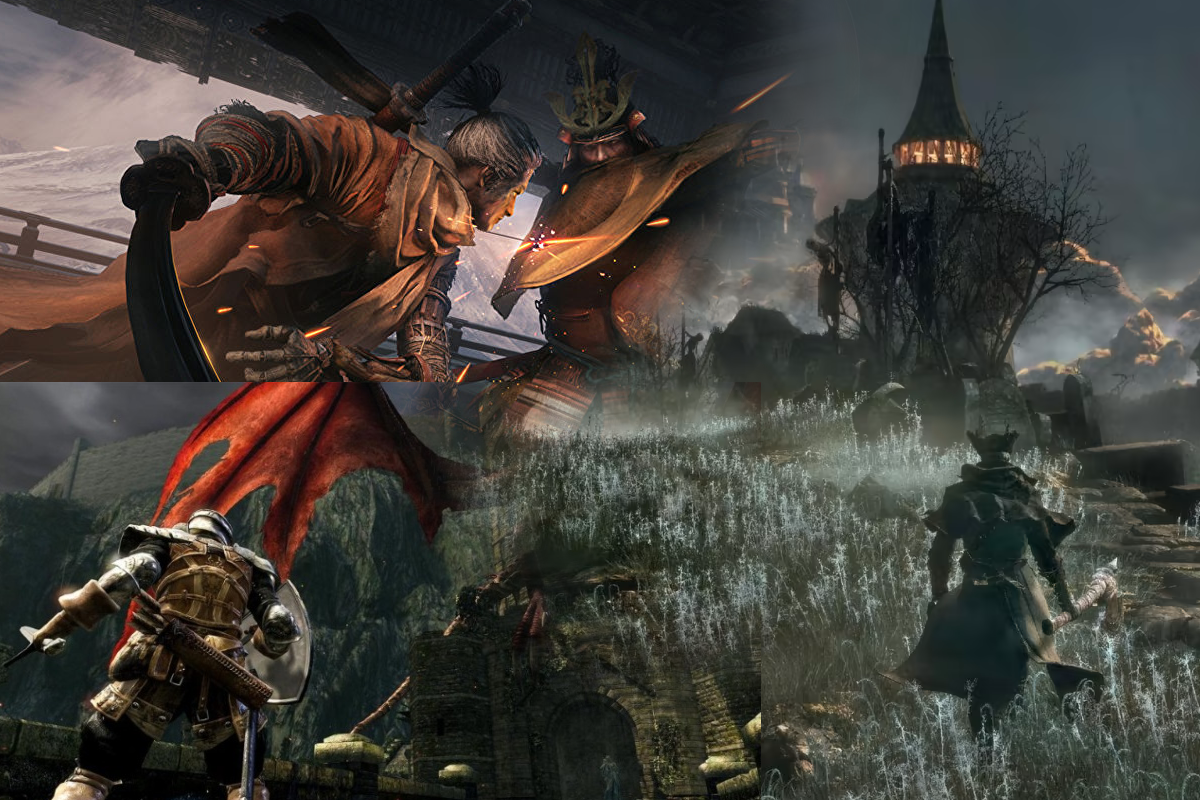
FromSoft and The Taxonomy of a Parry

I love parrying things in video games. You might have already guessed that. I’m always looking for how and why things work or don’t work in games, so I have a particular interest in one of my favorite gameplay mechanics, the parry. So what is a parry? In the context of an action game, I’d define it as a maneuver the player can execute on the fly to nullify incoming damage and disarm enemy defenses, which requires an acute execution of timing to succeed. Commonly, it’s a button press that initiates a short window of animation during which, if an enemy attack connects with the player character, the parry activates. After considering how to approach the design of this gameplay mechanic, I’ve decided there are three pillars of a good parry mechanic: usability, versatility, and impact.

Usability describes the practicality, from the player’s perspective, of actually using the parry at all. How restrictively difficult is the timing necessary to succeed in using one? Is the risk of using the parry worth the reward? How necessary is the use of this parry to succeeding within the game? Are there other specific considerations like spacing that make the parry more or less practical?

Versatility describes the frequency of general use cases for the parry. Can the parry be used to deflect any attack encountered in the game, or is it limited in some way? Can even large and powerful enemies be parried? Do you need a specific weapon or in-game skill to use the parry? Is the parry’s reward worth forgoing a more straightforwardly offensive approach?

Impact is at the center of what makes me want to use a parry. A parry can be powerful, but ultimately I am motivated to use it by how fun it is. What’s the audio-visual feedback of a successful parry like? Do I get a rush from disarming my opponent, or is the reward for parrying barely noticeable? Does it make me feel powerful? Does it make me feel skilled?

FromSoftware or FromSoft is a Japanese game developer well known for their popular action games, all of which in recent memory include a parry of some kind. I want to run through three of their flagship titles, the original Dark Souls, Bloodborne, and Sekiro: Shadows Die Twice, and analyze their respective parry mechanics through this lens I’ve come up with to see how it can be applied to specific cases.

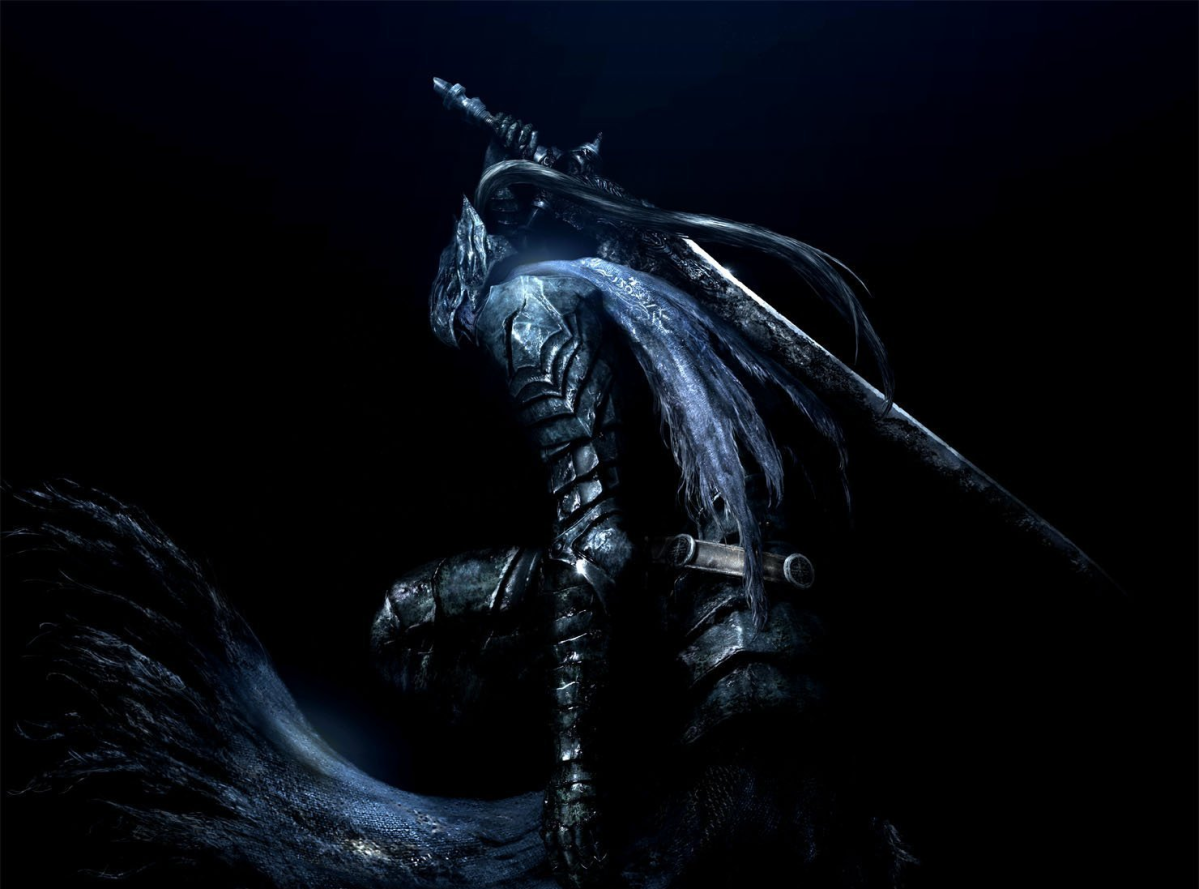
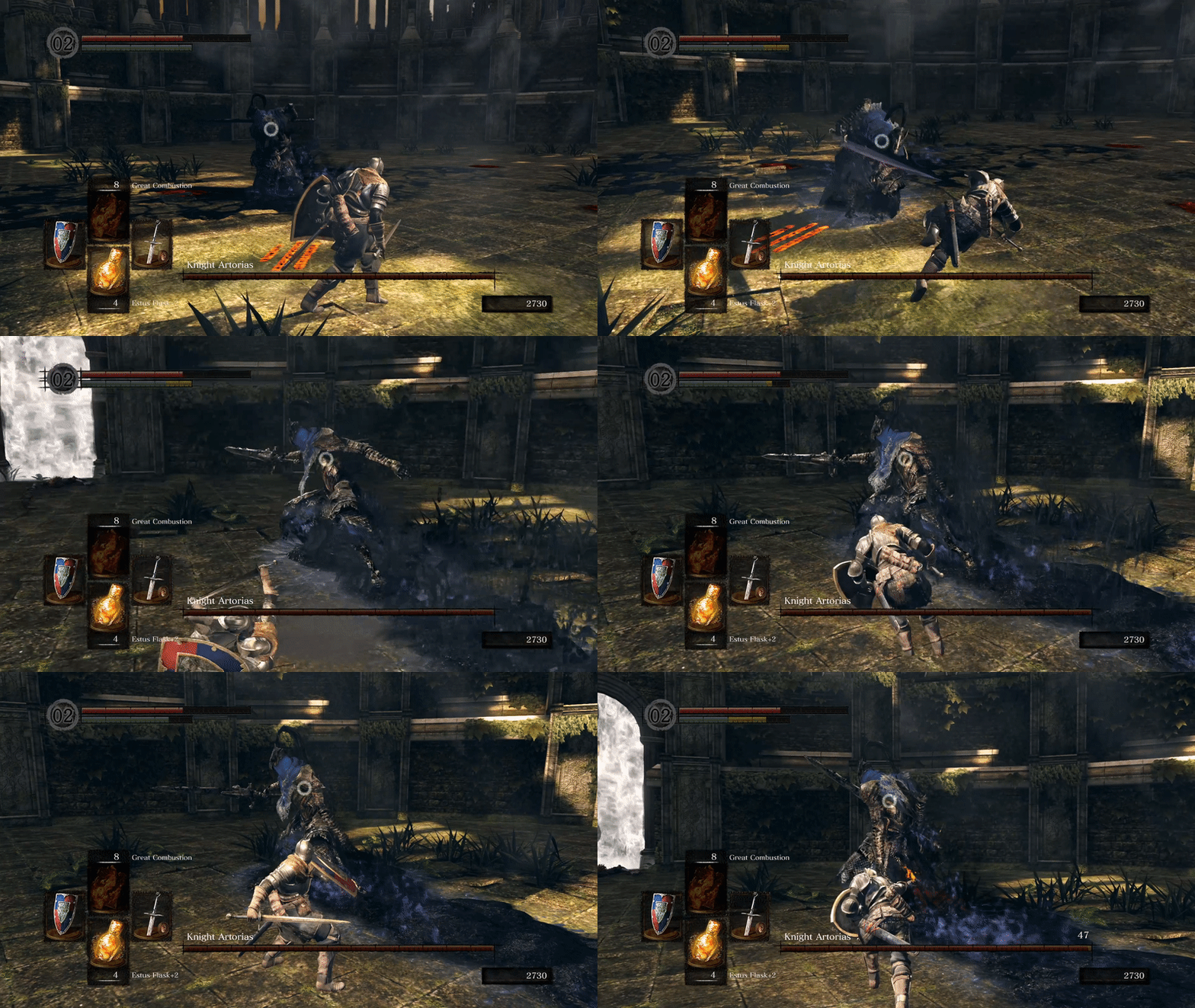
The parry mechanic in Dark Souls is an interesting beast. A favorite of the game’s more hardcore fans but, in my experience, one that new and even many veteran players ignore completely. It’s powerful, and it’s fun to use once you get the hang of it, but that’s kind of the problem, it’s not very fun to learn to use, and many players will not bother with it, as it is far from essential to completing the game. I’ve found most friends I’ve introduced to the game simply ignore the utility of parrying, or try it once and discard it in favor of the game’s more developed mechanics.

Though powerful, the parry in Dark Souls is stiff, restrictive, and difficult to master

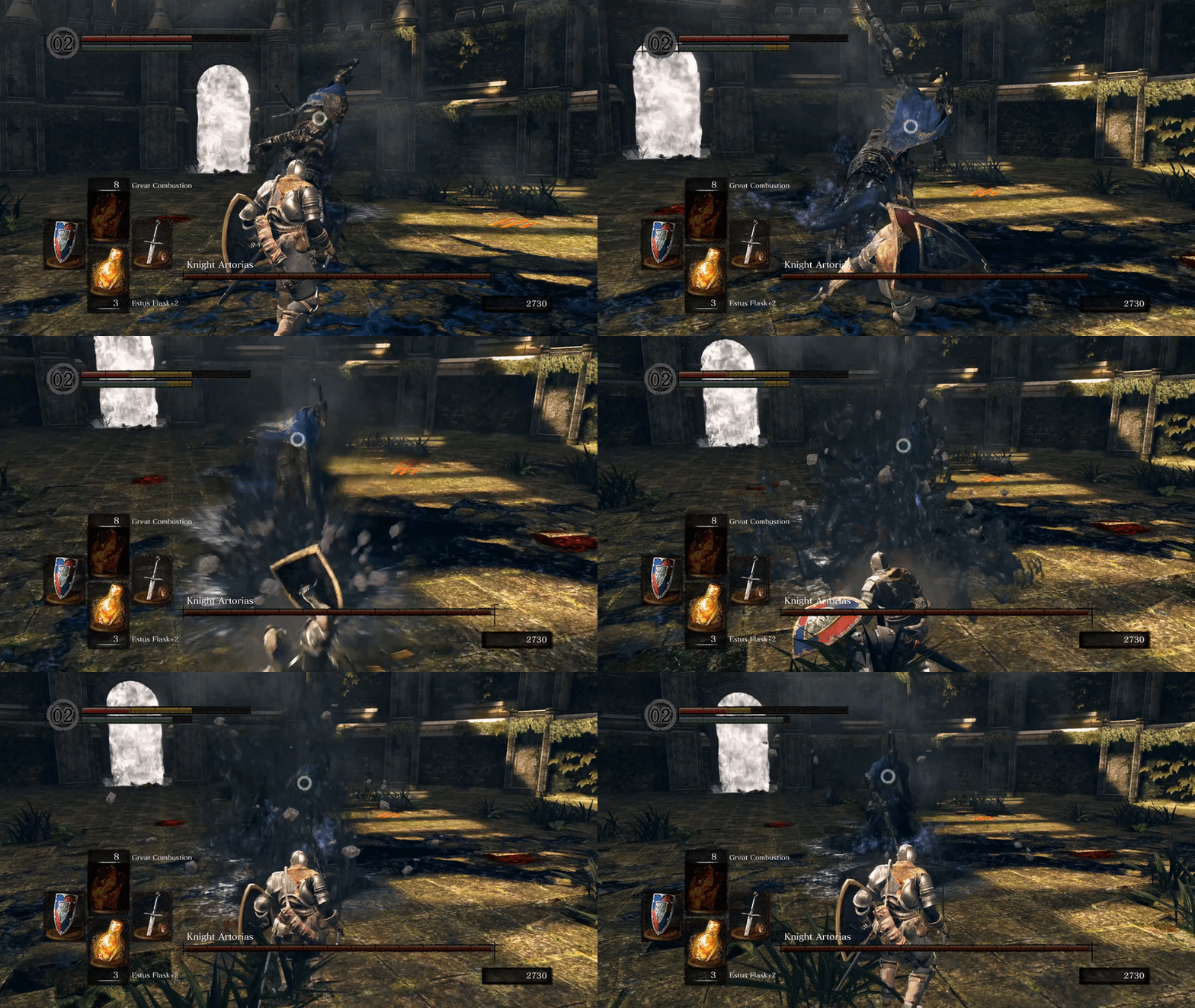
The parry in Dark Souls suffers severely from a lack of usability and versatility. Usability, as I explained, is my concept of how practical it is for a player to actually execute your parry maneuver consistently and successfully. Firstly, this parry is not universally available – the player must be wielding a small or medium sized shield in their off-hand. Given the wide and varied options of character customization in this game, it’s possible a player won’t be using a shield at all. I think the greatest source of dissuasion for using this mechanic, though, is how difficult it is to succeed with it. Dark Souls has a very specific and narrow window of time at which a parry will succeed. An enemy’s attack must connect with the player character during this 6 frame window – that’s one fifth of a second. Needless to say, it is a difficult mark to hit. Now, with practice one can hone in on Dark Souls‘ very consistent and reproducible rhythm. Not every enemy attacks with the same timing, but they all share a fairly general pattern of wind-up, swing, and follow-through. Once you get it, you’ll find parrying a pretty consistent tool.
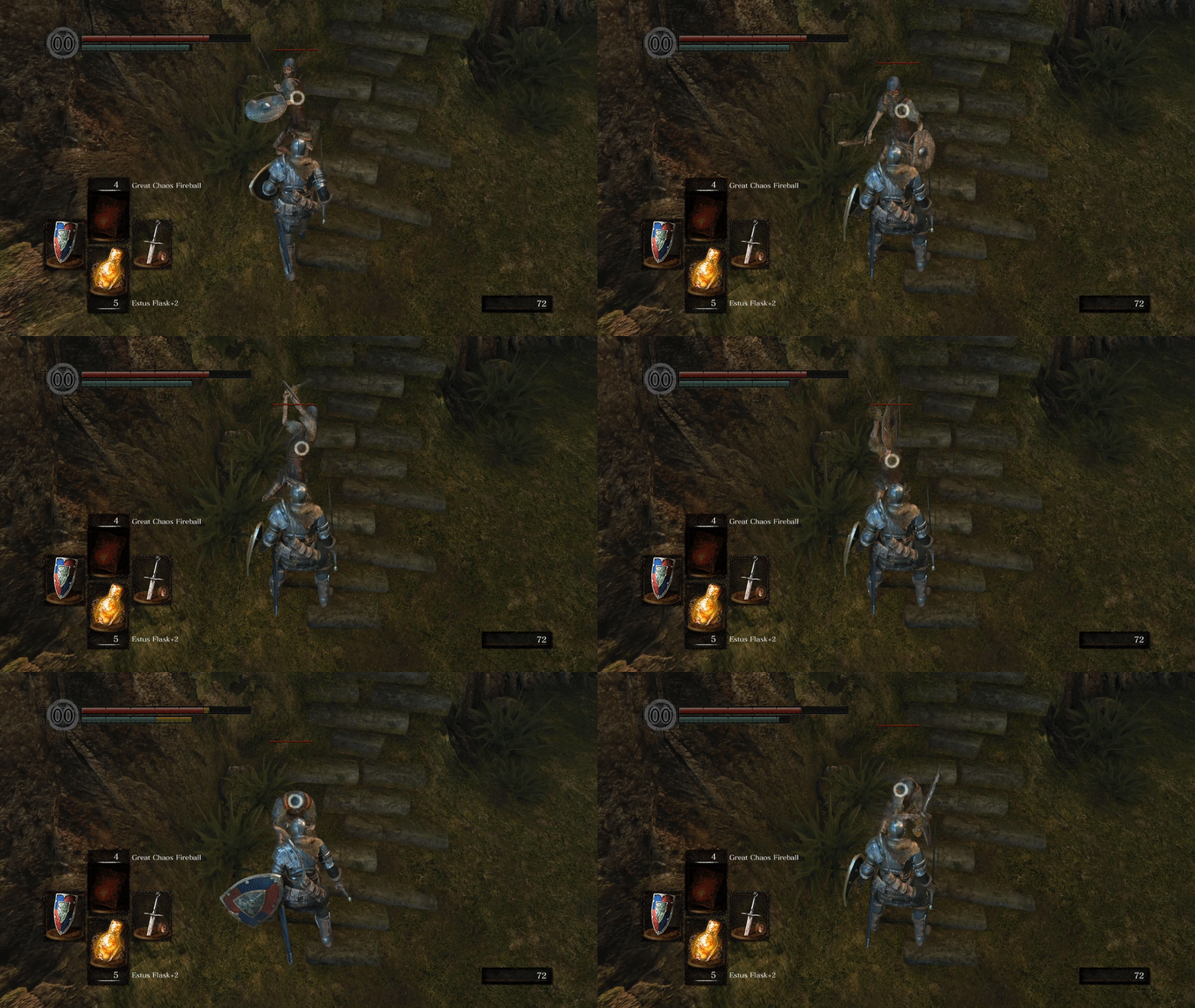
Failing to parry can result in incurring massive damage, and its timing is excessively strict

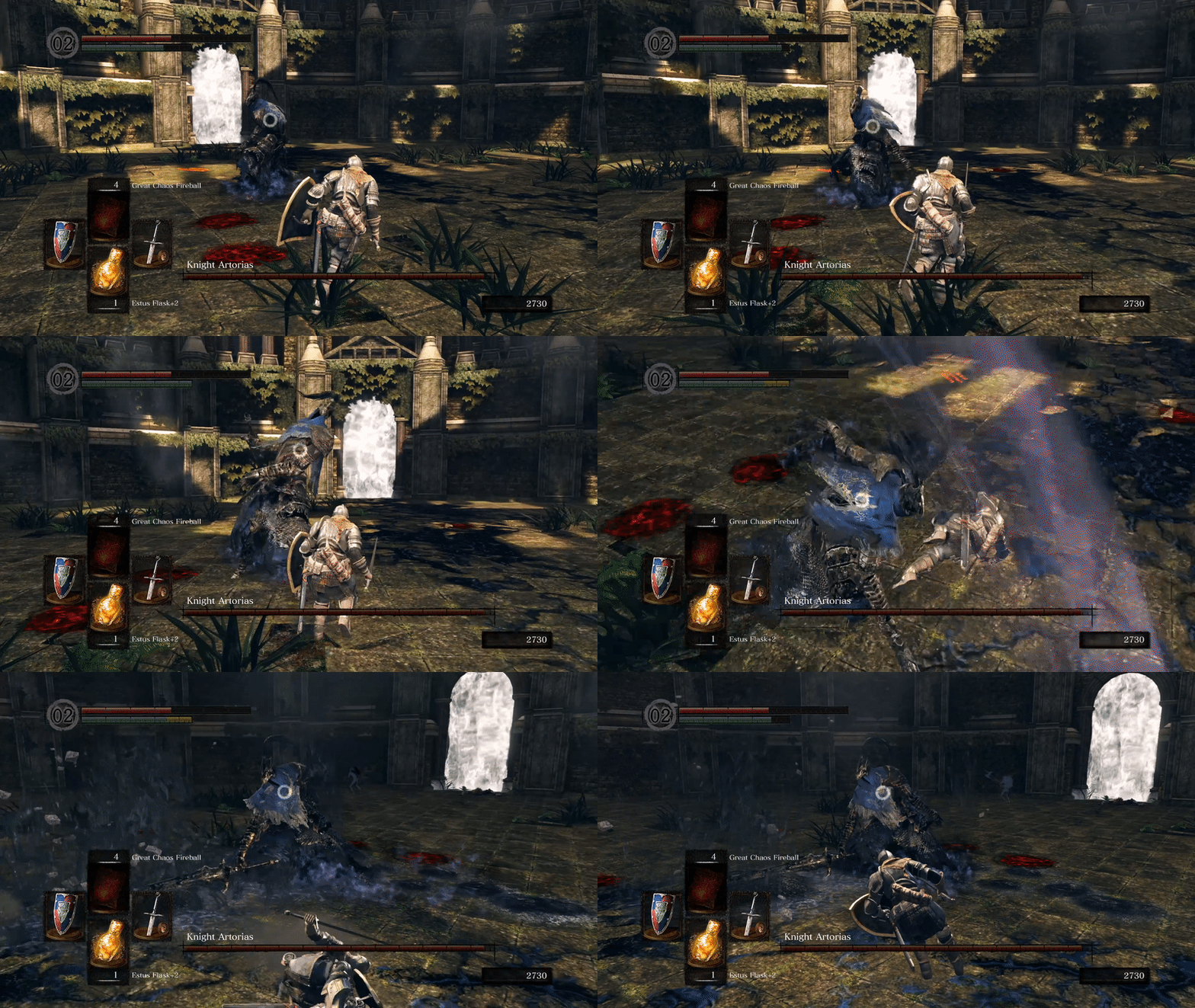
However, the skill floor to reaching this point of consistency is restrictive, even by this game’s standards. Given how great the risk is of failing a parry in this game, and how the game itself trains players to be extremely risk-averse with enemies that deal massive amounts of damage when interrupting player actions, players are naturally disinclined to even take those risks. Thus, they’ll not learn the parry timing. What’s more, most enemies can be thoroughly dispatched, with far lesser risk, by simply striking them down with your favorite weapon or spell when the foe’s defenses are down, between their attacks. I conclude that the parry in Dark Souls is not entirely practical, or usable without a great deal of personal investment, time, and effort most players will find better spent in learning the nuances of movement, dodging, and attacking. These options are far more practical, realistically, even if the parry becomes very powerful once one masters it.
The impact of this parry is intense, and intensely reward, so it’s a shame it’s so hard to use

This would be enough turn off most players from the mechanic on its own, but the move also struggles in the versatility department, meaning the frequency of its general use cases. Dark Souls is filled with enemies that can be parried – essentially any enemy that can suffer a backstab. I’d always say that any enemy with an obvious spine that your player character can reach can probably be backstabbed and parried, as a general rule of thumb. Not every enemy matches this criteria though, and nearly none of the game’s 25 boss encounters do either. Boss encounters are a major part of this game, and something players will be spending a lot of time on. They’re also notoriously among the game’s most difficult and high-intensity segments. Since parrying is useless in those encounters, it further disincentivizes paying the mechanic any time or energy. If you can’t use a move for a game’s greatest challenges, what worth is it? Any real world skill building towards parry mastery is, objectively, better spent on other things, if finishing the game is your goal.

I like using the Dark Souls parry – it’s got excellent impact. A harrowing low boom sound effect accompanies its successful use. Parried enemies reel in a wide, exaggerated swooping animation, soon to be followed by a riposte that drives a weapon straight through them, gushing comical amounts of blood (if the foe has blood). It all really accentuates the player’s power and superior skill over the opponent. The totality of the audio-visual feedback here is excellent, it’s just a shame so few will ever get to actually see it. The move is simply not useful to a significant portion of the player base.

When a mechanic like this goes so underutilized by your players, the designer might ask themselves what’s causing this discrepancy, and what can be done to address it.

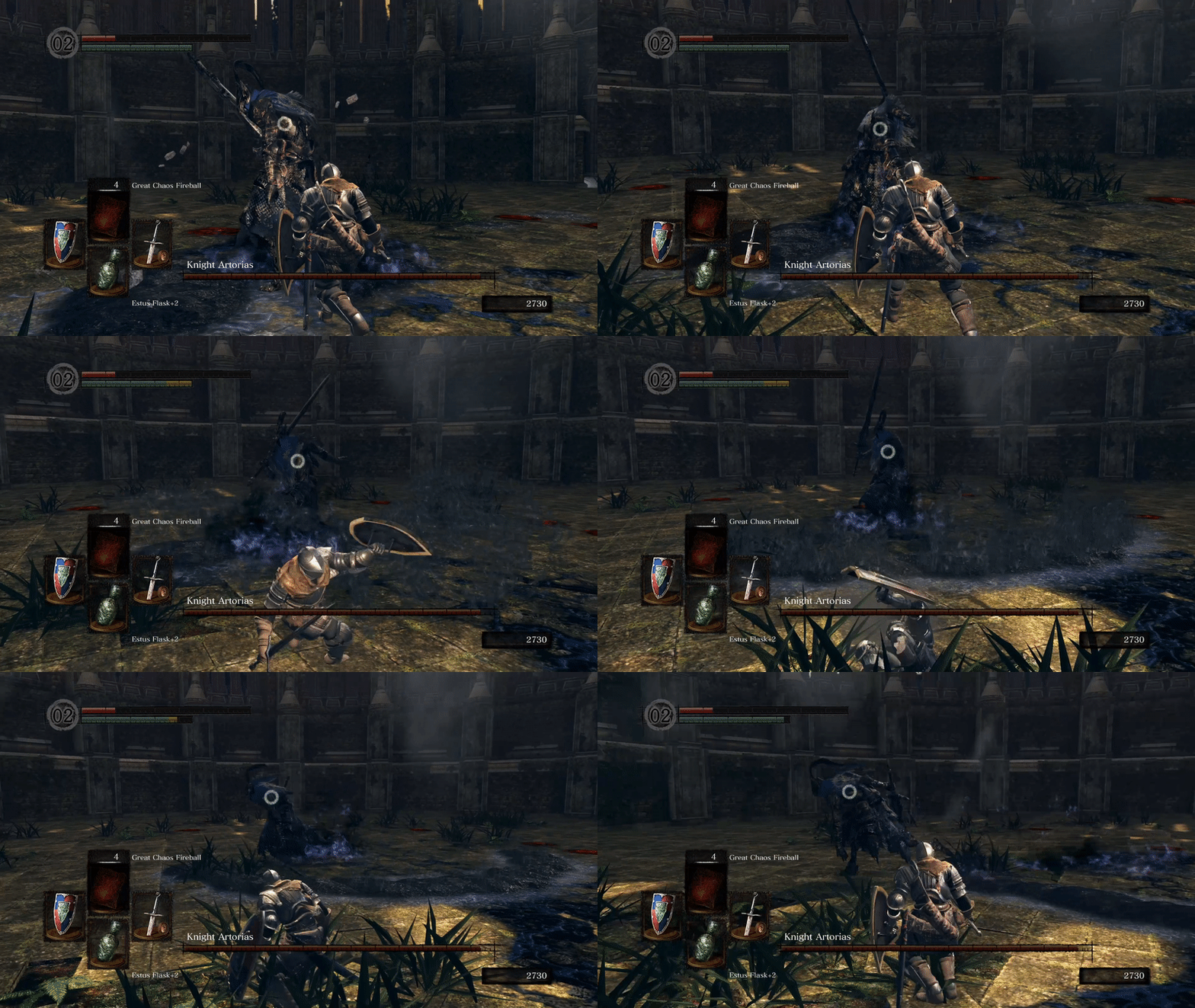
In Bloodborne, FromSoft wanted to shift to a more action-oriented system, less about patient and considered movements, more about reaction and aggression, as compared to Dark Souls‘ more traditional RPG inspired roots. As part of this shift, the parry in Bloodborne was made to be more of a central mechanic than in Dark Souls, something to be expected of the player regularly throughout combat encounters. So that means getting players to actually use it. First, FromSoft needed to address usability. Bloodborne‘s parry is unique in that it takes the form of a projectile. This accomplishes two things. One, it makes accounting for space exceedingly easy for players. Dark Souls was fairly strict about where player and opponent were standing for a parry to successfully work. In Bloodborne, if an enemy is shot during the tail end of its attack animation, it will be parried, no matter its distance from the player. Two, this means the player does not have to put themselves in direct danger to parry, as an enemy can be parried even if their attack is very unlikely to actually hit the player. The risk to parrying now feels much more proportional to the benefit, making it a valid alternative to just wildly attacking.

Even when incurring damage, it’s possible to parry in Bloodborne, the mechanic is forgiving

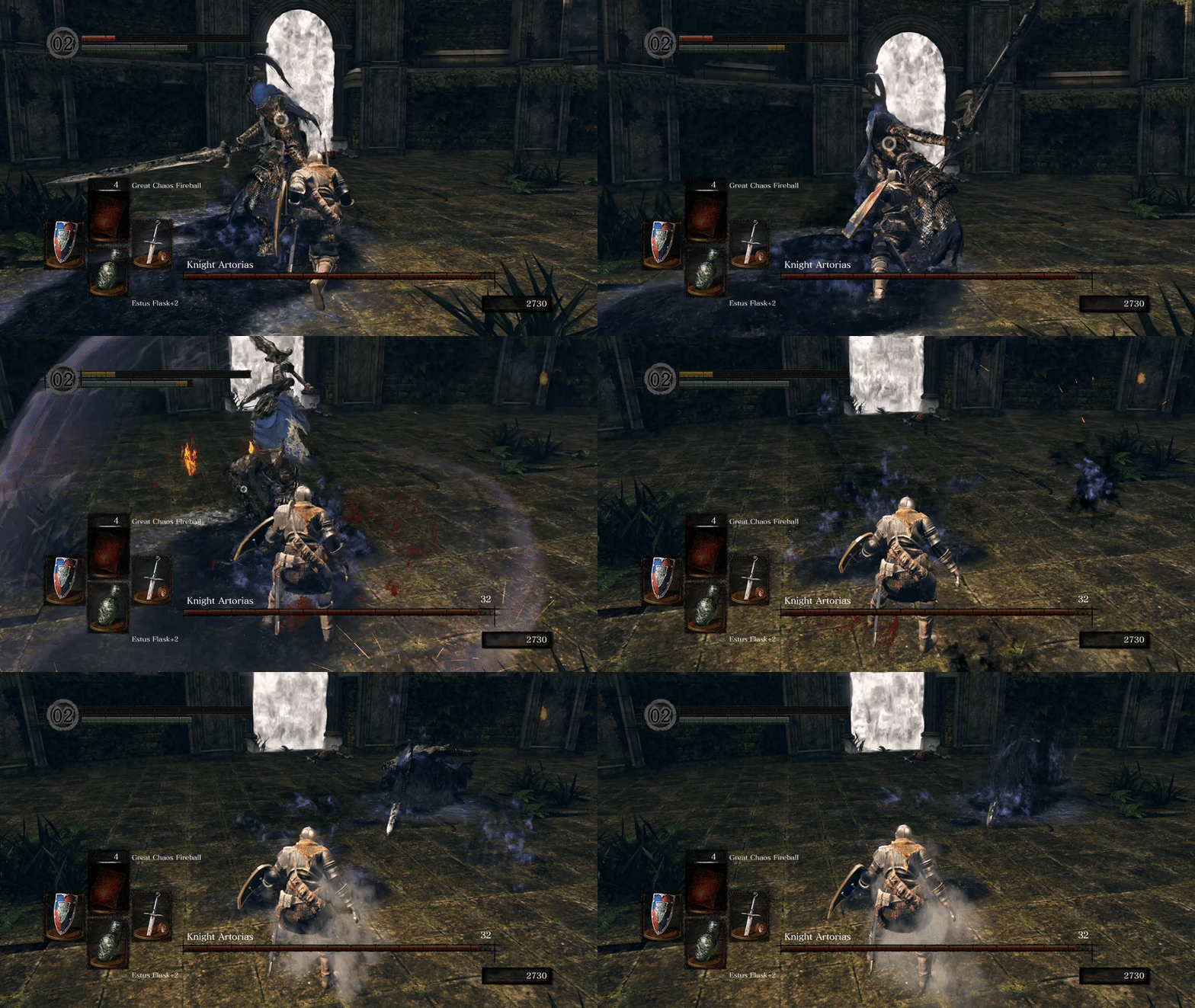
As the timing for Bloodborne‘s parry is now timed to the enemy‘s attack, and a moving projectile, rather than lining up the player’s parry animation with the enemy’s animation, the player really only has to track one movement, the enemy’s. Together, these elements remove a ton of cognitive blocks on actually using Bloodborne‘s parry system, so its usability is extremely effective by comparison. Bloodborne‘s parry is also extremely versatile. When looking at the 30 or so bosses in the game, about 15 of them can be parried, roughly half, making mastery of the parry a far more effective tool in way more situations than it was in Dark Souls. Bloodborne doesn’t shirk in the impact department either. The same familiar boom sound effect accompanies a success, and can be followed up with a violent and beastly visceral attack that grabs the enemy’s insides, twists them, and rips out a huge gush of blood, knocking the foe to the ground and stumbling nearby enemies. The player hunter’s sense of superiority over their prey is the focus.

Even the biggest and burliest can be parried, and at a distance too!

The Dark Souls parry had another issue I didn’t mention; if you did master it, and made it a consistent tool in your arsenal, many enemies outside of boss encounters become exceedingly easy to deal with, even if they are still fun to beat. Nevertheless, this runs the risk of the move becoming too powerful, especially if it’s easier to use. FromSoft’s solution to this was to make parry attempts a limited resources. This elegantly maintains the risk of attempting a parry, while assuaging the frustration of losing one’s own progress as a result of said risk. There’s still some risk of injury to a failed parry, but it’s much less likely than in previous games, most of the risk is the parry-centric resource of quicksilver bullets.

If Bloodborne made parrying a more central mechanic, then Sekiro made parrying a core mechanic, one of the primary action verbs of the game. Parrying is most of what you do in combat. Formally, the Sekiro move is called ‘deflection’.

To accomplish its design goals, Sekiro‘s parry is made to be even more accessible and low-risk than Bloodborne‘s. A deflection can be directly transitioned into from a block (which itself nullifies incoming damage), and a block can be transitioned to directly from a deflection. Both ‘block’ and ‘deflect’ are activated with the same button, block is simply the result of holding it. Deflections are initiated when the button is compressed, not when it is lifted, so erring on early deflections makes the maneuver even safer – deflections that fail for being used too soon simply result in a block. No damage is taken either way. The limiting resources of Bloodborne are gone here, at least for parries, so player’s will often find themselves using the deflection move even more than they attack, but this was the goal. Sekiro aims to evoke the back-and-forth clanging of cinematic sword fights, and the game is built around the interest of deflecting a series of attacks in quick succession. Any one given deflection is easy, but the difficulty can be smoothly ramped up by stringing a sequence of them together.

Sekiro conditions the player to use a series of parries as a defensive, and offensive tool

We’ve come a long way since Dark Souls, with a skill floor that is extremely approachable, without sacrificing the skill ceiling. Where the parry window of Dark Souls was only 6 frames, one fifth of a second, Sekiro‘s deflection window starts at the extremely generous, by comparison, half-second. This deflection window decays in size if the player abuses the deflect button. Deflecting rapidly and repeatedly causes the window to shrink down to only a small fraction of a second. The goal is to make any given deflection easy, but the player is encouraged to use their own powers of reaction and prediction, rather than relying on spamming the button. Even still, this window decay is also generous, as the deflection’s full capability is restored after only a half second of not using it.

All this to say, Sekiro has extremely generous usability for its deflection mechanic. It has to, as deflection is the primary tool for defeating enemies in this game. Were it as restrictive as the parry in Dark Souls or even Bloodborne, it would be an exercise in frustration. To counterbalance this, the individual reward for one Sekiro deflection is much lesser, and you need to do a lot of deflections to add up to a bigger reward.

Sekiro is a masterclass in parry versatility. The deflection maneuver is applicable to nearly every encounter in the game. It’s extremely generally useful, so much so that exceptions, attacks which cannot be deflected, are unlikely to be deflected, or require other special maneuvers to deflect, are given their own glowing red UI graphic to further make them stand out. Outside of that, if it deals damage, it can be deflected by the player’s sword, near-universally. Formalizing what can and can’t be parried in this way is also helpful for usability, as it removes guesswork on the part of the player.

When deflecting successfully, right orange sparks fly like a firework cracker was set off as a cacophony of metal sounds clang in satisfying unison. The audio-visual feedback for a successful deflection is actually kind of subtle, compared to simply blocking. It is merely a heightened, more intense version of the block visuals, just distinct enough to unambiguously be its own separate function to ensure players know when they’re succeeding, but similar enough to not be distracting. This makes sense, as players are expected to deflect a lot of attacks in any given encounter. A series of successful deflections looks and sounds like a larger-than-life battle of master swordsmen, with sparks showering about amidst the metal clanging. When an enemy has finally been deflected past the limits of their endurance, Sekiro will delight players with some of the most lavishly animated executions in video games, anything from the tried and true gut-stab, to decapitating a gorilla with a hatchet the size of a refrigerator, to gingerly extracting tears from a dragon’s occular injury. The impact of Sekiro‘s parry system is not only good, but usually proportional to each situation, even though the overall impact of any one given deflection is not super intense.

It’s clear somebody at FromSoftware loves parrying things almost as much as I do. It’s a common mechanic for a reason, giving players an area of skill to strive for mastery over, which reinforces a sense of power. Few things can make a player feel more powerful than successfully turning enemy attacks against them. Over the course of these three games, FromSoft has made parrying more and more central to the experience, to the point of it becoming the main point of focus for Sekiro. It’s clear there was an awareness of how neglected parrying was in Dark Souls among casual players, and even some veterans. They needed to find ways to make using it more attractive, without sacrificing the sense of power it imparted, the thing that makes it fun in the first place. While the Dark Souls parry has its flaws, I’m glade they persisted in iterating on it. I think Sekiro and bloodborne have two of the most consistently fun combat systems out there, and the excellence of their respective parry mechanics are a huge part of that, in Sekiro especially, which deserves its own write-up, eventually. The metrics I’ve come up with here to assess parry mechanics are just the way I look at things, though. It’s useful to look at design through a variety of lenses. So the next time you stab some zombie in the face after battering its arm away like you’re in a kung-fu movie, think about why and how that maneuver works the way it does.
Hesitation is Defeat…

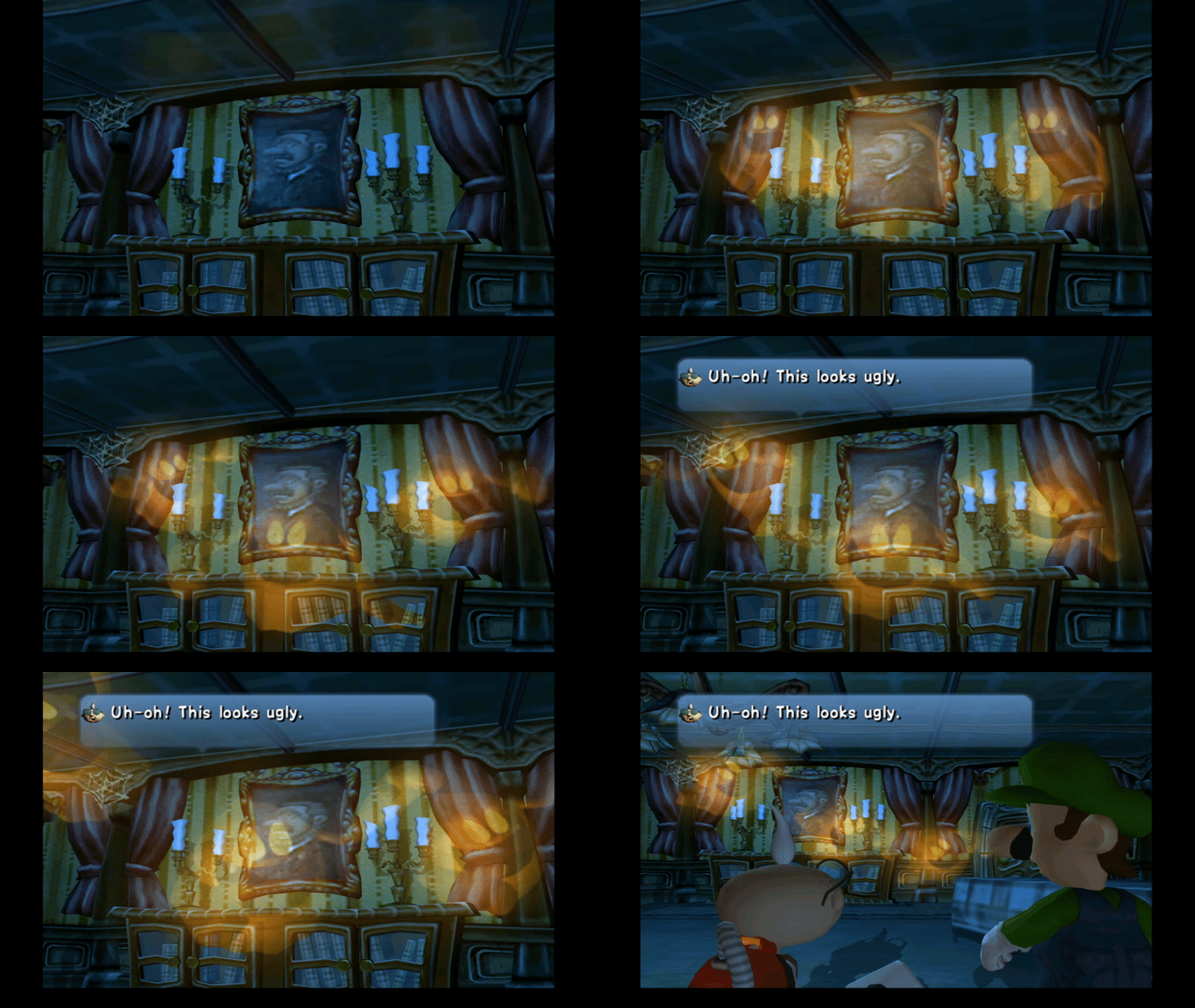
The Iterations of Luigi’s Mansion

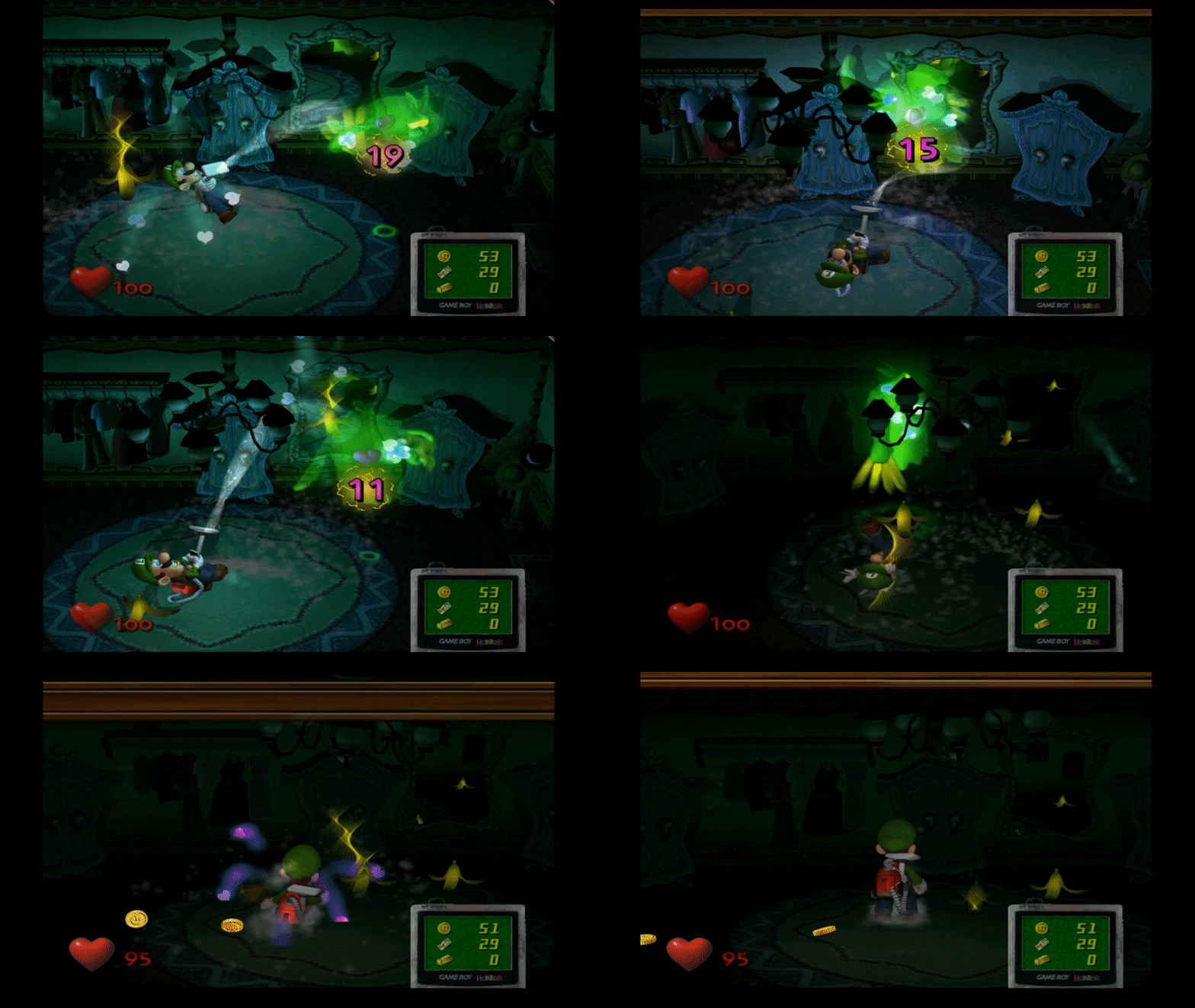
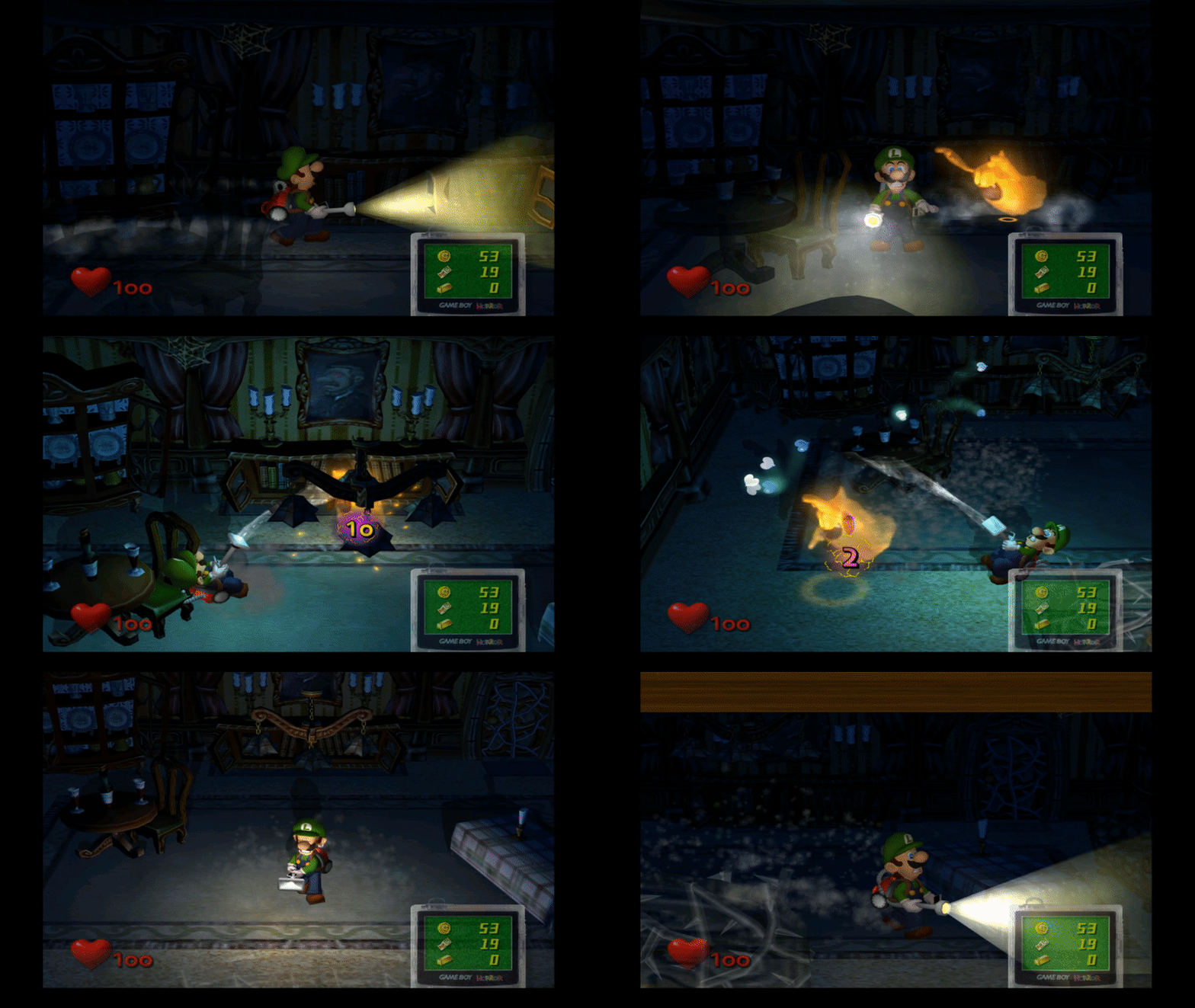
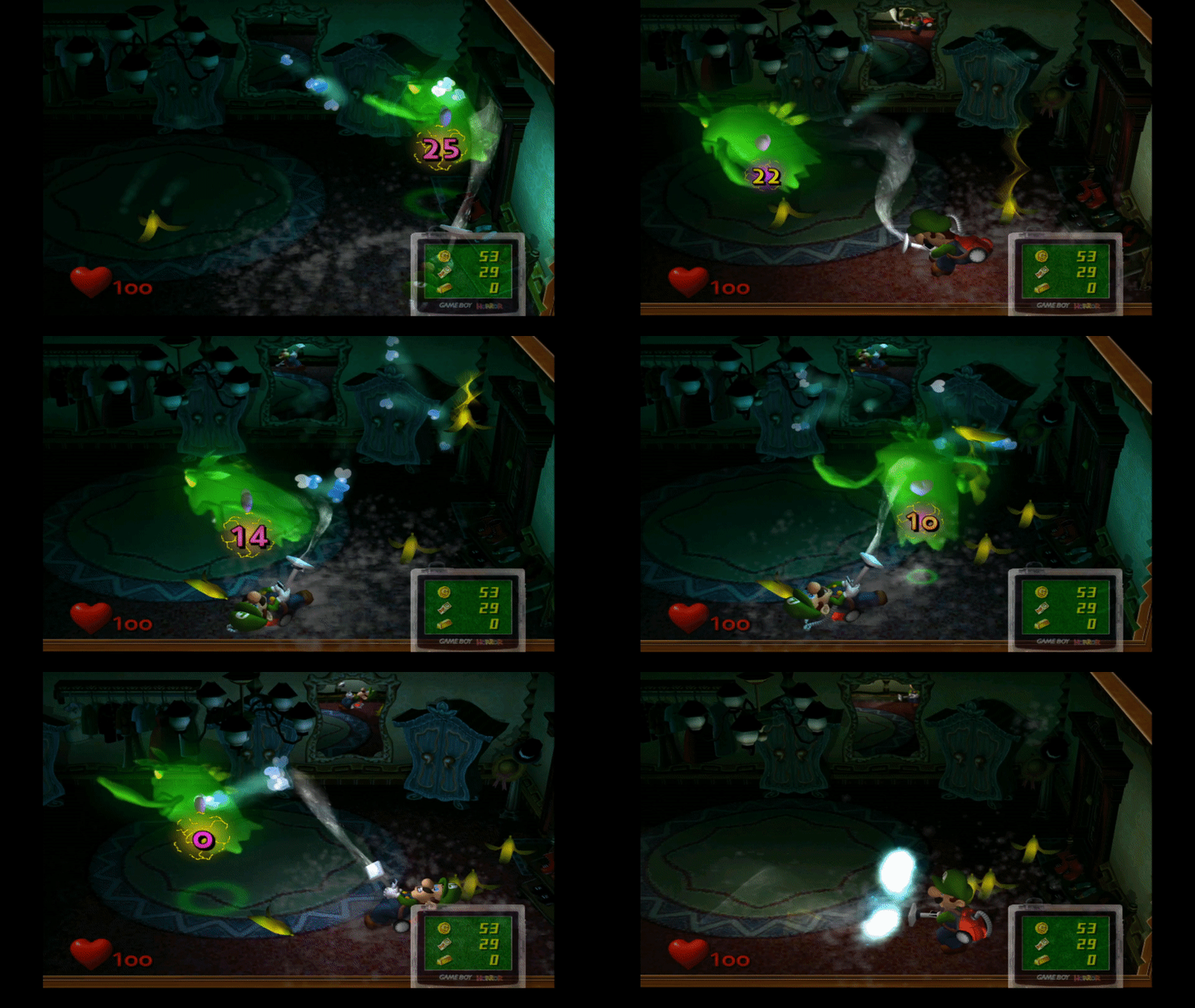
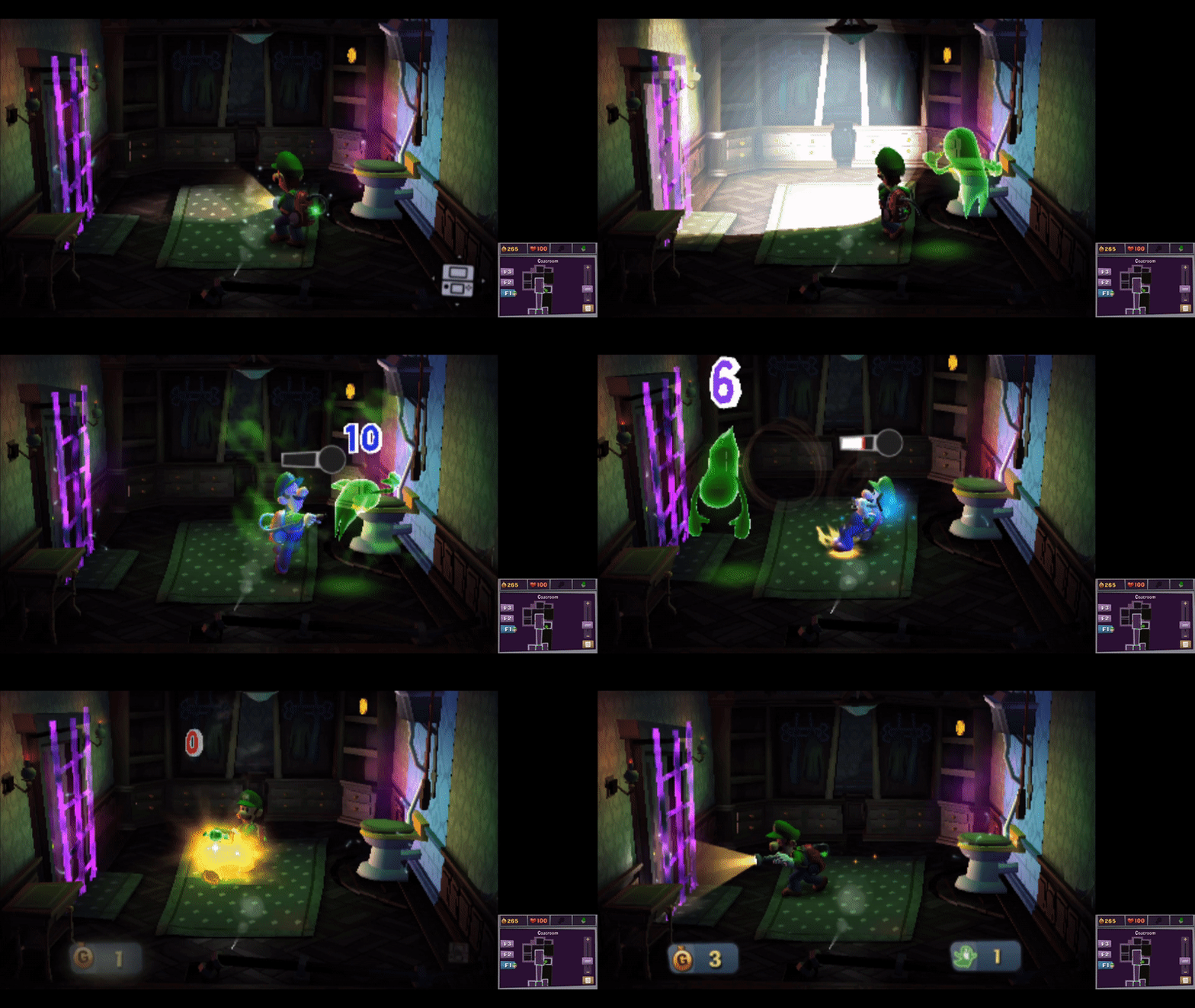
Alright to finish off Spooky Month I’ve got to talk about the spookiest game franchise there is; Luigi’s Mansion. It’s the superlative. There is no other. That’s science. Luigi’s Mansion is an action adventure game (does that mean anything?).. Luigi’s Mansion is a spooky ghost-catching action game centered around methodically exploring a creepy mansion whilst engaging in periodic encounters of high-action ghost-hunting that punctuate the gloom. It released in September 2001 for the Nintendo GameCube, received a sequel in March 2013 titled Luigi’s Mansion: Dark Moon for the Nintendo 3DS, and a second sequel, Luigi’s Mansion 3, in October 2019 for the Nintendo Switch. All the games’ action plays similar on the surface, involving a lot of running around, bumping into things while you fight ghosts in a tug-of-war scenario. They’ll drag you around the room, and you’ll suck them up by the tail with a vacuum cleaner. The player can lean Luigi around in different directions to have a limited control of his movement while the ghosts try to escape his vacuum. Leaning away from the ghosts drains their energy faster, and poor movement control might let the ghost escape. The combat of Luigi’s Mansion is easy to grasp and instantly satisfying. What I’m interested in though, is how the simple systems were iterated on in its followups. In particular, why I found the combat of Luigi’s Mansion 3 so blase so often.

The game doesn’t look that bad for being over 20 years old. At least I didn’t use the 3DS version.

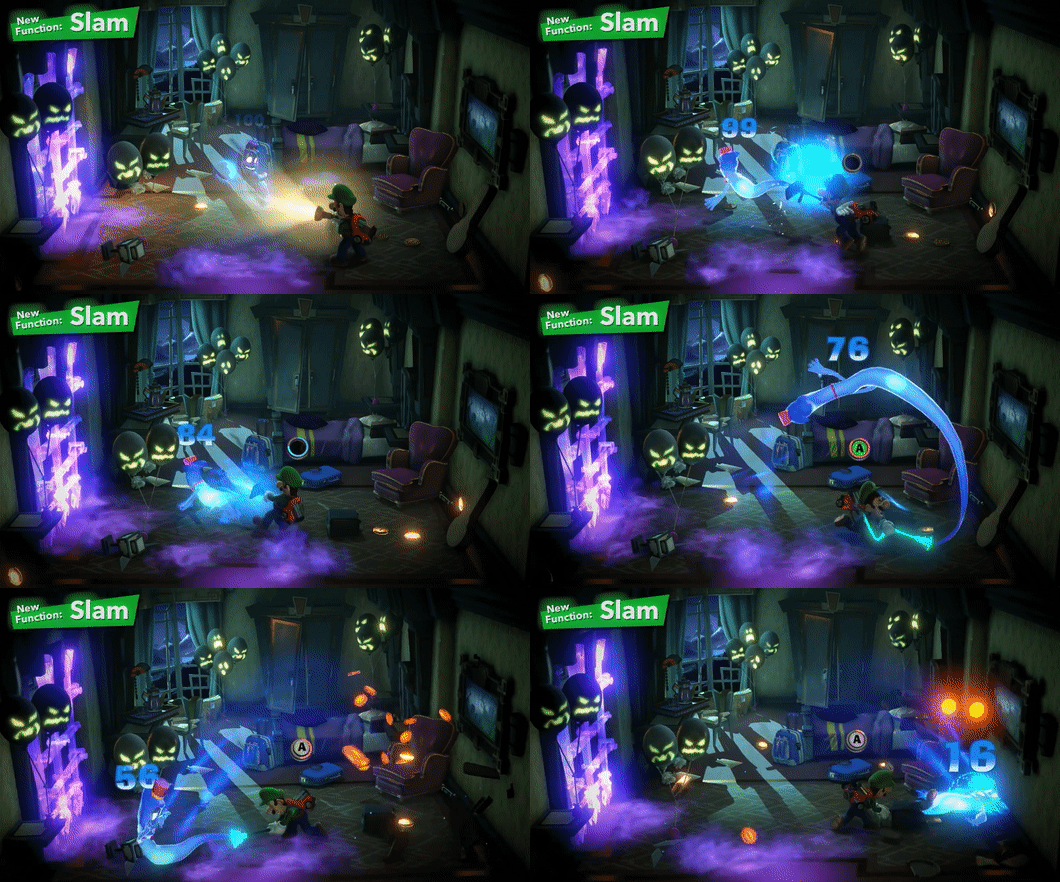
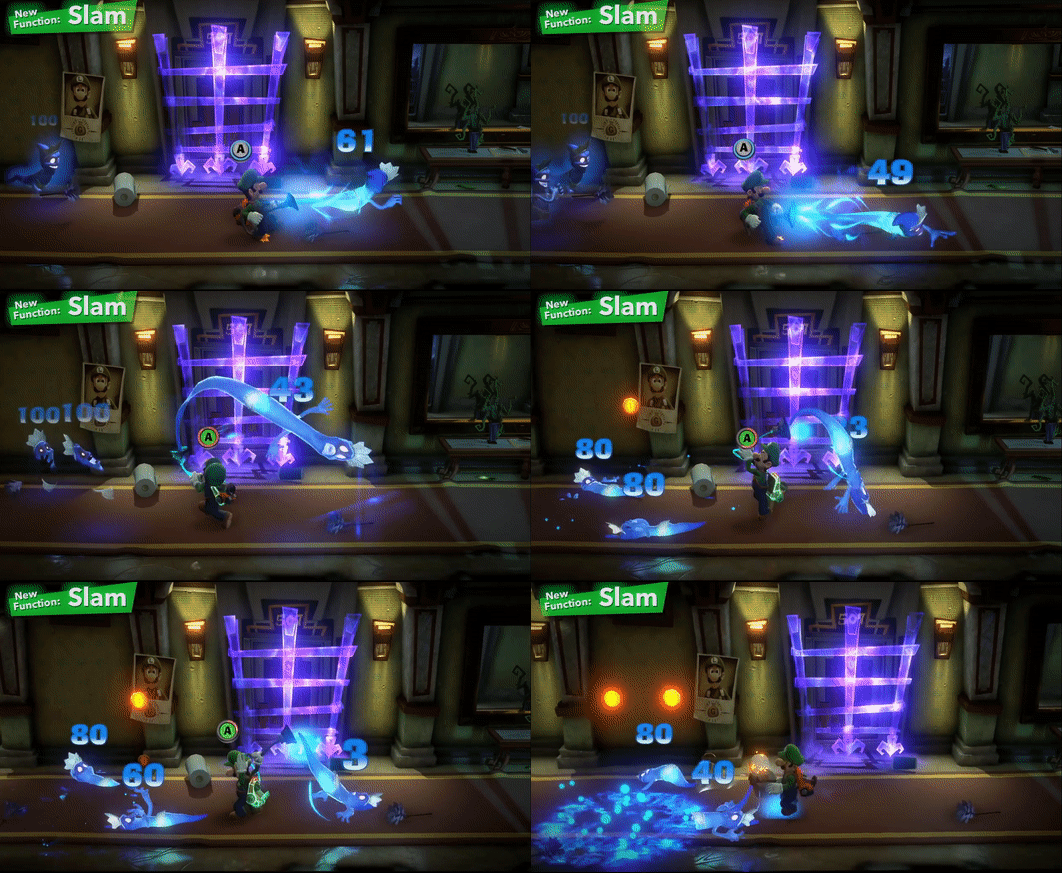
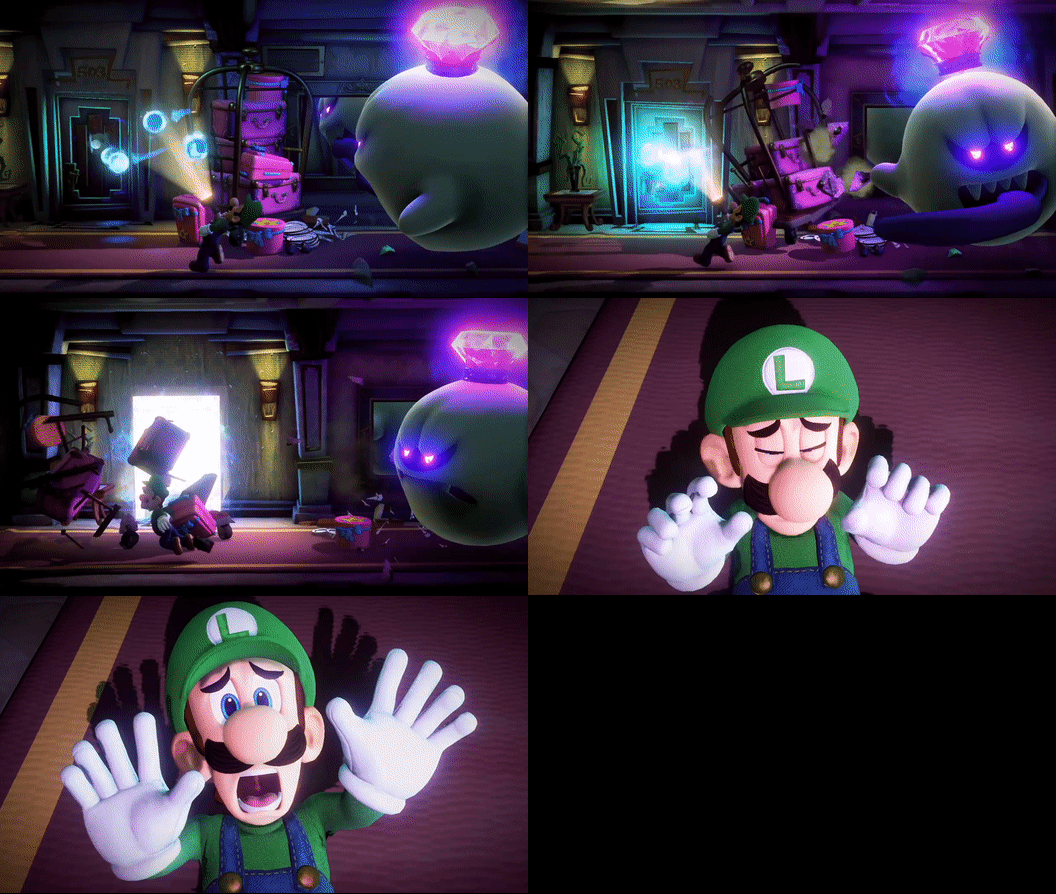
Aha, yes. Plot twist, I actually think the combat in Luigi’s Mansion 3 is pretty weak in comparison to its predecessors. The games play mostly the same, and there aren’t that many elements in play here, relatively speaking, so it shouldn’t be too difficult to suss out what’s going on here. Luigi’s Mansion 3 introduced a mechanic called the slam to Luigi’s arsenal, which allows him to, after vacuuming a particular ghost for a short time, repeatedly slam the ghost into the ground, in any direction, stunning and damaging other ghosts while annihilating his main target’s energy. It quickly becomes a one-size-fits-all solution to any ghost altercation outside of boss fights, and isn’t an especially engaging mechanic on its own.

My brain cells preparing to critique one of the Nintendo Switch’s most critically acclaimed games

Luigi’s Mansion 3 was never going to miss out on its well-earned popularity for lack of a more considered difficulty curve. Being too easy isn’t exactly the problem I have. Luigi’s Mansion 3 was always going to be popular because it is one of the most lavishly produced, polished, and animated Mario games of all time. I don’t really think Luigi’s Mansion 3 has bad combat. On the contrary, I think one among the many reasons for Luigi’s Mansion 3‘s notable anticipation was due to its less talked about predecessor’s proof of concept. It showed that the off-beat, frankly weird gameplay of Luigi’s Mansion was a formula with staying power that had room to grow as a robust system. Indeed, Luigi’s Mansion: Dark Moon doesn’t quite get the credit it deserves for what it contributed to the notoriety and design ethos of Luigi’s Mansion. Luigi’s Mansion 3‘s combat has its basis in Dark Moon and works well enough as a result. Dark Moon is where most of the changes to the formula came from and they are for the most part, positives.

The strobulb is Dark Moon‘s first prominent addition. Where in the first game, sweeping one’s flashlight over a ghost’s exposed eyes was sufficient to stun it and open it up for being captured, Dark Moon requires an active button press. The light will flash brightly, and anything caught in its cone will be stunned. The strobulb can also be charged up for a wider flash that is less likely to miss its mark, and has the added bonus of hitting many more ghosts at once. The original GameCube game made stunning ghosts in this way passive – simply sweeping the light over them is sufficient. Speaking of passivity, I liked the way the first two games in this series made defeating ghosts such a concerted effort. They would drag Luigi about the room, possibly ramming him into obstacles. The player’s own control input was the only thing stopping them. Admittedly this aspect of being dragged around a room began to be de-emphasized in Dark Moon, and that trend continued in 3.

Finished in a flash … *cough*

On the flip side, Dark Moon added the power surge ability, which would let Luigi deal extra damage to a ghost he had been focused on for a certain amount of time, uninterrupted. Adding this simple additional button prompt helps keep the player feeling like an active participate, among other advantages like rewarding skilled play. The slam move is an iteration of the power surge, whereas now pressing the button after focusing on a ghost will slam it into the ground for massive damage, and this can be repeated multiple times on one charge. The move is so powerful and repetitive I often found myself passively clearing rooms of ghosts without thinking much of it.

That’s not to say that passively oriented gameplay is inherently a negative. There’s plenty of passive gameplay in Luigi’s Mansion anyway. It’s an atmospheric piece about slowly creeping through an abandoned estate. If action is half of what you do, the other half is kind of just wandering around, albeit in a extremely realized world dripping with personality. The point is, the action could stand to have some active engagement to accentuate and contrast the more low key exploration. I think something that made the original GameCube game’s spooks stand out as so, well, spooky was how legitimately threatening ghosts could be, and how that threat made a real intrusion upon the quiet tension of Luigi’s nervous wanderings. Luigi’s reactions are telling me that I should be elevating my heart rate when ghosts appear, after all. The ghosts need to pose a legitimate threat.

Ghosts’ erratic movements can reposition Luigi into obstacles if you’re not careful

Luigi’s Mansion 3 is not lacking for interesting boss fights that feel legitimately threatening, but while bosses are often a highlight of their games, moments that stick out as particularly exciting or memorable, they’re not what you’re going to be doing in an adventuring game like Luigi’s Mansion 80% of the time. If most of what you do is fighting mooks, or if even half of what you do is fighting mooks, fighting those mooks may as well be fun, or at minimum engaging. I found the slam ability’s overwhelming power and utility distracting from this. I wasn’t engaging the core Luigi’s Mansion experience like I used to. I missed those chaotic tugs of war. What’s more, the animation for this maneuver just looks… wrong. I did mention this is among the most lavishly animated Mario games ever, and it completely is. There’s some real talent and attention to detail on display here, so it’s kind of confusing how strange the transition is on this loop of Luigi slamming the ground. The way he’s leaning his weight around just doesn’t make much visual sense. It looks much more like he’s supposed to shift from slamming on one side to the other, yeah? The natural motion here would be for him to swing the grappled ghost over his head. This is fairly obvious if you go out of your way to alternate what side of Luigi you’re slamming the ghost on.

The biggest problem, though, is in how powerful the slam move is, relative to how easy it is to use. The power surge mechanic in Dark Moon only served to accentuate and accelerate the flow of gameplay as it happened. An enemy with a piddling 10 hp is probably going to be captured by a skilled Luigi pretty quickly regardless, so the addition of the power surge mechanic would let a skilled player skip that extra 5 hp at the tail end of the engagement – we all knew they’d get through it no problem anyway. In this way it’s a reward for skilled play that keeps things smooth and flowing, but it doesn’t overtake the game’s main combat mechanics, it merely augments them. The slam, on the other hand, functionally replaces the combat of Luigi’s Mansion as it had existed up to the point of Luigi’s Mansion 3. It’s not a extra tool that augments gameplay, it’s a sledgehammer that is overwhelmingly more powerful than engaging with the game’s other tug-of-war mechanics. More often that not, the goals of struggling in a ghostly suction-y duel are shuffled aside for the goal of simply reaching the point where you can start slamming which, while rewarding in its own way, gets awfully repetitive in how readily available it is. It begins to homogenize the combat encounters of the game.

The slam animation loops really awkwardly, and IT DOESN’T SUCK UP GHOSTS WHAT?!

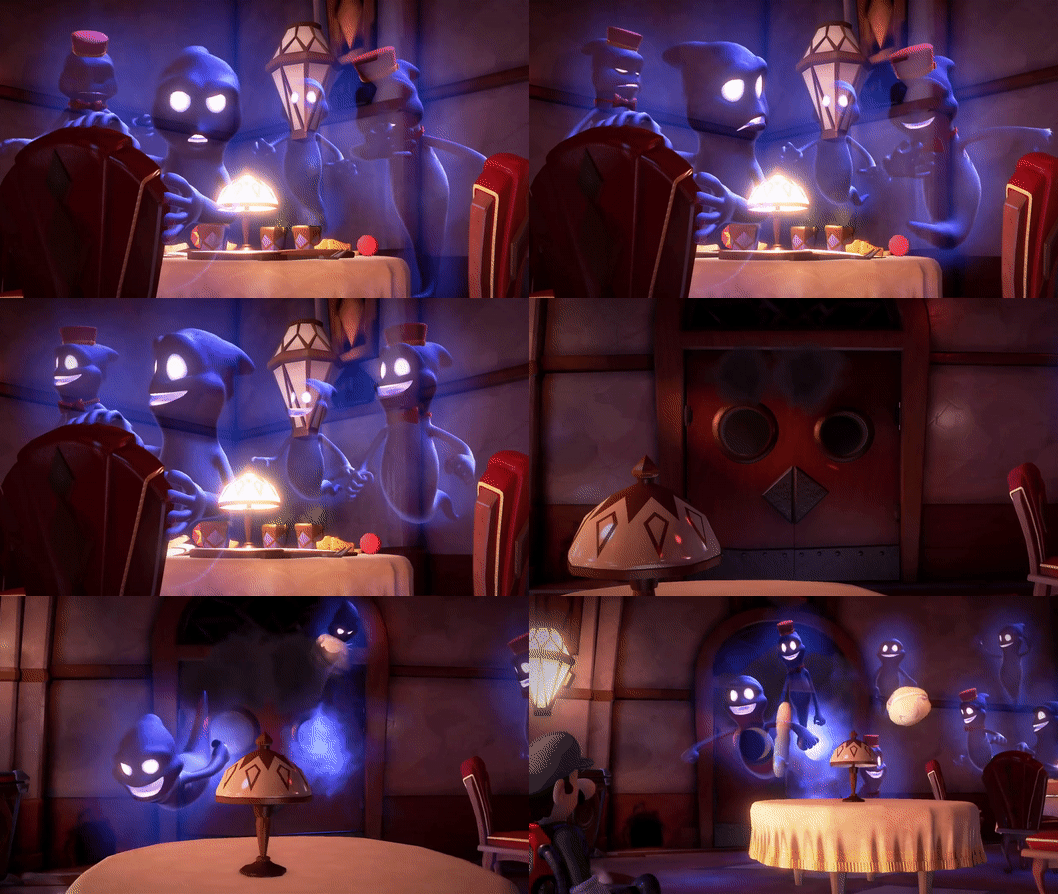
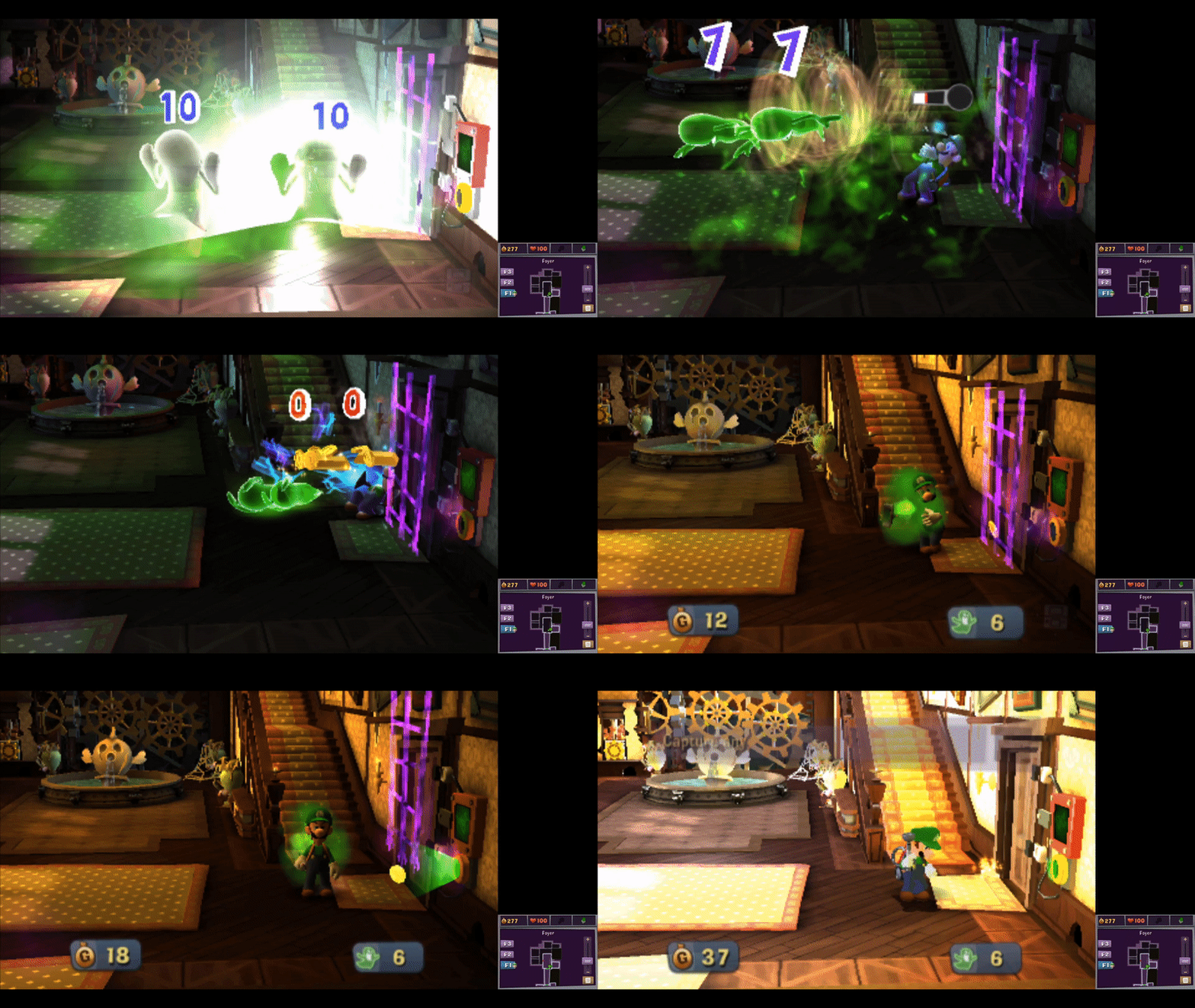
I have to touch on the fact that when defeating a ghost using the slam, it does not, I repeat, does not, get sucked into Luigi’s vacuum. Defeating ghosts in Luigi‘s Mansion near-universally results in the ghost’s malleable body getting all smushed into the mouth of the device, before disappearing into it with a satisfying slurp and *pop* sound. Delightfully expressive flails of panic from the victimized ghosts accompany. It’s the punctuation of ultimate victory over your foe. The cherry on top. The fullest realization of the fantasy of Luigi’s Mansion– being a ghost hunter. Any and all dark spirits no matter their might may be laid low before the great equalizer of an overcharged vacuum cleaner. There’s little more satisfying than that in the game. The idea that the most powerful move in Luigi’s Mansion 3 is also the only way to dispense with ghosts without that oh so sweet final animation of a ghost being sucked away into oblivion is utterly baffling to me. How is a ghost even destroyed? Is that not the point? They’re already dead, so you need to capture them with a device, right?

Ahhh, that feels better

This may seem like a minor point, but I cannot under-emphasize the importance of nailing the aesthetics of your game to work in concert with its mechanics. Would Luigi’s Mansion be as fun if everyone and everything were replaced with featureless blobs? No, I don’t think so. I don’t think its as fun if it’s missing even this one crucial animation and sound effect. Destroying ghosts just doesn’t feel right compared to capturing them in this setting. Imagine your favorite tense or emotional scene from your favorite dramatic game, or movie. Now imagine it set against the backdrop of this music. I just cannot reconcile the incongruence here. If you defeat a boss ghost with Luigi’s slam ability, the ghost-getting-sucked-into-a-vacuum-cleaner animation plays in its entirety, because of course it does. Why is this not the case for regular ghosts, whom you will be encountering far more often? It throws off the whole vibe of the game, so I have to physically restrain myself from using the most powerful tool in Luigi’s arsenal if it would finish off a foe, and that feels terrible.

Ahhhh, one more for good measure. So satisfying

Now if this sounds pretty harsh, don’t worry, because this is the part where I shower praise on the slam mechanic, as it is not a bad concept by any stretch. One of the greatest strengths of Luigi’s Mansion is its slapstick and cartoonish aesthetic. Action in these games quickly becomes outlandish and comedic as kitchenware flies off of shelves, vases are smashed, and tablecloths go whipping about in the scuffle. The thought of a struggle with Luigi escalating to the point that he’s literally slamming stubborn ghosts over his head like he’s hammering a tent peg into the ground is inherently hilarious, and perfectly congruous with the game’s general feel. Having this big and bombastic move to build up to gives every encounter a concurrent goal alongside simply ‘defeat all the ghosts’. It does potentially offer an interesting choice between slamming ghosts or simply sucking them, were it rebalanced to make the latter method more viable. The addition of an attack specifically for dealing with large crowds of ghosts also fills a niche in Luigi’s moveset that could allow for a far more varied and interesting array of encounter designs.

There are so many possibilities. Ghosts that wear armor which needs to be slammed into pieces before they can be properly captured, ghosts that can only be captured after they’ve been slammed into water, ghosts that only take damage if other enemies are slammed into them, rooms full huge numbers of ghosts that are best dealt with using the slam to thin out their tanks. The list of goes on and on. If it were just a little less frequent, if it were just a little less powerful, if it didn’t replace the more seamless power surge ability, and if it were just a little more in line audio-visual-wise with the rest of the game (by which I mean, allow the slam to suck up regular ghosts like it does bosses), I’d probably be over the (dark) moon for this addition to Luigi’s repertoire. The point is, the slam is a potentially excellent addition that fumbles in the execution.

Personally, I think a slam in this scenario would’ve been a bit excessive

What’s frustrating about this, is that Dark Moon had already figured out how best to implement this. In the game, there are instances where the power surge technique can charge up to multiple levels, by spending more uninterrupted time connected to a particular ghost. In essence, by proving you are able to keep up with a ghost for a longer period of time, you are rewarded with a great amount of damage you can ‘skip’. A longer charge yields greater damage, but also requires making a meaningful decision as to whether hanging out for a little longer for a little extra damage is worth it. Why not implement the slam in a similar way? After suctioning a ghost for a short period of time, you could power surge to get some extra damage. Useful for quickly dispatching small ghosts, or for pumping the damage on a ghost you’re not totally sure you can hang onto much longer. If you can, however, stay connected for a decently long period of time, you can instead slam them for much greater damage, and the added bonus of stunning and damaging other nearby ghosts. This implementation would be a lot less repetitive by making the slam more specialized, requiring a greater investment of time and risk to perform. By specializing the slam more, you improve the flow and perceived speed of the game, because Luigi’s tug of war action with the ghosts is no longer being constantly interrupted. The slam now acts as a crescendo to more gradual and engaging interest curve within each combat encounter, while most of the benefits of the previous version of the slam remain intact with the power surge as a replacement.

Right. I’ve gone on and on about the changes to the combat formula of Luigi’s Mansion that I didn’t care for. To be clear, I did not dislike the game. It’s gorgeous, funny, and engrossing with an abundance of creativity on display. Its polish is outstanding in almost very way, but it could’ve have been even better if all of its gameplay was as overachieving. That’s the ultimate takeaway I have here. Luigi’s Mansion 3 has almost all good ideas, but not all of those ideas are executed as superbly as they could be. The way the slam ability ironically beats the game’s own combat mechanics over the head distracts from the combat’s other strengths, and moves the game away from those strengths. Luigi’s Mansion 3 deserves a lot of praise for bringing one of the Mario franchise’s weirdest entries back into the limelight and to a bigger audience than ever before. I just hope they keep iterating on its quirky gameplay and don’t forget what great ideas all of its games brought to the table. I hope a new surge in its popularity doesn’t mask the fact that no game is perfect, and Luigi’s Mansion still has room to grow. Forgetting that, would be the spookiest fate of all. Happy Halloween everybody!

What do they feed you Mario Brothers anyway… Gullible Soup?

Boss Breakdown: Metroid Fusion’s Nightmare

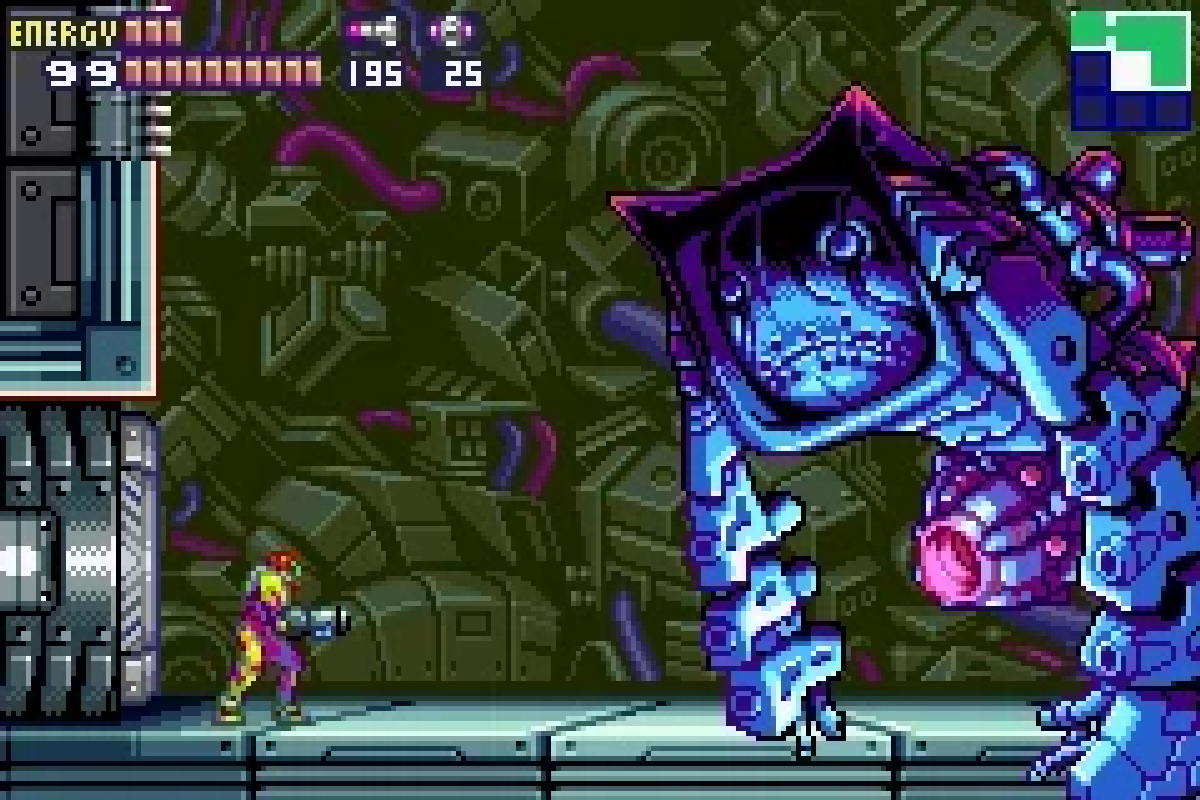
In honor of Spook month, I wanted to analyze the design of Metroid Fusion‘s arguably spookiest boss, Nightmare. Certainly a spooky name. I’m fascinated by gameplay that leaves a lasting impact on people, experiences that are remembered long after the game’s last play session. Nightmare seems to be one of those special few bosses that everyone remembers, if they’ve played the game he debuted in. There’s something viscerally haunting about Nightmare in particular that sticks with you. In a game full of terrifying encounters with predatory aliens on an isolated space station, he manages to stand out as this weird, horrific science experiment gone wrong.

In Metroid Fusion you play as galactic bounty hunter Samus, once again finding herself in the unenviable position of being trapped in isolation with ravenous alien monsters that want to eat her face. Unfortunately for them, wanting to eat Samus’s face is the leading cause of death in the Metroid universe, so the player and Samus will team up to claw their way through the abandoned space station to recoup Samus’s gear, destroy the monsters within, and blow the place to kingdom come.

To give a quick rundown of Samus’s capabilities, for those who have not played Metroid Fusion, Samus primarily does a lot of running, gunning, and jumping. Samus can jump high into the air and, at this point in this game, perform the space jump – where she can gain extra height in mid-air as much as she likes, so long as the jump button is pressed just as Samus begins to fall from the previous jump. Think a standard double jump, except with no limits. An infinite jump, a space jump, if you will. She can make herself a smaller target by curling into the morph ball form, with which she can also roll around in tight spaces. Samus can shoot horizontally in basically any position except the morph ball form. She can also aim vertically while standing or jumping, but diagonally upward or horizontally while running as well. Her primary weapon is a beam that can be charged up while moving then released for extra damage, and she has a limited stockpile of missiles she can fire in place of her beam. They do about as much damage as a full charged beam, but have expendable ammo.

Very ominous, the way you keep turning your sprite renderer on and off

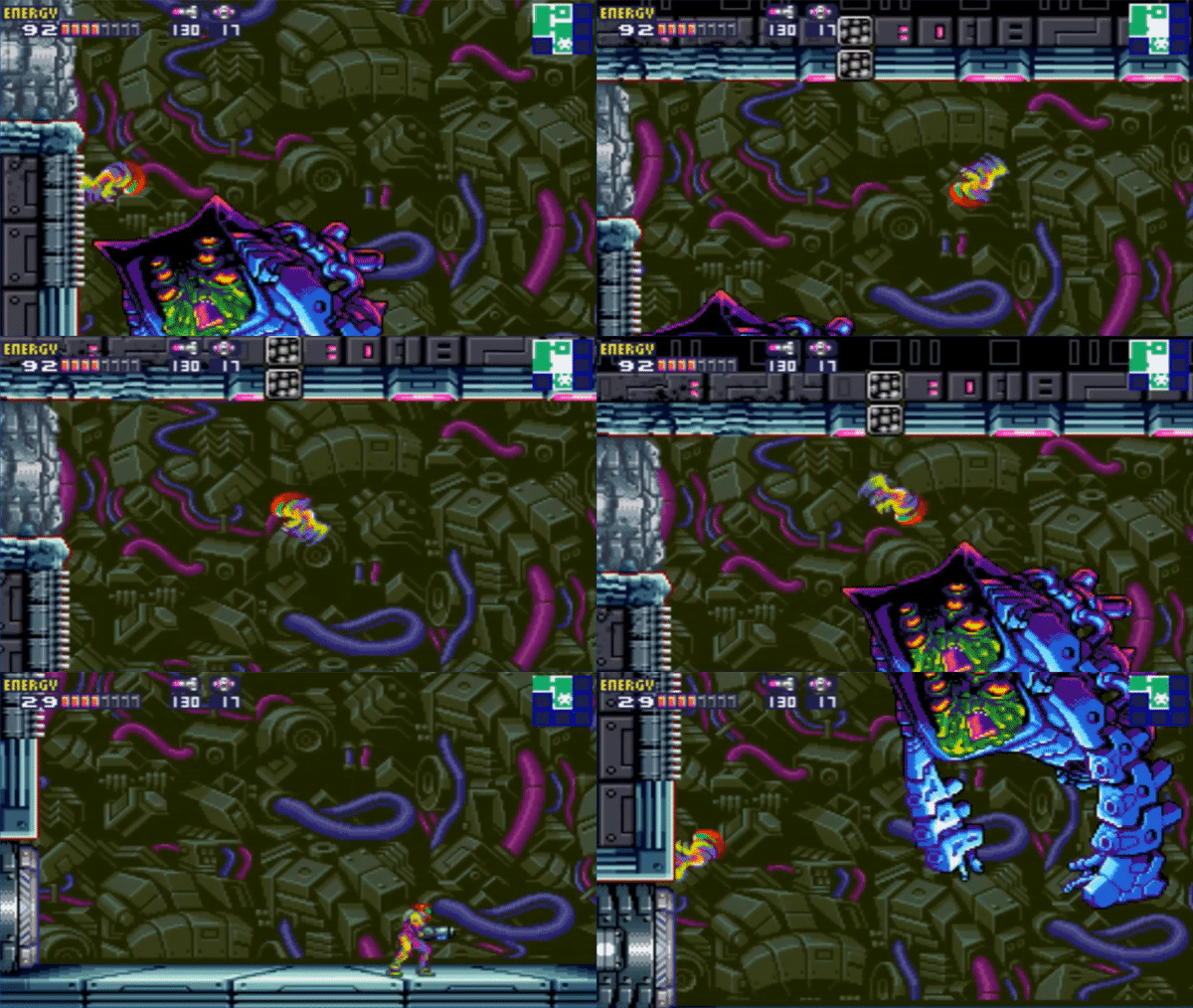
It’s hard to describe what exactly Nightmare is. He’s some sort of awful military experiment with gravity manipulation. It a bio-mechanical monstrosity hooked up to a gravity device, and perhaps some sort of life support apparatus, sealed within with an ominous mask. He has very limited animation, with basically only a few details on his arms and *ahem* face to distinguish him. He kind of just stares in one direction and floats around, but visually it works because of the kind of character he is. He’s pretty horror-themed, with his thousand yard unblinking stare and immovable stance in one direction reinforcing this sort of awful, emotionless terror-machine.

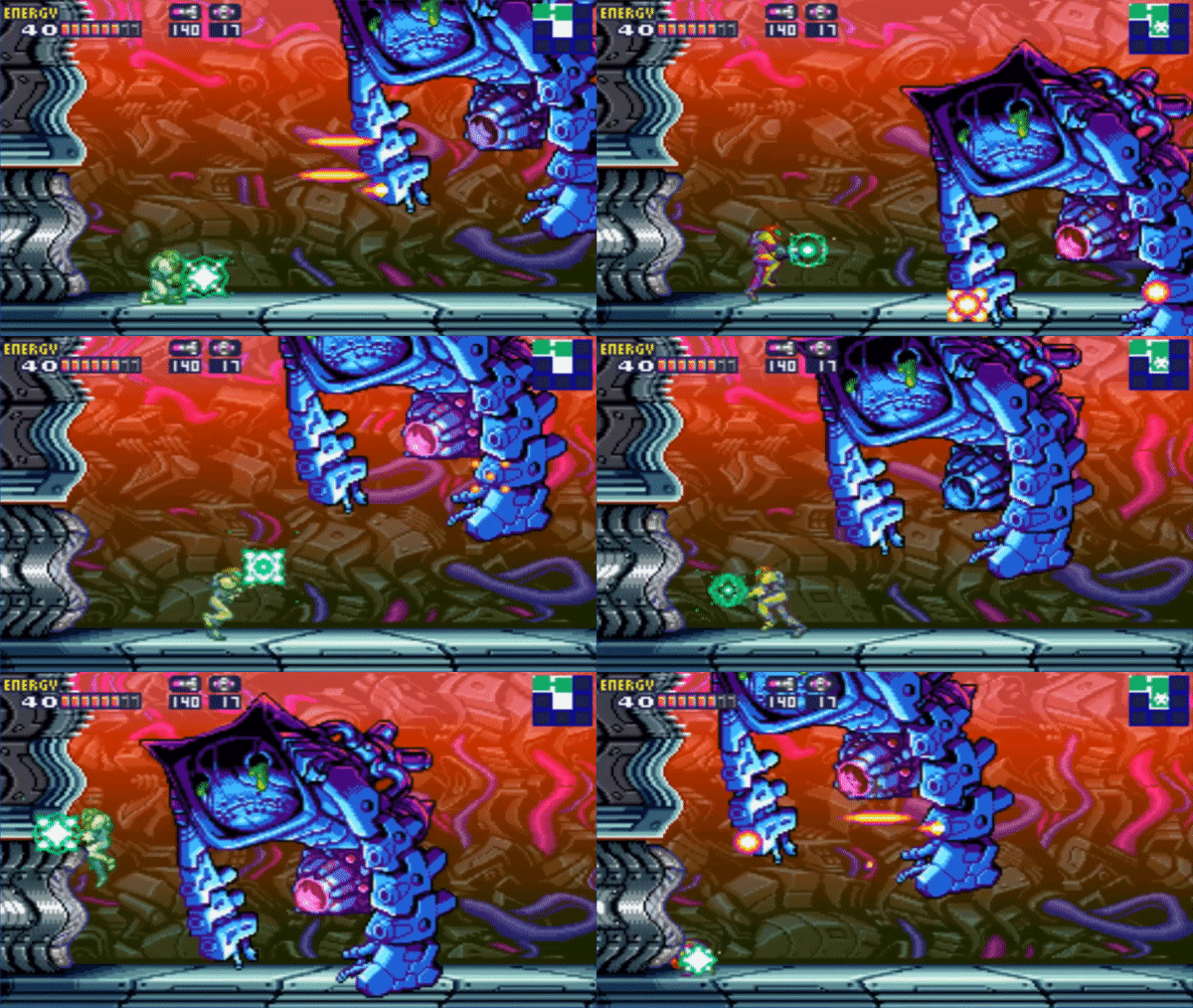
The Nightmare boss fight is made up of three distinct phases that seamlessly transition from one to the other linearly as the Nightmare creature takes damage. As is often standard for 2D action games, Nightmare’s behavior pattern is actually rather simple once you break it down. In the first phase, Nightmare will only do two things. First, he’ll fire a salvo of laser projectiles that move horizontally in a line from his arms. Several are fired at once, forming an obstacle that is just high enough for Samus to be able to jump over, if they’re fired near the ground. This is complicated by the second thing he does; he will track Samus’s vertical position with his own, levitating up and down to match her “y” position on the screen. It’s not one-to-one though, Nightmare overshoots Samus’s position, and if she quickly changes her vertical place, Nightmare will have to take a moment to reorient itself as a result.

This movement creates the sense that Nightmare is an intelligent predator going out of its way to aim its deadly lasers at Samus, although in truth they aren’t aimed as such. Nightmare is repositioning its entire body to fire at Samus. This overshooting vertical motion is a simple and effective way to convey the illusion of intelligence in enemy AI. An enemy that perfect lands its shots every time, with no room for error is even simpler to implement, but it’s not very satisfying to fight against. By having Nightmare overshoot, he seems more alive, with the capability of making error, while staying motivated and on target – he tries to shoot Samus, but does not do so perfectly. Once the player can properly manipulate Nightmare’s movement, they can defeat him much more easily. One could even say that Nightmare’s movement is an extension of the player’s own as Samus. It’s always a response to how she moves, that is then disrupted by the lasers which fire on their own time, beyond the player’s control. Having mechanics interact like this instantly multiplies the number of situations that are possible, and this simple interaction alone drives the entire first phase of the fight.

There’s one more complication, however. Nightmare is immune to Samus’s weaponry on most of his body, vulnerable only at one specific weak point – his gravity device. Dodging Nightmare’s attacks in the first phase is not a terribly daunting task, as again his movement is totally lead by Samus. The position of his weak point forces you to try to manipulate him in a certain way, though, and this may put Samus in harm’s way. It’ll be easier to understand how this work by understanding how Nightmare is shaped:

Very definitely NOT shaped like a friend

As you can see, Nightmare is made up of these four primary parts, very approximately outlined here. None of the areas marked in green can take damage, but the red gravity device can. So now first phase is a game of landing your shot in that small space between his arms, which will otherwise block your fire. Seems difficult, but is thankfully alleviated somewhat by a beam upgrade Samus will have by this point in the game, which makes her shot very wide, so damaging Nightmare requires a precision, but not pinpoint precision shot from Samus. This also means hitting Nightmare is much easier with the charge beam than with missiles, ensuring the player is taking some time to charge up, and therefor interacting with Nightmare’s attack pattern as the fight goes on, none of his mechanics can go ignored. To access this weak point, Nightmare needs to be high enough in the air, and thus the ladder on the back wall Samus can use to goad him into exposing himself. This little scenario will also give the player ample time to observe and learn about how Nightmare’s movement works. If the player can successfully repeat this cycle a few times, Nightmare will activate his gravity field, and we enter phase 2.

Shaped like an enemy, even

Nightmare’s gravity field makes Samus heavier, causing her jump to get a lot less airtime, and her running movement to be a lot slower. At the same time, Nightmare will be encroaching on Samus slowly, characterizing a very off-kilter and haunting vibe. Nightmare does not track Samus’s position here, but rather simply bobs up and down a short distance. This happens rhythmically and regularly. He notable stays in his higher position for a longer time than his lower position, designed such so that the player has time to aim a beam shot at the gravity device. His lasers now fire only two at a time, so Samus’s shorter jump can clear them, but they follow their own regular timer that is desynched from Nightmare’s movement, meaning they can fire at any vertical “Y” position, so the player will have to duck or jump the lasers on the fly. This shift to a more reaction-focused mechanic reinforces a sense of being on the backfoot, of the terrifying creature closing in you, literally forcing you into a corner.

Similar pattern, new context

The method of attack remains the same here, but it’s re-contextualized, as Nightmare now moves of his own accord, meandering around like a zombie, rather than following your lead. He reminds me of a horror-movie monster, the way he sort of just vaguely shambles toward you. The fight remains simple, but the distortion of the environment, the ooze dripping from his eyes, and the ominous humming of his gravity device, along with the subtle shift of the mechanics toward reaction-based gameplay really sets the mood. The aesthetics do a lot of work here, creating a building tension going into the third face, er, I mean phase, which starts with..

AAAAAAH DIE DIE DIE DIE DIE DIE DIE DIE DIE DIE DIE DIE DIIIIE

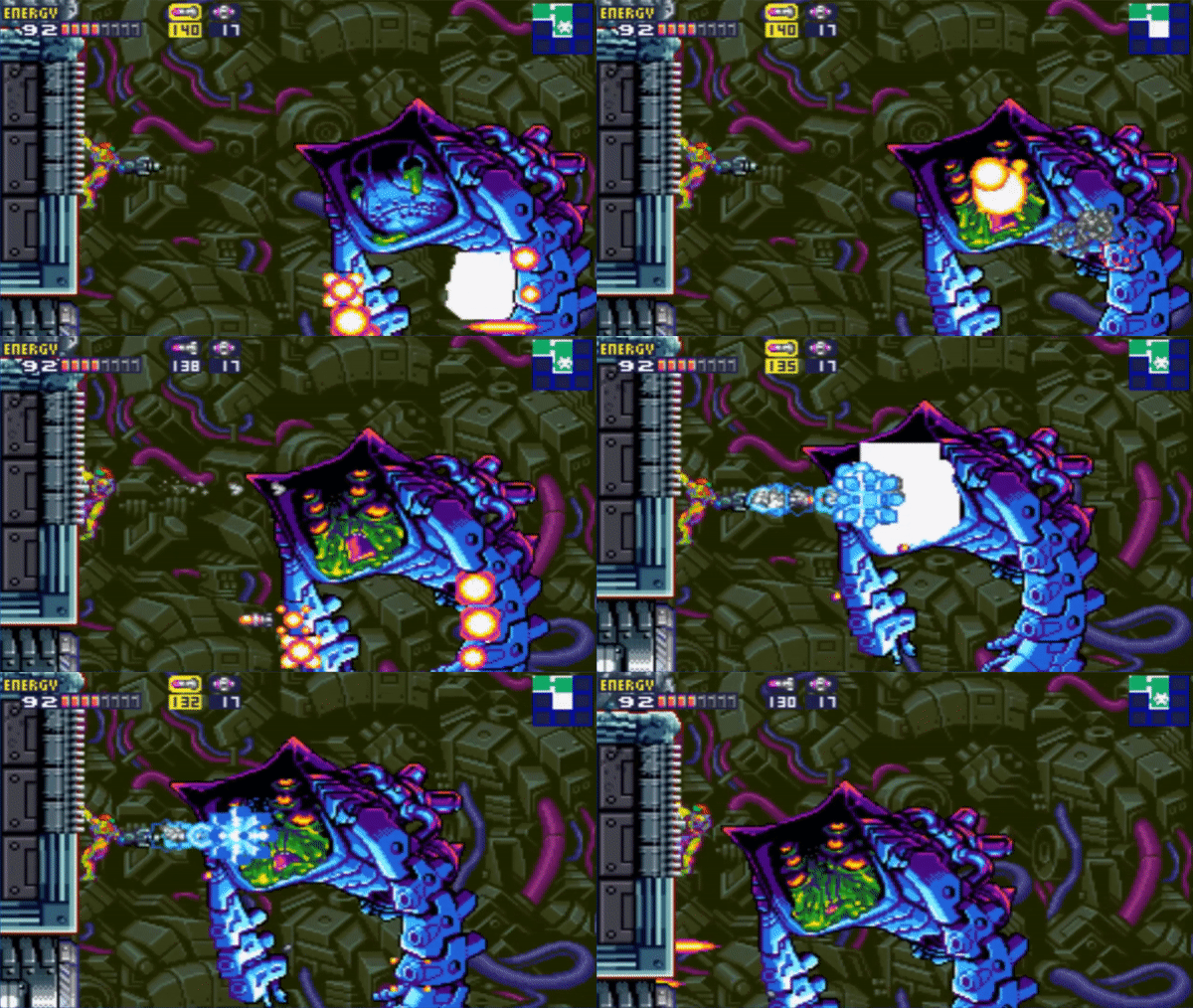
HOLY mother of god what IS that!? Augh, yes his mask comes off to reveal this grotesque melting abomination once you’ve destroyed the gravity device. At this point Nightmare will gradually move toward you, firing lasers in a new much more aggressive pattern, forcing Samus off the ground. If Samus tries to jump over Nightmare, he will fly off screen then back on in an attempt to ram her. Nightmare is responding to Samus’s movements again. It’s more obscure and aggressive, but still predictable. Once you understand that bosses like Nightmare are only responding to their circumstances (aka you, The Player), you can predict how they’ll react and use that to your advantage, and this applies to pretty much any AI enemy. Incidentally, this is largely how competing against real people in games works, too, although they might be a bit smarter than Nightmare. At any rate, he’s now vulnerable to missiles, so blast his exposed face to smithereens. It’s a lot easier to damage him in this phase, so it’s simultaneously cathartic as his increased aggression continues to build tension. The extra room and freedom to move about more of the arena creates a sense of a shift in tone. Samus is now in a position of greater power, and Nightmare a position of greater desperation, to match his screeching unmasked face.

Oof

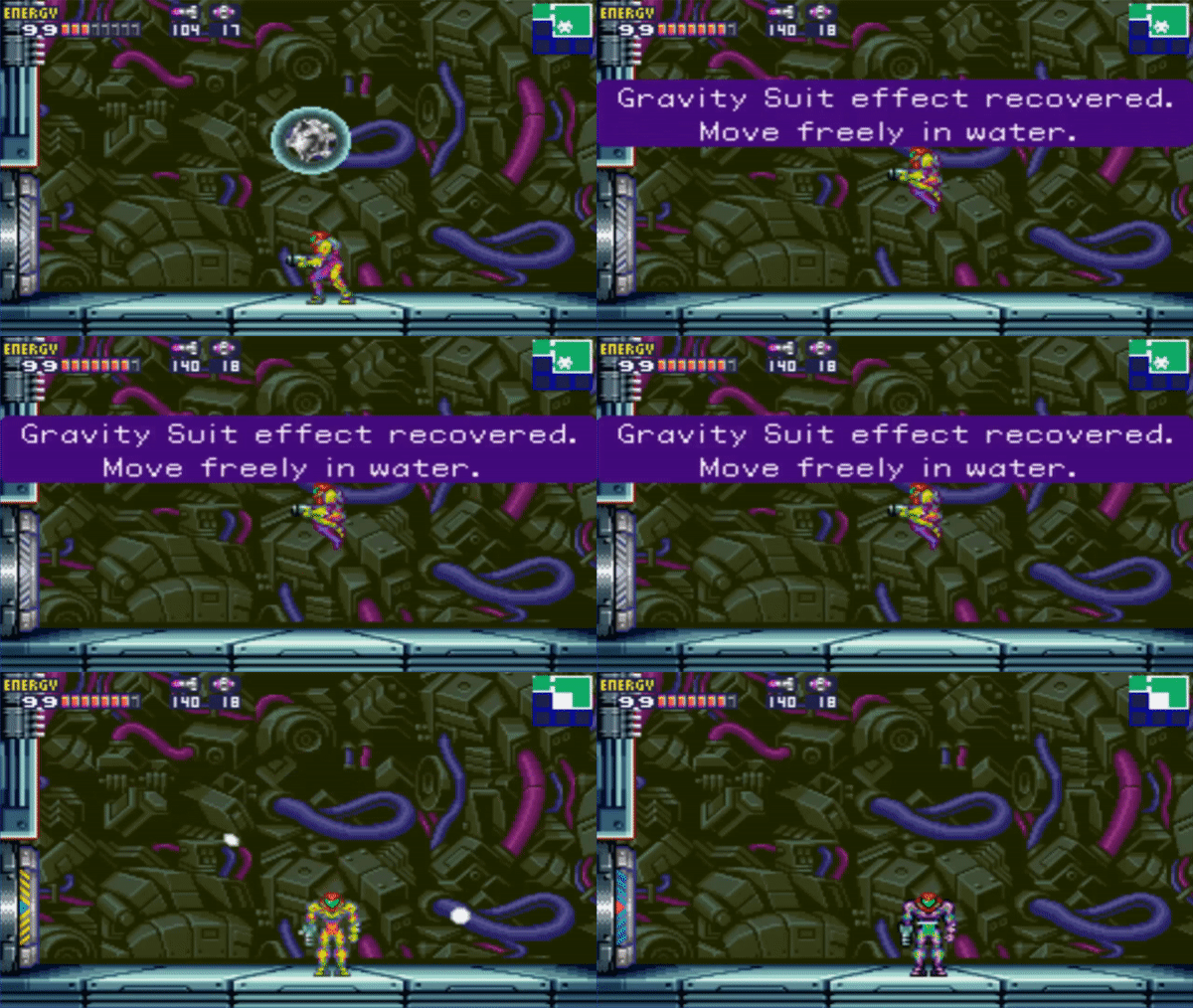
It’s worth going over here a kind of ‘soft’ phase 4 for Nightmare. Nearly every boss in Metroid Fusion, once defeated, releases its Core X, a parasitic creature that contains some of their power. Samus must defeat this as well, before she can breathe a sigh of relief. The Core X is a pretty simple floating target that can be taken down with a few missiles. Beam attacks don’t damage it, but they do release some health and ammo restoring items. The Core X’s behavior is to simply follow Samus’s current position, and move towards her to ram her. You’ll notice it uses that same ‘follow but overshoot’ technique Nightmare employed, except in both the horizontal “x” and vertical “y” positions. If you know to look for it, you’ll see this mode of movement in AI design everywhere. I always found these Core X encounters a very interesting kind of denouement to boss fights, where there’s still some danger, but not nearly so much, as the heightened tension eases out. It’s a pretty satisfying cap off to hard encounters, and not many games do anything similar. It’s unique.

Wobble wobble wobble

It seems to be the case that Nightmare’s design is intended to exercise all of Samus’s mobility options. The presence of a ladder on the back wall gives the player easy access to the air above Nightmare for some evasive space jumps, certain Nightmare attacks are best evaded by Samus’s famous morph ball, and a command of Samus’s ability to fire diagonally while moving gives a huge advantage in this fight. Nightmare is one of the first bosses in Metroid Fusion that really pulls together a lot of Samus’s various capabilities, and, even though he’s rather simple and straightforward, he does a great job of it. He marks the beginning of the endgame sections of Fusion, and can be a bit of skill check for people, so they may very well get stuck on him for a time. This coupled with the outstandingly horror-filled atmosphere that follows from his horrific design, reinforced by AI behavior reminiscent of a lumbering horror villain, and you’ve got a recipe for an extremely memorable encounter.

This thing is out of control. Hurry before it destroys the entire station…

Healing in Hollow Knight

It’s spooky season, and I’m gonna talk about one my favorite spooky games, Hollow Knight (Science fact: a game doesn’t have to be scary, to be spooky). I mean, hey, it’s got ghosts and zombies and curses and lots of tombstones, so it counts. Hollow Knight is a 2017 side-scrolling 2D action game. It has other genres too, but I won’t be getting into that, an interesting topic in itself. Mainly I want to look at its very elegant combat system, specifically the way it handles health and healing. In Hollow Knight you play as The Knight, a mysterious little guy wandering a vast, sprawling underground kingdom of bugs once teeming with life, now racked with curses, beasts, and sorrow. Everybody, you included, in this game is a bug, if that wasn’t clear. Lot’s of danger out there for a bug. You’ll get into plenty of scrapes, and will need a reliable way to patch yourself up after a fight. Thankfully, you obtain the ability focus pretty early on, which allows The Knight to restore health by expending a resource called SOUL.

So what design purpose does a healing spell like this serve in a game? If you think about it, the presence of a heal really just artificially extends the number of mistakes a player can make before triggering a fail state. Why not just extend their health pool? What is the advantage of a healing spell? There are a number of reasons you can put something like this in your game. Healing hides information from the player, in particular how long they can survive encounters, making their success and failure less certain. A healing system can act as a safety net against frequent failure states for less skilled players to lean on. Hollow Knight accomplishes these things with its healing system, as its an exploration-based game that requires long ventures between check points. As to why Hollow Knight uses a certain specific implementation of healing in particular, I think it serves three primary purposes.

  1. Creating tension
  2. Teaching situational awareness
  3. Allowing meaningful decision-making on the part of the player

I will elaborate, but.. Okay first, it’s time for some math. To heal, The Knight need only stand still and concentrate for precisely 1.141 seconds. This will restore one unit of health, which usually translates to one hit of damage from an enemy. For each subsequent 0.891 seconds The Knight holds focus uninterrupted, another unit of health will be restored. This costs the resource SOUL, like I said, and this resource is accrued whenever The Knight deals damage with a melee attack to an enemy. SOUL has a maximum value of 99, and it costs 33 to restore each unit of health. 11 SOUL is restored to The Knight each time an enemy is struck by the melee attack. This means, from a full SOUL meter, the player can restore 3 hits of damage to their health. For each additional unit of healing, they’ll need to successfully strike the enemy 3 times. In other words, to succeed in Hollow Knight you’ll need to be hitting an enemy while receiving damage at a ratio of 3 to 1, while successfully casting your focus spell without being interrupted, of course.

With this system, you just have to be good enough. Comforting, in the dark caverns of Hollownest

Those time figures, 1.141 and 0.891 seconds, seem awfully precise, and that’s probably because they are. My thinking is that these figures were arrived at after extensive playtesting against Hollow Knight‘s wide variety of enemies and bosses. Because The Knight needs to stand absolutely still during that roughly one second of time, it was pretty essential that it’s possible to safely do so during boss fights without being interrupted, otherwise the healing ability would be completely useless. However, if it was always safe to do so, or if the safe windows of time in which the healing could be done were always obvious or easy to react to, the game’s challenges and combat gameplay could be in danger of being trivialized. That being the case, I don’t doubt that a lot of consideration was put into these figures, as they carry the heavy burden of creating tension during combat encounters. A lot of that tension happens in the final moments of the focus healing animation. You may find yourself waiting with bated breath as that one second of focus seems to stretch out to years, an angry bloodthirsty beetle bearing down on you.

Hollow Knight‘s combat can be broken down into small-scale, medium-scale, and large-scale encounters. Large-scale encounters are things like boss battles and long gauntlets of enemies. Small-scale encounters are the moments of fighting against smaller enemies found wandering around the world. Medium-scale encounters can be found somewhere in the middle, being rooms full of those small-scale encounters like enemies, or tougher enemies strategically placed to challenge the player. The healing system in Hollow Knight needs to be versatile and universal enough to function in any of these situations. During and after fights against small enemies, the healing focus spell can usually be used pretty safely, without interference, as enemies can be easily retreated from. Resources for healing are provided in return for successfully striking enemies, so as long as the player is engaging with the combat to a certain minimum level of success, these small encounters will provide some sense of danger without bringing the player closer to failure. On a medium-scale, the healing system being so tied to successful combat helps keep an encounter’s obstacles threatening. It is possible to bypass much of Hollow Knight‘s dangers without fighting, but if a slip up is made, no additional resources can be obtained without engaging an enemy. This ensures the player is consistently engaging with the game’s mechanics, and learning to fight as they explore. Ironically, although the healing system exists to keep the player safe, the way it works, hinging on a delicate balance of risk and reward, promotes engaging with the game in such a way that tension is built, and that there remains an ever-present sense of danger.

Not minding your spacing or timing can get you into trouble

Large-scale encounters are where things get really interesting. If the player can heal indefinitely, then how do you build tension in a boss encounter, when the player should theoretically be in the most danger? This is where the ratio of how many hits a player needs to land to restore health, how quickly a heal can be executed, and how frequently a boss attacks the player had to be tightly balanced. As the game goes on bosses will provide smaller and smaller windows of time for the player to heal, but there always must be some possibility of healing or else the system would feel broken. At the same time, by requiring those three all-important melee attacks of the player before allowing them to heal, engaging with the boss’s combat mechanics is essentially enforced, with that aforementioned ratio of hitting-to-getting-hit acting as a sort of design guide for how boss fights should be structured. It gives the designers a pretty good barometer for how to tune the difficulty of Hollow Knight‘s fights. ‘At any given point in the game, the player should be averaging 3 hits against the boss for every 1 hit they take, if they are to defeat it’.

Boss enemies will give you plenty of space to heal, the key is knowing where to find it

This all of course assumes the player can successfully heal against frantically aggressive bugs (the creepy crawly kind, not the game-breaking kind) that want to kill them. Knowing when to attack and when to heal is one of Hollow Knight‘s most essential skills, and it ties in with that relative spacial awareness I’ve mentioned in other topics. The focus spell teaches the player to keep their eyes open for the various tells and telegraphs of their opponent, to be aware of their Knight’s relative position to the enemy, and how to exploit gaps in the enemy’s activity. Utilizing and capitalizing on situational awareness is one of the best ways to make a player can feel powerful or skilled, as though they have some secret knowledge that puts them above the opposition. Gently nudging the player to get good at sneaking in healing spells in-between the boss’s attacks reinforces that feeling. Making meaningful decisions is also how a player stays interested and invested in a game, it’s how to make their agency in the play space feel impactful. Deciding when to start up a heal in Hollow Knight is a meaningful decision, but the game pushes this idea further.

Using SOUL to attack is a risk as you can see in this clip of Hornet… basically whupping my ass

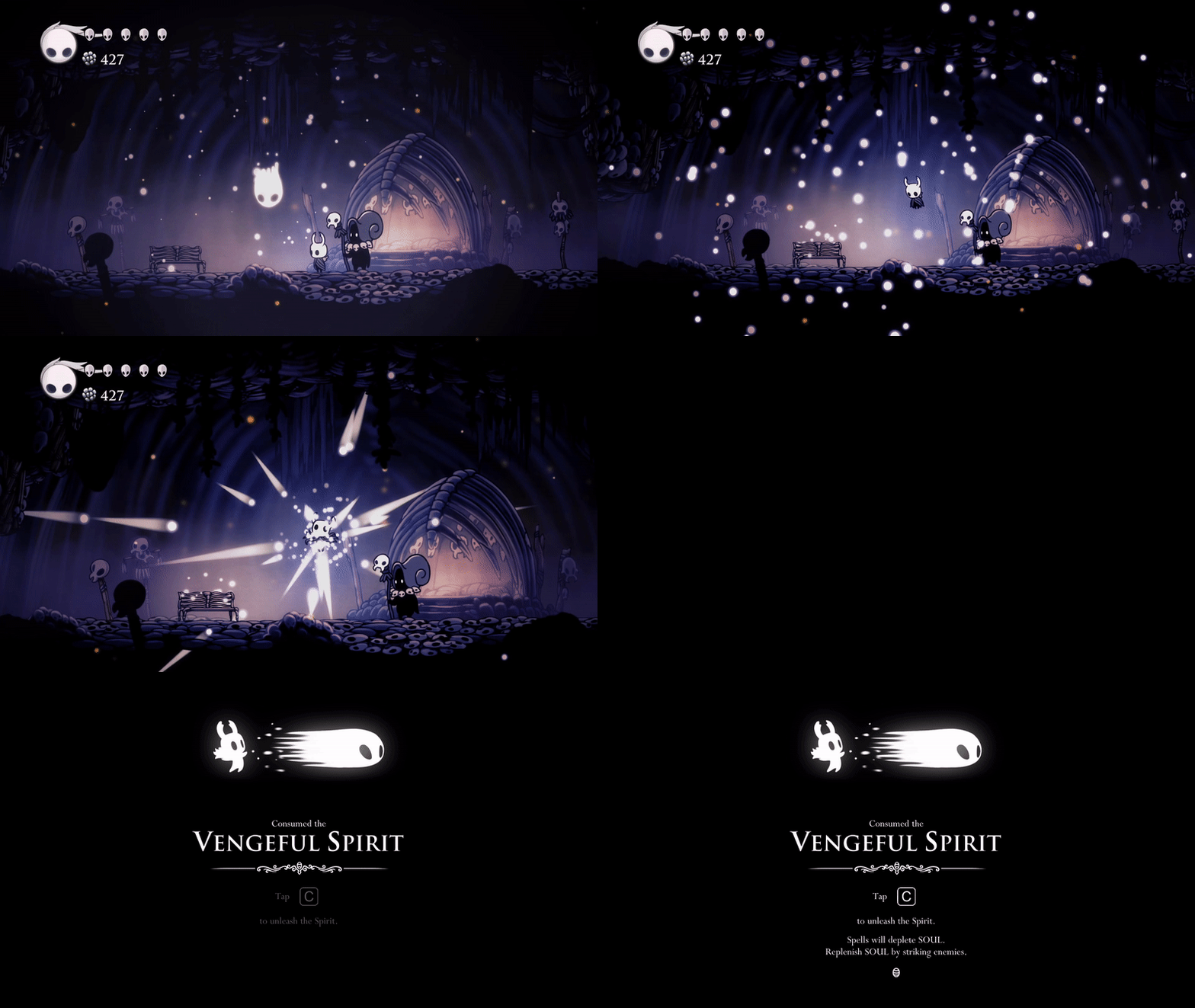
You see, SOUL can be spent not only on healing spells. Early on The Knight will obtain a projectile attack spell called vengeful spirit that deals even more damage than their normal melee strike. Other attack spells will also be obtained at various points throughout the game. These attack spells draw on the same SOUL resource, and cost the same 33 point value as a heal. Suddenly, the player has options in combat. Heal one hit of damage, or deal extra damage? It’s very tempting to go aggro with those powerful spells, especially against tough enemies with deep health pools. If they die quicker, that’s less time the player’s spent potentially making mistakes, after all. So now the player is being made to think critically about the overall situation, weighing their intake of SOUL versus how often they need to heal, factoring in their confidence in their own abilities into how SOUL should be spent. It becomes a series of interesting decisions all happening in rapid, in-the-moment succession. It makes the combat overall more interesting, while also rewarding mastery of the game, as skilled play will allow the player to launch the satisfying and crunchy magic attacks more often while healing less, defeating enemies and bosses more quickly.

As you can see in this clip, I make the impactful, meaningful decision to fail spectacularly

So Hollow Knight‘s healing system accomplishes a lot by playing with the player’s investment of time, sharing a resource with the player’s offensive magic, and tying its efficacy to the player’s success in combat. It creates a satisfying risk-reward experience where the risk is determined by the player’s skill and self-knowledge, as well as a tense and exciting atmosphere in combat.

Very tense. The Knight nearly pee’d their pants here. Do bugs wear pants?

I think it’s worth considering some alternative healing systems games similar to Hollow Knight often employ. Hollow Knight lets you heal indefinitely so long as your combat performance is up to a certain par, but some games will put a hard limit on how much healing you can do before reaching a checkpoint, potion shop, or other such demarcation. Limited quantity healing systems do have some unique strengths. They still give the player ultimate agency over whether and how to use healing resources, like in Hollow Knight, but also give an emphasis on a player’s overall performance, rather than Hollow Knight‘s more moment-to-moment focused system. You can make a lot of mistakes in Hollow Knight but still recover to full strength with some acutely skilled play. With limited quantity healing, you can succeed with skilled play even if you make a lot of mistakes, but the tension will remain high when you’re all out of healing, as your mistakes cannot be undone. Both systems have a lot of potential, depending on what player experience your design is geared toward. I think Hollow Knight‘s implementation is pretty perfect for its world design. With fewer check points and an emphasis on prolonged exploration, it makes sense to make The Knight’s healing resources theoretically indefinite.

Another alternative is health pickups, a very common healing system. In game series like Metroid and Mega Man you can restore health through health pickup items randomly dropped by defeated enemies. This accomplishes a similar end as Hollow Knight‘s healing system, with a safety net against failure being rewarded for successfully fighting enemies. There are a couple of key differences though. For one, health pickups are usually randomly generated by defeated enemies to keep the flow of healing less continuous, and more uncertain. There is a certain excitement unique to finding a healing item right when you most need it. During extended combat encounters without an abundance of targets, such as during a boss fight, naturally there won’t be any health pickups. Games with a health pickup system often try to circumvent this latter issue by throwing smaller enemies into the middle of boss fights that drop health pickups, but that comes with a couple of problems too. For one, the presence of smaller enemies in a boss fight can distract from the fight’s core mechanics and design appeal, especially if it’s meant to be a pitched duel between some important character and the player. For another, that scenario is now rewarding healing for engaging with the small enemies, rather than fighting the boss directly, which may not be the intended experience. Players might spend a lot of time only engaging with smaller enemies to collect health pickups, and ignore the boss. The alternative is simply balancing boss fights such that players aren’t expected to heal during them, or having the boss themselves drop health pickups at various times, but at that point your creeping awfully close to Hollow Knight‘s rather elegant solution anyway.

That elegant solution is not the best way to do healing necessarily, no design scheme is objectively the best one in every situation. It may just be the best one for Hollow Knight though, and it’s hard to argue with the precision of its implementation.

Whew! Got through an entire gameplay analysis of Hollow Knight without once mentioning Dark Souls… wait, damn it.

*Sighs* Bafanada…

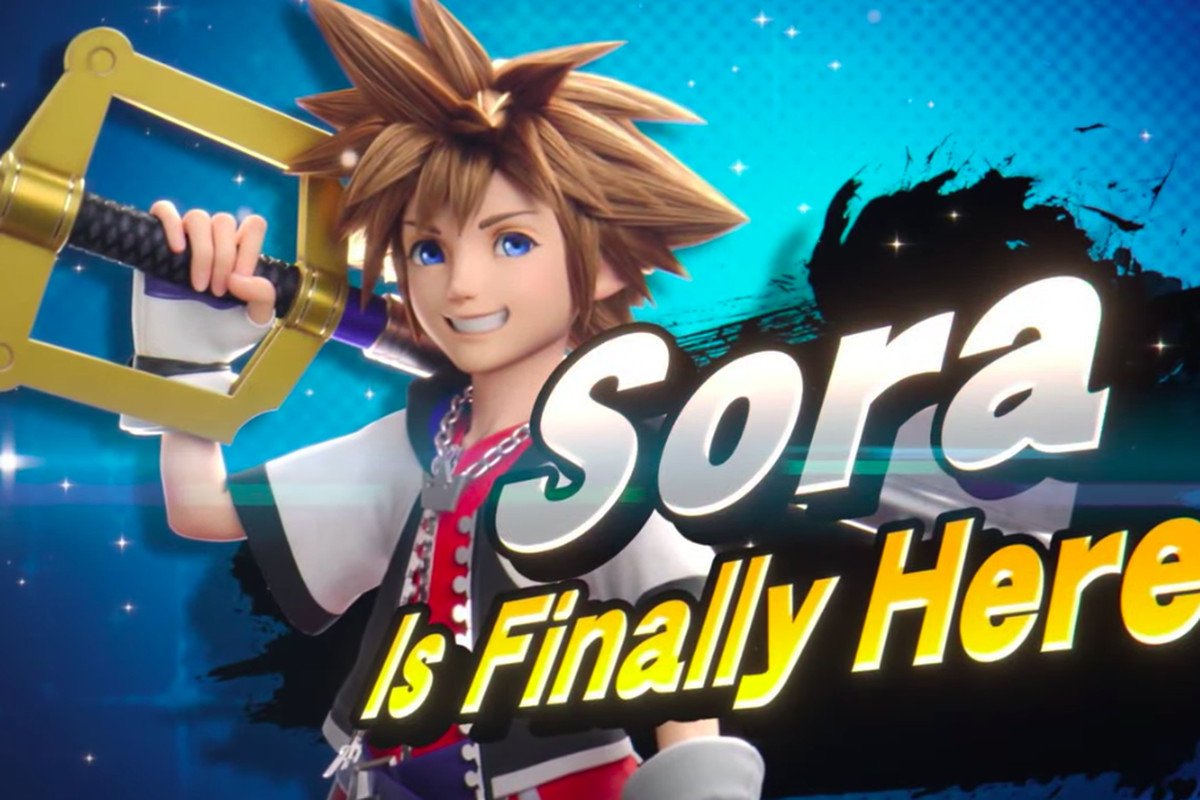
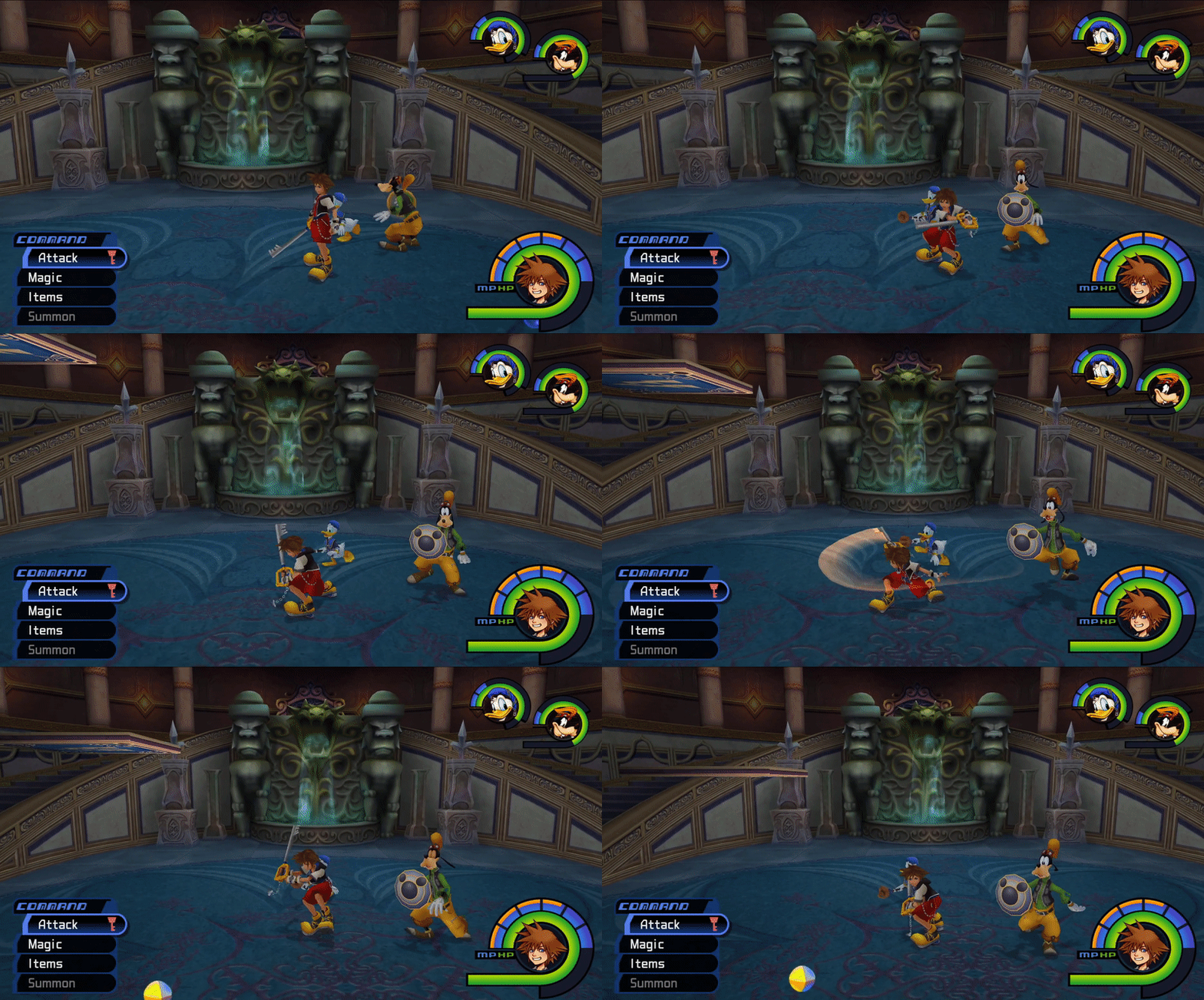
Smash-ifying Kingdom Hearts

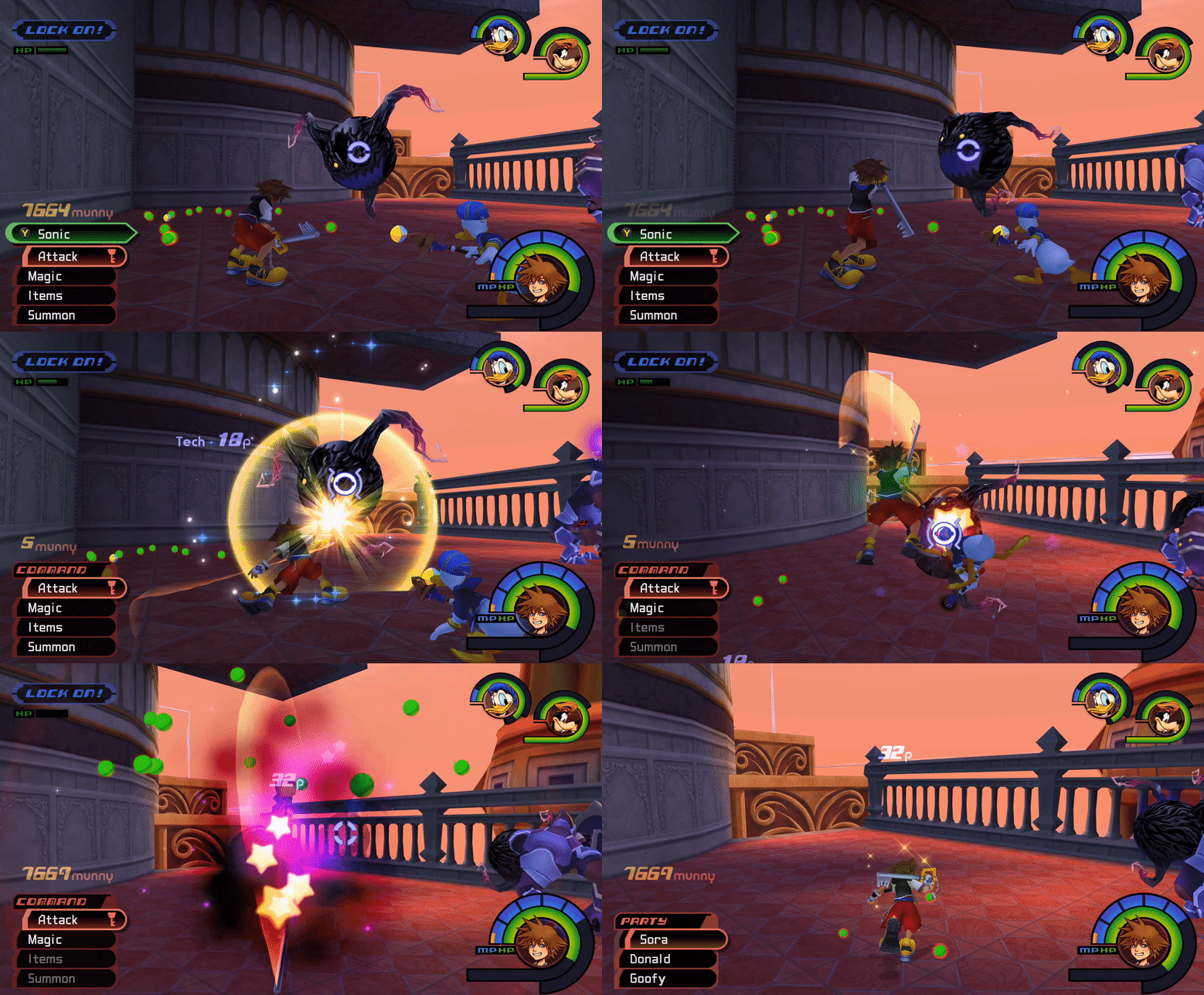
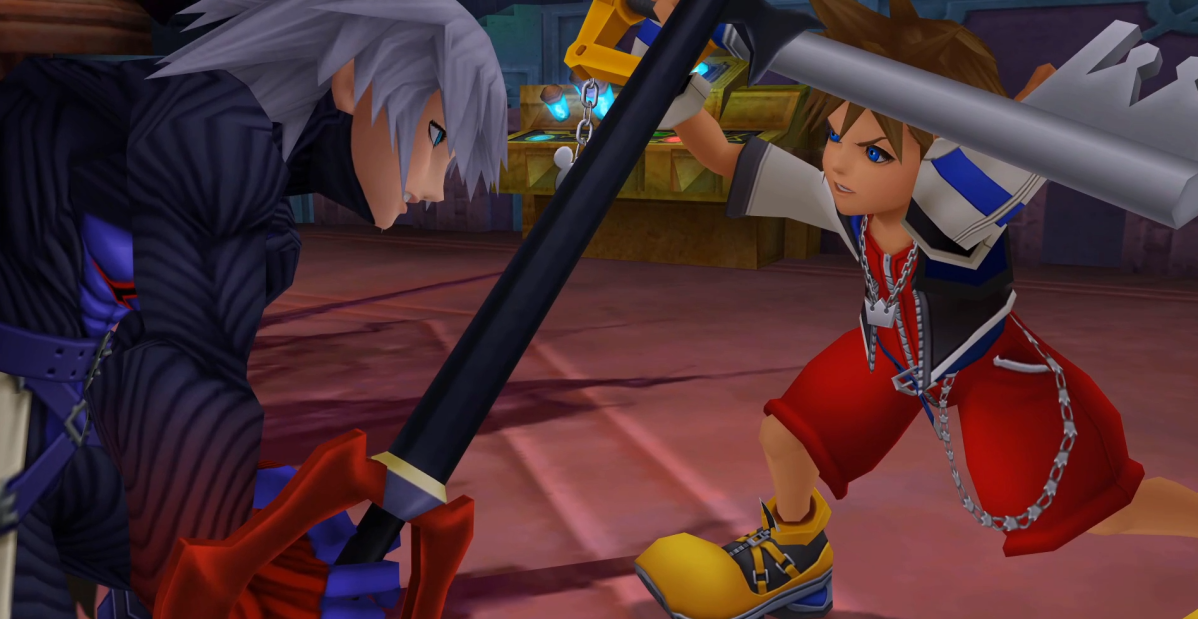
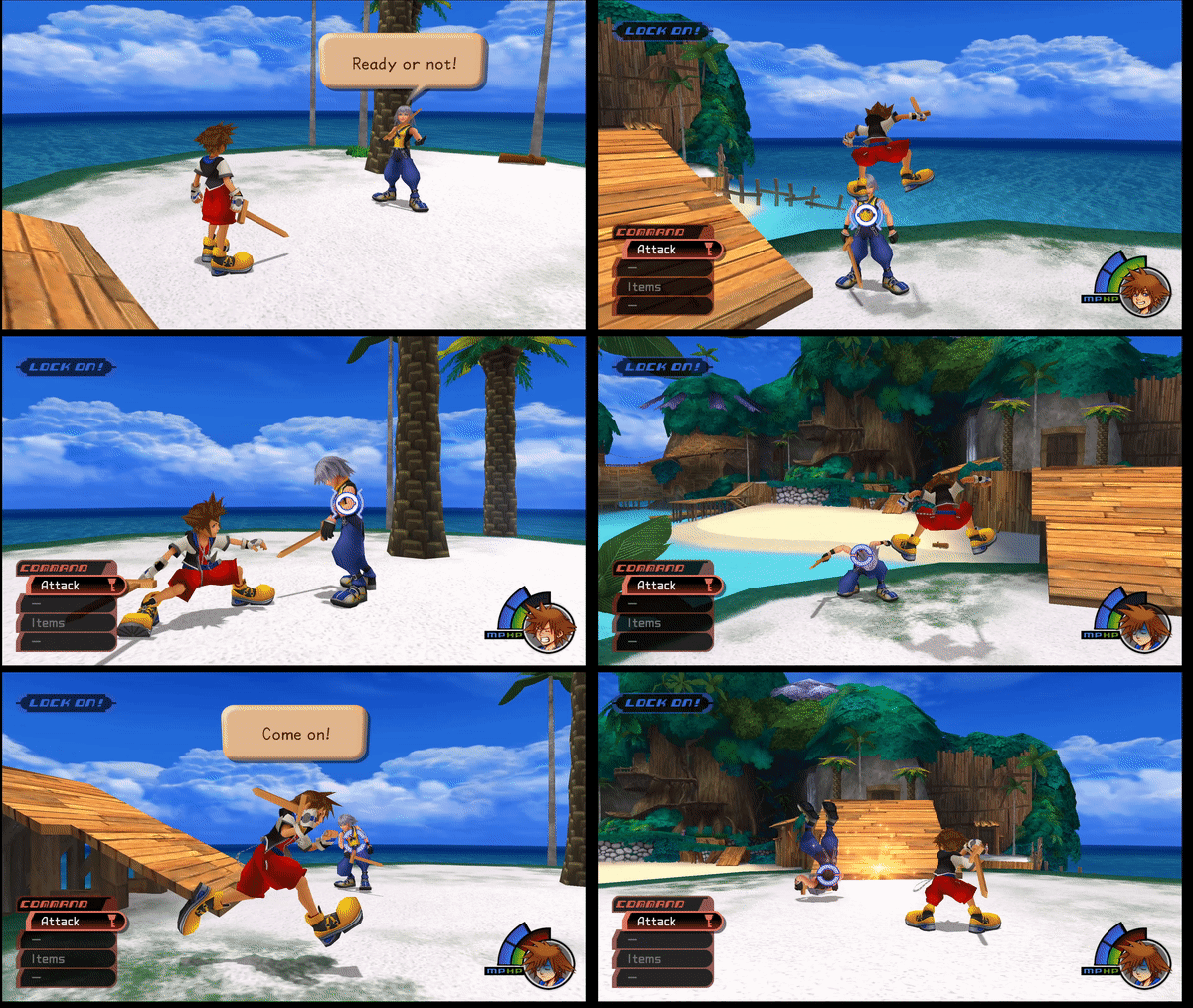
What’s that, an excuse to talk about Kingdom Hearts again? Yeah so you may have heard that Super Smash Bros. Ultimate is receiving its final playable character for the foreseeable future. I’ve long had a huge admiration for the way the Smash team is able to adapt characters from their home franchises while retaining the charm and feel of that source material. It’s why your Mega Mans (added 2014) in Smash feel more like they stepped right out of the game Mega Man than Sonic (added 2008) feels right out of Sonic. Especially in more recent years, a prominent design goal of new Smash fighters seems to be matching the experience and feel of playing the game that fighter first appeared in. In this case, KINGDOM HEARTS! Yeah, I’m a bit of a fan, so I’m just gonna gush for a minute about how Sora’s been ported from an action RPG into this platform fighting game, and analyze some of the choices that were made to do it.

Sora is the protagonist of Kingdom Hearts, a 2002 3D action RPG in which he fights using magical abilities and an enormous key. Super Smash Bros. Ultimate is a platform fighting game, a genre essentially invented by Smash Bros. itself, in which multiple fighters compete in a 2D fighting arena with lots of platforms and aerial space. Naturally, the 3D spaces of Kingdom Hearts, such as Sora’s attack swings, had to be mapped onto a 2D plane, and you can see that was done pretty much one-to-one. Sora’s attacks feel familiar in terms of reach and timing to his original game. So immediately, you can tell somebody is a huge fan of the first Kingdom Hearts game. Although other entries in the franchise are represented through costumes, and a couple of Sora’s attacks, the lion’s share of his moves are evocative of the debut in Kingdom Hearts specifically.

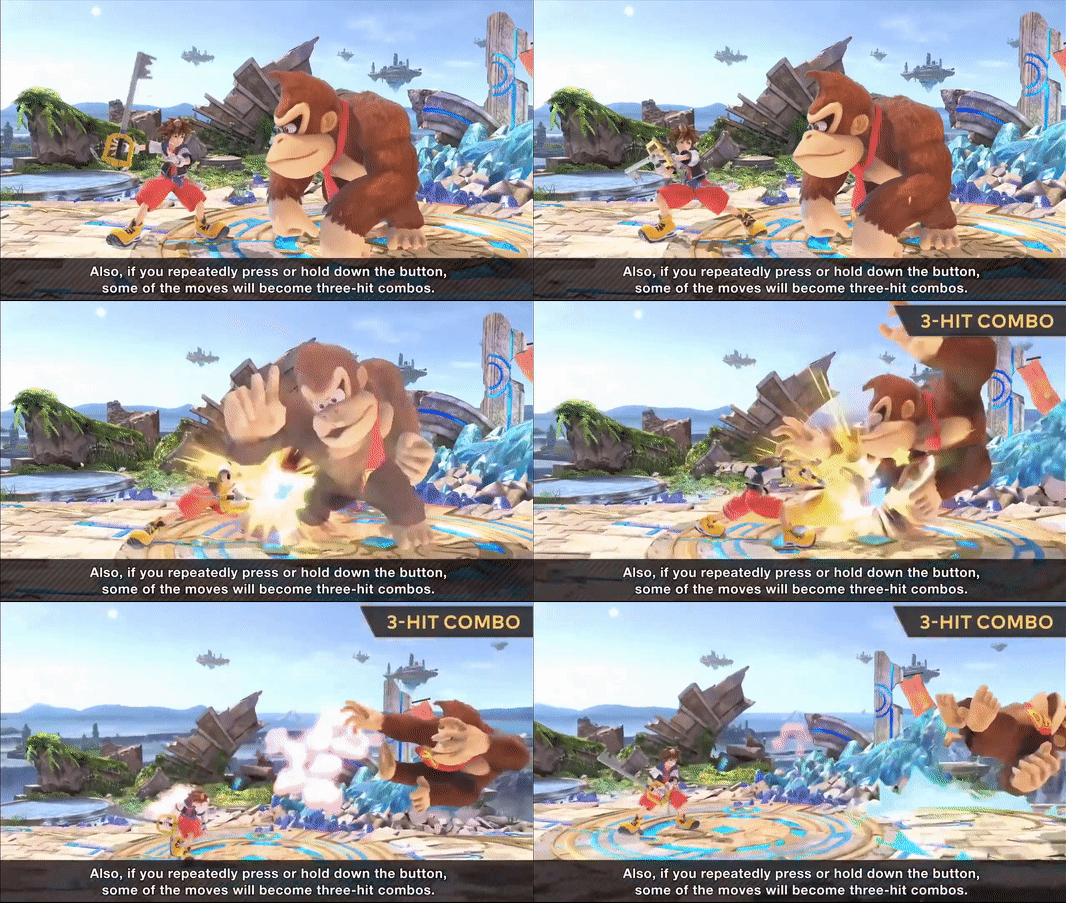
The three hit combo is one of the most fundamental aspects of Kingdom Hearts. It’s a game filled with disney characters, and as such was initially marketed to a younger audience, so one of Kingdom Hearts‘s chief design goals is the ease of accessibility to its combat. Sora’s combo attacks home in on and reliably stun enemies in his original game. Lots of action games have very complicated series of specific button inputs necessary to make your player character do cool stuff and feel really powerful. 90% of attacks in Kingdom Hearts will be triggered by one, maybe two buttons simply pushed in succession, the idea being that the minimum knowledge and prowess necessary to make Sora feel cool and powerful should be very easy to achieve, so players of all skill levels can, at least, feel cool and powerful even if they aren’t ready for the game’s toughest challenges yet. This is a design philosophy Smash and Kingdom Hearts share in common. Several of the newest fighters added to Smash have felt a bit more complicated than earlier entrants, especially as guest fighters from more traditional fighting games were added. I think it’s significant that the decision was made to make Sora notably simple to pick up and play, without any of the complicated inputs or resource management of other new Smash fighters.

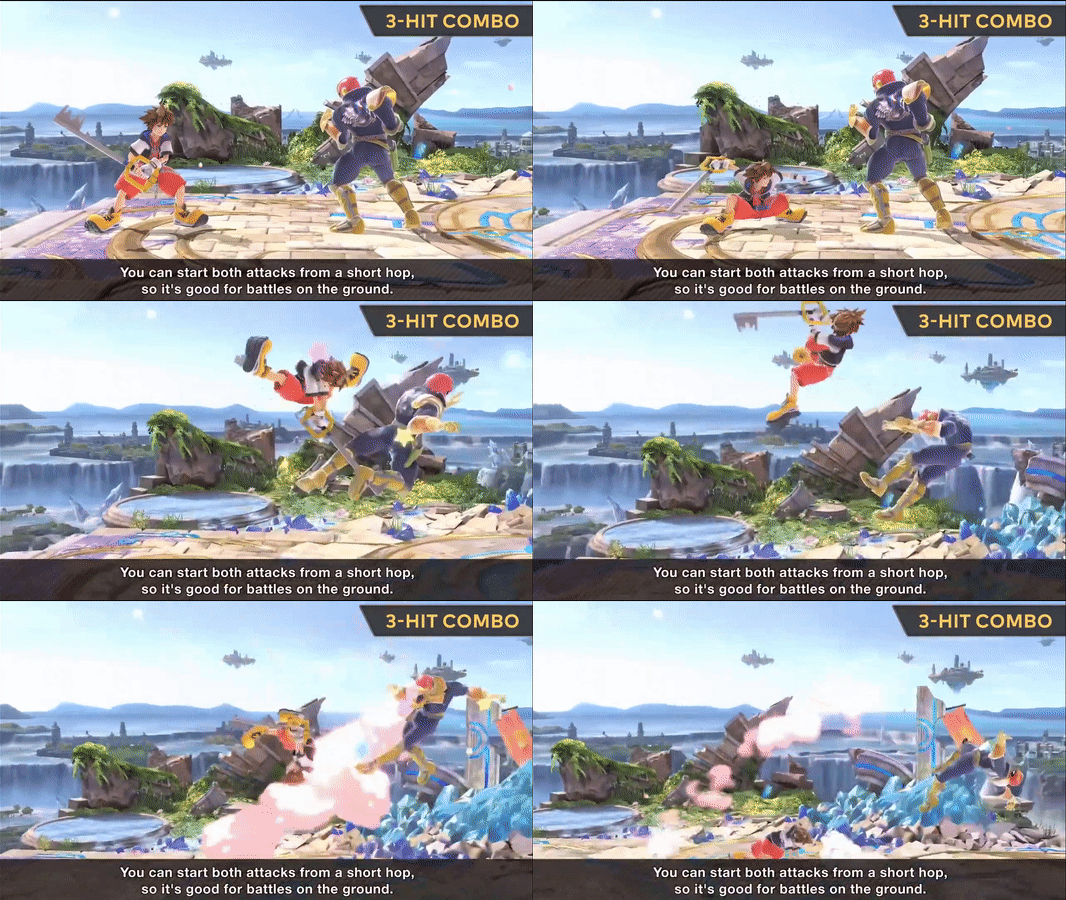
The Super Smash Bros. attention to detail really comes through in each of these new fighters. I think my favorite detail in Sora’s moveset is the aerial 3 hit combo. Stringing several attacks together from just one move like this is not something Smash fighters are normally able to do, at least not in this particular way, it’s unique to Sora. Aerial combat in Kingdom Hearts is essential. Square Enix had never really moved into the 3D space before the way they did with Kingdom Hearts, incorporating a full range of movement both horizontally and vertically. Kingdom Hearts goes out of its way to fully utilize these dimensions by giving Sora a powerful jump, and the ability to attack anywhere in the air. Gravity is just a gentle suggestion, in Kingdom Hearts. With access to the 3D space around a target, this would let the player jump into a variety of attack angles to really push what was possible in this combat system. This is true of all fighters in Smash Bros., probably to accomplish the same thing. In Kingdom Hearts 1 in particular, as opposed to its sequels, short-hop combos, in which the player would jump the minimum height and quickly hit an enemy with aerial attacks, would result in a much faster combo that can sneak through in more situations. It was a powerful and common technique you could use to push your skills in the game further, so I was absolutely delighted to see an adaptation of this highlighted in the Smash presentation, used in the exact same way.

Sora’s smash attacks borrow from various attacks he’s used throughout the series. His down smash is the finishing leap from Kingdom Hearts 2, which would replace your combo finisher on command, and propel enemies into the air for further combos. Sora’s up smash is the Ripple Drive from Kingdom Hearts 1, albeit without its magical effects. Sora lifts his keyblade above him to damage an area of foes around him. The Smash version actually retains this ability to hit multiple enemies at once.

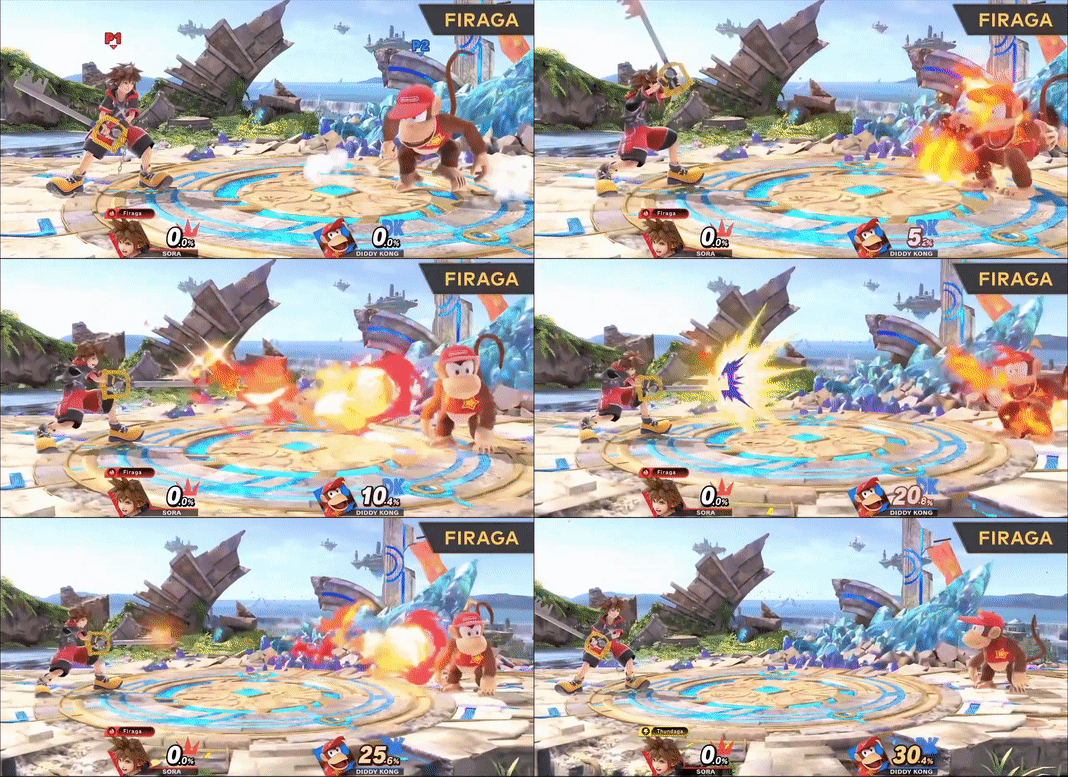
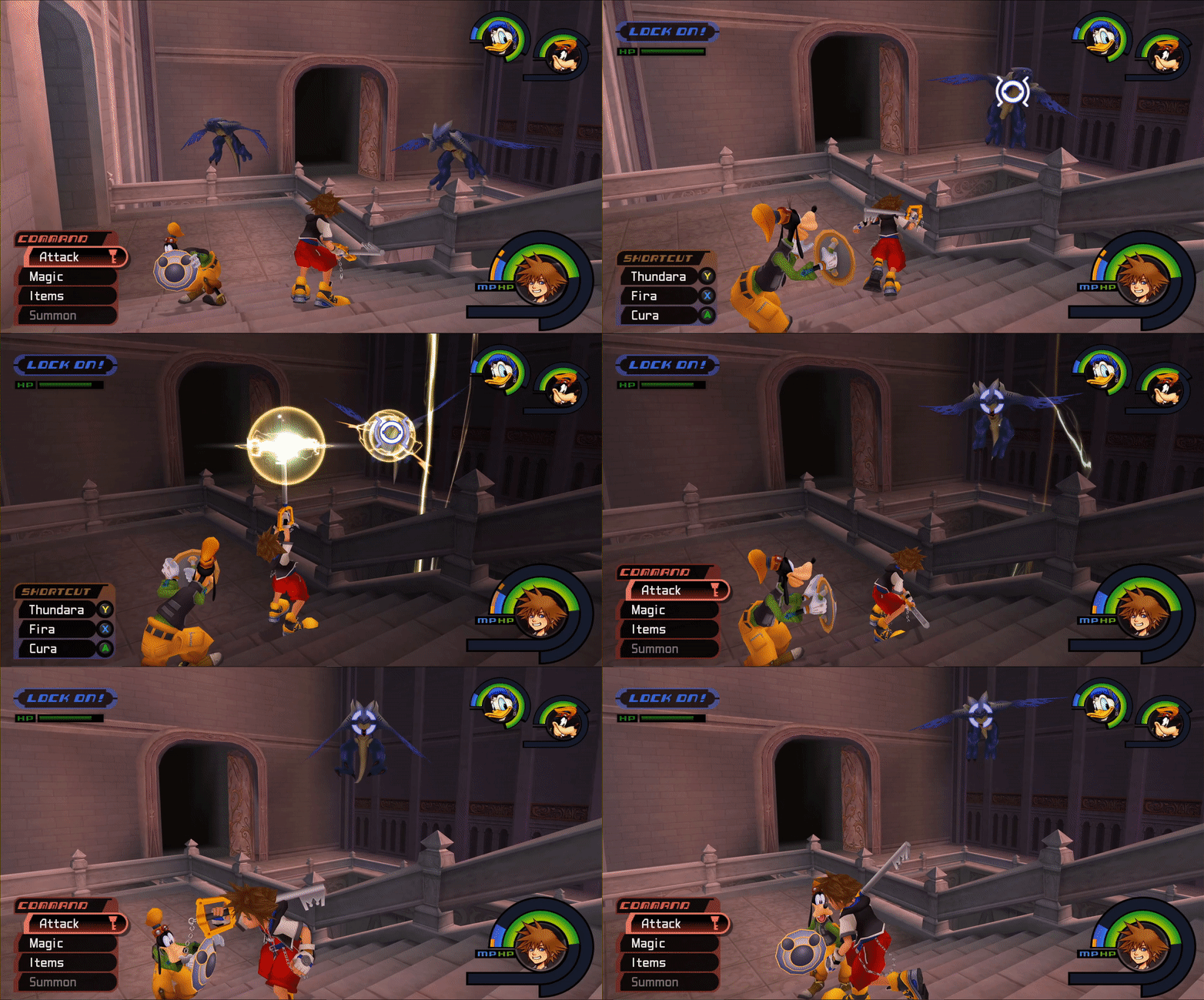
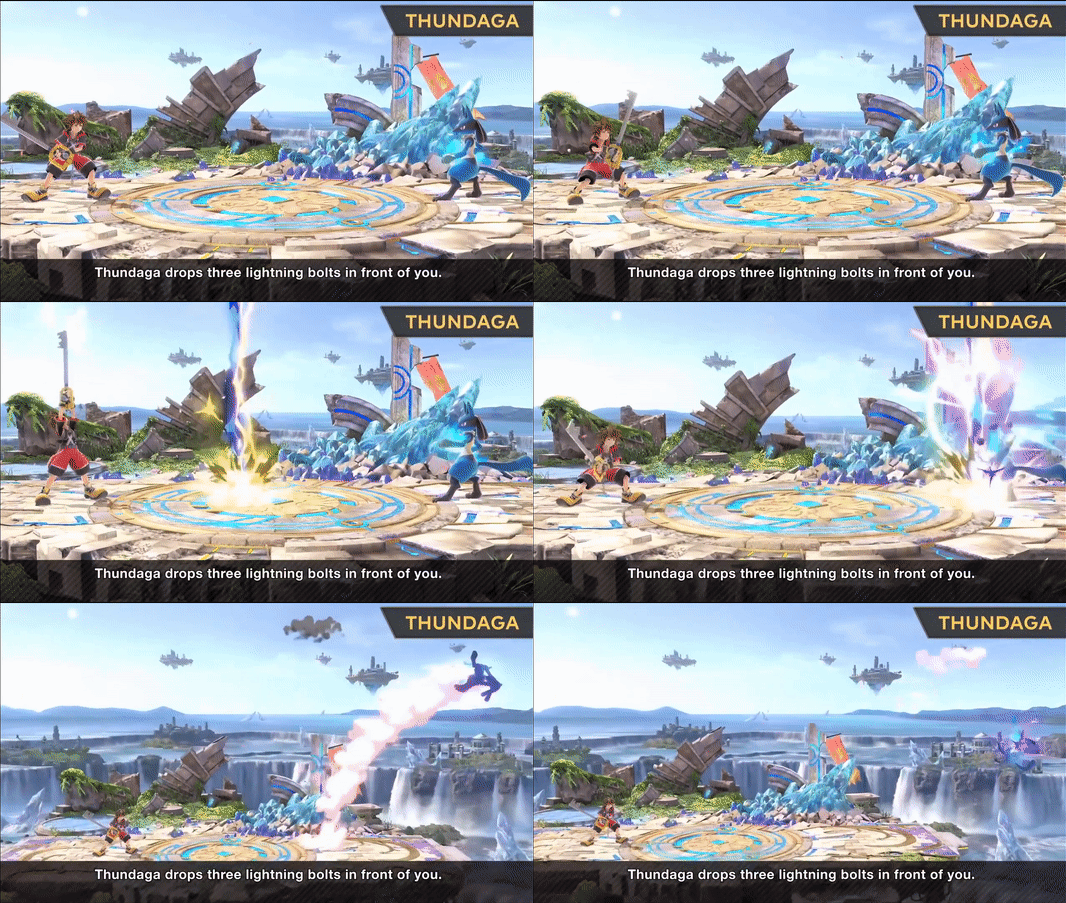
Sora’s specials are all direct references to attacks from Kingdom Hearts 1. The magic available, firstly, all behaves as it does in that debut game. Firaga is a repeatable, spammable, almost rapid-fire series of small projectiles. Thundaga is a vertically-oriented series of lighting strikes that can clear out a wide area. Blizzaga is a shotgun-pattern spray of particles, although it curiously did not freeze enemies in the original. The notable thing about Sora’s magic in Smash Bros. is the way it rotates, which was not a feature of the original game. This rotation does, however, reflect the way that Kingdom Hearts is menu controlled. Yeah. Kind of odd for an action game, but all of Sora’s actions outside of running and jumping are operated by selecting them from a menu in the corner of the screen. Yes, even attack is a menu item, and so was magic. Each spell could be chosen from an expanding sub-menu, which is what this rotation of spells in Smash represents. A few of the other DLC smash fighters do this, using a similar but not quite the same mechanic to represent something from the original game when it was not feasible to lift it directly to Smash, like with the Persona fighter Joker, whose rage meter does not feature in his home title. It does, however, somewhat reflect the themes of Persona 5 – rebellion and defiance.

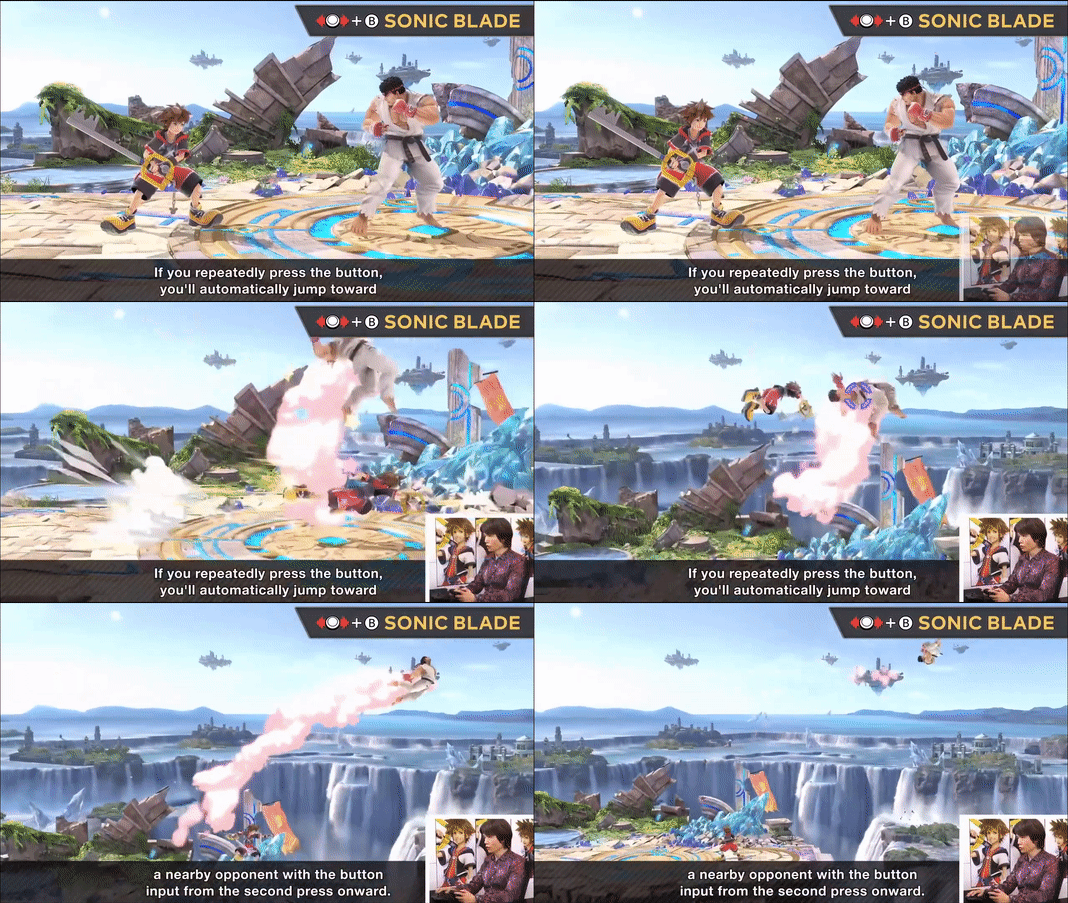
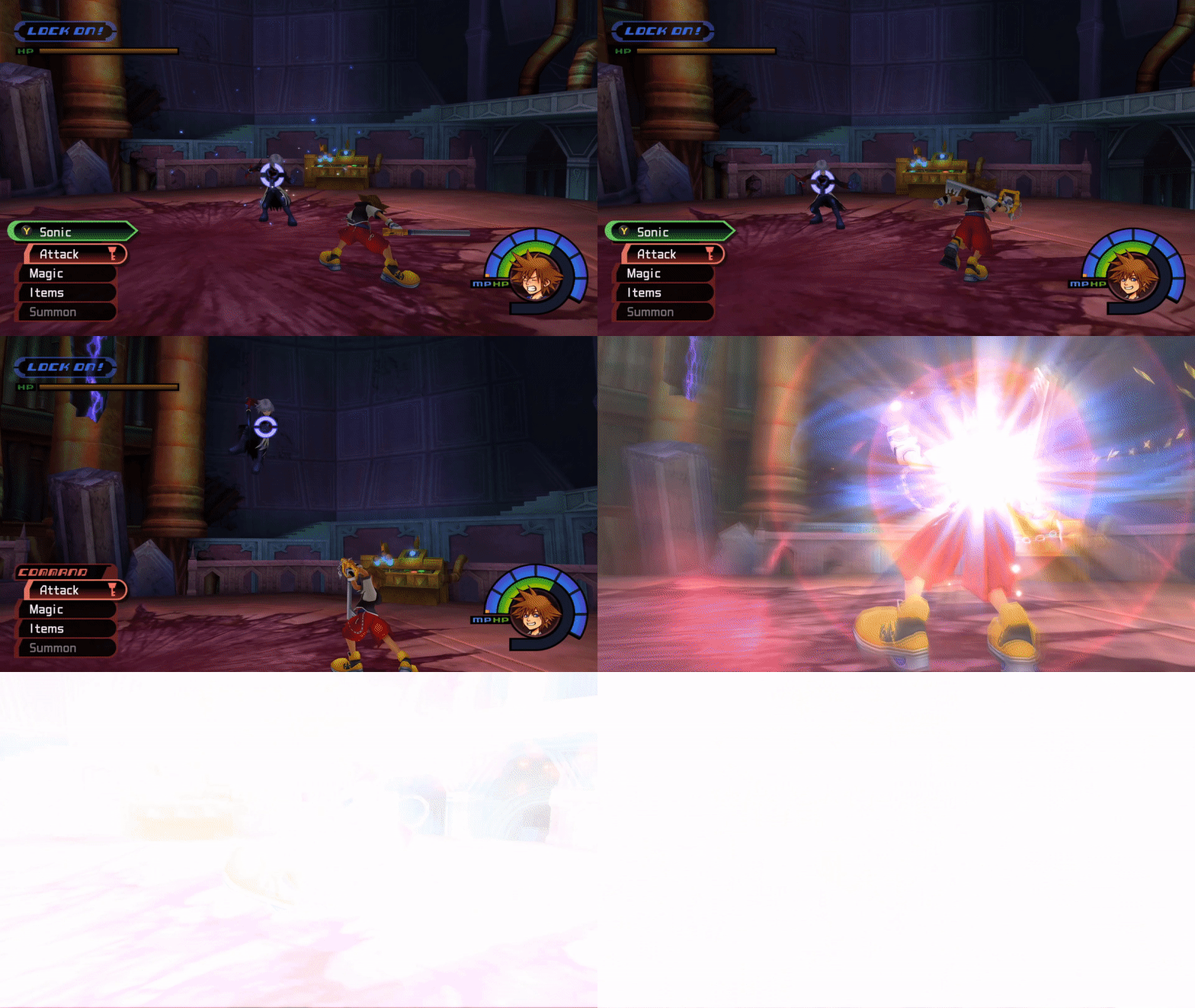
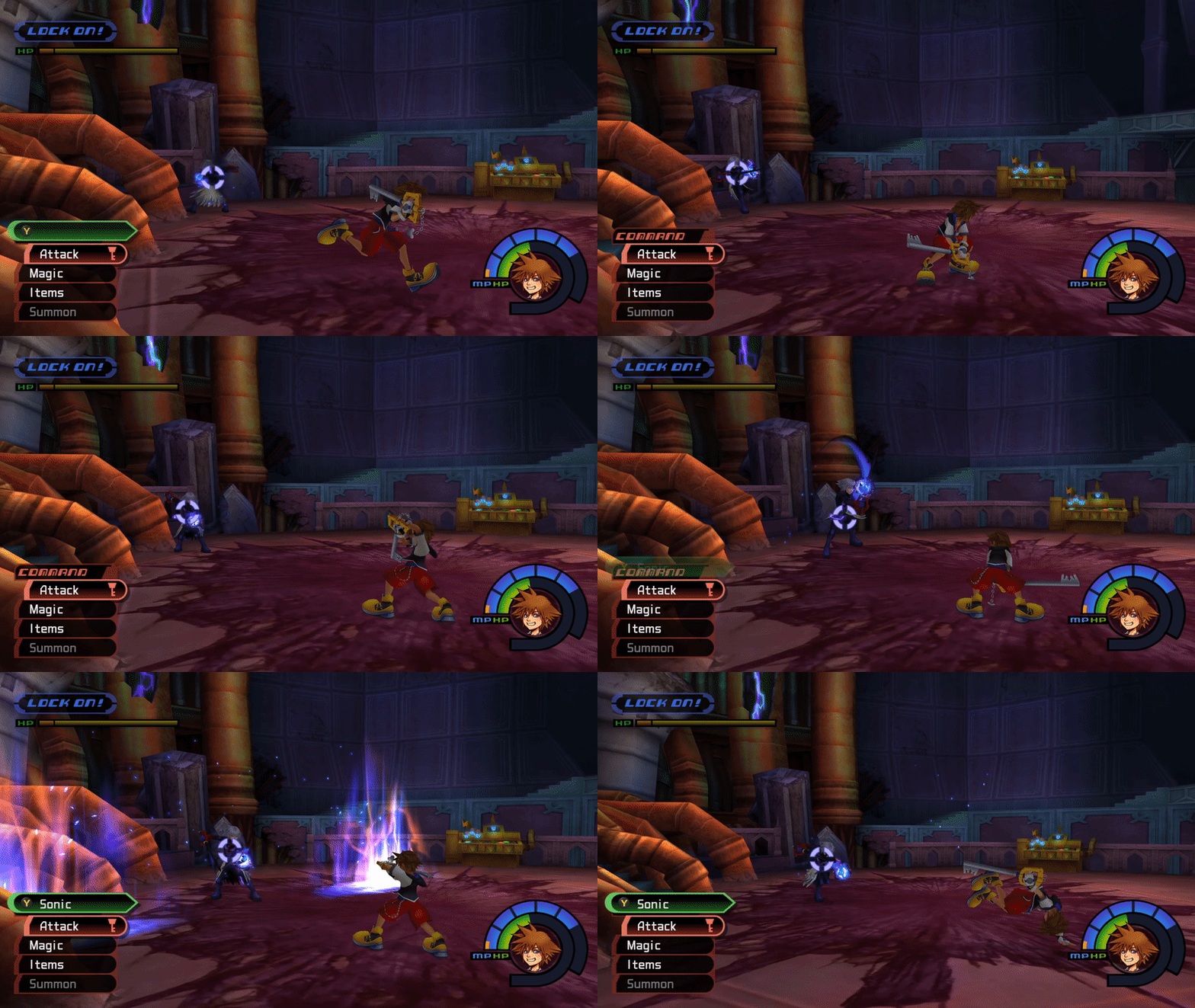
The Sonic Blade (actually a move Sora learned from Cloud Strife of Final Fantasy VII, fun fact.) allowed Sora to dash across the battlefield repeatedly, piercing enemy defenses and clearing out crowds of enemies. In Smash, this move has been given an aerial component, probably for a couple of reasons. First off, the original Sonic Blade was notable mainly for how it would zigzag across enemies, hitting them at multiple angles in a row. On a 2D plane, you can’t really convey this without, well using both of the two dimensions, so Sonic Blade has to go up now. The second reason reinforces the overall design of Sora in Smash, which is the archetype of an air fighter. Smash, along with many other fighting games, utilizes certain models for its fighters, or archetypes, such as fighters that are heavy and difficult to move, fighters that can quickly close distance, or fighters that are dangerous to cross with in the air. Sora falls into the latter category, and this too is a reflection of his original game, which included a lot of fighting mid-air, where Sora was able to home in on enemies like a bird of prey. In addition to reasons I’ve mentioned such as the full utilization of 3D space, there are also segments in which Sora can literally fly, and all the fighting takes place in the air! So making Sora a huge aerial threat fits perfectly. Sonic Blade in Super Smash Bros. can be directed manually by the player, which is technically possible in Kingdom Hearts, just not with the control stick – You’d have to change your lock-on target mid-attack to change Sonic Blade’s trajectory, but they thought of that! Smash Bros. features the blue lock-on indicator from the original game when chasing down a fighter! See what I mean about that attention to detail?

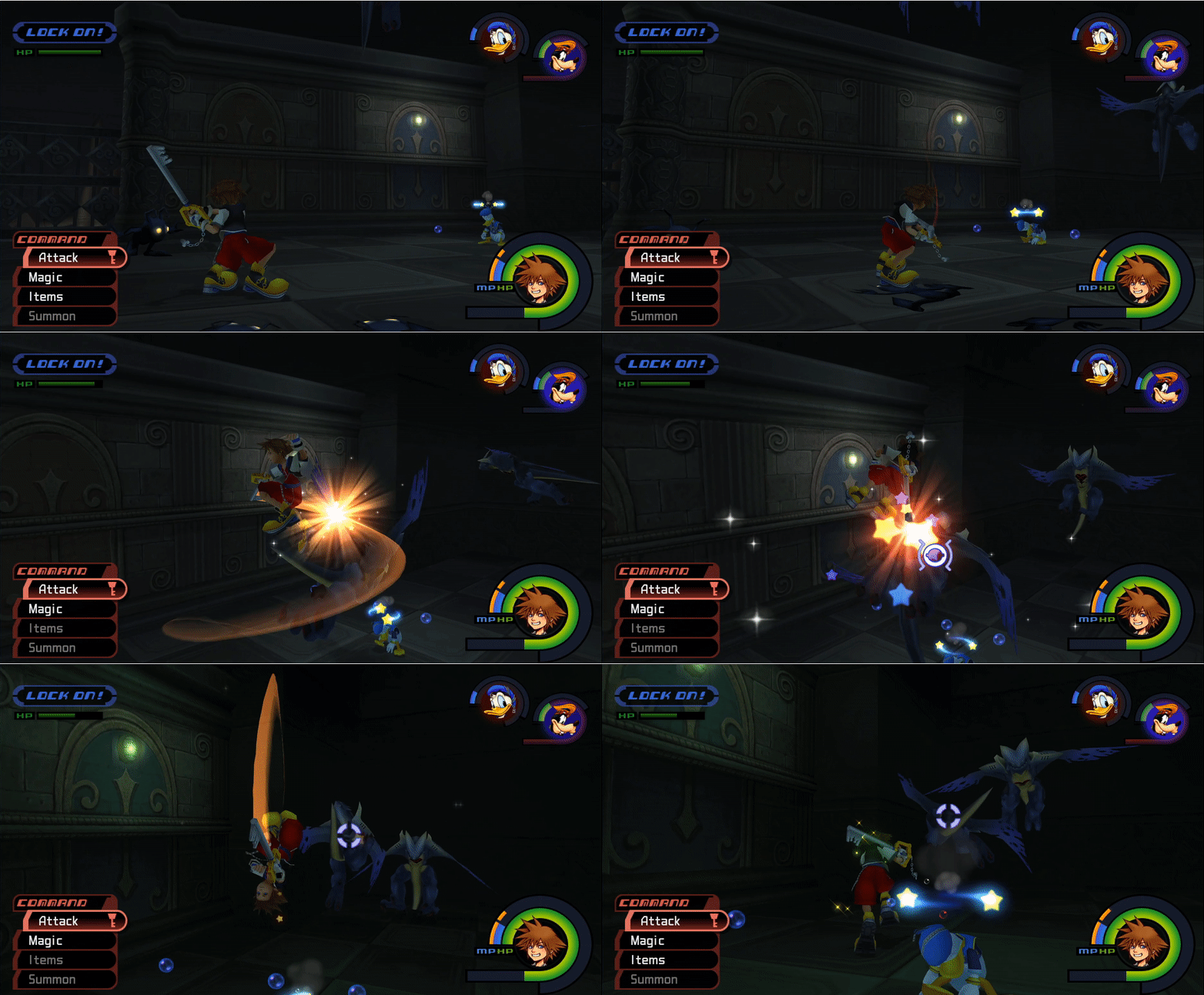
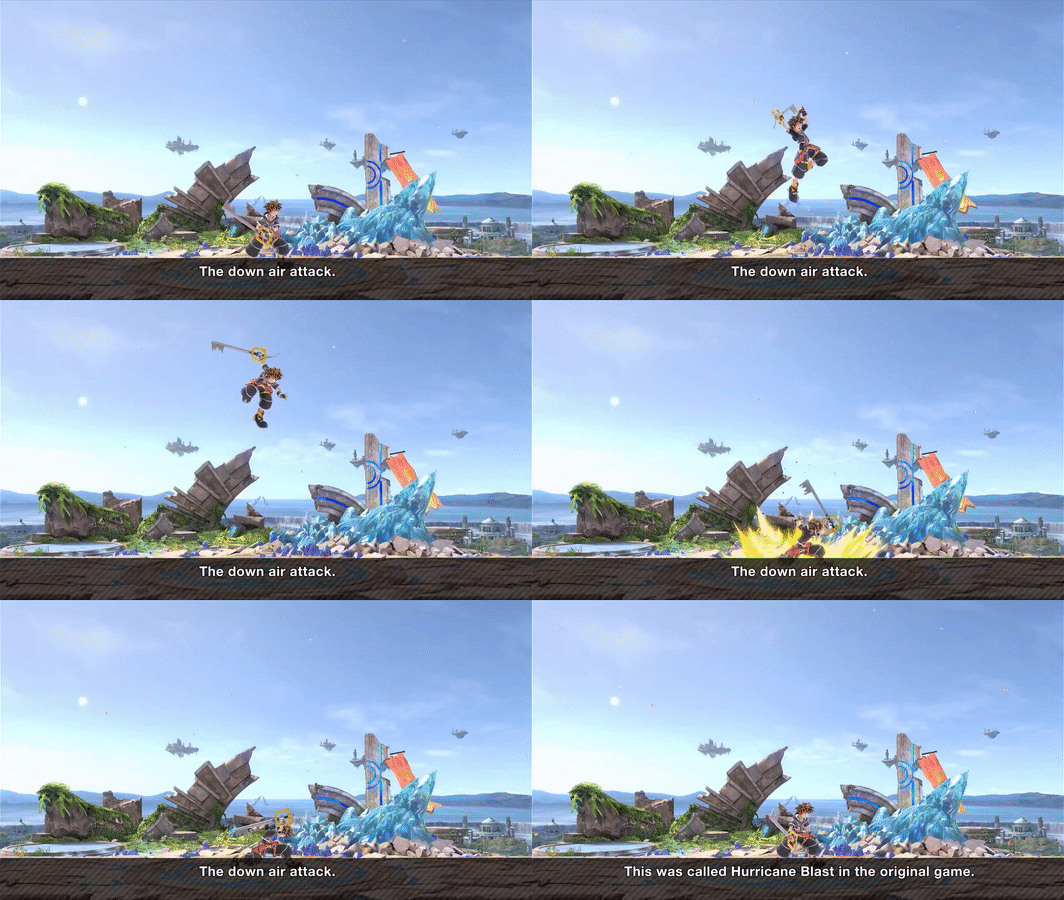
Speaking of air fighting, Aerial Sweep and Hurricane Blast are among the tools in Sora’s toolbox from his debut game that made air fighting so powerful. Sora’s attack combo is set and invariant until he levels up through experience. Once he does, he can unlock new abilities that extend or modify his attack combo. Arial Sweep and Hurricane Blast are both such modifiers. The Kingdom Hearts modifiers operate in an interesting way, where they may only activate when Sora and his target are in certain positions relative to each other. For example, Hurricane Blast, an attack in which Sora spins his keyblade vertically like a pinwheel around his body, activates if Sora attacks an enemy at a lower elevation than him, while midair. Aerial Sweep activates if Sora is grounded, and attempts to attack an enemy at a significantly higher elevation, without jumping. Kingdom Hearts combo modifiers were so compelling because, while they tended to deal more damage with more advantageous hitboxes than regular attacks, they needed to be set up with careful positioning, making the player change the way that they play as they level up, and think more critically about the game space. Super Smash Bros. is a game almost entirely about critically engaging with the game space, so both Hurricane Blast and Aerial Sweep are situated appropriately in Sora’s moveset to reflect their uses in Kingdom Hearts. Hurricane Blast can close distance with foes beneath sora, and Aerial Sweep does the same for foes above.

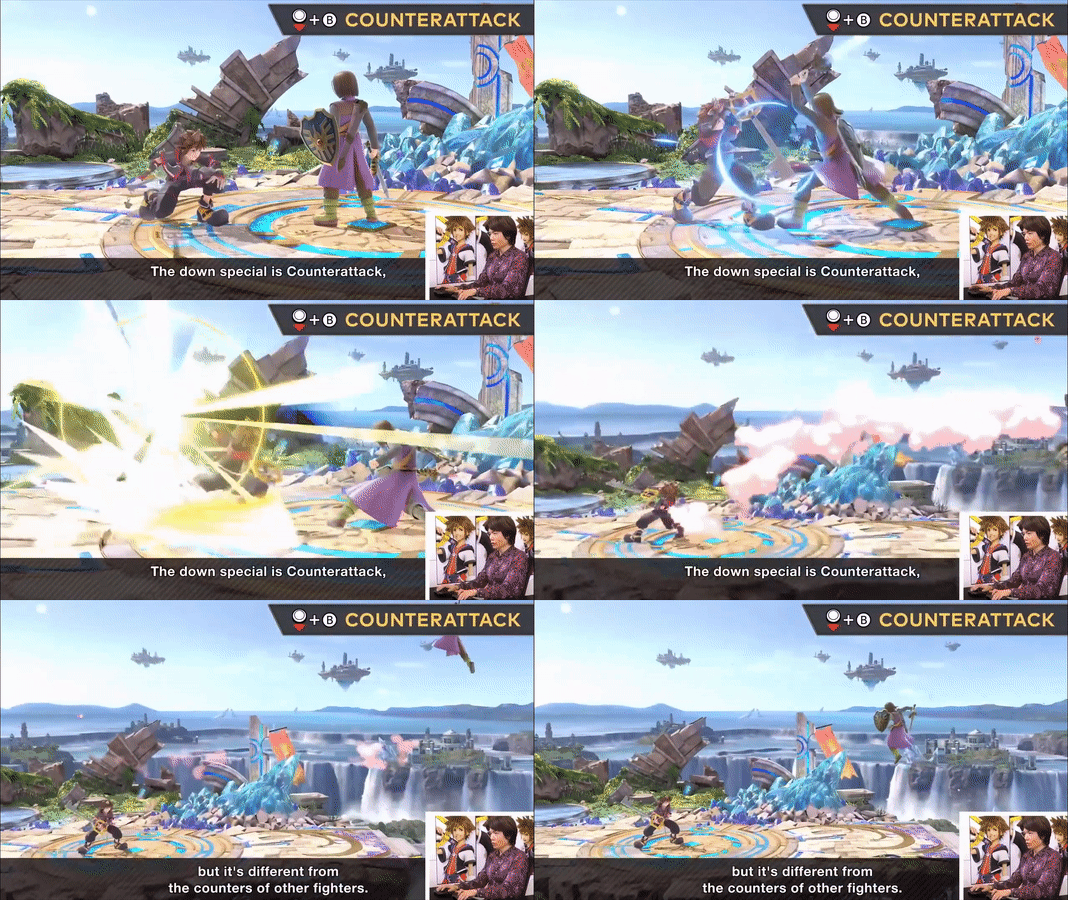
Finally Sora’s got his counter. He takes a defensive stance, and if an enemy hits him during that short window of time, Sora retaliates with an attack of his own. It’s a common mechanic in Smash, but I can see why it’s so oft used. Fighting games are inherently games of prediction, and some of their most exciting interactions are between players pulling one over on each other by anticipating an attack and turning it against the attacker. It just makes sense to include a mechanic specific to that sort of interaction, even if it is perhaps somewhat overused for various fighters. This kind of had to be in Sora’s kit, though, as it’s one of the primary methods for defeating the more difficult foes of Kingdom Hearts. Sora even had an ability specific to it that would increase his attack speed and restore magic points when he successfully countered. Countering is so integral to Kingdom Hearts that Sora can even convert a blocked attack of his own into a counter in his original game through the clash system, although Smash has its own system for handling clashing attacks between two fighters, so it wouldn’t make sense to give Sora the advantage over everyone else on that front.

So yeah I couldn’t be more chuffed. One of my favorite video game heroes from one of my favorite games is now.. in another of my favorite games, a celebration of all things video game. I pretty much just wanted to geek out over how incredible the translation to Smash fighter has been for Sora, and hopefully I pointed out something or other that you didn’t notice before. Now if you’ll excuse me, I’ve got some labbing to do…

Colors weave into a spire of flame…

Blazblue: Characterization Through Play

If you’ve ever been in a literature class you may know the basics of how characterization is generally conveyed – how a character acts, how a character speaks, how other characters act and speak in response. Typically this is done through audio and visuals, you can see and hear all these things play out to get an idea of a character’s personality and vibe. Games, of course, have their own interactive advantage. There’s a way to characterized that only games are capable of. The way a character plays, the way the systems and mechanics that make up their utility incentivize and reward certain methods of play can also be tools of characterization. There’s personality in a playstyle.

I’ll be using as a case study Yuuki Terumi from the traditional 2D fighting game Blazblue, as I think this character is a particularly acute example of what I’m talking about. A fighting game, specifically a traditional 2D one, if you didn’t know, is a game about pitting two fighters, each controlled by a player or an AI, against each other in a relatively small arena, with nothing but their fists (or swords) and their wits. First guy to die loses. A game more or less similar to Blazblue you may have heard of is Street Fighter. Fighting games can get pretty heady with strategies and counter-strategies, feints, double-fake-outs, predictions, counter-predictions, etc. There are a lot of moving parts and a lot of interesting player behaviors that go into a fighting game match, so there’s also a lot of room to explore game mechanics to characterize these behaviors.

I’ll try to give the simplest explanation for the rules of fighting games to define our terms here. Each player (or AI) picks a fighter from a roster of unique combatants. They try to hit each other without being hit in return. Landing a hit generates meter, a special resource that can be spent on special, powerful maneuvers. Getting hit also generates meter, but slightly less, while you lose HP. When your HP reaches zero, you’re out.

Just a game about two dudes kickin’ each others asses. There’s a purity in the simplicity of it

Games are defined by their rules, and so it is with playable characters. Even in the most open-ended game one cannot do anything in the play space. You’ll always be limited by what your play avatar or player character is or isn’t capable of. Given this inherent fact, the design of what can or can’t be done in a game defines the game’s character. When you’re assuming the role of Pac-Man, you play a hungry guy who loves fruit, is wary of ghosts, but is also quick to turn the tables on those ghosts when he gets the upper hand. Well, that’s all that Pac-Man is capable of, which is exactly the point. It’s extremely rudimentary in the case of Pac-Man, but this basic idea of characterizing through play can be expanded far in a lot of directions. When a player is incentivized to behave a certain way in a given play space, it characterizes their play, which can reflect on the character they are playing.

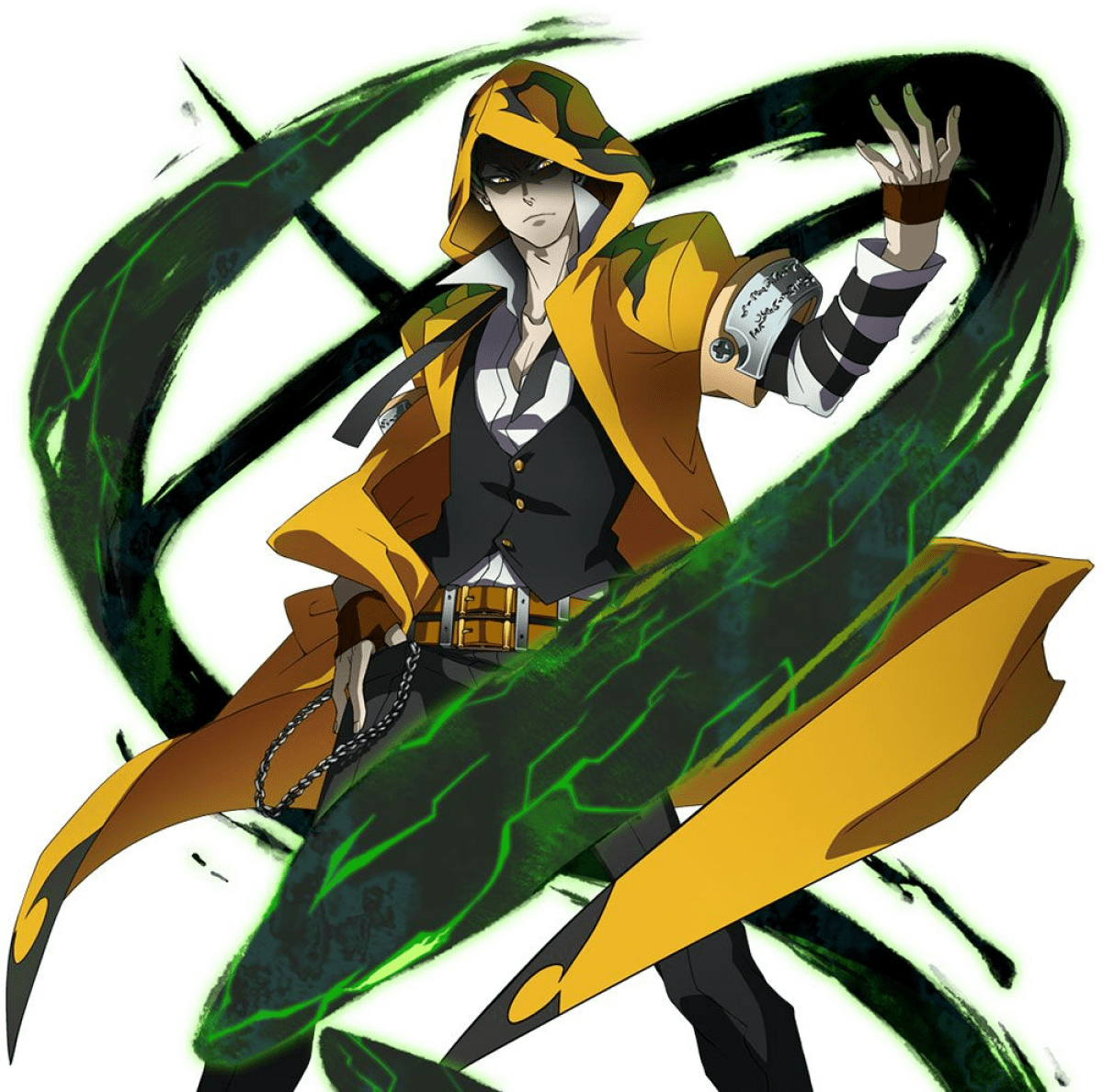
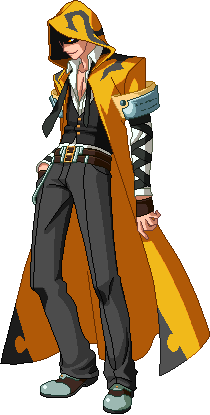
So how does Blazblue accomplish this in this case of Yuuki Terumi? Characterization begins with first impressions, and the first you’ll get of Terumi is his appearance, so let’s have a look.

Good God. He looks like a used car salesman half-heartedly dressed in a voldemort costume cobbled together at the last minute from miscellaneous articles found in a party city. He is impossibly cool. I will never achieve a fraction of this man’s sense of style. LOVE this guy. So there’s not a lot to go on here without further context within Blazblue‘s world. Some people might have that context, but many won’t, picking up the game mostly interested in some fun fighting game versus action without delving into the story mode. We get the sense from his posture that Terumi is perhaps a shady, underhanded fellow. He wears a suit, but loosely, maybe it’s just a facade of professionalism. The bright yellow cloak with wicked black patterns on it is a lot more striking and threatening, maybe even villainous.

Terumi is what’s known in fighting game communities as a rushdown character, meaning to succeed he generally wants to get in an opponent’s face, put up an oppressive offense, and not let up. Let’s take a look at some of Terumi’s basic moves to see how they reinforce this playstyle.

Nothing but his fists, his wits, and an absurdly large collection of knives

Basically everything Terumi can do, is either fairly short-ranged, or physically moves his character forward, toward the opponent. The game is trying to gently nudge all Terumi players to behave in a certain way – close in on your foe quickly, and use the tight space to your advantage. “Attack, attack, ATTACK!”, the game seems to say. Playing rushdown is all about keeping your foe guessing to get around any potential defenses they may mount against you. In a word, you’re manipulating your opponent into making mistakes, never giving them a moment to breathe. You want to make them seem stupid. You want to be dancing circles around them. Aggression and manipulation. It’s a pretty elegant abstraction of Terumi’s proclivity for psychological torment. It all paints a pretty vivid picture of a man that thrives off of schadenfreude, who feels superior, who’s powerful and knows it. I mean how often do you see curb stomping as a gameplay mechanic? Absolutely brutal.

I want to evilly cackle just watching this

One of Blazblue‘s primary mechanics is drive. It’s a special form of magic attack unique to each fighter, providing a unique mechanic that individualizes each character’s play style. Differentiation like this is great for making each fighter feel different, which is further great for your game’s variety and long term interest. It’s also excellent for characterization, with each drive mechanic reflecting on the characters’ various personalities. In Terumi’s case, his drive is called Force Eater, and its unique mechanic is as follows. Normally, as I mentioned earlier, each of the two fighters on screen build up meter when they deal or receive damage – more meter in the case of the dealer than the receiver. However, when Terumi deals damage with his Force Eater, he steals all of the meter his opponent would have generated through received damage, for himself.

It’s pretty intuitive that taking anything from a player that feels rightfully theirs makes things personal, and that’s the idea. Terumi breaks the almost sacrosanct understanding that taking damage refunds a resource as a consolation, but nothing is sacred to Terumi. It’s a subtle thing. Your opponent may not even notice that you’re stealing from them, but as a Terumi player you’ll know. You feel like an absolute bastard for doing this and it’s great. This is your primary method of generating meter, and how you fuel your play as Terumi. To be Yuuki Terumi means taking from others to survive. If you follow the game world’s narrative definitions that meter = magic = the soul, then Terumi eats away at his opponents’ souls to fight them. Pretty apt. The end result of all this is that Yuuki Terumi can generate a dizzying amount of meter in a very short amount of time, which further reinforces the next point I want to discuss, his supers.

Watch the respective fighters’ meter (the number in each bottom corner) when Terumi just kicks his opponent vs. when he uses his green drive attack

In traditional fighting games like Blazblue, a super is a big, stylish, spectacle-rich attack that deals a lot of damage at the cost of some of your meter. It’s the big haymaker attack that you gradually build up to. Most characters in Blazblue have two normal supers to choose from, sometimes three, and rarely even four. Terumi has SIX. In fact, most of his versatility as a fighter comes from his supers. Tools that some more specialized characters might have, like counters and and ranged attacks, are only available to Terumi through his supers, requiring him to spend meter to use them. So not only is Terumi a power-hungry soul eater, but he also delights in spending enormous amounts of that magical energy he siphons, burning through it like it’s nothing, unleashing a deluge of power other characters struggle to scratch the surface of. Because Terumi can generate so much meter so easily, you as a Terumi player are almost always flooded with the stuff. You cap out at 100 meter, and money in the bank does nothing for you, so it’s most efficient to be spending it frequently. This promotes an extremely aggressive playstyle, which is good, because Terumi is an aggressive guy.

Terumi’s words drip with venom, and also everything else he does

You’ll notice a lot of growling, sneering, and jeering coming from Terumi. He’s constantly berating, insulting, and taunting his opponents. He clearly doesn’t think much of them and wants them to know it. Gameplay is the core of what we’re talking about here, but gameplay has to work in concert with audio and visuals – all three are essential to the overall experience. The animation does a lot of heavy lifting here too, as you may have noticed. It can communicate some nuances of Terumi’s character that don’t quite come out through gameplay alone, such as the elegant yet slippery, almost dance-like way he moves, like a snake. There’s also a lot of snake imagery here. Okay yes, the snake thing isn’t all that subtle. Terumi = snake.

Yes, this is a thing you can actually do to people in this game. You monster

Feeling superior isn’t just a kick for this guy, it’s like an obsession, or a need. It’s as if he’d disappear in a puff of green smoke if ever a single person in a room with him wasn’t made to feel lower than a worm. He’s powerful, and he knows it. From his unassuming form he can unleash a torrent of magic that puts others to shame, and he loves doing it. He’s cruel, sadistic, and aggressive. He doesn’t want to just stomp you into the dirt, he wants to machine-gun stomp you a thousand times per minute until you’re a red paste on the ground. The game treats you like a bloodthirsty sadist, so that’s what you become to play Terumi. Blazblue is so effective at this, I often find myself repeating caught up in Terumi’s rapturous celebration of his own ability when I land a particularly nasty combo. It’s all in good fun, of course. Of course. Is this that “role playing” I’ve heard so much about? They should make games about that kind of thing.

“DAMN I’m strong!”

So how do you make your player feel like Spiderman.. or Batman, or Pac-Man or whoever? Build systems that incentivize behaviors reflective of Spiderman. Construct your gameplay mechanics around these behaviors so that a player will naturally be inclined toward doing things that Spiderman would do, and back up these behaviors with coordinated audio and visuals that promote feeling the way that Spiderman would feel. If your gameplay mechanics are built well, if they’re fun, you can even give players a reason to have fun roleplaying. Becoming a character within a narrative is something you can only do with a game, so make it fun to become your game characters for a time and make an experience players can’t have anywhere else.

Stand up! I’m not satisfied yet…

Undertale: Combat Where Nobody Has To Die

Much ado has been made about the prevalence of violent combat in games, how it is a much-trodden space with an overabundance of focus on the damaging and killing of enemies in games. It’s worth interrogating how we make games and what the systems we put in place represent. ‘Combat’, as a gameplay system takes the form of abstract tasks meant to represent a conflict. Conflict doesn’t have to be violent, or even involve fighting. When you think about it, a lot of the standards and practices that are common for designing ‘combat’ conflict in games can be abstractly applied to a wide variety of real-world situations that don’t directly involve violence. There’s an adage that action or fight scenes in narrative is like a conversation, and I think this broadly applies to all sorts of interpersonal conflict. All this to say that Undertale takes extremely familiar RPG combat design traditions in an extremely nontraditional way to represent its conflict, which can take the form of violent struggle or extremely peaceful, yet tense conversation. I want to talk about this, in particular, the space where the bulk of Undertale‘s gameplay can be found, in the peaceful ‘pacifist’ style of playing Undertale.

A similarly large quantity of ‘ado’ has been made of Undertale‘s underlying morality system, which allows the game to read and react to player actions across save files to drastically alter the story and how characters react. I’m sure there’s not much more I could add to that well-worn conversation, but what I don’t see talked about near as much is the actual mechanics that make up Undertale‘s combat system. Undertale is ostensibly a turn-based RPG, and it has many of the trappings you’d expect of traditional RPG combat. The player and AI take turns taking actions, there are character statistics such as health or defense, and there are the usual available actions such as attacking or fleeing. Compared to the traditional turn-based RPG formula, however, Undertale leans a lot less on strategy, which is to say forethought and formulating a plan of attack. Success in combat in Undertale is much more contingent on one’s ability to navigate enemy attacks, which take the form of ‘bullet’ patterns in a shoot em’ up or shmup styled dodging sequence. Now, that all sounds rather violent, but all this really means is the player must move around a little icon representing themselves (in this case a heart) so it doesn’t collide with any objects on screen. In this way, Undertale works to make defending, in other words passivity, a more engaging and fun mechanic than attacking. Undertale also loves to borrow from genres outside of RPGs to accomplish this, like incorporating elements of text-based adventure games.

Have fun fighting and/or dating a skeleton, no explicit violence involved

When monsters randomly encounter the player, as they’re wont to do in RPGs, the monsters will be naturally on the defensive around you, a human, a member of the vile people that attacked and banished monsters underground. The goal for a pacifist player will be to simply exit the encounter unharmed so they can reach their next story chapter. You see, when it comes to the player’s form of ‘attack’, their agency in all of this, the problem Undertale faced was making the act of de-escalation as interesting and satisfying as the act of chopping dudes in the face with a sword. The solution to this problem was found in three ways. First, the act of defending is made into a compelling game in and of itself. Secondly, the player is given short-term and long-term goals in every encounter. Finally, the incentive for the player to not perform acts of violence is made to take the form of exploration into interesting characters.

We’ve touched on that first item. Undertale’s defense or ‘bullet hell’ sections involve dodging the magical attacks of your opponents. The conceit here is simple, but a time-tested one, utilized in tons of classic games like Galaga or Space Invaders. The player is represented by a small heart, and obstacles will move around the screen which the player has to avoid by moving freely in two dimensions. It’s among the barest, simplest forms of spacial and temporal awareness as gameplay one could think of, but that’s why it’s so effective. Some of the best games are those that start with an extremely simple base that can be built upon, and Undertale certainly builds upon it. Bullet patterns become increasingly elaborate and difficult towards the end of the game. Bullet patterns can take the form of obstacles that are abstract shapes, obstacles shaped like characters, obstacles along vector lines, any of which can move in a variety of patterns. The game will also iterate on these basic designs using new rules and wrinkles that change up the variety, such as adding gravity to the player’s avatar, a controllable shield, or a controllable projectile to destroy obstacles.

These ‘bullet hell’ sections get very creative. Here I have to redirect the enemy’s own attacks at them to pacify them!

This makes up the player’s short-term goal in every combat encounter. Each turn, the player has to focus on the imminent danger of enemy bullet patterns. Lots of RPGs have incorporated real-time gameplay into turn-based actions. Integrating short-term goals like this sort of action gameplay with longer-term goals keeps the player’s attention engaged and the tension subsequently high. There will always be something in the back of your mind that you’re working toward, while immediate concerns keep you constantly engaged. In Undertale‘s case, the long-term goal for each monster encounter is trying to figure out how to make them passive, and amenable to ending their attack against the player. Each one is different, and like a little puzzle or text adventure encounter where the player has to figure out how to spare their opponents. The need for dodging enemy attacks, is essentially your payment ticket for each attempt made to pacify the opponent. A wrong answer means needing to dodge more attacks. There is some strategy in Undertale’s combat in how you approach multiple opponents. Sometimes more than one monster cannot be pacified in the same turn, so a consideration of the order in which they are tackled is added to the player’s long term goal achieving process.

Not every puzzle solution is a brain-teaser, but they engage you with the monsters’ personalities. Get it? Don’t pick on your eyes.

The final and I think most important of how Undertale solved for nonviolent ‘combat’ is its methods of incentivizing the player. The typical pattern for any game with combat is to reward the player for killing or defeating enemies, increasing the player’s power as they accumulate more and more victories. So it is with Undertale, when you choose to kill. When sparing foes, however, the game goes out of its way to makes sure there is no direct material reward of in terms of player power. Undertale did not have to do this. In a vacuum, there’s no reason a nonviolent victory cannot reward and empower the player. In Undertale it was very important that external rewards like player ‘LV’ be tied exclusively to killing. Undertale is trying to justify its thesis of pacifism by making that path entirely implicitly motivated by narrative elements, or in other words the process of pacifism itself. ‘Not killing things can be fun too, no reward needed’ it seems to say.

Horse mermaid see, horse mermaid do

The ‘bullets’ players must dodge can take a wide variety of forms from the tear drops of a depressed ghosts, to the flexing muscles of a pompous weight-lifting horse. If those sound odd to you, it’s by design. Undertale‘s first boss throws magical flames at you, but very little afterward will ever be so typical. Undertale uses the contrivance of ‘magic’, a power which monsters can use to express their emotions as power, to explore the character of the enemies you fight, as you fight them. In what other game can you expect to be attacked by the excited barks of an overstimulated puppy? These attacks are used as subtle characterization of each and every monster you encounter. The act of play is characterization in and of itself. In the world of Undertale magic is an outward expression of emotion, and this carries through gameplay as well. It’s not always a direct metaphor, and it’s often subtle, as reading emotion is in real life, but the attack conveys the emotional state of the monster which used it. You can get a sense of monster personalities just by playing. The dialogue does heavy lifting in this department as well, through hilariously absurd and weird scenarios. In this way, your ‘prize’ for victory is often a hearty joke, or an emotional catharsis. It can engender an intense curiosity to see more out of these monsters, more you won’t get to see if you kill them.

How could you hurt a face like that?

The player is ideally motivated by the desire to explore interesting and compelling characters. This, entwined with the short and long-term goals I mentioned earlier. The player’s long-term goal is usually discovering exactly how new monsters will react to their various actions. The monster Shyren loves to sing but is too timid, needing gentle encouragement from the player humming along. The monster Woshua is obsessed with washing things, so asking for a cleanup and successfully intercepting its healing water will make it very happy. The monster Aaron will become so swept up in out-flexing you if you try to match his style, that he’ll flex himself right out of combat. Keying in on visual indicators like the enemy’s emotional state, the personality in their dialogue, and the queues of their overall physical appearance all work as hints to solving the ‘puzzle’ of connecting with them socially and deescalating conflict. One can trace subtle changes in expression even, in certain encounters. The game, as it were, becomes one of determining your conversation partner’s wants and needs. It becomes a game that teaches empathy.

Here our hesitant mentor Toriel refuses to kill us, it’s clear here what emotions her gameplay are meant to convey

Combat, as it is typically designed, in all of its many forms, is fun. That’s just simply true, and it’s probably the biggest reason violent conflict remains so prevalent in games, as it’s the most obvious way to explore this form of play. This form of play was invented to represent violence, after all. Undertale is refreshing in how it explores a world where such play can be representative of all manner of other forms of conflict. Lots of conflict occurs in our daily lives every day that doesn’t end in death or grievous injury. There’s clearly a lot of space yet to explore how to adapt our design conventions to the task of representing these nonviolent forms of conflict in fun and interesting ways. I think part of the reason Undertale made such waves is that there’s a huge appetite for that as-yet only slightly explored space.

Even when you ran away, you did it with a smile…

Boss Breakdown: Dark Riku at Hollow Bastion

Kingdom Hearts does something interesting with Riku. He’s set up at the beginning of the game as the player and the player character, sora’s, rival through gameplay and narrative alike. His initial early-game boss fight establishes Riku as the primary barometer for the player’s capabilities within the game’s systems. That’s the set up. The punch line, coiled and poised to outstretch and clothesline the player at mach 2, is Riku’s final boss fight – Dark Riku, awaiting at the ominous castle of Hollow Bastion. Regular Riku is difficult, way more difficult than might be reasonable at the very start of a game. However, he’s optional and therefor more of a story beat for both the game’s narrative and the emotional experience the player is being primed for. Dark Riku is not optional, and Dark Riku is levels above his predecessor. This boss also represents a notable difficulty spike and more or less fulfills the role of narrative climax to Kingdom Hearts, and that aforementioned emotional experience for the player themselves. People remember this boss fight. There’s something about it that sticks with you. It leaves an impact.

Growing up is finding Dark Riku impossibly cool, cringe, and then unironically cool again, in that order.

Dark Riku is a fight divided roughly into three phases. Dark Riku, as with the Destiny Islands Riku, has a pretty modest repertoire of actions to use against the player character, Sora. Riku fought defensively and passively on the Destiny Islands, almost always awaiting the player to approach or take some action. His voice lines were goading and taunting, meant to lull the player into making hasty mistakes. Dark Riku doesn’t wait. He may pace around for a few seconds before attacking, but will go on the offensive on a hair-trigger. At this point in the game, the player will have access to new defensive options compare to the Destiny Islands encounter; the block and dodge roll. They will also be able to heal themselves with cure magic.

Like clashing, in which Sora negates an oncoming attack by timing one of his own attacks to hit at the same time, the block negates incoming damage and sets Sora up to counterattack. The timing on a block is much more forgiving. However, if a block is whiffed, that is, if the block is used when there’s nothing to block, Sora has to spend a lot more time returning to a neutral stance than if he had just attacked, so there’s an interesting tradeoff between using attacks as defense and using a block as defense. One is more reliable, but more risky in the event of a failure. Using cure magic to restore Sora’s health will also have become a core mechanic by this part of the game. Sora takes a lot of damage and his health is not expected to hold out over an entire battle. The player is expected to keep on eye on their MP resource, which determines how often they can use magic. The MP bar is also another design tool for encouraging the kind of aggressive action that Kingdom Hearts is going for, as the primary way to restore MP is by attacking. Playing defensively will only get you so far. Using cure at an inopportune time can also mean getting interrupted, so the player must be aware of their surroundings and situation to heal. Riku is constantly prepared to counterattack, meaning the player will have to be more aware of how Riku will respond to certain actions, predicatively.

Magic is fueled by the power of VIOLENCE

For example, one of Dark Riku’s attacks is a medium-ranged overhead swing. The attack can be easily blocked or clashed and then followed up on with a counterattack for a pretty safe way to deal damage to Riku. Riku likes to use this overhead after dodging or blocking Sora, so the fight will reward consciously keeping track of Sora’s actions. Being able to switch from attacking to defending and back to attacking is the surest way to deal damage without being hit. One can goad Riku into dodging, which will likely trigger this overhead attack, which can then be countered. That kind of forethought is what’s being encouraged here. For a player, being able to successfully predict and counter enemy moves is a huge signifier of personal prowess, so it’s advantageous to a combat system to be predictable to a degree, if making your player feel powerful is a goal.

This attack-counterattack pattern Kingdom Hearts settles into creates fight scenarios that are both mechanically and visually dynamic

Another of his basic attacks is a two-hit combo that can close the distance between himself and Sora. It comes out fairly quickly, but it’s most often used when there’s some distance already, so the first hit will rarely make contact. It’s more of a tool for Riku to discourage simply running from him, but like with the overhead it can be blocked or clashed, then countered, meaning it’s also another tool for the player to direct the fight and indirectly control Riku’s actions to making openings. That’s the gist of it, really. If you want to make a really challenging boss fight and trust in the fun of your combat system, focusing on fundamentals makes for a solid foundation. In phase one Riku is just a very aggressive, very damaging, and responsive sword fighter. Understanding of the various defensive and offensive options available to Sora will carry the player far through this fight, but Riku still has a few tricks left.

Like Destiny Islands Riku, Dark Riku may take a defensive stance and taunt Sora, though this time with his more villainous tone. This time getting behind him won’t work, as Riku will always turn to face Sora, so taking his taunt with an attack is the only option outside of waiting. Fortunately, Riku almost always responds to this with an attack that can be easily countered with a block. If Sora gets too close to Riku, he’ll do a fast spin attack to help maintain his optimal distance. This helps keep the player in danger, so to speak, which helps keep the fight exciting. This quick attack is blockable, but not easily counterable.

Riku’s third attack in this phase is the helm splitter, where he jumps high into the air and comes down with a magical shockwave on the ground. This attack is unblockable and deals significant damage, so dodging out of the way with a roll or out-ranging the attacking are the only options. Dark Riku has a few of these unblockable attacks, most likely intended to encourage the player engaging with a fuller breadth of the combat mechanics, such as the dodge roll, blocking, jumping, and clashing. Unblockable attacks don’t have a universal signifier in Kingdom Hearts, but it does a pretty good job of making them intuitive. Riku’s helm splitter is quite a bit more exaggerated than his other attacks in animation, with him jumping very high into the air before coming down. It’s obvious straightaway that it’s more powerful than his other moves. The energy his shockwave creates is given a lot of pure white in its color profile, and any attack he or his derivatives use from here on out with similar visual details are likewise unblockable.

The big jump both warns of the impending danger, and gives ample time to dodge out of the way, which I… fail to do, here

Once Dark Riku has taken a bit of damage, the warm up is over. This is phase 2. From here on out, he’ll occasionally empower his weapon with a dark aura, adding some nasty new effects to his attacks. The art and design assets of this empowered state are really just overlays on the basic behaviors he already has. It’s very efficient design, that wouldn’t have demanded too much production overhead, and yet expands the fight in very interesting ways. Every time he does his two-hit gap closer while empowered, he’ll launch an energy disc ahead of himself, which can damage Sora, or even set him up to be combo’d by followup attacks from Riku. Riku’s overhead will now also launch some unblockable energy, in two lines out to either side of him. The way these two attacks in particular are designed utilize a common trick in action games with a dodge mechanic like Kingdom Hearts. By extending out the danger area of these attacks in lines, they require a greater degree of fine control from the player while dodging. Usually, dodging just vaguely away from danger is sufficient, but if you dodge to Riku’s side during an overhead, or directly away from him during a gap-closer, you’ll get hit. Closing off specific vectors around the enemy during their attacks like this tests the player’s ability to dodge in specific ways, a straightforward step up from what is usually expected of a dodge.

The game is funneling Sora to certain positions with attacks like this, keeping Riku front and center.

During his empowered state, Riku is extremely aggressive, moreso even than before, and will barely give the player a moment to breathe. During this state, healing is very risky, as is going on the offensive, so the challenge becomes figuring out what the player can accomplish that won’t lead to their own defeat. Riku’s gap closer is still blockable, as are the projectiles he creates from it. So essentially, Riku’s empowered state has an unblockable attack that is most effectively dodged, and an attack that is most effectively blocked, so that pattern of encouraging the player to utilize a variety of their tools and maneuvers is reinforced. Riku is much less likely to flinch during his empowered state, but it can still happen, so the player must keep an extremely sharp eye out for their opportunity to deal some damage. The longer the fight goes on, the narrower this opportunity becomes, requiring the player to take greater and greater risks to deal damage, naturally elevating the tension as it reaches its crescendo. The narrative in this fight is meant to be an underdog overcoming his greatest rival consorting with pure darkness – a symbol of overwhelming power. Demanding persistence of the player in knocking down Riku’s increasingly ironclad defenses reinforces this feeling.

Persistence is key in turning Riku’s attacks against him

Riku will finish out his empowered state with an empowered helm splitter that unleashes a wave of unblockable energy bursts. As with any enemy in Kingdom hearts, the key to avoiding this attack comes from understanding its behavior. The attack itself sort of acts like a little mini-enemy in that it has its own logic to how the energy bursts appear. They will surround Sora, and appear at semi-random locations, but there’s a bit of a predictable method to it. They seem to predicatively try to lead whatever direction Sora is currently moving, so quick changes in trajectory as Sora dodges drastically reduces the likelihood Sora will be hit. Figuring out your enemy’s behavior through observation is one of the primary skills Kingdom Hearts tries to impart, and that can also be applied to individual attacks like this.

Notice the appearance of energy bursts are clustered around where I’m facing, just ahead of me, but slightly offset

Riku cycles between his empowered state and the attack pattern from phase 1 until he is reduced to low health. Now the final phase begins, and with the player’s competence in regular combat well-established, the game shifts somewhat to introduce feelings of desperation and survival. Riku will permanently enter the empowered state, and the player will now have to constantly deal with his empowered attacks while whittling down the last of his health. The tension is raised and the stakes are at their peak – be defeated now and lose all that progress you made fighting Riku. The player’s ability to manage risk, defense, and offense is pushed to its limit.

Every so often, and with increasing frequency as his health is reduced, Riku will initiate his ultimate attack. This is one of the earliest examples of such show-stopper, set-piece, mega powerful, screen-subsuming attacks that will become a Kingdom Hearts favorite tradition. First, how does it work? Riku will raise himself into the air, announcing his intention, then fly straight at sora in a dashing attack. A series of identical dashing attacks, this time each forming a part of a rotating danger area around the arena happen in rapid sequence. Finally, Riku does an even more empowered version of his helm splitter, sending energy bursts outward from the center of the arena towards the edge. Like the previous empowered helm splitter, the game is asking of the player here to recognize the behavior of this attack, how it works, and formulate a response. Since this ultimate attack is constituted of mostly things we’ve seen Riku do before, it also acts as a capstone to the fight’s mechanics.

Give me everything you got, jerk!

The final step of the fight is, essentially, trying to squeeze in a last few good hits against Riku. You’ll notice he’s totally invulnerable during his ultimate attack. He’s also prone to using it very very frequently when his health is almost spent. I have mixed feelings on this. On the one hand I’m wary of ever making a boss completely invulnerable like this when up to this point the fight has been so open ended and player-driven. Riku is never invulnerable otherwise, even if it’s not always wise to attack him, so it can be a somewhat frustrating disruption, especially when he is using it near-constantly towards the end of the fight. I understand what the intent is here. This attack is the most difficult thing to defend against that Riku can throw at you, so it makes sense to use it consistently to up the tension at the fight’s climax. The experience of having only a small window to deal that last tiny bit of damage you need is also a compelling one – it gives the feeling of the fight becoming more and more desperate. Still, the attack is dangerous enough that it feels as though Riku didn’t need to be unassailable during it. The added danger of trying to damage Riku while he’s flying around with this ultimate attack could even be quite compelling, itself.

Support her head and neck, ya dingus

When this all started, Kingdom Hearts went out of its way to really build up the rivalry between Sora and Riku. It was a rivalry built on a childish sense of possession of their mutual friend Kairi, though that was all merely a pretense to air their own senses of inadequacy toward one another. The rivalry was only ever really about Riku and Sora. They both care deeply for Kairi, but Kairi and her feelings weren’t the real reason they fought. Now, the situation is turned on its head. Riku’s will is suppressed, the real Riku is nowhere to be seen in this dark reflection, and Kairi is in imminent danger. There’s no rivalry anymore. Sora no longer fights for himself, but only for the safety of his friends, both Riku and Kairi. The Dark Riku fight paints a stark contrast to the idyllic playful world our characters once found themselves in, forcing them to grow past the irresponsibility of their rosy childhood to own the consequences of their actions to this point. With the battle wrapped up, Riku is left to deal with the darkness he’s unleashed, and Sora has to be willing to give up his heart, his ego, to save Kairi, proving her well being more important to him than his own.

Ah Sora, always the martyr

The Dark Riku boss fight is incredibly memorable. Anyone who played Kingdom Hearts in their childhood will tell you as such. It’s an excellent culmination of the skills one builds up through a long RPG like this, while capping off the central emotional through-line of the game, established all the way back in the opening minutes of the experience. It’s a great fight, but there are some pretty notable issues I should mention. Most egregious, is how the relatively small boss arena interacts with the game’s lock-on feature. The lock-on is meant to keep your enemy front-and-center for easy viewing. While dodging around Riku’s flanks, the camera has to spin and can often get caught on surrounding walls in such a way that Riku will be pushed off-screen, essentially hiding information from the player through the mechanic that is meant to do the opposite of that. It’s a pretty significant technical hitch, and a shame that it can be so readily reproduced. There’s also the repeated periods of invincibility Riku enjoys near the end of the fight, which as I said do accomplish some of the fight’s design goals admirably, but creates a bit of unnatural frustration I feel could have been designed around. While I find what is blockable and unblockable in his fight rather intuitive, that’s a bit of a gray area and I could see it unduly confusing some people. Still, all that emotional catharsis in finally defeating Riku at his best, and seeing how Sora’s matured could make one overlook some of these flaws. I mean who could forget Donald Duck tearfully running to Sora’s side as he disappears.

I told you Donald was the key to all of this

Overall, I think it’s pretty clear why this one fight sticks so strongly in people’s minds. It’s not just the narrative, nor is just that it’s incredibly hard. It’s that synthesis of gameplay and story – action and emotion that really cements moments like this for people. The emotion is heightened by the interactivity, and the interactivity heightened by the emotion.

He sought a way to cross over into other worlds. And he opened his heart to darkness…

Boss Breakdown: Riku on Destiny Islands

Today on Boss Breakdown I’m going to be delving into the wonderfully weird world of Kingdom Hearts to examine an optional boss encounter that comes very early on in the game – the player’s ultimate rival, Riku. Kingdom Hearts is an action RPG developed by Square Enix. Combat in Kingdom Hearts is a fast-paced series of sword battles (well, keyblade… yeah, we’ll just say sword battles) that take place on the ground and in the air with over-the-top fantastical feats of acrobatics and agility. It’s very much larger than life, exaggerated, and full of charm.

The player fills the role of the young dreamer Sora, a resident of the Destiny Islands, a vague sort of childhood-paradise world where teenagers enjoy their seemingly endless summer vacation racing, play-fighting, collecting seashells, and imagining the world outside their own. Sora’s got two best friends – Kairi, a creative, sassy yet kind-hearted girl and Riku, an abrasive, competitive, and contemplative boy. The Destiny Islands act as a safe tutorial space for Kingdom Hearts where the player is free to explore the game’s movement systems without fear of battle unless they seek it out. Riku has an optional boss fight in this early stage and it’s very notable for what it accomplishes. I wanted to talk about Riku particularly for how strong the gameplay-narrative aspects of his fight’s design are. This first Riku boss fight on the Destiny Islands is very basic, comes very early, and is seemingly innocuous. You wouldn’t think it has huge implications on the rest of the game, but there was clearly a lot of thought put into how this early game challenge would fit into the overall experience.

Also Donald Duck is involved, somehow, I understand

Riku is absolutely terrible, at this point in the narrative. I don’t mean to say I dislike his character, in fact he’s very effective in his role. From the moment you meet him he’s a driving force for the player, motivating them to explore the combat mechanics. He teases and condescends to Sora, but it’s all innocent enough. It feels like friendly banter. Some red flags start to go off when Riku and Sora challenge one another to a foot race. Surreptitiously, outside of earshot of Kairi, Riku puts up a prize, a very symbolic and intimate moment with Kairi, as a bet to be won by the victor of the race. It’s somewhat chilling. Sora doesn’t even have a chance to really respond to the rather untoward proposition before the race begins. The player has a single chance to establish who wins this “bet”, though the result is inconsequential, as Riku will play it off as a joke. It certainly doesn’t sound like he’s joking when he first brings it up, however.

This is like wagering her hand in marriage, basically

There’s some clear tension building among this group of friends, and Riku seems to be the source of it. At a later point, Kairi will offer to escape the island with just Sora, the two of them leaving for adventures together, implying Riku would be left behind alone. Sora doesn’t answer quickly enough, and Kairi too plays off her startling proposal as a joke. In actuality, with the benefit of hindsight, Riku doesn’t act all that terrible generally. Perhaps a bit full of himself, but he does show a genuine camaraderie with Sora and Kairi. It’s isolated moments like that proposition at the footrace where an inner darkness peeks through from him. He says hurtful things from time to time, but he’s ultimately a confused teenager from a very narrow world. Before all this though, Riku strongly establishes himself as the de facto leader and strong, wise “elder” of the group (he’s only a year older than Sora and Kairi, but still). He taunts and brags to Sora constantly during encounters with him, demeaning his abilities in a sort of ribbing way, but also the kind of way that gets under your skin and moves you to prove him wrong.

Look at how perfect it is, that text field was MADE FOR THIS

As a young kid, I really did feel like Riku was driving a wedge between Sora and Kairi. It invested me in this microcosmic little world, with Riku as our small-scale antagonist. Riku is positioned that way by the gameplay, as antagonistic. He’s meant to drive you, as the player, to better yourself through game mechanics to better Sora. You feel the same rivalry Sora feels with Riku , and you’re suffering the same way Sora is when Riku beats you into the sand. And he will. A lot. Riku’s boss fight is incredibly overtuned for what I’d consider to be an appropriate early-game boss fight, under normal circumstances, but that’s why Riku is an optional fight. I say optional, but given the aforementioned story context, you’d be hard pressed to find a Kingdom Hearts player who would not at least attempt to defeat Riku a few times.

Me too Sora, me too

You can challenge various characters to play-fights with wooden swords. Please ignore the fact that beating each other with wooden weapons would still be horribly dangerous, as this is anime land where human children can effortlessly bound twenty feet in the air, do three backflips, then deflect a flying bullet out of the sky with a sword. It’s fine. These are the only real sources of combat available to the player in this tutorial stage, as the story isn’t ready for monsters to be popping out just yet. They act as a sort of optional tutorial set, with each kid you can challenge specializing in teaching some aspect of the combat system.

How humiliating… for them

Selphie teaches the player how to clash with an enemy’s weapon. Tidus teaches you how to outmaneuver a melee attacker. Wakka will teach you how to deflect projectiles. Riku is the fourth and final kid you can challenge, and he’s here to teach you how to lose. I’ve at times heard individuals deride Kingdom Hearts as a button masher, or in other words, implying the gameplay is overly simplified to the point of being trivialized by mindlessly mashing the attack button. I could go into detail about that misconception, but essentially if you have that experience, you’re playing on too low a difficulty setting for your level of skill. Riku’s boss fight is here to prove that to you.

Riku’s arsenal of maneuvers and attacks is pretty modest at this stage, but very effective. The player too, this early in the game, does not have very many options. Sora can run, jump, or attack with a 3-hit melee combo in the air or on the ground. Your defensive options are severely limited, you don’t even get your proper block or dodge roll until later, so using good positioning is your only way to avoid damage. That, and utilizing Kingdom Hearts‘ delightfully intuitive weapon clash system, which will nullify enemy attacks if Sora matches them with a well-timed attack of his own, deflecting the attack with a satisfying *clash* sound. This system simultaneously rewards attentive observation of your enemies’ attacks for proper timing and promotes aggressive attack-happy play, which makes the combat a very frenetic and fast-paced system. Attacking is, in a way, also a form of defending.

Ahh youth… smacking around your buds with two by fours like god intended

Riku has a fast melee attack that he’ll bring out if you get too close, teaching the basics of how enemies behave in this game. They mostly respond to the player’s position. They can be proactive, but their behavior is extremely contingent on Sora’s position relative to them. If sora dodges this attack but stays close, Riku can follow it up with a second, similar fast and close-ranged hit. At a medium distance, Riku can stab out his sword for a slower but longer-reaching attack. Riku also has a small spinning attack. Observing what Riku can do will also teach the player what Sora can do, as their arsenals at this stage are very similar. The attack button in Kingdom Hearts is contextual, and will activate a different attack depending on Sora’s relative position to his target, and whether or not he’s airborne, similar to Riku! These fast attacks of Riku’s can be clashed, which may stagger him and leave him vulnerable to a counterattack. This is one of the basic methods of dealing damage to enemies in Kingdom Hearts.

Simple so far, right? Well that’s just what Riku wants you to think. In Kingdom Hearts, because battles are so overwhelmingly player-directed, enemies keep track of how much they’re being hit by the player with something called a revenge value. This invisible numerical value, once it reaches certain thresholds, changes the behavior of enemies, causing them to retaliate, or use super moves. Riku has no super moves, but his favorite form of retaliation is so deadly it might as well be classified as a super weapon. If he feels he’s taken too many hits too quickly, Riku will lean onto his back, and point his feet toward the air, before kicking up into a standing position, clobbering Sora if he’s standing in front of the kick’s path. This maneuver deals devastating damage, and has a very tight window within which the player can react and move out of the way. Riku loves to do this in the middle of Sora’s attack combos. Riku’s revenge value is very sensitive, and he’ll start doing this if Sora’s hit Riku with even one full attack combo. The player can stop Sora’s combo, but only between attacks. If you push that attack button one too many times, Sora will be locked into his attack animation, and it’ll be too late. Button mashing is the easiest way to get absolutely demolished by Riku. I think it was very clever to key into this player behavior specifically as a bad habit worth shaking, if one ever wants to be as good at this as Riku. You’ve got to think, look, and listen carefully before just wildly swinging your sword.

prepare to experience a lot of THIS

If you do keep an eye out though, Riku’s greatest weapon can become your greatest weapon. Riku is unable to retaliate if you hit him just as his kick-stand maneuver ends. If you see it coming, you can step out of the way and respond with a free attack combo, punishing him. If Riku feels he’s in a bad position, or has been hit too many times without landing hits of his own, he may make a short, grounded dash movement to close the distance, or jump into the air to make distance. Riku is unable to attack in the air, nor can he retaliate in the air. The timing is tough, but if you can land an aerial combo on Riku while he’s jumping, he has no recourse. Giving Riku no aerial options at all helps the player realize that aerial and grounded combat have distinct differences and that enemies will react differently to those approaches. Knocking enemies into the air will tend to make them more vulnerable, so this is good knowledge to have.

Riku’s final trick is his taunting. He’s constantly, constantly, goading and heckling Sora and by extension the player about how they’re scared or not good enough. If you act in haste, he’s likely to clobber you, so this really is a game mechanic of sorts. It’s easy for people to tunnel vision in games and make mistakes, which is the main thing this boss fight is trying to teach you overall. One of Riku’s taunts is accompanied by a blocking motion. Any attempts to attack Riku from the front during this extended block will fail, and after a few failed attacks, Riku will hit Sora with a powerful overhead strike. This may at first seem like an impasse where the player simply as to wait for Riku’s taunt to end, but in actuality, if you get behind him, Riku will realize his block won’t work, and he’ll jump to a new position. Given what we’ve learned, and how predictable this behavior is, the player can learn to catch Riku out of this reliable jump to turn the taunt against him. Cool!

I can feel genuine, seething rage start to rise from the depths of my heart. How authentic!

Amusingly, the game takes a moment after each and every confrontation with Riku (you can challenge and re-challenge him to races and fights as much as you want) to highlight your win rate against him, with Sora musing on the current “score”. A fresh player is likely to have lost to Riku many, many times by the time they beat him, if they beat him. The game does not want you to forget that Riku is better than you at this. The race alone, which you are required to run at least once, is likely to give Riku at least one win over you, as the race is also extremely difficult to a new player. The game sets the player up for failure when it comes to beating Riku, and engenders the same sense of dissatisfaction and perhaps inadequacy that Sora feels toward his older counterpart. The player, like Sora, is motivated to improve and master their combat skills as Riku himself becomes an implicit motivator.

Y-yeah, yay. Woo-hoo?

It is the game designer’s job to make the player motivated to want to play their game, to spend time in the world they’ve helped to build. Obviously, a designer needs to motivate the player to do so. There’s explicit motivation, which promises the player rewards and treats for doing so, outside motivation. These are useful tools, but potentially much more powerful are the inner motivations whose rewards come from within the player. Fun, satisfaction, and investment in a story are all implicit motivators. These are ephemeral terms, difficult to pin down, which is why when they are designed for effectively it’s so remarkable to behold, and worth studying. Riku will destroy a new player, repeatedly. However, as beating him is entirely optional, this is unlikely to demoralize the player, who is allowed to continue the story, but now carries this internalized rivalry with Riku. One day, you will be able to beat him, the game implicitly promises. Maybe not now, but continue playing, continue improving, and one day, you will. You might see this technique used in games often, if you’re on the look out for it – establish a rival or mentor that both the player and player character cannot overcome, setting the player up to go on a journey of self-betterment alongside their protagonist.

Ow, my pride

This player-protagonist harmony, where the player feels analogous feelings to your protagonist, is an excellent method of immersing the player in a game world. If the player has nearly the same motivations and emotional responses as the character they are playing, they’ll find it much more natural to put themselves in their shoes and empathize with them for whatever wild scenario you can dream up. This is the real power of video games as a medium. It’s the only form of media where the player can really be part of the story, explicitly, emotionally, mechanically, so I’ve always believed one should lean into that. Gameplay itself can be a form of storytelling.

But this is only part of the story. So Riku is set up as this big imposing physical and emotional obstacle for the player, as well as for Sora. They’re ready to tackle it together. But what next? Where does this story go? You may have heard that Kingdom Hearts‘ narrative gets complicated. People like to exaggerate, but for the sake of simplicity I think next time we’re going to skip ahead a bit and see where this path we’re on leads us, in regards to Sora and Riku. This is, after all, not the only Riku boss battle in this game. Players familiar with Kingdom Hearts will know the others well. In part 2 of this Riku Boss Breakdown, we’re going to take a look at the infamous Dark Riku boss fight.

They’ll remain a part of each other’s lives, no matter what…
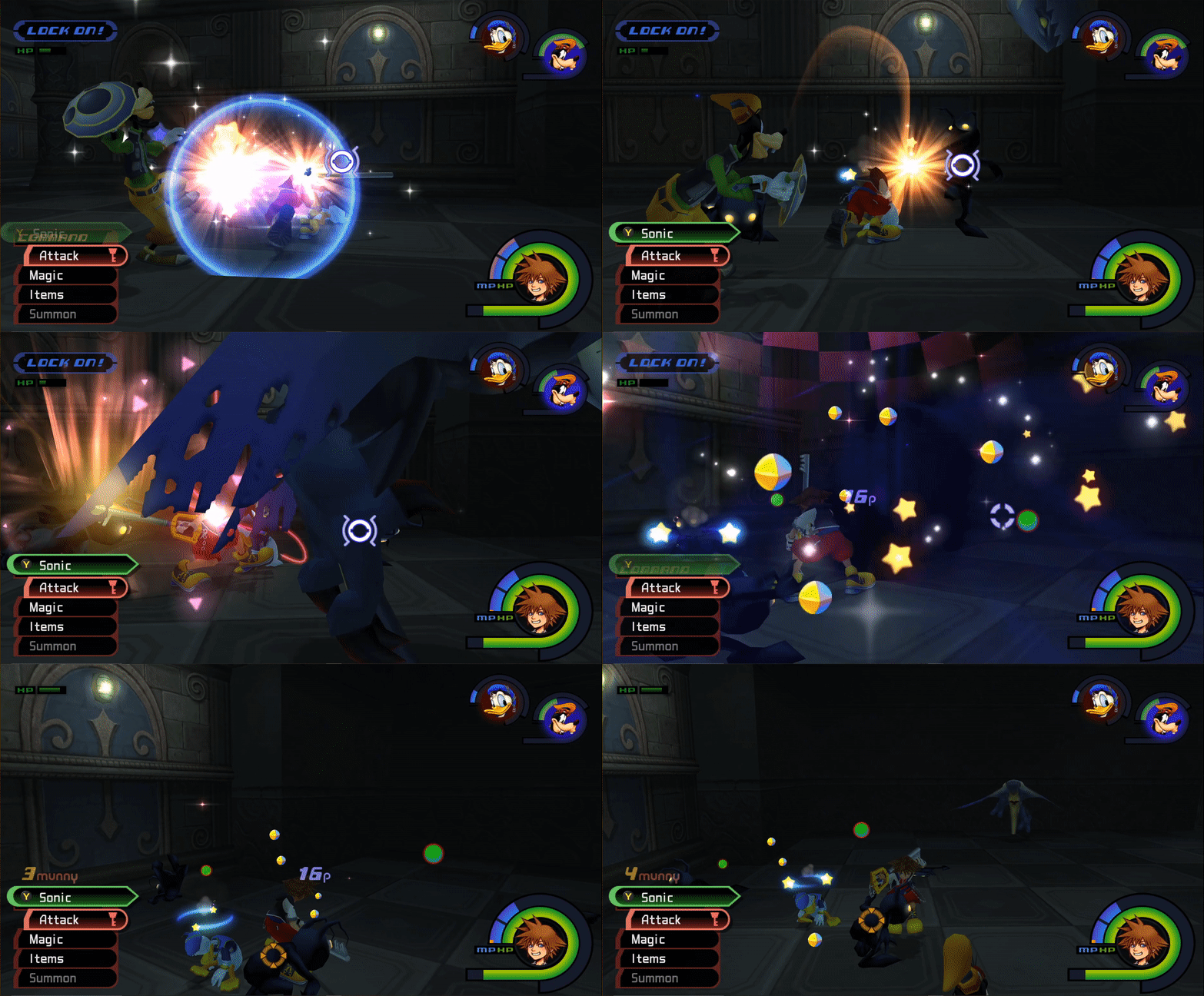
Boss Breakdown: Artorias The Abysswalker

Welcome to Boss Breakdown! I wanted to do a series of posts specifically about boss design and the particulars of some of my favorite bosses (as well as perhaps some not-so-favorite ones that are otherwise notable to me). It didn’t take long for me to think of what boss I wanted to talk about first…

What an entrance.

We’re going to start off strong with Artorias The Abysswalker from the original Dark Souls. He’s one of my favorites and an excellent study in readability for enemy design. I’m going to go over his general behavior, as I can observe it, then breakdown a number of the specific attacks and moves he can employ against the player. I’ll wrap up by sharing my analysis of what the design goals of this fight were, and how well the final design accomplished them. Some mild spoilers for Dark Souls are to follow. For context, Artorias the Abysswalker is a legendary and divine knight within the Dark Souls world renowned for his heroics and saving the land from a menacing force called the abyss. You happen upon him crusading against abyssal creatures when he turns on you and attacks like a madman. Dark Souls is an action RPG about clashing sword, spell, and shield against various gods and monsters, and thus you must likewise do so against Artorias.

Even with my experience, if I don’t focus on my timing I’m likely to get clipped by his large attacks.

Artorias is a knight, albeit a possessed one, and he fights like a knight. Mimicking many of the behaviors of other humanoid enemies in Dark Souls, Artorias likes to circle around you slowly, as if sizing you up. He’s aggressive, but doesn’t leave you with no breathing room at all. He seems to cycle between states of high-aggression, letting loose a deluge of attacks, and low-aggression, where he’ll be more reactive and less proactive. If in his reactive state, it’s dangerous to engage in maneuvers with a lot of time investment like healing. Enemies in Dark Souls generally do not like it when the player tries to heal, and will move to stop them more often than not if they are able. This is especially true of bosses and especially especially true of humanoid late-game bosses like Artorias. I suspect there is a special behavior baked into his AI to make Artorias lose his cool if he sees you try to slip in a quicky sippy of your healing Sunny-D potion. Healing is not meant to be a free action in this game, rather its something you must do while your opponent is occupied, in order to accomplish it safely. You must take a risk to heal, as healing is, ultimately, correcting a mistake you’ve made to begin with. The added risk is your payment for taking a hit. If you’re hugging Artorias too close he may have trouble hitting you with his wide-arcing attacks, so to counter this problem he may roll away from you to get some distance, or use an attack that allows him to reposition himself like a leaping strike. He also has a dodging side-swipe combination to really dissuade the player from trying to confuse the AI by getting too close. Artorias is most effective when facing the player, so if the player tries to get behind him he’ll splash some dark muck their way. It’s one of his quickest attacks and, proportionately, does the least damage. This move is more an inconvenience than anything, and really meant to just gently discourage getting behind Artorias too often, as it is disruptive and difficult to react to.

NO ENERGY DRINKS ALLOWED IN THE ABYSS! We only drink BLACK COFFEE here!

Most of Artorias’s attacks are slow and sluggish, objectively speaking. He has some extremely generous telegraphs to his attacks, some of which can be almost as long as a full second, while the average human reaction time is at around 250ms, or one quarter of a second. This is purposeful. Artorias is meant to be difficult, but despite a somewhat exaggerated online reputation, Dark Souls always aims to be fair in what obstacles it throws the player’s way. Clearly communicated telegraphs seem to be a priority for the enemy design in this game, and this seems especially true of Artorias. Obstacles simply tend to be more satisfying to overcome for players when they are clearly conveyed, even if they are difficult to overcome, and in an action-based boss fight this means effective attack telegraphs.

Notice how Artorias really drags his sword behind just before he swings it. The sword is so massive it’s very easy to track with the eye, especially with how the animators framed Artorias’s poses relative to the player’s position. They knew Artorias would be usually staring straight at you from the center of the screen, so they knew how to best frame him such that his actions are very traceable by the player. This is important, as a boss that is difficult to read can often mean a frustrating and dissatisfying fight. Most of Artorias’s attacks do not have very strong tracking, meaning he does not aim himself in 3D space at the player with perfect accuracy. Obviously, if tracking on an attack is too strong it becomes impossible to outmaneuver. Artorias’s sword swings have just enough tracking to make casually walking out of the way an unwise evasive tactic, but not nearly enough to overtake the speed of a well-timed dodge roll.

Artorias slowly drags the sword into position and swings it over his head, but then slows down the movement of his arm right before he strikes to make sure you can see his sword about to come down, its silhouette clearly defined.

That dragging action of his sword also communicates a part of the narrative; this Artorias is being controlled by an outside, corrupting force. He moves almost like a puppet, as though his limbs don’t act in concert with the rest of his body. Using narrative elements like this as gameplay elements helps make the entire fight feel more cohesive and ‘settled in’ so to speak with the context of the world. I think one of the things that stuck with me so much about Artorias is just how effective his telegraphs are. They are pretty generous with a lot of leeway, but just quick enough to make them feel dangerous, frenetic, and challenging, while at the same time I never feel cheated whenever Artorias gets a good whack in against me (which he does. Frequently). That readability is really essential in making a good boss fight for an action game like this.

Artorias may bound into the air, do a flip, and bring down his sword onto the ground in a slam. For this flipping move you can once again see Artorias’s massive attack telegraphs which give the player ample time to react. This attack doesn’t actually do anything until Artorias has nearly hit the ground, and all that time he spends hanging in the air like he’s posing for a comic book cover is just fluff to telegraph the attack more effectively. Well, perhaps not fluff. It also serves a purpose to cut quite a striking scene. This incredible feat of acrobatics really sells Artorias as an inhuman swordsman. Dark Souls characters don’t really do this. Not usually, anyway. At their most nimble, the player character is a mildly athletic normal person. These sorts of insane stunts really set Artorias and what he’s capable of apart. It reinforces that you’re fighting a monster. Another fun design aspect of this attack is how it can chain into itself. Artorias will do this same attack one to three times in a row, requiring the player to dodge them with correct timing subsequently. It’s one of the best tools in Artorias’s kit for enforcing mastery of the Dark Souls dodge roll. Because the difference in Artorias’s body language between repeated flipping strikes and returning to a neutral position can be very subtle, it’s also an excellent tool for enforcing mastery of observation. To know how to react, one has to perceive their opponent very closely, which can be very challenging with all the moving information in a game like this.

Once again, we can see Artorias’s animation noticeably slow down just as he reaches the apex of his jump to punctuate the attack. Everything the player needs to know is communicated clearly.

The aforementioned flipping attack as well as a long-reaching vertical strike Artorias may interweave in his grounded combat both share the properties of being overhead attacks. Because of how overhead attacks behave in Dark Souls it is probable, depending on the player’s spacing relative to Artorias, that the attacks will go over the player’s shield and hit them regardless of a block, making shields less viable for these specific sorts of attacks unless spacing is well managed. So, these overheads enforce a level of skill in fine spacing – you want these overheads to tip your shield so they do not overreach you. The other option is to engage in at least some dodging, which fits with this fight’s goals of demanding mastery of numerous game mechanics. Another of those mechanics is the stamina meter, essentially a hard limiter on how often a player can block or dodge. If either defensive option is abused, stamina will be drained for a moment and the player will be unable to defend. When Artorias is in his aggressive state, he keeps up the pressure. If defending is done without forethought, stamina will be quickly drained and the player will likely take damage. Managing stamina in concert with your defensive options is another skill demanded of the player here.

Artorias has a stabbing thrust attack with a unique property- it hits twice, and it hits hard. Blocking Artorias with a shield is a plenty viable strategy. Shields are in fact very powerful in the first Dark Souls. This stab move, if taken full-on with a shield, however, may barrel through your stamina, breaking the player’s block and damaging them. Badly. Having your shield stance broken means entering one of several states the game considers to be off-balance, where combatants are vulnerable to bonus damage. The Artorias fight seems to be specifically tailored to ensure a player never relies too heavily on one strategy. To beat Artorias you have to be adaptable, and have at least a cursory understanding of a variety of Dark Souls‘ many combat mechanics, not just one or two.

One of the most devastating attacks in this boss’s arsenal is his leaping stab. Generally I find there are two main kinds of attack telegraphs in action games. There are the momentary tells, which flow directly into the attack they are telegraphing. Think a sword pulling back just before it comes down in one smooth motion. Then, there are the “hey heads up, I’m gonna hit ya!” telegraphs that are more like an ambulance siren alerting you to get the heck out the way, because something is coming. Artorias’s leaping stab is the latter kind. In these situations the game wants you to know that something is about to happen, and you need to be ready to follow up on that knowledge. With this kind of telegraph, you’ll know its coming well ahead of the attack. Designing an attack this way helps build variety in an enemy’s moveset and how the player paces themselves. It also allows the enemy to have an extraordinarily dangerous move that does not feel cheap because it is so forewarned. Artorias will howl at you before leaping into the air from a great distance and slamming his sword down in a stab. Sprinkling in these massively damaging yet easily nullified attacks is a good way to convey the danger and power of your boss without making it feel unfair. This attack also reinforces precision in one’s dodging and spacing, as dodging directly away from the landing site of the attack, toward the camera, is a good way to get stabbed, while lateral dodging, or even dodging towards Artorias’s starting position is much safer.

“AAARRROOOGH” – Sir Artorias D. Abysswalker, Esquire

Artorias is not a multi-phase fight, meaning he does not employ new strategies or abilities, for the most part, against the player throughout the fight. Fighting Artorias is as straightforward as it gets. He does have one last trick he might employ once he’s sustained a decent bit of damage, though. What I often affectionately call his ‘super saiyan power-up’ is an ability where he’ll stand perfectly still while gathering a cloud of menacing darkness around him. Cleverly, this makes boss staggering a central mechanic of the fight, whereas in most other boss fights throughout Dark Souls and throughout the series, even, it is a secondary concern, at best. Enemies in Dark Souls take an invisible stagger value or poise damage in addition to health damage when struck by the player. It represents the force being applied to an enemy’s stance and it’s pretty intuitive- a giant battle axe will inflict more stagger than a rapier. Once a minimum threshold of this stagger value has been reached in a short enough time, the enemy stumbles. Most enemies stagger on every strike. Larger ones tend to be able to shrug off a few hits. Bosses will often require a number of strikes to feel the pain and react. The only way to stop Artorias’s accumulation of power is to stagger him. Fail to do so and you’ll not only be caught up in a damaging explosion of darkness if you’re too close, but you’ll also have to deal with an empowered Artorias capable of decimating health and shields alike with his sword for some time. It creates an interesting dilemma of risk and reward. Do you attack Artorias while he refuses to fight back in the hopes you can stop his empowerment? Or do you take the down time to heal and hope you can dodge his empowered assault later? It demands the player make a snap calculation as to whether they can stagger Artorias in the short window they have to do so, while also making Artorias an even more terrifying opponent.

This… is to go… even further… BEYOND
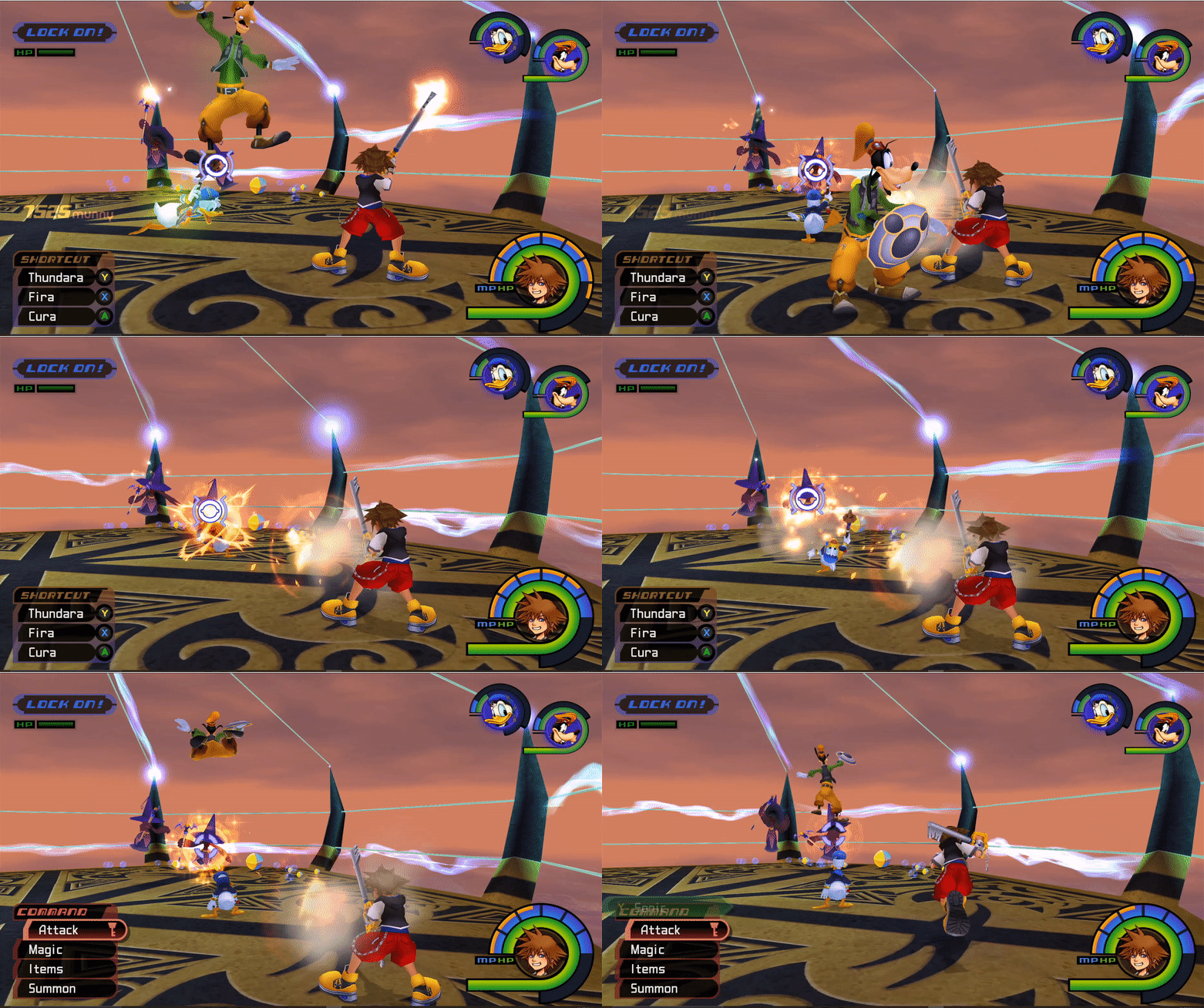
Now I’d like to briefly go over some of the narrative elements of this boss fight. Any game with a narrative that also has bosses will naturally inject some sort of story into those boss fights. Gameplay is storytelling, after all, so there’s some things worth pointing out. As I stated earlier, Artorias’s sluggish and labored movements pull double-duty in making a satisfyingly readable opponent and selling Artorias as a dangerous, wild monster-warrior not in full control of his faculties. He moves almost like a puppet on invisible strings, with his head leading him where he goes, his limbs dragging behind. The sword is animated to depict its incredible weight, which also informs the shape his attacks take. The sheer might of his heavy strikes, their ability to tear through defenses, and his inhuman acrobatics shores up Artorias as a legendary divine knight. Several of his attacks, especially his spinning horizontal strikes, are very reminiscent of his wolf companion Sif, another boss in Dark Souls. Sif would eventually take up Artorias’s sword, so it’s natural Sif learned to wield it by observing their master. The darkened knight’s volatile, mindless state implies the tragic fate of this hero, and his fall to darkness. Dark Souls is also well known for its environmental storytelling so I’ll indulge a bit and point out a fun detail that can be gleaned about this Artorias from the environment. Elsewhere, it is noted that Artorias is renowned as a legendary left-handed swordsman. You may notice Artorias fights the player with his right hand. Eventually it is discovered Artorias gave up his shield to defend Sif from the abyss. It stands to reason that before succumbing himself, Artorias tried to defend with his left arm, sword-in-hand, shattering all of its bones in the process. The now corrupted Artorias fights, hobbled, with his offhand wielding the sword, main hand a wobbly useless husk. As challenging as the Artorias fought in Dark Souls may be, he is but a shadow of his former self. What a glorious sight the fully capable Artorias must have been in his prime.

But did Artorias carry POCKET SAND in his glory days!?

So I obviously really really like this boss fight. It may be one of my all time favorites from any game. The design suggests a boss that is more straightforward than almost anything in the rest of Dark Souls. Even simple bosses like the early-game Taurus demon have some sort of twist or gimmick, but Artorias is fought in a big, round empty room. His tricks are not that tricky, his attacks are mostly what they all appear to be. It’s a drag-out fight where only one guy can walk away. Dodge and hit better than Artorias to win. It really pushes you to use all of your defensive options. With generous attack telegraphs, but tight windows between attacks in which Artorias is vulnerable, the fight makes knowledge of spacing, Artorias’s animations, and the timing of his attacks your greatest tools. It feels like the purest form of Dark Souls. No fat, just learn your opponent’s moves, learn how to deal with them, and execute well to win. That was the goal with Artorias, and even at this relatively early stage of the Dark Souls franchise he’s one of the stand-out examples of that sort of design. Future games will iterate liberally on what Artorias represents, to great effect, but good ol’ Arty will always be one of the most elegant of these ‘pure fighting’ Dark Souls boss fights. It’s also got some great narrative elements baked right into the gameplay. They really wanted to sell you on the mindless rage of this abyssal thing controlling a once great hero. The way he violently massacres a hapless mook in his intro cut-scene sets an excellent tone that the deranged flailing of his animations expertly follow up on.

Pictured: Me not hitting and dodging better than Artorias

Artorias is a microcosm of what Dark Souls wants to get out of you as a player – observation, spacial awareness, and reaction. Thinking while you’re fighting. No matter what approach you take, with whatever tools are at the player’s disposal, Artorias is prepared to respond with the tools at his disposal to ensure you’re awake, and know what you’re doing. He’s an end-game boss, so he’s tuned to be difficult, and a penultimate test of your mastery over the Dark Souls combat mechanics. Artorias also marks the culmination of a shift in boss design for Dark Souls and its various sister series that began with some of the later bosses in the previous game Demon’s Souls. From this point forward, the emphasis the Artorias fight places on in-the-moment decision making, close observation of the opponent’s tells, high-stakes reaction based gameplay, and mastery of the game’s defensive mechanics such as dodging and countering will become a cornerstone of the series, more so than even anything that had come before.

Knight Artorias came to stop this, but such a hero has nary a murmur of dark…