Boss Breakdown: Bloodborne’s Blood-Starved Beast

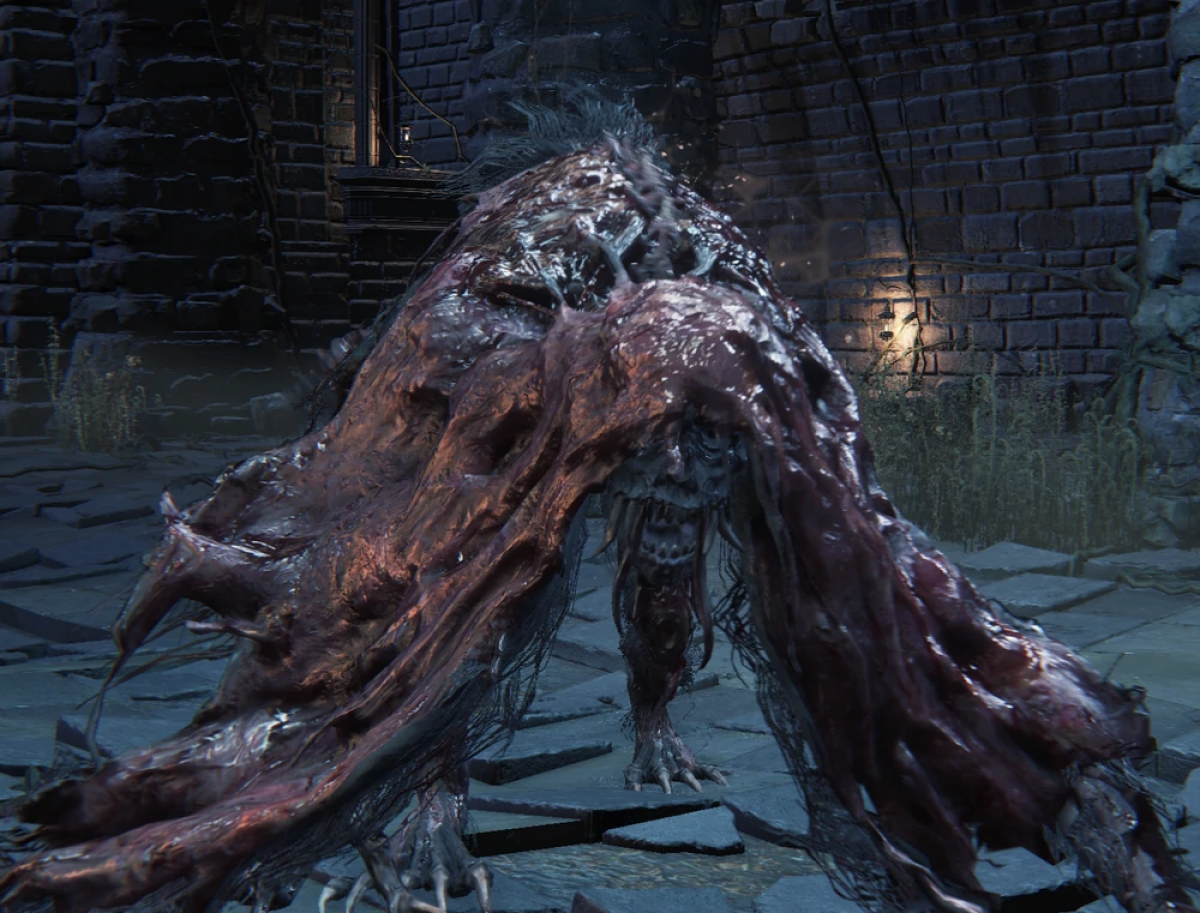
You step into a large chapel overgrown with sickly vines and eerily empty, save for one hunch-over figure at the back, nearest the chapel shrine. It stalks toward you like an animal as its boss music kicks in, and you’re introduced to its name: Blood-Starved Beast. The Blood-Starved beast is a mid-game boss in FromSoft’s action RPG Bloodborne. Though technically optional to complete the game, Blood-Starved is centrally located, and gatekeeps one of the game’s major features; the chalice dungeons. It is thus likely to be a boss that most players encounter toward the start of Bloodborne‘s mid-game. This malnourished and emaciated figure fights with the ferocity of a starved predator, and its design backs up this idea while also serving appropriate functions within the overall experience of Bloodborne.
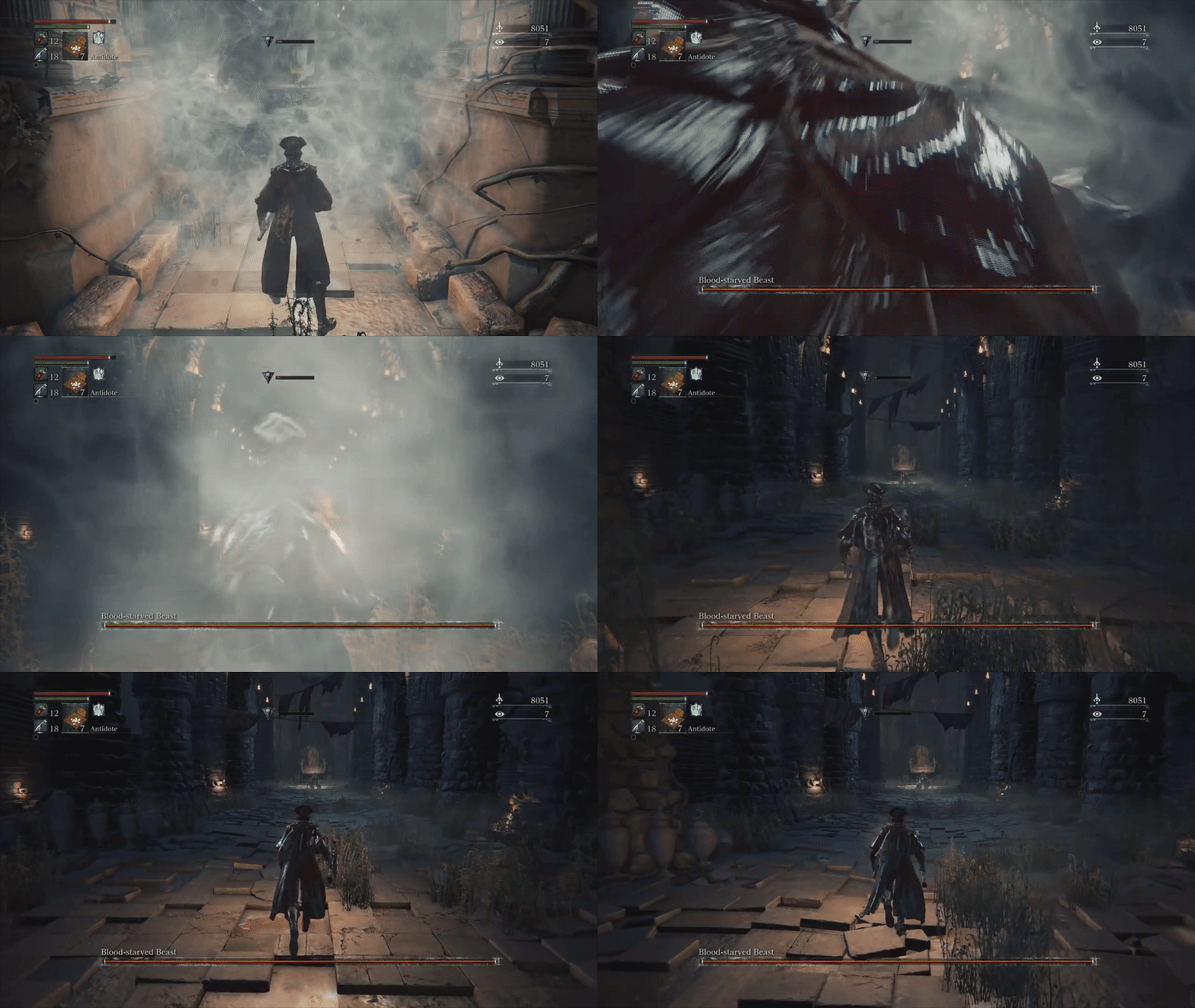
A hunter in a long black coat and tricorn hat pushes through a wall of fog into a run down stone chapel, lined with columns and torches. A lone figure, on all fours, slowly trudges toward the hunter from the distant shrine of the chapel.
FromSoft really knows how to set the scene

My philosophy when it comes to design, and especially in regards to big set-piece combat encounters like this is to reinforce the overall feel and experience of the game. It’s one of the reasons I so admire FromSoft’s design ethos overal.. Bloodborne, at this point in its story, is a visceral gothic horror about hunting horrible, bloody beasts. It’s gritty, it’s guttural, and it’s dangerous. The blood-starved beast begins to reinforce Bloodborne‘s overall aesthetics and feel from the moment you see its visual design. It’s a hunched-over, somewhat skeletal, feral humanoid figure with large portions of its skin bloodily peeled from its back, and draped over its head like a shawl. It’s a gruesome sight that reflects the environments and tone of Bloodborne. It fights with a hunter’s aggression, homing in on the player with a ravenous intent, keeping the fight high-intensity. The Blood-Starved beast is a quintessential representation of Bloodborne‘s hunt. It’s bloody, it’s animalistic, brutal, and imminently deadly.
A hunter in a long black coat and tricorn hat runs at a semi-humanoid skeletal beast, who charges at him on all fours, before wildly swiping at the air with large claws.
This thing’s animations and attacking pacing create a frantic sense of danger

Blood-Starved’s sense of danger is essential to making its fight come together. It needs to feel as though this thing could rip out your throat at any moment, a violent, unstable, rabid animal. This is most embodied in its grab attack, which does a huge amount of damage and can potentially kill a player outright. Highly lethal attacks like this are a favorite of FromSoft’s design to establish the threat of their enemies, and keep them oppressive. The ever-present looming promise of an attack that can potentially outright end the fight in a game over keeps the player on their guard, and shores up the tension. That said, such attacks can feel cheap and unfair if not handled carefully. If an attack is extremely deadly, best practice is keep it predictable and telegraphed, so if the player does fail to avoid it, they don’t feel as though they were blindsided, and the mechanic remains one of skill in the player’s mind, not a random vector of bad luck. The Blood-Starved Beast assumes a very particular posture, it’s normally gyrating and animated movements become still, and focused, it’s arms almost exactly shoulder-width apart in an even stance. This stance really stands out once you know to look for it, rewarding close observation of the boss, which is a standard for FromSoft enemy encounter design, something they are very much always looking to reinforce.
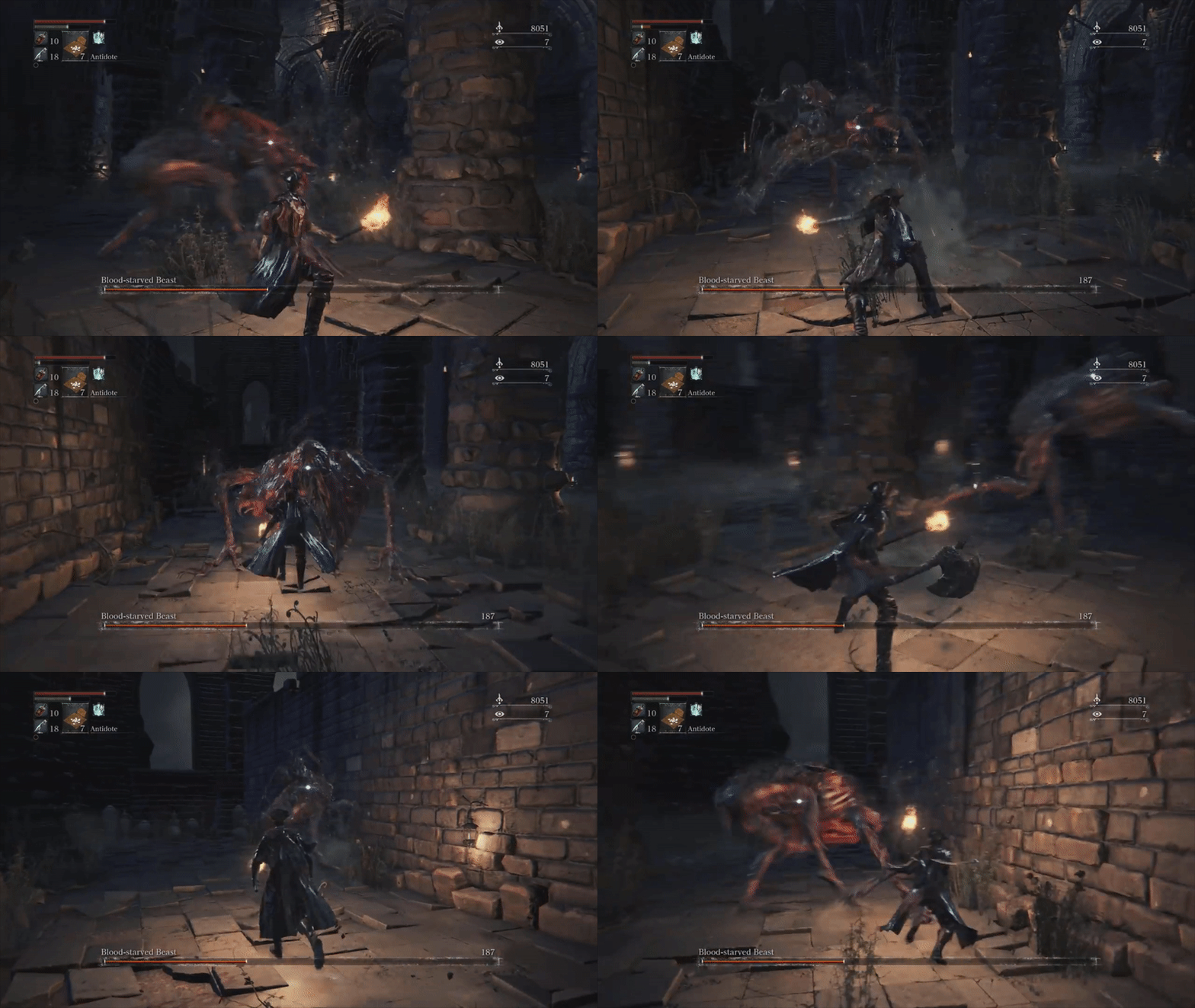
A hunter in a long black coat and tricorn hat strikes a vaguely humanoid skeletal beast with an overhead swing of a large battleaxe. The beast reels, but then assumes a steady, wide stance, before leaping at the hunter, who barely dodges out of the way.
After the first axe strike, you can see the beast assume this very still, square stance, a clear telegraph for its deadly grab attack, seen here missing the player.

On the more usual and rote side of things, the Blood-Starved Beasts’s primary attacks almost exclusively are aimed in front of it, and they have very little player tracking, meaning just a bit of movement will move the player out of danger. If the player moves too far away, however, the beats will initiate a Dashing attack that covers a lot of ground, to reset the neutral positions of the fight. These patterns, while predictable and simplistic, create the very strong spacial dynamics of the fight.

Blood-Starved’s quick attacks and short response time make it dangerous to approach, and risky to engage in close combat. As an early-to-mid-game boss, Blood-Starved functions to help really cement the player’s skillset and prepare them for the steeper challenges that are to come, and it does so by emphasizing Bloodborne‘s parry mechanic, in which players shoot an oncoming attacker with a firearm just before being hit, stunning the enemy and preparing them for a visceral counter-attack. It’s a powerful option that can carve through enemy health bars quickly, and will remain useful throughout the rest of the game, so Blood-Starved really pushes the player to master this. Its attacks are fast but reactable, wide-reaching but mostly short-ranged, perfect for being parried by the player’s firearm. If the player utilizes the parry and visceral attack, the difficulty of the Blood-Starved Beast can be curbed to a great degree, rewarding mastery of the skill.
A hunter in a long black coat and tricorn hat is attacked by a vaguely humanoid skeletal beast who swings with its immense claws horizontally, striking the hunter just as he blasts the beast with a flintlock pistol. The beast reals from the gunshot, so the hunter grabs it by the neck, and violently rips out a gush of fluid, sending the beast flying onto its back.
Even though the player takes damage here, he is able to rally all of his health back thanks to a well-timed, aggressive parry, while grievously harming the boss to boot.

Later on in the fight, The Blood-Starved Beast will start to string a long series of attacks together. With a maneuver like this, the beast is more likely to get some licks in, to give players more opportunity to leverage the health-restoring rally system, which rewards reprising attackers. It also punishes a lack of attention paid. Once the attack begins to hit a player, it is not difficult to disjoint with a dodge so the remaining hits miss, but being caught unaware could mean quickly and drastically losing health. There is one more feature to this attack though, which is that, since it’s a rapid series of strikes it makes parrying it very easy. A lot of times FromSoft will employ rapid attacks like this that seem very intimidating, but realizing how parrying works – that it requires player input to intersect with a certain part of an enemy’s attack animation, means knowing that if you try to parry one of these rapid attacks you are very likely to succeed, as the enemy’s ‘vulnerable’ animation is flashing past over and over again, and it only needs to be snagged by your parry attempt once. As I supposed this boss is meant to greatly reinforce the use of Bloodborne‘s parry, I suspect this is one of the primary reasons for the presence of this attack, a reliable parry opportunity. It’s a powerful attack, but it can be turned against the beast, with an equal and opposite counter.

At the same time, Blood-Starved maintains the standard formula of FromSoft’s boss design through a moveset that reinforces spacing and timing. If the player is unable to master the parry mechanic, Blood-Starved is surmountable through diligent use of spacing. Fast yet telegraphed melee attacks make engaging with it directly from the front infeasible without parrying, so circling around behind can be effective. The boss’s preferred response to this is to create distance between itself and the player, which effectively sets up for it’s leaping grab attack or dashing slash attack, both of which require precise timing to avoid. This makes the boss feel proactive and responsive to the player’s actions, while ensuring player’s are unlikely to escape the battle without seeing their enemy’s most deadly attacks. Circle strafing it is an effective tactic, but not one that carries no risk. In a game that relies so much on its atmosphere, this illusion of a thinking and responsive agent behind enemy AI is essential.
A hunter in a long black coat and tricorn hat steps to the side as a vaguely humanoid skeletal beast tries to bite him. He responds with a strong vertical swing of his battle axe.
The best mainly will attack forward and in front of itself, making circle-strafing very effective

Once The Blood-Starved beast has taken significant enough damage, it will begin the first of two phase transitions, marked by a screeching roar it lets loose. Starting in phase 2, its attacks will now apply poison to the player. The addition of poison to the fight accomplishes two things. One, it ramps up the tension and danger of the encounter. If you’re hit by the beast too many times, even if you’ve got enough healing to recover from the damage, you’ll be poisoned and a constant ticking clock will hang over you. This punishment effectively sets the standard of how often the player should expect to successfully dodge boss attacks without incurring major disadvantages in the future, establishing their expectations accordingly. Secondly, the building of a slow poison encourages a more aggressive playstyle, which is one of Bloodborne‘s chief design goals and hallmarks, which sets it apart from its more slow and calculating predecessors, Dark Souls and Demon’s Souls. Players in high-intensity situations will often try to ‘turtle-up’, so to speak, avoiding direct encounters so-as to preserve their resources and maximize safety. This is somewhat the opposite of Bloodborne‘s strengths as an action game, so FromSoft went to great lengths to reward proactive behavior.
A hunter in a long black coat and tricorn hat fires his pistol repeatedly at a vaguely humanoid skeletal beast as it mills about on the floor. After a moment, it screams and rears up, a cloud of toxic mist emanating from its body and its wounds.
The poison is mechanically functional in gameplay, but also very stylish and intimidating

The presence of the poison’s ticking clock communicates that your resources will be depleted if you don’t return a good amount of strikes that the Blood-Starved Beast can dish out to you, complemented by Bloodborne‘s rally system, which restores health if player damage is followed quickly by successful attacks against enemies. Blood-Starved serves as an excellent tool for engendering a more aggressive playstyle that matches the frantic and gritty nature of Bloodborne’s encounters. Phase three sees this pushed further, with clouds of poison now spewing from the beast’s wounds in all directions as it attacks. Spacial awareness becomes even more pivotal, and reliance on just one strategy becomes dicey. Players who can utilize a variety of approaches based on the situation, and do so proactively and aggressively, will find the final phase of the Blood-Starved Beast much smoother.

If a player is too risk-averse or simply not yet up to playing very aggressively, there are alternative solutions to besting the beast for the more strategically-minded. ‘Antidotes’ are plentiful from the carrion crow enemies that dot the level leading up to Blood-Starved Beast, and keeping them handy can put off the pressure from poison, if you find a moment to take one in-between dodging attacks. The pungent blood cocktail, a common item meant to distract the bloodthirsty minor beasts players can encounter, appropriately, works on the Blood-Starved Beast. It will become distracted if one is thrown, and clamor after the small traces of blood within. It’s really refreshing to see that kind of flavorful ingenuity that relies on knowledge of the game’s fiction be rewarded that way. Purely from a gameplay perspective, it might not be obvious that an item like that would work, but from a narrative standpoint it makes perfect sense. Anyway, I always appreciate these little alternate routes to victory in difficult games. Thinking around a problem is as impressive a show of skill as tackling it head on, and players should be encouraged to do so. Reward experimentation.

Blood-Starved is an extremely effective mid-level fight, I think. It’s rather straightforward with its only real gimmick coming in the form of the poison, which as I explained, fits rather well in what the beast’s design utility is. That is, the beast is at home in Bloodborne‘s oppressive atmosphere, with its oppressive combat style, and helps to reinforce a lot of Bloodborne‘s combat fundamentals leading up to the more advanced challenges that await afterward. Players who find themselves able to fight aggressively, and reliably perform parries, counters, and sidesteps, will find themselves well equipped for what comes after. You might say the Blood-Starved Beast is a ‘skill check’ in that way. Designs that focus on both teaching the player abstract technical concepts while engrossing them in the atmosphere of the world is what FromSoft does best in its boss design, and I think the Blood-Starved Beast is pretty emblematic of that.
A hunter in a long black coat and tricorn hat is struck multiple times by a vaguely humanoid skeletal beast, then backs away. He injects himself in the outer thigh with something, then dodges out of the way as the beast tries to bite him.

Hunters are killers, nothing less…
Rethinking ‘Health’ as Game Mechanic: Sekiro’s Verisimilitude

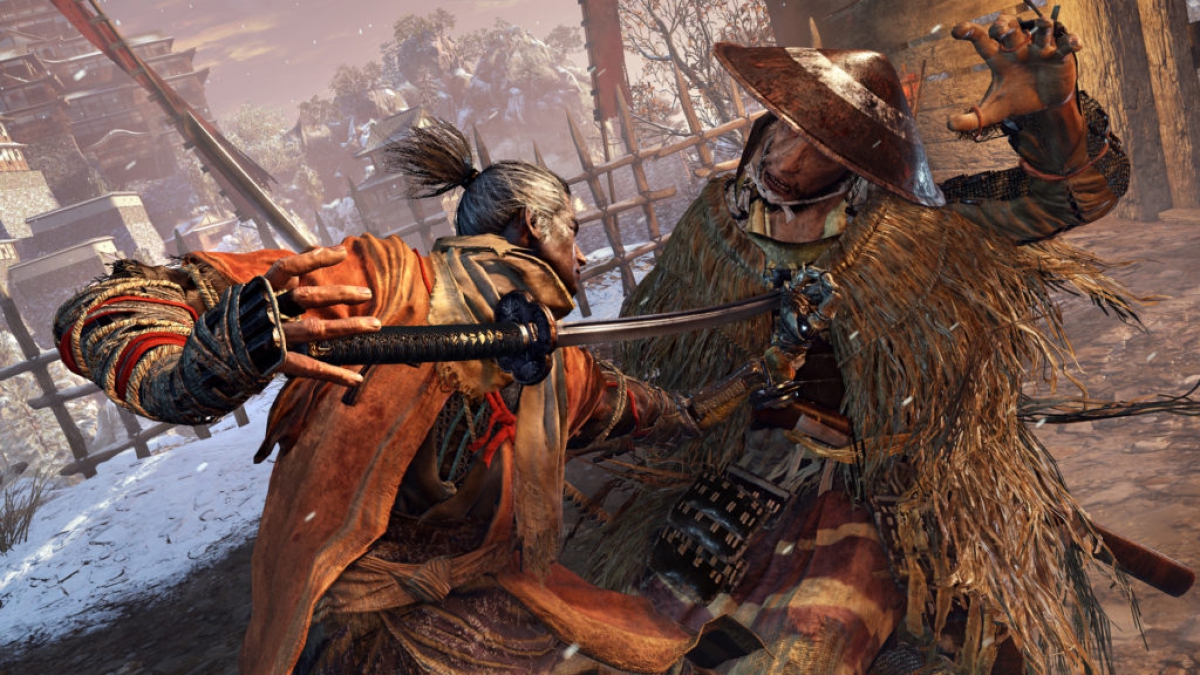
Talking about Sekiro again. Sekiro is a ninja action game by FromSoftware, that involves a lot of sneaking around and backstabbing, but nearly as much sword-to-sword clashing and front-stabbing as well!

A ninja in a red coat and scarf attacks a spearman in an old-japanese-style interior. The ninja is stabbed, but blocks the followup attack, breaking his opponent's guard before stabbing him through.
That beautiful yellow bar there, that’s the posture bar. Love that thing. We’ll get to that.

Verisimilitude! A big word, and one of my favorite ‘game-designerisms’. What exactly does it mean? So if realism is invocation of the real, of reality upon your fiction, verisimilitude in the context of game design is the invocation of what seems real, or rather feels right to give the impression of reality. That distinction might seem fuzzy, but it’s very important. What makes a game realistic is an adherence to the facts of the subject you are simulating, from an objective standpoint. What gives a game strong verisimilitude is a respect for the experience of what you’re trying to depict. In the latter case, it is more important that the gameplay feels right than it is for the game to be objectively close to reality. A horse’s hooves are expected to make a certain sound in television and movies, but this sound is often expected to be the sound of clapping coconut shells, instilled in audiences after many years of the sound effect’s prominence in television and movies. As you can see, creating a fulfilling sense of verisimilitude involves a complex balance of player expectations and affordances. This becomes even more complex, as these things tend to be, when you involve the dimension of interactivity. In Sekiro, I want to talk specifically about the verisimilitude of the game’s sword fighting.

I think one of the things I respect most about Sekiro: Shadows Die Twice is the design’s willingness to reevaluate even the most fundamental assumptions of action games. The health bar, for one, is ubiquitous in such games. But, if you think about it, ‘health’ as a gameplay mechanic is a little weird, right? There is an arbitrary number representing your opponent’s closeness to death. Maybe the enemy will pull out some stronger ‘desperation moves’ when their health gets low, but so long as it isn’t zero, they can fight as well as they ever have. When that last HP or ‘hit point’ is depleted though, POOF! Their body’s ability to sustain its own weight goes up in smoke and they crumple like their bones have suddenly turned to sawdust. The HP mechanic exists for a reason, it works well. The suspension of disbelief needed to accept this abstraction of how fighting capability works is easy enough to achieve such that most players will not question it, in return for the fun gameplay that HP pools provide. Sekiro wants to go a step further though, and bring the abstraction of their combat closer to a cinematic realization of an idealized sword fight.

A ninja slashes a flurry of blows at a spearman in a old-japanese-style interior. The ninja steps on an oncoming spear attack, knocking it out of the way, then breaks the spearman's guard with a final blow, before stabbing him to death.
The enemy’s posture indicated by a yellow bar above them (the red bar is HP). As the posture bar fills, the enemy is closer to loses their stance.

In reality, a sword fight does not involve two guys hitting each other back and forth until one guy runs out of hit points and collapses. Really, it’s closer to the first guy to land a clean hit… has probably just killed his opponent. So Sekiro has created a system that abstracts this reality – Sekiro is not generally a game about cutting opponents over and over again until you’ve punched out all of their blood, but rather, you strike at opponents as they deflect your blows until you can land a clean hit, killing them instantly. This makes a lot of sense. In a real fight, wearing down your opponents’ defenses, finding ways around their guard, is paramount. Most opponents are not going to just stand there and let you stab them with a sword. The idea Sekiro proposes is that ‘hit points’ are secondary to ‘posture’, or the strength of one’s defenses.

Two ninja duel in a Japanese manor courtyard, one garbed in grey and a mask, one garbed in a red coat and scarf. The masked ninja strikes at the other several times, each time deflected in a flurry of sparks, after the fourth strike, the masked ninja loses his stance, and the red-coat ninja quickly stabs him to death.
clang, clang clang, CLANG. And its over. The nature of the posture system creates a ‘correct’ sense of lethality and back-and-forth in combat.

Posture in Sekiro can be reduced by striking an opponent’s guard to rattle their stance, deflecting their attacks with a well-timed parry, or participating in a number of other contextual maneuvers such as the mikiri counter, a special counter against thrusting attacks, or jumping over enemy sweeping attacks. Posture naturally regenerates over time, and the player or enemy combatants can quickly restore it by holding their position and guard. When posture is completely gone, enemies become vulnerable to a deathblow, which will kill them instantly, while the player becomes stunned if their posture is gone, forcing them to dodge or take a hit. The idea of becoming too tired or psyched-out to defend myself in a tense situation due to relentless pressure from my opponent is much more relatable to me than suddenly exploding into red mist and collectible coins because I was punched one too many times. I am able to, through this system, put a bit of myself in the battle. Feeling my defenses wear down is something I have really experienced, in real life, so that feeling of the real draws me further into the game through Sekiro‘s clever abstraction of the concept.

Deathblows becomes the real hinging point of combat in Sekiro. As I said, whenever an enemy’s posture is depleted, they become vulnerable to the instant-killing deathblow. I say instant-killing, but some enemies can endure two or even three deathblows before really dying. Sekiro takes places in a fictionalized and fantasy-tinged realization of 16th century japan, with inhuman warriors, monsters, and demons, so the idea that a giant ogre-man can survive two ‘clean hits’ before he goes down for good does nothing to hurt the verisimilitude in my estimation. It’s not realistic, but it still feels right. The thought that even the strongest demigod opponents you face can be brought down by just two or three true strikes really grounds the world in a sense of grit and lethality. The illusion is given that life in Sekiro is nearly as fragile as it is in reality, even with divine powers. These ‘deathblow counters’ work brilliantly with Sekiro‘s stealth mechanics as well, as one needs only sneak up on an opponent to get a free deathblow, no risky one-on-one fighting required. The two systems work so well together that I feel I could write an entire article just about that, so I’ll move on for now.

A giant white, headless gorilla charges a ninja in a red coat and scarf in a knee-high spring in a valley. The gorilla, wielding a giant sword and its own severed head, swipes at the ninja. The ninja manages to block, being pushed back by meters with each p;arry.
The verisimilitude of the combat mechanics highlights and heightens the impact of the supernatural elements. So it still works when a beast keeps fighting after decapitation.

Now hit points still exist in Sekiro, but their role has been shifted somewhat. Enemies will still die if their HP reaches zero, though this is much less likely to occur than their posture reaching zero. That’s not to say wearing down your opponent’s HP is pointless. The lower a combatant’s HP is, the slower their posture can regenerate. Now if HP is still meant to represent ‘health’, then this makes a lot of sense. A clean hit is likely to just kill someone in a sword fight, but a series of glancing blows are very likely to make someone less able to defend themselves. Cuts, bruises, a broken finger or two, such things would definitely add up to a poorer and poorer defense, and so this adds to the overall sense of internal consistency in Sekiro‘s combat. No matter the true reality, fighting in Sekiro creates an experience that meets the player’s imagination of how being a sword-fighting ninja would actually work. This level of gradient to the effects of losing HP, where the more injured a combatant, the worse they can defend themselves, addresses much of the inherent weirdness of HP I mentioned earlier, and it does it in such a simple, smart fashion.

Verisimilitude is all well and good, but I wanted to quickly go over some other practical advantages of this system. Since posture is an ever-shifting and renewable resource, it creates a very dynamic tension that can shift back and forth freely as the situation demands. Empowering reversals of fortune on the part of the player are common, as posture greatly rewards consistent performance, making a win when you’re on the ropes a lot more feasible than you might expect. Posture also allows many little tweaks and knobs for the designers to create a great variety of enemy fighting styles based on their posture stats alone. Maybe one boss restores their posture absurdly quickly, but doesn’t have huge stores of it, meaning this boss must only be parried a few times, but they cannot be given the downtime to recover. Maybe another boss has huge stores of posture, but recovers it very slowly. Some enemies might recover posture quickly, but lose this advantage if they’re even a little injured. Etc. There are a huge number of possible variations of these, and Sekiro implements pretty much all of them.

A twelve-foot-tall woman in a skull mask and large monk robes swings a naginata polearm in wide arcs at a ninja in a red coat and scarf, atop a bridge in the mountains, covered in snow and autumn leaves. The ninja is able to deflect several strikes, then steps on the naginata to block it, The ninja cuts the monk twice, then blocks two more strikes, before leaping over a sweeping attack and stomping her shin, breaking her stance, and stabbing her.
The versatility of the posture system can create endurance battles of attrition, or deadly quick-draw duels, depending on context.

Obviously glowing praise is my default position for much of Sekiro‘s systems, but it’s worth mentioning some drawbacks. Sekiro‘s posture system works specifically because of how intense a game it is. It demands constant, focused attention of players in a way that may not be appropriate for every game experience. It’s very much ‘Sekiro‘ but every action game may not benefit from such high levels of gameplay intensity so consistently, and so the posture system isn’t a one-size-fits-all solution that can be injected into every action game without adaptation considerations or consequences. I would like to see more systems like the posture system see popularity, but it is a very delicately balanced system that would demand a lot of care in the implementation. Just plain old HP is much simpler, and it’s been the de facto way to represent combat in so many games for so long for a reason. As I’ve said before, the level of abstraction it creates can be an acceptable tradeoff if it’s supported by a strong combat system, and the simplicity of it fits your game. Another aspect of Sekiro‘s posture system is not only the gameplay intensity, but the intensity on the player’s hand in controlling the thing. The system demands a lot of very rapid and often repetitive inputs that may not be suited for all players. It’s an obvious drawback, perhaps not inherent to a posture system, but correlated to how it’s implemented, and so the system would likely need some fundamental changes and re-tuning to map to a more inclusive suite of control options.

I think the posture system is a great look at how we can rethink the traditionally established rules of how games need to be. Creating new and exciting interactive experiences means being willing to accept that no one game mechanic can be sacred, even if it is ubiquitous. HP bars are so universally standard that any deviation from that mold feels almost alien. The posture system picks apart what HP is meant to represent and repackages it in a way that is extremely conducive to the kind of ninja-action experience Sekiro aims to create, in a way that is evocative of the real, even if it is still very abstract. Sekiro‘s posture system isn’t purely realistic, it’s not what sword combat actually looks like, but it feels very real to experience. It feels like pitched life-or-death battle with high stakes, and real tension.

A ninja man in a red coat and scarf clashes swords with an old woman ninja dual wielding kunai. She jumps from a hidden wire connected to the walls of a crypt-like cellar. Her attacks are deflected repeatedly by the red-coat ninja before losing her stance and being stabbed.

My Lord, I Have Come For You. This… Will Only Take A Moment…
Dark Souls 3’s Brigand Twindaggers or How I Stopped Worrying and Learned To Love Status Effects

It is February 2022, my dudes, and you know what that means. Elden Ring is around the corner and there was absolutely no way I wasn’t going to just talk about Fromsoft games all month. I want to share an interesting experience I found while playing Dark Souls 3 as it pertains to a specific weapon found in the game, the brigand twindaggers. This is less a breakdown of this weapon’s moveset or particular attributes and more a little anecdote about how the daggers won me over once Dark Souls 3 had sold me on using status effects on my weapons, and the subsequent analysis that followed.

In RPGs with character customization I love to bring in my own stock of characters to populate the world, and there are some old standbys I revisit frequently, such as a thief who wields a pair of daggers, whom is often my player character in Fromsoft games. If at all possible, I will deck out my characters in their appropriate gear. I kind of like the RP side of RPG that way.

In Fromsoft’s Bloodborne, an action RPG that preceded Dark Souls 3, there is a weapon called the blades of mercy, a sword that can transform into a pair of daggers. I often refer to this weapon as a lawnmower – it absolutely shreds enemies to pieces with a massive amount of damage output. It scales incredibly well with Bloodborne‘s equivalent of the dexterity attribute, and its moveset is a flowing, seamless series of rapid strikes. Its the most satisfying to use pair of daggers in any of Fromsoft’s games to that point, so I had high hopes and expectations when it was revealed that Dark Souls 3 would have, as a new feature, paired weapons – weapons that come in a set, made specifically for dual wielding. I went over the game with a fine-toothed comb when I got it, clamoring to find a pair of daggers. Surely if paired weapons were a thing, I’d find dual wield knives.

And so I found them, and it quickly became difficult to contain my disappointment. Compared to Fromsoft’s previous outing with dual wielded daggers, these brigand twindaggers had a slower moveset with a much longer startup, and tremendously pathetic damage by comparison. They didn’t even scale that well with dexterity. I tried to like them, and tried to use them throughout my first play-through, I really did. In the end, there were just so many better speedy weapons, whose damage scaled so much better, that I could really not justify using the daggers any longer. I ended up embracing my inner edgelord and used a paired katana and wakizashi, two japanese style swords, as their damage output was insane compared to the daggers.

I had a blast on my first playthrough of Dark Souls 3, but I always regret not making a player build I was satisfied with involving the daggers. It didn’t feel true to my player character to not have him using knives, and I wished the knives were better. They didn’t really need to be though, after some experimentation, I would discover I just needed to change my approach. It started when I saw a player versus player showcase of the brigand twindaggers. The very skilled video author was destroying human opponents, seemingly with ease, utilizing the weapon I had condemned as largely useless. His secret? The daggers were enhanced with a bleeding effect. The Dark Souls series has always had weapon status effects, special attributes that can be applied to weapons to make them debilitate enemies in specific ways, applied if enemies are hit enough times rapidly. Primarily, this takes the form of bleed weapons and poison weapons.

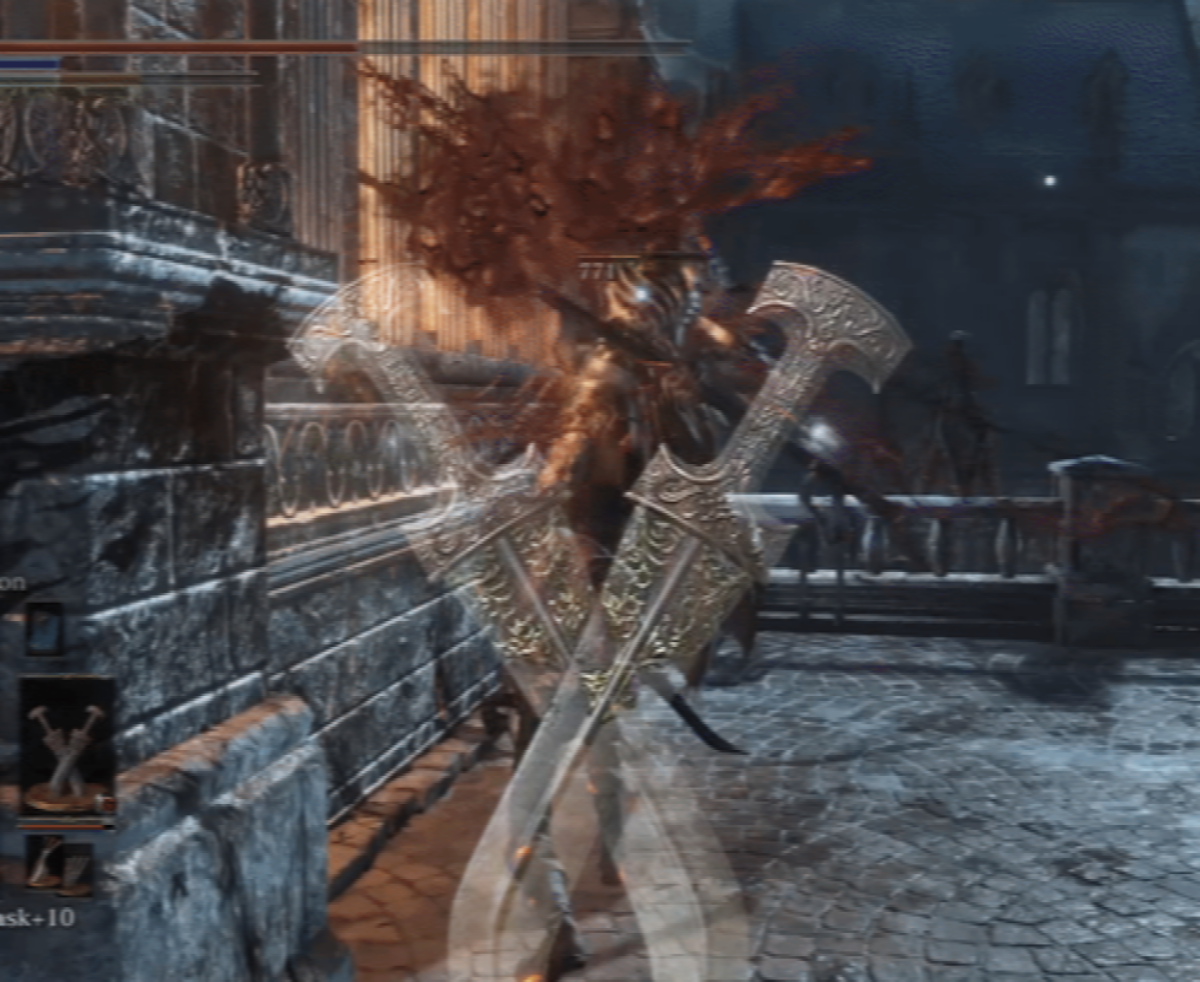
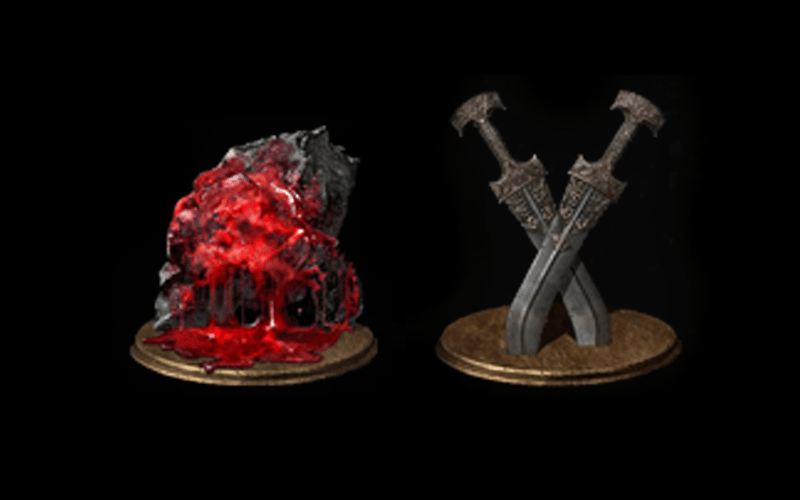
On two pedestals, side-by-side, sits a jagged stone covered in a shiny oozing red liquid, dribbling onto one pedestal. On the other, a pair of curved knives crossed over each other.
Like peanut butter and jelly.

Enhancing a weapon in Dark Souls always modifies its base damage and damage scaling in some way. Status effect weapons on the whole tend to deal a lot less base damage as a tradeoff, and so I’d often shy away from them not just in Fromsoft games but in RPGs in general. It just felt like it was an unnecessary extra step, compared to simply dealing more damage directly. But I wanted those daggers to work, so I gave it a try. In Dark Souls bleed is a status effect that builds up by hitting your target repeatedly, and when it’s built up completely, the victim loses a large chunk of their health to a hemorrhage, all at once. It’s a rather cool mechanic that gives the player a smaller micro-goal to achieve while fighting enemies, that is, quickly building up bleed, in addition to just fighting. It makes for an interesting playstyle and when I tried it out, I found I was having a ton more fun than before. Even when modified, the daggers still deal similar damage to their sharpened variant, and yet now acted as a powerful poison or open wound delivery system.

An undead wrapped in tattered garb thrashes two daggers at a frostbitten undead ghoul, in a snowy medieval city. The ghoul gushes blood as they are struck. After several hits, the ghoul's health indicator suddenly takes a large amount of damage.
See how quickly enemies vulnerable to bleed pop like balloons? It’s a great time, all round.

Status effects in Dark Souls 3 just work. Astounding. But why is this such a pain point for me in so many other RPGs? What is it about Dark Souls 3 in particular that makes it work? I think I’ve identified a few factors that majorly contributed to my enjoyment of using bleed and poison variants of the brigand twindaggers. First off…

It Works

Yeah okay so this one is a little self explanatory. Players aren’t likely to use a game mechanic that doesn’t work, obviously. It goes deeper than that though, players aren’t likely to use a game mechanic that isn’t effective. Every enemy in the game could be vulnerable to bleed, but if it only did a piddly pathetic amount of damage nobody would care enough to go that route. Thankfully bleed is very effective, and can often kill enemies even faster than raw damage. It was also seen fit to make nearly every enemy in the game vulnerable to bleed, a very wise decision. Some are resistant to it, some weak to it, but only a handful are completely invulnerable to bleed. Was this point even worth mentioning? Yeah I think so. Each of these points is something I’ve seen failed in many many games before. There are tons of games where status effects are simply unreliable to the point of near-uselessness. What good is a poison effect if it takes a dozen tries before it actually sticks? What’s more, what is the point if the poison is super hard to apply, but it barely does anything as a result? By then I could have just beaten by opponent to death with a stick. Floundering around with weak status effects feels terrible, and they need to be at least as viable as the more straightforward option.

It Works On Bosses

I cannot stress this one enough. Nothing will make me drop a combat mechanic which requires a time investment more definitively than seeing it is ineffective against boss encounters. Often in combat centric games bosses are the height of the combat system, pushing it to its limit where the most fun to be had is, or even the central axis about which the rest of the gameplay turns. If a combat mechanic breaks down in a boss fight, as a player I often feel as though it’s not worth my time. Status effects work on bosses in Dark Souls 3, generally, or at least frequently enough that I never find myself despairing at the futility of using them.

It is so strange to me that so many RPGs see fit to make bosses immune to status effects. On the one hand I can see the perspective – status effects tend to be very powerful in certain contexts, especially when they are not direct damage dealers, like disables or other utility effects, and one does not want to trivialize combat encounters. And yet. If one has been relying on a certain game mechanic, they begin to take ownership of it as a playstyle. They feel clever or powerful for utilizing it. Taking it away at the most crucial encounter feels awful. There are ways to design around the brute force method of just making bosses immune. Perhaps bosses are merely resistant, and incur a diminished form of status effects applied to them. Perhaps bosses have the ability to remove their own status effects under the right circumstances, or perhaps they last less time. Perhaps status effects are balanced as such to simply be generally useful, but not overly powerful against bosses. I think it’s rarely ever wrong to let players think around a problem, and removing a strategic tool such as status effects from their arsenal, when they can be employed elsewhere feels like player punishment.

In Dark Souls 3, applying a bleed effect deals a flat chunk of damage to enemies, usually enough to kill lesser foes. On bosses, it’s merely a nice step toward their defeat, but not an utter showstopper by any stretch. For bosses that may be felled too quickly if they are bled out repeatedly, it was decided they would be resistant to bleed effects. You can still get that extra damage, and it’s not that hard to do, it just takes a little longer, and the balance is kept that way. There are some enemies and bosses which are immune to bleeding, but not nearly enough to make me question the status effect’s efficacy, and what’s more it contributes to the overall fiction of the game, which has to do with my next point.

Strong Feedback

Dark Souls 3 has very strong audio-visual feedback for when you’re wailing on an enemy. Blood shoots out in exaggerated sprays along with a crunchy *squelch*ing sound with each strike of your weapon. Against armor, you can hear the rattling clang of steel on steel. This is obviously good design from a gamefeel standpoint, but it also provides the very useful advantage of illustrating what can and cannot be inflicted with a status effect. Hitting stuff that can be bled tends to use that exaggerated blood graphic I mentioned, but things that are resistant or immune will show less blood when struck, or none at all.

A well-armored women swings a wrist-mounted blade at a cage full of reanimated corpses. Blood shoots out when it is struck, and after several hits, an explosion of blood gushes from it.
A cage full of reanimated corpses? Can the cage bleed? Kind of ambiguous, except that it shoots blood off when hit. Okay so it can be inflicted with bleed!

I’ve mentioned that some enemies are immune to status effects and how that enhances the fiction of Dark Souls 3. What I mean by that is, it is effectively intuitive what enemies can and cannot bleed. Bulbous fleshy beasts, dripping and shambling undead, living creatures. Things that obviously have blood, are all vulnerable to the bleed effect. Things like enchanted empty suits of armor, a giant tree, skeletons. These things obviously do not have blood, and thus do not bleed. It seems like a simple trick not to miss, but yet again I’ve seen this very concept done poorly too often. Consistency is key. The player shouldn’t have to guess, or at least not guess blindly whether or not their combat tools will even work. Obviously you can’t bleed a skeleton, but obviously you can bleed a giant rat. Design the game so players can trust their own eyes and ears, and the play experience will feel much more seamless. Immunities and resistances should have logical reasoning grounded in the rules of the real world, even if the game takes place in a fantastic one, so your player has a hint of familiarity with which they can decipher the rules of your game.

We’ll have to come up with some other clever solution to deal with the skeletons

Conclusion

So I guess my takeaways from this experience are twofold: certain weapons can be satisfying to use in how they fulfill certain gameplay niches. The brigand twindaggers are an excellent status effect tool in how they apply effects quickly through rapid hits. My other takeaway is that a lot of games could do status effects in a much more satisfying way that makes them feel powerful and useful, something a lot of the designs I’ve seen are often too bashful about. They can be a viable alternative gameplay style all their own, you just need to put in the legwork to make sure this gameplay style feels strong and effective. Locking it out of boss fights makes it feel like a lesser, illegitimate gameplay style, an afterthought. Players should be able to discern the applicability of status effects with audio and visuals alone, without having to consult a wiki. Overall, I think status effects can be underappreciated in games mostly because they so often could be implemented better. When games get it right, I think it’s worth giving a closer look to see exactly what went right. Status effects in Dark Souls 3 were fun enough to use, and strong enough to completely reverse my opinion of an entire weapon’s implementation.

An undead wrapped in tattered garb thrashes two daggers at a giant armored mage wielding a flaming staff. in a snowy medieval city. The mage gushes blood as they are struck. After several hits, the mage's health indicator suddenly takes a large amount of damage.

Such weapons inflict lacerating damage. Most effective with sharp or spiked weapons…

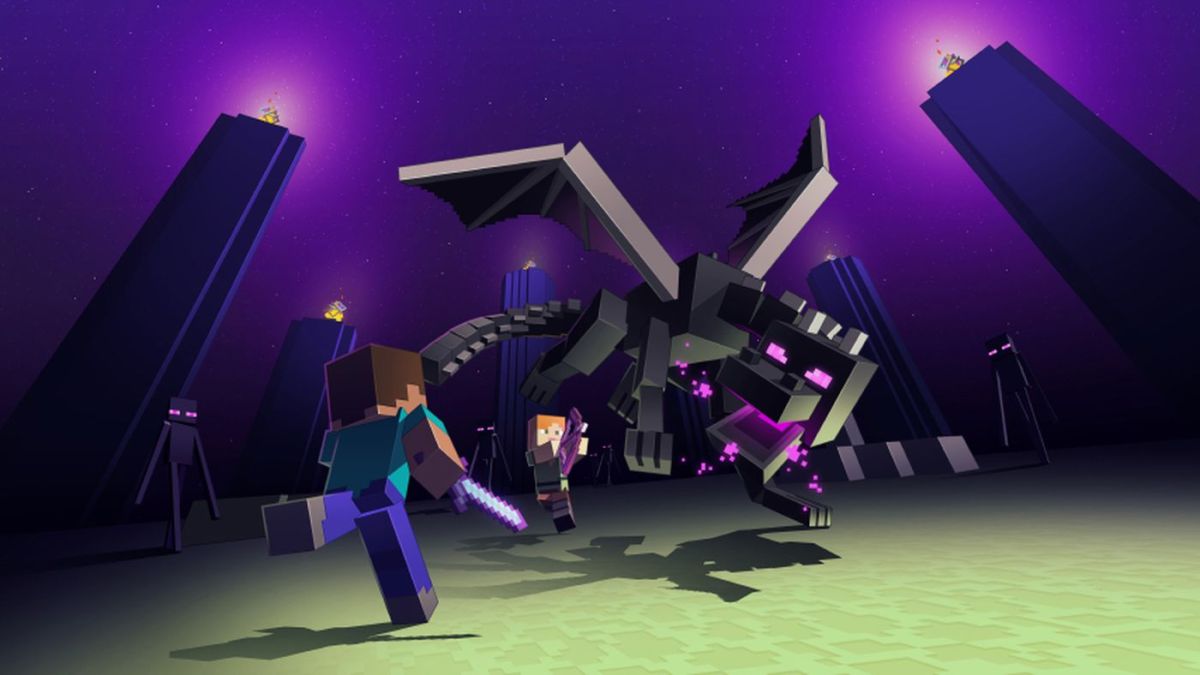
Boss Breakdown: The Ender Dragon

I had one of those weeks. You know the type. An update for worldwide phenomenon Minecraft, survival-based multiplayer sandbox game in which all the world is cubes that can be deconstructed and rebuilt as the player desires with enough energy and time, came out recently. So some friends decided to boot up a new multiplayer server, and there goes all of my free time for the week. We just accomplished Minecraft‘s nominal win condition for its survival mode, the condition which triggers the game’s strange credits sequence; killing a creature known as the Ender Dragon.

Minecraft is a game that, by its very nature does not lend itself to a win condition at all. Even in survival mode, at its core Minecraft opens itself to players defining their own goals and aspirations. Perhaps you wish to build a tall, imposing tower, or a glass city under the sea. Maybe you just want to explore and find beautiful landscapes, or dig into an enemy stronghold and steal their treasure. Maybe you want to raise animals, or start a zoo, or automate the production of gunpowder. All of these things are possible in the game, and none of them really have anything to do with, nor contribute to, the process of killing a dragon, at least not directly. Minecraft isn’t really a combat game, you see. Sure, it has combat in it, and there’s even some nuance to how it works, but it isn’t exactly a challenging set of deep mechanics one is naturally predisposed toward mastering, especially when Minecraft is so rewarding towards its other forms of play, such as digging, landscaping, crafting, and building. All that aside, it was decided Minecraft would have an overriding game-defined goal.

So met with the quandary are we, how does one design a boss for a game in which, A: combat is barely involved, and B: is primarily a game of non-combat mechanics like traversal, building, and uh, mining and crafting. The Ender Dragon is an interesting example of this idea in practice. There are a lot of cool ideas the design of the Ender Dragon utilizes to make it interesting within the context of Minecraft’s unique suite of sandbox game mechanics. If I were to make an appraisal of its overall success in this regard, I’d say the Ender Dragon is… okay. It is at once somewhat convoluted yet also simplistic, and more than a little janky. I’ll get into a little more detail, but overall the fight is fun, and though I don’t think it is the utmost pinnacle of this idea, it is one of the most popular – Minecraft is played by millions, and is in a unique position to examine this idea of boss fights or boss-fight like gameplay engagements for games that are not primarily about combat.

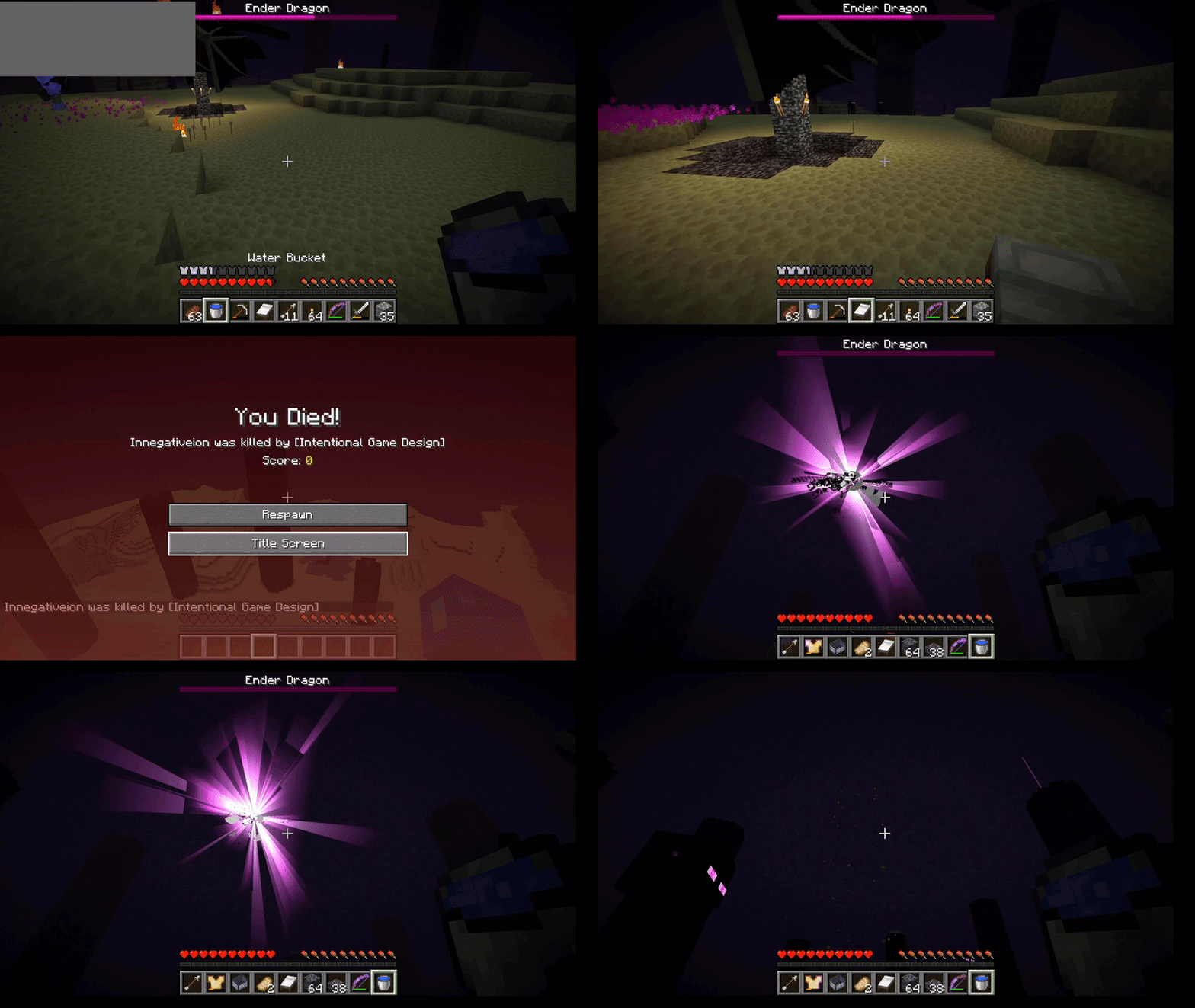
From a first person perspective, a person stands atop a high obsidian pillar, while shooting arrows at a black dragon made of cubes, who flies and circles in the distance. Another minecraft guy stands atop a second nearby pillar and shoots fire arrows at the dragon.

The Ender Dragon encounter is primarily a player-directed boss fight, meaning that the pace and rhythm of the fight is directed by the player, rather than by restricting rules of the boss’s environment. The player directs their interaction with the environment, rather than the other way around. The Ender Dragon is a large black winged beast that breathes fire and flies around an isolated island in an empty void. Her behavior consists of several states which she cycles through, with a preference for certain states over others depending on the status of the structures surrounding the outer edges of her boss arena, called End Crystals. The dragon will dive at players occasionally, and being buffeted by her wings can send players careening off into a lethal fall if they’re not careful. Whilst circling above, the dragon will launch fire balls that leave pools of deadly fire-like substance that persist for some time. Minecraft does not have extremely robust combat mechanics as I mentioned, and dodging usually just means moving to where the danger is not. The fire pools can be irritating, still, them lingering encourages players to dig and build around persistent obstacles.

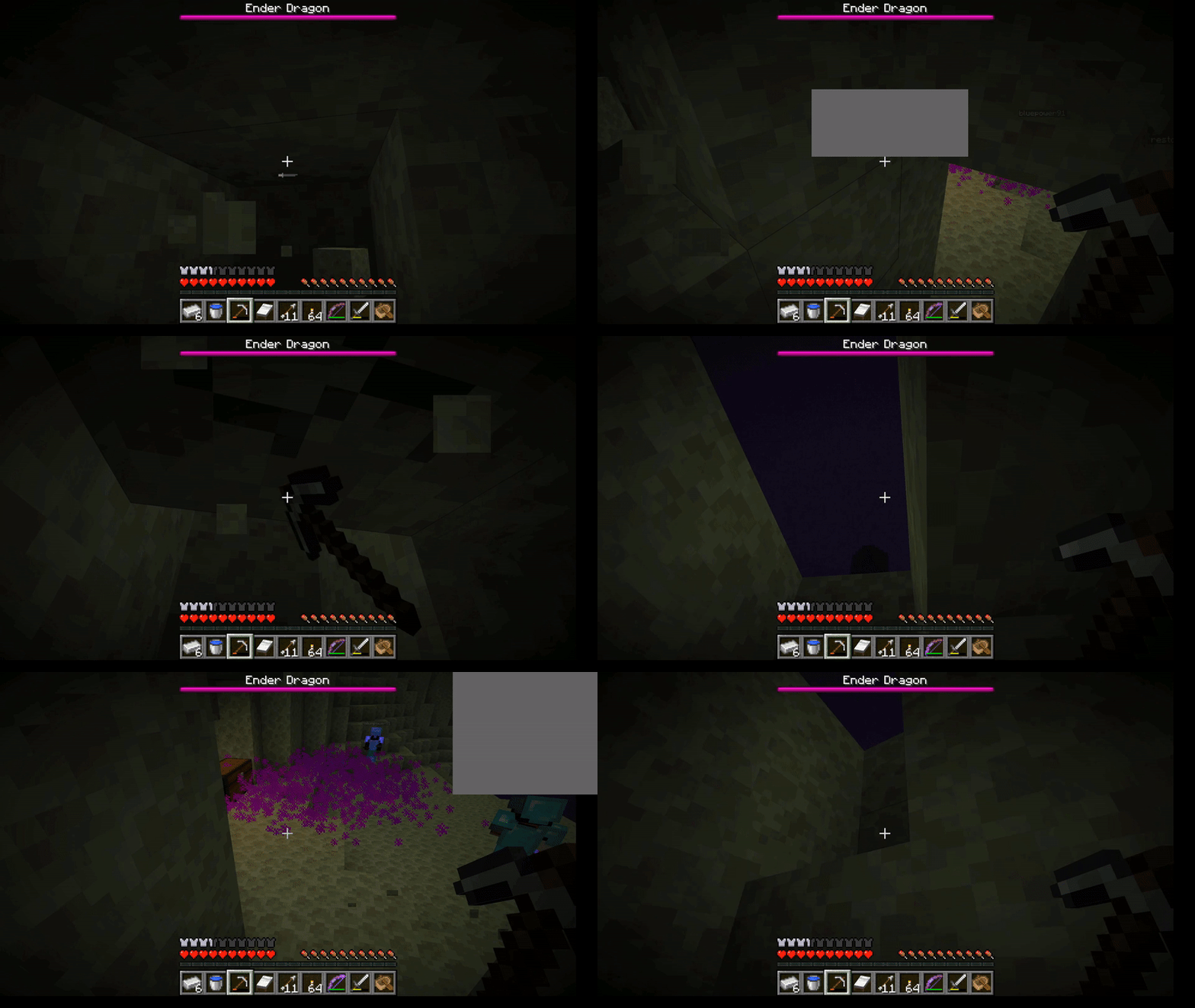
From a first person perspective, a person digs into the side of a stone wall with a pickaxe, then further up to reveal purple sky above the dug hole. Outside the whole, several blocky minecraft guys scramble around a pool of purple fiery gas.
Burying yourself underground is a viable strategy, like some sort of gopher or marmot

So essentially what’s going on, is that these Ender Crystals want to be destroyed. Some can be sniped with projectiles, but some have protection that needs to be dug through, and to do that you need to build a scaffold up to their elevated location. If you don’t destroy these, the dragon stays in the air and restores her health. The design is suggesting the player utilize their building skills to solve the problem, which is good. Building is one of Minecraft‘s most fun and robust features, so it’s good to lean into for a boss fight. It’s a little straightforward though, there isn’t much developed knowledge of building technique needed to build up to these crystals. What’s most restrictive is simply the intimidation factor of the dragon, and outside of that there’s not much to it, as far as the end crystals are concerned.

Another strange quirk of this fight is the presence of many Endermen monsters in the area. Endermen are some of the strongest, most deadly, and most aggressive enemies in the game, but only when provoked. They can be provoked by attacking them, or by centering one’s camera on theirs. The Enderman’s relatable aversion to being perceived translates to a need for avoiding eye (camera) contact with them. I can’t speak too much for others’ strategy, but I always find myself look down at my feet during this encounter, as though my character is just really embarrassed to be there. It’s strange challenge – having to be wary of where your camera is pointing, not just where you character is standing. It does fit with the dragon being an Ender Dragon, as the Enderman monster, which can be encountered outside this fight, and isn’t all that uncommon in the overworld, always abides by this eye-contact rule. It does give the player another plate to spin, but it may feel claustrophobic and a little artificial to some. I can’t help but wonder how this fight might be improved if the designer can rely on the player having full freedom of motion with their camera.

From a first person perspective, a person shoots a bow and arrow at a black dragon made of blocks, flying around in circles below. The person stands atop a tall obsidian pillar.

In the bottom left corner of the display, a dialogue states that several allies have been killed by Endermen.
The Endermen live up to their name

One of the things I find most commendable about the design of the Ender Dragon is how open to various forms of problem solving it is, and how it accounts for the many methods a player might used to dethroning it. Minecraft offers players a huge number of tools with which to solve problems as they explore the world. For instance, the dragon usually is flying around the sky, out of reach of Minecraft‘s most common weapon, the sword. It can, of course be shot with range weapons such as arrows, but the dragon will also frequently land to rest after the End Crystals are dealt with, making it vulnerable to melee attacks. This is one solution. Since the dragon will land and stay stationary for a time, it’s also possible to load up her roost with explosives and set them off like a trap.

From a first-person perspective, a person runs up to a roosted Black dragon made of cubes and places a white bed on the ground, which then promptly explodes in their face, catapulting them into the sky.
Yup. Working as intended.

The dragon’s fire can be dangerous to those walking across her arena’s surface. Of course, Minecraft, being a game about building and digging, it’s totally possible to dig a safe series of tunnels under the arena to move around, or build up cover to protect from the dragon’s fire balls. Climbing up to reach the End Crystals poses another challenge, one that can be tackled in several ways. Shooting the crystals with projectiles is possible, but some are encased in shields that need to be removed. Building up to them with blocks is an option, or placing water (which can inexplicably be swam up in Minecraft) also works. Gravity is an ever-present threat in this encounter, so it’s wise to have some way to address it. Careful use of water can break any fall, or enchantment to one’s boots renders great falls less lethal, or you can drink a potion to fall more slowly. The point is, in Minecraft there are a myriad of ways to approach any given problem, and the dragon neatly accommodates nearly all of them.

From a first person perspective, a person is falling down the side of a tall obsidian pillar. As they approach the ground, they dump a bucket of water onto the side of the pillar, whose contents miraculously breaks their fall. The person then eats a slab of steak.
The tools of dragonslaying: steak, a four poster bed, and a bucket of water

The existence of the crystals is evidence of this. They exist apart from the dragon, at stationary, elevated points. If you want to destroy them up close, they require you to reach their elevated location, likely with building. Building during a dragon attack is a pretty compelling idea, and having to build up to your target seems like a natural fit for a boss fight in Minecraft. There is some inherent risk and reward to how one approaches building up to them. You can build straight up, or try for a more cautious staircase, or perhaps build up to one crystal, then create a bridge to the others.

Another advantage of Minecraft‘s immense suite of problem solving tools is how it frames the fight against the dragon. It is a difficult undertaking, even with a group of friends cooperating. There are a lot of hazards to look out for, so preparation is key. Minecraft is, in a lot of ways a game of preparation. Each night, hostile monsters will appear and overwhelm the unwary, but a solid roof over your head, and an ample supply of food will get you through. Bigger challenges in Minecraft harbor greater risks, and protective enchantments, armor, potions, special food, animal companions, building materials, etc. can all lighten the load. There’s a special sense of camaraderie when all of your buddies convene at a central location to swap enchanted bows and arrows, high-quality armor, and buckets of water in preparation for a great adventure. The Ender Dragon’s accommodation for all these varied modes of tackling problems is one of the best parts about it, regardless of other shortcomings. It’s the context and framing of this boss fight, I think, that creates its greatest moments.

Blocky minecraft guys in armor run around an enclosed space made of gray bricks. There are boxes, chests, and supplies piled around the room. One guy runs up a staircase at room's center and repeatedly crouches and stands.
Just messing around is truly the essence of this game

Whether Minecraft players wanted it or not, the Ender Dragon is the unambiguous overriding goal of a Minecraft ‘playthrough’, its final boss. Is the Ender Dragon a culmination of the skills and knowledge a Minecraft player accrues during their journey to the End? Well, kind of. The levels of preparation and supplies gathering players can engage in is huge in scope. There’s all sorts of stuff you can gather and build to prepare for this fight, and gathering/building is one of the most fun things you can do in the game. In my opinion, the experience is only heightened when a group of friend communally pool their resources to maximize the chances of success. The fight itself is a little convoluted, with the disparate Ender Crystal targets, apart from the dragon itself, but also somewhat dead simple in the very limited suite of behaviors the Ender Dragon can actually engage in. Having to utilize building or similar methods to reach the Ender Dragon’s crystal weak points is compelling and fits with Minecraft’s gameplay, although it’s a somewhat blunt and simplistic implementation. I find the Ender Dragon’s overall design commendable in a lot of ways, and I do look forward to the challenge as a fun communal activity with friends, but it feels under-designed in several ways. Sometimes putting a dragon boss fight into a game like Minecraft feels like hammering a square peg into a round hole. Still, I think there’s a lot to praise about and learn in regards how to approach these sorts of challenges in games that don’t primarily utilized combat as a central game mechanic.

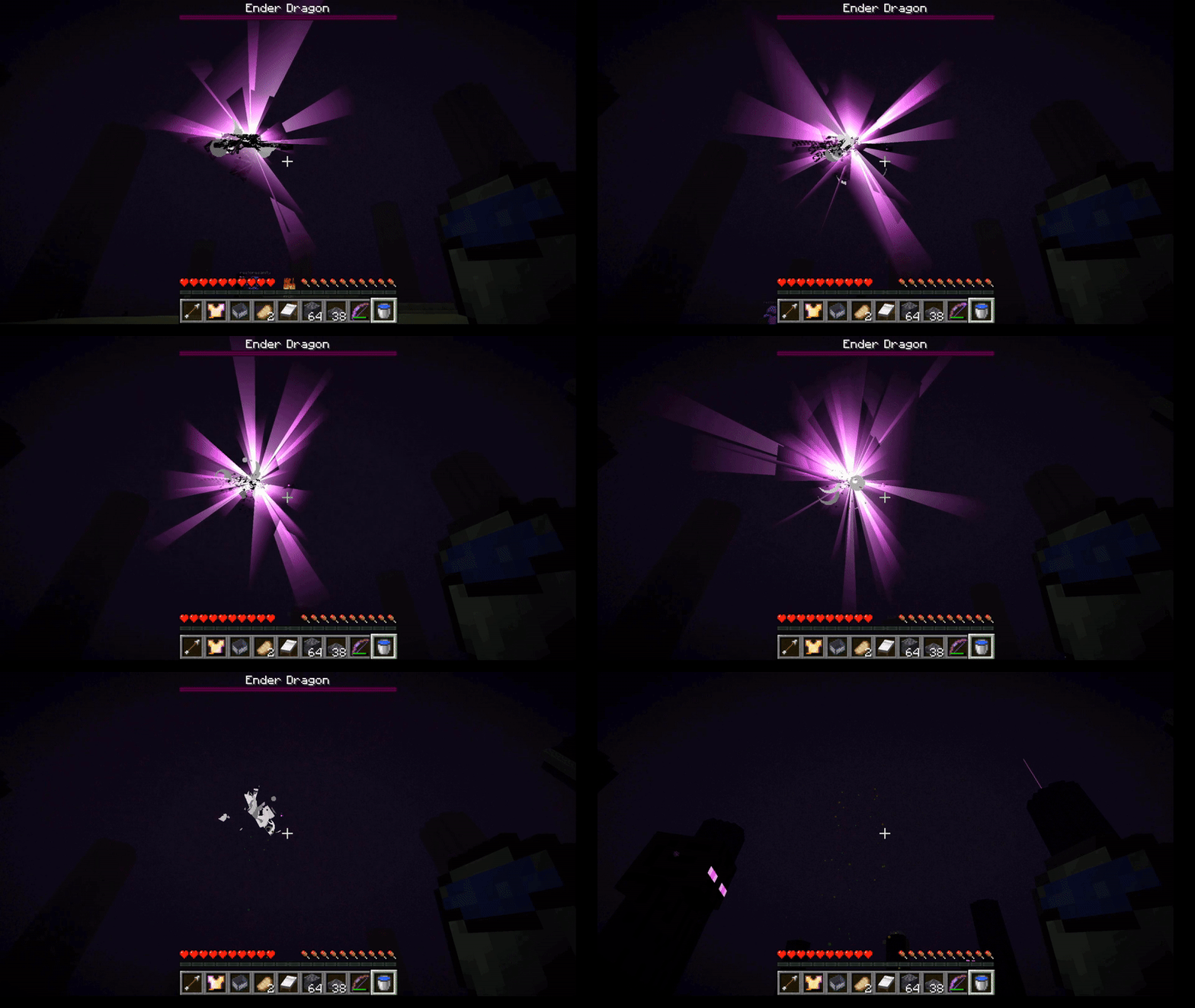
A black dragon made of cubes slowly rises into the air as it disintegrates, a purple light emanating from it, then it explodes.

And the game was over and the player woke up from the dream…

If Your Game Needs a ‘Skip Animations’ Button It’s Too Slow

I notice a lot of people turn off battle animations in Pokémon games. It’s kind of wild this is even something they considered right? I mean it makes sense on the surface, RPGs like Pokémon can be time consuming and people often play it on the go, or lead busy lives. But let’s take a step back here. We’re streamlining by cutting out the battles? Isn’t that, like, most of the actual game of Pokémon? To be clear I don’t think people are wrong to utilize this feature, I use it too. But why has it come to this? Why does the central gameplay mode of Pokémon have to be so time consuming it becomes tedious to the point of cutting its art assets out of the equation? I think this is really something happening within the game itself – if your game needs a ‘skip animations’ option to be playable by enough people to warrant the existence of a ‘skip animations’ option, well, the title’s right there. Options aren’t bad. It’s not that the option is there that bothers me, it’s that so many people, myself included, feel compelled to use it. Perhaps there’s a greater issue here. Pokémon games’ combat is turn-based. The player can take all the time they need to formulate a strategy each turn, but once their choice is locked in, the battle plays out before them. They aren’t directly participating so there’s no stress or pressure on the player tied in with the speed of the game… unless waiting long periods of time stresses you out.

I want to head this all off with some proposed solutions to the problem I’m about to describe in greater detail. I don’t want to come off as overly negative, but rather constructive. I love Pokémon dearly, but I feel as though it has at times struggled to meet the expectations of its own success. Personally I feel as though it is showing its age now more than ever in a number of departments. There are techniques that have been employed by Pokémon‘s contemporaries that allow combat, even turn-based combat, to be very breezy and flow seamlessly. One of my favorites is one employed by the popular Persona series of RPGs, a franchise that, lord knows, started out as a slooooow and ponderous combat experience in 1996. Lessons were learned from this, though, and by 2008, Persona 4 was establishing one of the smoothest and most appealing turn-based combat systems in the business, an advantage that would serve the explosively popular Persona 5 well eight years later.

A gray-haired Japanese high school student stands in a dreamlike space resembling both a castle and TV set, with a distorted background.

Several monsters resembling giant mouths stand before him. He crushes a crush in his hand and an ethereal samurai warrior appears before him. The warrior shoots a bolt of lightning at one of the monsters.

This scene plays out a second time, except the samurai appears much more quickly and the lightning attack resolves faster.
The saved time doesn’t seem like much, but it adds up over a full length game!

In Persona 4, whenever the player uses the same move on multiple turns in succession, the animation for that move is sped up, and the action is truncated. The player just saw this animation in its entirety seconds earlier, after all, there’s no need to run it into the ground. This simple consideration drastically eases the repetitiveness of spamming the same move in turn-based combat, something you might find yourself doing often in Pokémon. In Yakuza: Like a Dragon, when an attack fails to connect with a character, the information is conveyed visually and the action transitions very rapidly to the next step of the turn. The word ‘MISS’ is barely on screen for a second, as the game does not dwell on and minor things. I’m sure I can think of more, but techniques for keeping turn-based combat flow smoothly aside, Pokémon just really has a problem with the structure of its attack animations in general. To be clear, I mean the special effects like lightning that occurs when a move is used, not the motion of the pocket monsters themselves, though that’s its own can of worms. They just tend to be far too long, and often could communicate the same level of awe, excitement, dread, or wonder in half the time or less.

Several men and women are brawling an ubran Japanese market street. A thug takes a swing with a knife at a man in a red suit, but he stage-falls onto his back, dodging the attack. A second thug takes a swing with a baseball bat at a woman, but she backpedals and the attack misses.
What the attack missed? Okaythatscool moving on.

It occurred to me while watching The Pokémon Company’s recent animated short Bidoof’s Big Stand with a friend. How striking and appealing the (admittedly truncated) battle scenes were in this 3D animation! So much character and charm. Compare this animation for the move ‘earthquake’ in 2016’s Pokémon Sun and Moon to the same move in Bidoof’s Big Stand.

It’s not perfect. The earthquake move in Bidoof’s Big Stand for one could probably communicate a bit more force and impact before I’d ship it in a game, but that could be accomplished without inflating its screen time, easily. The fighting in the animated short exaggerates its action in ways Pokémon games probably never could given that their battle animations must be generic and prefabricated to be used by hundreds of interchangeable creatures, but I must insist that Pokémon as a game franchise can get closer to this level of dynamism and flow. It could be as simple as a baseline speed pass for each battle animation. Maybe earthquake doesn’t need to be on screen for a full five seconds. Maybe thunder doesn’t need as much anticipation as it’s getting. Maybe the transitions between turns could be faster. Game animation has a lot of conventions of minimizing anticipation and downtime, making visuals as reactive and instant as possible, and this is for good reason. The benefits extend to all sorts of interactive systems, not just action-y or real-time ones.

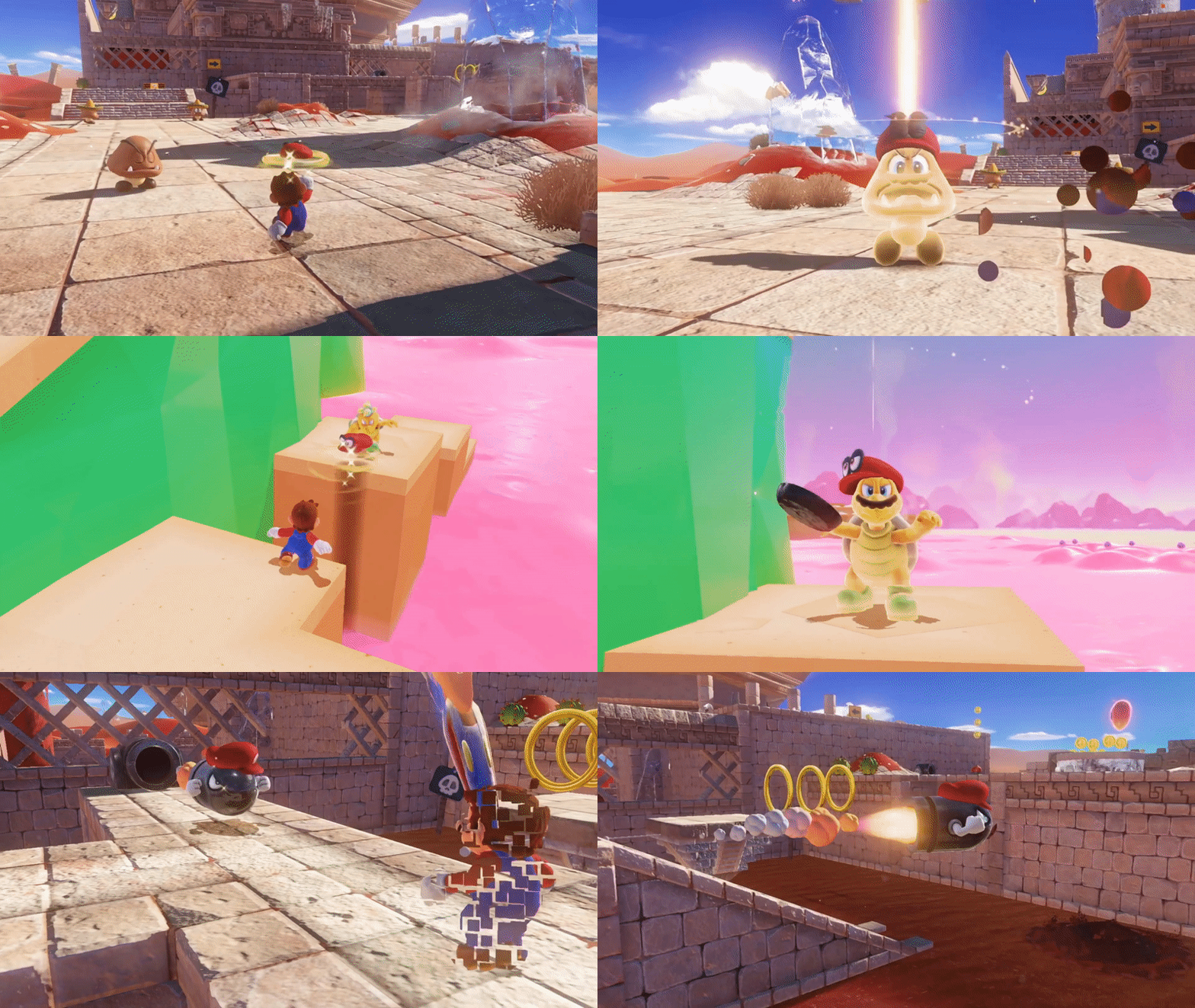
In a desert environment, Mario throws his cap at a goomba, a brown mushroom monster. As his hat lands on the goomba's head, mario becomes ethereal and zooms into the goomba's form, 'capturing' it. This takes place over the course of 1.5 seconds.

A similar scene plays out as mario 'captures' a bipedal turtle and an anthropomorphic bullet.
Games have been condensing exciting visual effects into smooth, seamless transitions for decades. Mario’s ‘capture’ visuals looks just as impressive as any five-second-long pokémon move, easily.

The difference in timing between the in-game earthquake and Bidoof’s Big Stand is staggering to me. I feel as though the Bidoof’s Big Stand earthquake communicates the idea of an ‘earthquake’ just as well, if not better, than its in-game counterpart, in less than half the time! A difference of three seconds might not sound much on paper, but bear in mind that in a pokémon game, you’ll be seeing moves like this, on average, about six times per battle, at minimum. Small increments in moment-to-moment gameplay like this matter. More likely you’ll see moves like this play out repetitively dozens of times per battle, over the course of hundreds of battles that take place in your standard Pokémon game. Arceus help you if we count all the redundant narration about status and field effects that pauses the battle to re-explain itself every turn. This is so much dead air to add to a game, it’s no wonder Pokémon‘s ‘skip battle animations’ feature has become so popular. And why shouldn’t it? I know I use it. I mean, I want to enjoy Pokémon‘s battle animations, many of them are genuinely a joy to watch, but I can usually really only muscle through a chunk of the game before turning them off for long periods of time. They just hamper the flow of the game too much for me.

I believe that games are greater than the sum of their parts. Games can have great music, great writing, great animations, or even great gameplay, but it is only in the confluence of these things, in varying balances, that the true strength of games as a medium comes out. I hate having to skip Pokémon‘s battle animations to avoid feeling burnout. I want the game’s various bits of art to come together beautifully. So, it begs the question, is there something perhaps less essential than the visuals themselves that can be cut out to improve the flow of Pokémon‘s battles?

And that brings us… To the Battle Dialogue.

Pokémon‘s Battle Dialogue is one of many idiosyncrasies Pokémon has brought forward through its many generations. It’s a small window at the bottom of the screen that essentially narrates what’s going on in battle.

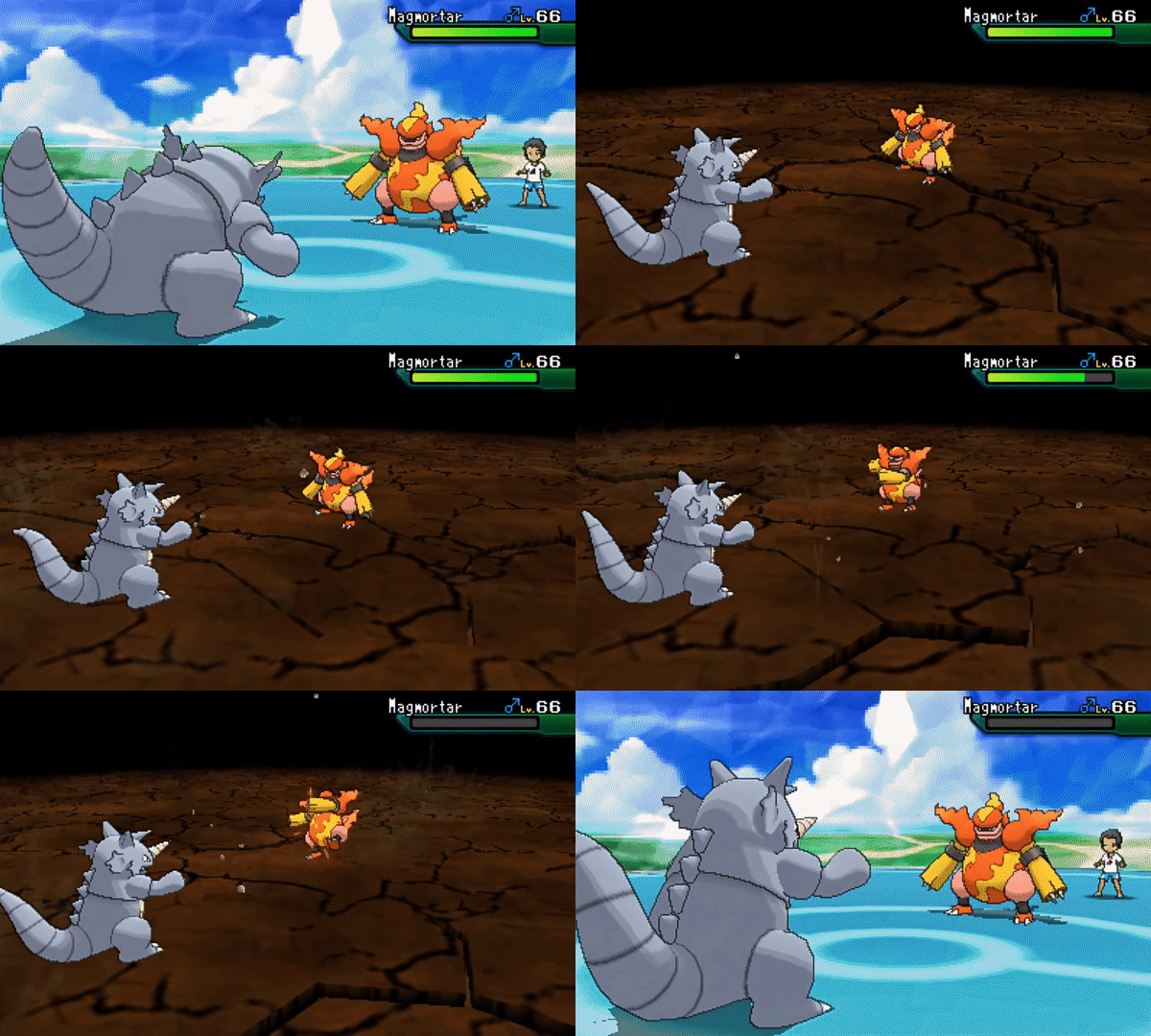
A pokémon will take part of an action, this action will resolve completely, and then the Battle Dialogue will narrate it, before any reaction to this move takes place. The result is an incredibly stilted and lifeless visual accompaniment to Pokémon‘s otherwise excellent battle system that so often holds it back. Take the pokémon move ‘self-destruct’ for example. It’s an old classic from the original gameboy Pokémon games. In the following scene, you will witness the literal events of a clay doll monster violently bursting into a fiery explosion, causing its opponent to become so injured it can no longer stand. See how these events are visually translated, in a way that only Pokémon can.

The pokémon claydol, a many-eyed idol-like monster is tackled by its opponent manetric, a yellow and blue canine. The claydol then uses self-destruct, causing an explosion to emanate from its body. Several seconds later, the claydol faints. Several seconds after that, the manetric faints.
What on earth did I just witness.

I hope my point is becoming clearer here. Thanks to the strange reverence held for the Battle Dialogue, which is always given visual priority, there is no sense of real presence to these creatures, no impression of cause and effect. It’s more like the pokémon are pantomiming their moves. Pokémon has, over the years, become more and more attached to the idea of making their collectible monsters and their world feel real and inviting, like a place you could actually visit. Newer Pokémon games have featured Pokémon pet simulator mini-games, wider areas of exploration, and a more complete impression of the world the games take place in. The problems with Pokémon‘s visual presentation, especially in its battles, feels utterly antithetical to this design goal to me. I know there are certainly technical and production limitations that are causing issues like this, but I felt compelled to bring it up anyway as these issues can never be fixed going forward if they aren’t given voice, and moreover perhaps us other developers can learn something from it. It’s a topic I don’t see discussed much among the *ahem* many other popular topics in Pokémon *ahem ahem* discourse.

What if, perhaps, we entertained the idea of eliminating the Battle Dialogue altogether? Now, it isn’t as though it serves no purpose. Pokémon derives much of its success from being friendly to the young and casual as well as appealing to the hardcore and diehard. The Battle Dialogue inarguably conveys information in a clear and unambiguous way, all the while reinforcing the rules of the game through its constant narration, but is it really the best and only solution for accomplishing those things? Surely, at the very least, longtime fans would woefully miss iconic phrases like “It’s super effective!”. Perhaps, but streamlining Pokémon‘s visual information could mean repackaging iconic visuals in new and exciting ways. Perhaps “It’s Super Effective!” could live on as a visual or particle effect itself, not just plain text. Yes, big changes like this may be a hard sell at first, but if Nintendo’s other recent output the likes of Breath of The Wild or Bowser’s Fury has taught me anything, is that nothing need be unassailably sacred, and sometimes fans are just waiting to fall in love with something new, even if they don’t know it yet.

When all’s said and done I don’t think my vision for a faster, breezier version of Pokémon battling is the only ‘right’ choice. But I do think Pokémon could stand to peek at its peers’ homework from time to time and modernize the way it presents itself a bit. Some of the things that greatly harm the pace of Pokémon are entirely inventions of a game designed for an 8-bit calculator of a console. Some of these things I feel the franchise has outgrown entirely, and some could be re-contextualized in a more modern way. There’s some considerations in art direction to be made too that could smooth out some of these rough edges. In this article I proposed removing or rearranging a lot of things, but honestly much of this could still remain optional. I just think it’s emblematic of an issue that could be assuaged through design rather than blunt force, if a lot of people are choosing to turn off the thousands of man-hours that went into making your game look appealing.

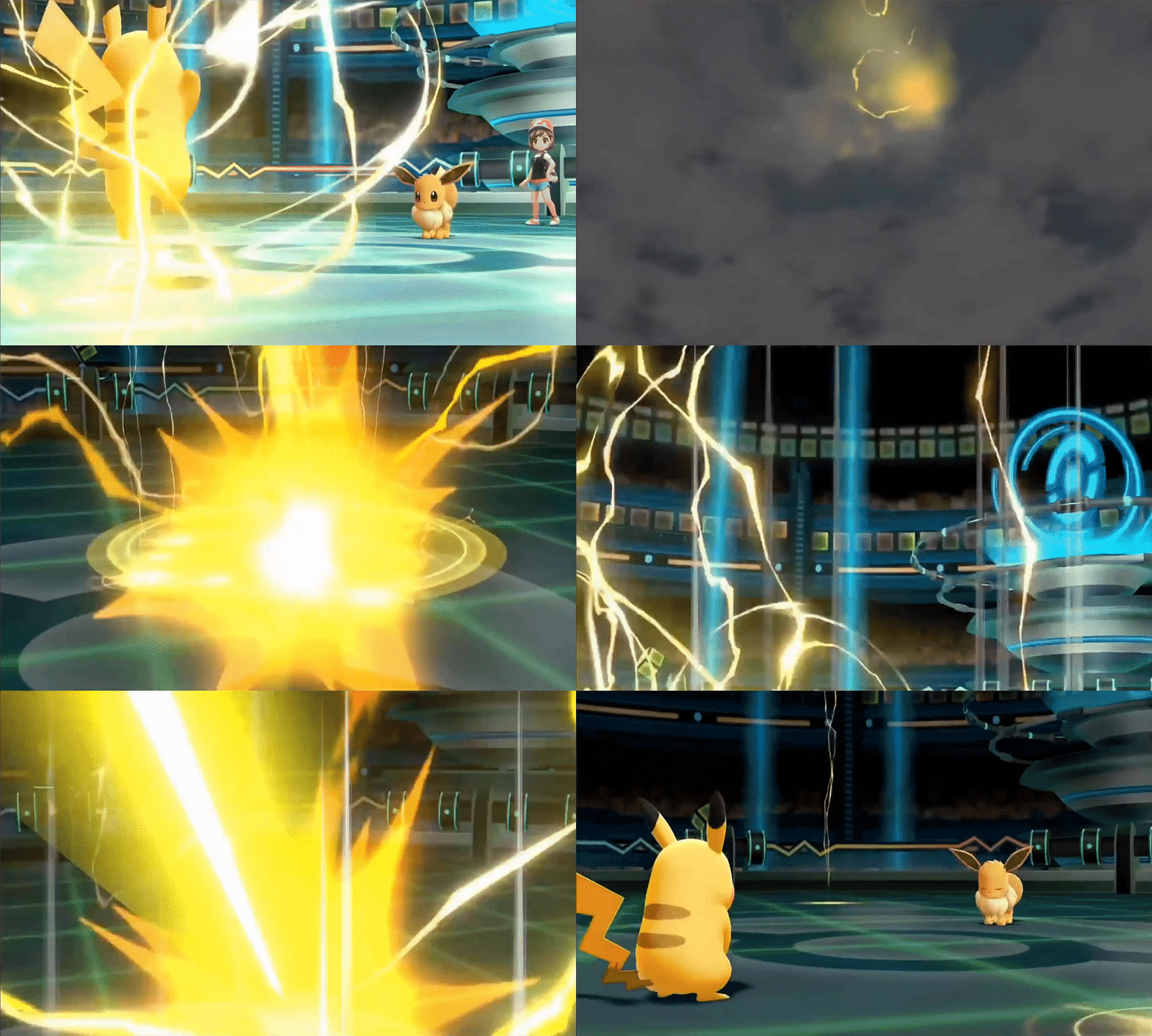
The pokémon pikachu, a yellow mouse, shoots lightning into the sky, which roils in the clouds before falling onto pikachu's opponent, a small brown fox-like pokémon called eevee, in a column of lightning.

The same scene plays out again, but this time edited down with bits and pieces of the animation sped up.

It runs agilely as if on wings…

Dota 2’s Dark Willow: Effective Audio-Visual Feedback, and Mechanical Synergy

Dota 2 is a game of the genre MOBA, Multiplayer Online Battle Arena. In simpler terms, it’s a team-based game with a focus on combat and strategy. It’s played from a bird’s eye view, and features a number of colorful fantasy heroes to choose from. Dark Willow, the mischievous, slightly sadistic thieving fairy is my personal favorite, and I wanted to just jot down my thoughts on how effectively her abilities are communicated through audio-visual feedback.

Birds eye view of a tropical rain forest. A fairy glides down a pathway. 

Text chat: 
Someone says "usually pick turbo just to dark willow"

I respond "That was my plan"
“Let’s have some fun, shall we…”

Audio-visual feedback is as it sounds; the fairly basic concept that important information should be communicated to players implicitly through their senses, and that things like affirmations of success or confirmations of failure should be communicated in this way. For example, if a player character swings a sword, that sword swing should make a distinctly different sound whether it misses its target, strikes an enemy, or strikes a wall. It should probably look distinctly different in each of those cases as well.

Dark Willow has five abilities. Bramble Maze allows her to sprout a circle full of equally spaced bramble bushes at a distant location. Enemies will have only a narrow space to squeeze between the brambles, and if they touch one they are rooted to the spot and damaged. Shadow Realm allows Dark Willow to hide in a shadow form, immune to most attacks, then burst out with a powerful shadow attack. The longer she is hiding, the stronger the attack, so long as the ability does not wear off first. Shadow Realm can later be upgraded to fire a barrage of shadow attacks. Cursed Crown is a curse Dark Willow places on a target, causing it and nearby allies to be stunned exactly four seconds after the curse is cast. Bedlam causes Dark Willow’s wisp minion to orbit her, firing destructive magic at nearby enemies. Terrorize projects the wisp to a distant location, causing any enemies at that location to be terrified and sent running toward their base.

Birds eye view of a tropical rain forest. A number of heroes do battle in a river. A series of blue concentric circles indicates where a bush full of brambles is about to sprout. When the circles are lined up with enemy heroes, the brambles rise up and capture them.
Here you can see me line up exactly where the brambles should be placed, so I can catch multiple targets, thanks to the handy previsualization UI.

A lot of Dark Willow’s power as a hero comes from the synergy between her various ability mechanics. Bramble maze does a great deal of damage and holds foes in place, but they have to touch the brambles for this to happen. Luckily, Dark Willow has the ability to force enemy movement in the form of Terrorize, clever of use of which can cause enemies to flee in terror into her brambles. Cursed Crown is a strong stun that can disable multiple opponents but only if they are standing together, which is why Terrorize, in conjunction with Bramble Maze, is so effective at sticking enemies together. Dark Willow can dish out immense damage with Bedlam, but only if she gets close, and she is not very durable herself. Luckily, Shadow Realm renders her immune to most dangers, which she can use in conjunction with Bedlam. The fact that Shadow Realm can cap off this combo with a burst of damage is a nice compliment to the more sustained damage of Bedlam, which can be more easily reacted to.

Birds eye view of a tropical rain forest. A fairy sneaks up from the trees on a man made of lightning. A bramble sprouts beneath him and captures him. The fairy flies up with her wisp, which tears him apart.
Clever use of synergized game mechanics can make your player very powerful

Because it is so important to coordinate your various abilities together like this, it is essential the player can develop a seamless feel for how the various timings, cast ranges, and nuances of her abilities work, without having to look at a detailed explanation. That’s where audio-visual feedback is essential for making gameplay mechanics like this synergize in an effective way that’s satisfying and fun for the player. Dark Willow’s Shadow Realm is an excellent example of this.

Birds eye view of a tropical rain forest. A fairy is surrounded by shadows before a red circle begins to glow around her feet. It becomes more distinct over time.
The red aura around Dark willow becomes more and more distinct as the shadow realm attack becomes ‘ripe’ for unleashing.

First off, Shadow Realm is kind of a complicated ability when you break it down. When its button is pressed, Dark Willow becomes subsumed in shadow and immune to most enemy attacks, which is easy enough to understand. However, during this period Dark Willow is also charging up an attack. This shadow attack reaches the peak of its potency after 3.5 seconds of charging, but the ability itself ends after 5 seconds. So there is a period of 1.5 seconds in which it is optimal to use Shadow Realm’s attack competent. That’s a little unintuitive, or rather it would be if not for the audio and visual considerations. After 3.5 seconds of Shadow Realm, Dark Willow is surrounded by an additional visual effect: a red circular aura that surrounds her and gives the impression of peak power. As soon as Shadow Realm begins, a distinct and almost melodic humming sound begins to emanate from Dark Willow, it gives a sense of building power and changes over time. Its intensity crescendos after exactly, you guessed it, 3.5 seconds. The humming then peters out for the remaining 1.5 seconds, giving a strong impression of when the attack should be dealt.

Birds eye view of a tropical rain forest. A fairy becomes surrounding in shadows as a wizard is caught in a bramble patch. A wisp flies around the fairy and attacks the wizard, before the fairy throws her own projectile, but it fails to kill the wizard.
Here, I crucially missed the shadow realm cue, and my attack fails to kill my target. Entirely my own misplay, but emphasizes the importance of those cues.

This sort of feedback is also helpful for those opposing Dark Willow. Without having to count, any player can get a pretty good idea of when Dark Willow is most likely to release her shadow attack. Giving easy access to this sort of information is conducive to a healthy competitive game, allowing complex strategies to form. Knowing what your opponent is capable of, if not necessarily what they intend to do, you can act and react to game events as they occur. Acting and reacting is the core of competitive gameplay. If each player doesn’t have the right information to available for them to utilize, there is no counterplay, there is no game.

Curse Crown is a very interesting example of this concept. It counts down, loudly and with a visual timer represented by four icons for each of the four seconds in the countdown, but this countdown is a strategic benefit to both Dark Willow and her victim. The victim will know that standing near allies when the countdown pops means putting those allies in danger. Dark Willow will be eagerly awaiting for her victim to become stunned and helpless, so she can unleash her most powerful offense. The strong visual feedback makes for a better experience for both the victim and user of the spell. By giving both parties this important information as a readily apparent graphic and audio cue, they can both formulate plans to deal with the respective obstacles to their goals, which is itself the fun of the game.

Birds eye view of a tropical rain forest. A fairy sends a wisp out to scare a giant lizard man, who flees in terror. Where the lizard man stood, a zombie comes back to life, and chases the lizard man together with the fairy.
With terrorize, enemies are driven off of my allies, and with shadow realm, I can further pursue and subdue them.

As the victim is stunned, Dark Willow may try to line up a Bramble Maze on them, to further damage and disable them. Typically, you’d want to place the brambles in the enemy’s path, so they move into the bush themselves. If they are stuck in place though, one can carefully line up the bramble to appear beneath your target’s feet, thanks to a convenient target-preview interface that will shadow the Dark Willow player where exactly they brambles are going to appear. For the opponent’s part, the brambles are distinctly shaped, leaving little ambiguity as to where it is and is not safe to walk.

As you may have gleaned, Dota 2 can become fairly visually loud, with ten individual heroes all throwing out impressive and explosive spells like this. That’s why it’s so important to keep a distinct visual not only for each ability, but a distinct visual style for each hero as well. It should be unambiguous when it is Dark Willow in particular using her spells, so that enemies and allies have a fair amount of information with which to react. Dark willow’s visual effects are uniformly composed of dark violets and maroons, evocative of shadowy undergrowth and wild flowers, which is also thematically relevant to her character as a dark fairy. Big and important abilities that can completely shift the tide of battle, such as Terrorize, tend to be louder and more immediately noticeable, in proportion to their power.

Birds eye view of a tropical rain forest. A large number of heroes do battle. A fairy throws increasingly powerful projectiles at a lightning man. When the lightning man falls, a friendly zombie is frozen in ice, and his allies are forced to attack him. This ends when a fairy sends her wisp to terrorize nearby enemies. Afterward, the fairy turns to throw her projectiles at a fleeing wizard.
In an extended battle, there’s LOTS to keep track of, so knowing the visual and audio cues becomes an essential skill. It’s better to make that learning curve as painless as possible. It may be hard to track Dark Willow in all this mess at first, but look out for her midnight color scheme.

Audio-Visual Feedback is one of those things you really have to nail, if you’re game’s to be any good, honestly. If a lot of important information is moving around in your game and it doesn’t reach the player in a prompt and unintrustive way, it can severely hamper the experience. Dota 2 is pretty good at it, considering all the challenges of keeping things clear and readable that comes with the MOBA genre. Dark Willow is a particularly strong example, and perhaps that’s one of the reasons I was drawn to her and her playstyle.

The aftermath of a green explosion in an open plain is overlaid with the words 'Radiant Victory'. In response to someone asking 'why did you mid' I respond 'so wed win, like this', to which someone responds 'like milk'.

A scoreboard follows.

You thought you were winnin’?

Let The Player Break The Game Already; Inscryption, Isaac, and Others

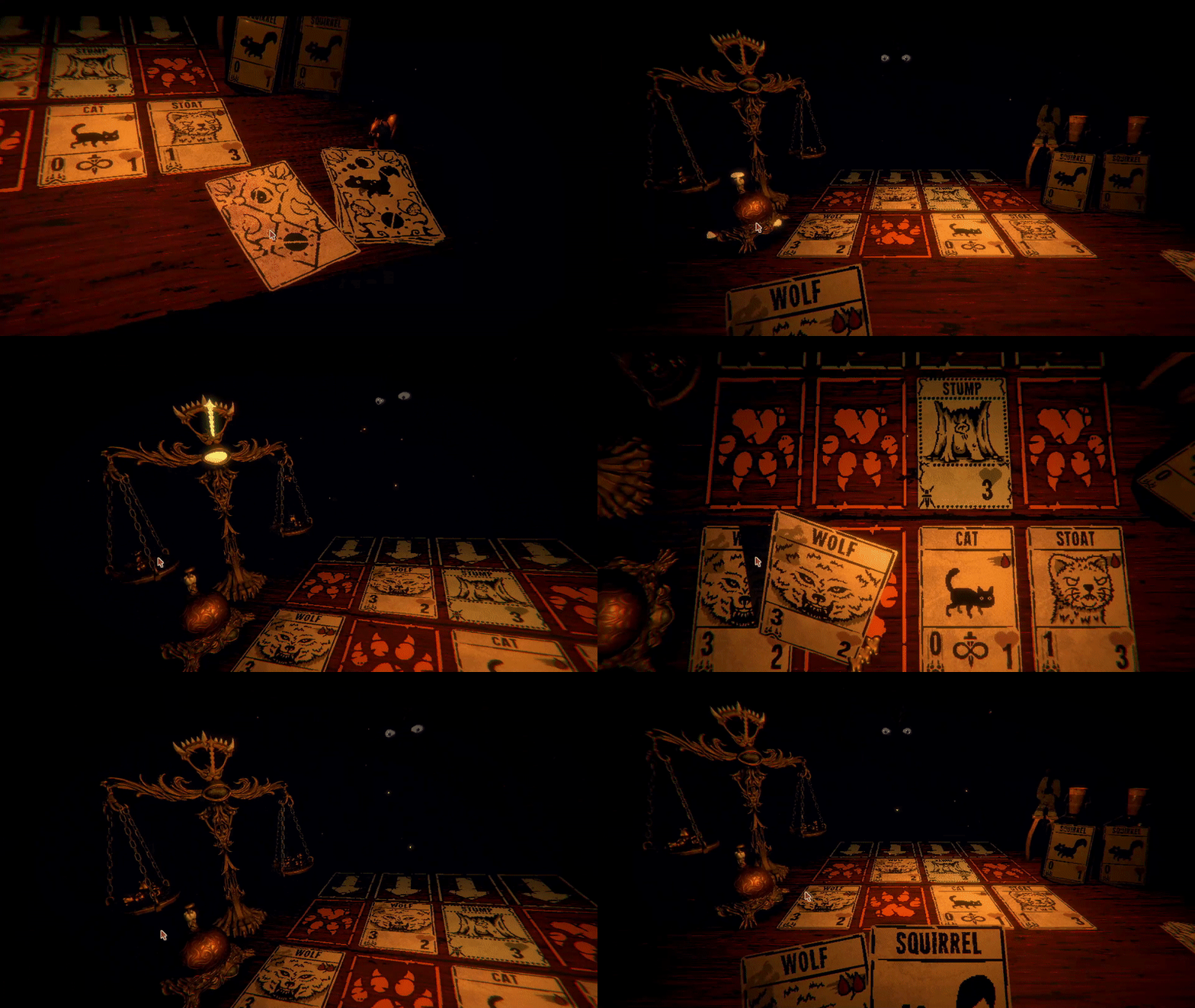
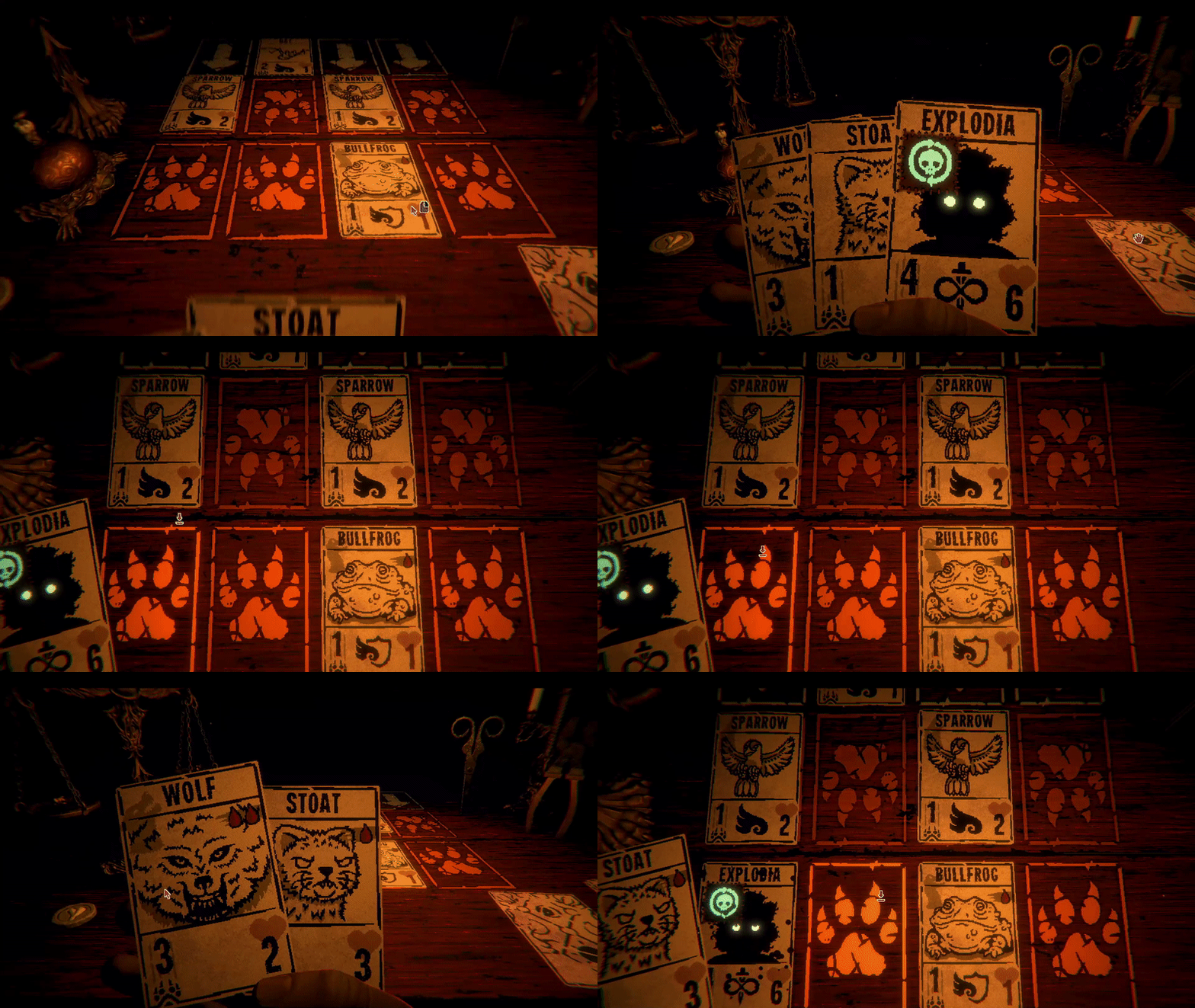
While on break for the holidays I found myself finally taking a look at a little indie card battler game I’d heard much about. Daniel Mullins’ Inscryption is a 2021 roguelike card battler in which you build a bestial-themed deck of cards to traverse a table-top adventure scenario game-mastered by a mysterious shadowy card dealer, who seems to be keeping you in a spooky woodland cabin. You may have heard the game is rife with compelling mystery and secrets, and it is, so rest assured I won’t be spoiling anything about the game, merely talking about its combat mechanics sans any story context.

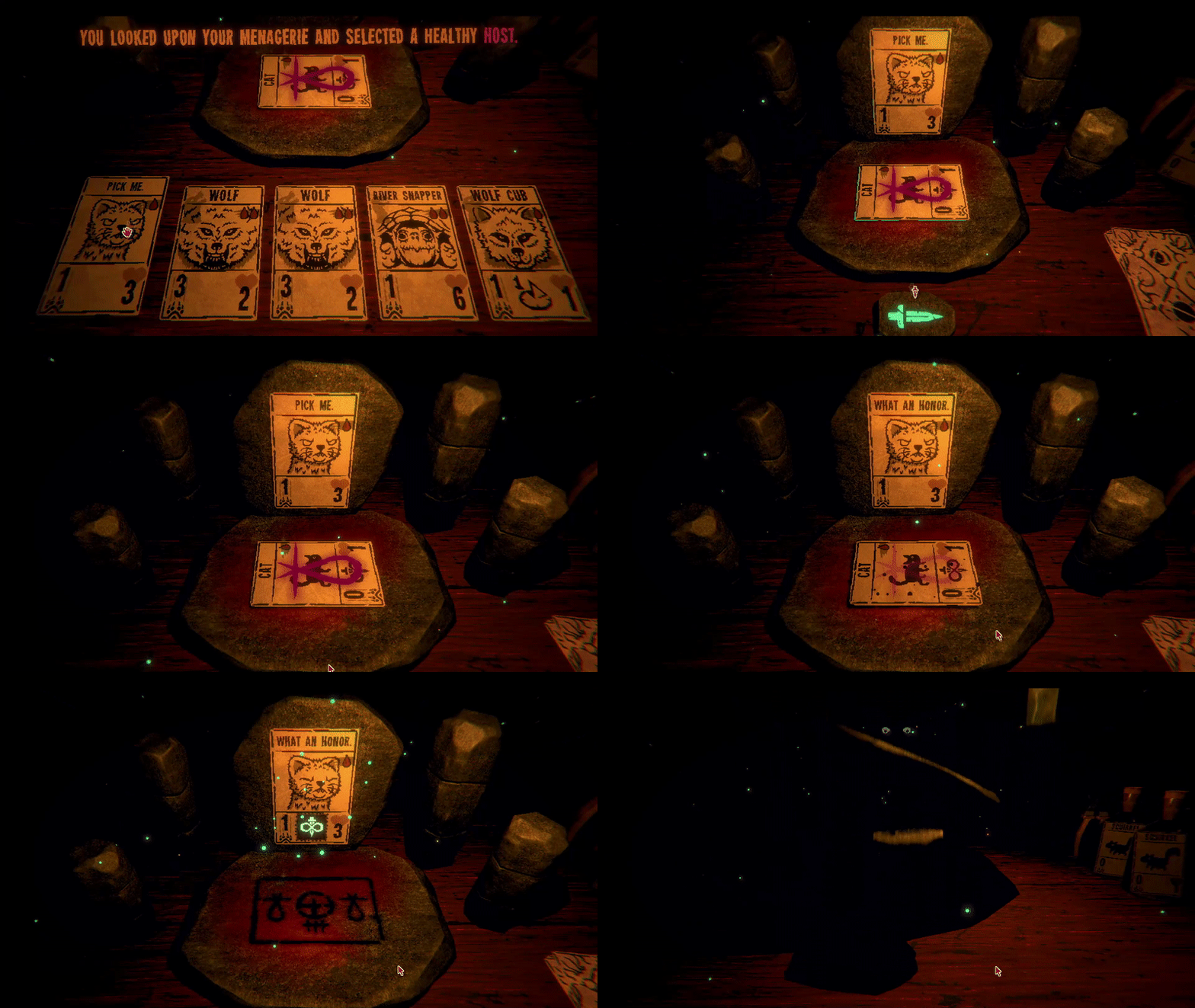
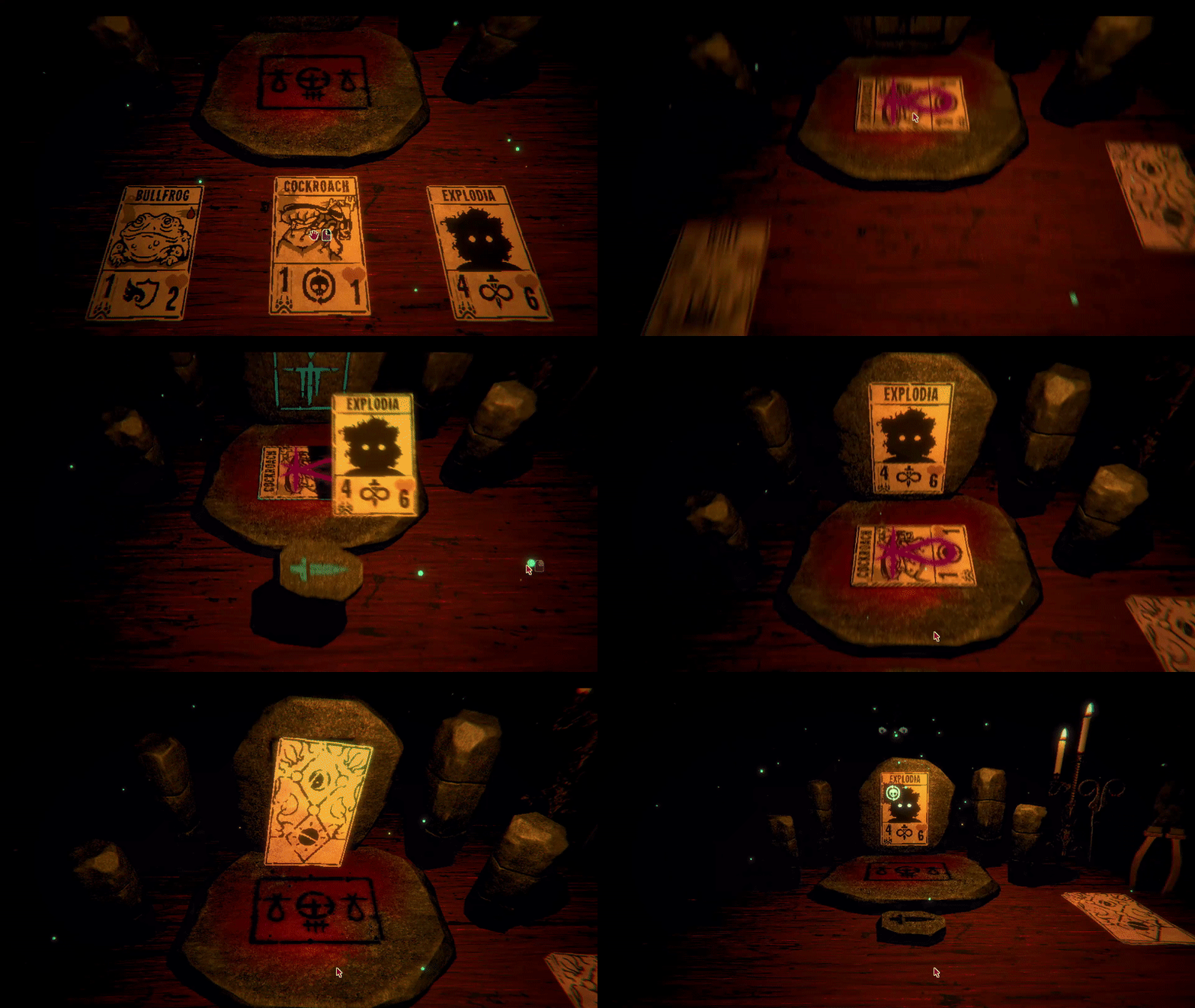
A stone altar is placed on a wooden table immersed in shadow. A set of cards featuring the likeness of beasts is lined up before the altar. A card with a cat is sacrificed on the altar and disappears, but a stoat card is granted the cat's sigil, a special power in the form of an infinity sign on a dagger.
Yeah, you look very honored.

Specifically I want to talk about this concept of ‘breaking the game’, or employing a strategy so overwhelmingly power it almost seems to throw off the difficulty balance. Here’s the thing though, well-designed games like Inscryption and The Binding of Isaac: Rebirth want to create this feeling in the player of overwhelming power, which is why they tend to be so brutally difficult at the start. Roguelike games, by their nature, are games designed with the players’ repeated failure in mind, and thus repeated replaying. With each of those failures, generally, new inherent advantages are collected, as well as new knowledge of the game. By game’s end, the player will have accrued a large number of mechanical advantages and game knowledge, allowing them to plow through challenges that once seemed insurmountable. The game designer’s fear of the ‘Dominant Strategy’ is the trivialization of their game mechanics.

What’s clever about a lot of the more popular roguelikes, is that they leverage powerful strategies as a way to engage the player with their systems. Knowing exactly what the most reliable and powerful combinations of weapons and items in The Binding of Isaac: Rebirth takes time, effort, and exploration, so by the time you’ve ‘broken the game’ so to speak, you’ve already gone through a lot of the game’s interest curve just getting there, and a well balanced game can tilt that power scale back at you. Often in the roguelike Hades I’ve found myself achieving a combo that can absolutely demolish early content, but I’m then brick walled by later enemies, and have to change up my approach, keeping the game dynamic and interesting. These games make the opposition an overwhelming obstacle, so that overwhelming power is not only incentivized in the player, but almost demanded.

I’m tending more and more towards designing the opposition in a combat game to be more powerful, rather than limiting the powers and options of the player. Finding wacky solutions to the problem of ridiculously deadly enemies is fun! Isaac allows you to reach such absurd levels of power that it’s comical, and yet Isaac is so vindictively engaging. Every time I fail in that game I’m just reminded of how much I want to taste that overwhelming power again, I think about all the little ways I could combine and recombine the disastrously large number of powerups existent in Isaac, and I dive right back in. The same is the case for competitive games with deckbuilding elements such as Dota 2‘s Ability Draft, in which one drafts the ability for their player hero from a pool of powers that don’t normally go together in Dota 2‘s base game modes, but can combine to create some ridiculous effects. The possibilities are just so tantalizing, because the designers went out of their way to insure the various elements all meshed with each other in interesting ways, without much need for exceptions or limitation. Dota 2 also has its own roguelike mode that utilizes design sensibilities as I’ve described. Enemies are monstrous, lethal, and oppressive, but clever power up allocation can render what once seemed impossible, routine, and it’s an exciting climb to that point.

No matter how overwhelmingly powerful one might become in these games, the games generally stay extremely lethal throughout. That is, even if you can crush your opposition with a flick of the wrist, a couple mistakes may still lead to a loss, especially later in the game. Pulling a bad hand in Inscryption, all of your overpowered cards aside, can still be disastrous if you don’t have a plan to stall the game until you can pull your winning cards. This is a pattern games which employ the concept well have in common – their core gameplay is still reinforced even as the player becomes ‘overpowered’. In Hades and Isaac, you still have to be able to dodge attacks, or you’ll most likely be toast very quickly. In Dota‘s Ability Draft, you still need to have a feel for the game to make the advantageous plays. In Inscryption, you still need to think through your strategy in case of unfavorable scenarios, as described above.

The key is to make things dramatic. The game can quickly swing in either direction based on the player’s performance, and if the player ultimately becomes an unstoppable force, it should be as a reward for a good performance, and therefor not feel cheap. The rug can still be pulled out from under you if you underestimate opposition that is designed to itself be powerful, and lethal. Inscryption‘s particular health system resembles other card battlers, but takes the form of a scale, so the winner is determined by who has dealt more damage as weighted by a literal scale, and the threshold of victory is not much. So in other words, even with your most powerful cards, things can swing quickly. If the purpose of combat in a game is to be an easy vector by which to create conflict for the player to overcome, and the purpose of conflict in a narrative sense is to be dramatic, then combat should be dramatic. I’m personally pretty tapped out when it comes to power ups the likes of “Increases critical strike chance by 0.5%”. Sure, such things have their place, but I think I’m over entire skill trees and player progression systems being centered on the low-numbered variety of powerups. They’re often barely noticeable in practice, even if they add up over time. When a player gets a new card, or a new weapon, it should dramatically shift the balance of power, or change how the game is approached. Really play up that drama. Otherwise, what’s the point of the new element even being added?

In dark cabin a rustic card game is set up on a wooden table, seen from first-person perspective. The player attacks with two cards marked 'wolf' and 'stoat', causing teeth to be loaded on the opponent's end of a scale. The opponent attacks with their own wolf in kind, and the scale swings back toward the player.
Danger in this game is swift and intense, but it swings both ways

Inscryption embodies this philosophy with how its death cards and sacrificial altars work. Death cards are essentially custom cards, created by the player, utilizing elements of their own deck to combine into one card. The player is given a random assortment of cards from their deck, from which they can choose one card’s play cost, one card’s power and health, and one card’s special effects aka sigils. The result is more often than not something far and away more powerful than what can be normally obtained. The sacrificial altars are similar, allowing you to sacrifice one card to permanently transfer its sigils to another, making a powerful card. This system greatly rewards understanding of the game’s mechanic, and is inherently explorative in nature. Player’s are invited to use the game mechanics as a form of personal experession, so they can leave their own mark (in this case literally, as you can also name the card) on the game. A personal favorite of mine was a card with a medium level of power and health, but no play cost, the ability to attack three times, and the ability to return to my hand when killed on the play field. I called him ‘The Immortal Mantis’. Needless to say, getting this card into play was a reliable way to end matches in my favor. And yet, I never felt as though I was cheating the game, or robbing myself of a more compelling and challenging play experience, because Inscryption like Hades, like Isaac, like enemy players in Dota‘s Ability Draft, and like many other roguelikes, because it took a lot of effort on my part to make this power happen. Either effortful forethought, or playing through a challenging game with little power to start, or both. My ability to swiftly end combat encounters feels earned, and misplays can still lead to a loss by virtue of how lethal a game Inscryption is.

I think making the player ‘too powerful’ is more a question of how you design their environment, or high you contextualize that power, than it is something to be altogether avoided. Inscryption is one of the most compelling play experiences I’ve had this year, all other advantages it has such as its narrative and world-class aesthetic presentation aside. Inscryption certainly allows you to become ‘too powerful’! Power in a combat game often means a wide breadth of possibilities, and that power can translate directly into a sense of ownership of, and self expression within the game mechanics. There are many ways to ‘break’ Inscryption and Isaac and Hades, but no two players are likely to do it in exactly the same way.

In dark cabin a rustic card game is set up on a wooden table, seen from first-person perspective. The player draws a card featuring a silhouetted figure with the name... Explodia
This card right here is dopamine, in auido-visual format

In that fashion, ‘breaking’ the game, is the game. Outmaneuvering and outwitting your opposition is the essence of conflict. Building systems where breaking free from their perceived constraints is the point of those systems seems somewhat counterintuitive, but I think the continued explosive success of the roguelike genre, especially in regards to games that operate this way, speaks for itself. There is a market for this specific flavor of power fantasy, and there are ways to give the player that overwhelming power without trivializing the game.

Sacrifices must be made…

Sonic Adventure 2: Combat as Traversal

Sonic Adventure 2 is loved and it is hated. As an early adaptation of the 2D platform game star Sonic the Hedgehog it is rife with both 3D growing pains and extravagant, outside-the-box ideas. I find it notable for a great number of things. I’m particularly fond of how the game integrates its main gameplay attraction of momentum-based platforming- going fast, in so many words – with enemy encounters. More precisely, how this enemy encounters do not intrude upon the traversal gameplay, as the combat itself becomes a form of traversal.

Specifically I am talking about the Sonic and Shadow Action Stages, as they are relevant to what I’m getting at here, with the treasure hunt and mech stages being their own beasts. The Action Stages as such involving running across long, winding highways filled with deadly robots and ridiculous loopdy-loops. The first thing to note about these enemy robots is that they barely attack Sonic. Maybe a laser or bomb or two will be launched every few seconds. The thing is that Sonic stages need obstacles for there to be a game. Speed is meant to be a reward for performance, and if there’s nothing to overcome there’s no way to perform. An excess of obstacles though, quickly grinds down the experience to one of attrition, with frequent starting and stopping that strips away the core gameplay. In other words, Sonic has to have a very low skill floor and barrier to entry. Complicating this with more involved combat breaks the flow of Sonic that is one of its staple selling points.

Sonic (Sonic Adventure 2), in a tropical jungle environment, rolls into a ball and dashes straight ahead at high speed, blasting through a robot and running ahead as if the obstacle was nothing.
Yeah, that robot did not put up much of a fight.

So enemies in Sonic Adventure 2 are barely obstacles, and will generally be destroyed in one strike. They’re more like platforms in and of themselves, as the act of attacking them can propel Sonic forward and allow him to bridge gaps. By making the act of combat also an act of traversal, it blends more seamlessly with the main gameplay of traversing at high speeds. Sonic doesn’t have to stop and build up any sort of combo or other combat-centric mechanic to deal with enemies. He can simply vanquish them as he runs by, they’re more like a speed bump than a wall.

Sonic (Sonic Adventure 2) spins into a ball and launches into the air in a San Francisco-like cityscape, bounces off three flying robots, destroying them, then jumps off a hapless humanoid robot as it jumps out of a hidden spot.
Being able to careen past this humanoid robot at the end is hilarious, and fun. Stupid enemies can be a feature!

By necessity, this is also somewhat an article about the homing attack, introduced in the original Sonic Adventure. The homing attack was a pretty clever solution to adapting Sonic’s primary method of attack, which is to say jumping into things as a spinning ball, from his 2D genesis games to 3D space. By pressing the jump button in mid-air, Sonic will do an air dash with a burst of speed, and home in on a nearby enemy, destroying it, if there is one. It’s still possible to precisely jump into enemies as Sonic in Sonic Adventure 2, but it is cumbersome, a pain, and more pertinently, slow. That’s the real undercurrent here, that every time the Sonic franchise has endeavored to include more complex or involved combat into its gameplay it’s operated mostly to slow down gameplay or distract from the core fantasy of playing as Sonic The Hedgehog. Obviously, to go fast, or in a more practical game design sense, to build and maintain momentum and feel powerful in doing so.

Sonic is at its best when speed is an expression of skill that gives the player power over their environment. The homing attack essentially compensates for the third axis of a 3D game in a way that makes using a homing attack comparable to jumping Sonic into an enemy on a 2D plane, in terms of complexity. What’s more, if there is no enemy is available to home in on, the attack operates more as a normal air dash, giving Sonic a degree of momentum in the direction he is facing with little to no ending lag. With the homing attack as Sonic’s primary method of attacking, combating enemies because an integrated part of movement itself. You’re always moving while attacking, and almost always attacking while moving as well. Part of the reason I chose Sonic Adventure 2 in specific to cover this topic is because the homing attack’s lack of ending lag is not always the case in every Sonic game. I feel as though the evolution of the homing attack across the series is something that could fill out its own write up.

In a grassy urban park, Sonic (Sonic Adventure 2) spins into a ball and dashes ahead at high speed, bouncing off a humanoid robot, destroying it, and bounding over a fence. He then speeds across the grass to two flying robots, which Sonic bounces off of and destroys in one smooth motion.
The homing attack would never feel nearly as satisfying as this again.

The game implements some clever ideas with the homing attack too. It allows strings of enemies to act as a sort of make-shift bridge to get to hard-to-reach areas. It allows Sonic to climb up more vertical surfaces if they’re lined with targets. Common elements in Sonic that need to be interacted with, like powerups and bounce pads, are less easily missed with the homing attack. If every one of these targets needed to be precisely collided with, Sonic’s own speed could make the process disruptive, and the homing attacking does away with that awkwardness as well.

Sonic (Sonic Adventure 2) swings through the air of a tropical jungle on a vine, then briefly runs across a grassy platform before rolling into a ball as he jumps and homing in on two flying robots, destroying them, then homing in on a red bounce spring.
No stopping to fight, fighting is going, because this is a game about going!

All of these advantages Sonic Adventure 2 rings out of the use of simplified combat are things that later Sonic games double back on at various times, that I feel makes them overall weaker. Sonic Heroes and Shadow The Hedgehog populate their levels with slow combat encounters full of enemies that will take multiple, repetitive attacks before allowing the player to return to the main gameplay loop of high-speed platforming. Sonic The Hedgehog (2006) and many of the later “boost” style games like Sonic Colors sport a homing attack with greater ending lag and less seamless momentum, making them clunkier and less generally useful for traversal. When combat is an end onto itself, rather than an element of the greater gameplay which adds to the overall experience, the combat itself has to be extremely engaging. The problem with putting extremely engaging combat into a game primarily about traversal, is you’re now overloading your design overhead with two very complex, very essential systems that need to not only both have a great deal of depth, but also not interfere with one another. It can be done, but it’s not something to be undertaken lightly. When Sonic attempts to flesh out combat in this way it has thus far for me invariably fallen flat. If there’s any point I was trying to make here, I think it’s that combat does not always have to be an end onto itself, and can be simplified to serve a greater design purpose. That from a guy who has an embarrassing number of hours in the sorts of high-complexity combat games that are the antithesis of the homing attack. Sometimes less is more.

Sonic Adventure 2‘s weakness, when it comes to combat encounters, I feel is largely in its boss fights. The game is not without some fun to be had in boss encounters, but this is definitely one area in which the Sonic franchise has usually improved over time. If the unity of combat and traversal is the game’s strength, as I have claimed, then the scarcity of boss battles that take place while Sonic is running a distance is pretty alarming. Later Sonic games would have Sonic running down an infinitely long highway as the boss keeps apace with him and the two exchange blows that way. It seems a natural fit to Sonic’s gameplay, so the question of a lack of this sort of encounter in Sonic Adventure 2 may have been a technological one. The game includes precisely one boss encounter of this type, but it is rather simplistic compared to what would come later.

Combat in the Sonic series never felt so satisfying to me as when it was merely a tool of traversal. It had its place, populating the Action Stages with obstacles that were not too intrusive to the overall experience. Often I find games, especially platforms, shoehorn combat into spaces where it does not belong, and this intrusion can disrupt the flow of a game, which can be dire for a game like Sonic, so dependent as it is on that flow state. Sometimes the best way to design a system is knowing when to simplify, and knowing when to hold back, knowing the proper place for each element. The prospect of the upcoming Sonic Frontiers is an exciting one, following in the trend of open world games inspired by The Legend of Zelda: Breath of The Wild, itself a game primarily about traversal, but applied to the momentum- based platforming of sonic. The synthesis of those unique gameplay styles could be something really special. I hope the design keeps its emphasis where Sonic really shines – on the traversal – with combat not intruding too much on the fantasy of gliding across vast landscapes with super speed.

Sonic (Sonic Adventure 2) runs along metal scaffolding over an artificial bay. He spins into a ball then launches into the air, destroying several flying robots before landing on another scaffold.

Talk about low budget flights! No food or movies? I’m outta here…

How To Fight Things in Three Dimensions: Zelda’s Z-Targeting

Can’t believe I haven’t done one of these on this topic yet. The Legend of Zelda: Ocarina of time is rightfully revered for how it set the tone for what action and adventure games could be in what was the relatively new frontier of polygonal 3D games in 1998. Moving to 3D comes with a whole host of problems, though, especially when it comes to active combat. Our real three dimensional space is very complicated, and abstracting that to a computer program can have some disorienting results if not done with care. One of Zelda‘s most notable contributions to the craft, I think is the Z-Targeting system. “Z-Targeting” is the name for Ocarina of Time‘s 3D targeting system which would let the player focus the game camera’s attention on a single point of interest by tapping the “Z” button. It gets plenty of mention, but honestly I feel like sometimes this one innovation doesn’t get praised enough. It kind of set the standard for how real-time gameplay involving two moving bodies works even to this day. There are also a lot of little things that helped this first iteration of a 3D targeting system work remarkably well, despite its age.

Child Link (The Legend of Zelda: Ocarina of Time) strafes to the left and right while a targeting crosshair focuses on a rock in a grassy forest. The rock remains center-camera, while Link shifts to either side of the camera.
The rock was very patient with me during the filming of this clip.

Notice in the image above how the camera smoothly and automatically situates Link to one side. You may have heard of the rule of thirds, an stylistic concept in art for generating compelling composition. By dividing an image into thirds and placing the subject of your art into the first or last of those thirds helps emphasize their importance, and draws the eye. It also frames the remaining, more open two thirds as a point of interest to the subject, a place they might be looking or going. Link is the subject in this scenario, and the camera essentially enforces the rules of thirds while Z-target is active. It’s not only very aesthetically pleasing, and helps draw the player into the drama of a good sword fight, but it’s very functional. But ensuring Link and the target occupy opposite ends of the screen, then it becomes very rare that Link himself will obscure his target from the player sitting on their couch. In this way essential information conveyed by your target, like an incoming attack, isn’t accidentally hidden from the player. This diagonal framing also helps keep the spacial relationship between Link and his target clear and unambiguous, which as I’ve mentioned elsewhere, is essential to satisfying combat.

This mechanic of making Link’s position relative to his target unambiguous is very strictly upheld. The camera will eagerly clip into walls to ensure the target remains properly framed, but this isn’t a problem as obscuring geometry will often not be rendered, so the camera’s over-commitment to framing is actually an advantage. It’s very intuitive. In an interview with the game’s general director, Toru Osawa, it was said that the system was inspired by a ninja and samurai themed performance. A ninja attacked with a sickle on a chain which was caught by the samurai. The ninja moved in a circle around his opponent as the chain connecting them was pulled tight. It seems drawing an invisible and unbreakable line between two entities helped the developers visualize how this new system would work. Link will always circle around his target in-game, and inputs on the controller are changed during a Z-target to reference the subject of the target. Moving Link “Left” means he will move clockwise around his target. “Right” means he will move counterclockwise around his target. It is as if Link is moving on a 2D plane, but bent and wrapped around the target. This abstraction expands into a rather robust system.

Child Link (The Legend of Zelda: Ocarina of Time) sidles up to a wall while a targeting crosshair focuses on a giant spider. The camera moved through the nearby wall, but the wall fades from view as this happens, allowing Link to see the spider's underside, which he shoots with his slingshot.
With the spider conveniently framed by the camera, even through this wall, Link is able to sneak a shot in to hit its vulnerable underside.

Another thing I noticed while playing Ocarina of Time recently is how movement during Z-targeting relates to the input of the gamepad controller. I’ll give you an example. While a Z-target is active, Link can do a quick side-step or back flip to avoid enemies. Holding the control stick back, toward yourself, when you press the action button will initiate a back flip. Holding the control stick to the left or right will initiate a side-step when the action button is pressed. So it seems the game is tracking Link’s relative facing direction to the camera for the purposes of his evasive jumps. If Link is facing perpendicular to the camera, or in other words, if his shoulder line forms a right angle with the plane of the game screen, then a “right” or “left” input on the control stick is considered “back” for the purposes of evasion. You can see this illustrated below:

Child Link (The Legend of Zelda: Ocarina of Time) hops to the side repeatedly in a naturalistic wooden interior. A targeting crosshair focuses on a giant cyclopic bug. When Link is almost side-on to the camera, he does a back flip.
During this clip, I am holding only the “right” direction, but Link eventually back flips anyway.

In this above clip, I am holding “right” on the control stick throughout. Once Link’s angle to the camera becomes too extreme, he no longer side-steps, and instead back flips. However, Link’s stride never changes. “Right” on the control stick is always considered to be Link’s right, relative to his current standing position, for the purposes of calculating what direction Link should be running. I can imagine a couple of reasons this might be. Changing Link’s continuous move direction on a dime would be very disorienting for the player. Link’s stride is not really changing in the previous clip, only the player’s angle of observation, so it’s unintuitive to think that a change in input is required to keep that stride in any scenario. The evasive jumps, however, are discreet units of movement and thus are not jarring when their operation changes based on camera position. Further, if Link were to side-step while side-on to the camera, it would be difficult to tell if he had done much of anything. By changing it to a back flip, the feedback of Link making an evasive move is maintained.

The Legend of Zelda: Ocarina of Time, being the first 3D Zelda game, obviously utilizes its verticality in ways that previous Zelda games could not. Zelda is a series well known for an arsenal of unique weapons and tools for solving puzzles and dispatching enemies. Iconic tools like the boomerang and hero’s bow are very compelling. It would have been a drastic admission of defeat to not translate such things into the first 3D Zelda. They have some hefty inherent problems, though. Control sticks are, frankly, not best suited for precision pinpoint aiming compared to a computer mouse, a gyroscope, or a photonic motion sensor. Ocarina of Time still offers the option of manually aiming projectiles through a first-person perspective, which is convenient for solving puzzles, but not ideal for most combat encounters. The Z-Targeting system rather elegantly solved this problem as well. The drawback is that the player doesn’t do much aiming at all when utilizing their bow and arrow in combat, which could be argued as part of the skill set of playing the old Zelda games, but in trade Ocarina gets the advantage of keeping airborne enemies in focus and keeping the use of projectiles in combat practical. Zelda combat is typically more about understanding the best tool for the job than skillful execution anyway, so I think it was a savvy decision to enable ranged combat in this way.

Child Link (The Legend of Zelda: Ocarina of Time) shoots a strange giant egg off of a ceiling, in a naturalistic  wooden interior, using his slingshot. He then stabs a nearby giant bug with his sword, then shoots it as it runs away.
There was an intent focus in this game on making your tools practical and functional, even if they’re not always the most complex or involved.

So many modern games utilize an automated camera or targeting system that can be traced directly back to Z-targeting, so I felt it deserved its own appreciation post here. The mechanic is unintrusive, fit-for-purpose, artistically sound, and practically seamless. It even has its own little diegetic explanation of your partner fairy, Navi acting as the source of your target’s focus. You might notice her dancing around targeted enemies in the clips I’ve provided. Helps reinforce her as an important partner to Link, even in spite of her infamous chattiness. Honestly, after looking into it, there are some features that even some modern targeting systems don’t do as well as Ocarina of Time. There have been perhaps more elegant, more robust, and even more interesting targeting systems since, but it’s absolutely astounding how much Zelda nailed it on its first try, and set the stage for the iteration of 3D navigation for many years to come.

Child Link (The Legend of Zelda: Ocarina of Time) pursues an elephant-sized cyclopic insect as it climbs up a wall in a dark cavern. Link aims up at it with a targeting crosshair focused on it, then shoots its eye with his slingshot.

Time passes, people move. Like a river’s flow, it never ends…