Door Key Mechanics

It’s been a short, busy month, so this time I wanted to talk about something that might be of particular concern to me, specifically. One of my pet peeves. A real bee-in-my-bonnet moment. I’m going to get into why this particular design pattern bothers me so much in a moment, but first what am I talking about?

You ever find yourself at the heart of a deadly dungeon, having just slain a cursed demon dragon of darkness? Of course you have. You open up the chest he was guarding, and viola! A super cool, exciting, new weapon, spell, or other tool. You’re so hyped to get back out in the field and use this thing, but first you’ve got to figure out how to use it to make your way out of here. You start playing around with it, but pretty quickly you find that its use cases are rather… limited. Maybe it’s a whip that doesn’t really damage enemies – but it’s sure useful for hitting distant switches to open doors! Maybe it’s a freeze gun. It’s cool – I mean it can’t freeze enemies or bodies of water, but it can freeze waterfalls, to unblock doors. Maybe it’s a grappling hook! You can’t control the grapple or decide where to use it – it just pulls you to fixed targets so that you can reach previously inaccessible… doors.

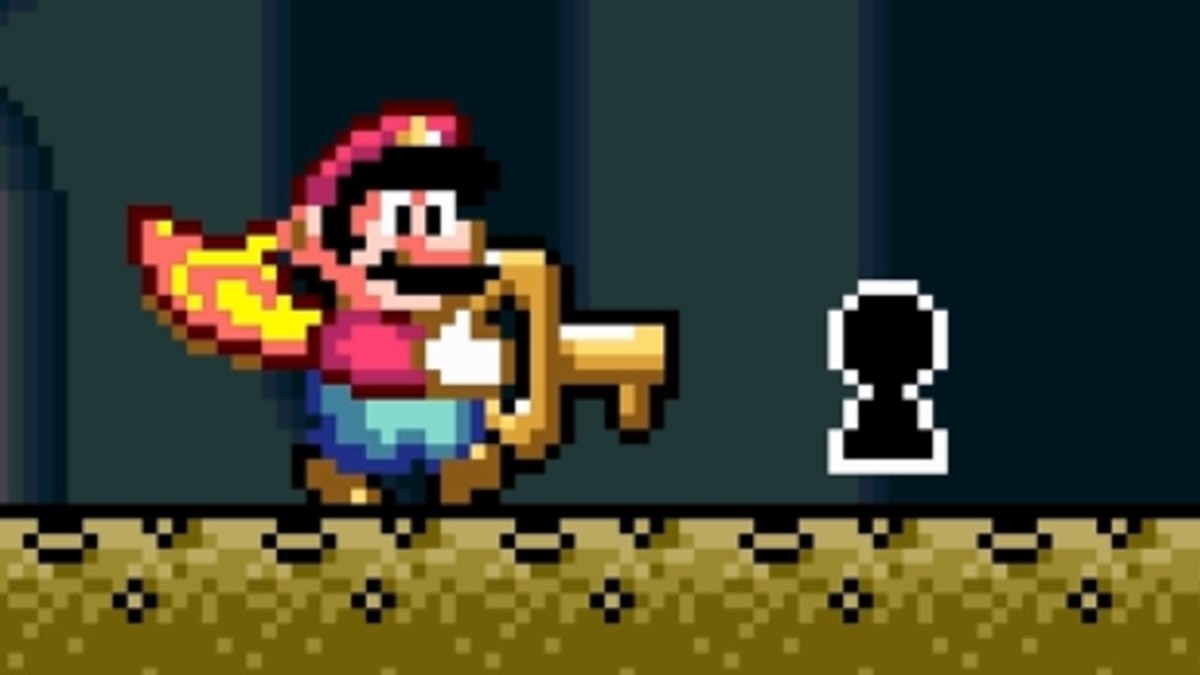
You have just encountered, what I like to call the Door Key Mechanic. It’s a game feature masquerading as a fancy new play mechanic, but it’s not really. When you zoom out, and take a high-level top-down look at what all these mechanics actually do in the context of the play space… they just open doors. Maybe they pull specialized switches that then open doors. Maybe they disable electric fences so you can get to the doors behind them. Maybe they transport you to doors you couldn’t get to before in a predefined way, but that’s it. Above all it is interactivity that makes game mechanics compelling to me, and these are interactive in the most rudimentary way possible – do the thing, and a door opens.

There’s nothing inherently wrong with having features in your game that specifically exist to remove some gate to the player’s progress. These sorts of items are all over the place. I mean, literal keys, for one. It’s an important purpose to fill. The presence of an inaccessible door is inherently tantalizing to the player, and finding an appropriate key gives a sense of puzzle-solving or excitement. The trouble comes in when it’s something a lot more complicated than a key or a special inventory item pretending to be more important than it is. Need some examples? Let’s do some examples.

I think the most egregious example I can think of is the last game produced by Sonic The Hedgehog creator and indicted insider trader Yuji Naka, Balan Wonderworld. It’s a great instance of what I’m talking about, because it also highlights the crux of the problem. You see, this game had several marketing angles, such as Naka’s involvement, the visual and stylistic echoes of cult classic games like NiGHTS Into Dreams, and most relevantly here, the fact that the game would feature EIGHTY different costumes! Each with unique abilities! Or in other words, game mechanics. Ignoring that several of the costumes are just variations or upgrades of others, we have to interrogate how meaningful and interactive these costume mechanics actually are.
A child in a pig costume runs over to a silver piston in a grassy field and slams the ground with its bottom, forcing one piston down and causing a different piston to shoot up. The child jumps onto it and grabs a gem.

Well, we have a ground slam for a start, the Pounding Pig, which doesn’t do anything except hammer posts and break blocks – basically just opening specific doors. There are jellyfish and dolphin costumes, which do little else but allow access to water terrain that otherwise gates you. There’s a spider costume that allows you to climb webs, which are also just simple obstacles – doors in other words. The Itsy-Bitsy Elf costume “Allows the wearer to pass through tiny doors” and nothing else. Lickshot Lizard sounds like a grappling hook, but it only works on stationary targets that are trivial to target – it’s just opening a door with extra steps. Happy Horn activates an event when stepping onto a pre-placed stage. Functionally the same as a key item. Gear King allows you to use specific gear switches, to open doors. Hothead lets you light torches to open doors.
A child in a rock star costume runs over to a stage in a grass field and plays a short concert to some monsters, and they turn into gems.

Riveting Stuff.

Important to note that ‘door’ here proverbially means any simple gate preventing player progress, but a gate of minimal player interactions. Flipping a switch causing a bridge to appear. Destroying a block to reveal a staircase. That’s all the same as opening a door. Like, there’s Balan‘s Laser Launcher costume…

“A robot costume that shoots a laser from its chest. Use the laser to break blocks and flip switches.” -Official Website Description

I can use the robot to open doors, OR open doors you say!? Okay granted, a lot of these very simplistic costumes in Balan can also be used for combat, but that is such a bare minimum. Doorkey Mechanics make one wonder ‘why is this even here?’ Like, why do you need a spider costume to climb webs? Most game characters can just do that, like on their own.
A small armored alien, Ratchet from Ratchet and Clank, traverses a small gap in a broken bridge amidst a futuristic sci fi metropolis. He does so using an energy tether thrown into a rift portal.

“Does it do anything?”

“It allows you traverse this door bridging a very small gap.”

“Yeah but does it do anything??”

It’s easy to criticize Balan. Door Key mechanics pop up in some of my favorite games too, though.

I adore A Hat In Time. It’s a delightful, fully-featured, cute, and compelling indie game in the style of classic 3D platform games. It feels great to control, it’s pretty to look at, and it’s just an overall fun time. We need more games like A Hat In Time. That said, of the six hats available in the game, which each provide unique abilities, I couldn’t help but wish the Ice Hat and Brewing Hat were more generally useful. The sprint hat makes you dash at breakneck pace, allowing you to bound over great distances – it’s super fun and super useful. The Kid’s Hat helpfully guides you where to go if you ever lose your way. The Time Stop Hat does what it says. However, the Ice and Brewing Hats flip switches and break barriers, respectively, only in hyper-specific scenarios. They can technically be used in combat, but I never once felt it was prudent to do so next to just, say, smacking enemies with my umbrella.

The Door Key Mechanic is a sliding scale, too. Game mechanics can be more or less door key-like. Hi-Fi Rush, a game I should really talk more about sometime, has mechanics that are Door Key-adjacent in the form of your party’s assist moves. Macaron’s punch assist breaks down hyper-specific walls and Peppermint’s gun assist shoots switches, but they can both be used in combat. The difference between Hi-Fi and say Balan, is that Hi-Fi Rush has very robust combat mechanics where that addition is not a footnote. Assists can be woven into combos and used in a variety of ways, defensively or offensively, to uniquely color each player’s experience. That’s interactivity, and that’s what makes a Door Key Mechanic less noticeable. The Legend of Zelda series has been occasionally guilty of making legacy items more door keyish. For instance, take the hookshot / claw shot item.

When first introduced in A Link To The Past, the hookshot was a metal spike on a spring loaded chain that could latch onto blocks, chests, rocks, and pots to pull Link rapidly to the target location. Not only that, but it can grab distant items and pull them to link, hit switches, stun some enemies, and outright defeat others. It’s used for unlocking doors, sure, but also for combat and traversal in interesting ways. Its uses are fairly prescribed, but not so much that it doesn’t feel generally useful.

In the sequel, Ocarina of Time, the hookshot was brought into 3D and it became even more generally useful. It still activates switches, pulls in items, stuns some enemies at a distance, and defeats others, but now in three dimensions. In addition, the list of things it can latch onto has been expanded to include most wooden or soft surfaces, like climbing vines, tree branches, rooftops, and rafters. The hookshot doesn’t just latch onto specific predefined targets, it also lets you grapple to anything it can stick into around the world! And there’s a logic and consistency to this general use that makes it feel like an organic part of that world. That kind of flavoring and context can also help alleviate the sense of artificiality that Door Key Mechanics invoke.

Later Zelda games would not be so magnanimous with the use of their hookshot analogues. The hookshot in The Wind Waker feels noticeably more limited, with fewer viable targets. Where in Ocarina of Time there were a lot more organic environmental targets to hit, Wind Waker and Twilight Princess lean somewhat heavily into literal bullseye targets, and floating targets, obviously specifically placed for Link’s benefit. The difference is stark in Skyward Sword, where the clawshot is used for little else other than clearing gaps to reach brightly colored, artificial bullseyes that exist in the world without context. The interactivity of the clawshot in Skyward Sword is severely limited.

My point is not that the more limited hookshots make these games bad – but rather that it makes specifically the hookshot item in those games a lot less compelling. Compare it to the Shieka Slate spells in Breath of The Wild, which can be employed almost anywhere, and used for almost anything – crossing gaps, attacking, blocking projectiles, climbing cliffs, retrieving items, escaping… flying, if you use them just right. That’s interactivity.

Here’s another Zelda example. In Majora’s Mask for the N64, the ice arrows allow you to shoot projectiles encased in freezing magic. Shooting the arrow at any body of water. *Any* body of water, an icy platform is produced, that Link can walk on. I’m sure you can already imagine the applications of that. This is in addition to the arrows being useful for stopping waterfalls, freezing enemies to use as platforms, or freezing them just to more easily defeat them.
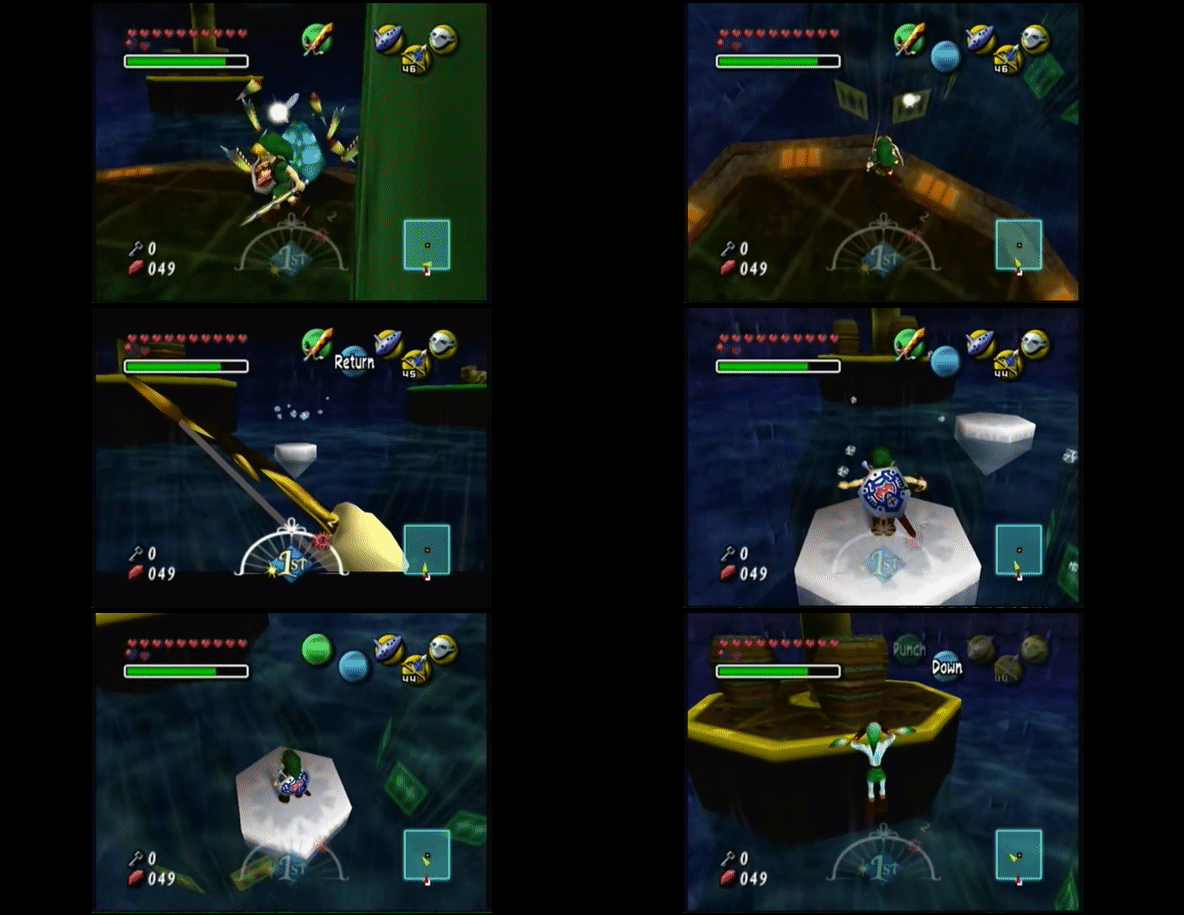
In a dark interior pipeworks chamber flooded with water, Link from The Legend of Zelda Majora's Mask. Link shoots two magic ice arrows into the water, creating two ice platforms, which he hops across.

In the remake, the developers opted to instead restrict how these arrows can be used. There are shiny blue sparkles on the surfaces of water where the ice arrows were intended to be used. Shooting them there creates the usual ice platforms, however… they also opted to prevent the platforms from ever being created elsewhere, severely limiting the interactivity of this item, and risking the player engagement. Originally, the ice arrows were a tool – a new avenue of possibilities that gets the player thinking and invested in what they’re doing. The latter version makes them a prescribed door key to access only a very specific planned path, with no engagement required on the player’s part. I find game mechanics most exciting when they expand possibilities, not limit them.
In an interior pipeworks chamber flooded with water, there are some conspicuous sparkles on the water. Link from The Legend of Zelda Majora's Mask, shoots magic ice arrows at each sparkle, although misses his target once, and the ice arrow fizzles on the water.

Heaven forbid anybody be required to do some lateral thinking while playing a video game.

When developing a new mechanic or feature for your game that might be a significant undertaking, ask yourself some questions; does this feature open up interesting interactions or decisions? Does it expand the play space? What are its use cases? How does the player interact with it? What does it accomplish? If the conclusion is that the feature accomplishes a similar level of interaction to simply unlocking a door with a key – if its use is no greater than removing a proverbial gate to the player’s progress, consider whether the feature is even worth developing, especially early on. Some of these features, such as the Balan Wonderworld costumes offer very little interactivity or engagement, but would have cost a huge amount of development resources for character models, bespoke animations, sound effects, and program implementation. The decision to add a feature is not one that should be done without forethought. Think about what each of your new features actually adds to the experience.
Link from The Legend of Zelda Ocarina of Time runs up to an ornate golden chest in a dank dungeon. Light pours forth from it, and slowly, dramatically, Link holds aloft a golden key inset with a red skull jewel.

A key opens doors…
Splatoon’s Salmon Run: Fine-Tuned Machine of Industry

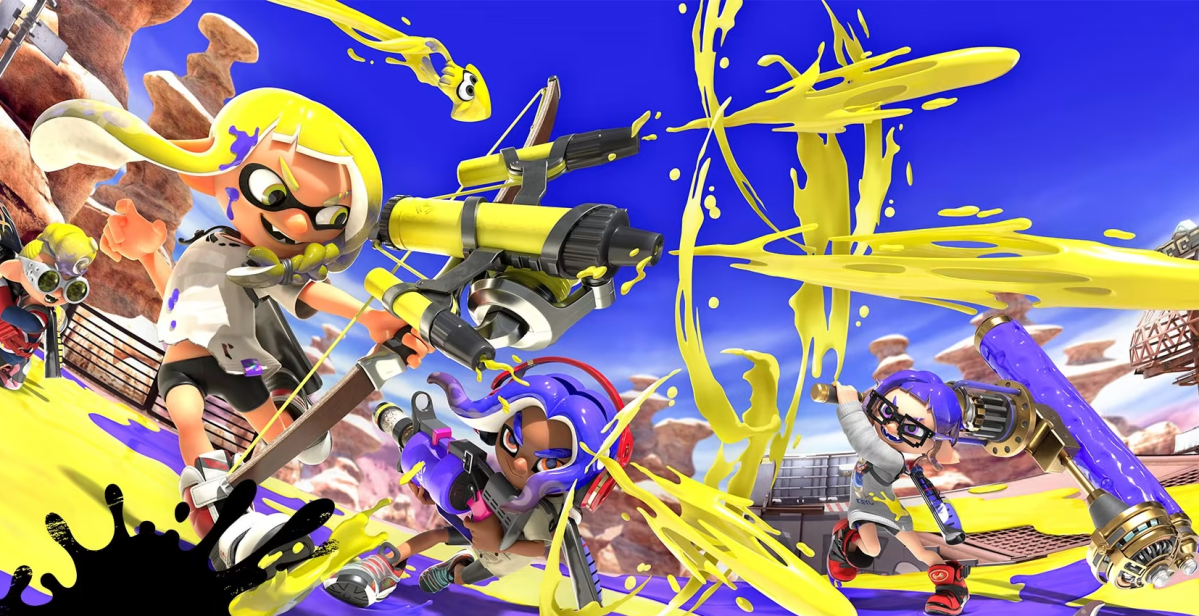
Got Splatoon on the brain, so that’s what I’m gonna talk about today. The game’s preeminent horde mode, added in Splatoon 2, and expanded in Splatoon 3, to be specific, Salmon Run. So essentially I adore Salmon Run, it’s some of the most fun I’ve had with a horde mode in a game, that is, a mode in which waves of enemies hound a team of players in hordes, as the players are tasked with holding them off. In Salmon Run, four plucky young squidkids and octoteens are on the clock to collect golden salmon eggs for their employer. Each run is divided into three waves of increasing difficulty, which can take a number of different forms at random. During each wave, hordes of minor salmonids of a small, medium, and large variety will hound the players, and occasionally larger ‘boss salmonids’ will appear. They are more dangerous and harder to take down, but each drop a number of golden salmon eggs, which then must be carried, one at a time per player, back to a centrally located basket to meet each wave’s quota of golden eggs. Fulfill that goal, and you progress to the next wave. I’m going to go over my perspective on the various elements that make Salmon Run work so damn well. It starts with the maps the game mode takes place on.

A Space Where Moments Happen

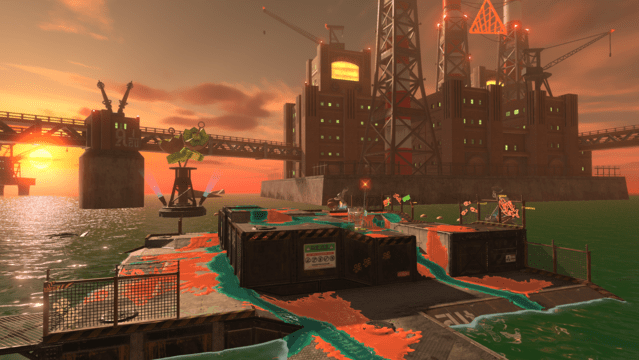
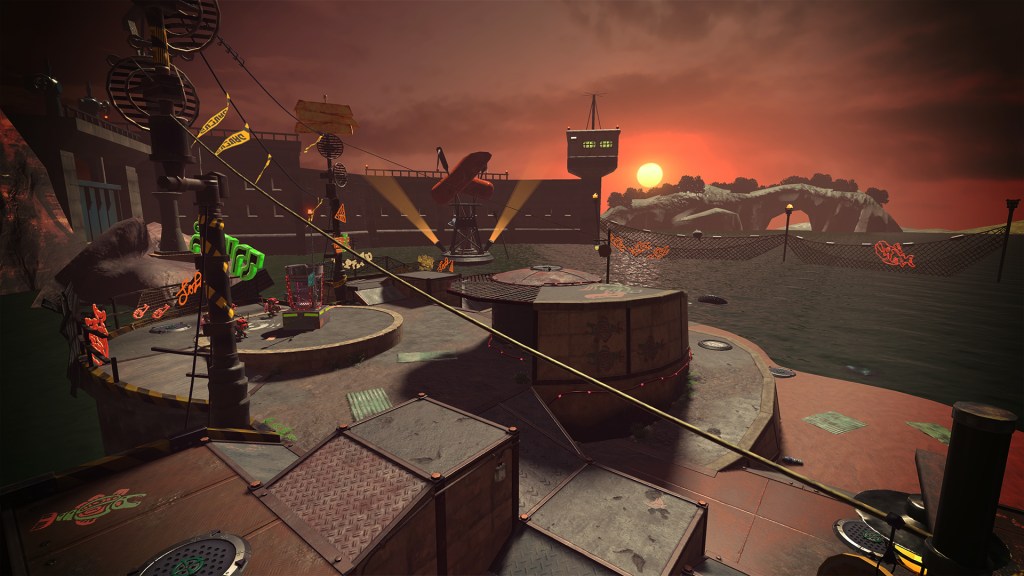
Salmon Run maps seem pretty simple on the surface. Smaller than Splatoon‘s versus maps, and usually approximately circle or square shaped. They all hold a few interesting features in common, though. For one, they all feature a large amount of elevation variation. This is important, as most salmonid cannot directly climb walls like players can, and thus will have to path around and through the level’s various ground passages. That’s important too, those passages. The heavily varied elevations create a lot of corridors and enclosed spaces. These enclosed spaces can lead to players getting trapped with enemies, in dangerous situations. That’s the point, Salmon Run maps tend to be less open to facilitate this up-close encounters, to really engage the players with how their enemies move and operate. Strategy becomes essential to keep yourself from being cornered. All this creates exciting ‘Moments’ of high action, that keep Salmon Run interesting.

Speaking of being cornered. Ever notice how all the Salmon Run maps are similarly shaped? Specifically I mean, if we are to assume they are basically the shape of a square, then three of their ‘sides’ are always exposed to the water, where salmonid always spawn from. The fourth side, is not.

This will cause salmonid, again always approaching from the beachheads, to surround players as they navigate, but never directly from behind, as that would feel unfair. So the minor salmonids; tiny small fry, player-sized chums, and larger imposing cohawks, all walk toward players at a moderate speed, usually in lines and clumps, then try to melee attack. The damage dealt by each, and the damage each can incur before being dispatched is proportional to their size. It might be one’s inclination to largely ignore the unruly masses and focus solely on bosses, but this would be a mistake, especially as that aforementioned difficulty scale begins to skyrocket. There is one wall for players to back up against in the face of the coming forces, but they also must keep an eye out for flankers, constantly. peripheral attention becomes essential. Reacting for flanks is another of these exciting ‘Moments’. Waves of high danger follow waves of control, forming Salmon Run’s interest curve.

Game is Hard

So one thing that a cooperative experience like Salmon Run needs is longevity – something for players to latch onto so they keep coming back. One way Salmon Run achieves this is through an adaptive difficulty system. Based on how frequently a player is winning at Salmon Run, an invisible difficulty scale will begin to go up for them. Higher difficulty scales mean more frequent salmon spawns, and higher egg quotas. The higher scales demand more and more efficiency of the players.

So, cleverly, Salmon Run starts out very forgiving, allowing players of any skill level to begin to succeed and claim their rewards for the game mode. What I find commendable is how unrestrained the upper echelons of this scale is. A lot of the fun of horde mode comes from the horde- tons and tons of enemies coming at you all at once. Through grit and determination, you can overcome.

An octopus girl is surrounded by fireflies as she picks up a golden egg with a net. She swims through blue ink to escape a frenzied mosh pit of enraged salmon, who flail at her with frying pans. She swims frantically away.
More like Salmon RUUUUUUUUUUN

Salmon Run also includes a lot of wrinkles and surprises, such as the special event waves, where the rules of the game are tweaked slightly. For example, high tide might shrink the play area, making the next round very claustrophobic. What is all this for, then? Well, like the level design which emphasizes situation awareness, every aspect of Salmon Run from its maps, to its enemies and bosses reinforces specific fundamental skills in the Splatoon player’s toolkit. Players are randomly assigned weapons they are forced to use, reinforcing general adaptability and understanding of the game’s mechanics. The maps are laid out to reinforce situational awareness and navigation skills. Specific bosses reinforce specific weapon-handing skills. As the game’s difficulty ramps up, so does the speed of the game, and the skills needed for mastery are further and more rapidly drilled into the player.

Entity Cramming

“Entity Cramming” is a term originating from Minecraft, a game which allows a very large number of entities like players, enemies, and animals to coexist in a very small space. Salmon Runs can get very cramped, very fast. Especially at higher difficulties with very high spawn rates, or during high tide, at which the viable play space shrinks. There is a need to combat the problem of overpopulation in a small space, to keep the game running smoothly and feeling fair. A lot of salmonid bosses possess some way to impede player movements or player attacks, or both. Even beyond that, with too many enemies present, it would become unfeasible for four meager squids to fight back, which would create an overwhelming and unfair disadvantage for the minor mistake of acting just a little too slow or inefficiently. There’s also the random chance that bosses might occupy the same relative space.

To combat this, salmonid bosses represent an inherent risk-reward factor. With many of them bunched up, there is great risk to approach them, but many slamonid bosses represent an opportunity to clear wide swathes of salmon all at once. There are bomb salmonid, for example, which explode and deal damage to their allies when defeated. When enemies are bunched up, players with wide-reaching area-affecting weapons can take out multiple of them at once. All bosses explode into friendly ink, which is toxic to some salmonid. The new Slammin’ Lid boss, added in Splatoon 3, will utterly crush any salmonid beneath it, bosses included, if it is goaded to use its slam attack.

An octopus-girl in a slopsuit approaches a green UFO piloted by a fish. The UFO hangs over two giant fish with bombs strapped to their heads. The UFO flashes, them falls directly onto the giant fish like a rapid hydraulic press, crushing them utterly into an explosion of orange ink.
Good Cod that is satisfying

So with this built-in risk-reward for salmonid bosses, it’s never too daunting when they team up. With a clever and careful approach, bosses can be used as weapons to take out other bosses! So while difficulty scaling leads to huge hordes of enemies, it also creates this rubber-banding effect where huge hordes of enemies can actual mean an increase in overall efficiency, where you’re dispatching two or three bosses at once, along with their smaller minions, rather than just one. At high levels of play, golden egg collection can skyrocket to huge profits.

Teamwork Teamwork Teamwork!

The real key to excelling at Salmon Run is efficiency, and efficiency is teamwork. It is virtually impossible to accomplish some of this game mode’s higher-end challenges without utter mastery and knowledge of your role on the team. The randomly assigned weapons ensure each player accels and struggles with some specific task. Long ranged precision weapons can take out unshield bosses from a distance with ease. Heavier wide-area weapons can dispatch crowds of small salmonid *much* faster that snipers can. Some weapons can defeat salmon from safety whereas others have to get up close and personal.

Later on efficiency becomes to important, that if you are ever swimming around with a full tank of ink ammunition, you are kind of a liability. My advice to ace Salmon Run? Always be doing something, whether its clearing small enemies or ferrying eggs. Rescue teammates as quickly as possible – four sets of hands outperform two or three. Everyone has a role to fill, even if that role is just moving eggs around, because you’re weapon is ill-suited to the current event wave. In Splatoon 3, a new event wave called the Tornado was implemented to highlight this. Large quantities of eggs spawn far away from the basket, so the four players must form an assembly line of sorts to taxi them across enemy territory. Kind of reflects the rough work environments that the game uses as its horde mode backdrop, huh? In fact, there’s a lot of parallels to game development in general..

An octopus girl in a slopsuit swims back and forth across blue ink, each time grabbing a golden salmon egg in a net, and hurling it up a ledge to a friendly squid kid, to whom it is handed off.
Pictured: The Production Pipeline

The Main Event: The Bosses

The bosses in Salmon Run are fun, inventive, visually creative, goofy, funny, and irresistibly compelling. They all fill specialized niches in the gameplay, and each reinforce a skill for the player. They all have specific rules for how best to deal with them. There’s a lot, so I’m going to rapid-fire-style review them in a series of mini boss breakdowns and see how they fit into this scheme, with a little more detail given on the new bosses added to Splatoon 3‘s Salmon Run.

Steelheads are giant salmon with bombs in their heads. They arm the bombs for a moment, then throw them as a player approaches. They teach precision aiming, as their weak point bobs about while it’s vulnerable. They also reinforce reactiveness to bombs and ground hazards – a common danger in Splatoon.

Steel Eels demand the skill of tracking moving targets, their weak point constantly on the move, and occasionally blocked by their own shield-like bodies. Terrain navigation is crucial here too, as getting sandwiched by one against another enemy or wall means death.

Scrappers, or Jalopies, as I like to call them, teach the skill of flanking. They always turn to face attacking players, and they are shielded from the front. Using teamwork, one player can distract or stun from the front as they other takes them out. This is one of the ‘kiteable’ bosses, which can be lured by the player to be very close to the basket when they die, leaving eggs right there. Retrieving golden eggs past salmonid enemy lines

Stingers are of a class of salmonid bosses I call ‘globals’, as they can damage players from anywhere on the map. Stingers use a long-range beam unimpeded by terrain. Stingers teach players a hierarchy of needs for the game. It’s near-impossible to kill every enemy as they spawn. Just reaching your egg quota and surviving is paramount. You have to triage your attention to what’s most important. Stingers are important. You’re excelling when you put out fires before they happen, and addressing Stingers quickly is a good example.

Maws can also be kited to the basket for easy eggs. They teach how to swim away while placing a bomb, which generally kills them. A surprisingly practical skill, as bombs cost a lot of ink, but swimming replenishes it. Efficient!

Drizzlers are a global salmon which create damaging rain that also ruins friendly turf. They teach lining up shots, and maintaining relative positions between player and enemy, as they are most easily dispatched by deflecting their projectile back at them. Lining this up is strict, to aim well!

Flyfish. Ooooh Flyfish. Perhaps most infamous of all salmonid. They are hovering mobile missile vehicles which periodically fire squid-seeking missiles at players who must be moving to avoid them. This is global. They are easily one of the most dangerous bosses to keep alive, so a great marker of Salmon Run mastery has become one’s ability to safely and efficiently take them out. Taking them out quick is a true marker of friendship between allies. They teach precision use of the grenade sub-weapon, as you must land a grenade in its open missile launchers after it fires. Twice. Once for each launcher. It also teaches patience, and the truth of your own mortality.

An octopus girl in a slopsuit swims through green ink to throw a grenade into the open missile launcher of a hovercraft being piloted by a salmon, just as its second missile launcher as been destroyed in a similar way by a friendly squid kid nearby.
Any man who can one-cycle a flyfish with me, I would trust with the life of my child.

The Slammin’ Lids (god I love that name) are one of two new Salmonid that seem to be purposed to teach one of the two new movement options in Splatoon 3. The lids are easiest to kill by baiting out their slam attack, then mounting them while they’re on the ground, to kill the pilot. The easiest way to do that, is by using the new Squid Roll, which allows rapid turning while swimming through ink. They are also one of the best example of the entity cramming solutions in Salmon Run, as I’d shown earlier. Their main threat is the impenetrable shield they produce beneath themselves, which can obscure lines of fire while they pump out small salmonid to shore up the enemy forces. They aren’t high-priority targets, but can become dangerous if they take up advantageous positions.

The Fish Stick is a toward carries by a rotating contingent of salmon. The stick is easily dispatched using the new Squid Surge, which allows one to rapidly ascend a vertical surface. The Fish Stick fills a new niche in the game mode, which is the use of the player’s wall-scaling abilities, and introduces an enemy that is itself terrain that can be inked. What’s really interesting is that the Fish Stick’s terrain remains in play even after it’s defeated and its eggs are retrieved, opening new strategic options for players. This can be a double edges stick though, as while the extreme vantage is usually safe, some salmon like the maws or dreaded fly fish can use its small surface area to trap players.

The Flip Flapper is a salmon dressed like a dolphin which drops rings of enemy ink where it is about to dive. Filling in this ink with friendly colors before it lands, stuns it and renders it vulnerable. I love this thing because it teaches the teamwork of efficient ink coverage. Nothing worse than teammates who waste time inking something you’ve already inked. Working together, these dolphin wannabes are no challenge, but they also serve Entity Cramming well, as they are very weak to the splatter from other enemies nearby being killed.

Big Shots are tough guys with lots of health that stay on the sidelines. I think what these guys are meant to teach is how the AI operates and reacts to player movement. You see, the Big Shot is a global who uses a machine at the beach to launch wave-generating projectiles toward the basket. Very inconvenient. What is, convenient, though is that the player can use the same device to launch golden eggs toward the basket. Toward, not in, mind you. Another player still has to be there to cash the eggs. If they don’t, salmonid will come in and snatch them up, making the players’ efforts a waste of time. What’s more, is that spending too much time on the beach, which I might remind you is where salmonid come from, can mean quickly becoming overrun by enemies, and trapping you in a place which is very dangerous and inconvenient to reach. Teaches teamwork and restraint.

And octopus girl holding a bathtub uses it to throw green bubbles at a giant salmon on the beach below who is fiddling with a wood-chipper like machine, and is then exploded into green ink. An allied squidkid below loads a golden egg into the machine, which is then launched across the field of view.
Couldn’t have gotten better footage of that egg being thrown by the Big Shot if I’d planned it

There are a few more event-specific bosses, but that was a lot, I think, so we’ll leave it at that.

EMERGENCY!

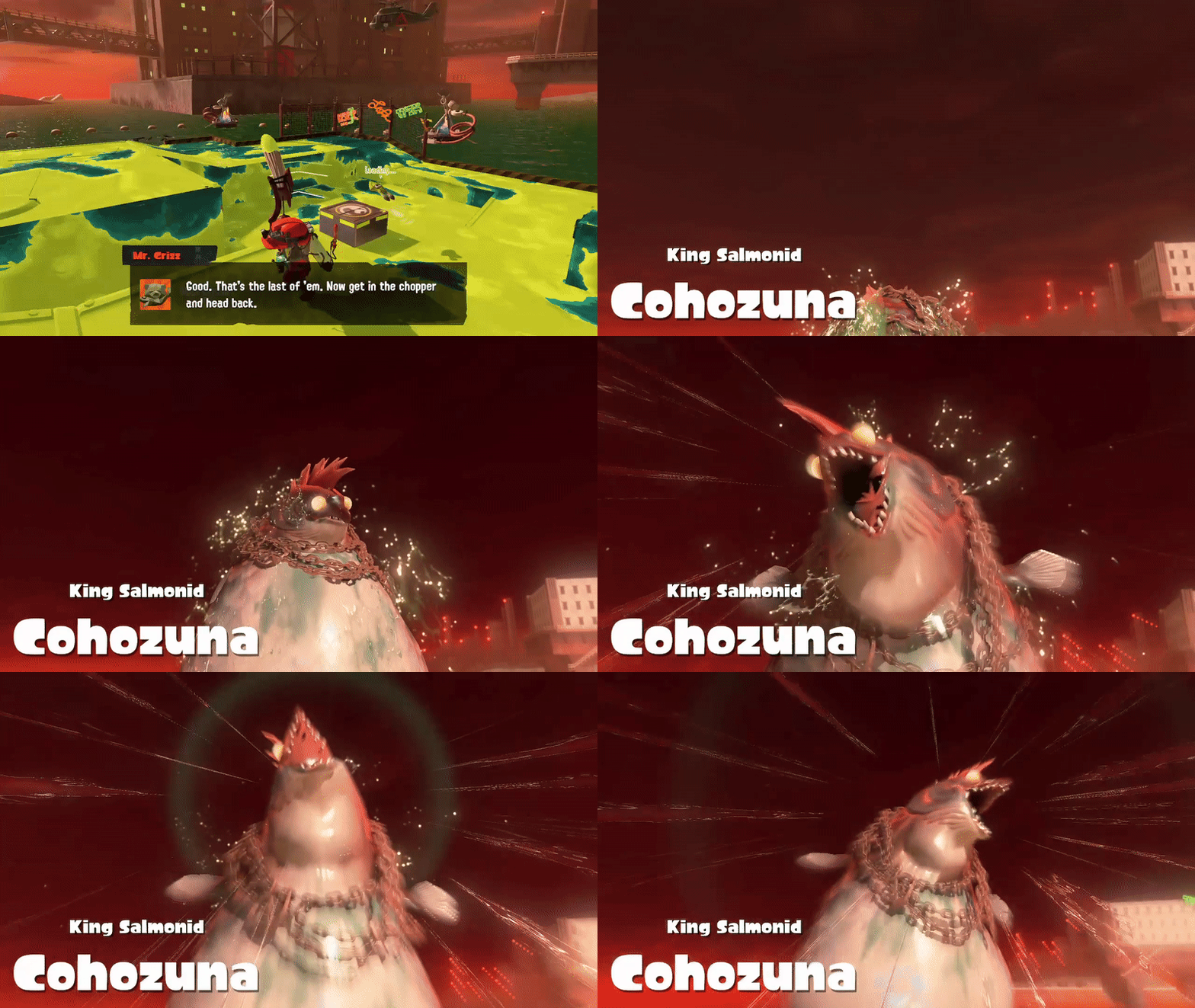
Octo-girls and squidkids are celebrating, only.. "EMERGENCY!" appears in orange text. Suddenly, a GIANT, like 30-60 foot tall salmon appears, and roars like godzilla. "King Salmond Cohozuna" appears in white text.

JUST KIDDING! They couldn’t have a sequel without upping the ante a little, right. At (slight) random, after winning a few Salmon Runs, the new King Salmonid Cohozuna will appear. You have a mere 100 seconds to send him back to the briny deep in order to secure the special fish scale rewards he provides. Really, there isn’t much to him or his AI beyond standing as a suitable final challenge to really test the player’s mastery over all these bosses and systems. His implementation is pretty clever, though.

He has a LOT of health, so normal weapons will simply not do enough damage to vanquish him on their own, not in the time allotted. To beat him, you’ll have to leverage golden eggs, which can, in this bonus boss round, be thrown with zero ammunition cost. They deal massive damage to him, and the only way to get them remains the same: defeat the boss salmonid that accompany him. You’ve only got 100 seconds, your team, one special weapon, and the ink your back, so I hope you’ve been practicing your aim and reaction time.

He seems to prefer to follow the last player who damaged him, so he can be tanked somewhat. He’s not that dangerous on his own. He’s slow, and only has two real attacks. One where he belly flops right in front of him – so keep somewhat at a distance. His other is a jump, which does heavy damage where he lands. Be ready to move. Other than that, it’s his health and his bulk that is the challenge. The team needs to work together to get enough eggs to bring him down, while positioning him such that he is not a threat to the team, and such that he is not covering vital resources with his body. It’s a stiff challenge, but if you really push your self and put a full understanding of all the little things Salmon Run has been teaching you, it’s very doable. A suitable finale to any work day.

A giant 30-foot-tall salmon flops toward an octopus girl wielding a an automatic ink-gun. He is being pelted from the sides by golden projectiles. He turns around, then bursts into green ink in a fantastic explosion. A squidkid declares "Booyah!" as the four cephalopod teammates, now friends, celebrate.
That’s teamwork!

The Cohonclusion

Where. That felt like a gauntlet. We all get through okay? Yeah so I love Salmon Run, to reiterate. It’s got so many little clever design considerations to acutely tune the experience and promote active thinking while playing. Sure, it’s great fun to goof around in with friends, but even at a casual level, enough exposure to the game mode will gradually train certain behaviors that make you better at it. I think that’s a sign of some absolutely excellent game design, that deep consideration of incentives and how minor tweaks to Splatoon‘s gameplay setup will reinforce certain behaviors. Salmon Run is also just where some of Splatoon‘s considerable creativity comes to the fore. I mean “Slammin’ Lid”? An eel made of shower heads that forms an impenetrable wall of showering ink? A mothership that is a warehouse container full of smaller crates that deploy salmon? Come on. This stuff is gold.

An octopus girl swims across orange and green into into a torrent of orange produced by  allied weapons. She is showered with golden eggs as salmon burst around her. She grabs one and throws it into a large basket.

DO YOUR JOB!

The Ink Must Flow: How Splatoon Gets You In a Rhythm

Splatoon is my favorite multiplayer shooter series right now. There’s a lot of reasons for that, from the inimitable youthful aesthetic, to the novelty of its premise, to the breadth of self-expression available to players. I think what most draws me back to this game again and again is just how effortlessly it induces the Flow State. The Flow State is a psychological concept that you may have come across by many names in different fields. It is being fully immersed and cognitively absorbed with a task. It is being ‘in the zone’, so to speak. It is associated with a certain energy, a joy, in the act of doing. As applied to games, it’s what happens when you become so involved in with the game, so in sync with its rules and systems that you feel time slip away, when effort becomes so natural it feels like no effort at all. It’s the kind of thing I make games for, as opposed to any other medium, and Splatoon pulls it off beautifully in the way its most basic gameplay is structured.

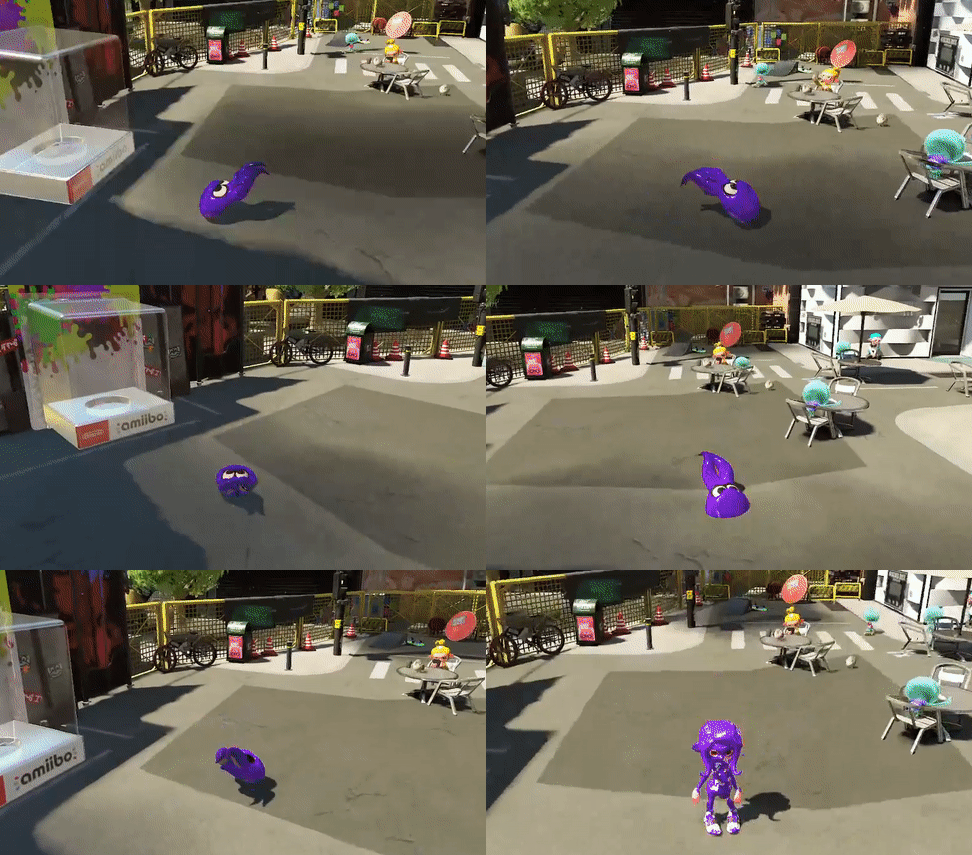
In a peaceful urban sidewalk patio, a purple octopus repeatedly bounces around in a circle on the pavement, before transforming into the purple silhouette of a young girl.
This is how I express myself

You’re a Kid Now You’re a Squid Now

Like many great games Splatoon is a system built on mobility and positioning. However, its breakout idea is that the players have agency not only in how they move, but in what areas of the game space are available to them to move. Most shooters’ main actions are move and shoot. Splatoon adds move, shoot, and claim turf. Your team claims turf on any playable surface they shoot with their ink-based weaponry. At any time, players may shift from their ‘kid’ form, in which they can shoot to claim turf or defeat opponents (‘splat’ them) to their ‘squid’ or ‘swim’ form. In the swim form, shooting is not available as an action, but mobility options are greatly expanded. While swimming, a player is significantly faster on the ground, while also gaining the ability to scale sheer walls that have been claimed by allied ink.

Splatoon has a created an inherent meaningful decisions layered on top of the typical scenario in a competitive shooter. Like in other games, players have the option to take cover, spray suppressive fire, focus down single targets, and the rest, but they also have the omnipresent option to forego offense entirely for the swim form, making them more mobile, and harder to see. The last essential wrinkle is that ammo (ink) is limited, the player can only load so much at one time. To reload, the player needs to swim through allied ink that has already been laid down. This also quickly heals any damage you’ve taken, acting as a catch-all resource renewal action.

Your two modes now create a feedback loop. Shooting can accomplish two things. One: splatting players which gives you and your teammates safe space to advance the game’s main objective, which is usually to claim turf. And two: claiming turf, which is the metric by which the winning team is judged, but also provides a tactical advantage in allied ink’s utility to evasive maneuvers, ambushes, and advantageous positioning. The more angles you have on your opponent, the more limited their options as opposed to yours. Swimming accomplishes two things as well. One: The increased swim speed, decreased visibility, and healing of the swim form makes a swimming player a much less vulnerable target than a shooting one. Two: A swimming player is restoring ammunition, which must be done to continue shooting.

A girl with octopus arms for hair in a white T-shirt runs across a shipping dock, drenching the ground with purple ink from a giant paintbrush she carries as she goes. Every few seconds, an ink tank on her back becomes visibly emptied, and she turns into a small octopus that sinks beneath the ink on the ground. When she emerges, the ink tank is full. She continues this pattern rhythmically.
It’s rhythmic, comfortable, almost, therapeutic. Yeah! Ink that turf!

Here Splatoon has through incentives solidified its gameplay loop to where shooting gives you more space for swimming, and swimming enables you to continue shooting. After getting used to the unconventional systems, it quickly becomes intuitive how they relate to each other, and thus players will naturally begin to fall into a pattern, which typically looks like this:

Lay down plentiful amounts of ink to claim turf, including a path to your next desired, probably tactically chosen, location. Then, swim to that location to reload your ink. Engage the enemy team either though frontal assault or ambush tactics, utilizing your own turf for advantage. Whether the enemy is splatted, or you or pushed back, you’ll relocated using your own turf, renewing your resources at the same time, and repeat. Ink and swim, ink and swim.

The Simple Pleasure of Splatter

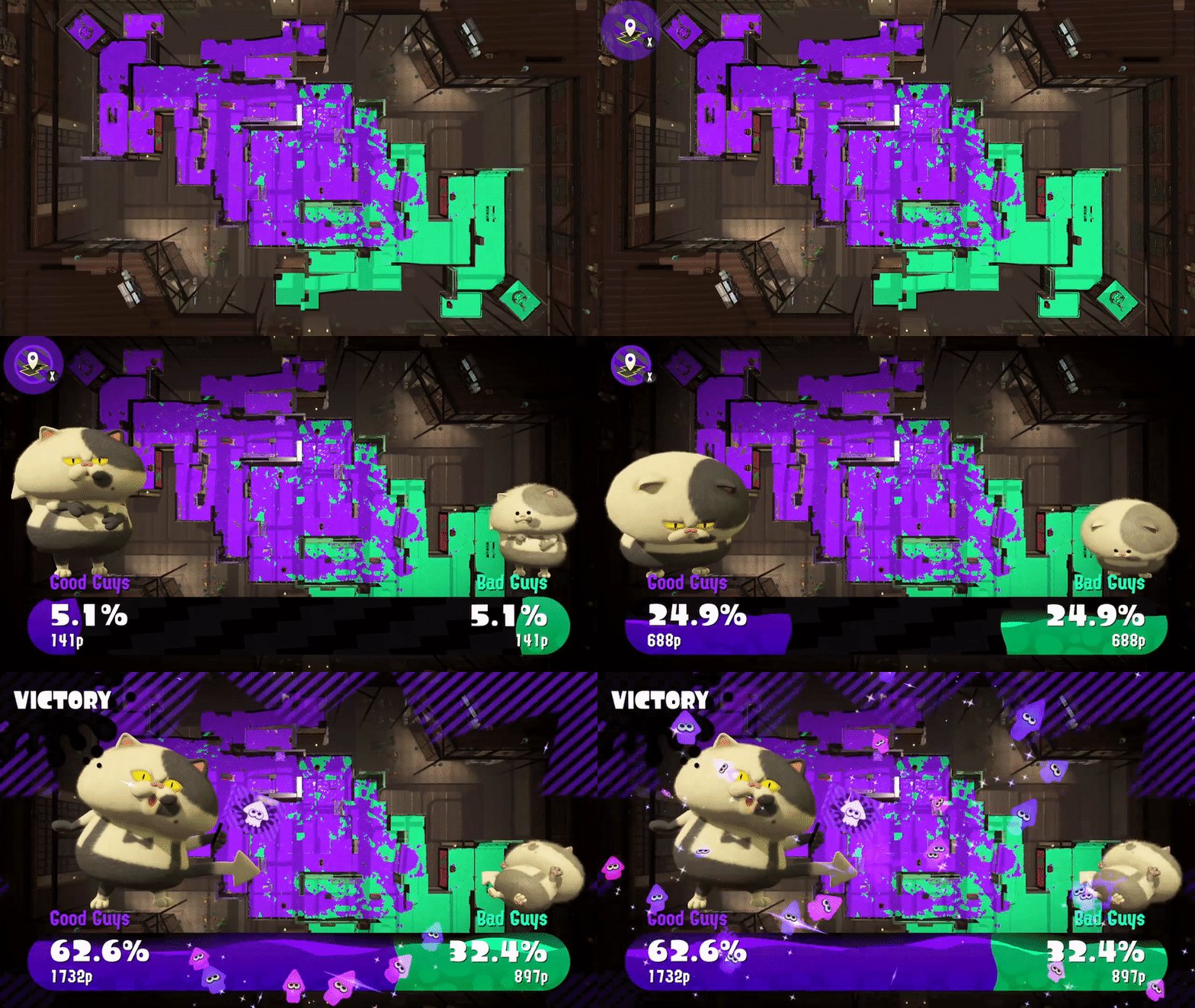
Splatoon is a crunchy, colorful, game with lush audio-visual feedback. A lot of care was clearly taken to making the act of laying down ink very satisfying. There’s a simple joy in seeing color overtake the environment, permanent marks of your activity. The wild shapes and pathways carved across the terrain, as seen from above in the final score tally screen of each match, leaves evidence of every assault, flank, retreat, and regroup each team took part in.

A bird's eye view of a symmetrical office complex. The upper left section and most of the center is covered in bright purple ink. The lower right is covered in neon green. The two ink colors meet at an uneven border, indicative of splashes, splats, and drips, the purple intruding on the green and vice versa. Two cats appear on either side of a meter indicating the ratio of purple to green. The cats dance and determine that the purple is more abundant than green, as the meter reflects this. The word "Victory" appears.
Sometimes these end screens can look pretty wild, a cathartic sendoff to an intense match.

It is intrinsically motivating to want to just cover stuff in pretty colors. With that desire in place, and the necessity of the swim form for continuing to do that, players are naturally encouraged to tactically engage with the game, and consider their surroundings. No matter what, when you run out of ink, you have to swim for a bit to restore it, so players are given a mandatory bit of space and pause in the action to acknowledge their context. Splatoon trains players to always be considering their next move. You know you have to restore ink, so you know you have to relocate eventually as some ground is ceded to your opponents.

This space to consider is a permanent and mandatory part of the game loop, but is also fun in and of itself. Movement in Splatoon while in kid form isn’t horribly slow, not nearly slow enough to be frustrating, but it is pointedly slower than swimming. The contrast makes swimming through ink exhilarating and liberating. It also makes one feel powerful compared to those not swimming at that exact moment, as a swimming squid has the advantage of wall-scaling and stealth through their reduced visibility. At any moment you can jump out to ambushed an unsuspecting opponent. So while Splatoon is essentially forcing an idealized interested curve through the interplay of its mechanics (moments of high intensity shooting to moments of less intense swimming, reloading, and repositioning), it remains intrinsically motivating throughout.

A girl with octopus arms for hair in a white T-shirt summons a fountain of ink beside a bridge soaked in pink and yellow ink. A yellow squidkid, threatened by the pink geyser, retreats beneath the bridge, and uses an inflatable wall there as cover. The octo-girl runs back and forth a bit behind the wall to mix him up, but as she goes in for the kill, the yellow squidkid backs off of a safety girder and falls to his doom.
Tricking this squidkid off a cliff is tangentially related… but mostly I though it was funny

Through this enforced rhythm and tactical engagement, the endless looping of shoot, swim, ink, shoot, swim becomes natural. Before long, it will feel second-nature to veteran players, like skiing veterans effortlessly gliding back and forth across a slope. Ink, shoot, swim, reposition, shoot, ink, swim, retreat, ink, swim, etc.

I really think its the rhythmic nature of this extreme tight gameplay loop that makes Splatoon so engrossing. In some ways it feels almost like a ritual, meant to teach you the inherent interrelations of Splatoon‘s various modes of interaction. For example, knowing that swimming is the best, fastest way to move, and that it restores your ammo, one might realize that swimming with a full tank of ink is a bit of a waste. That’s ink which could be better spent elsewhere. If you know you’re going to be swimming for a bit to get to your next location, it would be ideal if you could spend a great deal of your ink all at once at something productive. And… wouldn’t you know it, there is such a tool, a secondary weapon all players have access to that consume a large amount of ink, but can claim turf at a great distance, create threatened space to keep enemies away, or even outright splat enemies instantly. Indeed, throwing a splat-bomb secondary weapon into the distance before swimming a ways to restore the sunk cost is a powerful strategy.

Push Buttons and You’re Contributing

One thing I want to briefly touch on is how Splatoon goes out of its way to maintain this rhythm no matter what. After all, the point of Flow is its uninterrupted and focused nature. You know, a flow. Splatoon clearly values this flow state greatly, with all of the contingencies it deploys for possible interruptions. There’s a couple of techniques it uses to do this.

First, death and death timers. Sorry, splatting and respawn timers. When getting splatted, you’re put out of commission for some time. There has to be some reward for getting a splat where shooting the other guy is a primary goal, so some space and time is awarded to the successful splatter-er. However, this game wants as little (boring) downtime as possible, and will thrust a defeated player back into the action as soon as possible. Respawn timers never last more than 10 seconds. Lots of shooters have similar respawn timers, but Splatoon‘s super jump mechanic, which lets players immediately jump to an ally’s location makes getting back into the action incredibly quick and breezy. To counteract this, so that every match doesn’t devolve into an immovable, non-dynamic stalemate, the average TTK or time to kill in Splatoon is very low, meaning just a little bit of forethought or even luck can unseat a skilled opponent who’s caught unawares. If ambushed, a squid kid can be taken down in a fraction of a second.

A girl with octopus arms for hair in a white T-shirt jumps across a shipping dock drenched in yellow and purple ink. Yellow cephalopod-kids spray yellow ink at her, partially covering her. She sprays purple ink at her feet and turns into an octopus to submerge in it, before retreating. As she does, she spies a yellow opponent spraying ink on her purple turf, sneaks up behind them, and splats them into a burst of purple ink in less than a second.
Here demonstrates the utility of Splatoon’s ink-swim-ink rhythm. I only lived here because I repeatedly swam in my own ink to restore heatlh. It also shows how attainable a good ambush is.

The inherent risk in attacking in Splatoon is reduced in this way. If you can outmaneuver an opponent you might be able to defeat them before they have a chance to hit you with any reprisal. There’s a synthesis of strategy and instinct here that’s very friendly to newer players. If beating someone in a competition is so demanding that a new player can never get one over on their opponent, the game runs a high risk of bouncing off of them. We want those new players to experience that engrossing flow state uninterrupted, so beating even veteran players in shootouts is made a very attainable goal.

Of course, even if you’re not extremely predisposed to shooting opponents in general, Splatoon‘s got your flow state covered. Simply shooting the unmoving ground beneath your feet creates a tactical advantage for your team. Inking turf is how you build up your special weapon, which itself is quite powerful for creating space, inking turf, and splatting opponents. A note on those special weapons, by the by. If a player is splatted, they lose progress towards charging their special weapon, even if it’s already fully charged! I love this design decision, as it encourages liberal use of the special weapons, which is exciting for both sides of the match. Use them with some strategy, sure, but if you don’t use it for too long, you will most certainly lose it. Why is this good? Well it prevents that boring downtime, where players might be encouraged to play passively, waiting for the perfect moment to throw out a bunch of specials rather than just using them so they can charge up the next one.

A girl with octopus arms for hair in a white T-shirt sprays purple ink on a moving bit of drawbridge as it goes vertical. She turns into an octopus and swims up the surface, then leaps down to ambush a fleeing yellow opponent. Finally, she doubles back, and inks some more wall to create an escape route.
Play long enough, and everything from using your specials, to nabbing kills, to laying out turf becomes second nature, a continuous stream of consciousness

Anyway, inking turf is the main goal of most gameplay modes, and it contributes directly to your team’s likelihood of success. It also increases your more violently-minded teammate’s options for splatting opponents. If the enemy team’s hard-hitters are simply hitting too hard for your comfort zone, any player can contribute with minimal risk of interruption if they avoid the front lines, and just focus on getting into that flow of laying ink, swimming, laying ink.

Masahiro Sakurai, creator of the Kirby and Super Smash Bros. series, recently shared his theory that there is a relationship between the level of a game’s ‘Game Essence’ or ‘Risk and Reward’ and the broadness of its appeal to a wider audience. I think there’s some merit to this line of thinking, and the runaway success of Splatoon, which has implemented so many clever ways to diminish inherent risk so as to maintain the integrity of its gameplay loop for all players, winning or losing, while also allowing greater levels of risk for high-skill strategy and gameplay execution, supports it. One of the many reasons for Smash Bros. success, I think, is a philosophy of risk vs. reward similar to Splatoon‘s. In fact, I wouldn’t be surprised if the former were an inspiration to the latter.

Swimming In Splatoon’s Energy

If there’s three words I’d use to describe Splatoon‘s vibe they’d be ‘youthful’, ‘vibrant’ and ‘expressive’. It’s a game that gives so many unique avenues to accomplish it’s primary goals, but all through a highly tuned gameplay loop that encourages situational awareness and engagement to create an engine for inducing the flow state. Splatoon‘s greater context of youth-dominated urban spaces playing host to the world’s coolest city-wide paintball matches encourages an inviting environment of constant partying, and playing the game feels like that too; a nonstop party, three minutes at a time. It’s a lot of little hidden motivators working in tandem behind the scenes that create this overall vibe. It’s amazing the sense of freedom I get from such a precisely controlled set of parameters. When I really get into a match of Splatoon, I hardly feel as though the space between myself and the world of the game exists at all. It’s like swimming in that exciting space. If I could master one aspect of Splatoon‘s design it would be that.

A girl with octopus arms for hair in a white T-shirt runs through an office complex with floors and walls drenched with green and purple ink. With a giant paintbrush she leaves behind purple ink as she goes. Several ink-bombs go off around her before a countdown timer reaches zero, as a barrier of caution tape with the word "Game!" written on each piece covers the screen.

Stay Fresh…

If Your Game Needs a ‘Skip Animations’ Button It’s Too Slow

I notice a lot of people turn off battle animations in Pokémon games. It’s kind of wild this is even something they considered right? I mean it makes sense on the surface, RPGs like Pokémon can be time consuming and people often play it on the go, or lead busy lives. But let’s take a step back here. We’re streamlining by cutting out the battles? Isn’t that, like, most of the actual game of Pokémon? To be clear I don’t think people are wrong to utilize this feature, I use it too. But why has it come to this? Why does the central gameplay mode of Pokémon have to be so time consuming it becomes tedious to the point of cutting its art assets out of the equation? I think this is really something happening within the game itself – if your game needs a ‘skip animations’ option to be playable by enough people to warrant the existence of a ‘skip animations’ option, well, the title’s right there. Options aren’t bad. It’s not that the option is there that bothers me, it’s that so many people, myself included, feel compelled to use it. Perhaps there’s a greater issue here. Pokémon games’ combat is turn-based. The player can take all the time they need to formulate a strategy each turn, but once their choice is locked in, the battle plays out before them. They aren’t directly participating so there’s no stress or pressure on the player tied in with the speed of the game… unless waiting long periods of time stresses you out.

I want to head this all off with some proposed solutions to the problem I’m about to describe in greater detail. I don’t want to come off as overly negative, but rather constructive. I love Pokémon dearly, but I feel as though it has at times struggled to meet the expectations of its own success. Personally I feel as though it is showing its age now more than ever in a number of departments. There are techniques that have been employed by Pokémon‘s contemporaries that allow combat, even turn-based combat, to be very breezy and flow seamlessly. One of my favorites is one employed by the popular Persona series of RPGs, a franchise that, lord knows, started out as a slooooow and ponderous combat experience in 1996. Lessons were learned from this, though, and by 2008, Persona 4 was establishing one of the smoothest and most appealing turn-based combat systems in the business, an advantage that would serve the explosively popular Persona 5 well eight years later.

A gray-haired Japanese high school student stands in a dreamlike space resembling both a castle and TV set, with a distorted background.

Several monsters resembling giant mouths stand before him. He crushes a crush in his hand and an ethereal samurai warrior appears before him. The warrior shoots a bolt of lightning at one of the monsters.

This scene plays out a second time, except the samurai appears much more quickly and the lightning attack resolves faster.
The saved time doesn’t seem like much, but it adds up over a full length game!

In Persona 4, whenever the player uses the same move on multiple turns in succession, the animation for that move is sped up, and the action is truncated. The player just saw this animation in its entirety seconds earlier, after all, there’s no need to run it into the ground. This simple consideration drastically eases the repetitiveness of spamming the same move in turn-based combat, something you might find yourself doing often in Pokémon. In Yakuza: Like a Dragon, when an attack fails to connect with a character, the information is conveyed visually and the action transitions very rapidly to the next step of the turn. The word ‘MISS’ is barely on screen for a second, as the game does not dwell on and minor things. I’m sure I can think of more, but techniques for keeping turn-based combat flow smoothly aside, Pokémon just really has a problem with the structure of its attack animations in general. To be clear, I mean the special effects like lightning that occurs when a move is used, not the motion of the pocket monsters themselves, though that’s its own can of worms. They just tend to be far too long, and often could communicate the same level of awe, excitement, dread, or wonder in half the time or less.

Several men and women are brawling an ubran Japanese market street. A thug takes a swing with a knife at a man in a red suit, but he stage-falls onto his back, dodging the attack. A second thug takes a swing with a baseball bat at a woman, but she backpedals and the attack misses.
What the attack missed? Okaythatscool moving on.

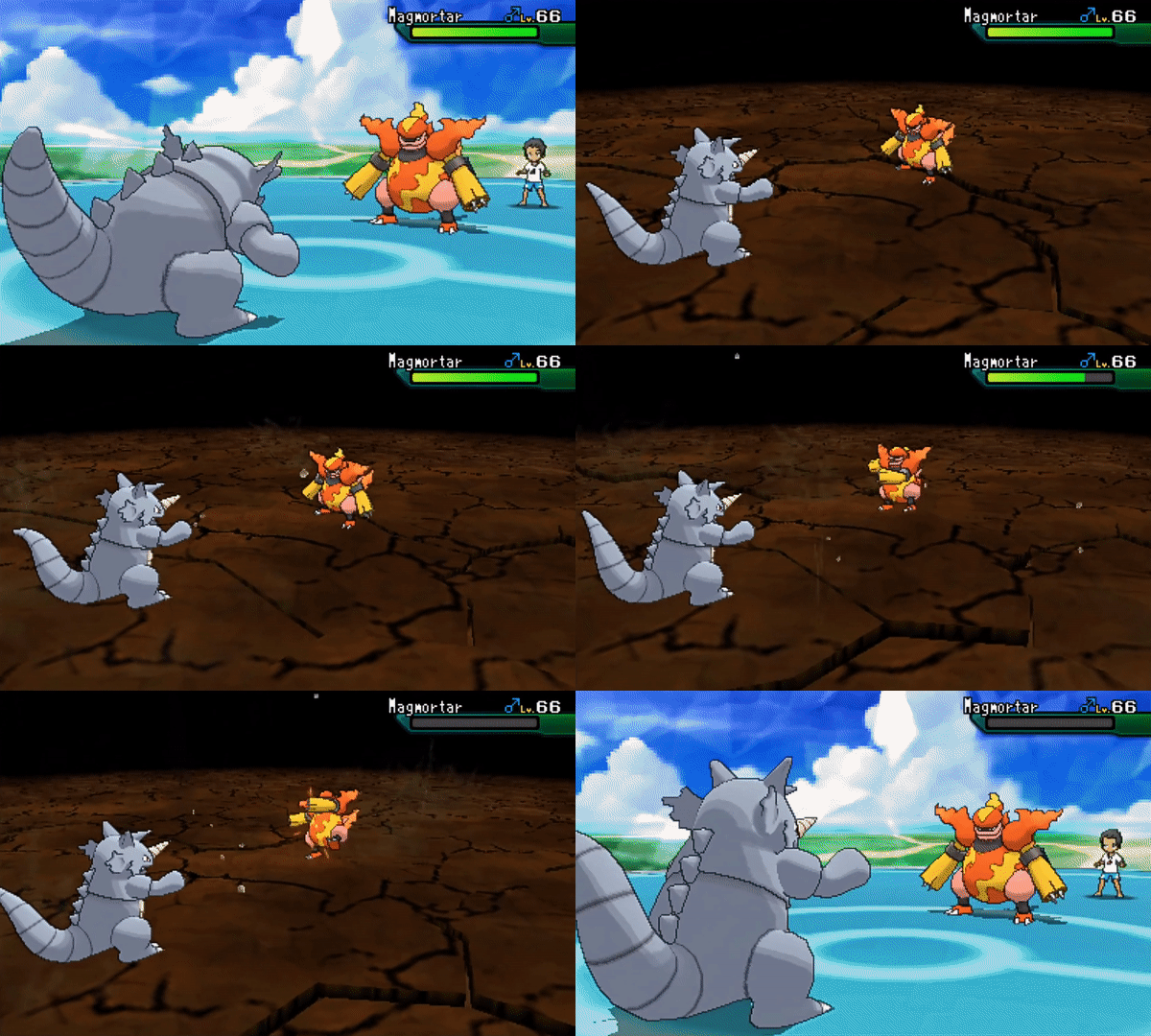
It occurred to me while watching The Pokémon Company’s recent animated short Bidoof’s Big Stand with a friend. How striking and appealing the (admittedly truncated) battle scenes were in this 3D animation! So much character and charm. Compare this animation for the move ‘earthquake’ in 2016’s Pokémon Sun and Moon to the same move in Bidoof’s Big Stand.

It’s not perfect. The earthquake move in Bidoof’s Big Stand for one could probably communicate a bit more force and impact before I’d ship it in a game, but that could be accomplished without inflating its screen time, easily. The fighting in the animated short exaggerates its action in ways Pokémon games probably never could given that their battle animations must be generic and prefabricated to be used by hundreds of interchangeable creatures, but I must insist that Pokémon as a game franchise can get closer to this level of dynamism and flow. It could be as simple as a baseline speed pass for each battle animation. Maybe earthquake doesn’t need to be on screen for a full five seconds. Maybe thunder doesn’t need as much anticipation as it’s getting. Maybe the transitions between turns could be faster. Game animation has a lot of conventions of minimizing anticipation and downtime, making visuals as reactive and instant as possible, and this is for good reason. The benefits extend to all sorts of interactive systems, not just action-y or real-time ones.

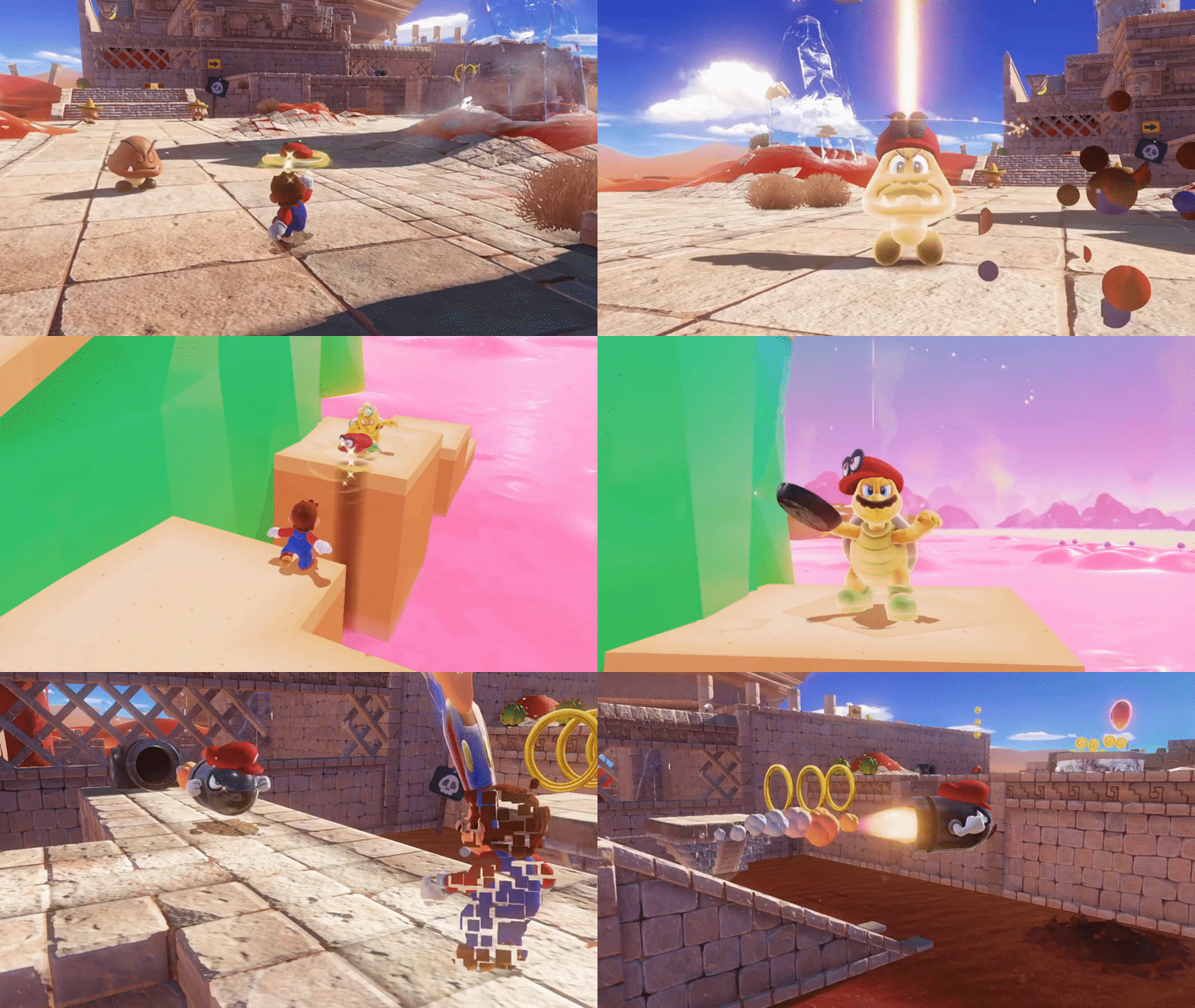
In a desert environment, Mario throws his cap at a goomba, a brown mushroom monster. As his hat lands on the goomba's head, mario becomes ethereal and zooms into the goomba's form, 'capturing' it. This takes place over the course of 1.5 seconds.

A similar scene plays out as mario 'captures' a bipedal turtle and an anthropomorphic bullet.
Games have been condensing exciting visual effects into smooth, seamless transitions for decades. Mario’s ‘capture’ visuals looks just as impressive as any five-second-long pokémon move, easily.

The difference in timing between the in-game earthquake and Bidoof’s Big Stand is staggering to me. I feel as though the Bidoof’s Big Stand earthquake communicates the idea of an ‘earthquake’ just as well, if not better, than its in-game counterpart, in less than half the time! A difference of three seconds might not sound much on paper, but bear in mind that in a pokémon game, you’ll be seeing moves like this, on average, about six times per battle, at minimum. Small increments in moment-to-moment gameplay like this matter. More likely you’ll see moves like this play out repetitively dozens of times per battle, over the course of hundreds of battles that take place in your standard Pokémon game. Arceus help you if we count all the redundant narration about status and field effects that pauses the battle to re-explain itself every turn. This is so much dead air to add to a game, it’s no wonder Pokémon‘s ‘skip battle animations’ feature has become so popular. And why shouldn’t it? I know I use it. I mean, I want to enjoy Pokémon‘s battle animations, many of them are genuinely a joy to watch, but I can usually really only muscle through a chunk of the game before turning them off for long periods of time. They just hamper the flow of the game too much for me.

I believe that games are greater than the sum of their parts. Games can have great music, great writing, great animations, or even great gameplay, but it is only in the confluence of these things, in varying balances, that the true strength of games as a medium comes out. I hate having to skip Pokémon‘s battle animations to avoid feeling burnout. I want the game’s various bits of art to come together beautifully. So, it begs the question, is there something perhaps less essential than the visuals themselves that can be cut out to improve the flow of Pokémon‘s battles?

And that brings us… To the Battle Dialogue.

Pokémon‘s Battle Dialogue is one of many idiosyncrasies Pokémon has brought forward through its many generations. It’s a small window at the bottom of the screen that essentially narrates what’s going on in battle.

A pokémon will take part of an action, this action will resolve completely, and then the Battle Dialogue will narrate it, before any reaction to this move takes place. The result is an incredibly stilted and lifeless visual accompaniment to Pokémon‘s otherwise excellent battle system that so often holds it back. Take the pokémon move ‘self-destruct’ for example. It’s an old classic from the original gameboy Pokémon games. In the following scene, you will witness the literal events of a clay doll monster violently bursting into a fiery explosion, causing its opponent to become so injured it can no longer stand. See how these events are visually translated, in a way that only Pokémon can.

The pokémon claydol, a many-eyed idol-like monster is tackled by its opponent manetric, a yellow and blue canine. The claydol then uses self-destruct, causing an explosion to emanate from its body. Several seconds later, the claydol faints. Several seconds after that, the manetric faints.
What on earth did I just witness.

I hope my point is becoming clearer here. Thanks to the strange reverence held for the Battle Dialogue, which is always given visual priority, there is no sense of real presence to these creatures, no impression of cause and effect. It’s more like the pokémon are pantomiming their moves. Pokémon has, over the years, become more and more attached to the idea of making their collectible monsters and their world feel real and inviting, like a place you could actually visit. Newer Pokémon games have featured Pokémon pet simulator mini-games, wider areas of exploration, and a more complete impression of the world the games take place in. The problems with Pokémon‘s visual presentation, especially in its battles, feels utterly antithetical to this design goal to me. I know there are certainly technical and production limitations that are causing issues like this, but I felt compelled to bring it up anyway as these issues can never be fixed going forward if they aren’t given voice, and moreover perhaps us other developers can learn something from it. It’s a topic I don’t see discussed much among the *ahem* many other popular topics in Pokémon *ahem ahem* discourse.

What if, perhaps, we entertained the idea of eliminating the Battle Dialogue altogether? Now, it isn’t as though it serves no purpose. Pokémon derives much of its success from being friendly to the young and casual as well as appealing to the hardcore and diehard. The Battle Dialogue inarguably conveys information in a clear and unambiguous way, all the while reinforcing the rules of the game through its constant narration, but is it really the best and only solution for accomplishing those things? Surely, at the very least, longtime fans would woefully miss iconic phrases like “It’s super effective!”. Perhaps, but streamlining Pokémon‘s visual information could mean repackaging iconic visuals in new and exciting ways. Perhaps “It’s Super Effective!” could live on as a visual or particle effect itself, not just plain text. Yes, big changes like this may be a hard sell at first, but if Nintendo’s other recent output the likes of Breath of The Wild or Bowser’s Fury has taught me anything, is that nothing need be unassailably sacred, and sometimes fans are just waiting to fall in love with something new, even if they don’t know it yet.

When all’s said and done I don’t think my vision for a faster, breezier version of Pokémon battling is the only ‘right’ choice. But I do think Pokémon could stand to peek at its peers’ homework from time to time and modernize the way it presents itself a bit. Some of the things that greatly harm the pace of Pokémon are entirely inventions of a game designed for an 8-bit calculator of a console. Some of these things I feel the franchise has outgrown entirely, and some could be re-contextualized in a more modern way. There’s some considerations in art direction to be made too that could smooth out some of these rough edges. In this article I proposed removing or rearranging a lot of things, but honestly much of this could still remain optional. I just think it’s emblematic of an issue that could be assuaged through design rather than blunt force, if a lot of people are choosing to turn off the thousands of man-hours that went into making your game look appealing.

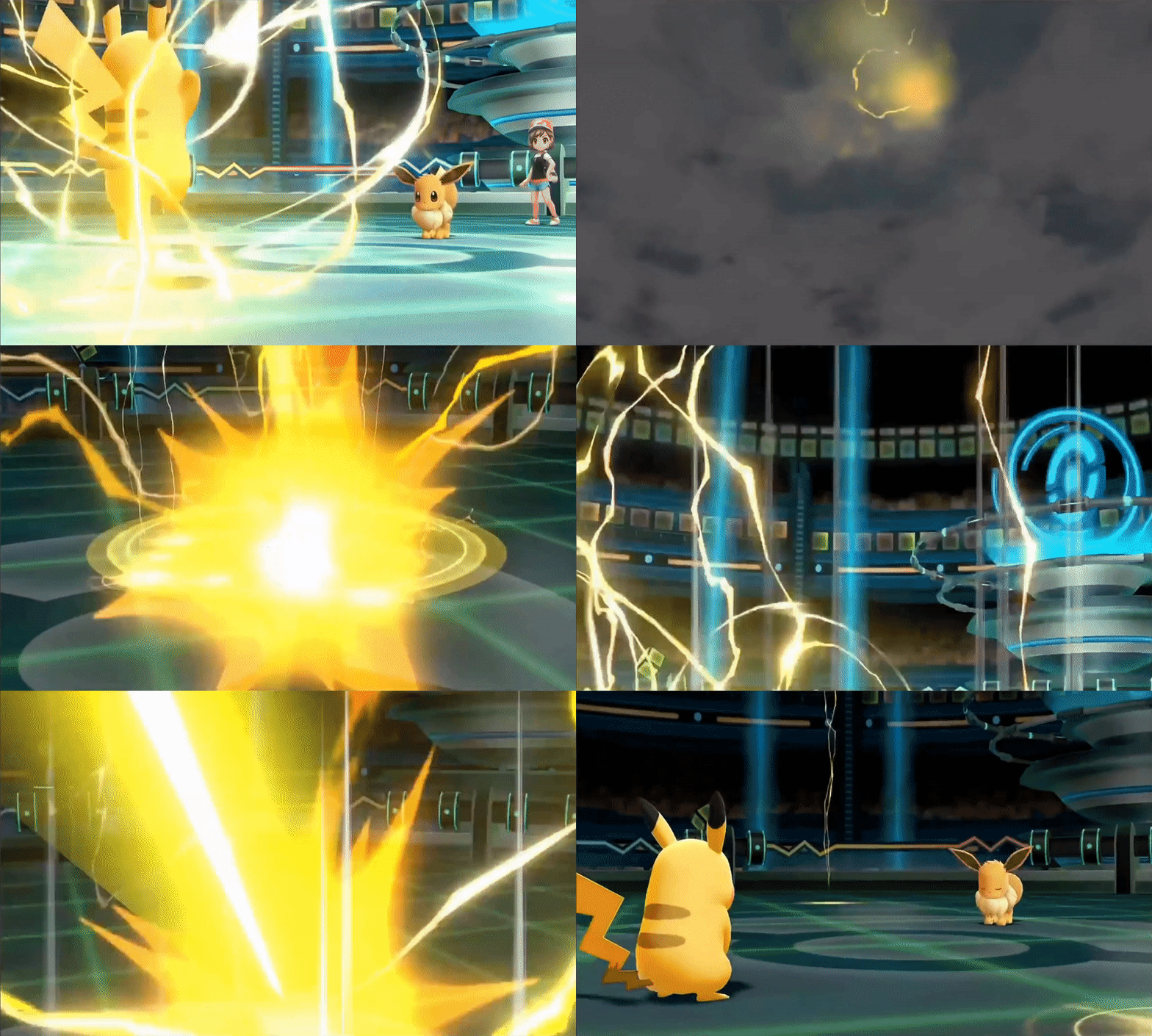
The pokémon pikachu, a yellow mouse, shoots lightning into the sky, which roils in the clouds before falling onto pikachu's opponent, a small brown fox-like pokémon called eevee, in a column of lightning.

The same scene plays out again, but this time edited down with bits and pieces of the animation sped up.

It runs agilely as if on wings…
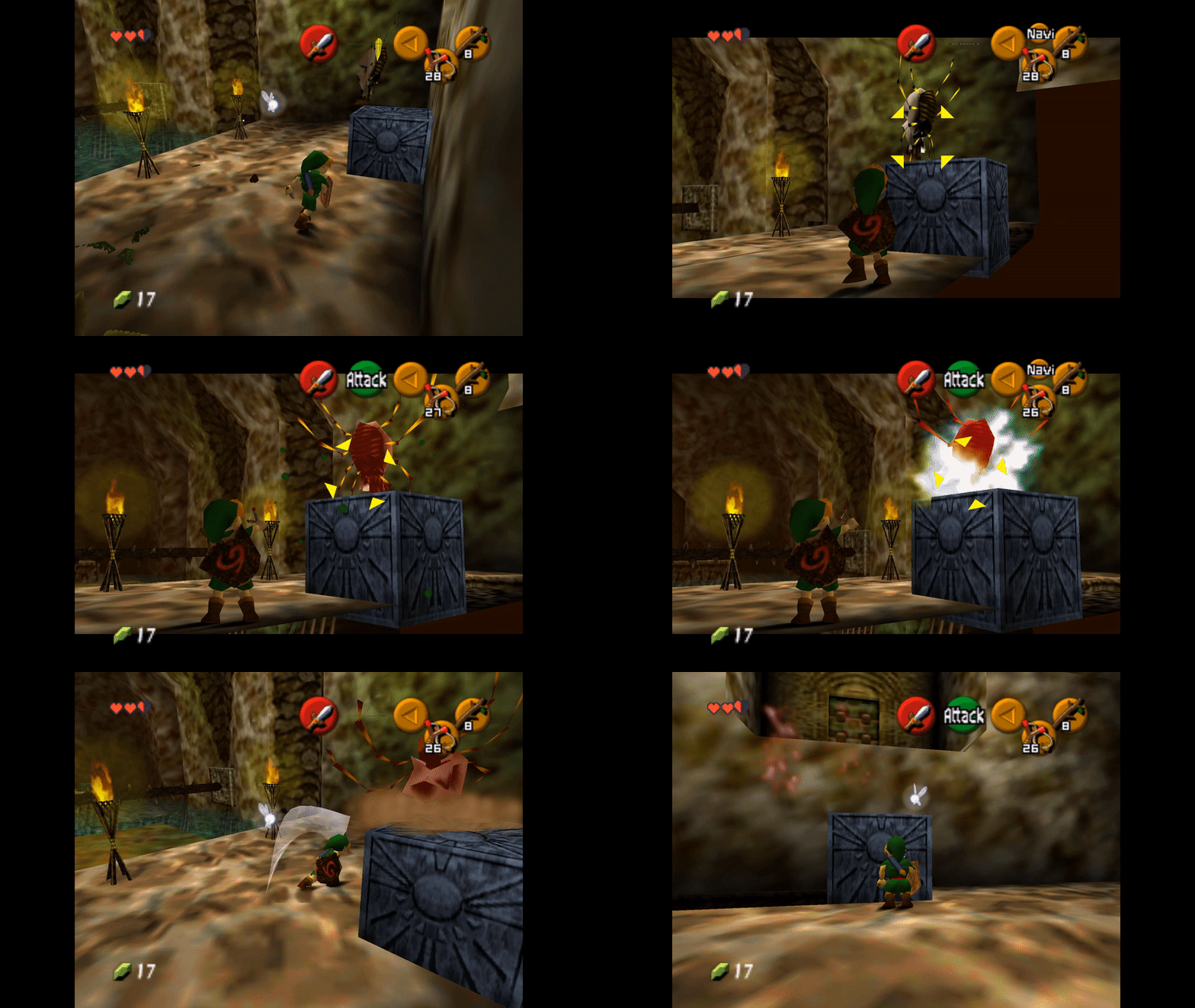
How To Fight Things in Three Dimensions: Zelda’s Z-Targeting

Can’t believe I haven’t done one of these on this topic yet. The Legend of Zelda: Ocarina of time is rightfully revered for how it set the tone for what action and adventure games could be in what was the relatively new frontier of polygonal 3D games in 1998. Moving to 3D comes with a whole host of problems, though, especially when it comes to active combat. Our real three dimensional space is very complicated, and abstracting that to a computer program can have some disorienting results if not done with care. One of Zelda‘s most notable contributions to the craft, I think is the Z-Targeting system. “Z-Targeting” is the name for Ocarina of Time‘s 3D targeting system which would let the player focus the game camera’s attention on a single point of interest by tapping the “Z” button. It gets plenty of mention, but honestly I feel like sometimes this one innovation doesn’t get praised enough. It kind of set the standard for how real-time gameplay involving two moving bodies works even to this day. There are also a lot of little things that helped this first iteration of a 3D targeting system work remarkably well, despite its age.

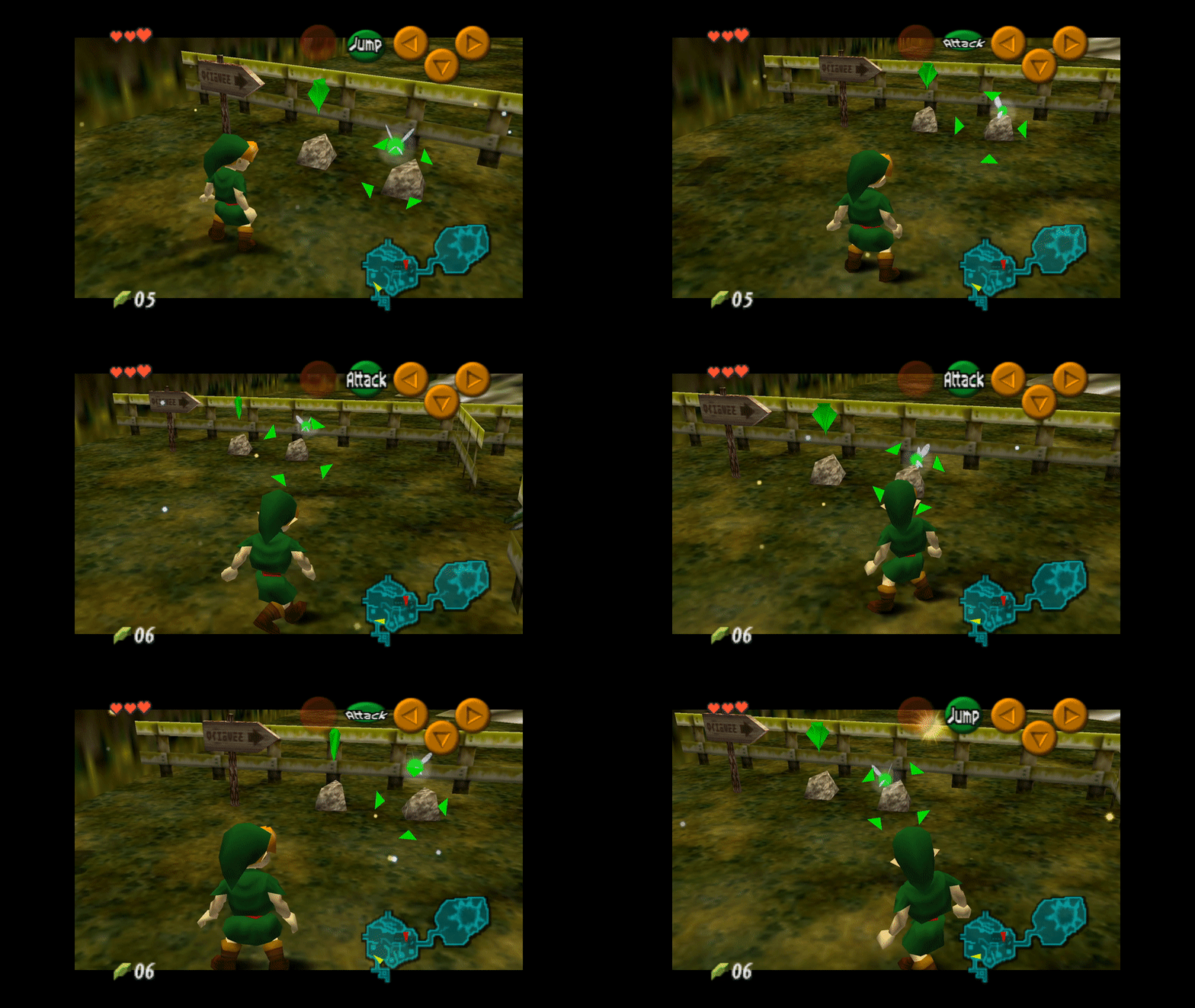
Child Link (The Legend of Zelda: Ocarina of Time) strafes to the left and right while a targeting crosshair focuses on a rock in a grassy forest. The rock remains center-camera, while Link shifts to either side of the camera.
The rock was very patient with me during the filming of this clip.

Notice in the image above how the camera smoothly and automatically situates Link to one side. You may have heard of the rule of thirds, an stylistic concept in art for generating compelling composition. By dividing an image into thirds and placing the subject of your art into the first or last of those thirds helps emphasize their importance, and draws the eye. It also frames the remaining, more open two thirds as a point of interest to the subject, a place they might be looking or going. Link is the subject in this scenario, and the camera essentially enforces the rules of thirds while Z-target is active. It’s not only very aesthetically pleasing, and helps draw the player into the drama of a good sword fight, but it’s very functional. But ensuring Link and the target occupy opposite ends of the screen, then it becomes very rare that Link himself will obscure his target from the player sitting on their couch. In this way essential information conveyed by your target, like an incoming attack, isn’t accidentally hidden from the player. This diagonal framing also helps keep the spacial relationship between Link and his target clear and unambiguous, which as I’ve mentioned elsewhere, is essential to satisfying combat.

This mechanic of making Link’s position relative to his target unambiguous is very strictly upheld. The camera will eagerly clip into walls to ensure the target remains properly framed, but this isn’t a problem as obscuring geometry will often not be rendered, so the camera’s over-commitment to framing is actually an advantage. It’s very intuitive. In an interview with the game’s general director, Toru Osawa, it was said that the system was inspired by a ninja and samurai themed performance. A ninja attacked with a sickle on a chain which was caught by the samurai. The ninja moved in a circle around his opponent as the chain connecting them was pulled tight. It seems drawing an invisible and unbreakable line between two entities helped the developers visualize how this new system would work. Link will always circle around his target in-game, and inputs on the controller are changed during a Z-target to reference the subject of the target. Moving Link “Left” means he will move clockwise around his target. “Right” means he will move counterclockwise around his target. It is as if Link is moving on a 2D plane, but bent and wrapped around the target. This abstraction expands into a rather robust system.

Child Link (The Legend of Zelda: Ocarina of Time) sidles up to a wall while a targeting crosshair focuses on a giant spider. The camera moved through the nearby wall, but the wall fades from view as this happens, allowing Link to see the spider's underside, which he shoots with his slingshot.
With the spider conveniently framed by the camera, even through this wall, Link is able to sneak a shot in to hit its vulnerable underside.

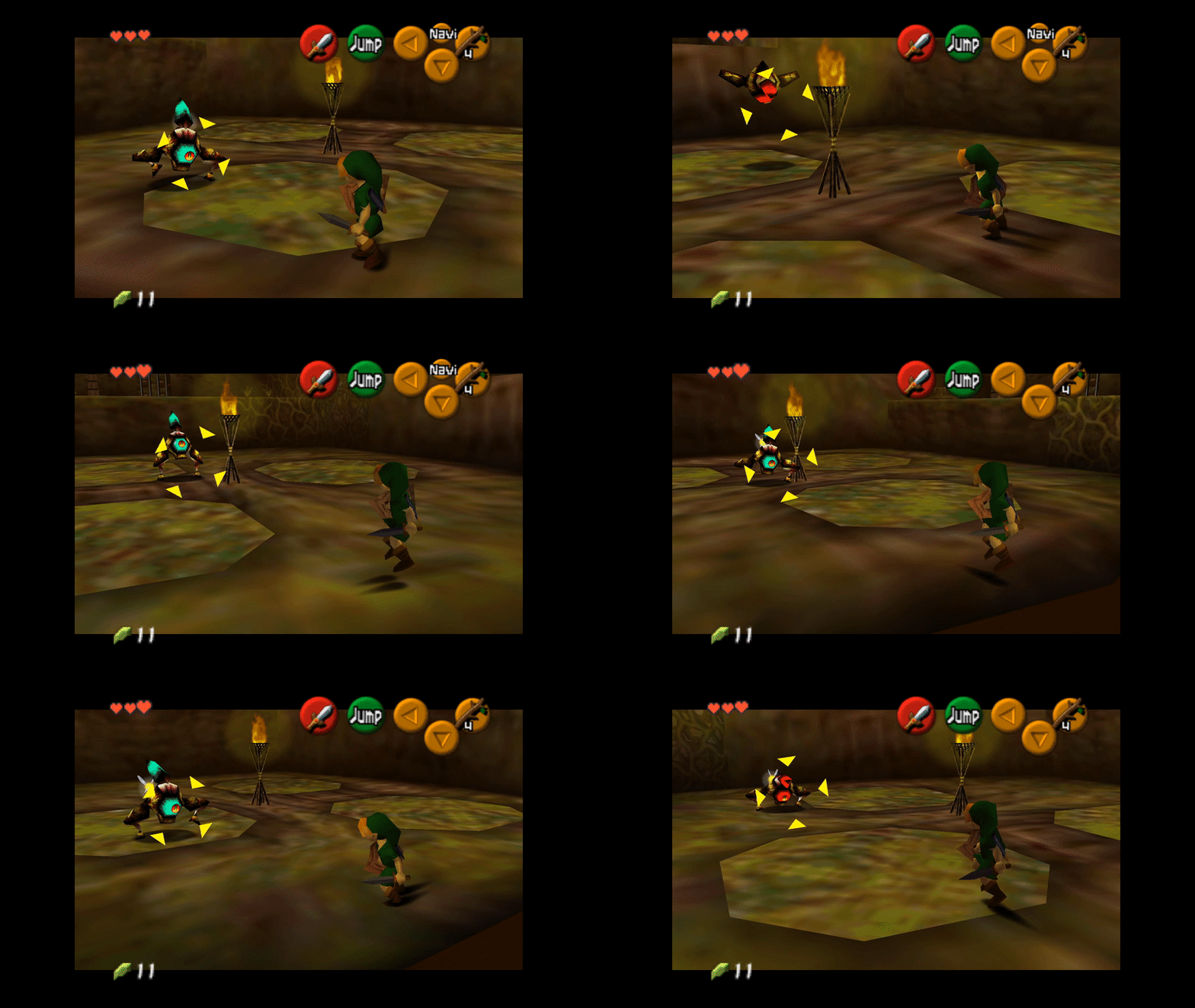
Another thing I noticed while playing Ocarina of Time recently is how movement during Z-targeting relates to the input of the gamepad controller. I’ll give you an example. While a Z-target is active, Link can do a quick side-step or back flip to avoid enemies. Holding the control stick back, toward yourself, when you press the action button will initiate a back flip. Holding the control stick to the left or right will initiate a side-step when the action button is pressed. So it seems the game is tracking Link’s relative facing direction to the camera for the purposes of his evasive jumps. If Link is facing perpendicular to the camera, or in other words, if his shoulder line forms a right angle with the plane of the game screen, then a “right” or “left” input on the control stick is considered “back” for the purposes of evasion. You can see this illustrated below:

Child Link (The Legend of Zelda: Ocarina of Time) hops to the side repeatedly in a naturalistic wooden interior. A targeting crosshair focuses on a giant cyclopic bug. When Link is almost side-on to the camera, he does a back flip.
During this clip, I am holding only the “right” direction, but Link eventually back flips anyway.

In this above clip, I am holding “right” on the control stick throughout. Once Link’s angle to the camera becomes too extreme, he no longer side-steps, and instead back flips. However, Link’s stride never changes. “Right” on the control stick is always considered to be Link’s right, relative to his current standing position, for the purposes of calculating what direction Link should be running. I can imagine a couple of reasons this might be. Changing Link’s continuous move direction on a dime would be very disorienting for the player. Link’s stride is not really changing in the previous clip, only the player’s angle of observation, so it’s unintuitive to think that a change in input is required to keep that stride in any scenario. The evasive jumps, however, are discreet units of movement and thus are not jarring when their operation changes based on camera position. Further, if Link were to side-step while side-on to the camera, it would be difficult to tell if he had done much of anything. By changing it to a back flip, the feedback of Link making an evasive move is maintained.

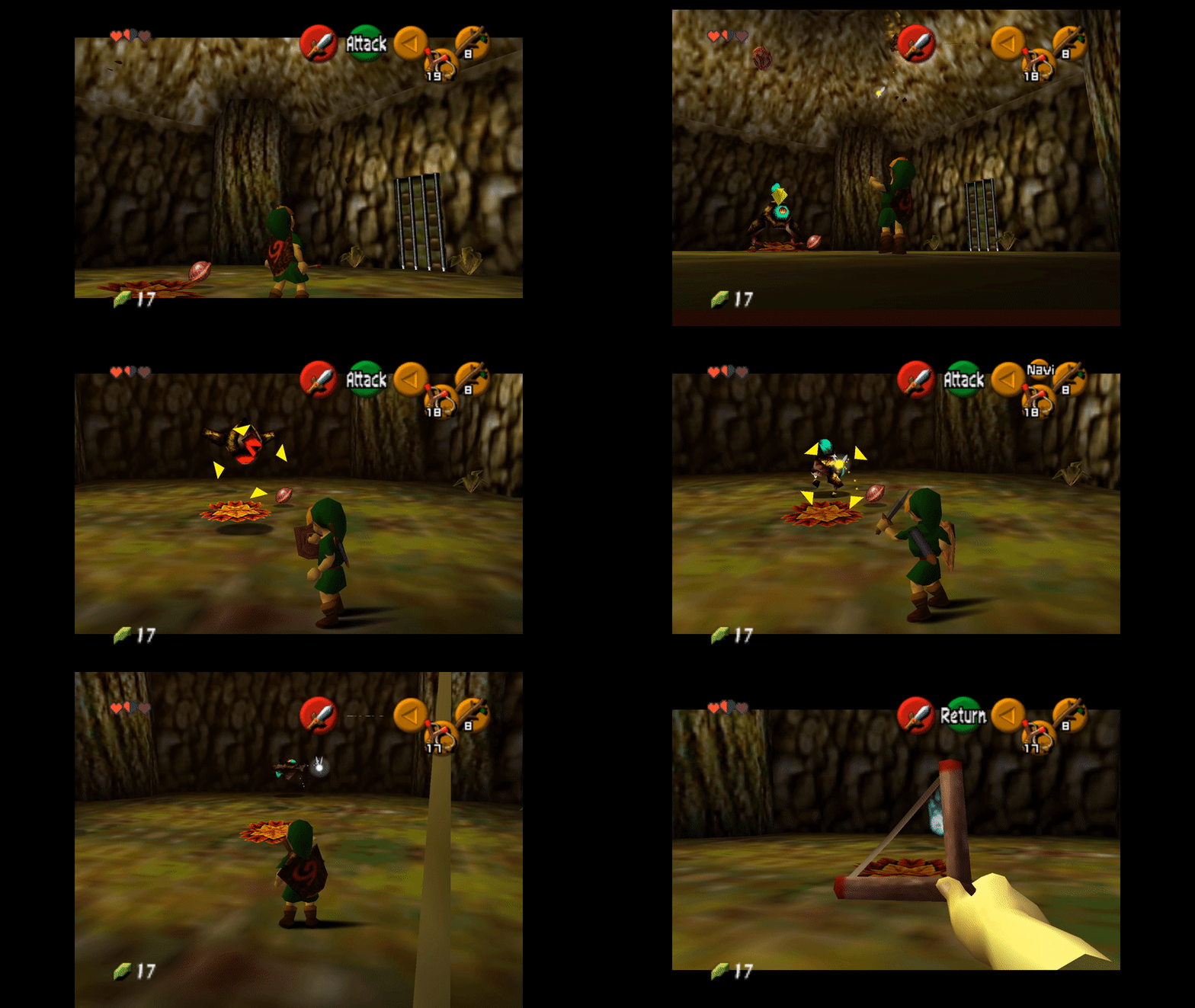
The Legend of Zelda: Ocarina of Time, being the first 3D Zelda game, obviously utilizes its verticality in ways that previous Zelda games could not. Zelda is a series well known for an arsenal of unique weapons and tools for solving puzzles and dispatching enemies. Iconic tools like the boomerang and hero’s bow are very compelling. It would have been a drastic admission of defeat to not translate such things into the first 3D Zelda. They have some hefty inherent problems, though. Control sticks are, frankly, not best suited for precision pinpoint aiming compared to a computer mouse, a gyroscope, or a photonic motion sensor. Ocarina of Time still offers the option of manually aiming projectiles through a first-person perspective, which is convenient for solving puzzles, but not ideal for most combat encounters. The Z-Targeting system rather elegantly solved this problem as well. The drawback is that the player doesn’t do much aiming at all when utilizing their bow and arrow in combat, which could be argued as part of the skill set of playing the old Zelda games, but in trade Ocarina gets the advantage of keeping airborne enemies in focus and keeping the use of projectiles in combat practical. Zelda combat is typically more about understanding the best tool for the job than skillful execution anyway, so I think it was a savvy decision to enable ranged combat in this way.

Child Link (The Legend of Zelda: Ocarina of Time) shoots a strange giant egg off of a ceiling, in a naturalistic  wooden interior, using his slingshot. He then stabs a nearby giant bug with his sword, then shoots it as it runs away.
There was an intent focus in this game on making your tools practical and functional, even if they’re not always the most complex or involved.

So many modern games utilize an automated camera or targeting system that can be traced directly back to Z-targeting, so I felt it deserved its own appreciation post here. The mechanic is unintrusive, fit-for-purpose, artistically sound, and practically seamless. It even has its own little diegetic explanation of your partner fairy, Navi acting as the source of your target’s focus. You might notice her dancing around targeted enemies in the clips I’ve provided. Helps reinforce her as an important partner to Link, even in spite of her infamous chattiness. Honestly, after looking into it, there are some features that even some modern targeting systems don’t do as well as Ocarina of Time. There have been perhaps more elegant, more robust, and even more interesting targeting systems since, but it’s absolutely astounding how much Zelda nailed it on its first try, and set the stage for the iteration of 3D navigation for many years to come.

Child Link (The Legend of Zelda: Ocarina of Time) pursues an elephant-sized cyclopic insect as it climbs up a wall in a dark cavern. Link aims up at it with a targeting crosshair focused on it, then shoots its eye with his slingshot.

Time passes, people move. Like a river’s flow, it never ends…

Galaxy Brain: How NEO: The World Ends With You Recaptures the Experience of its Predecessor

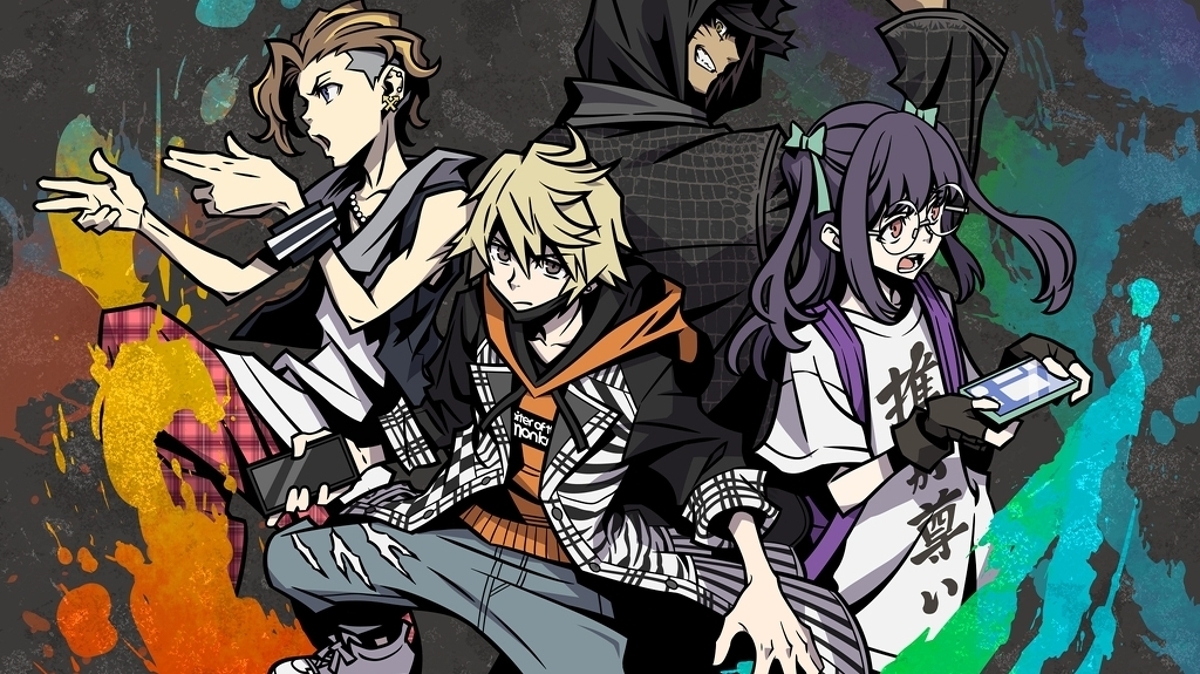
The World Ends With You is a distinct and memorable little action RPG originally for the Nintendo DS. It is remembered and well-loved for an engaging story about coming out of your shell and expanding your horizons by connecting with people. The game also sported an incredibly unique action combat system utilizing the DS’s hardware features – one of the first touch screens used for video games, and two concurrent display screens. In The World Ends With You, combat is conducted through a loadout of unique psyches, the player’s attack moves, that each are used via a respective touch-based gesture to fight enemies. This all occurs on the DS’s bottom screen. At the same time, a second character is controlled with buttons to defend against additional enemies on the DS’s top screen. These features allowed for some standout gameplay mechanics that helped The World Ends With You achieve its cult status, but how has this gameplay evolved as its been ported to other, more traditional interfaces?

It’s a lot to keep track of, but MAN do I feel like a genius when it works!

The World Ends With You has been ported to a number of systems since its original release, including the Nintendo Switch and several mobile devices. Given how entwined the original game is with its hardware, particularly in utilizing the feature of action occurring simultaneously on two screens, it seemed a given that the game’s mechanics would have to be re-imagined for these other systems. The route these ports took accommodating the change in hardware was a simplification of focus. In lacking a second screen, the Nintendo Switch version of the game changed the player’s partner character, normally an independent actor on the DS’s top screen, into another psyche in the player’s arsenal, controlled similarly by touch gesture. Using this partner psyche in conjunction with the normal psyches would confer combat bonuses. This was a fairly elegant way to make the game functional on devices that lacked the DS’s unique features, and the game remains fun, if somewhat more cumbersome to control without a touch screen stylus. However, these ported versions of the game seem to lack something experiential and essential when compared to the original. In cutting the second screen’s mechanics entirely, something fundamental was lost.

In enters the bluntly titled NEO: The World Ends With You, a new direct sequel to the original game for the Nintendo Switch and Playstation 4, arriving some fourteen years later. The PS4, notably, lacks a typical touch screen entirely. One may note further, that NEO lacks gesture control, entirely. The design focus of this game has, perhaps surprisingly, shifted entirely away from replicating the methods of the DS touch controls. Although The World Ends With You‘s gesture controls were incredibly intuitive and satisfying on the DS, they weren’t entirely one-of-a-kind. Other games like WarioWare: Touched! accomplished similar things with their controls, albeit in different genres. NEO shifts focus to what is more unique about its predecessor, and seeks to replicate not the control scheme, but the core experience, what is happening in the mind of the player, something more recent ports of The World Ends With You struggled to do.

One screen, one window of focus, but has something been lost?

The World Ends With You for the DS had some best-in-class gesture controls for an action game on that system, but this wasn’t the only gameplay mechanic that set it apart. During regular gameplay, the player’s main character, Neku, acted on the bottom screen, where he’d have to attack enemies while dodging around them according to the player’s touch gestures. Simultaneously, on the top screen, Neku’s partner would be stationary, and slowly assaulted by enemies. The player would have to control Neku with one hand, while commanding the partner character to defend themselves via button inputs with the other. Neku and his partner share a health bar, so if either screen was not given due attention, both would suffer. This created an absolutely mesmerizing experience of splitting attention between two active scenes, triaging and reacting to both. It was a different and challenging sort of mindset to get into, this constant multitasking, demanding players adjust to a new way of thinking. In fairness, it could even be restrictive to some players, a shortcoming that is assuaged somewhat by the versatile difficulty options present in the game. Once the player got use to this, however, it could create a state of flow and rhythm where successfully managing two characters was almost hypnotically engaging.

NEO once again features multiple simultaneously controlled player characters that share a health bar, this time up to four, all on one screen, in a 3D space. As stated, gesture control is done away with entirely in favor of assigning each psyche move to a button input. Each psyche is assigned to one of up to four characters in the player’s party. The twist is, each party member answers the player’s input independently of each other, but are each still vulnerable to counterattack at all times. As before, all psyches operate with different game mechanics at different time frames, but they can be layered together, offset from one another, done in sequence, executed in any way the player is able to push the associated buttons.

For example, one character might loose a volley of energy bullets when the player repeatedly taps a face button, while another character charges up a big rock to throw when the player holds down a shoulder button. In this scenario, the rock will do extra damage if timed to hit just as the first character’s bullet salvo is finished, using Neo‘s combo system, which encourages finishing multiple psyche moves on the same enemy in quick, timed succession. Bonus damage and and the potential to unleash a devastating ultimate move is rewarded for doing so consistently. In this way, the player is rewarded for roleplaying their party of characters as working together, and supporting one another, just like the original DS title, all while replicating that challenging and engaging split-attention experience through its design alone.

Boom-Bomb-BAM! Now that’s satisfying.

NEO even further addresses the barrier of entry for new players by condensing all the action to one screen. A single field of view is intuitive- it replicates how we view spaces in real life. Two screens, while novel, also create two separate cognitive spaces in our minds. No matter how close together they are, switching between two screens is harder than simply utilizing your peripheral vision on a single screen, due to that cognitive distance the break between screens creates. There is something to be said for that novelty of control across several distinct cognitive spaces, but it is a trade off that fits naturally for game consoles that simply don’t support multiple screens.

The player characters once again share a health bar, but unlike in the previous title, now all exist in the same game space. Each party member’s movement and dodge mechanics become directly controlled by the player when their psyche was the last one to be used. Each time a new psyche is used, control is shifted to a new character. The player must shift their control around like this. To keep things from getting disorienting, the 3D camera is directed by the game, rather than the player, and party members quickly run into the player’s field of view on their own as they are queued up to be controlled, creating a smooth transition.

Enemies will still react and attack in real-time, and all party members are vulnerable, thus the player has to be splitting their attention to multitask and triage the various goings on in the battlefield, all while keeping up their rhythmic combo of attacks. If one party member is pinned to the ground, the player might respond by sending another to help them out. All this together emulates the original game’s sense of almost melodic flow within gameplay, that makes the player feel smart and skillful to maintain. A complete re-imagining of gameplay mechanics was able to recapture The World Ends With You‘s most distinctive feature, by focusing on the core experience. Although the gameplay is structured very differently in many ways, the experience one feels while playing the new game is incredibly reminiscent of the original.

Here we see one character’s melee attack push an enemy out of the way of a rock throw – being aware of spacing and timing is essential

This also serves to reinforce some of the themes of both games – expanding your horizons by reaching out and connecting with other people. As Neku must learn in the original game to open himself to others, the player learns how to coordinate Neku and his partners’ distinct gameplay styles together, to create a greater whole. NEO‘s combo system accomplishes the same result, rewarding the player for being cognizant of the timing, effects, and spacing of each player character independently, and how they work together. They must consider a greater group, and not just an individualized self. The result on screen is an amazingly coordinated show of teamwork, reinforcing the player’s small band of party members as a real team working together toward the same goal. It’s a narrative in its own right, told entirely through the gameplay mechanics, reinforcing the explicitly written and acted narrative told between sections of gameplay.

A friend’s been pinned by wolves, indicated by those red “!!!” in the front. Let’s beat them back together!

NEO‘s renewed shift in focus re-frames what was once a hardware problem into a design problem, while playing to the strengths of the platforms the game was developed for. What’s more, the new angle by which this design problem is tackled plays to the original strengths of The World Ends With You, recreating the experience that makes it unique, not just the control scheme. It does this to draw the player in to this stylish and exciting world, while also creating a consistency of narrative between gameplay and non-gameplay sections. Re-framing issues like this in terms of design, playing to a game’s strengths and unique experiential identity is something that makes games truly memorable. NEO: The World Ends With You knows its strengths, knows the experience it’s aiming to create, and executes on that in a manner best suited to its platform, choosing not to adhere rigidly to old solutions and patterns. As it turns out, entirely changing its approach and expanding its horizons may have been the best way to become a true successor to The World Ends With You.

Expand your world…