
Today on Boss Breakdown I’m going to be delving into the wonderfully weird world of Kingdom Hearts to examine an optional boss encounter that comes very early on in the game – the player’s ultimate rival, Riku. Kingdom Hearts is an action RPG developed by Square Enix. Combat in Kingdom Hearts is a fast-paced series of sword battles (well, keyblade… yeah, we’ll just say sword battles) that take place on the ground and in the air with over-the-top fantastical feats of acrobatics and agility. It’s very much larger than life, exaggerated, and full of charm.
The player fills the role of the young dreamer Sora, a resident of the Destiny Islands, a vague sort of childhood-paradise world where teenagers enjoy their seemingly endless summer vacation racing, play-fighting, collecting seashells, and imagining the world outside their own. Sora’s got two best friends – Kairi, a creative, sassy yet kind-hearted girl and Riku, an abrasive, competitive, and contemplative boy. The Destiny Islands act as a safe tutorial space for Kingdom Hearts where the player is free to explore the game’s movement systems without fear of battle unless they seek it out. Riku has an optional boss fight in this early stage and it’s very notable for what it accomplishes. I wanted to talk about Riku particularly for how strong the gameplay-narrative aspects of his fight’s design are. This first Riku boss fight on the Destiny Islands is very basic, comes very early, and is seemingly innocuous. You wouldn’t think it has huge implications on the rest of the game, but there was clearly a lot of thought put into how this early game challenge would fit into the overall experience.
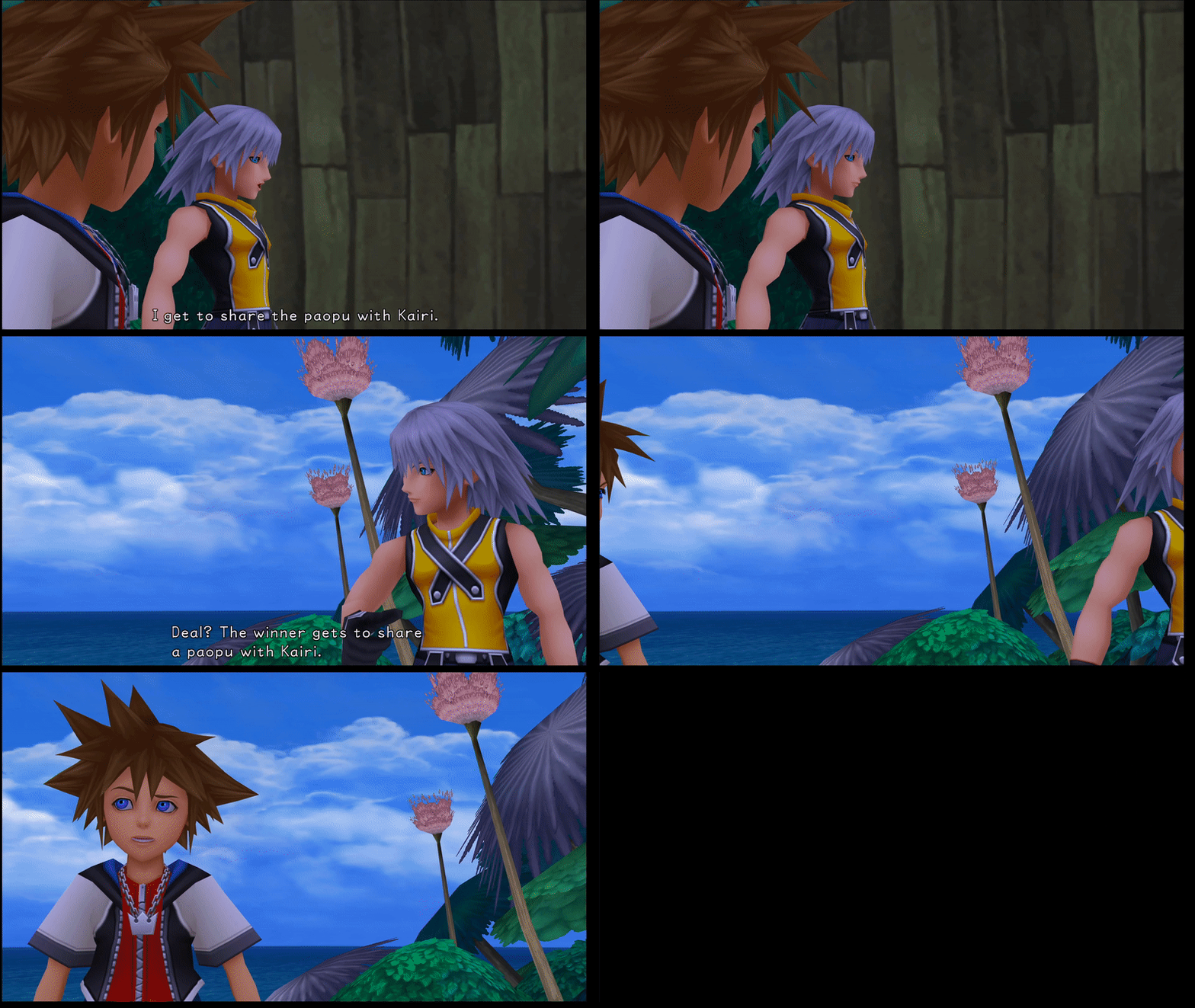
Riku is absolutely terrible, at this point in the narrative. I don’t mean to say I dislike his character, in fact he’s very effective in his role. From the moment you meet him he’s a driving force for the player, motivating them to explore the combat mechanics. He teases and condescends to Sora, but it’s all innocent enough. It feels like friendly banter. Some red flags start to go off when Riku and Sora challenge one another to a foot race. Surreptitiously, outside of earshot of Kairi, Riku puts up a prize, a very symbolic and intimate moment with Kairi, as a bet to be won by the victor of the race. It’s somewhat chilling. Sora doesn’t even have a chance to really respond to the rather untoward proposition before the race begins. The player has a single chance to establish who wins this “bet”, though the result is inconsequential, as Riku will play it off as a joke. It certainly doesn’t sound like he’s joking when he first brings it up, however.
There’s some clear tension building among this group of friends, and Riku seems to be the source of it. At a later point, Kairi will offer to escape the island with just Sora, the two of them leaving for adventures together, implying Riku would be left behind alone. Sora doesn’t answer quickly enough, and Kairi too plays off her startling proposal as a joke. In actuality, with the benefit of hindsight, Riku doesn’t act all that terrible generally. Perhaps a bit full of himself, but he does show a genuine camaraderie with Sora and Kairi. It’s isolated moments like that proposition at the footrace where an inner darkness peeks through from him. He says hurtful things from time to time, but he’s ultimately a confused teenager from a very narrow world. Before all this though, Riku strongly establishes himself as the de facto leader and strong, wise “elder” of the group (he’s only a year older than Sora and Kairi, but still). He taunts and brags to Sora constantly during encounters with him, demeaning his abilities in a sort of ribbing way, but also the kind of way that gets under your skin and moves you to prove him wrong.
As a young kid, I really did feel like Riku was driving a wedge between Sora and Kairi. It invested me in this microcosmic little world, with Riku as our small-scale antagonist. Riku is positioned that way by the gameplay, as antagonistic. He’s meant to drive you, as the player, to better yourself through game mechanics to better Sora. You feel the same rivalry Sora feels with Riku , and you’re suffering the same way Sora is when Riku beats you into the sand. And he will. A lot. Riku’s boss fight is incredibly overtuned for what I’d consider to be an appropriate early-game boss fight, under normal circumstances, but that’s why Riku is an optional fight. I say optional, but given the aforementioned story context, you’d be hard pressed to find a Kingdom Hearts player who would not at least attempt to defeat Riku a few times.

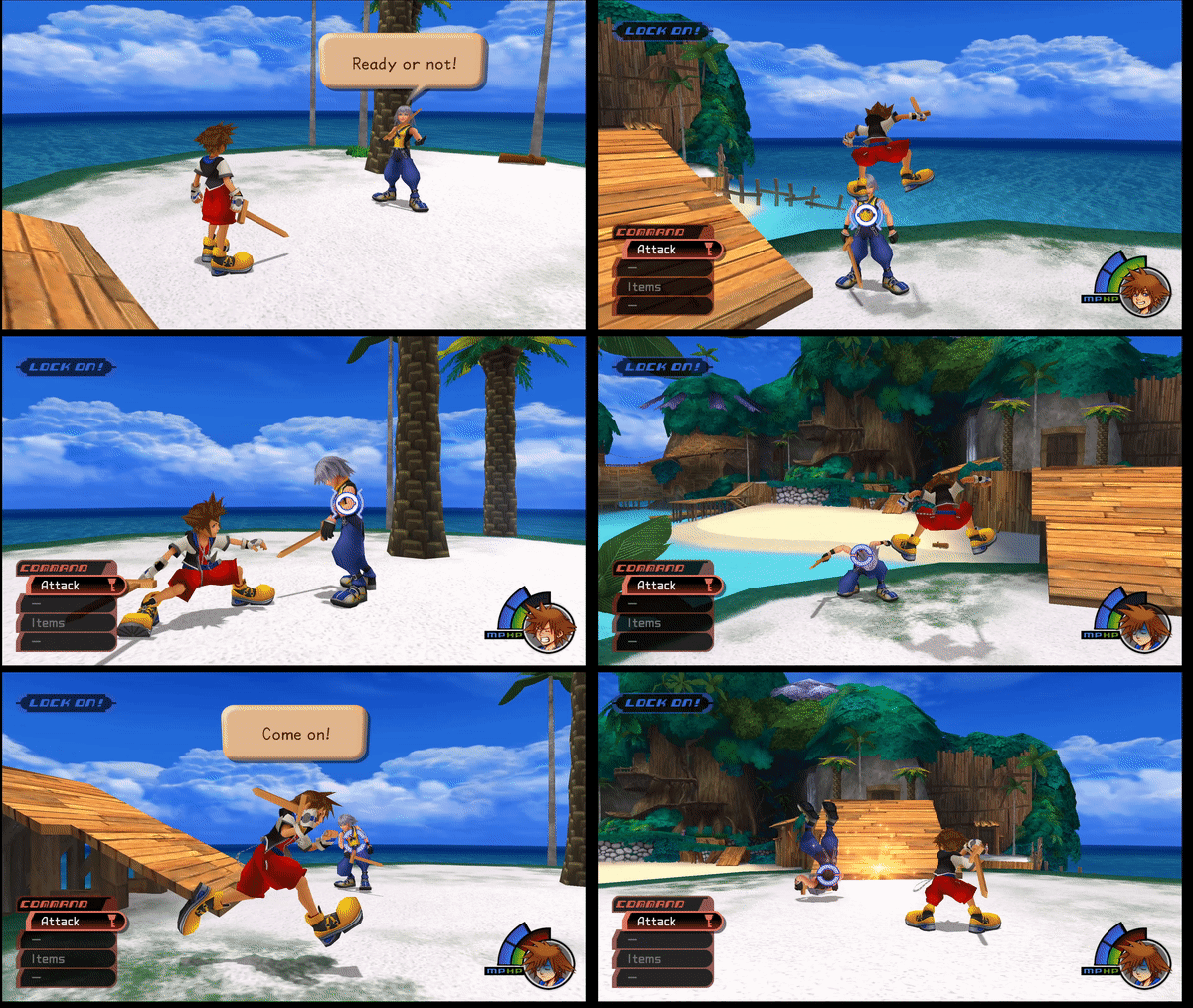
You can challenge various characters to play-fights with wooden swords. Please ignore the fact that beating each other with wooden weapons would still be horribly dangerous, as this is anime land where human children can effortlessly bound twenty feet in the air, do three backflips, then deflect a flying bullet out of the sky with a sword. It’s fine. These are the only real sources of combat available to the player in this tutorial stage, as the story isn’t ready for monsters to be popping out just yet. They act as a sort of optional tutorial set, with each kid you can challenge specializing in teaching some aspect of the combat system.
Selphie teaches the player how to clash with an enemy’s weapon. Tidus teaches you how to outmaneuver a melee attacker. Wakka will teach you how to deflect projectiles. Riku is the fourth and final kid you can challenge, and he’s here to teach you how to lose. I’ve at times heard individuals deride Kingdom Hearts as a button masher, or in other words, implying the gameplay is overly simplified to the point of being trivialized by mindlessly mashing the attack button. I could go into detail about that misconception, but essentially if you have that experience, you’re playing on too low a difficulty setting for your level of skill. Riku’s boss fight is here to prove that to you.
Riku’s arsenal of maneuvers and attacks is pretty modest at this stage, but very effective. The player too, this early in the game, does not have very many options. Sora can run, jump, or attack with a 3-hit melee combo in the air or on the ground. Your defensive options are severely limited, you don’t even get your proper block or dodge roll until later, so using good positioning is your only way to avoid damage. That, and utilizing Kingdom Hearts‘ delightfully intuitive weapon clash system, which will nullify enemy attacks if Sora matches them with a well-timed attack of his own, deflecting the attack with a satisfying *clash* sound. This system simultaneously rewards attentive observation of your enemies’ attacks for proper timing and promotes aggressive attack-happy play, which makes the combat a very frenetic and fast-paced system. Attacking is, in a way, also a form of defending.
Riku has a fast melee attack that he’ll bring out if you get too close, teaching the basics of how enemies behave in this game. They mostly respond to the player’s position. They can be proactive, but their behavior is extremely contingent on Sora’s position relative to them. If sora dodges this attack but stays close, Riku can follow it up with a second, similar fast and close-ranged hit. At a medium distance, Riku can stab out his sword for a slower but longer-reaching attack. Riku also has a small spinning attack. Observing what Riku can do will also teach the player what Sora can do, as their arsenals at this stage are very similar. The attack button in Kingdom Hearts is contextual, and will activate a different attack depending on Sora’s relative position to his target, and whether or not he’s airborne, similar to Riku! These fast attacks of Riku’s can be clashed, which may stagger him and leave him vulnerable to a counterattack. This is one of the basic methods of dealing damage to enemies in Kingdom Hearts.
Simple so far, right? Well that’s just what Riku wants you to think. In Kingdom Hearts, because battles are so overwhelmingly player-directed, enemies keep track of how much they’re being hit by the player with something called a revenge value. This invisible numerical value, once it reaches certain thresholds, changes the behavior of enemies, causing them to retaliate, or use super moves. Riku has no super moves, but his favorite form of retaliation is so deadly it might as well be classified as a super weapon. If he feels he’s taken too many hits too quickly, Riku will lean onto his back, and point his feet toward the air, before kicking up into a standing position, clobbering Sora if he’s standing in front of the kick’s path. This maneuver deals devastating damage, and has a very tight window within which the player can react and move out of the way. Riku loves to do this in the middle of Sora’s attack combos. Riku’s revenge value is very sensitive, and he’ll start doing this if Sora’s hit Riku with even one full attack combo. The player can stop Sora’s combo, but only between attacks. If you push that attack button one too many times, Sora will be locked into his attack animation, and it’ll be too late. Button mashing is the easiest way to get absolutely demolished by Riku. I think it was very clever to key into this player behavior specifically as a bad habit worth shaking, if one ever wants to be as good at this as Riku. You’ve got to think, look, and listen carefully before just wildly swinging your sword.

If you do keep an eye out though, Riku’s greatest weapon can become your greatest weapon. Riku is unable to retaliate if you hit him just as his kick-stand maneuver ends. If you see it coming, you can step out of the way and respond with a free attack combo, punishing him. If Riku feels he’s in a bad position, or has been hit too many times without landing hits of his own, he may make a short, grounded dash movement to close the distance, or jump into the air to make distance. Riku is unable to attack in the air, nor can he retaliate in the air. The timing is tough, but if you can land an aerial combo on Riku while he’s jumping, he has no recourse. Giving Riku no aerial options at all helps the player realize that aerial and grounded combat have distinct differences and that enemies will react differently to those approaches. Knocking enemies into the air will tend to make them more vulnerable, so this is good knowledge to have.
Riku’s final trick is his taunting. He’s constantly, constantly, goading and heckling Sora and by extension the player about how they’re scared or not good enough. If you act in haste, he’s likely to clobber you, so this really is a game mechanic of sorts. It’s easy for people to tunnel vision in games and make mistakes, which is the main thing this boss fight is trying to teach you overall. One of Riku’s taunts is accompanied by a blocking motion. Any attempts to attack Riku from the front during this extended block will fail, and after a few failed attacks, Riku will hit Sora with a powerful overhead strike. This may at first seem like an impasse where the player simply as to wait for Riku’s taunt to end, but in actuality, if you get behind him, Riku will realize his block won’t work, and he’ll jump to a new position. Given what we’ve learned, and how predictable this behavior is, the player can learn to catch Riku out of this reliable jump to turn the taunt against him. Cool!

Amusingly, the game takes a moment after each and every confrontation with Riku (you can challenge and re-challenge him to races and fights as much as you want) to highlight your win rate against him, with Sora musing on the current “score”. A fresh player is likely to have lost to Riku many, many times by the time they beat him, if they beat him. The game does not want you to forget that Riku is better than you at this. The race alone, which you are required to run at least once, is likely to give Riku at least one win over you, as the race is also extremely difficult to a new player. The game sets the player up for failure when it comes to beating Riku, and engenders the same sense of dissatisfaction and perhaps inadequacy that Sora feels toward his older counterpart. The player, like Sora, is motivated to improve and master their combat skills as Riku himself becomes an implicit motivator.

It is the game designer’s job to make the player motivated to want to play their game, to spend time in the world they’ve helped to build. Obviously, a designer needs to motivate the player to do so. There’s explicit motivation, which promises the player rewards and treats for doing so, outside motivation. These are useful tools, but potentially much more powerful are the inner motivations whose rewards come from within the player. Fun, satisfaction, and investment in a story are all implicit motivators. These are ephemeral terms, difficult to pin down, which is why when they are designed for effectively it’s so remarkable to behold, and worth studying. Riku will destroy a new player, repeatedly. However, as beating him is entirely optional, this is unlikely to demoralize the player, who is allowed to continue the story, but now carries this internalized rivalry with Riku. One day, you will be able to beat him, the game implicitly promises. Maybe not now, but continue playing, continue improving, and one day, you will. You might see this technique used in games often, if you’re on the look out for it – establish a rival or mentor that both the player and player character cannot overcome, setting the player up to go on a journey of self-betterment alongside their protagonist.

This player-protagonist harmony, where the player feels analogous feelings to your protagonist, is an excellent method of immersing the player in a game world. If the player has nearly the same motivations and emotional responses as the character they are playing, they’ll find it much more natural to put themselves in their shoes and empathize with them for whatever wild scenario you can dream up. This is the real power of video games as a medium. It’s the only form of media where the player can really be part of the story, explicitly, emotionally, mechanically, so I’ve always believed one should lean into that. Gameplay itself can be a form of storytelling.
But this is only part of the story. So Riku is set up as this big imposing physical and emotional obstacle for the player, as well as for Sora. They’re ready to tackle it together. But what next? Where does this story go? You may have heard that Kingdom Hearts‘ narrative gets complicated. People like to exaggerate, but for the sake of simplicity I think next time we’re going to skip ahead a bit and see where this path we’re on leads us, in regards to Sora and Riku. This is, after all, not the only Riku boss battle in this game. Players familiar with Kingdom Hearts will know the others well. In part 2 of this Riku Boss Breakdown, we’re going to take a look at the infamous Dark Riku boss fight.
They’ll remain a part of each other’s lives, no matter what…
 Parry Everything