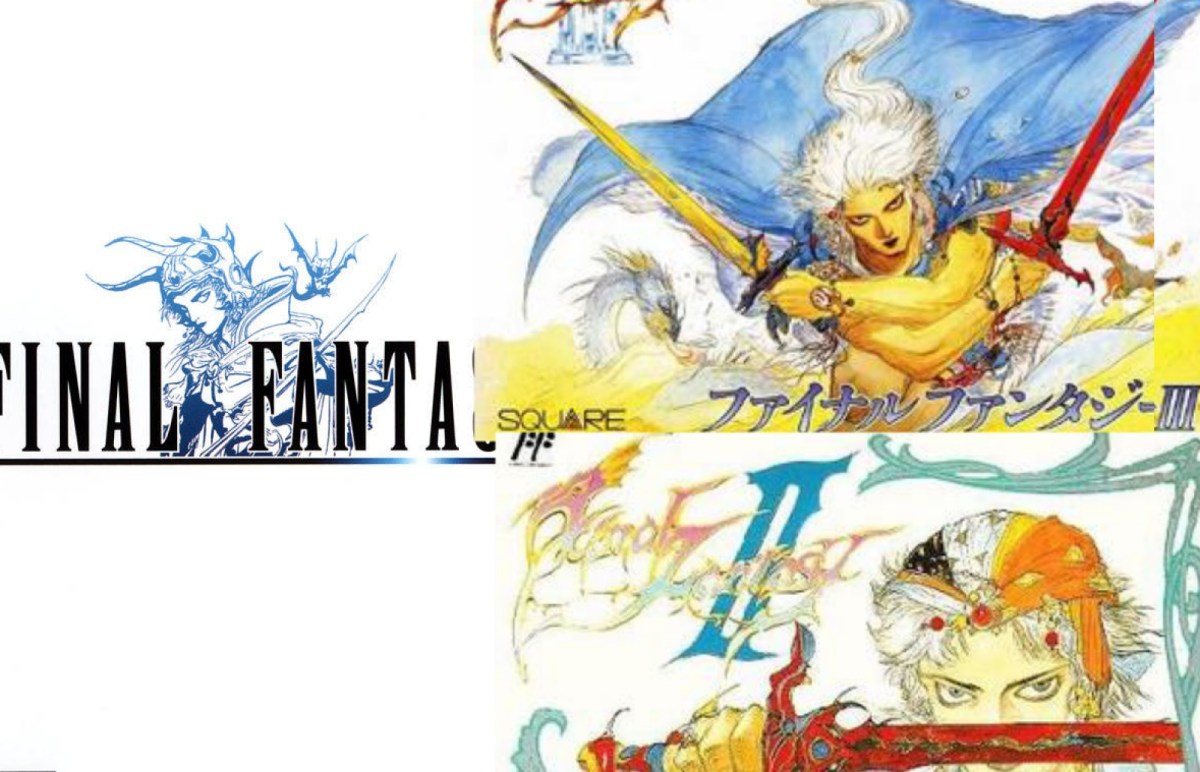
Playing Final Fantasy I, II, and III For The First Time

I try to play a lot of games. I find exposing oneself to a wide variety of ideas and precedent helps one form a better understanding of the craft. I especially am fond of tracing the development of certain ideas and precedents over long stretches of time. In a moment of hubris that could be perhaps, generously, described as “insane”, some friends and I decided to undergo the herculean task of playing through the entirety of the Final Fantasy canon. The Roman numeral numbered ones, anyway. There are scant few games with such a distinct and traceable lineage. This is but the first leg of a long journey. Perhaps by the end you dear reader, and I, will have learned… something.
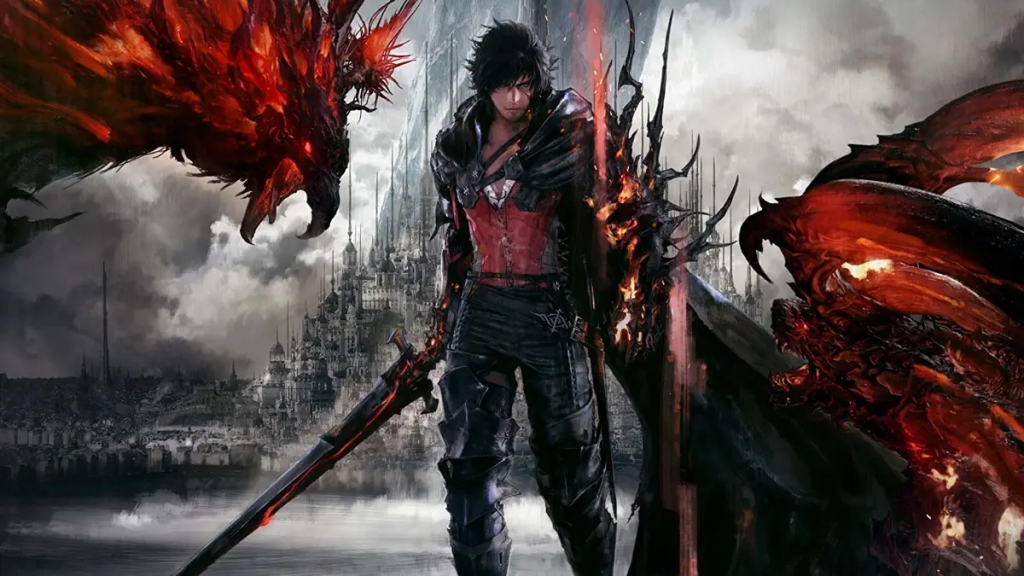
A man in red and black armor wielding a black sword with a red crack in it in one hand. His other hand is spiky and demonic with an orange glow over black armor.

He stands before an ashy gray castle in the background. A fiery phoenix and wolflike beast growl at each other from the corners of the screen.

Promotional image of the game Final Fantasy XVI

…We’ll get there.

As this is a retrospective, expect at least some spoilers for these games.

Final Fantasy I – Setting a Precedent

This is not going to be a narrative retrospective, at least not primarily, but story is an important part of this franchise’s identity, so I will touch on it briefly where I have something to comment about. Final Fantasy I‘s initial setup is about as simple as it gets. Four Warriors of Light set out on a quest to save a princess from an evil knight, then quickly discover they are heroes foretold in legend, destined to defeat Four Fiends, collect four magic crystals, and restore the balance of light and dark in the world. Still, even from humble beginnings, someone somewhere wanted to make this tale stand out a bit, with inspirations likely from Japanese mythology, manga, and anime, all of which tend to deal with rather esoteric concepts. The evil knight from the beginning of the game, Garland, reveals that he has enacted a complex time loop by sending the Four Fiends back in time. The result of this is that Garland becomes the immortal demon Chaos. Once defeated, all of our heroes’ adventures are undone, along with the evil of Chaos, though the memory of those adventures remains etched in the Warrior’s hearts. There are elements of Final Fantasy‘s heart here already. The esoterica, the high-minded fantasy concepts, the slight twinge of melancholy at the end of a long journey, all feelings that pervade the Final Fantasy games and their derivatives that I have played.

A man in full platemail, helmet decorated with bull-like horns and glowing yellow eyes. He wields a giant greatsword, and has a woman in a dress slung over his shoulder. A castle looms very small in the background. An image of the evil knight Garland.

Yeah man, this guy…

At the outset, the player chooses a lineup of four heroes from a roster of possible character classes with different abilities. Notably, you can loadout your team any way you like. Use four white mages, aka healers if you so like. Use four glass cannon black mages. This level of customization sets a nice precedent going forward for what the gameplay of Final Fantasy is, I think. The game followed the release of Dragon Quest about a year earlier, and follows similar conventions of its contemporaries. Turn-based combat with simple rules, spells, attacks, and the ability to run from battle.

Often I judge my enjoyment of turn-based gameplay by how much leeway I am given for strategic thinking. There’s… not a whole lot of that in Final Fantasy I. Boss and enemy designs tend to be straightforward. One throws fire at you. One throws ice at you. Sometimes enemies are stronger than you, though, and figuring out how to maximize your heroes’ damage while keeping them alive can be a bit of an entertaining problem.
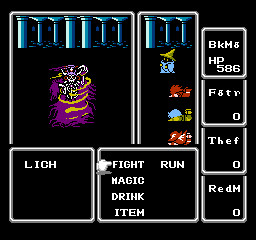
A skeletal mage labeled 'Lich' fights against a mage in a blue robe with a face shrouded in shadow, all on a plain black background. The menus surrounding the fight are labeled 'Lich' 'Fight' 'Magic' 'Drink' 'Item' 'Run' 'BkM 'Fhtr' 'Thef' 'RedM'

The game’s visuals are simplistic, but refreshingly uncluttered.

My friends and I did arrive at a rather interesting strategy. It’s pretty apparent that it wasn’t the primary method of play, that it was a strategy unique to us, so that’s pretty cool. We had a part of one strong physical attacker, the warrior, one potent offensive mage, the black mage, one healing support, the white mage, and one jack-of-all-trades red mage. Our go-to method is thus: The white mage casts a strength-enhancing spell on our warrior, and the red mage casts a speed-enhancing speed spell on our warrior. Our black mage continues to blast offensive spells away, not needed enhancements to do decent damage, especially against several enemies at once. Meanwhile, our warriors becomes a lawnmower, shredding through bosses and other monsters like dry grass.

So while our decision making process never really changed, we did make some interesting decisions that allowed us to clear the game, so that’s good. On the other hand, the presence of a certain mechanic I dread really accentuates the repetitiveness – that being random encounter system. In the overworld, the player character moves across terrain divided into tiles on a grid. Each time they pass a tile, there is a chance they will be forced into a monster encounter. I think I’ve decided by now I pretty much detest random encounters, for a number of reasons. They introduce a level of abstraction that is irritating to me, bringing me out of the fantasy of the world. Where are all these monsters coming from? Where are they hiding? Why are they not dangerous until they are on top of me? Worse than that it bring an unjustified level of agency away from the player. The use of random encounters in early RPGs almost certainly was partially a tech consideration. The NES can only render so many items on screen, and a consistent supply of enemies to fight was needed. Still, from a purely ludic standpoint it’s annoying as hell. Crossing a continent in this game could take two minutes, or two hours, depending on your real-world luck stat. Mine is very very low.

I always find myself comparing old RPGs with random encounters to one of my favorite RPG – Chrono Trigger which, contrary to many of its contemporaries, had no random encounters. Enemies were consistently visible in the overworld. Sure, there were surprise encounters, and required encounters. Enemies often leap out of bushes to ambush the heroes. The added context and predictability of these encounters make them far more tolerable, especially when backtracking through areas, as is often required in RPGs. When one can mentally prepare for exactly how long a task it’s going to take, it’s a lot more pleasant than getting surprised with a lot of meaningless activity that does little but waste time. Any advantages you could gain by having random encounters can be achieved with more bespoke, designed encounters, with none of the frustration. But, this is Final Fantasy I of 16, so I’d better get used to them. Just wanted to throw out the random encounters rant early on here.

There’s one more thing I’ve got to say about this first game. Final Fantasy I sprang forth about a year after the release of watershed title Dragon Quest, itself inspired by similar role-playing-type games like Ultima. Ultima, in turn was inspired by Dungeons & Dragons, itself inspired by other tabletop war games and major fantasy works like The Lord of The Rings. J.R.R. Tolkien’s Legendarium, which includes The Lord of The Rings, represents a sort of fictive mythologized history of the real world – a legend for the modern age. My point is, Final Fantasy represents a lineage of people exploring the nature of the world as they understand it through imagination. There’s something poetic, I think, about how the heroes of the story embark on a journey that brings them across the world, and to the edge of history, only to rid the world of evil, at the cost of forever leaving those fantastical events behind, as nothing more than a fantasy. They don’t get to stay in that world, but the memory of it stays forever with them. Final Fantasy I is a humble game, with systems, gameplay, and storytelling that are primitive by today’s standards, but it’s also impossible to divorce it from all this context of its creation. There’s a lot of beauty, in this humble little adventure.
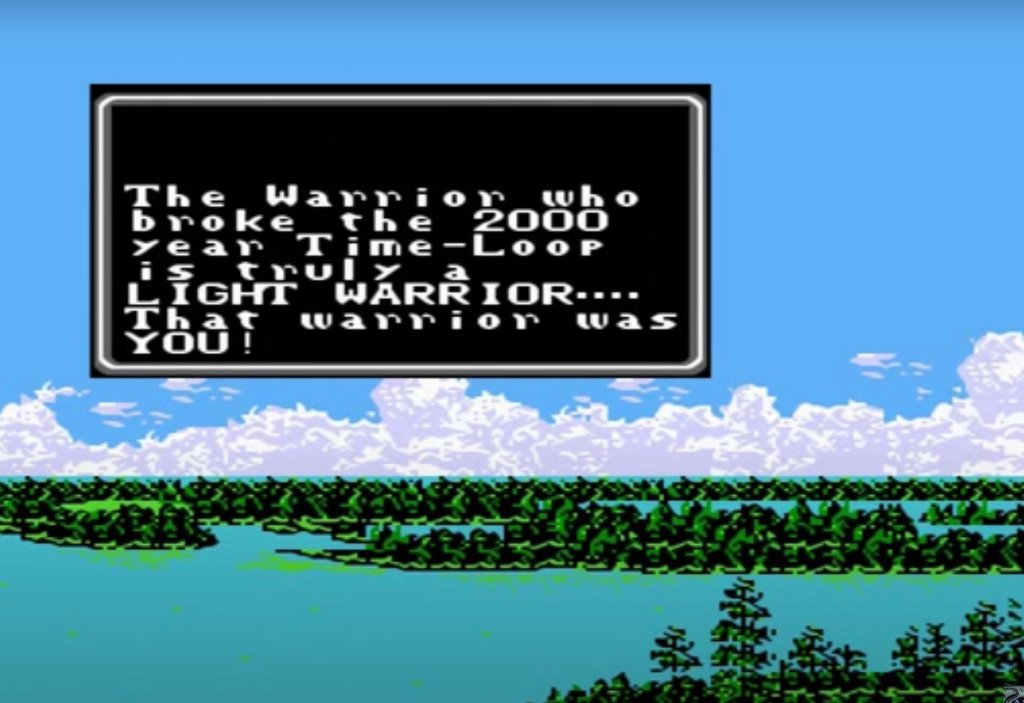
A message saying; 'The Warrior who broke the 2000 year Time-Loop is truly a LIGHT WARRIOR.... That warrior was YOU!' is imposed over a backdrop of peaceful waters and forests of pine trees under a blue sky.

Final Fantasy II – Experiments Are Educational, But Not Always Fun

The early Final Fantasy series was notoriously mislabeled in the west under its English releases, with Final Fantasy IV being erroneously christened Final Fantasy II to English speakers because the actual second and third entries to the franchise were simply not released outside of Japan. You know, I believe in the dissemination and availability of media across cultural boundaries. Translations and localization with easy availability are not only good, but necessary for a thriving and robust culture. That said… I think I could see how The Powers That Be found that, in the project of bringing Final Fantasy to the western market… I understand why they decided, “eh, think we can skip this one” (this is a joke). I mean… It’s bad, guys. I did not thoroughly enjoy my time playing Final Fantasy II.

The story of this game is alarmingly Star Wars. I know that’s an easy criticism to levy at a lot of fantasy media, but it’s really true in this case, I think. Everything from a rebellion lead by a princess fighting an evil empire, to a secretive emperor with a flying super weapon that razes civilizations, accompanied by a right-hand man dressed in black who is a secret lost family member that eventually turns good again at the last minute. The biggest major departure is the journey’s terminus taking place in a bright technicolor version of hell, which was a pretty delightful surprise, though somewhat harsh on my eyeballs.
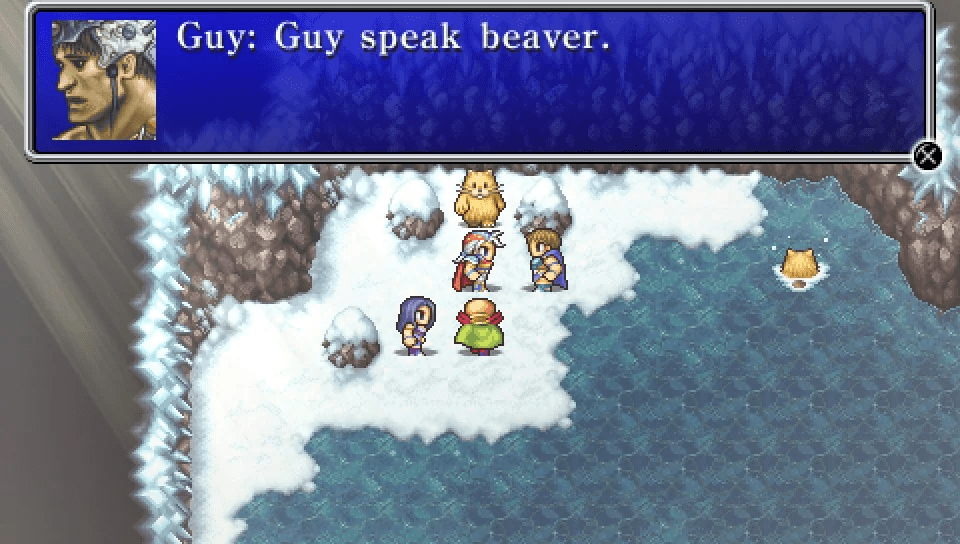
A portrait of a man in an armored hat next to a text box reading "Guy: Guy speak beaver."

Below the text, four people stand near a beaver in the snow.

Okay, never mind this story is Kino.

Once upon a time, the coolest, hypest, most exciting RPG on the horizon was the as yet unreleased Elder Scrolls V: Skyrim. We were dazzled with its cutting edge graphics in one-thousand-and-eighty-whole-p, 1080p! We were told about many of its new, innovative, never-before-seen gameplay systems that would upend what we thought an RPG could be! For example, the traditional RPG character level system? Out the window! Replaced, with this shiny novel skill system where your hero would improve specifically at the tasks they performed the most. How fresh! How new! Except, of course, this system predates Skyrim by more than two decades. It exists, in near identical fashion, in Final Fantasy II, which also forgoes its predecessor’s level system in favor of an adaptive skill system. Suffice to say, it leads to many of the same problems that plagued Skyrim in its day, though in some cases to a far greater degree.
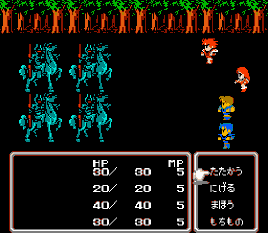
Against a black background, four cerulean blue knights on horseback fight against a four heroic warriors. The menu at the bottom of the screen reads hp and mp, as well as the heroes' names in Japanese.

Oh featureless black void in which all fights take place, we’re really in it now…

Your heroes’ efficacy with a sword, with a shield, even with their ability to sustain damage is all determined by individual numeric values that only increase when engaged in their associated property. For your Warriors of Light to have a decent health pool, they have to be smacked in the face, repeatedly, and at length. Because you are able to target allies with offensive commands in battle, the best way to train hp is to have your heroes smack each other. The adaptive skill system introduces all kinds of bizarre and irritating behaviors like this. Whenever you get a new spell, you are not enthralled by the exciting new possibilities, but debilitated by the crushing knowledge that you’ll have to spend hours mindlessly blasting weaker monsters to get this new spell to even reach the point of being partially usable.

You will consistently feel pigeon-holed by the choices in character building presented in this game. Make no mistake, Final Fantasy II offers a bevy of options when building your heroes for battle. There are lots of different swords with different properties, from swords, to axes, to polearms. You can even dual wield! You can carry a shield. You can practice black magic and white magic as you please! You can customize your spell loadout. And yet. It takes so much time, and so much effort, to get any of those aforementioned options up to a level of usefulness with the adaptive skill system, that if you don’t choose your course for each hero early on, and stick with it, you’ll find your jacks-of-all-trades to be rather useless in combat by the end. In this way, Final Fantasy II rather lacks the adaptability in hero roster customization that even Final Fantasy I had.

This is not to say that such a level of adaptability is necessary to even complete this slog of a game. And I don’t use that word lightly. A lot of RPGs are very long, and very repetitive, but engaging with II‘s content is so consistently irritating, with more random encounters than ever before, that I eventually found myself engaging in… the Teleport spam. You see, Teleport is one of those spells – the kind that remove enemies entirely from battle. Usually, the tradeoff for that in most RPGs is that enemies will not drop loot, or provide experience points to level up. However, my hero’s skill at successfully casting Teleport did improve every time they used it, making this spell an infinite feedback loop of instantly killing everything, and becoming more likely to instantly kill everything. Including bosses! Including the last boss, save for his… very very super last, final form. Even then, we moved on to employing some other similarly cheesy strategy to dispatch him. ‘Cheesy’ in the case meaning, that it does not feel as though the strategy meaningfully engages with the mechanics of the game. The win against the boss at the end rang kind of hollow for me.

So Final Fantasy II was extremely experimental. It tried a totally new way to conceptualize character building. Even its Star Wars-ass story feels like a test bed for what these games could be capable of narratively. I mean certainly a lot of things happen in this game. It’s turn of event after turn of event, even if they all feel very familiar. Gameplay seems to have become even more simplified since the first game, but that may also be a byproduct of experimentation, with new spells and skills and whatnot. Experimentation isn’t a bad thing though, even if it seems to have thoroughly ruined this particular outing. Based on what I know of Final Fantasy now, it’s almost certain that the developers learned a lot about what worked and what didn’t while making this game, and that’ll serve them well in future titles.

Final Fantasy III – Why This Game And Not Any Other?

Final Fantasy III starts introducing more of those bizarre, esoteric concepts that require some serious thinking to really keep straight it your head. There’s no time travel, as far as I can tell, but there are larger than life mythological wizards, with special gifts of immortality, or dream walking, etc. There is global time stoppage, though. There’s a giant floating continent that the heroes were born on, not knowing it was a small part of the larger world. To the game’s credit, I also experienced that same emotional journey – and I’m sure that was the intent, a surprise reveal for players of the smaller Final Fantasy games that came before. Surprise! The game’s world is actually way larger than you thought. Pretty cool. The Warriors of (The) Light are still mostly hollow player-inserts, the quest is still to collect a bunch of magic rocks, and most characters present are not terribly deep or engrossing. The villain is once again preoccupied with immortality, and entangles themselves with dark forces beyond them for their hubris. The series is establishing its pattern of repeating narrative motifs – which is not necessarily a bad thing!

Final Fantasy III introduces the Jobs system. The seeds of this system will germ and survive long into Final Fantasy‘s future, up to present day. It is, in essence, the ability to swap your Warrior of Light’s class and associated abilities or on the fly, or under certain circumstances. In III, this circumstance is any time outside of battle. Your choice of jobs to pick from expands as you progress through the game, with more powerful ones coming later. This is pretty exciting, and does enhance the possibilities of team building from the first game. You don’t have to commit to a team right away. There are a couple problems with this first run at the system, though. For some reason, swapping jobs makes the swapped hero weakened for several battles. I say ‘for some reason’, but it’s likely to make committing to specific jobs per hero attractive, so heroes build more of a gameplay identity, rather than faceless fighters who can do all things at all times. I suspect this, because future such jobs systems will be designed toward that end, but usually in a more clever and less frictional way.
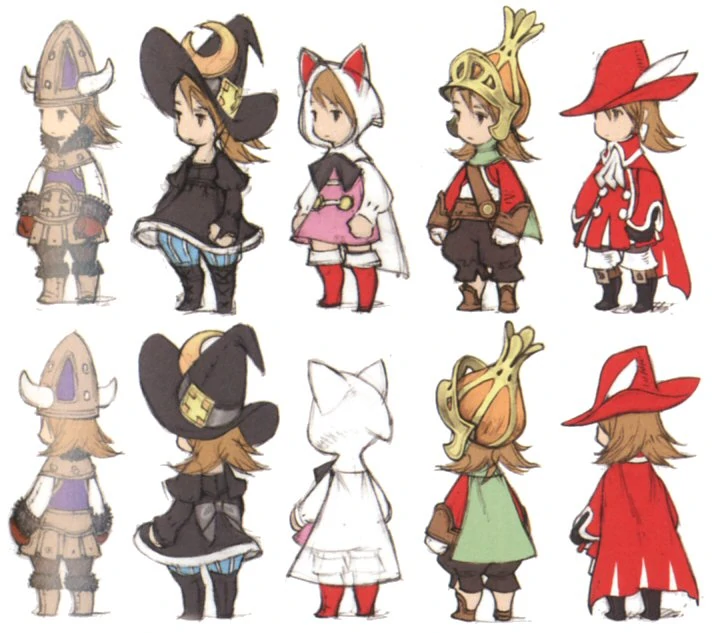
A grid view of the same drawing of a girl five times, with the girl in a different outfit for each drawing, and then again in those respective outfits seen from behind.

All that said though, yeah, the jobs system is cool.

Boss and enemy design of Final Fantasy III is once again fairly simplistic, but there was a moment that came late in the game. I think what I saw in Final Fantasy III was a spark, a flicker, a momentary glimmer in the night that reminds me of the reason that I actively seek out games with turn-based combat. I’m not talking about why I play JRPGS, a vague collection of aesthetic and ludic conventions that form a genre. I’m talking about why I enjoy the play of commanding a team and managing resources in a turn-oriented fashion the way Final Fantasy does it, divorced from all aesthetic and narrative trappings. Within the optional dungeon of Eureka, I saw the essence of what makes turn-based RPGs worth the effort.

The bosses of Eureka are tough. They threaten the Warriors of The Light with devastating attacks and powerful spells. Instant death for individual heroes is a very real possibility. To defeat these bosses, my own team of heroes – us nerds playing the game, had to put our heads together and reason out a strategy. A lot of games require this kind of creative thinking – where your initial approach is brick-walled by an impassible obstacle, and a different approach is required to progress. However, given the strictly governed rules of a turn-based game, the player’s ability to think laterally and solve abstract problems is something unique to this kind of play. It’s the same sort of thing that’s made activities like Chess and Go among the most enduring of all designed games. In hundreds of hours across three games of mowing down group of monsters, after group of monsters, boss after boss, villain after villain, mostly just by spamming our most powerful moves over and over again or… gods save me… spamming the Teleport spell, Final Fantasy III, in it’s final hours, at last forced us to think. It wasn’t just that we could think creatively to solve a problem, but that the game responded to this, and rewarded this. When creative application of game mechanics leads to interesting and rewarding, designed scenarios, that, to me, is strategic liberty, the very reason turn-based games are compelling to me.
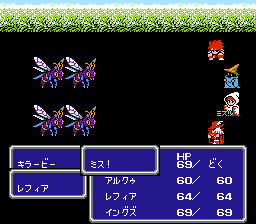
Four purple wasps on a black background fight against four heroic warriors. The warriors names, as well as the options for combat are listed in Japanese on blue menus.

You kill an awful lot of wildlife in RPGs, I’m realizing…

It’s so important for a game to recognize its own worth. Why play this game, and not any other? I play action games to feel a sense of dexterity in my hands and tension in my heart that isn’t possible or quite the same in other formats. I play rhythm games because my sense of music aligns with my sense of play, and the two complement each other. I play platform games because the ease of traversal they entail appeals to a sense of exploration and adventure. I think often games will replicate certain mechanics or conventions based on precedent, without stopping to recognize why those things are precedent in the first place. This is the kind of thing I was hoping to see, playing Final Fantasy as a retrospective – these important core principles to the turn-based RPG and JRPG traditions develop before my eyes in real-time.

It occurred to me that the strategic liberty I so value in turn-based RPGs is much like the solving of a very elaborate and very particular kind of puzzle. It isn’t just that we had to think creatively with the tools we were given, but that the tools we were given operated in tandem to produce new possibilities. For example, the Warrior of Light Refia was our dragoon hero, or spearman. She was also our greatest damage dealer. We were fighting a boss whose physical attacks devastated the heroes. We could counter this with the Protect spell, but that Protect spell could only target one hero per turn, and only two of our heroes were capable of casting it. Moreover, each of our four heroes served an essential role in the party. Refia brought the damage, the dark knight Ingus was the only one who could take a hit, the red mage Luneth was our go-to spell caster, including caster of Protect, and the white mage Arc was needed for healing duty. Losing even one would debilitate us for the rest of the fight.

While our mages were busy casting Protect on people and not healing, one or more of our heroes might straight up die, so raising a full defense was just too slow a prospect. It occurred to us, after some experimentation, that Refia’s Jump ability – in which she jumps off screen and becomes immune to damage for one turn, then crashes back down to deal bonus damage – was maxing out the damage count at ‘9999’. Five of those jumps alone would bring the enemy down. So instead of insuring every hero could survive incoming damage, one of my friend’s suggested, let’s ensure Refia can, so she can constantly jump to safety, while busting the enemy down over the course of ten turns. Instead of Protecting the party, our mages would Protect themselves, while Refia used the guard action to survive. Then, we would buff her with Haste to ensure she’d always Jump before the enemy could act. If ever she was caught with some damage as she landed, we would repeat the process of setup, then sent her on her way to continue the attack. After a couple of tries, it worked! The enemy was defeated, and all of us players cheered.

The sense of satisfaction that washed over us was fantastic. Our friend expressed that they felt like a genius – a familiar sensation for anyone who’s played a particularly challenging RPG. It’s just a shame that this sort of thing had to take several dozens of hours of gameplay to get to. That’s a bit unfair, though, there was some strategizing that took place in the earlier levels of Final Fantasy III. However, it never reached near this level of depth. Knowledge of the game’s rules or how its various mechanics interacted was never really necessary. It was more a continuous process of experimentation – seeing what the various hero jobs did, though a feeling of utilizing them to some greater end was disappointingly infrequent.

That said, the presence of this strategic liberty, even at the eleventh hour, kind of redeemed Final Fantasy III a bit in my eyes. Like Final Fantasy I, I think it’s very commendable for its time, and it’s scratching at the surface of some of the things that I think makes this kind of game great, which is a good sign! I’m optimistic going into Final Fantasy IV, another game I’ve never played! Final Fantasy will be entering a transitional period, I predict, as it undergoes a transformation from its simple NES days to the robust cutting edge graphical and storytelling experiences of the SNES and PS1 eras, and beyond, that the series is famous for.
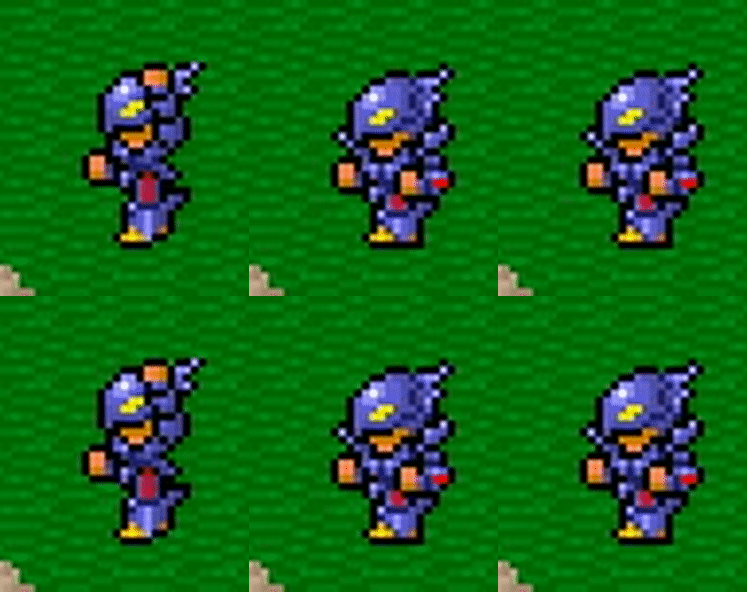
A man in blue dragon-like armor with glowing yellow eyes repeatedly pumps his fist in the air on a grassy background.

With the memory of their struggle buried deep in their hearts…
Final Fantasy 7 Remake: Active Time Battle Finally Comes Home

There was a lot that impressed me about the Final Fantasy VII Remake, released 2020. For me, it set the standard for the full revitalization of an old game. Or rather, it would be if it weren’t only part one, a game that covers a fraction of the story of the original. Repackaging the story of one game into several full-sized, full-priced games, re-imagining the combat systems completely, expanding and rewriting the story. These are all controversial decisions, though they are assuaged somewhat by the existence of Ever Crisis, another full remake of Final Fantasy VII that is a more traditional, more faithful remake using updated assets. Indeed, there are so many interesting questions surrounding this game one could discuss. For now, let’s talk about the changes to Remake‘s combat systems, what experience they’re trying to accomplish, and why they are the way they are.

A girl in a plush animal-shaped hood and a stoic man with a staff team up to beat the ever-loving-stuffing out of an ostrich-like carnivorous bird.
ATB: The gentleman’s method of abstracting physical altercations with wildlife

One feature of Remake‘s combat that I find most interesting is the presence of the ATB bar. For those unfamiliar, Final Fantasy has employed at various points since its fourth installment the Active Time Battle system, or ATB for short. For the folks who may have been riled by Square Enix’s recent efforts to bring Final Fantasy more into the realm of action games, and deployment of increasingly arcane systems combining action with turn-based combat, rest assured that this is not a new trend. They have been trying to do this since the 90s. In its traditional use, the ATB bar is a timer that counts down to when a player character can act in battle. The faster that character’s speed stat, the more often they can act. When action is not possible, characters stand idle. So essentially, it’s a traditional turn-based combat, but with the wrinkle of an active timer.

At the heart of the ATB system’s ambitions, successes, and failures, I think is this tension a lot of combat-oriented games experience between their action elements and strategic elements. There advantages in verisimilitude, theoretically, as a real-time element brings with it less abstraction, but also a loss of many of the advantages that turn-based represents.

Turn-based games are inherently strategic in their foundation. The benefit of having combat play out over an indefinite amount of time is giving the player the space to make informed and meaningful decisions to gain an advantage over the opposition, which is where the challenge in turn-based combat comes from. Enemies need to be powerful enough to require critical thinking and problem solving in order to be engaging. Problem solving and critical thinking requires time to think. On the other hand, action combat is often all about twitch reaction, muscle memory, and being present in the moment as developments unfold around you. This is why you often finding me describing real-time game systems as ‘action’ ones. Now, action games can and often do have strategic depth as well, but the strategy of a game like soccer exists on a different state of mind than a game like chess.

There is an inherent friction between these ideas that can crop up in any system that aims to combine the two experiences. If action is meant to be all about the pressure of events happening in real-time, when do you get the time to develop your strategy? If that space for critical thought and puzzle-solving is needed for a turn-based game to have its strategic depth, how do you provide that space without disrupting the flow and rhythm of an action game?

In the ATB system’s early uses, the main advantage I can see is its ability to offer variable turn frequency through the speed state. It’s an interest dimension to scale character power, not one that is super frequently employed in turn-based games. Usually enemies and players only get one turn each, in even ratio to one another. Allowing that ratio to change can create some very interesting scenarios. There are disadvantages though. Personally, I love taking my time to formulate the perfect strategy and course of action in any given situation in a turn-based game. It’s a big part of the draw for me. The ATB system, which allows enemies to continue acting in spite of the player, demands that one keep taking actions or quickly become overwhelmed. Older Final Fantasy games would often have a mode to address this, but the wait mode of of old Final Fantasy is effective the same as regular old turn-based, kind of defeating the purpose. I believe Final Fantasy VII Remake has an optional mode akin to this, though I would argue Remake’s combat is a fuller realization of ATB’s design goals regardless. The argument that the wait mode represents a lack of confidence in the ATB systems early on is stronger I think, when one examines Final Fantasy X, a game in which the speed stat still exists in the form of agility, but represents the frequency of turns for an actor within a non-real-time system. Static turns are simply queued up in an ordered list, with faster characters getting more turns. The real time element here, was unnecessary, and therefor not included.

A girl in a plush animal-shaped hood teams up with a stoic man wielding a staff to pummel a leopard-like monster. Time stops after a moment while a UI element is navigated, after which both characters unleash powerful flashy moves.
In FFVIIR, real-time actions fuel strategic resources, which fuel combat advantages

What are those design goals then? Well going by the nomenclature it seems the Active Time Battle systems was meant to make turn-based combat more actively engage the player with its time-sensitive elements. Final Fantasy, like Dragon Quest before it, utilize turn-based combat akin to the tabletop games that inspired them. Turn-based combat was developed as a way to create an abstract representation of combat for the safe environment of a game. There aren’t a lot of practical ways to really play out hitting each other with swords while gathered around a table, without this layer of abstraction. Nowadays, I think there’s a lot of appreciation for the unique experiences possible only through a sophisticated turn-based system. I get the sense that even in the 90s, all the way up to now, some at Square Enix felt as though the turn-based system imposes limitations on what the combat can be, and imposes a barrier between the player and being immersed in the game’s world.

I think that last point is debatable, but what isn’t, so it seems to me, is that the ATB system wants the player to feel more pressured, with a more present sense of danger and action playing out in real-time. The problem for me, is that the simplicity of the ATB system feels like somewhat of a half measure. It’s a little at odds with the strategic systems of Final Fantasy combat, but also doesn’t fully create a sense of urgency or action for me. It’s kind of just a turn-based combat systems where you jump through a few extra hoops. The first real exception to this for me… is… not Final Fantasy VII Remake, which would come a lot later. Chrono Trigger is a vary notable instance of a game taking the ATB system and pushing it in an interesting direction.

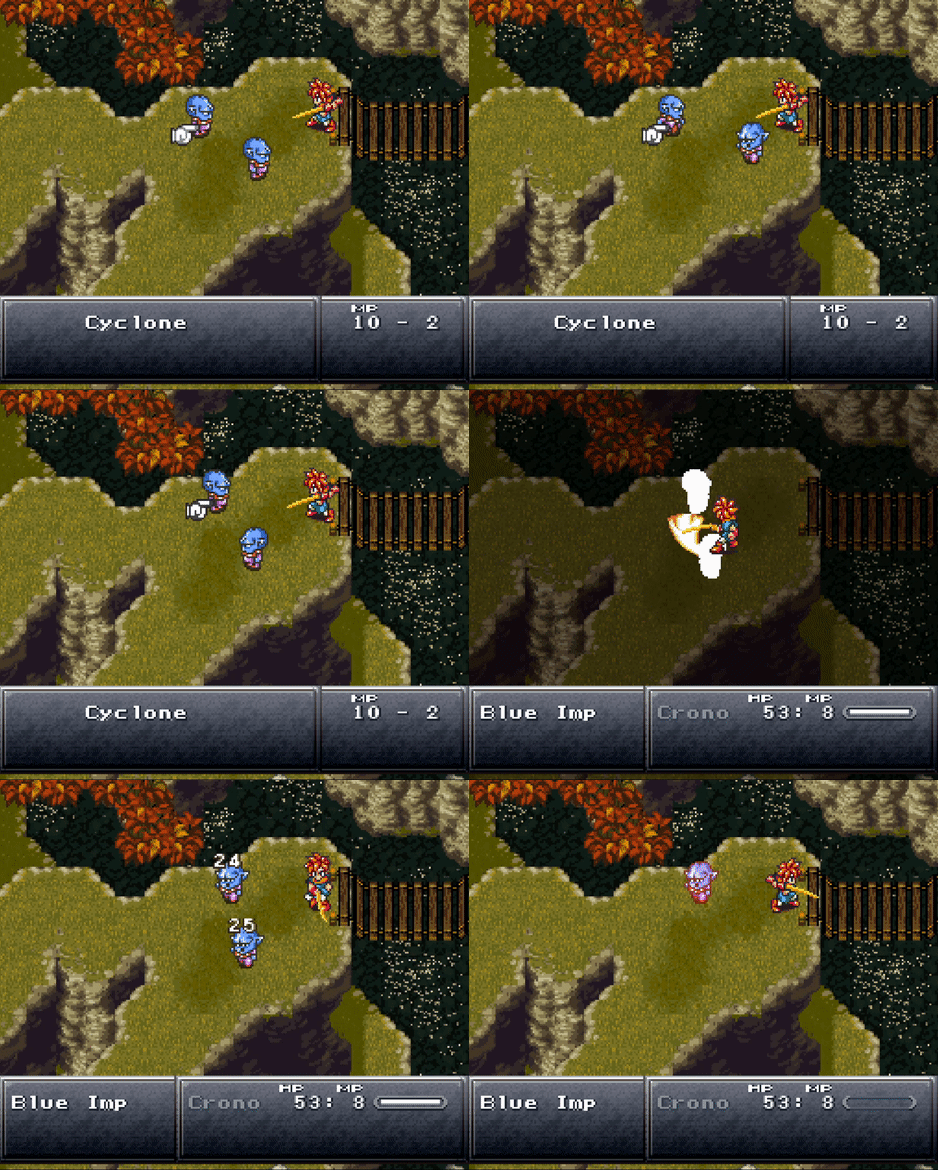
A red-haired swordsman is accosted by a pair of blue goblins. One kicks him. The swordsman then spins his blade around in a cyclone, hitting and dispatching both goblins at once.
Wait for the opportune time to use the right move, and this real-time element makes a lot of sense

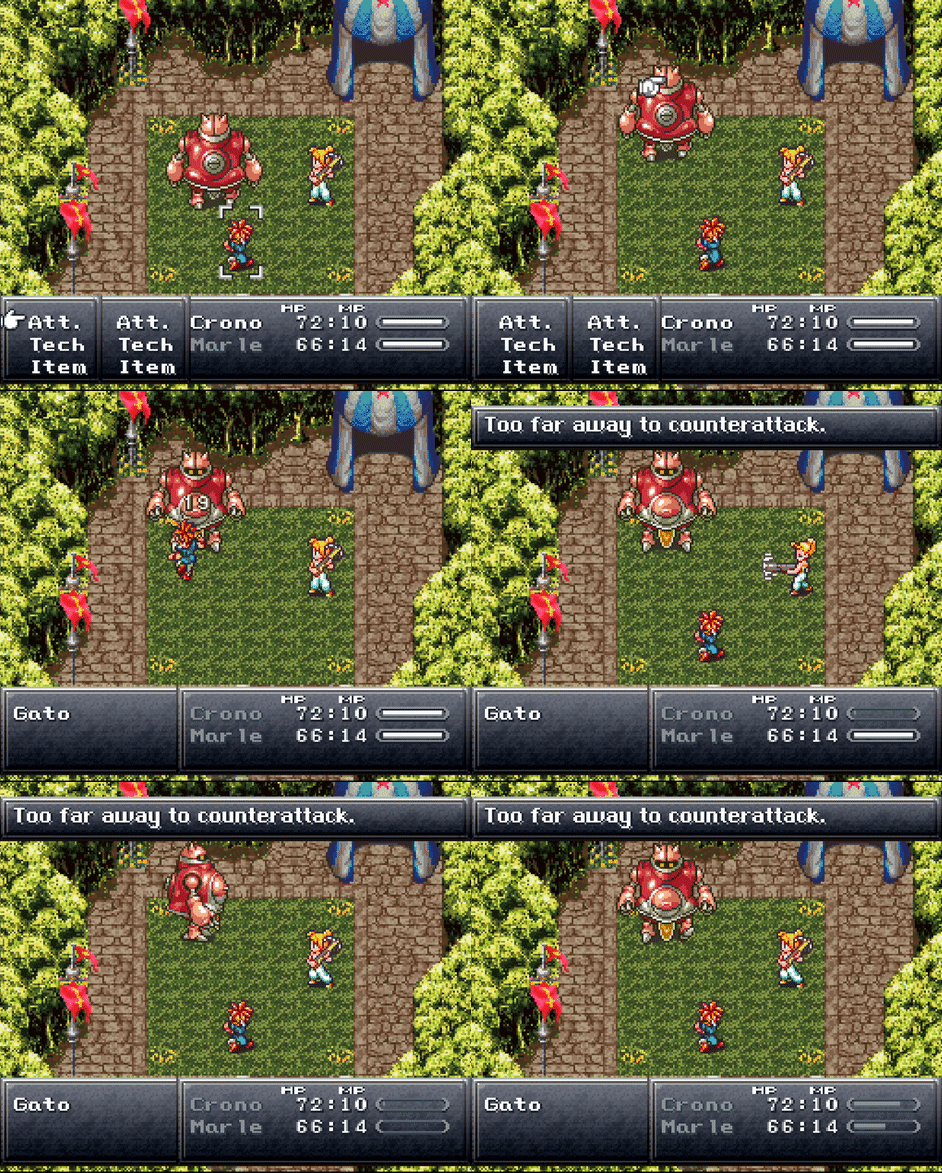
The key for what makes the ATB system work for me in Chrono Trigger is the importance of player and enemy positioning. Some of the Final Fantasy games had shades of this, but it was very digital and binary. IE: If you’ve ambushed enemies you have an advantage, if they’ve ambushed you, they have the advantage. In Chrono Trigger though, the relative position of enemies is analogue, constantly changing, and an ever-present strategic element. This element is often just a small, simple detail. For example, when several enemies are close together, you may be able to hit all of them at once with a single special attack, but not if they’re spread apart. If an enemy is too close to the player character when attacked, they may immediately respond with a counterattack. That sort of thing.

This simple extra dimension was like a missing link for me. Real-time is only one element of what makes action games engaging. In a traditional turn-based game. Things such as multi-hit attacks and counters are often very static and abstract. A multi-hit attack might always hit three enemies, or always hit enemies adjacent to one another, though they never move. In Chrono Trigger, and games influence by it, enemy positions are organic and ever-shifting, a natural and intuitive extension of the world. This ingredient alone makes the ATB bar make sense, as the dynamics of battle change in real-time along with the turn order. As I’ve often said elsewhere, relative position and spacing management on the part of the player is also an essential element. Chrono Trigger had a great commitment to holistic nature of its world. There are no random encounters. There are no battle transitions – the combat takes place in the same physical space it is initiated in. And, of course, battles occur in real-time. The game works to minimize abstraction in the broad strokes to make the game as seamless and cohesive as possible. Chrono Trigger brings these elements together in the context of a turn-based game, and was the last real evolution of the ATB system, in my opinion… until…

Well okay, there are a couple of other Square Enix games I want to talk about that finally lead us to where we are today with Final Fantasy VII Remake, but first I’ll finally talk about Remake. Remake‘s primary conceit in its combat is that you can run your player characters around a 3D space and directly command them to attack in real-time, taking after the likes of a Kingdom Hearts or Devil May Cry. While not as robust a system as those, Remake‘s action makes for an effective stopgap of realism to reinforce what is being represented by the more abstract strategic decision making that takes place between – the action forms an important bedrock of context. Kingdom Hearts is another series that initially attempted to marry turn-based combat’s strategic elements to an action system, but ultimately fell head-first into the symbolic dream-ocean of full-on action game by its first sequel. The wrinkle for Remake, though, is the player’s ability to pause the action at any time to assess the situation and execute specific commands for the party members, commands which are invariably a lot more powerful than the standard real-time attacks.

A lot of games have tried this ‘stop and go’ sort of combat. Most prominently I think of old CRPGs like Baldur’s Gate, Planescape: Torment, or Dragon Age for a more recent example. These games take direct inspiration from Dungeons and Dragons or are indeed, even licensed games tied to the property. Weirdly though they’d often not employ turn-based combat at all, unlike the actual tabletop game they’re based on, almost as if turn-based is this inherent limitation to be overcome. I wonder if the developers at Square Enix ever played these games, or were inspired by their indifference to turn-based combat, haha. Suffice to say I think turn-based combat has almost always been underappreciated for its merits in many spheres of video game development. What made combat for a game like Dragon Age a little dull for me, was in how the real-time segments and paused segments, the player characters’ capabilities are exactly the same. So ultimately, I just felt like I was disrupting whenever I needed to pause the game to line up a spell, and since all characters are only indirectly controlled through commands, I never felt fully engaged during real-time either.

A girl in a hood shaped like a plush animal summons mystic runes around her to launch magic attacks at a soldier. Her partner, a stoic man with a staff, dashes up alongside the soldier at the same time she does, to do a combination attack.
Satisfying action, satisfying strategy, but most importantly the two modes support one another

This is where Final Fantasy VII Remake really accels, I think. It’s built on the solid foundation of an action game, with a full suite of direct control for the player, from blocking to dodging to parrying. And you’ll need those options, as the enemies take full advantage of their freedom of movement while the game is un-paused. Engaging with this action system builds up your ATB gauge, no longer a mere function of time, it is a function of engagement with the core systems. At certain thresholds of ATB, you can command a party member to unleash a powerful attack, and are given the ability to pause the action to carefully consider how and where to employ these ATB abilities. This pausing never disrupted the flow of the game for me, because they’re always big moments I was building to – rewards for effectively playing the game. The barrier between what can be done during real-time, and what cannot be, also very effectively delineates the two modes, so I never felt as if one is intruding on the other. I have to pause the game to heal a party member, or to unleash a skull-cracking dive kick. These actions are not something I can just do on the fly. They require strategy and consideration, so their presence within a pause sub-mode of the game feels natural. The ability to pause is a godsend too, as the player characters each have very intricate combat mechanics unique to them that, when used in tandem with careful consideration, can have some devastatingly powerful results.

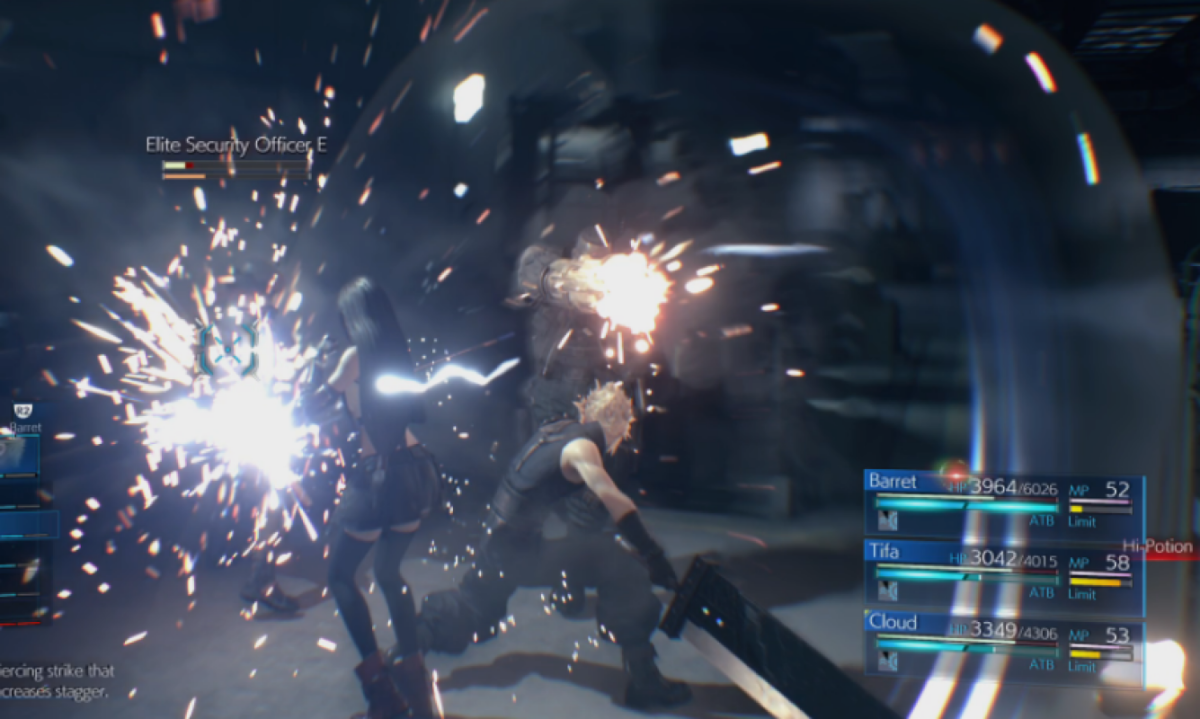
Cloud, Tifa, and Barret from Final Fantasy 7, beat the stuffing out of a soldier in a sci-fi wearhouse. The action pauses mid-fight, in dramatic slow-mo fashion, then the beatdown resumes.
It’s also all very pretty to look at.

Another key to this is the stagger system, which is also an ongoing iterative system featured in many Square Enix games. It creates a long-term goal in any given combat encounter that the player can build up to. By using the right moves at the right times, enemies can be staggered, opening them up for massive damage. A balance of micro-goals and long-term goals is essential to a compelling combat system. From not getting hit, to setting up an enormous combo. It’s these interlaced interest curves, build ups and releases, that keeps combat from getting stale.

This makes for a sophisticated system of setups and payoffs, where every party member is instrumental in stringing together combination maneuvers. Cloud can easily set up a stagger on an enemy with his powerful counter attacks in real time and big sword strikes from the command menu. Meanwhile, Tifa can empower her abilities by stringing together a series of strikes. At the same time, Barret, who can take a lot of punishment, is safe to set up some buffs like haste to increase the party’s speed. Once the target is staggered, Tifa can unleash her built up power to fully exploit in the enemy’s weakness, and Cloud can finish them off once they’re low on health. The fantasy that Remake really delivers on for me is twofold; One, it creates this delightful scenario of being able to pause and survey a complex battlefield, almost like stepping into a freeze-frame of an action movie, owed to how well the real-time segments of the game operate in isolation to create impressive spectacle and compelling scenarios. I can survey these wild combat engagements with a strategic, discerning eye without fear of reprisal. Secondly, the way all of the character’s complex mechanics mesh together creates for me the sense that they are a real, team, working together to accomplish incredible things they could not do alone.

Cloud, Barret, and Tifa team up against soldiers in a futuristic warehouse. Barret, a man with a gun for an arm, casts a spell empowering Tifa, a woman who then punches a soldier dozens of times in a second, before the action pauses again, then resumes as Tifa knocks him over with a dropkick.
Buff up, wear down the target, knock em down. Just as planned!

This schema didn’t appear fully formed in Remake from thin air or divine inspiration, though. Many might not realize Final Fantasy has been trying to achieve this awakening of the ATB system’s dream for years. I can think of three major stepping stones of this journey: Final Fantasy XIII, Final Fantasy XIII: Lightning Returns, and Final Fantasy XV. All three of these games have bits and pieces of the puzzle that would make up the combat system of VII Remake, each containing the germ of an idea that you can see grow into what we have today.

XIII established party-wide strategic command overlaid upon action that exists in a different mode from that strategy. There’s been a lot of criticism over the lack of player engagement for this in-between mode, but the basis of VII Remake started as far back as this game. It became an example how combing two modes of play without disrupting pacing could work, although the quality of the pacing of XIII‘s combat is debatable. The later sequel Lightning Returns did away party dynamics, but intimately explored the stagger system, and how indirectly controlling player characters in real-time could work.

XV was an interesting beast. The result of an overlong development time, branched off from a very different design concept that leaned more on action gameplay. XV shows signs of its troubled development, but I think none is more prominent than the combat system. It isn’t bad, per say, but it feels very underdeveloped. A lot of the ideas that shine in VII Remake exist here in a sort of primordial form. Optional wait modes exist alongside a limit-action systems that puts emphasis of enemies positioning, and party-wide combination attacks. Everything is just a little off. A lot of those micro-goals I mentioned don’t feel as though they are totally in-sync, and long-term goals within combat aren’t totally clear. Nothing quite meshes like it feels as though it should, but all the ideas are there. Whether you actually like these games or not, the long and short of this is that Final Fantasies XIII, XIII: Lightning Returns, and XV walked so VII Remake could run.

The old lessons from Chrono Trigger live at the heart of Final Fantasy VII Remake as well, with the relative positions of enemies and party members in 3D space determining how actions resolve. A big sword swing might hit a dozen enemies at once if you’re careful about positioning! This is taken further than Chrono Trigger even, with the ability to finely control exactly where each party member is standing, and a third dimension to play around with. It’s an intricate dance of set ups, payoffs, and strategic positioning wrapped in a solid-as-stone action game bedrock crafted by old hands when it comes to hack-and-slash ARPG gameplay.

A girl in a plush animal-shaped hood, wielding a giant ninja star, runs up to a group of giant ratlike monsters. The action pauses for a moment, then resumes as she places a magic rune on the ground, which sucks in all the rat monsters, dispatching them all at once.
Real-time danger is the risk one can weight against the reward of advantageous positioning

So Final Fantasy VII Remake does not have turn-based combat, and that is an understandably big loss for some people. What it is not, however, is a turn-based combat system trying to masquerade as a hybrid of action and strategy. Rather, it is the realization of that decades long dream to create an engaging hybridization of strategy and action RPGs. It is at last, finally, the ATB system come home. It is the design goals set way back then finally pushed to their apex, at least so far. Fully realized, the ATB can shine in accomplishing what it’s struggled to do for years. I’m also pretty impressed, and thankful, that a second completely differently imagined remake of Final Fantasy VII is due in the form of Ever Crisis, which seems to retain the old combat system, as a companion piece to Remake. Remake‘s redone combat aims to capture its predecessor’s strengths in a heightened form. It’s a brilliant system to build off of in that regard, and has become one of the biggest reasons I remain very excited for the future installments of Final Fantasy VII Remake.

A blonde young man with a huge sword, an unarmed, long-haired woman, and a large man with a gun for an arm team up to battle soldiers in a futuristic warehouse. Time slows to a crawl as a menu of options is manipulated in a game UI. When time resumes, the party teams up to unleash devastating attacks on the soldiers.

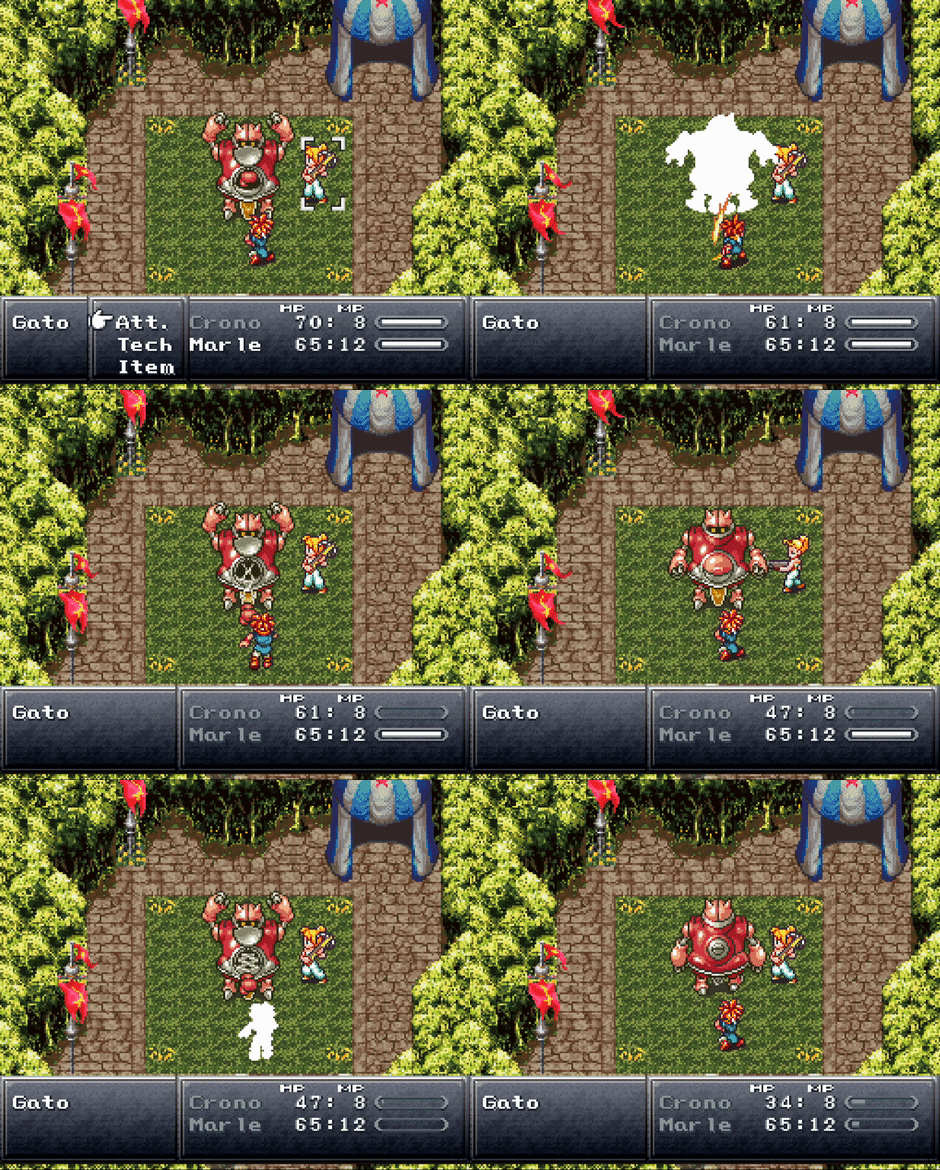
Attack while its tail is up! It’s gonna counterattack with its laser…

Boss Breakdown: Riku on Destiny Islands

Today on Boss Breakdown I’m going to be delving into the wonderfully weird world of Kingdom Hearts to examine an optional boss encounter that comes very early on in the game – the player’s ultimate rival, Riku. Kingdom Hearts is an action RPG developed by Square Enix. Combat in Kingdom Hearts is a fast-paced series of sword battles (well, keyblade… yeah, we’ll just say sword battles) that take place on the ground and in the air with over-the-top fantastical feats of acrobatics and agility. It’s very much larger than life, exaggerated, and full of charm.

The player fills the role of the young dreamer Sora, a resident of the Destiny Islands, a vague sort of childhood-paradise world where teenagers enjoy their seemingly endless summer vacation racing, play-fighting, collecting seashells, and imagining the world outside their own. Sora’s got two best friends – Kairi, a creative, sassy yet kind-hearted girl and Riku, an abrasive, competitive, and contemplative boy. The Destiny Islands act as a safe tutorial space for Kingdom Hearts where the player is free to explore the game’s movement systems without fear of battle unless they seek it out. Riku has an optional boss fight in this early stage and it’s very notable for what it accomplishes. I wanted to talk about Riku particularly for how strong the gameplay-narrative aspects of his fight’s design are. This first Riku boss fight on the Destiny Islands is very basic, comes very early, and is seemingly innocuous. You wouldn’t think it has huge implications on the rest of the game, but there was clearly a lot of thought put into how this early game challenge would fit into the overall experience.

Also Donald Duck is involved, somehow, I understand

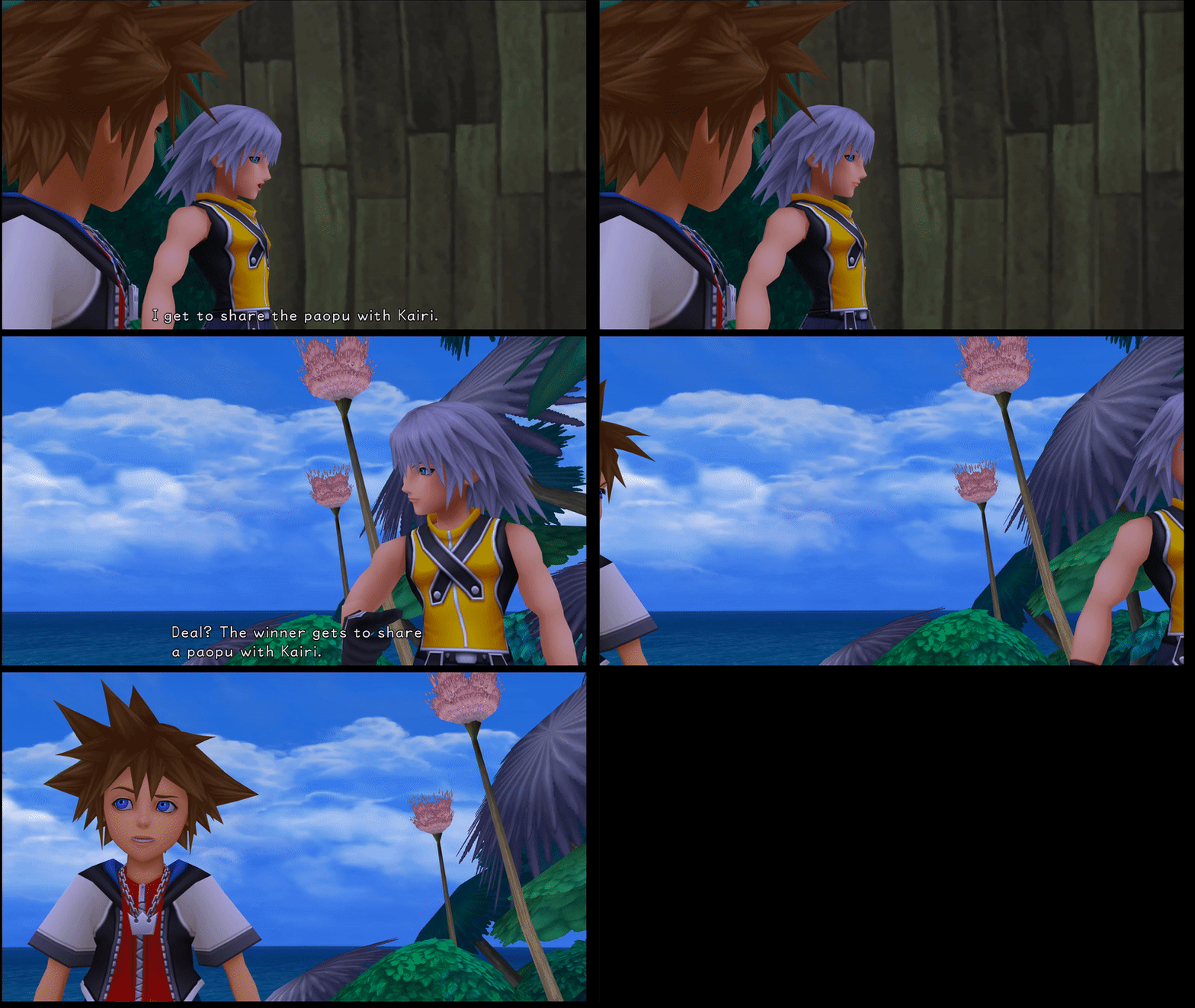
Riku is absolutely terrible, at this point in the narrative. I don’t mean to say I dislike his character, in fact he’s very effective in his role. From the moment you meet him he’s a driving force for the player, motivating them to explore the combat mechanics. He teases and condescends to Sora, but it’s all innocent enough. It feels like friendly banter. Some red flags start to go off when Riku and Sora challenge one another to a foot race. Surreptitiously, outside of earshot of Kairi, Riku puts up a prize, a very symbolic and intimate moment with Kairi, as a bet to be won by the victor of the race. It’s somewhat chilling. Sora doesn’t even have a chance to really respond to the rather untoward proposition before the race begins. The player has a single chance to establish who wins this “bet”, though the result is inconsequential, as Riku will play it off as a joke. It certainly doesn’t sound like he’s joking when he first brings it up, however.

This is like wagering her hand in marriage, basically

There’s some clear tension building among this group of friends, and Riku seems to be the source of it. At a later point, Kairi will offer to escape the island with just Sora, the two of them leaving for adventures together, implying Riku would be left behind alone. Sora doesn’t answer quickly enough, and Kairi too plays off her startling proposal as a joke. In actuality, with the benefit of hindsight, Riku doesn’t act all that terrible generally. Perhaps a bit full of himself, but he does show a genuine camaraderie with Sora and Kairi. It’s isolated moments like that proposition at the footrace where an inner darkness peeks through from him. He says hurtful things from time to time, but he’s ultimately a confused teenager from a very narrow world. Before all this though, Riku strongly establishes himself as the de facto leader and strong, wise “elder” of the group (he’s only a year older than Sora and Kairi, but still). He taunts and brags to Sora constantly during encounters with him, demeaning his abilities in a sort of ribbing way, but also the kind of way that gets under your skin and moves you to prove him wrong.

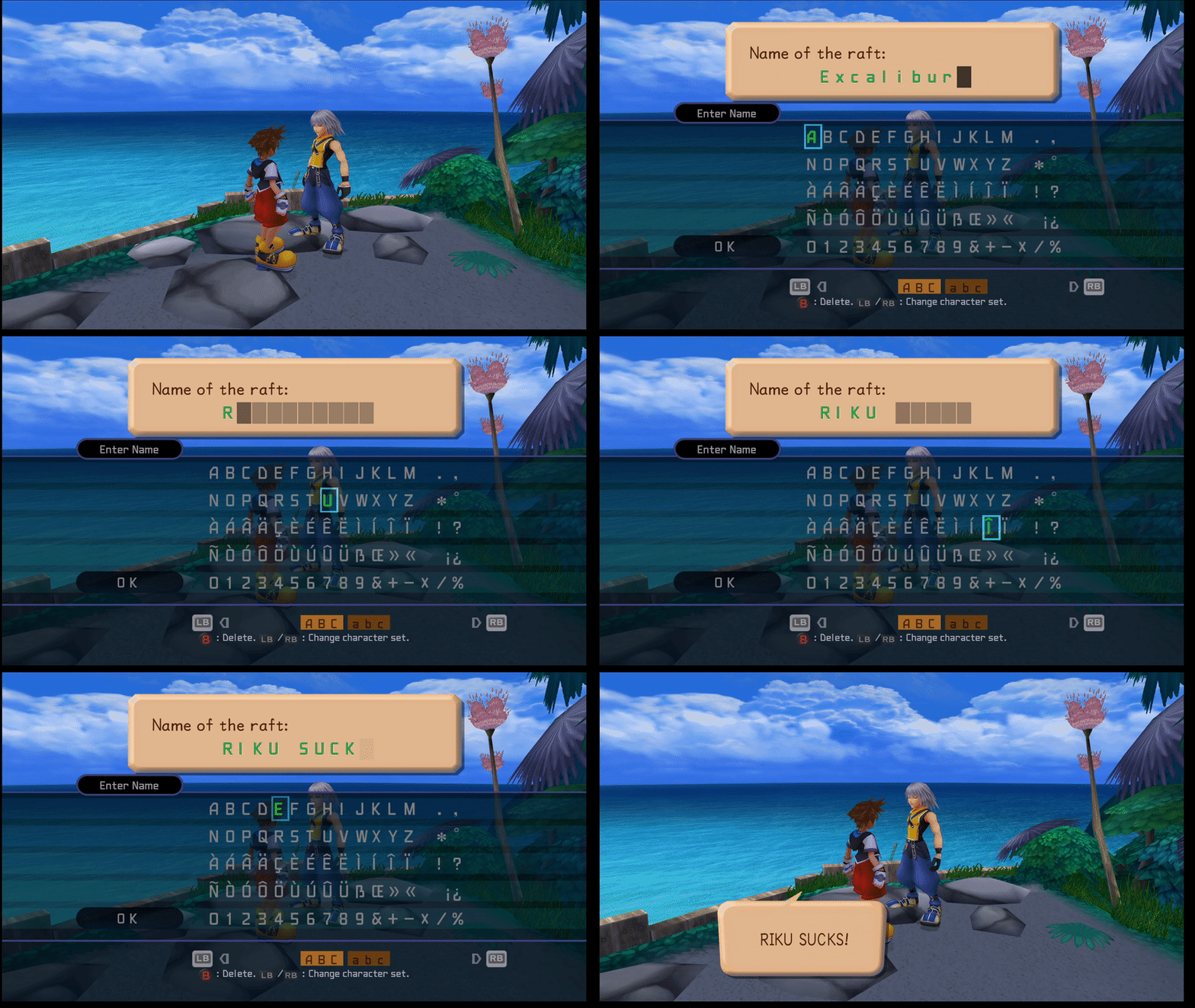
Look at how perfect it is, that text field was MADE FOR THIS

As a young kid, I really did feel like Riku was driving a wedge between Sora and Kairi. It invested me in this microcosmic little world, with Riku as our small-scale antagonist. Riku is positioned that way by the gameplay, as antagonistic. He’s meant to drive you, as the player, to better yourself through game mechanics to better Sora. You feel the same rivalry Sora feels with Riku , and you’re suffering the same way Sora is when Riku beats you into the sand. And he will. A lot. Riku’s boss fight is incredibly overtuned for what I’d consider to be an appropriate early-game boss fight, under normal circumstances, but that’s why Riku is an optional fight. I say optional, but given the aforementioned story context, you’d be hard pressed to find a Kingdom Hearts player who would not at least attempt to defeat Riku a few times.

Me too Sora, me too

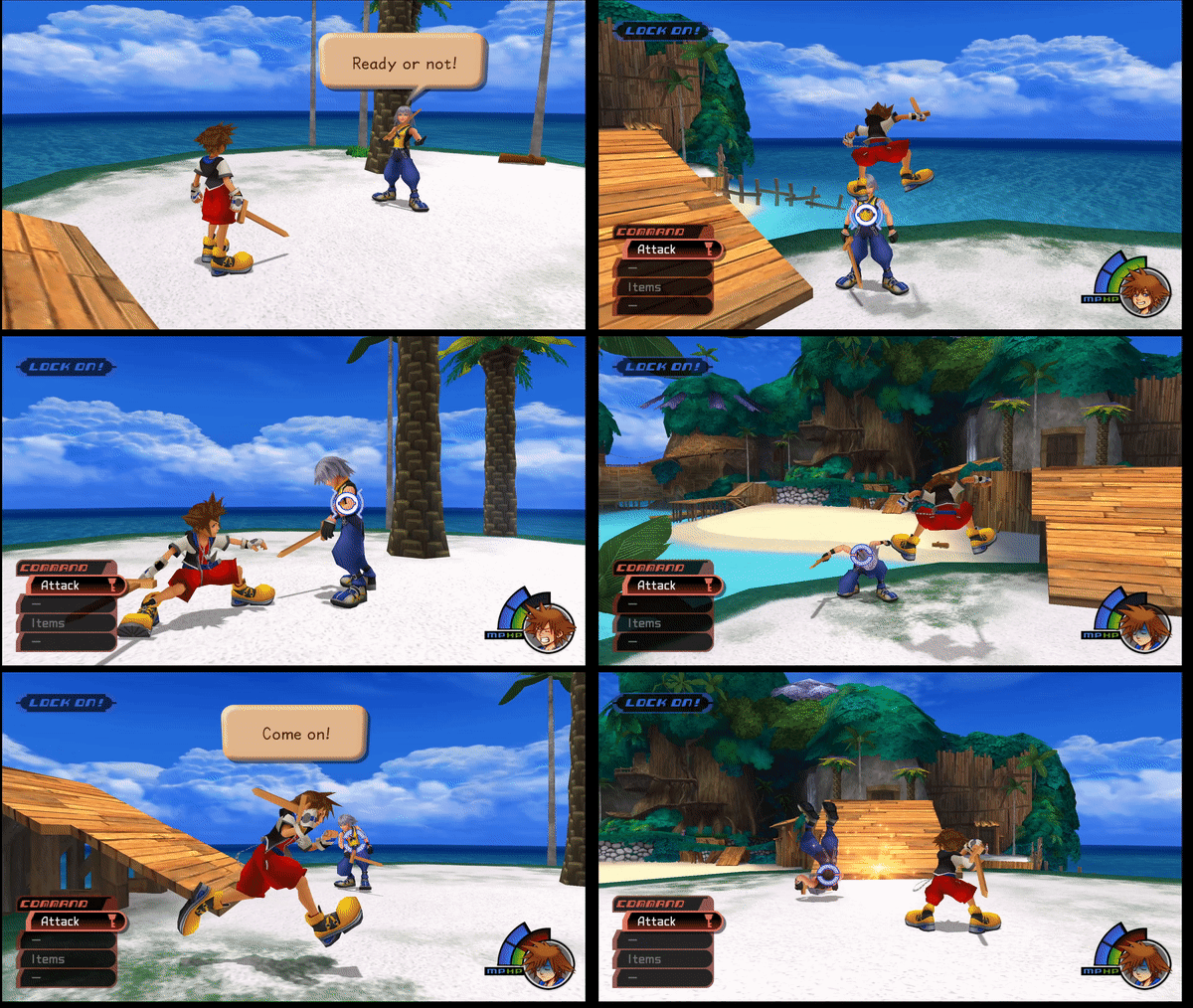
You can challenge various characters to play-fights with wooden swords. Please ignore the fact that beating each other with wooden weapons would still be horribly dangerous, as this is anime land where human children can effortlessly bound twenty feet in the air, do three backflips, then deflect a flying bullet out of the sky with a sword. It’s fine. These are the only real sources of combat available to the player in this tutorial stage, as the story isn’t ready for monsters to be popping out just yet. They act as a sort of optional tutorial set, with each kid you can challenge specializing in teaching some aspect of the combat system.

How humiliating… for them

Selphie teaches the player how to clash with an enemy’s weapon. Tidus teaches you how to outmaneuver a melee attacker. Wakka will teach you how to deflect projectiles. Riku is the fourth and final kid you can challenge, and he’s here to teach you how to lose. I’ve at times heard individuals deride Kingdom Hearts as a button masher, or in other words, implying the gameplay is overly simplified to the point of being trivialized by mindlessly mashing the attack button. I could go into detail about that misconception, but essentially if you have that experience, you’re playing on too low a difficulty setting for your level of skill. Riku’s boss fight is here to prove that to you.

Riku’s arsenal of maneuvers and attacks is pretty modest at this stage, but very effective. The player too, this early in the game, does not have very many options. Sora can run, jump, or attack with a 3-hit melee combo in the air or on the ground. Your defensive options are severely limited, you don’t even get your proper block or dodge roll until later, so using good positioning is your only way to avoid damage. That, and utilizing Kingdom Hearts‘ delightfully intuitive weapon clash system, which will nullify enemy attacks if Sora matches them with a well-timed attack of his own, deflecting the attack with a satisfying *clash* sound. This system simultaneously rewards attentive observation of your enemies’ attacks for proper timing and promotes aggressive attack-happy play, which makes the combat a very frenetic and fast-paced system. Attacking is, in a way, also a form of defending.

Ahh youth… smacking around your buds with two by fours like god intended

Riku has a fast melee attack that he’ll bring out if you get too close, teaching the basics of how enemies behave in this game. They mostly respond to the player’s position. They can be proactive, but their behavior is extremely contingent on Sora’s position relative to them. If sora dodges this attack but stays close, Riku can follow it up with a second, similar fast and close-ranged hit. At a medium distance, Riku can stab out his sword for a slower but longer-reaching attack. Riku also has a small spinning attack. Observing what Riku can do will also teach the player what Sora can do, as their arsenals at this stage are very similar. The attack button in Kingdom Hearts is contextual, and will activate a different attack depending on Sora’s relative position to his target, and whether or not he’s airborne, similar to Riku! These fast attacks of Riku’s can be clashed, which may stagger him and leave him vulnerable to a counterattack. This is one of the basic methods of dealing damage to enemies in Kingdom Hearts.

Simple so far, right? Well that’s just what Riku wants you to think. In Kingdom Hearts, because battles are so overwhelmingly player-directed, enemies keep track of how much they’re being hit by the player with something called a revenge value. This invisible numerical value, once it reaches certain thresholds, changes the behavior of enemies, causing them to retaliate, or use super moves. Riku has no super moves, but his favorite form of retaliation is so deadly it might as well be classified as a super weapon. If he feels he’s taken too many hits too quickly, Riku will lean onto his back, and point his feet toward the air, before kicking up into a standing position, clobbering Sora if he’s standing in front of the kick’s path. This maneuver deals devastating damage, and has a very tight window within which the player can react and move out of the way. Riku loves to do this in the middle of Sora’s attack combos. Riku’s revenge value is very sensitive, and he’ll start doing this if Sora’s hit Riku with even one full attack combo. The player can stop Sora’s combo, but only between attacks. If you push that attack button one too many times, Sora will be locked into his attack animation, and it’ll be too late. Button mashing is the easiest way to get absolutely demolished by Riku. I think it was very clever to key into this player behavior specifically as a bad habit worth shaking, if one ever wants to be as good at this as Riku. You’ve got to think, look, and listen carefully before just wildly swinging your sword.

prepare to experience a lot of THIS

If you do keep an eye out though, Riku’s greatest weapon can become your greatest weapon. Riku is unable to retaliate if you hit him just as his kick-stand maneuver ends. If you see it coming, you can step out of the way and respond with a free attack combo, punishing him. If Riku feels he’s in a bad position, or has been hit too many times without landing hits of his own, he may make a short, grounded dash movement to close the distance, or jump into the air to make distance. Riku is unable to attack in the air, nor can he retaliate in the air. The timing is tough, but if you can land an aerial combo on Riku while he’s jumping, he has no recourse. Giving Riku no aerial options at all helps the player realize that aerial and grounded combat have distinct differences and that enemies will react differently to those approaches. Knocking enemies into the air will tend to make them more vulnerable, so this is good knowledge to have.

Riku’s final trick is his taunting. He’s constantly, constantly, goading and heckling Sora and by extension the player about how they’re scared or not good enough. If you act in haste, he’s likely to clobber you, so this really is a game mechanic of sorts. It’s easy for people to tunnel vision in games and make mistakes, which is the main thing this boss fight is trying to teach you overall. One of Riku’s taunts is accompanied by a blocking motion. Any attempts to attack Riku from the front during this extended block will fail, and after a few failed attacks, Riku will hit Sora with a powerful overhead strike. This may at first seem like an impasse where the player simply as to wait for Riku’s taunt to end, but in actuality, if you get behind him, Riku will realize his block won’t work, and he’ll jump to a new position. Given what we’ve learned, and how predictable this behavior is, the player can learn to catch Riku out of this reliable jump to turn the taunt against him. Cool!

I can feel genuine, seething rage start to rise from the depths of my heart. How authentic!

Amusingly, the game takes a moment after each and every confrontation with Riku (you can challenge and re-challenge him to races and fights as much as you want) to highlight your win rate against him, with Sora musing on the current “score”. A fresh player is likely to have lost to Riku many, many times by the time they beat him, if they beat him. The game does not want you to forget that Riku is better than you at this. The race alone, which you are required to run at least once, is likely to give Riku at least one win over you, as the race is also extremely difficult to a new player. The game sets the player up for failure when it comes to beating Riku, and engenders the same sense of dissatisfaction and perhaps inadequacy that Sora feels toward his older counterpart. The player, like Sora, is motivated to improve and master their combat skills as Riku himself becomes an implicit motivator.

Y-yeah, yay. Woo-hoo?

It is the game designer’s job to make the player motivated to want to play their game, to spend time in the world they’ve helped to build. Obviously, a designer needs to motivate the player to do so. There’s explicit motivation, which promises the player rewards and treats for doing so, outside motivation. These are useful tools, but potentially much more powerful are the inner motivations whose rewards come from within the player. Fun, satisfaction, and investment in a story are all implicit motivators. These are ephemeral terms, difficult to pin down, which is why when they are designed for effectively it’s so remarkable to behold, and worth studying. Riku will destroy a new player, repeatedly. However, as beating him is entirely optional, this is unlikely to demoralize the player, who is allowed to continue the story, but now carries this internalized rivalry with Riku. One day, you will be able to beat him, the game implicitly promises. Maybe not now, but continue playing, continue improving, and one day, you will. You might see this technique used in games often, if you’re on the look out for it – establish a rival or mentor that both the player and player character cannot overcome, setting the player up to go on a journey of self-betterment alongside their protagonist.

Ow, my pride

This player-protagonist harmony, where the player feels analogous feelings to your protagonist, is an excellent method of immersing the player in a game world. If the player has nearly the same motivations and emotional responses as the character they are playing, they’ll find it much more natural to put themselves in their shoes and empathize with them for whatever wild scenario you can dream up. This is the real power of video games as a medium. It’s the only form of media where the player can really be part of the story, explicitly, emotionally, mechanically, so I’ve always believed one should lean into that. Gameplay itself can be a form of storytelling.

But this is only part of the story. So Riku is set up as this big imposing physical and emotional obstacle for the player, as well as for Sora. They’re ready to tackle it together. But what next? Where does this story go? You may have heard that Kingdom Hearts‘ narrative gets complicated. People like to exaggerate, but for the sake of simplicity I think next time we’re going to skip ahead a bit and see where this path we’re on leads us, in regards to Sora and Riku. This is, after all, not the only Riku boss battle in this game. Players familiar with Kingdom Hearts will know the others well. In part 2 of this Riku Boss Breakdown, we’re going to take a look at the infamous Dark Riku boss fight.

They’ll remain a part of each other’s lives, no matter what…