Kingdom Hearts ‘Floatiness’ and Gamefeel

Alternatively: “What The Heck is ‘Floatiness’ and Is It Ruining Kingdom Hearts? I Settle it Forever

‘Floatiness’ is the extremely scientific term that parts of the Kingdom Hearts fan community have adopted to refer to a sort of shift in how some of the more modern and spin-off Kingdom Hearts games feel to play, as opposed to their predecessors. I’ve seen this term come in and out of vogue when it comes to in-depth and armchair analysis of Kingdom Hearts‘s combat, but it’s always fascinated me. I’m going to try to define what this somewhat nebulous term is specifically referring to, and how it’s been supposedly creeping its way into one of my favorite action RPG franchises. What causes floatiness in particular? What is the greater context of design which is causing whatever this ‘floatiness’ is to happen? Perhaps this exercise can help us explore the often imprecise art of ascertaining gamefeel in general. I certainly hope so.
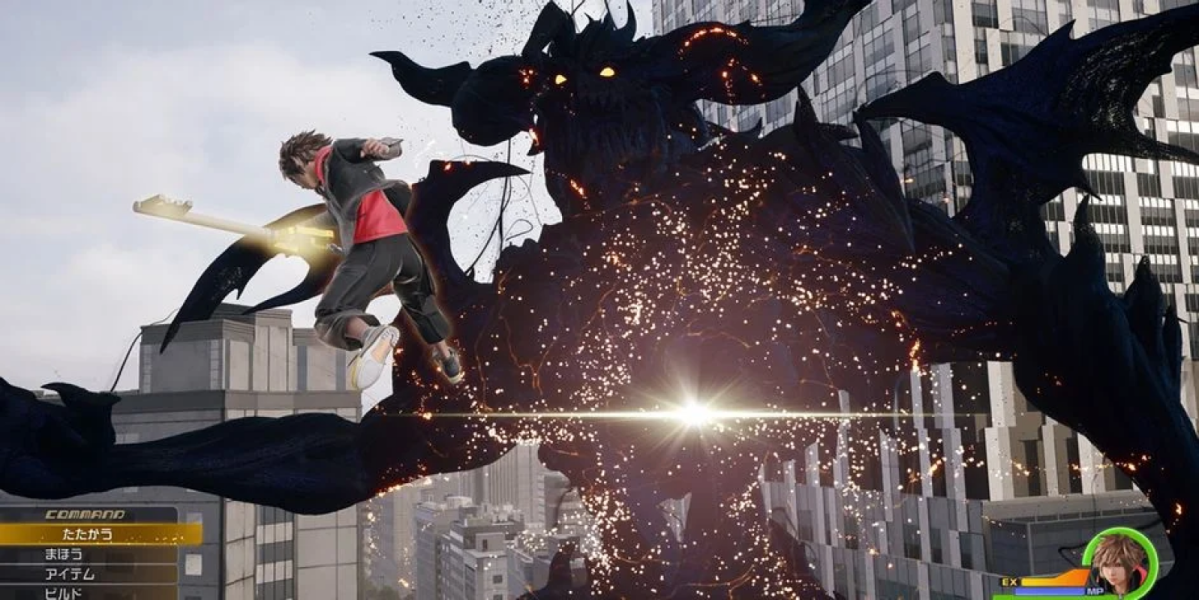
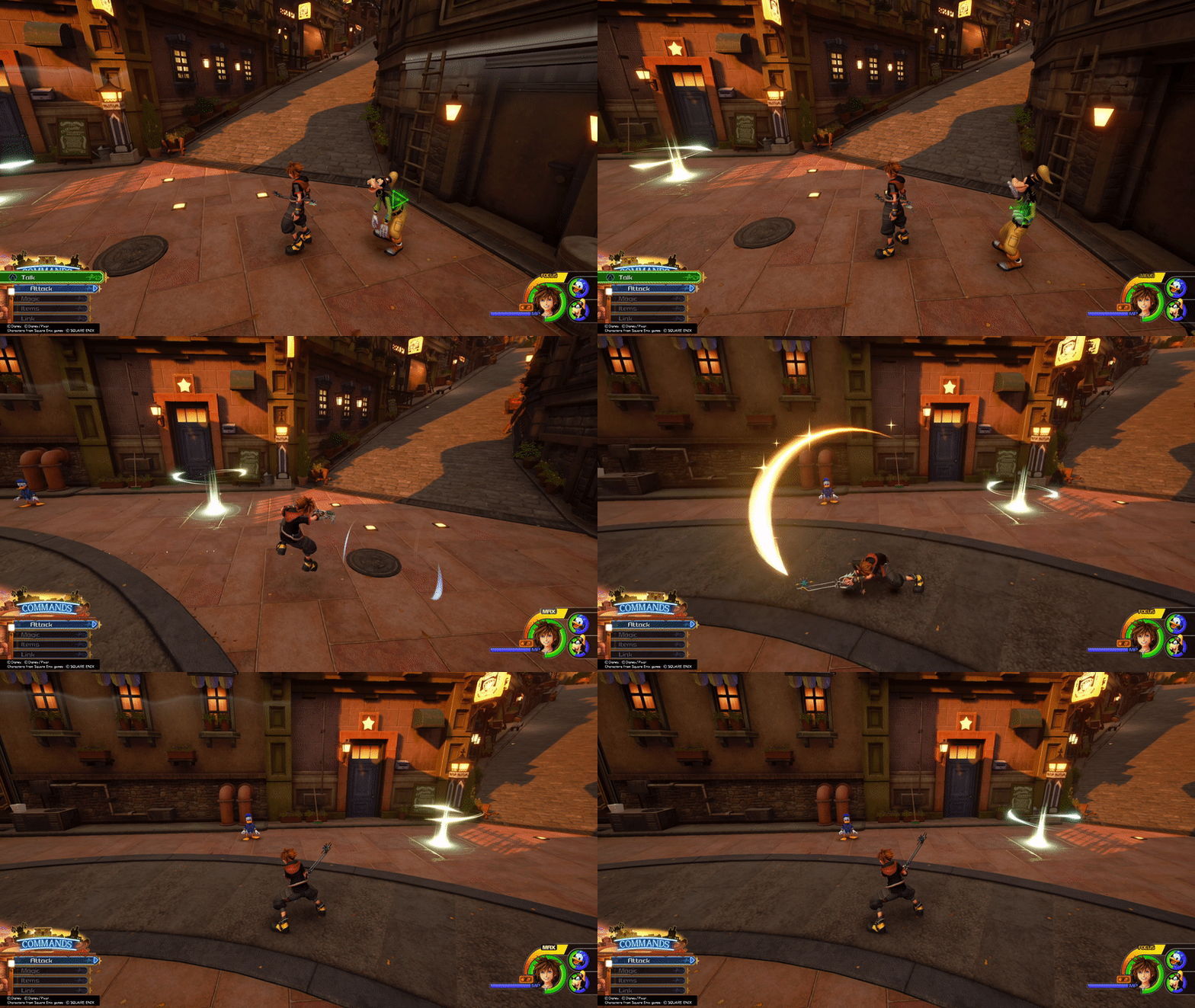
Sora, spiky-haired protagonist of Kingdom Hearts III spins his key-shaped sword around quickly, then slashes with an uppercut at the air in the dimly lit streets of San Fransokyo. He then jumps and does the same motion elevated about 15 feet in the air before falling back to the ground.
Pictured: Floatiness?

First off, we’ve got to define it, this floatiness. Informally, it is reported as the sensation that the Kingdom Hearts player character lacks weight, impact, and to my interpretation, immediacy, or some combination thereof. For those unaware, Kingdom Hearts is a series of action games with a particular emphasis on exaggerated, superhuman feats of acrobatic melee combat, favoring style, spectacle, and emotive action, akin to combat-heavy anime and manga. All that while immersed in a fantasy world full of Disney characters, Final Fantasy characters, and a unique dream-like fictional mythology of its own. Trying to define this term will be much of what this article is seeking to accomplish.

With combatants consisting primarily of magical swordsman and dark wizards, while borrowing aesthetically from classic Disney animation, Kingdom Hearts offered its players a combat system increasingly free of the bounds of gravity, allowing its player characters to bound meters into the air at a time, maintaining that airtime through continued swinging of their sword, with a cartoonish sort of physical logic.

So, all this in mind, I set out to compare the gamefeel of several Kingdom Hearts games in my own experience to try and get a better idea. To make this process somewhat more precise, I investigated what is by my estimation one of the key metrics in determining the gamefeel of an action combat system – the timing of the primary attacks. Every action in a game as visually rich as Kingdom Hearts and its sequels has a startup time and ending lag. The former is the real-time between the player’s button input and the resolution of the action they’ve input, the latter is the real-time between the resolution of the action, and when the player’s next input can be resolved. For example, if a player character is to swing a big hammer, they’ll push the swing hammer button. As their avatar lifts the hammer with a grunt and struggle to convey its weight, we have our startup time, and as he pulls the hammer back to his side after the big swing, we have our ending lag, with the avatar unable to run or jump while resetting the hammer, in this example.
Sora from Kingdom Hearts II swings his keyblade at a volleyball in elaborate spinning arcs, launching the ball further into the air with each strike, and Sora continues after it, ascending higher and higher before falling back down.
Trust me it… it does feel very responsive.

Now imagine the hammer is a comically oversized key and you have a pretty good idea of what we’ll be measuring. Floatiness became an almost absurdly hot-button topic among Kingdom Hearts diehards due to its relationship with the much anticipated Kingdom Hearts 3. As the successor to the beloved Kingdom Hearts 2, and first numbered entry in the series for a period of thirteen years (though by no means the only Kingdom Hearts game to release in that period), a lot of anticipation was placed upon what the game would feel like to play. Its gamefeel, so to speak. Kingdom Hearts 2 has stayed in many people’s hearts as an all-time favorite action game due to the smoothness of its combat system, as any fan would tell you. So comparisons were inevitable. The stakes were high.

Kingdom Hearts 3, despite being the best selling entry in the series, gained a healthy amount of criticism from long-time fans in regards to its gamefeel. Floatiness was oft invoked. The developers seemed to take feedback from hardcore fans seriously, as the game would be later patched in key ways to increase speed and fluidity of the gameplay. More on that later. So what’s the truth? Has floatiness ruined Kingdom Hearts forever? Are we doomed to forever circle the drain of game design discourse without knowing what on earth we’re actually talking about? I’ve spoken to friends who know how to use a computer and they allege that numbers are involved here, believe it or not. So I’m afraid I have no choice but to deploy the diagram.

Data World
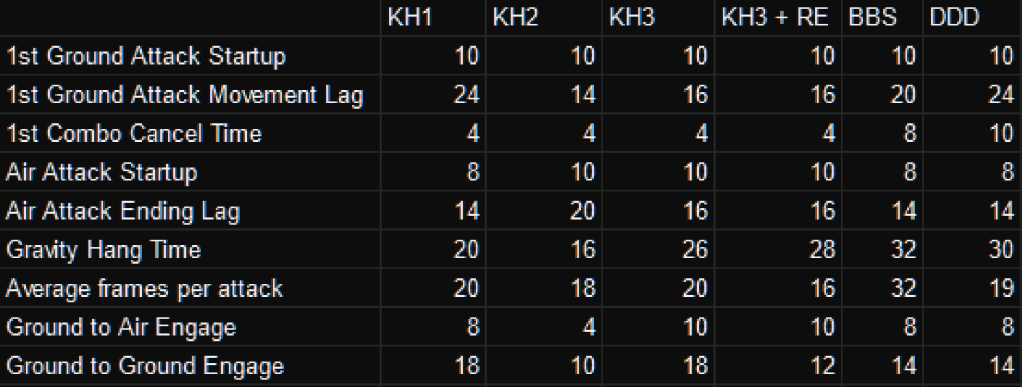
A 2 axis chart. A list of parameter such as "1st ground attack startup time" make up the Y axis. The different Kingdom Hearts games being tested make up the X axis. KH2 seems to be the fastest game judging by data, with KH1 shortly behind it. KH3 is in the middle range, behind KH1. BBS and DDD are nearly tied for slowest game.
So beautiful and horrible all at once!

First let’s define some terms. All footage I used for this analysis is from the Final Mix, 60fps versions of the games, captured on a Playstation 5. All values are measured in animation frames. For the sake of consistency, in each game I tested the animations of main player character Sora or his closest equivalent (In Birth By Sleep the resident Sora-like character is named Ventus, but he’s close enough and for our purposes we’ll consider him a “Sora”). The games I will be looking at are as follows:

Kingdom Hearts

Kingdom Hearts 2

Kingdom Hearts 3 pre-“Remind” patch

Kingdom Hearts 3 post-“Remind” patch

Kingdom Hearts: Birth By Sleep

Kingdom Hearts: Dream Drop Distance

“Startup” here is defined as the time between Sora beginning an attack and that attack “resolving”, here defined as the moment his weapon crosses in front of his body. “Ending lag” is the time between an attack resolving and when Sora can move again, no longer committed to the attack. “Cancel Time” is the time it takes before Sora’s first attack can be interrupted to perform his second combo attack. “Gravity Hang Time” is the amount of time between an aerial attack beginning and when Sora reaches his maximum falling speed. More on that later. “Engage” here means the time between inputting an attack and when sora can strike a distant enemy from a neutral position.

So these results are pretty much in line with what I expected going into this project. KH2 is the fastest game, KH1 is second fastest. BBS and DDD are dead-last, KH3 is about in the middle, while KH3 with its post-launch patch just a little bit faster than that.

Some surprises:

Every KH game seems to have the exact same startup time for the first most basic attack of a combo. Seems like they’ve been pretty happy with this one from the word ‘go’ and consistently on from there.

KH1’s movement lag from a grounded attack is insanely long, as long as DDD’s. KH2’s is way faster, and nearly the same as KH3’s.

KH1, KH2, and KH3 all cancel their first attack into an attack combo incredibly fast at just four frames, another astonishing level of consistency, although BBS and DDD combos take twice as long or more to come out.

KH2’s biggest advantages in speed are its gravity hang time, and time to engage enemies. KH3’s gravity hang time actually got worse with its post-launch patch, though not noticeably, and this has to do with a new attack added in the patch that has a longer animation in general.

BBS and DDD don’t do too badly in the enemy engagement department, better than KH1 and KH3 pre-patch, even. KH2 is still the champ here, but this fast engage time might be a saving grace for BBS and DDD.

There is a lot to talk about, so I’ll drop the chart here again real quick, just because I know you all wanted to look at it again.

A 2 axis chart. A list of parameter such as "1st ground attack startup time" make up the Y axis. The different Kingdom Hearts games being tested make up the X axis. KH2 seems to be the fastest game judging by data, with KH1 shortly behind it. KH3 is in the middle range, behind KH1. BBS and DDD are nearly tied for slowest game.
Even more beautiful.. and horrible the second time!

Okay, So What Is It?

What’s what? Oh! Floatiness. What is ‘floatiness’? My hypothesis going into this was that it’s tied up with the aforementioned startup and ending lag statistics, which would have a huge impact on the speed of the game. Kingdom Hearts: Birth By Sleep, Kingdom Hearts: Dream Drop Distance, and to a lesser extent Kingdom Hearts 3 are somewhat known among hardcore fans as the ‘floatier’ games, the former two by far the most guilty. I had presumed that in gathering my data, it would bear out that those two games would have the higher numbers when recording the delays, lag, and hang time. Kingdom Hearts 2 would be the fastest game, only slightly faster than Kingdom Hearts, and Kingdom Hearts 3 would fall somewhere in the middle. Indeed this was the result. So. Case closed? Shorter periods of loss of character control equals better combat? Probably a little more nuanced than that.

Golden calf Kingdom Hearts 2 absolutely has the advantage over its successors and predecessor when it comes to attack commitment. Its startup times, ending lag, and combo speed are universally faster across the board. But… they’re not that different from KH1 and KH3, even pre-patch. Almost immediately when I started this experiment, replaying each of the games side-by-side I came to realize the nuances of how gravity works in each game.

The Gravity Situation

As the Kingdom Hearts series progressed, aerial combat became more prominent. I always imagined in my head that the first Kingdom Hearts game was “the more grounded one”. And it kind of is. In the first game, attacking launches Sora high in the air toward aerial targets, and repeated attacks can keep him airborn somewhat. Kingdom Hearts 2 pushed this much further, with far more automated and accurate tracking on enemies, pushing Sora high into the air with each attack. I was kind of shocked to find that in Kingdom Hearts 2, the game I associate most with air combat, gravity is much more powerful than it is in any other game. With a delay of only 16 frames in KH2, compared to KH1’s 20, and double that at 32 frames in BBS, KH2 by far is the most beholden to gravity when the player is not attacking. This makes gravity a function of the player’s inaction. Never are they airborne without making it a conscious decision. In BBS and DDD, being strung up in the air against your will is almost the norm. There is a huge delay between aerial attacking and being affected by gravity.
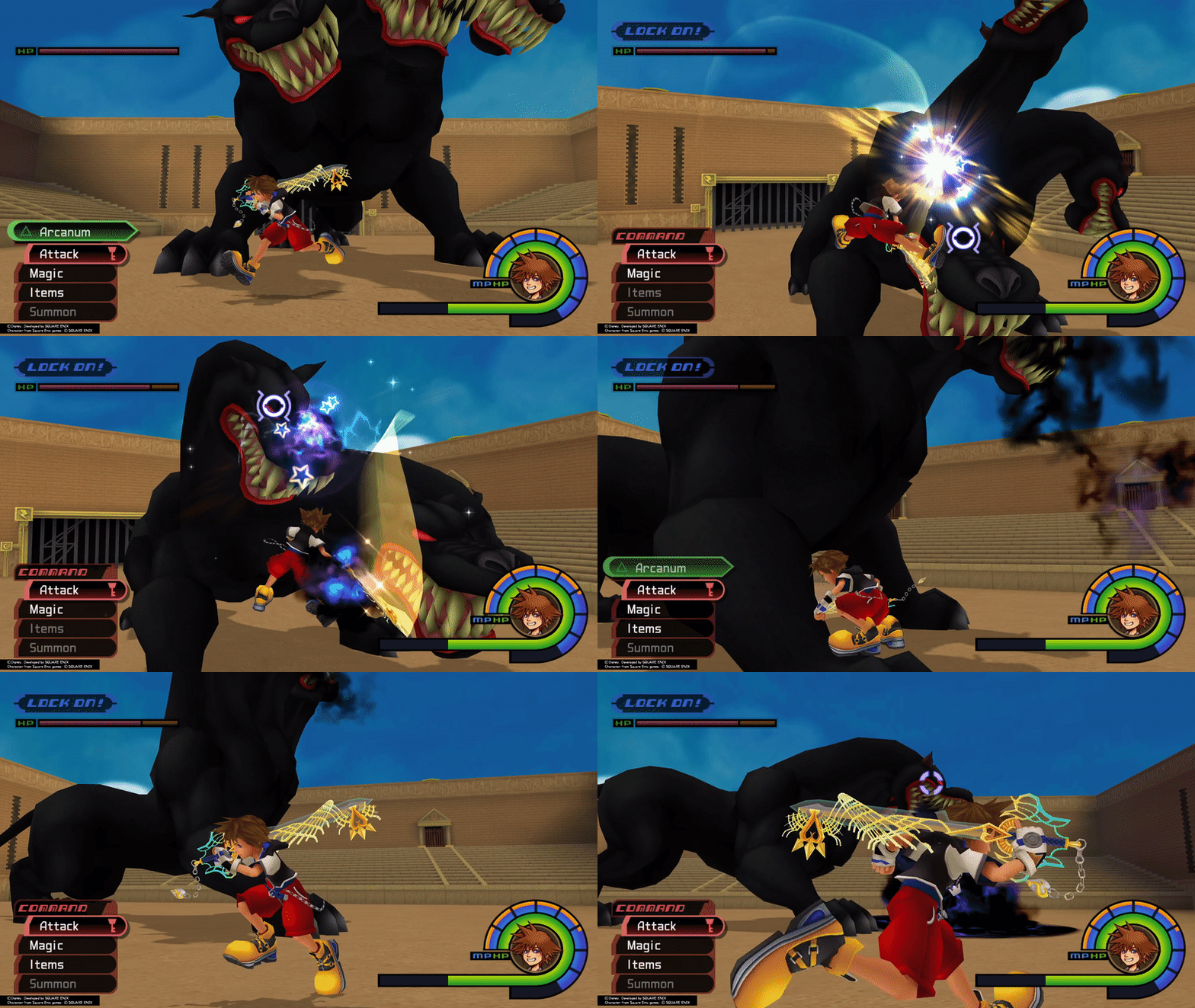
I think this is a major piece of the floatiness puzzle too. Being on the ground in these games naturally gives you a lot more options. You have access to your dodge roll. You are able to more precisely place yourself for things like blocking, or jumping out of the way, or lining up the right attack. Simply, being in the air is advantageous in some ways, but also a lot more risky. In the less ‘floaty’ games it feels as though being airborne is always a conscious choice, whereas the others place you there in spite of the player, and leave Sora hanging in a risky position for far longer than a player might intend. The ability to get back to the ground quickly gives finer control over the player’s risk vs. reward, and the game forms a more solid and consistent relationship with that risk vs. reward.

Gamefeel Good

The title of this article mentions gamefeel, so I’m going to take a moment to discuss that. Like ‘floatiness’ this term is a little hard to pin down, so, uh, how about wikipedia. They seem to know everything.

Game feel (sometimes referred to as “game juice“) is the intangible, tactile sensation experienced when interacting with video games. The term was popularized by the book Game Feel: A Game Designer’s Guide to Virtual Sensation[1] written by Steve Swink. The term has no formal definition”

Wikipedia Article on Game Feel

Well that was absolutely no help whatsoever. Wikipedia cites input, response, context, aesthetic, metaphor, and rules as the features a game can change to influence gamefeel, and this seemingly comes from Mr. Swink as well. It’s as good a place as any to start, so let’s see how this applies to our floatiness dilemma.

I don’t want to get too into the weeds with these, so I’ll limit my observations to response, metaphor, and rules. Suffice to say I think KH does pretty universally well in the input and aesthetics department. Context is a bit more nuanced, but again, trying to limit our scope here.

Let’s be a little contrarian and try to make at least a very small part of this gamefeel equation tangible. We’ve already broken down that there seems to be a correlation between the delay between action and reaction in Kingdom Hearts, and the popular perception of how well the games feel to play. KH1 and KH2 are beloved with their snappy reaction times, KH3 is well liked but garnered a lot of fan feedback. BBS and DDD are liked but not necessarily for the fluidity of their combat, and I rarely see gamefeel cited among their strengths. The data easily illustrates the importance of response time as a variable.

The metaphor at play here is how the timing of attacks translates to what the game is trying to convey. The main thing the mechanics of KH is trying to convey is melee combat. All these varying measures of time and attack resolution and ending lag etc. is all metaphor for the physicality of swinging a sword at a guy. A real person cannot instantaneously move their arms, the sword has startup time and ending lag in real life. That’s why these time gaps are there in the first place. It wouldn’t be a very fun game if you pressed the attack button and just instantly won. So as in a real, actual battle, you have to consider how your various actions leave you open to counterattack. On the other hand, one can go overboard with this, as in real life you’re also trying to minimize your vulnerabilities, and a swordsman is not going to be flashy at the cost of leaving himself open to a hail of enemy attacks. These are things people intuitively understand, and so players bring with them preconceived notions of how entities should behave in these situations.
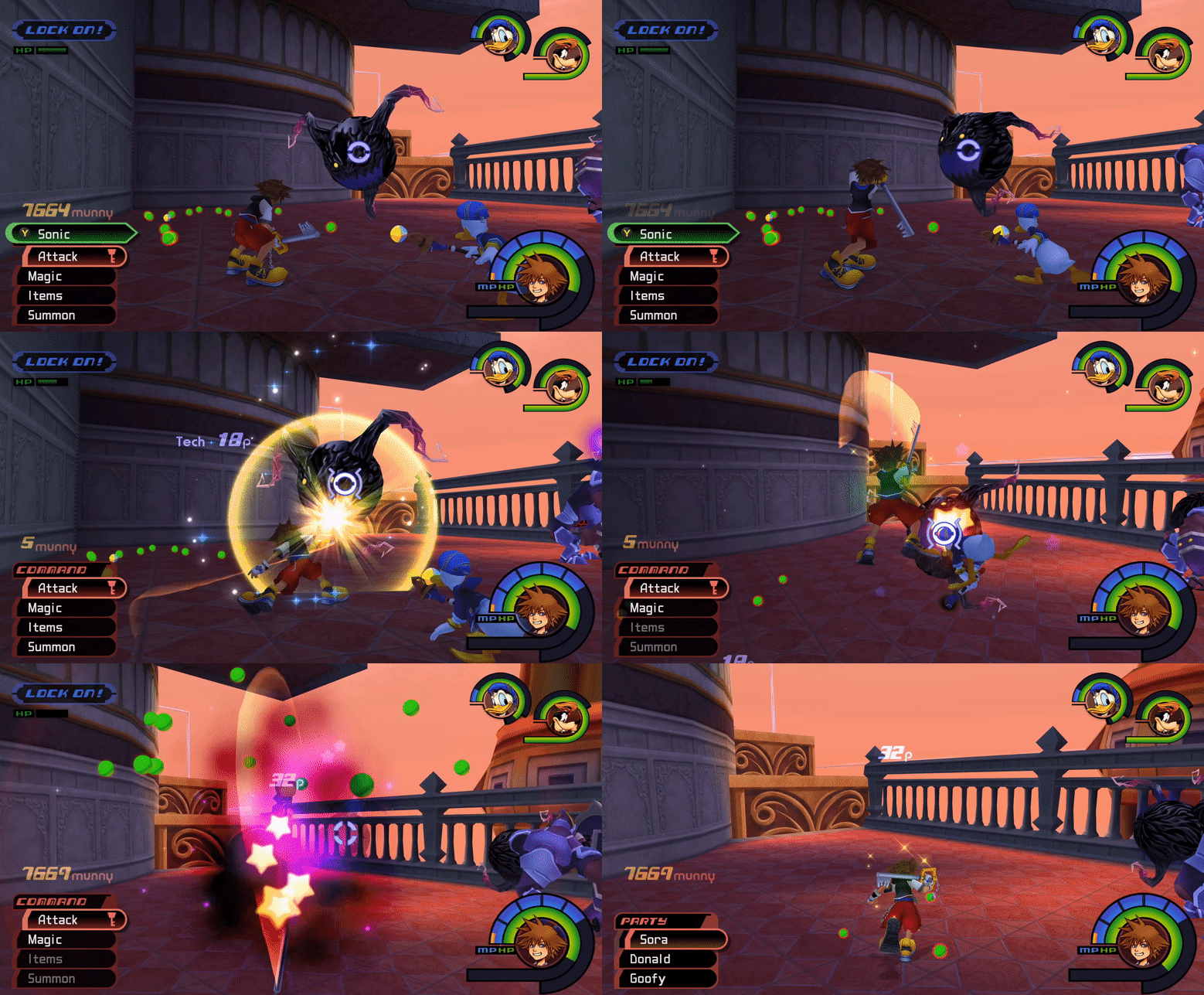
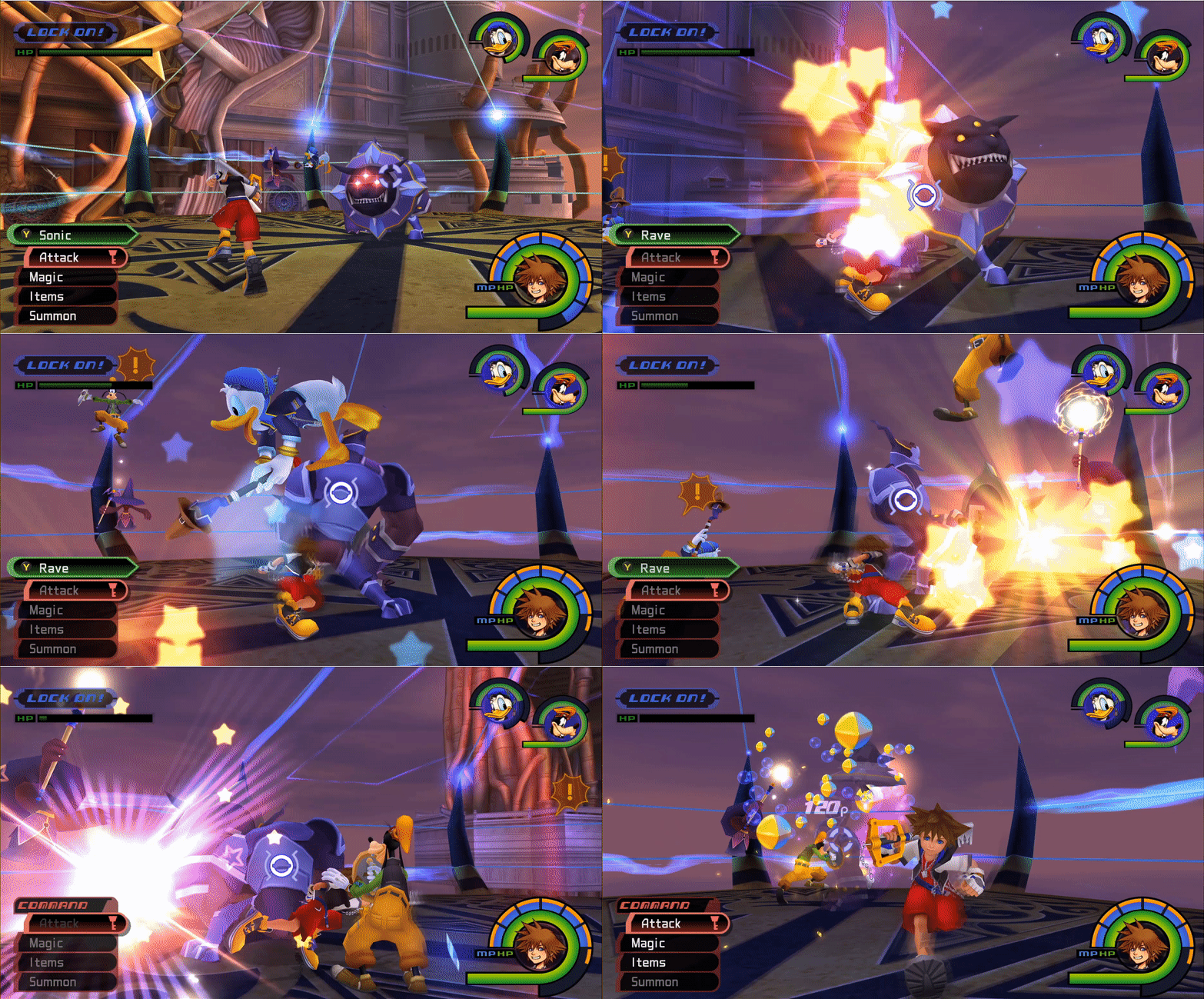
Sora from Kingdom Hearts 1 blocks an attack from a dark ball with a mouth. Immediately, he counters with a series of fast strikes in the air. He loses altitude with each strikes, and ends his combo standing on the ground.
Pictured: Gamefeel??

Drill even further down and you get to the rules of the game itself. Enemies are attacking you, while you’re trying to attack them. If you are locked into an animation you are unable to deploy any defense to stop them, and so we have a game. Risk, and reward. However, if the player’s control feels disconnected from how these rules operate gamefeel is thrown off. In Birth By Sleep and Dream Drop Distance, attacking creates great gaps of no-player time, where inputs on your controller mean nothing. You are vulnerable to attack, and a passive observer in the world. This disconnect throws off both the player’s relationship to response and to the rules of the game, as overly long and committed attacks can become more of a liability than an asset. In KH1 and KH2 throwing out attacks is almost always fun and satisfying, and usually rewarding. It’s often a lot more burdensome to do so BBS and DDD. BBS and DDD have other methods of dealing damage besides the basic attack, but since the basic attack is so pivotal in the main series, a lot of players are thrown off by how minimized it is in these spin off titles, which primarily utilize the command deck instead.

The Command Deck

So why is Birth by Sleep and Dream Drop Distance so damn slow compared to their peers? Well these two games share two very important elements in common. First, they were each developed for a handheld family of systems. Second, they share the game design system known as the command deck. These two points of similarity are very much entwined.

Kingdom Hearts and its two numbered sequels utilized the ‘command menu’, a little persistent menu in the corner of the screen that can be navigated in real time to select whether you want Sora to attack, use an item, or cast a magic spell, essentially. 90% of the time you will be spamming the attack button. The command menu was meant to evoke the strategic decision making of a turn-based Final Fantasy game, but re-tuned for an action combat context. Ultimately contextual combo modifiers became a much greater source of player expression in gameplay, and the strategic applications of the command menu are limited. However, it remains an elegant way to give the player a lot of options without bogging the game down with too many buttons.

When Kingdom Hearts went handheld it rethought its combat. Suddenly, we’re dealing with a much smaller screen, and the camera had to be pulled in on the player character to compensate. As a result, enemies can much more easily hit you from off-screen or sneak up behind you. Consideration was clearly given to a system that better fit playing on the go, where deep concentration on twitch-reaction may not be as viable or palatable. The command deck was the answer, a cooldown-based system where actions are selected from a rotating list and can be used at any time. Now the flow of combat is dictated by these ability cooldowns, and the regular attack combo was made to be more slow-paced, flashy, less freeform, and yes, more floaty so as act more like a stopgap to using the command deck, rather than the main form of attack itself. The command deck has a lot of advantages such as the ability to customize your attack loadout in a much more granular way, but it also has its own host of problems, which I won’t get into here.
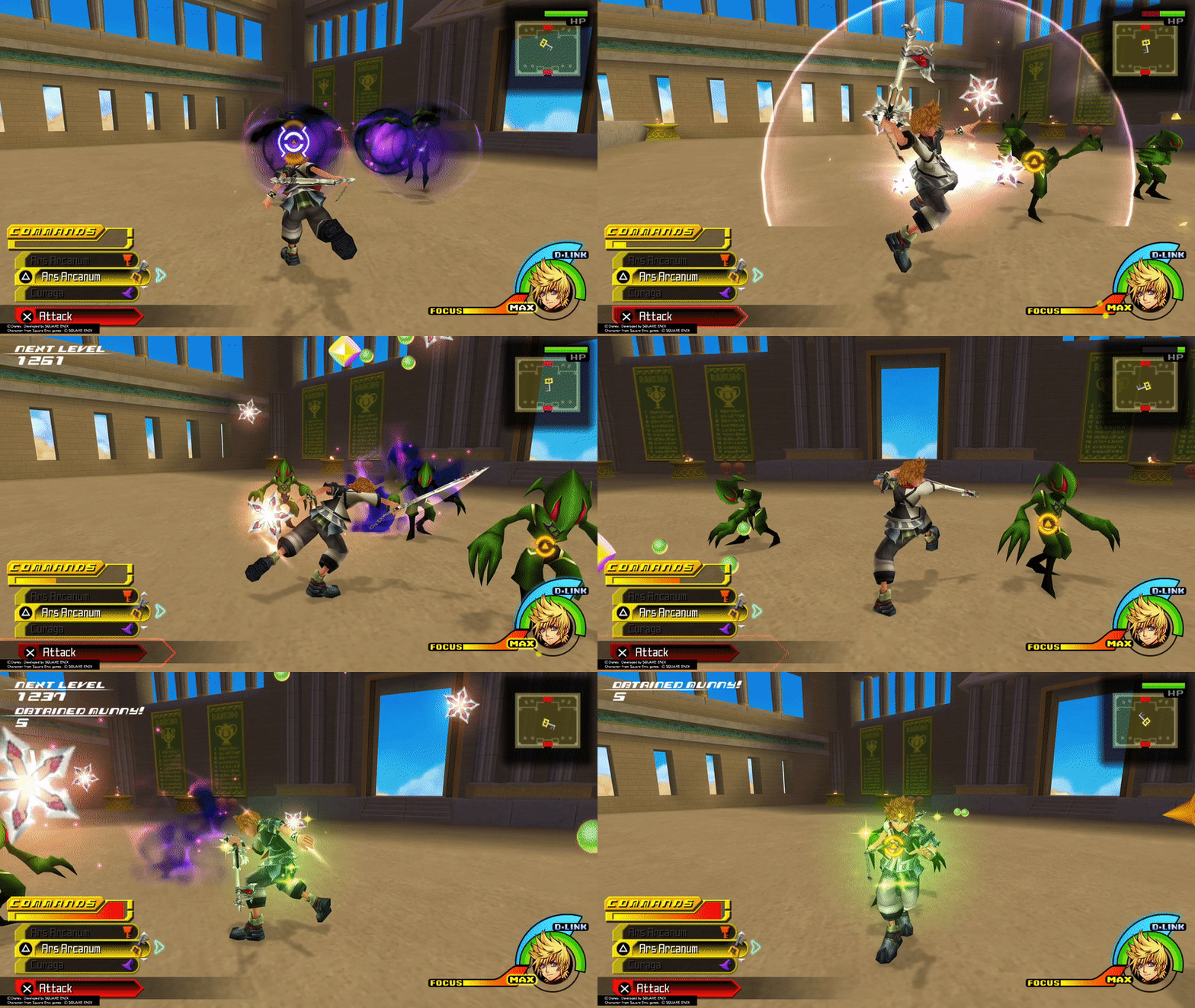
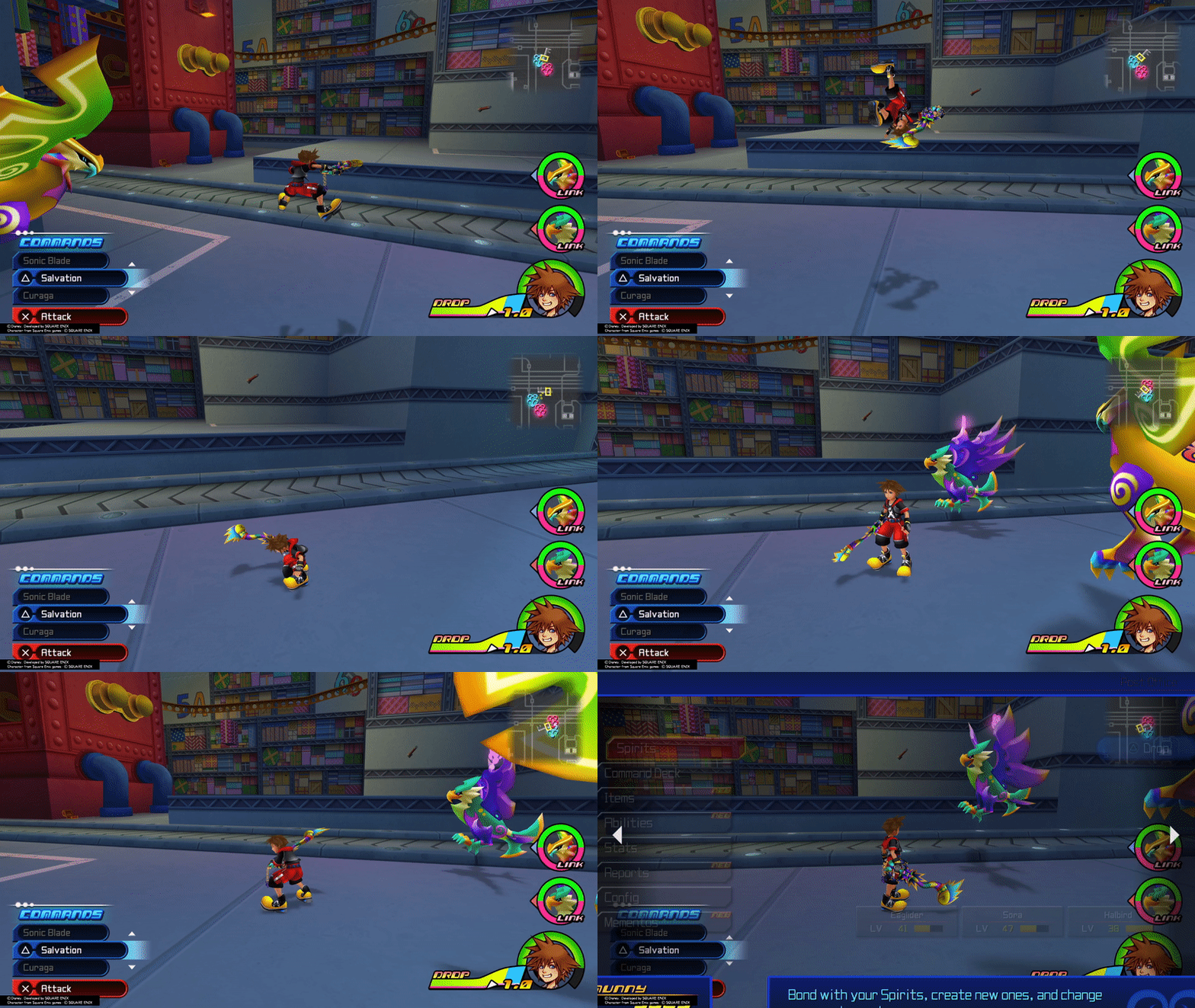
The point is, Birth by Sleep and Dream Drop Distance are deliberately slower games made so because they were designed to be played on the go, and utilize entirely new systems that weren’t designed with KH1 or KH2’s speed and flow in mind. Because KH3, BBS, and DDD share a lot of development talent though, it seems like a lot of the design philosophy of these handheld games bled over into KH3’s headliner console game, which was jarring for a lot of people.

Okay So… Is This Bad?

In my opinion, one of Kingdom Hearts‘ greatest strengths is the immediacy and responsiveness of its gameplay. A fine degree of control gives the player a much wider spectrum of possibilities in any given scenario, and this is what leads to a creative space within gameplay for players to express themselves through the gameplay. This fluidity also allows disparate gameplay mechanics such as movement and sword attacks to blend. Kingdom Hearts 2 always feels as though its many, many mechanics are in a harmonious conversation with one another. Engaging a ground enemy can be converted into an aerial assault, which can flow into a strategic repositioning, etc.

So yes, I think it weakens Kingdom Hearts‘ identity somewhat when some of the more experimental entries in the series have dabbled with slowing down the combat and making its pieces more discrete. The particulars are a bit beyond this already enormous article, but I did want you to understand my motivations for trying to understand how and why Kingdom Hearts 2 feels so different to play than a game like Kingdom Hearts: Birth By Sleep.
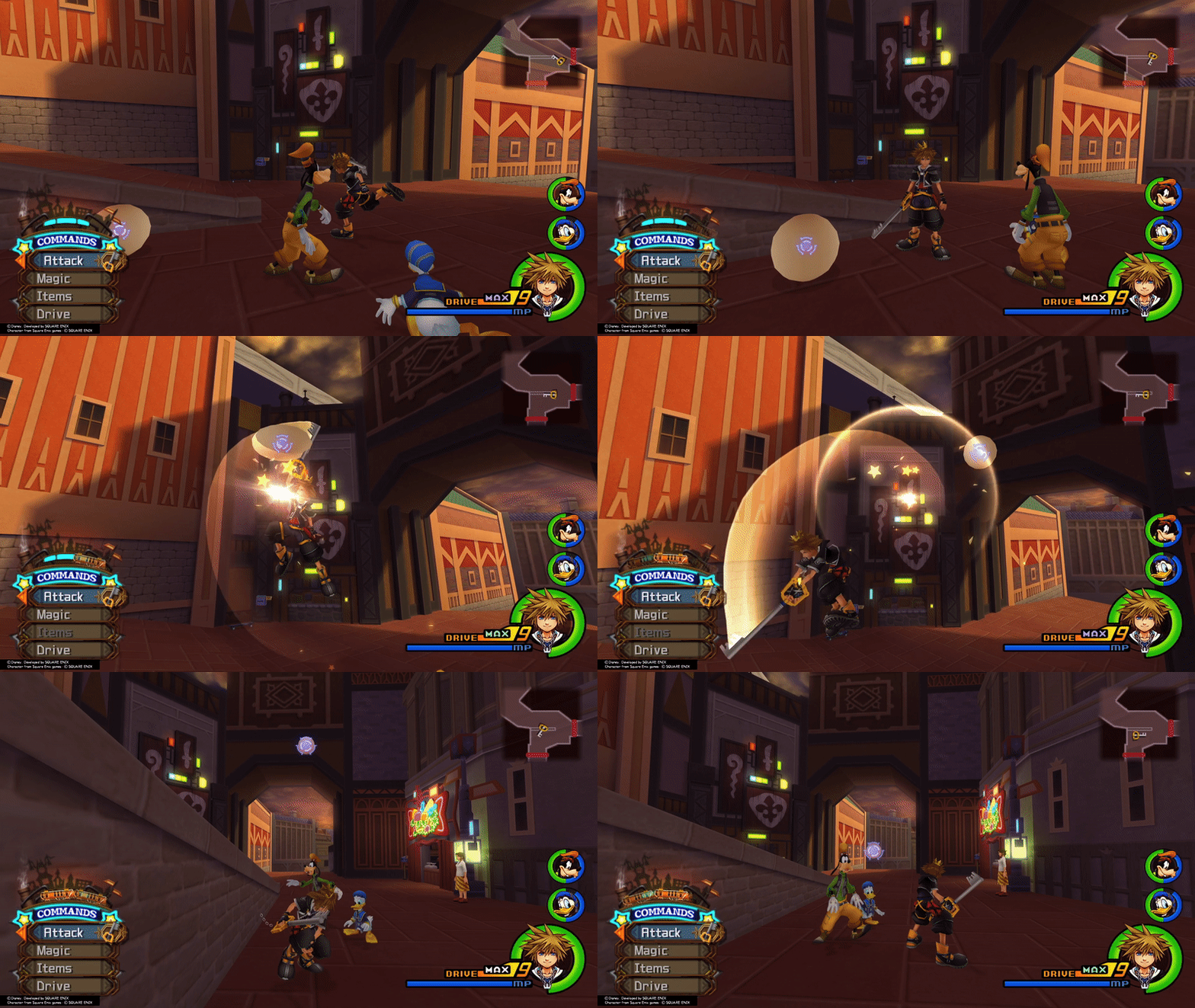
Sora from Kingdom Hearts 2 slashes at a volleyball, sending it bouncing into the air.
Up… and Down

Kingdom Hearts is a series about ridiculous anime battles between magical wizards wielding baseball bat-sized keys as weapons. People fling themselves through the air to attack one another. It’s not realistic, but it exists within the heightened reality realm of animation. Its primary inspirations are, after all, some of the animation greats, including Disney of all things. Animation works to heighten reality because it has an understanding of its underpinnings. Even if people can jump twenty feet in the air, there still has to be a since of presence and weight. It has to give the impression that some sort of underlying laws of physics are at play even if they aren’t one-to-one to our own laws of physics.

Despite appearances, it wasn’t a magic genie spell that made KH2 so satisfying to play. It was hard work, clever planning, likely some very precise number tuning, and likely a whole lot of playtesting. I want to know the nitty gritty of what made Kingdom Hearts one of the smoothest action games in existence, what distanced it from that, and what brought it closer to that esteem once again. Because you see, there are still those Kingdom Hearts 3: Remind post-launch changes to talk about.

Kingdom Hearts III And The Combo Modifier

In Kingdom Hearts, Sora has a very basic attack combo, with little by way of alternate options for the player, at first blush. You press the attack button, and sorry does the next hit of the combo. Rinse, repeat. The wrinkle though, is that Sora can gain abilities which cause his attack combo to behave differently depending on where Sora is standing relative to his target.

Kingdom Hearts 2 pushed this contextual combo modifier idea much further, with hosts of new options that allowed the player to flex mastery over the system through mastery of manipulating these contextual attacks. They did things like make engaging enemies faster, extending the combo, increasing the power and range of combo finishers, among other things.

Kingdom Hearts 3 launched with its share of combo modifiers, but they lacked the breadth and applicability of KH2’s abilities, and they did little to speed up combat overall. That is, until it was patched in anticipation of the Kingdom Hearts 3: Remind DLC. Numerous combo modifiers were added which increased the overall speed of Sora’s basic combo attack and made the game feel overall more responsive. I don’t think the Remind DLC gets enough credit for just how much it improved, and it’s kind of refreshing how in tune it is with popular feedback. Real people playing your game can tell you a lot about that mystifying, all-important yet elusive gamefeel.
Airstep is Literally a Game-Changer

Kingdom Hearts as a series has done a decent job with teaching players about its systems and how they work. Some of the more advanced mechanics that deepen higher-level play are a bit more obscure, but usually reaching a baseline level of competency at core systems is pretty straightforward. Kingdom Hearts 3, however, I found stumbled at instilling the importance of oce of its most important new mechanics, the airstep. The airstep allows the player to manually aim the camera toward a distant foe, and fling Sora at them at high speed for a relatively quick engage across a huge battlefield. This was obviously done to compensate for the much larger environments featured in KH3 as compared to older games, but utilizing this move frequently and often, even in close quarters, really does change the way the game is played.

Airstep can cancel out of nearly any other action, you see. In terms of making the game more fluid, or moreover in terms of giving the player fine control over their actions, the airstep affords an enormous amount of power and precision to determine the pace of fights in Kingdom Hearts 3. This along with the ability to cancel combo finisher attacks, which was added in the Remind DLC update, makes the whole combat a lot more cohesive and much more fluid than you might initially expect based on the raw frame data. Speaking of which, the frame data was improved in that update as well! The fact is that this latest iteration evolved the combat in a lot of interesting ways that I don’t want to see abandoned in favor of just making the series going forward exactly like everything that came before.
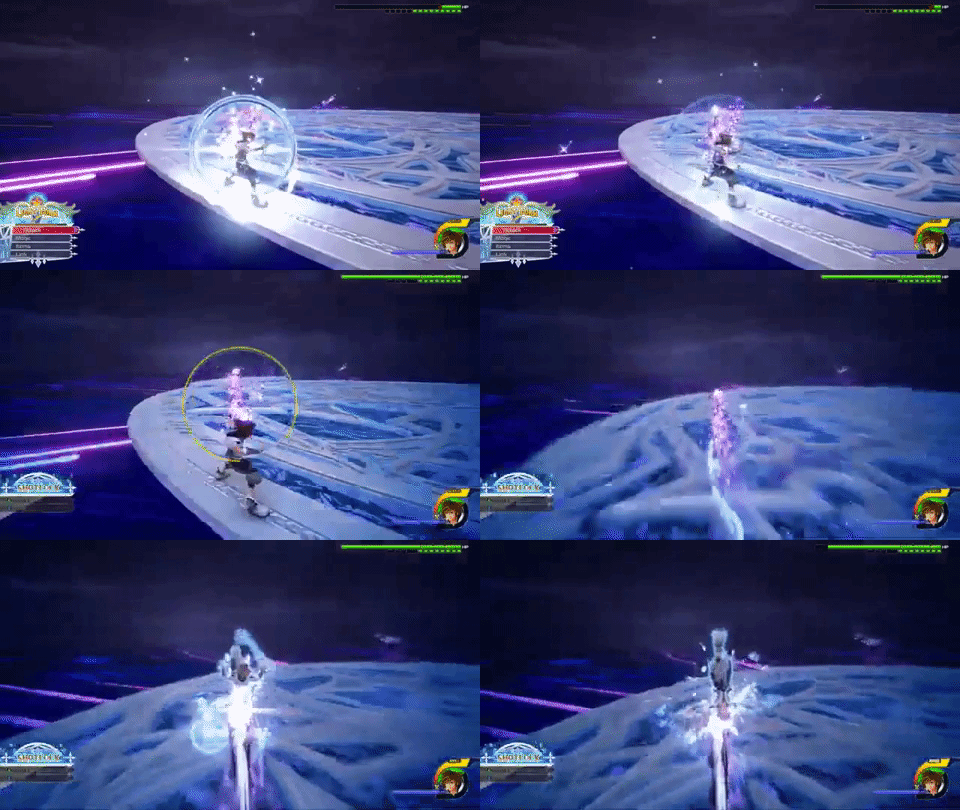
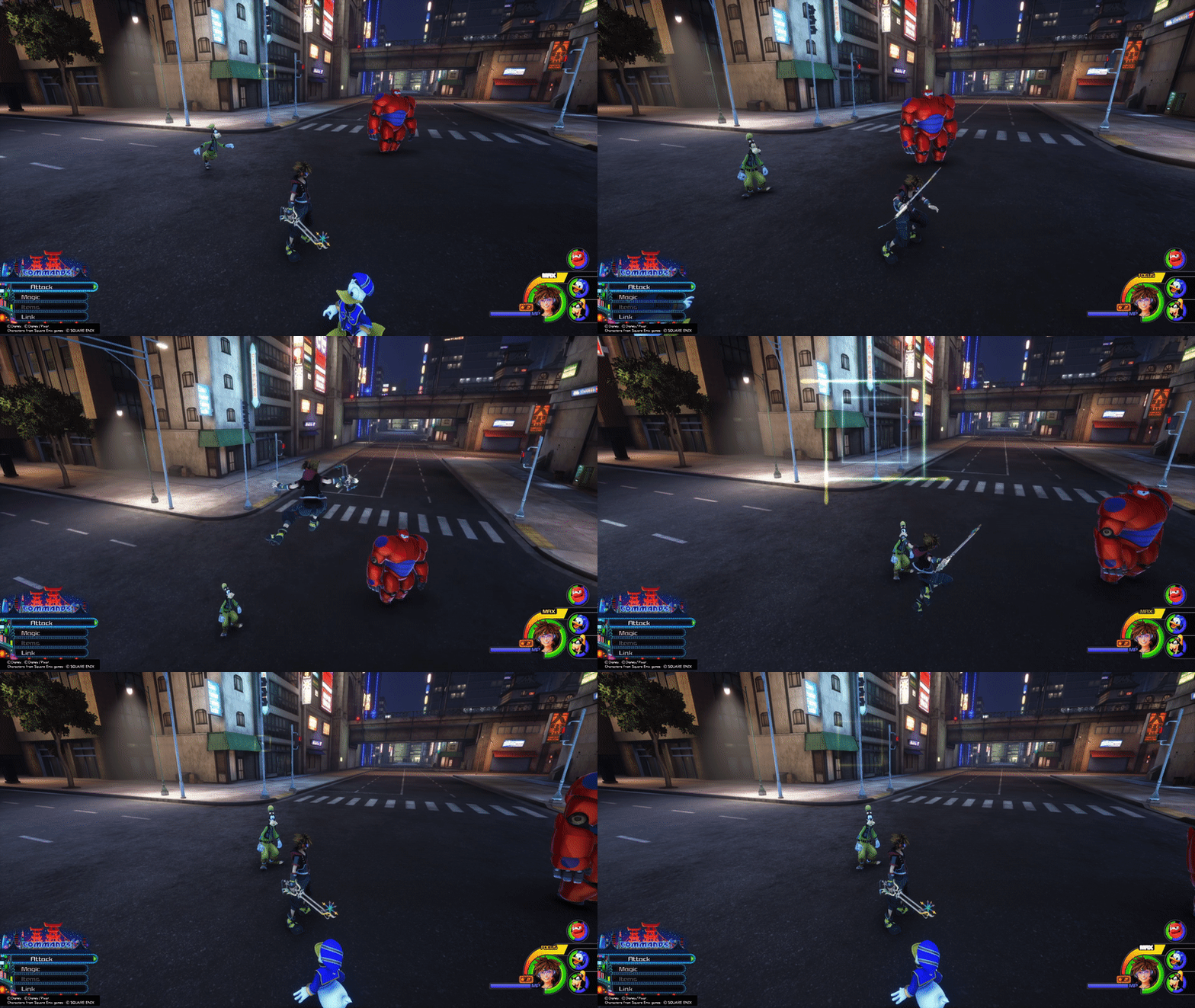
Sora from Kingdom Hearts 3 blocks an attack, before the camera zooms in on his enemy, Sora then zooms to their location in a flash of light.
Here Sora is sent at the boss straight out of a guard, exploiting an opening in an exciting way

Kingdom Hearts Is Doing Fine, Actually (But It Can Do Better)

So yeah, when people say Kingdom Hearts 3 feels ‘floaty’ as compared to Kingdom Hearts and Kingdom Hearts 2 the evidence is there. Attacks are less responsive and more of a commitment, generally, and gravity is turned off more liberally. You will literally find Sora floating more without direct player intervention. However, the frame data differences, discounting the gravity aspect, are minor at best. It’s really that gravity delay that accentuates the small differences to give a pretty stark impression. Birth by Sleep and Dream Drop Distance are so far afield of the gamefeel of the main series games that it’s clear there was no intention of recreating those mobile games for KH3’s release. The developers have further made it clear their intention to deliver an experience their longtime fans can enjoy with the changes made to the Remind DLC.

In fairness, it had been 13 years since a main Kingdom Hearts game had been made when KH3 was released in 2019. With just a few tweaks I feel they were able to bring it up to parity with KH and KH2 in terms of fluidity. It’s not the tightly wound, exceptionally blisteringly fast experience of KH2 precisely, but do remember that KH2 was developed only three years after the original, so the developers were coming right off the back of designing an already exceptional combat system. The experience was fresh. From where I stand I don’t think the future of KH is in any danger. Three years on from KH3 as of the time of writing this in 2022, and KH4 seems to be around the corner, poised to improve in ways reminiscent of how KH2 improved.

The Kingdom Hearts 4 reveal trailer doesn’t actually show any basic attacking in favor of mostly displaying the new movement options, and any gameplay it does showcase is subject to a lot of change to begin with, but what it does show looks pretty snappy and responsive to me. I’ll let you be the judge. The KH team learns quickly, and their intentions for this series’ gameplay have been made clear vis a vis the Remind DLC update. They understand the data I’ve so painstakingly gone to lengths to describe and how it affects gameplay, clearly. The KH3 update was so precision built for improvement it’s kind of astonishing. And, with KH4’s refocus on ‘reality’ as an aesthetic, I would not be surprised if a little more gravity came back to the party to polish the combat system even further into something really special.
Sora from Kingdom Hearts stands on a floating platform with a shield-wielding enemy, and rapidly dashes at and through them, holding out his keyblade.

Whatever you’re talking about, I don’t care…
Site Update and Going Forward

Hello! It’s been nearly a year now since I started Parry Everything and I’ve had such a blast putting down my thoughts on paper about game design and all its many many intricacies.

I didn’t really expect this blog to gain much traction either, so I’ve been blown away by people being actually interested in what I have to say, so thank you to each of you who reads my posts and articles!

I initially created this blog just to get my thoughts on game design out there, after a particularly inspiring time at the digital Game Developers’ Conference in 2021. With GDC 2022 now come and gone, and my life getting busier than ever, I’ve decided to move from a weekly format to posting monthly articles, plus leaving myself free to post some more informal stuff between articles if something catches my interest.

My intention is that this schedule will help me produce more finely polished and substantive pieces. Don’t worry, I’ve got something very exciting (and Kingdom Hearts combat design related! :>) planned for April. I hope you’ll find it as fascinating as I do. Ah, and I’ve also finally added a search bar for ease of navigation. I’ve produced a ton of writing on game design in the past year and I’m really proud of it, so check it out if you’ve got the time.

Sonic vs. Shadow Boss Breakdown: A Case Study

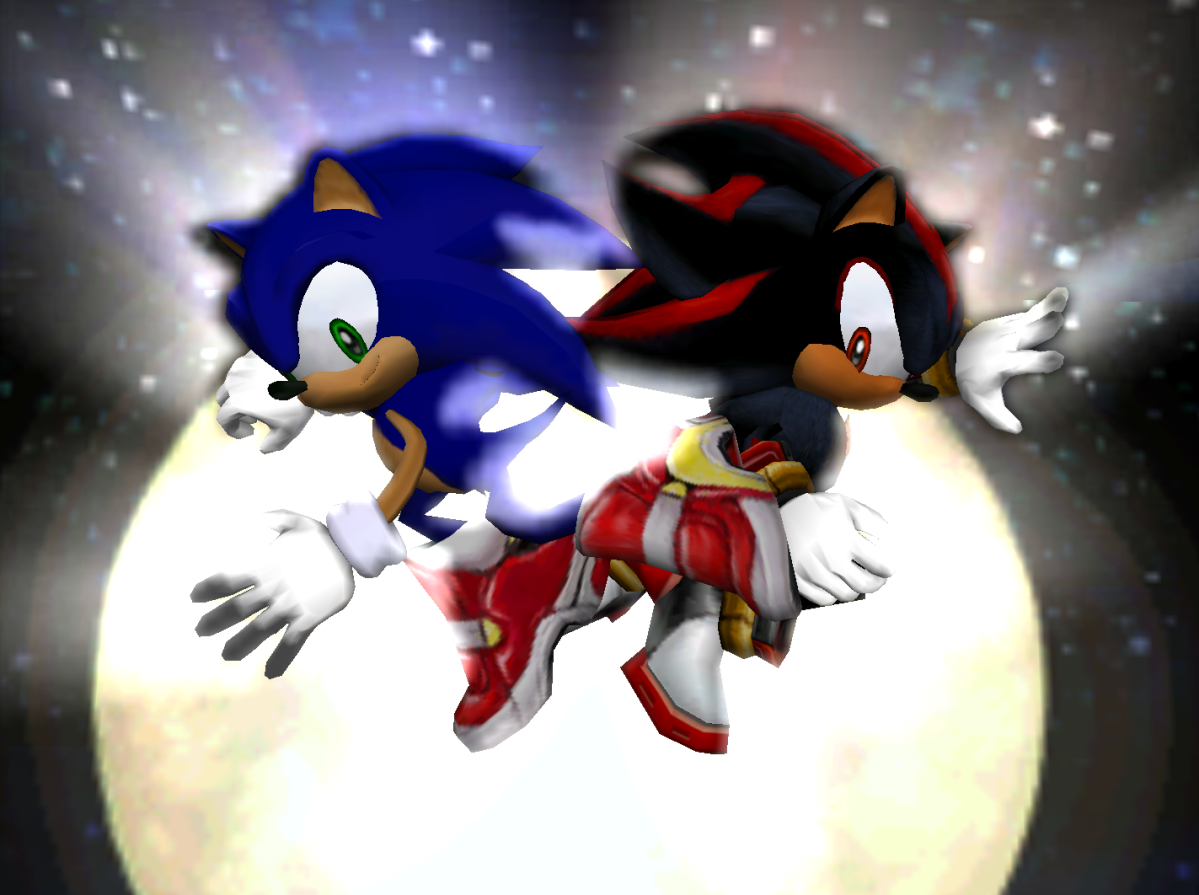
It’s April 2022, I just came back from the movies, and it’s got me in a Sonic mood. Sonic Adventure 2 was Sonic’s second major 3D outing and personal favorite of mine, warts and all. The big gimmick of this game was ‘hero versus dark’, or in other words two concurrent stories centering on our familiar heroic blue hedgehog Sonic, and the new dastardly red and black hedgehog Shadow, who has all the same powers that Sonic has!

The Sonic and Shadow showdown that’s built up across the game’s story was always a highlight for me as a child. It’s aesthetically and narratively well-realized, a great moment of tension and catharsis for one invested in the wacky world of Sonic. So it works on a number of levels. Taking an older and more analytical eye to it though, it is far from an ideal example of boss design in motion. Like much of Sonic Adventure 2, it has its share of flaws. So for this boss breakdown, I’m going to approach things a little differently, and go through an alternating list of the boss design’s pros and cons, trying to glean where this boss succeeds and where it falls short.

Sonic the Hedgehog stands in a long starship-like hallway. He is surprised when Shadow the Hedgehog walks up from behind him and begins to speak "You never cease to surprise me blue hedgehog. I thought that the capsule you were in exploded in space." 

Sonic replies, "You know, what can I say... I die hard!"
The motion-captured cut scene animations are still pretty comically bad, though.

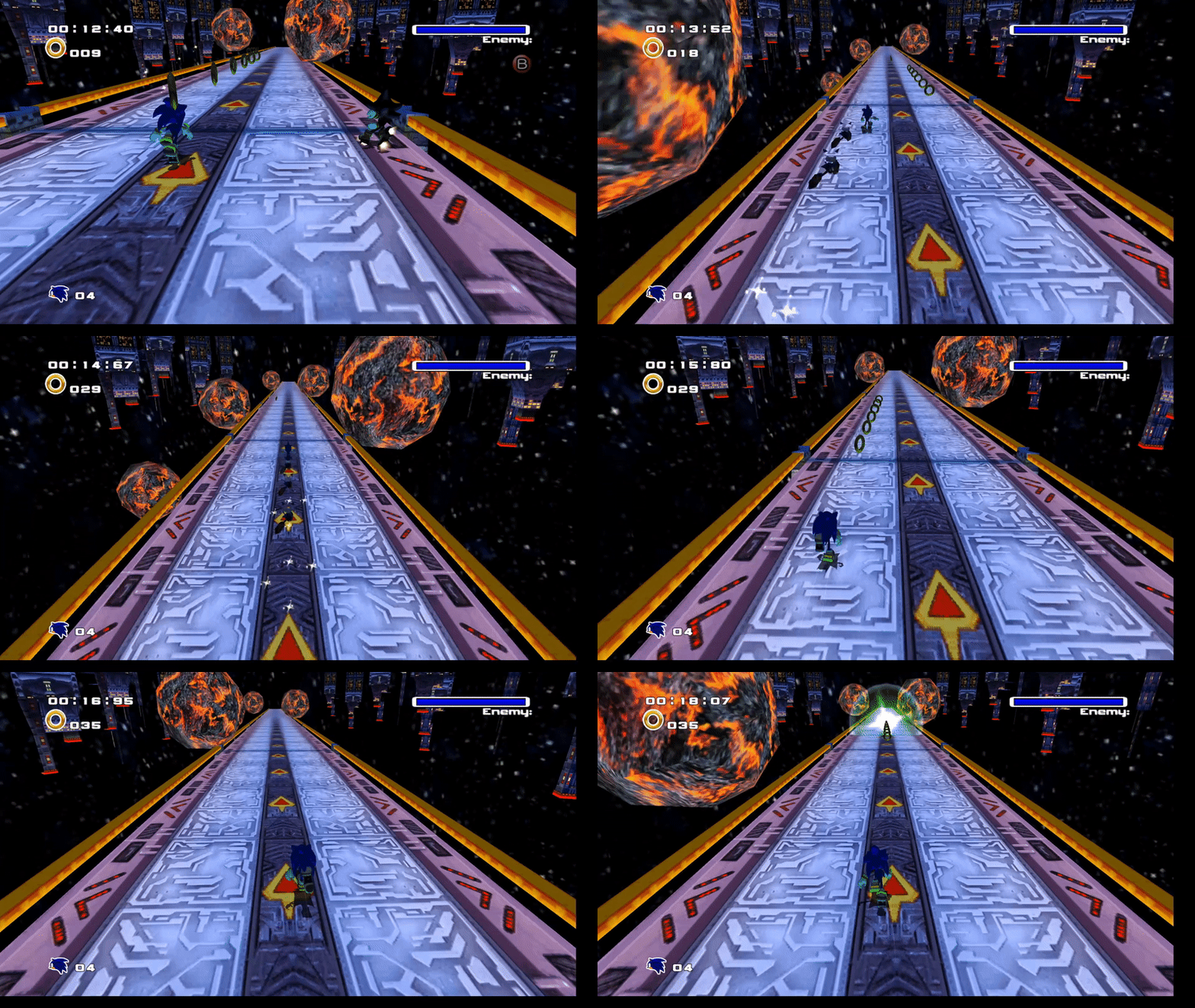
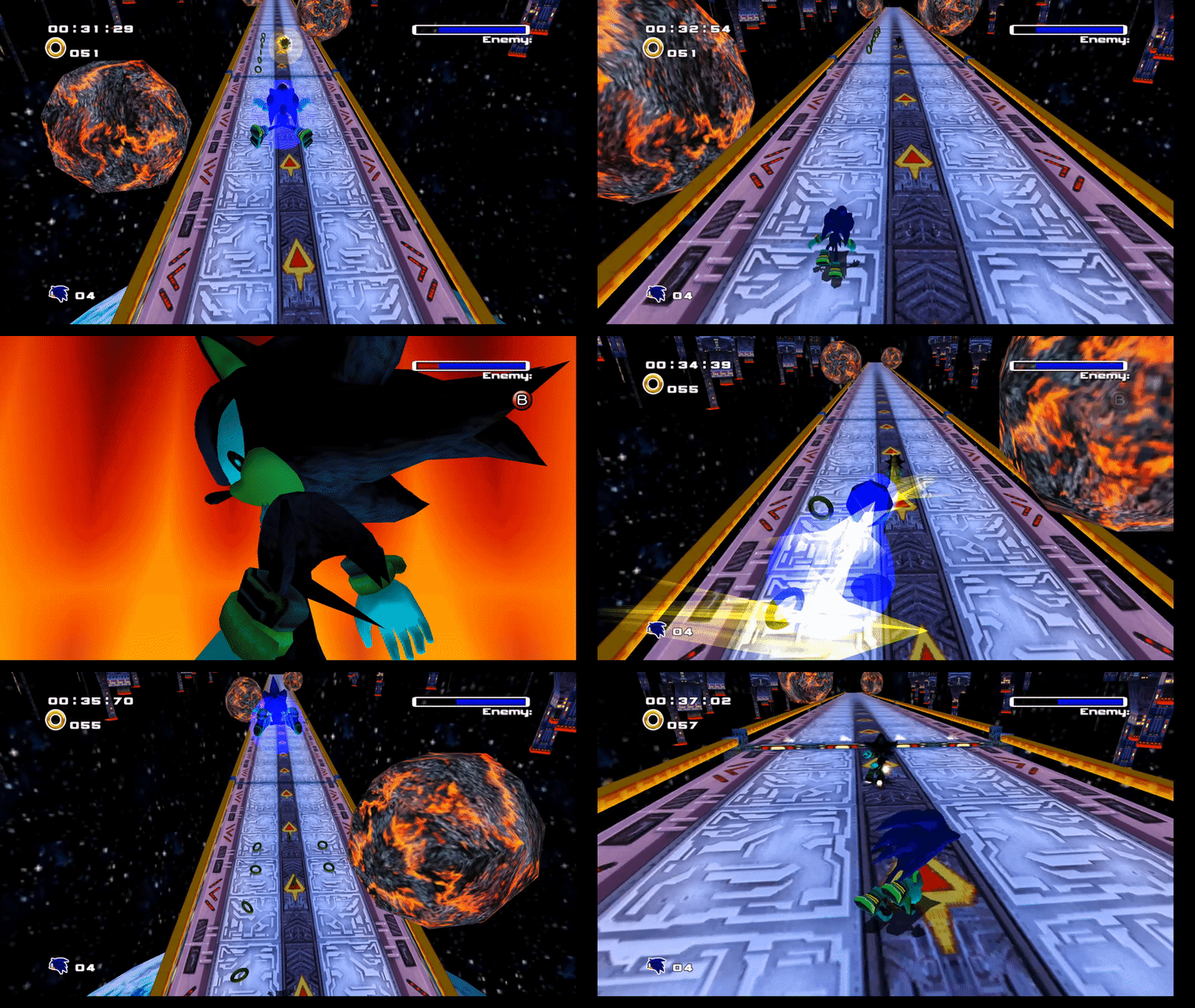
First, a quick overview. The player takes the role of Sonic or Shadow, depending on which story path they chose. Their opponent is whatever hedgehog they’re opposed to. In either case, the fight is identical, as both characters share identical movesets as players and as AI bosses. The two hedgehogs run along an infinitely long looping pathway suspended in outer space. Pieces of it fall out from under them if they run too slowly. If the enemy boss hedgehog falls off the path, they teleport back to the stage ahead of the player’s position. If the player does the same, they fall to their death. The enemy will occasionally use a homing attack on the player, which can be deflected by jumping, which produces a protective spin-shield on the hedgehog. The enemy can do the same, however, meaning most homing attacks will be deflected unless the player can make an opening in the enemy’s defenses.

These openings, as far as I can tell, take three forms. First, if the player lags behind the enemy by too great a distance, the enemy will come to a halt, and launch a screen-wide super attack, which can be avoided with a well timed jump. During this moment, the enemy is vulnerable to attack. Second, if the player runs too far ahead, or the enemy falls off of the arena, they teleport back onto the road ahead of the player, after which they are vulnerable for a brief moment, although this window of vulnerable seems to narrow as the boss’s health gets lower. Finally, timing an attack such that it hits the boss in the short window of time they are on the ground after landing from a jump, they are vulnerable.

With that out of the way, let’s get to some of the particulars.

Pro: We Framed The Camera

So Sonic Adventure 2 (and a lot of 3D Sonic games of this era for that matter) has a bit of a reputation with its camera. So this one might come off as somewhat of a backhanded compliment, haha. To be fair, I think the direness of the state of SA2‘s camera is often vastly overstated, when compared to other 3D cameras of the time, or even other Sonic games. Point is, sharp turns and elaborate level geometry could be let’s say… challenging for the hard working early 2000’s 3D camera, so Sonic Team played to their tech’s limitations and its strengths and placed this boss fight on a seamless, infinitely long straightaway.

With no turns, nor obstructions, the player always has a clear view of the action and the goal- defeating that enemy hedgehog. This has the added bonus of creating a series of dynamic set pieces visually between Sonic and Shadow’s fight, with the camera being centered on the highway path.

Sonic the Hedgehog outruns Shadow. A moment later, Shadow teleports in front of Sonic in a flash of green light.
Nothing but you, me, and the cinematic cameraman following behind us

Con: Rings, Rings Everywhere

Someone once did a write up on Sonic The Hedgehog’s traditional health system that utilizes its collectible coins. This system has a lot of flaws, in my eyes. The simple version is, that because having even one ring on Sonic has nearly as much advantage as having a billion rings, while having zero rings leaves Sonic in a drastically more vulnerable state, it is very difficult to build a consistent level of challenge with this health system. The battle between Sonic and Shadow takes place on an infinitely long looping pathway. It would be very possible, even likely, that most players upon taking a hit from Shadow or Sonic simply kept running, missed picking up their rings, and were left with a crushingly difficult unreasonable encounter.

This is obviously not desirable in a game marketed to children, and so to counter this eventuality, it was decided that the infinite path contain infinite rings. This is also a problem. So long as you keep collecting these readily available, plentiful rings, it is essentially impossible to lose this boss fight that is an alleged death battle between super powered titans. It doesn’t matter how many times Shadow strikes Sonic with a chaos spear, or how often Sonic homing attacks Shadow. If the player can collect more rings, and they can, they’re in no danger. It kind of takes the wind out of the tension-sails when you realize this.

Pro: The Game Does Not Tell You What To Do

There’s a certain appeal to to the idea of just being placed in an arena with a hostile opponent and… going at it. No rules, no holds barred, no ifs ands or buts. Of course, there are rules, such boss designs simply give the impression that the player can control the pacing of the fight, and can achieve progress against the opponent with mechanisms entirely driven by their own ability, not by arbitrary timers or enemy behavior tables. Someone once did a write up on the subject using The Legend of Zelda as an example.

When fighting Sonic or Shadow it is not initially entirely clear how one is meant to deal damage to them. They have a health bar indicating damaging them is the goal, but not much else. There’s very little indication of the boss’s weakness. The player’s standard methods of attack up to this point, homing attacks or the spin dash, have no effect in most situations. For a final confrontation, this makes sense. Shadow and/or Sonic stand as an imposing ultimate challenge with no clear exploitable point. It’s up to the player to decide how best to approach the enemy supersonic hedgehog, as their opponent has all manner of ways to deflect incoming attacks, such as rolling into a ball, homing-attack the player in retaliation, or using one of their screen-wide super attacks. This bare-knuckle brawl kind of boss design works well in establishing the tone of two co-equal rivals finally duking it out and giving it their all. If Shadow or Sonic had a big glowing ‘attack this to kill me’ button somewhere it would certainly diminish the effect.

It’s also worth mentioning, this is the second such encounter between Sonic and Shadow. The first, in an enclosed square arena, is a lot less exciting to play and talk about. I bring it up because it does begin to engender some of the concepts of how to fight the enemy hedgehog that you see here, but that fight also suffers from not being entirely clear on its mechanics, so the player will likely not have learned a definitive approach to fighting Sonic or Shadow by this point.

Sonic the Hedgehog repeatedly homes in on Shadow the hedgehog, but Shadow rolls up in midair to protect himself, deflecting the attacks.
Standard methods of attack don’t work. Figure out a way past his defenses!

Con: The Game Does Not Tell You What The Heck To Do

Yeah okay, so there are advantages to unstructured boss fights, but Shadow and Sonic’s weakness does exist, and it is largely arbitrary. The game gives little to no indication at all how best to damage the boss, and as a result, even for players who’ve defeated this boss before, it may not be entirely clear how they did it, and reproducing those results may require a lot of fiddling around with the boss’s behaviors. There is a method to consistently damaging Shadow or Sonic in this encounter, but to get there you really have to do some meandering experimentation. The investigative nature of this isn’t without its fun but it does feel kind of weird and incongruous, like a puzzle whose pieces fit together, but do not form a picture of anything.

Why is it, for example, that Shadow will only use his super move ‘chaos spear’ when Sonic has let him run far ahead down the path? Why does he stop dead in his tracks when chaos spear is used, leaving him vulnerable? This might have made a lot more sense if Shadow had a special animation to indicate he had to slow down to concentrate when using chaos spear, which would also explain his vulnerability and why he’d wait until he got some distance from Sonic before using it, but the player is left to essentially fill in these blanks themselves. Given the loose, fiddly nature of the boss’s behaviors, it’s also very possible to simply mash buttons and attacks against them until the encounter is won. Combined with the ring systems, there’s really no way to enforce a failure state to dissuade this, which in my eyes is an issue. The player should feel like they accomplished something even it’s an easy, so the possibility of a largely accidental victory is undesirable.

Sonic the Hedgehog and Shadow the Hedgehog repeatedly roll up into balls and bounce against each other, until Sonic lands on shadow's head and he dies
I can barely tell what happened here, and this is my gameplay footage

Pro: Forward Momentum

Sonic’s the name and, you may have heard, speed’s his game. If that’s the case it’s kind of wild that a ton of Sonic boss battles have nothing to do with the aforementioned. The premise of Shadow the hedgehog as a character is that he’s a dark mirror to Sonic the hedgehog, capable of all the same feats of speed and agility. Since that’s the big selling point here, we want our boss fight to illustrate that, thus the long straightaway.

Infinitely looping paths along which to run whilst fighting a boss would eventually become a halmark of the Sonic the Hedgehog franchise. It was actually kind of a rarity at the time of Sonic Adventure 2, though. The advantages are obvious. With an unobstructed pathway Sonic is free to run at full blast, the most fun thing to do in a Sonic game, while Shadow matches the speed, and the spectacle of a high-speed superpowered battled is nearly realized right there. Bits of the looping pathway collapse, leisurely, as they are cycled off-screen, gently encouraging the player to not stop running, keeping the pace of the fight breezy. It all works very well to construct the scenario they were going for.

Sonic Adventure 2 also iterated on the lightspeed dash, in which Sonic can quickly move across a path of rings with a well-timed button press, which gives an excellent and rewarding avenue for expressing player skill. Stringing together dashes along the many paths of rings is a blast.

Sonic zips across a series of paths made of gold rings at incredible speeds.
God I love this game

Con: The Enemy Is Not Proactive

I did praise this boss for being rather player-driven, allowing the player to decide the pace of the fight. However, the fact that the boss will do very little to actually attack you is a major problem for me. Shadow and Sonic are in a dire situation involving the fate of the earth and an orbital laser beam capable of blowing up half the moon. Things need to be tense, and the danger needs to run high. The hedgehog being controlled by the AI, though, just doesn’t feel especially desperate to kill the player. They will happily run alongside you, but never really do much to harm you unless you position yourself in a specifically vulnerable spot. The enemy homing attack is especially easy to deflect. If you run too far behind they’ll do that super attack I mentioned earlier. I feel as though a lot more could’ve been done to establish that the boss is very motivated to defeat you, and I would’ve included some more regular attacks and obstacles that the player has to maneuver to keep up. A lot of what makes running fast in Sonic, after all, is the satisfaction of skillful execution in avoiding hazards.

Pro: Timing and Execution

As unclear as the ‘rules’ of the boss’s behavior are, they do exist, and executing on them can be a lot of fun once you understand them. One of my favorite strategies for damaging the boss is to hang back, causing them to use their screen-wide super, then rush ahead and use the ring-dash to dash straight through the vulnerable enemy. These interactions are actually very compelling, requiring a reasonable bit of skill and control to execute on. It’s actually so fun to land hits on the enemy hedgehog once you understand what is actually going on in their behavior table, that it makes it even more frustrating that a lot of this is not clearly communicated.

Shadow the hedgehog stops running for a moment to shoot orange energy projectiles at Sonic, but Sonic dodges them and homes in on Shadow to damage him.
Baiting the enemy into an attack and retaliating does feel pretty good.

Pro Again: Aesthetics

Alright this article has been pretty critical of my blood brother Sonic Adventure 2, so I’ll end with one last pro that’s less to do with the gameplay design, but still an essential feature. If you didn’t know, aesthetics deal with all the principles of beauty, not just visuals. It’s an overall feel. A style, if you will. And man, does this game have style coming out of its comically large cartoon hedgehog ears. Shadow and Sonic are under-lit with an eerie green light that accentuates the alien environment and makes Shadow look positively menacing. The techno-electronic music blares with strange bell samples with some of the edgiest lyrics you’ve ever heard in your life. You can see the earth frames against the black sky. Meteorites and pieces of the space colony zip by as you run across this collapsing sci-fi highway. The fight has a lot to be desired in terms of gameplay depth, once you really deconstruct it, but it is an absolute juggernaut of presentation, for the year it debuted. Sonic has always done spectacle well, and the promise made by this game’s marketing: an epic showdown between an unstoppable force and an immovable object in the form of two equal superpowers of opposing worldviews, is fully realized through the aesthetics. Aesthetics can elevate an experience, and Sonic Adventure 2 leans into this hard.

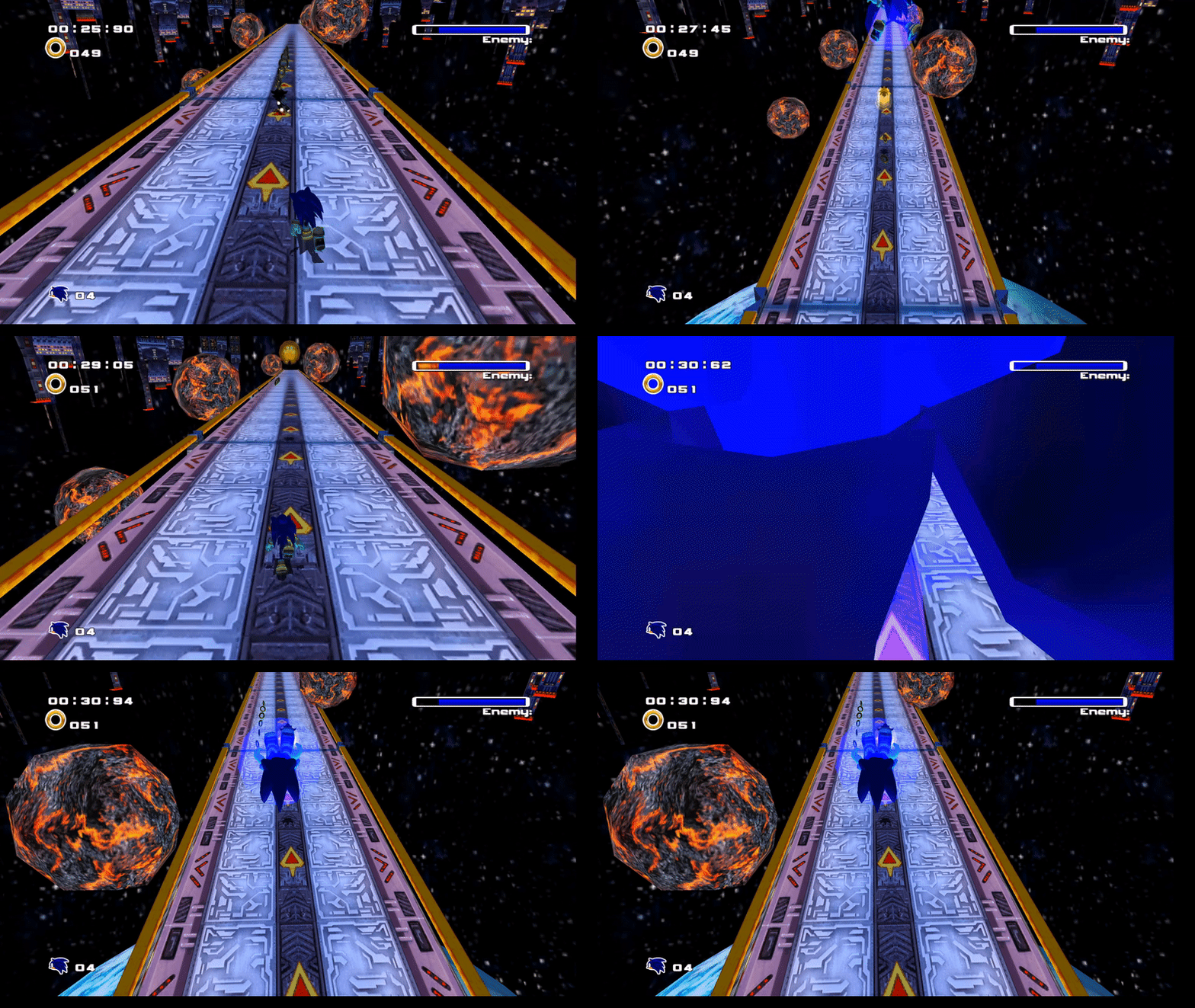
Sonic the Hedgehog runs alongside the menacing Shadow the Hedgehog as "Shadow" is spelled across his image. The two speed down a scifi highway amidst meteorites and space colony towers against the black of space.
This is one of the coolest things ever produced and I will entertain no dissent on the subject

It’s been a lot of fun reliving this fight, one of the longest-held in my memories, with the benefit of many years of design knowledge. The ‘rival’ fights in Sonic Adventure 2, in which the boss is a player character from the opposite story path, were heavily limited in what they could do, as they exclusively utilize the player character assets, animations, movement systems, etc. That said, it’s clear that this climactic battle was trying really hard to do a lot with a little. Not everything about it is stellar, but I think it’s still commendable they managed to make a pretty fun boss encounter that at least heavily delivers on the narrative promises of the game, if nothing else. I still find so much value in looking back at design of games like Sonic Adventure 2 that shaped my childhood, even with all of their flaws.

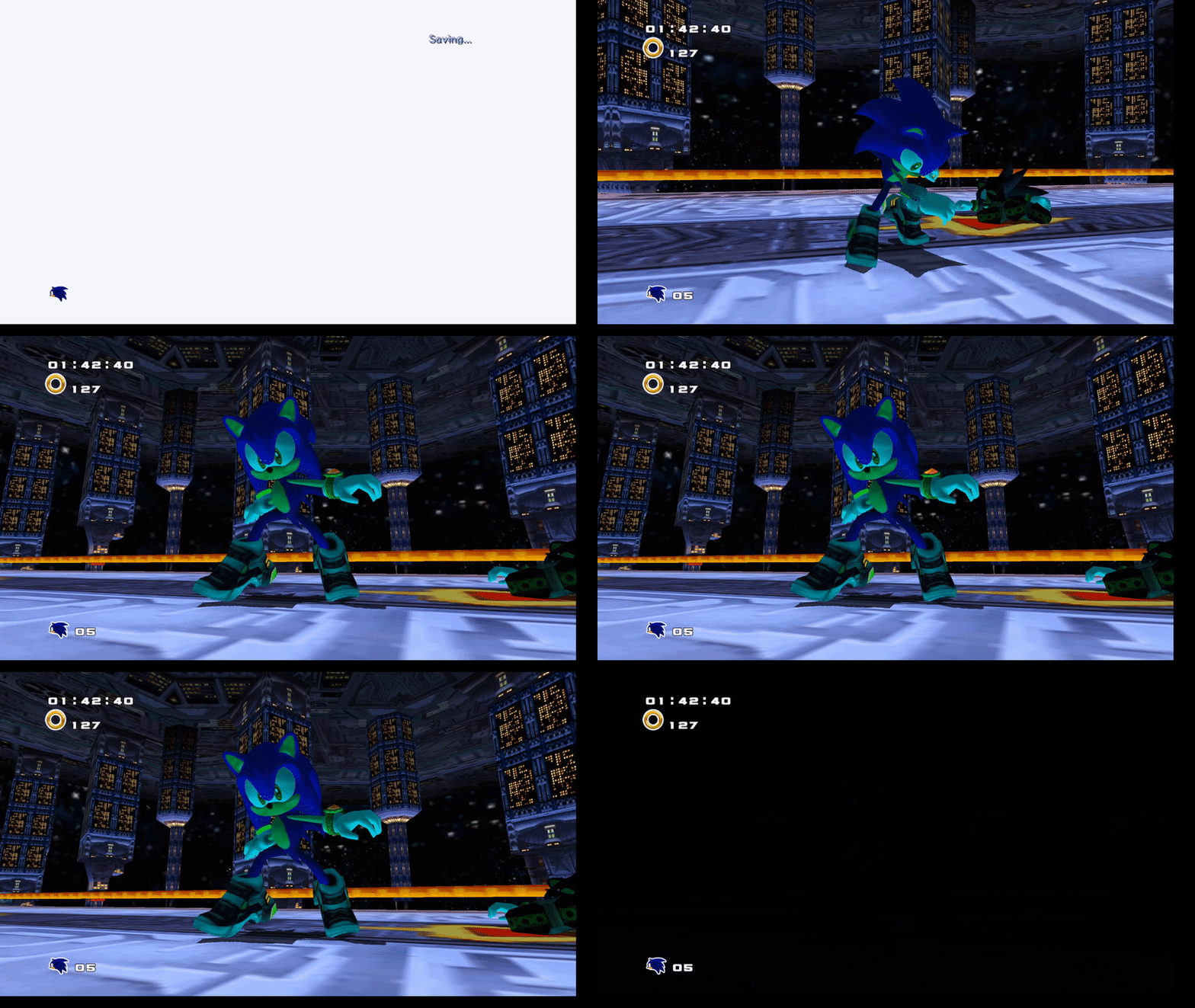
Sonic The Hedgehog celebrates over the unconscious defeated body of Shadow the hedgehog, standing on a sci-fi skybridge in the black of space, surrounded by inverted skyscraper-like structures.

That blue hedgehog again, of all places…

Difficulty as Narrative Design – The Emotions That Might Happen When You Fight Sans

I’ve had some stuff on the brain lately, in regards to difficulty’s place in design, which is what tends to happen when you play Elden Ring for so many hours straight. I’ve also been replaying Toby Fox’s Deltarune with a friend, another game that uses difficulty in interesting ways. I’ve had this thought for a while, to do a write up about how difficulty can be, and is, deployed in design to affect the greater experience. This article contains major spoilers for Undertale and mild spoilers for FromSoftware’s Elden Ring.

To be unambiguous here – difficulty is a very nuanced and at times personal subject in design that touches on a host of other things such as game balance, technical depth, general play enjoyment, and of course accessibility. These are very complex subjects that deserve their own discussions. What I’m specifically focusing on in this article is how difficulty can be deployed with purpose, and often has more relevance to the overall design than is often attributed to it, as a simple measure of player competence for the purposes of challenge. I wanted to look at an example of a game where difficulty is an intimate part of its narrative design, where the reactions it illicit is very much a product of how difficulty is utilized.

The idea that difficulty in gameplay can be a narrative tool should be fairly straightforward to grasp when looking at a couple of examples. In Elden Ring, all of your primary boss characters are demigods, children of gods, who once fought over the shards of the titular ring. The demigod Radahn fought his half-sister Malenia to a standstill. Radahn is oft touted as the strongest of all demigods – he holds the stars in stasis by his own power – he takes an entire platoon of elite soldiers in gameplay just to take down! This assertion that Radahn is the strongest remains more or less unchallenged for some time. There are harder bosses, but none that require so much backup to defeat, nor any nearly as hobbled with injury as poor Radahn.

There is a secret and hidden boss, however, another demigod called Malenia, who is still alive. When Radahn is found, Malenia’s power, the same power that has scarred the landscape around Radahn has left him ‘divested of his wits’, and fighting like a wild animal. Malenia, however, is more or less totally lucid, angrily awaiting the return of her missing twin brother and liege lord, Miquella. Malenia has never been in better form – there was nothing stopping her from taking Radahn’s shard of the Elden Ring and yet she did not, so clearly she has no interest in ruling. Indeed her dialogue reinforces the notion that she fought only for loyalty to her brother’s ambitions.

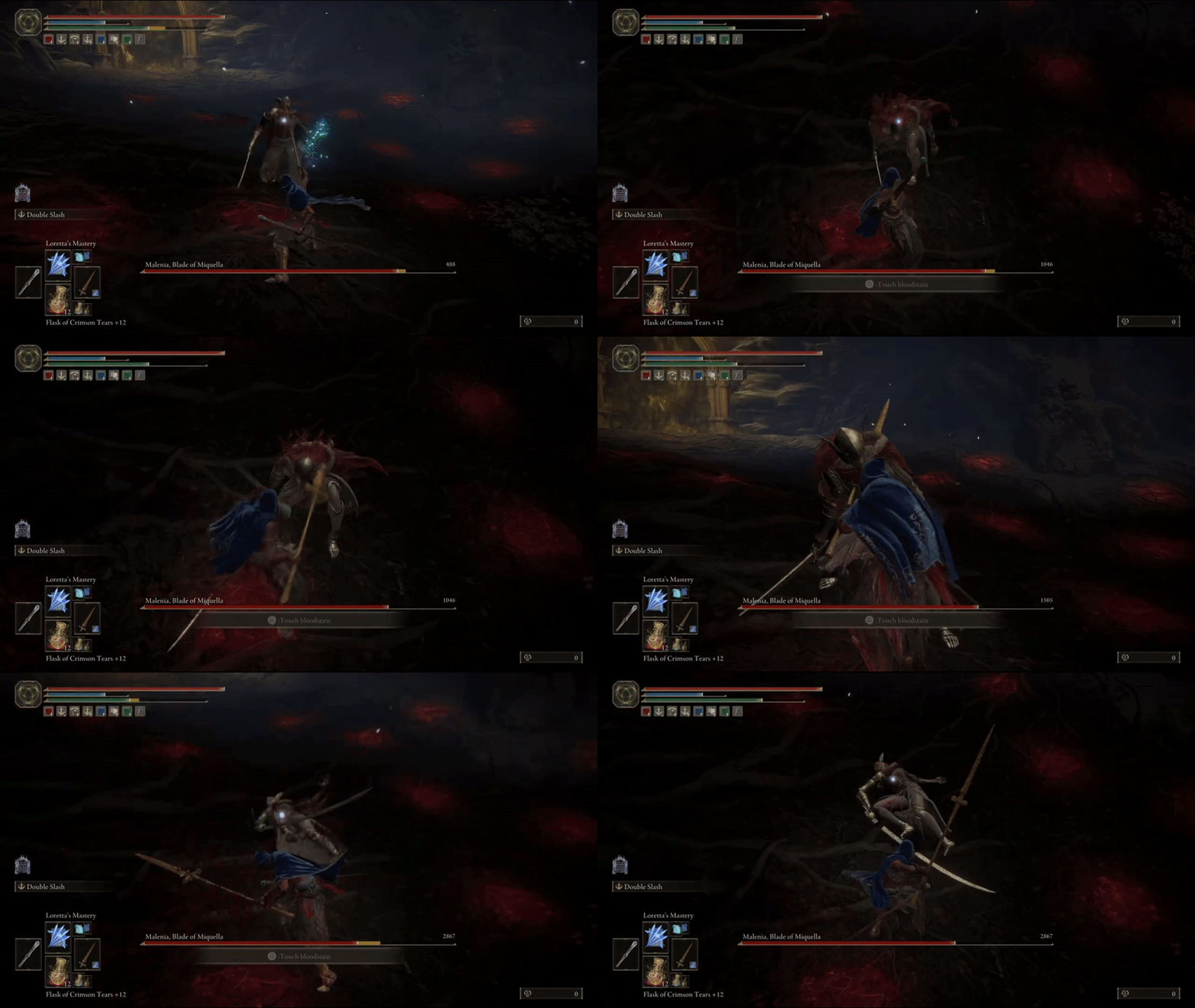
Two warrior women face each other in a lush cavern filled with white flowers. One has red hair and is in golden Valkyrie garb, with a sword. One is in a blue hood, with a spear. The Valkyrie ascends into the air and swings her sword with such ferocity it creates white-hot slashes of air in a blurring flurry around her. The blood-hooded woman runs and rolls around the attacks.
I can practically feel the hairs being shaved off the back of my neck.

Any who’ve fought Malenia will tell you, the idea that Radahn could stand a chance against Malenia in combat, is laughable. They could tell you entirely because of how demanding of a boss she is, how difficult she is tells you the entire story. There’s no possible way she left her encounter with Radahn in defeat, or even in a draw. Her swordsmanship is deadly and near insurmountable, and she hides an even greater power beyond that. She defeated him, and he was left without his senses. She must have left because her brother, the real aspirant to the Elden Ring, went missing. The player will know this intuitively, through experience. They lived it. They will feel it in their bones. Radahn could not have defeated Malenia, and the rest of the story follows. Without Miquella, there would be no reason to collect Radahn’s shard. If you’ve explored the world of Elden Ring thoroughly, this line of thinking is vindicated, as you’ll know Miquella underwent a sudden and shocking disappearance, followed by an extended and secretive absence.

A woman in a blue hood runs her spear through the chest of a taller woman with red hair and golden Valkyrie garb, the stabbed Valkyrie falls onto her back in a pool of blood as the spear is removed.
Difficulty is a marker of power in games, and examining power is essential in stories of conflict

If you’ll indulge me to invoke the first of two quotes from Bennett Foddy, designer of Getting Over It With Bennett Foddy, a notoriously difficult game.

The act of climbing, in the digital world or in real life, has certain essential properties that give the game its flavor. No amount of forward progress is guaranteed; some cliffs are too sheer or too slippery. And the player is constantly, unremittingly in danger of falling and losing everything.” – Bennett Foddy

All that said, difficulty is not just a mechanical gameplay consideration. Like all aspects of a game, it is an essential part of the cumulative experience. I am of the opinion that if an obstacle within your narrative is meant to be threatening, formidable, out to kill our dear player character, then the player should get the sense that this force is threatening and formidable. To trivialize it, or deny the sensation that there is an opposing force trying to halt the player’s forward motion, is to render the narrative dishonest, and rob it of its power. If conflict is about power, than difficulty is one of the most genuine ways power can be communicated in an interactive system. This isn’t to say that every game needs extreme challenge, or even that every game with conflict is necessarily trying to create the aforementioned sense of opposing force. This is but one type of experience you might seek to create, a goal your art may aspire to. In fact, this is just one way to deploy difficulty as a mode of narrative design. That brings us to Undertale.

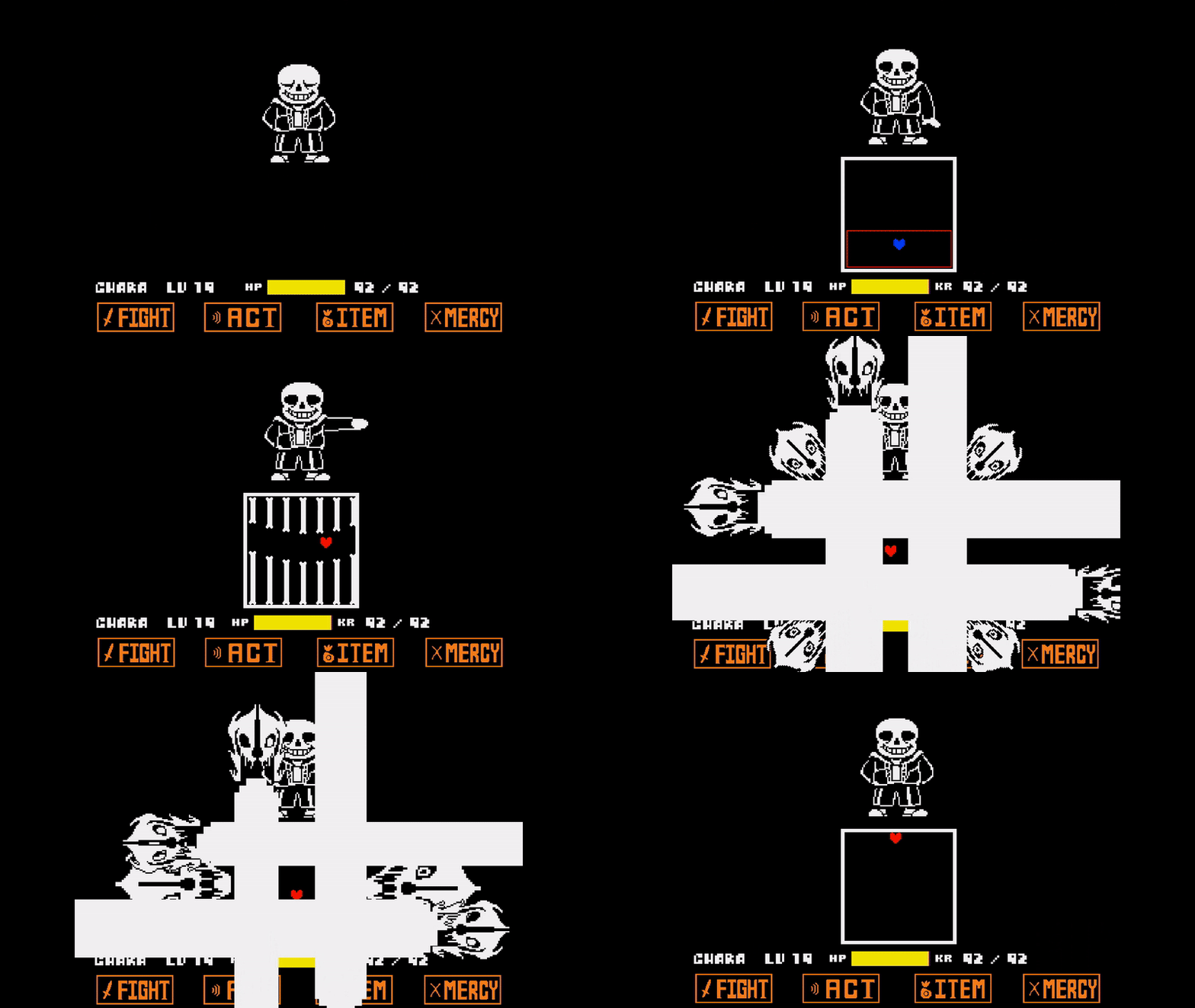
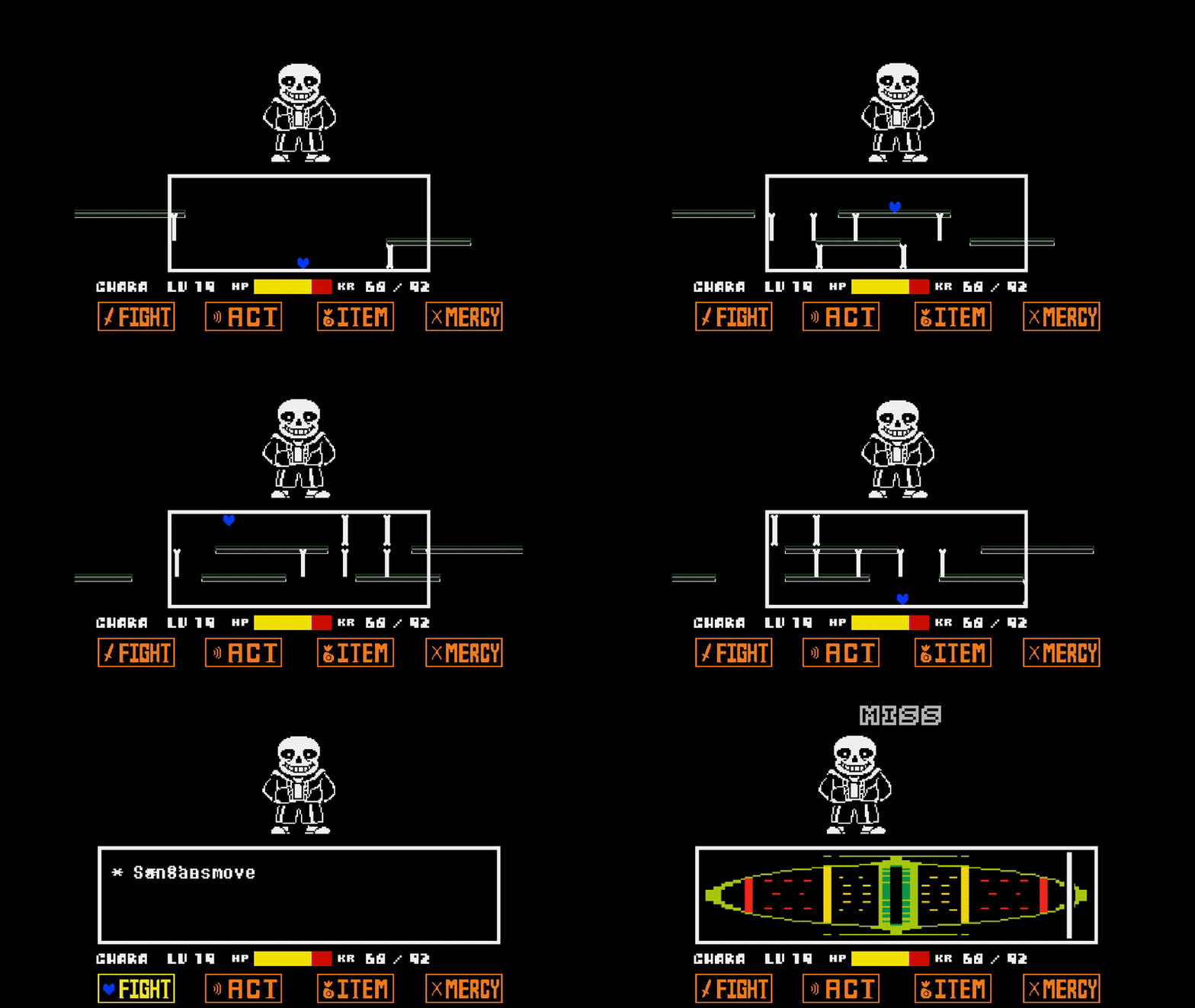
The skeleton Sans stands in a black void, above a battle UI overlay. He says "ready?" then suddenly unleashes a barrage of bones and laser beams to attack the player, represented by a red heart-shaped cursor.
“No.”

In Undertale, the story is persistent – and any runs of the game, even when reset, are remembered and color the experience of playing Undertale going forward in little ways. Death and resetting is diegetic, meaning the player character is literally dying and coming back to life at a previous point in time, within the game’s fiction. In this way failure is kind of inherently tied to the narrative. Undertale comes packaged with a few predefined paths to play that present themselves based on how the player tackles obstacles. Killing monsters casually as they come to confront you will result in one of several ‘neutral’ endings, in which the player’s human character escapes the world of monsters, which is left in varying states of disarray as a result. The ‘pacifist’ run will see the player avoiding lethal violence, and reaching out the hand of friendship to major characters to achieve the best world for everyone. The ‘no mercy’ run is the third and most obscure path, in which not only is lethal force deployed against all obstacles, lethal force is deployed against every potential obstacle, wiping out all monsters in the underground.

To do this, the player has to spend an inordinate amount of time trawling around for enemies to fight. Every single one needs to be killed for the No Mercy ending to hold true. This process is long, repetitive, somewhat dull, and even grueling at times. And yet, it remains an immensely popular way to play this already immensely popular game. There is a purpose to all this consternation, though. I think it pretty noncontroversial to say Undertale‘s ultimate message is one of nonviolence – that the best way to solve conflict is through open communication and a curious, empathic heart. The No Mercy run exists as a counterpoint to this message, to prove its efficacy. Killing everything in Undertale is a pain, frankly. It takes a lot of effort but not necessarily the kind of effort a player seeking challenge might be after. More of that exists along the less violent story routes. No, Undertale is instilling through the avenue of frustration that ‘the easy way out’ isn’t always easy, and while ‘the high road’ isn’t always easy either, it’s a heck of a lot more fun than willful cruelty, which is a continuous and conscious effort on the part of the abuser.

And yet, most playing through will persist. They have buy in, and as Undertale expects, most will be curious enough to want to know what happens next, not in spite of the frustration, but perhaps even because of it. One of Undertale‘s most infamous features is the normally comedic, friendly, and jovial character Sans, who is a bit of an internet meme. There’s a lot of reasons for that, but I think one of them has to be his sudden transformation into the game’s greatest and most stubborn challenge. The boss battle against Sans, with one other exception, is the only real challenge in the No Mercy run, with all other opposition crumpling like paper before the player. The player has not had a ramp up in difficulty in this point, and Sans comes out of the gate swinging with one of the most demanding gameplay experiences in modern popular interactive media. No punches pulled here, Sans is meant to be a brick wall of a boss, one that will have to be worn down with patience if it’s to be cleared at all.

Sans the skeleton stares you down from a black void with a battle UI overlay, as the player's heart-cursor, now blue, jumps across platforms littered with bones.
I have SO MUCH patience right now, you wouldn’t believe. Oh god the patience I have.

Fans of Undertale have such a personal relationship with it, and given its immense popularity that is quite impressive. The player at this point, is acting as an agent within the narrative, separate and apart from their controlled character, Frisk, who ambiguously is either mind-controlled by the player, or influenced by the player subtly to act or fight. Sans tries everything he can to appeal to the player to start over, to do anything but follow through on the path they’re on. He pleads, he appeals to humanity, he threatens, and he even cheats. After each failure, Sans comes up with some new unique dialogue with which to taunt and belittle you for trying. The player can come back as many times as they want to try again, so words and his ability to act as an immovable object are Sans’s only real forms of power over you. The ironclad stubbornness of this encounter, the unerring, unflinching confidence in its unreasonableness makes it feel real, like Sans is a thinking actor specifically trying to get under your skin, and make your goal unreachable, and that is what makes it feel personal.

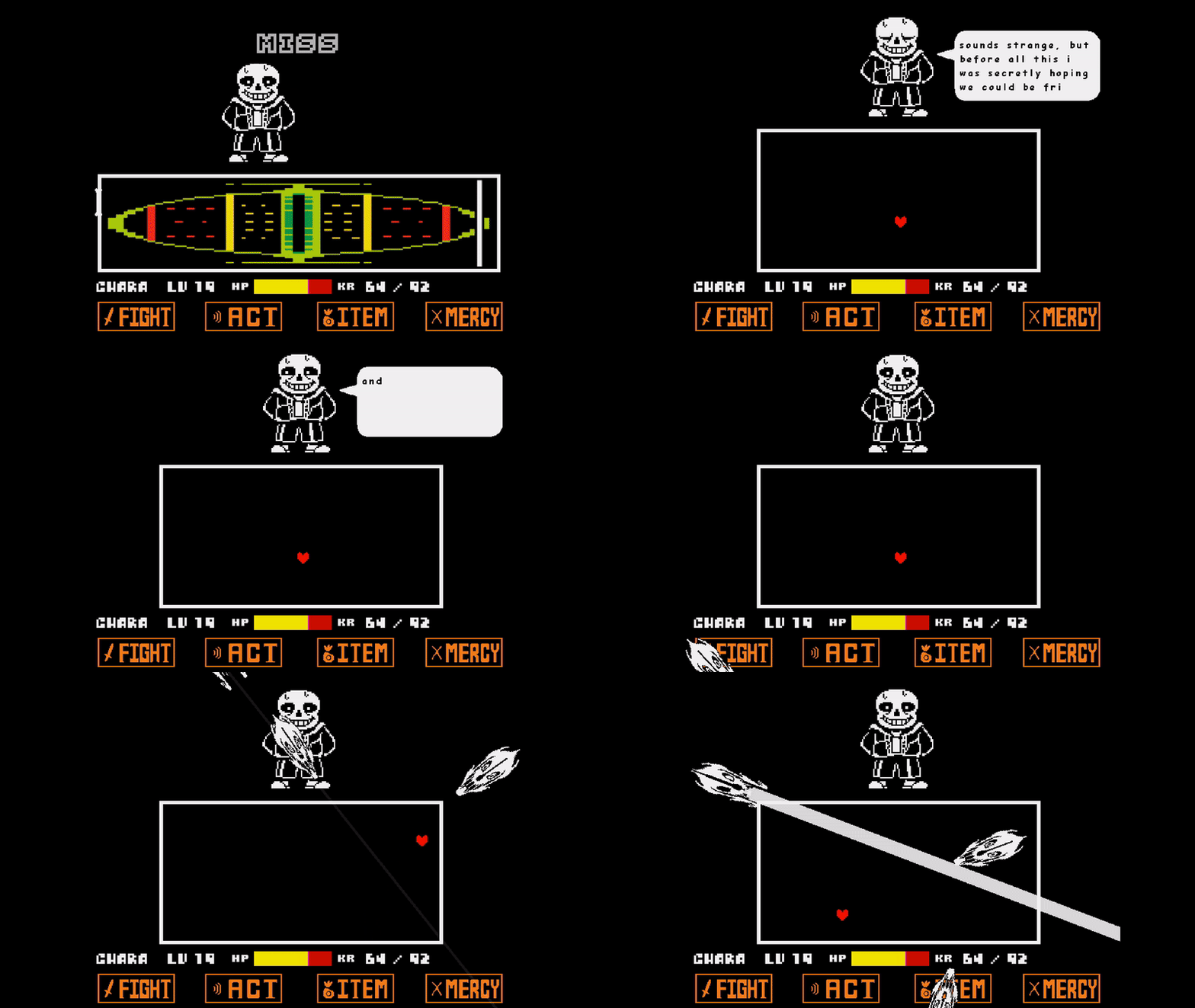
Sans the skeleton says, "sounds strange, but before all this i was secretly hoping we could be friends. i always thought the anomaly was doing this cause they were unhappy. and when they got what they wanted, they would stop."

He then fires a bevy of skull-shaped laser cannons at the player's red cursor.
Oh. Kind of makes me feel bad I’m trying so hard to kil- OH GOD LASERS

Sans isn’t trying to kill you – he knows that is beyond his power. He’s trying to wear you down, to frustrate you, to bore you, whatever it takes to make you give up on your killing spree, and maybe start over, or even give up. The story was very carefully set up to make this a legitimate way to cap off the narrative. In Undertale, the story is persistent – and any runs of the game, even when reset, are remembered and color the experience of playing Undertale going forward in little ways. In Undertale, giving up and starting over is a legitimate and designed-for chapter of the narrative.

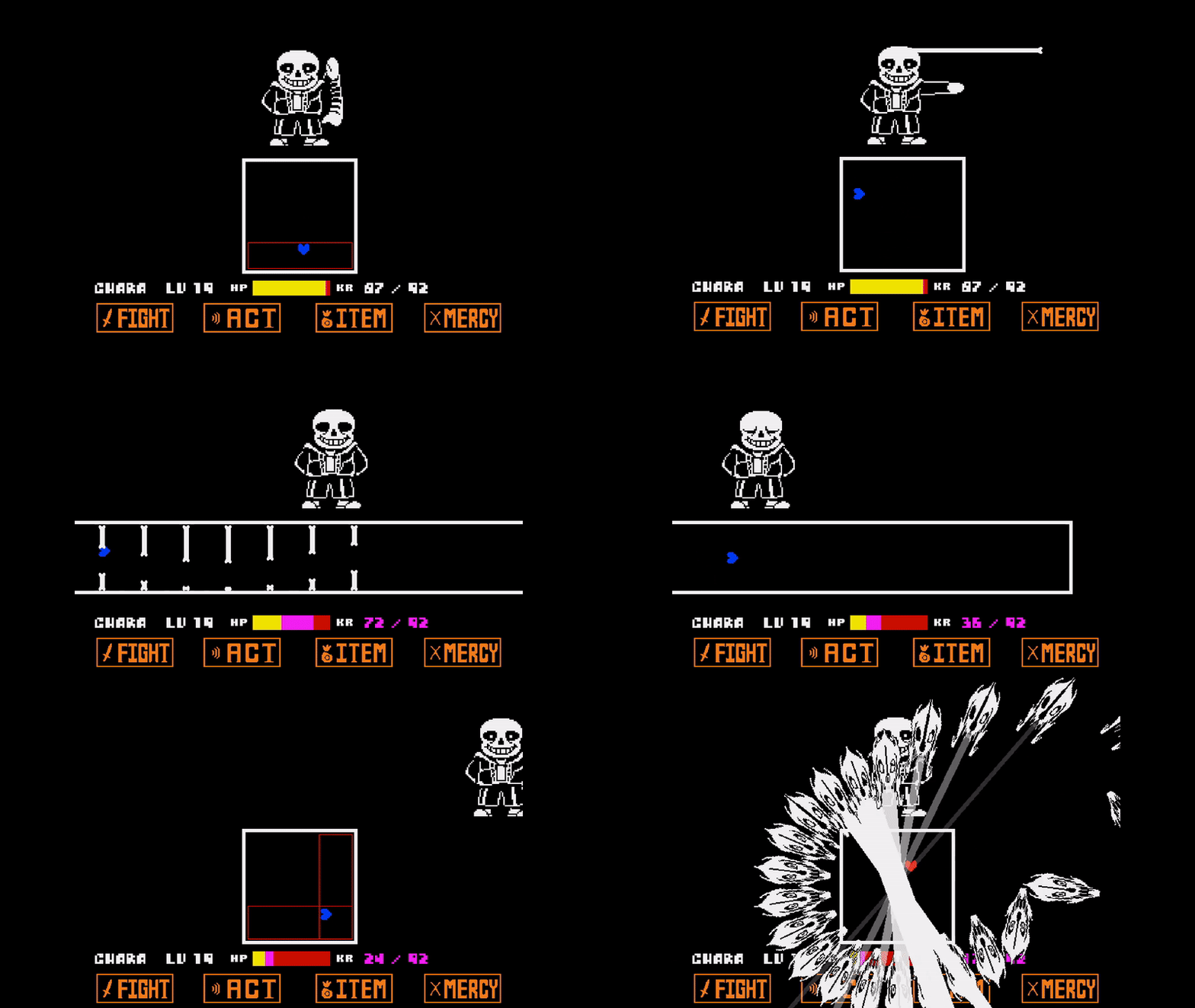
The skeleton Sans sends an onslaught of bones and laser beams at the player's heart-shaped cursor, turned blue now. After a moment he sends the blue heart careening into a deadly maze of bones as it flies against its will to the right side of the screen.
What a reasonable amount of garbage that can instantly kill me, on the screen, all at once

Giving up can mean a new beginning, a world where the player is not a force for destruction and misery, but a force for change and friendship. Whenever I play Undertale, I love to play the part of the sinister player destroying the world and its inhabitants for callous entertainment (and in a way, I truly am that), but then our protagonist, Frisk, overtaken by sorrow after killing Sans, is able to wrestle back control and ease me into a more peaceful, and ultimately more fulfilling world. I’ll play a No Mercy run just up until I’ve killed Sans, and no further. I’ll then roleplay the regretful monster, the powerful demon whose lost everything, and has no more mountains to conquer. From there I return, back to the beginning of the game, anew with a desire to learn and try again. Undertale makes failure an avenue for learning and improving at the game yes, but also a potential narrative moment of fulfillment.

I love this scenario. It creates a full arc for me, as the will and intention of the player character Frisk, to go through. It’s a rich narrative that unfolds entirely through gameplay that I get to be a part of. That’s the real magic of difficulty in games for me, it’s something entirely unique to the medium, a level of interactivity other forms of art simply cannot achieve. Sans is blisteringly difficult, to the point that he may even feel antagonistic to the human behind the screen. But the game isn’t trying to punish you, nor look down on you, it’s trying to play with you. It is a game, after all. It is interactive theater, a stage show where you are the star. And maybe just maybe you’ll get something valuable out of the experience.

Death and rebirth, trying and overcoming—we want that cycle to be enjoyable. In life, death is a horrible thing. In play, it can be something else.“-Hidetaka Miyazaki

You are meant to be along for this emotional ride through joy, through sorrow, through fear, through love, through distress, and yes, through frustration. It’s a frustrating thing to be denied passage, to face an opposing force that’ll do everything in it’s power to stop you. If the art is to be evocative, it may be necessary to instill that sense of frustration. I will deploy the second of two Bennett Foddy quotes, as I admire the way he puts it;

What’s the feeling like? Are you stressed? I guess you don’t hate it if you got this far, feeling frustrated. It’s underrated. An orange, a sweet juicy fruit locked inside a bitter peel. That’s not how I feel about a challenge. I only want the bitterness. It’s coffee, it’s grapefruit, it’s licorice.” – Bennett Foddy

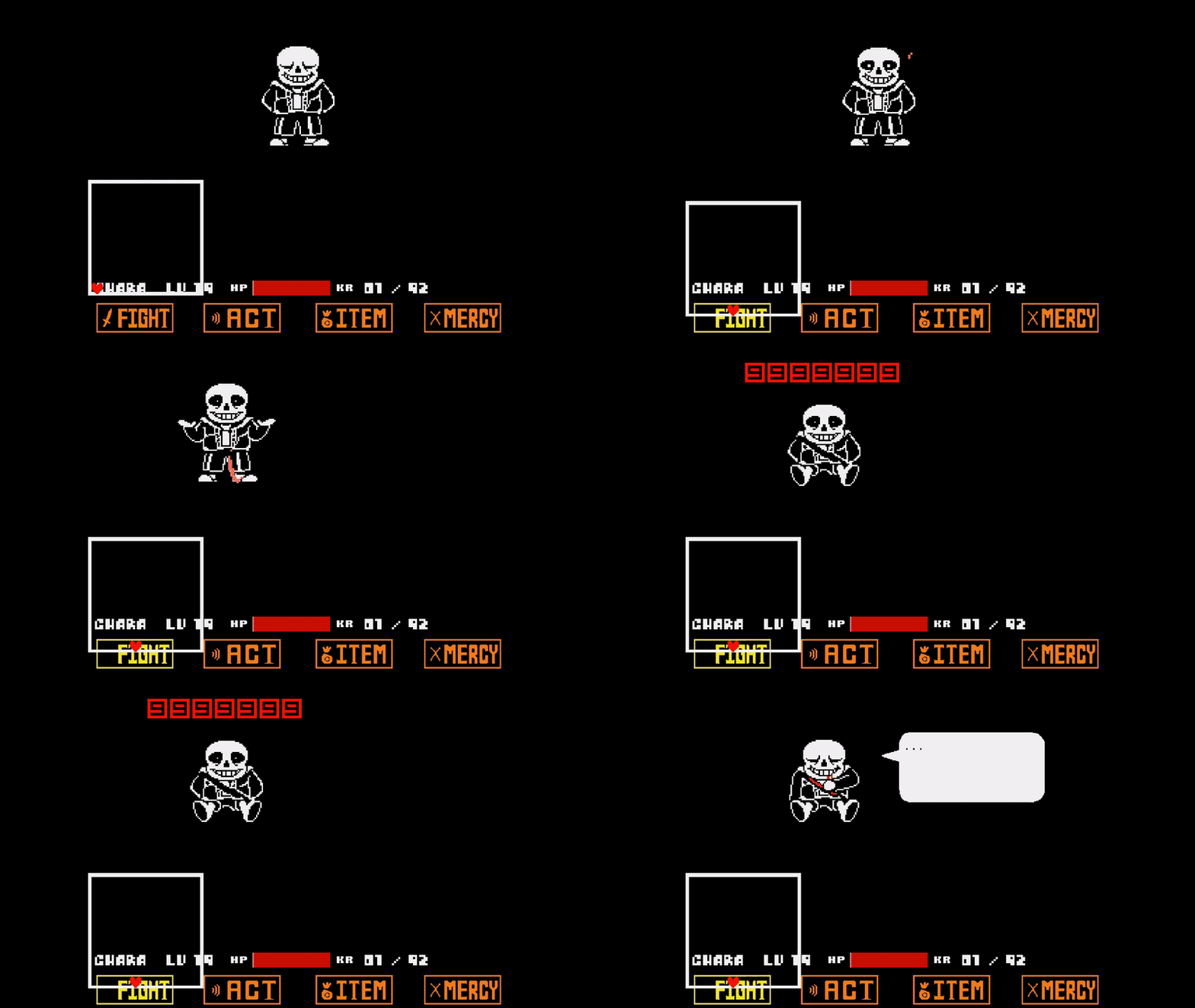
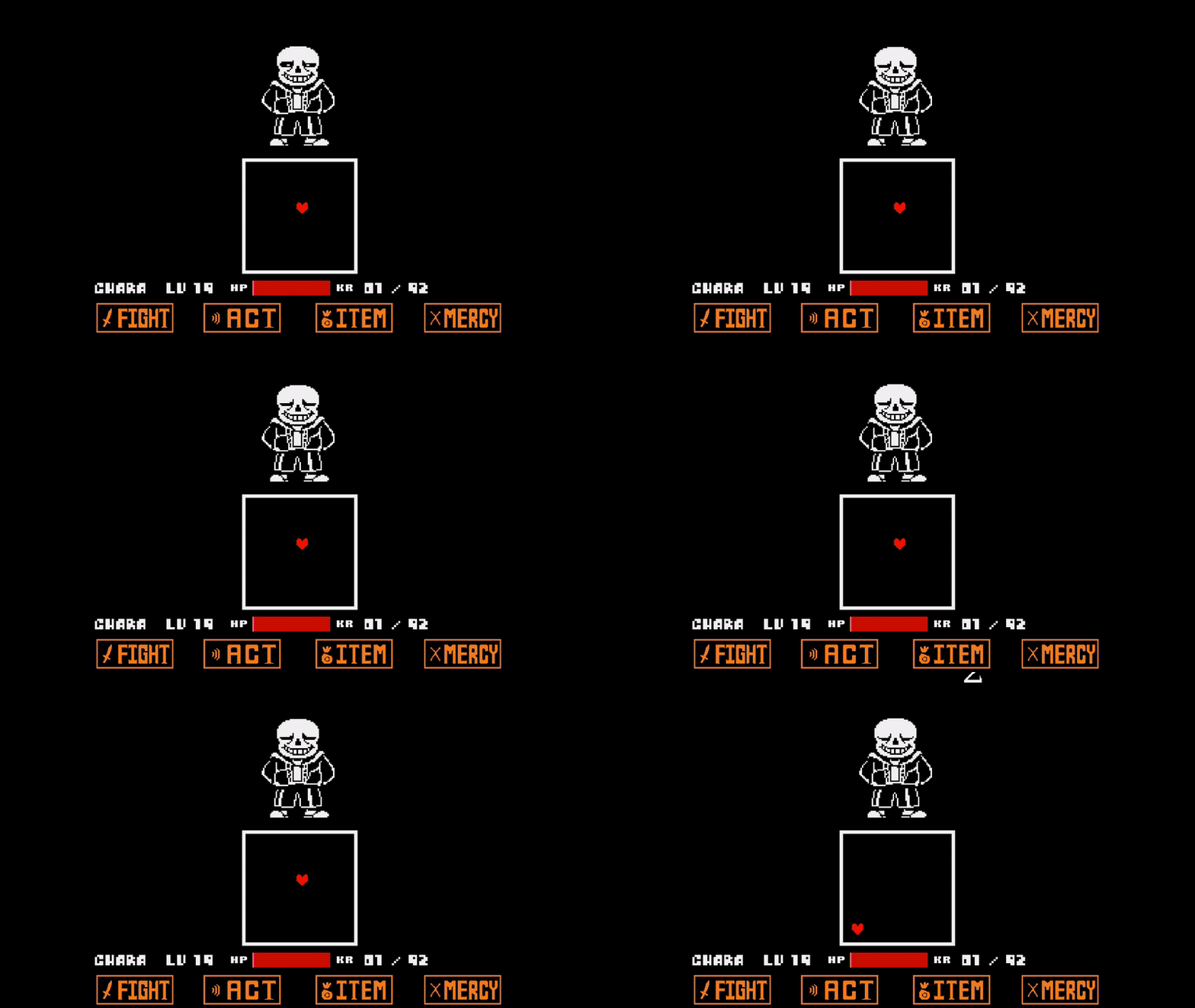
Sans the skeleton sleeps, standing up, in the center of a screen with a battle UI. A red heart-shaped cursor moves over to the UI button labeled "FIGHT". A slashing effect moves toward Sans, but he slides out of the way and begins to speak, but is cut off by a second attack, which leaves a violent gash across his chest.
Frustration and loss isn’t just a roadblock to joy and catharsis, it’s an essential part of the whole.

Frustration is not the opposite of fun. I think the runaway success of games like Dark Souls, Elden Ring, and Undertale, games that very much use frustration as feature of their storytelling, are strong evidence of this. There are hosts of games that follow similar patterns. When you play and watch people play difficult games as much as I do, you begin to notice that not only is frustration not a deterrent to the fun for most, it often accompanies the highest highs of player’s positive emotional reactions. Art is not a vehicle for merely delivering joy and nothing else. Life is a rich tapestry of a variety of emotions, and if art is to speak truth, then I think it’s worth considering how best to accurately reflect that. I’ve been talking a lot about feelings and emotional reaction, and I can’t overstate how subjective such things can be. You’re walking a fine line when utilizing traditionally negative emotions such as frustration to tell a story. As I said before, difficulty is a very nuanced and complex topic and this is just one aspect of it, one feature of difficulty to consider when configuring the shape of the experience you want to create. Difficulty can be used to tell and legitimize interactive narrative in a very profound way. That said, not all games need to, and by no means should they, take the same shape. Knowing how best to achieve the goals of your design starts with understanding your goals, and understanding the tools at your disposal.

Sans the skeleton sleeps soundly, standing up, in the center of a screen with a battle UI overlay.

You have something called ‘determination.’ So as long as you hold on… so as long as you do what’s in your heart… I believe you can do the right thing…