Video Games Vs. Horse

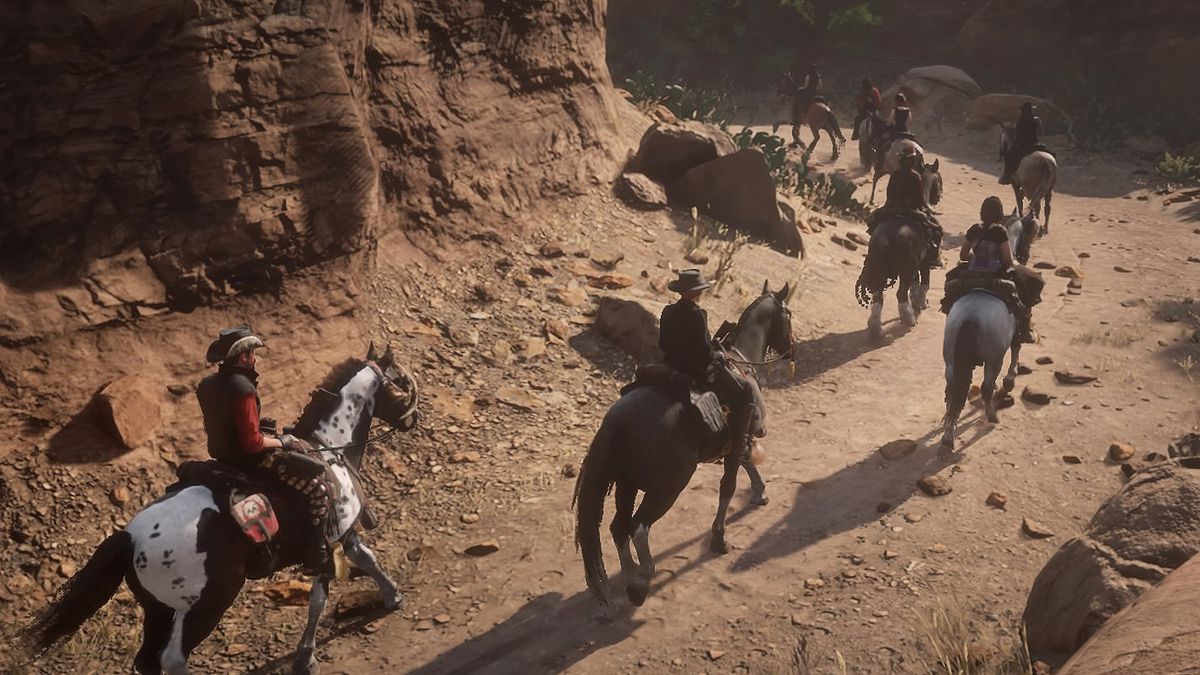
Ahh, horse. Strong, graceful, the picture of elegance. Truly one of nature’s most majestic creatures, and a favorite mainstay of the that one medium I like a whole lot. Welcome to ‘Video Games Vs.’ where I analyze the dumbest stuff in video games I can think of which inexplicably follows a pattern of being almost consistently jank and bizarre. And there is no creature in the interactive medium’s menagerie more jank and bizarre than the horse, and riding animals in general. Let’s get right into it.

Simulating a Living Creature

When adding a feature to your game, you always have to ask yourself what it is you’re spending your resources on and why. What’s the goal of having a horse in your game? Does it enable combat? Is it merely for making the player go faster? Are horses just cool? Or, does it need to be immersive, and make the player feel like they really own a companion animal? The goal of the later comes up a lot in small ways, such that it separates the concept of riding animals from, say, a dune buggy. One is a tool, the other is a living thing. In a lot of games, horses are not meant to be mere vehicles.

With this consideration, it makes a lot of sense that often, in games, the movement of horses is not nearly so smooth or precision as the movement of your main playable character. Many games are concerned with just this sort of behavior. For example, the recent Zelda: Tears of The Kingdom, and it’s predecessor Breath of The Wild features horses that do not map perfectly to the player’s control stick, the way link does. The horse does not go slow on a slight tilt of the control, nor does it gallop at a full tilt. Rather, Link must gently heel the sides of the horse, much like a rider does to a real horse, to encourage it to pick up speed. In Tears of The Kingdom, there are several ‘levels’ of speed which the player accesses through a set of states that the ‘kick’ button rotates to, and holding back on the control stick encourages the horse to slow down.

Besides that, these horses do not start out friendly to Link. They’re wild, and must be tamed. They may back and panic before they are tamed. The method to calm them is to simply press a button, yet still the player must be attentive to, and respond to the horse’s needs. These things do not facilitate the gameplay of movement, combat, or puzzle-solving which otherwise dominates Zelda‘s play space. Their purpose to give the illusion of life to these horses – temperamental, disobedient, and willful life. On the flip side, the illusion of life can also be a boon to movement gameplay. The Zelda horses, if set on their course, can follow paths and avoid obstacles automatically, as though the horse has a will of its own, allowing the player to occupy themselves with other activity. In this way, the horse is not an extension of the player, but rather a partner.
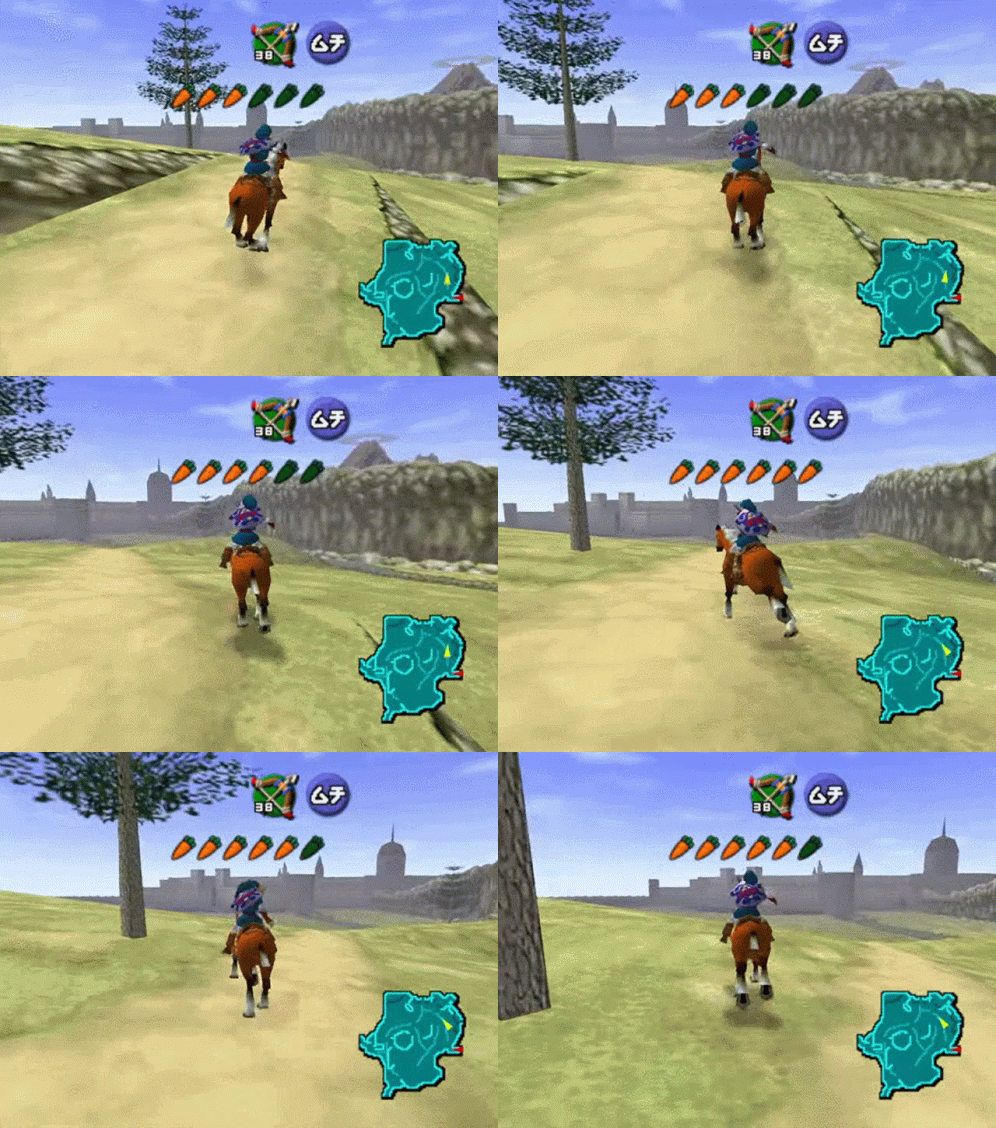
Link from Ocarina of Time rides his horse, Epona, over the grasslands of Hyrule field. A meter represented by six carrots slowly drains as Link encourages Epona to speed up.

Zelda has long toyed with this sort of behavior.

However, as I alluded, these considerations can also be obstacles to gameplay. Particularly in early Zelda games, the horse Epona would often get stuck on strange geometry. She’d whinny and complain, and at times refuse to move if one attempted to guide her over large tree routes, cliffs, or rough terrain. Zelda horses can never be commanded to jump, for another instances. Epona and her descendants will only jump if approaching certain obstacles like fences. With such loose rules, divorced from player controls, they are prone to errors and discrepancies, like Epona getting stuck on a gate, because she did not approach it at quite the precise angle.

These sorts of bizarre terrain interactions are terribly common for video game mounts. Agro from Shadow of The Colossus is a lovable and friendly free-thinking horse. However, his AI is sensitive to shifts in terrain, and sometimes can get a little mixed up. Elder Scrolls V: Skyrim is infamous for the ‘Skyrim Horse’. These otherwordly creatures are capable of scaling near-vertical inclines, and if you were around in Skyrim’s heyday you were no doubt subject to one or two horse-terrain interactions that were so bizarre as to totally shatter the fiction and immersion of the game, at least once or twice. It is, admittedly, rather funny.
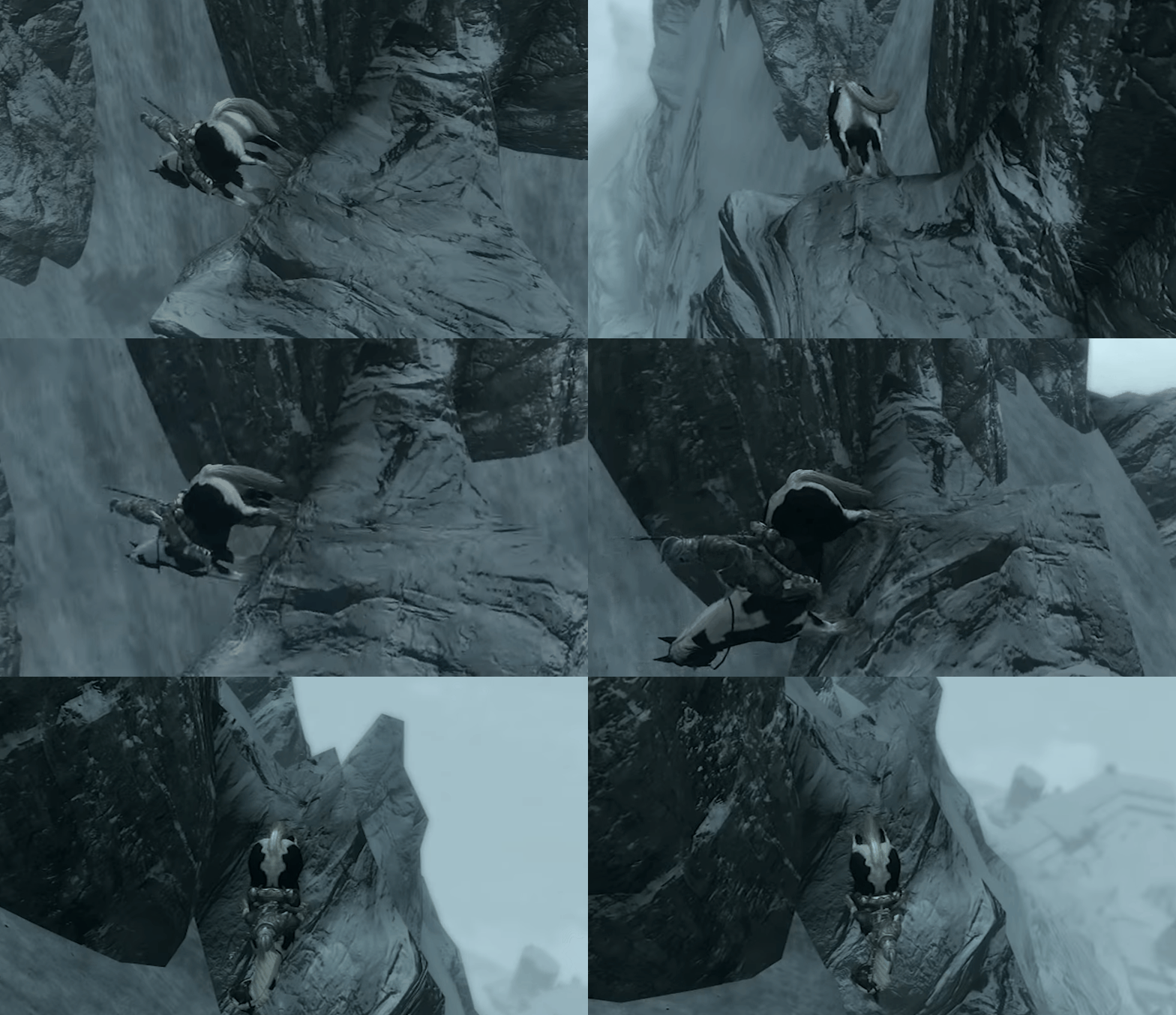
A knight on a black and white horse stand on a cliffside in the mountains. The horse is standing nearly vertically on a cliff face.

Charming.

When The Horse Is Only Decorative

There is an inverse to this, where horses are not considered as companions in gameplay, or even as vehicles. It is customary in MMORPGS to collect lots of mounts, and usually, the mount is merely a visual flare. It increases your move speed, and nothing else. No new mechanics are imparted, nor does the mount behave in any way like a living thing outside of its animations. Perhaps the mount even allows you to ‘fly’, but generally the ‘flight’ is just a repurposed swimming mechanic, again with the animations switched out. The horse in this instance appears with a button press, and disappears just as easily. In Final Fantasy XIV, presumably to counteract this sense of one’s chocobo riding bird feeling like a prop, among other reasons, you are able to summon it as a companion in combat, aside from its utility in increasing moving speed. World of Warcraft, in its latest expansion as of August 2023 added in new draconic flying mounts whose motion is governed by a more interactive flight and movement system, to better characterized them as living things, and make travel more interesting.

A woman in blue with a white braid whistles, and a giant ostrich-like yellow bird appears suddenly, her now riding it.

I’m faster, and riding it, but I’m not really riding it, you know?

A Peek Behind The Curtain

In MMOs and games like them, mounts usually appear and disappear out of nowhere as needed. However, wherever a mount is introduced, you have to decide how it’s going to be conveyed to the player. The Horse Delivery System, if you will. For Zelda, traditionally Epona is called on some sort of instrument, but what then? The player can potentially leave Epona wherever they want, travel a few miles, and then… what? Do they have to wait for Epona to make their way all the way across the land? Well no, and in fact the game will sometimes not even bother to remember where Epona was. Rather, she will spawn in off-screen, somewhere nearby. The camera will dramatically swing around to give the impression that Epona did travel across the land at the sound of your call, but this is indeed just an illusion – a visual trick.

There is a danger to this, though. In Dragon Age: Inquisition, due to how free the camera is at all times, it is very very trivial to swing your camera around fast, just as your horse appears and see what’s really going on; your horse jarringly winks into existence just where the game thinks it’ll be off-camera. I think many a curious or intuitive player might do this, it may even happen by accident, and it is extremely jarring. It underscores the artificiality of Inquisition‘s horses so much that I never saw them as representations of living creatures again. Besides that, while I’m on the subject, the Inquisition horses are so slow, relatively speaking, so as to not even be worth the enormous amount of screen estate that they demand with their huge bodies. If including a mount in your game, consider the trade offs – especially if implementing life-like features that may hamper control.
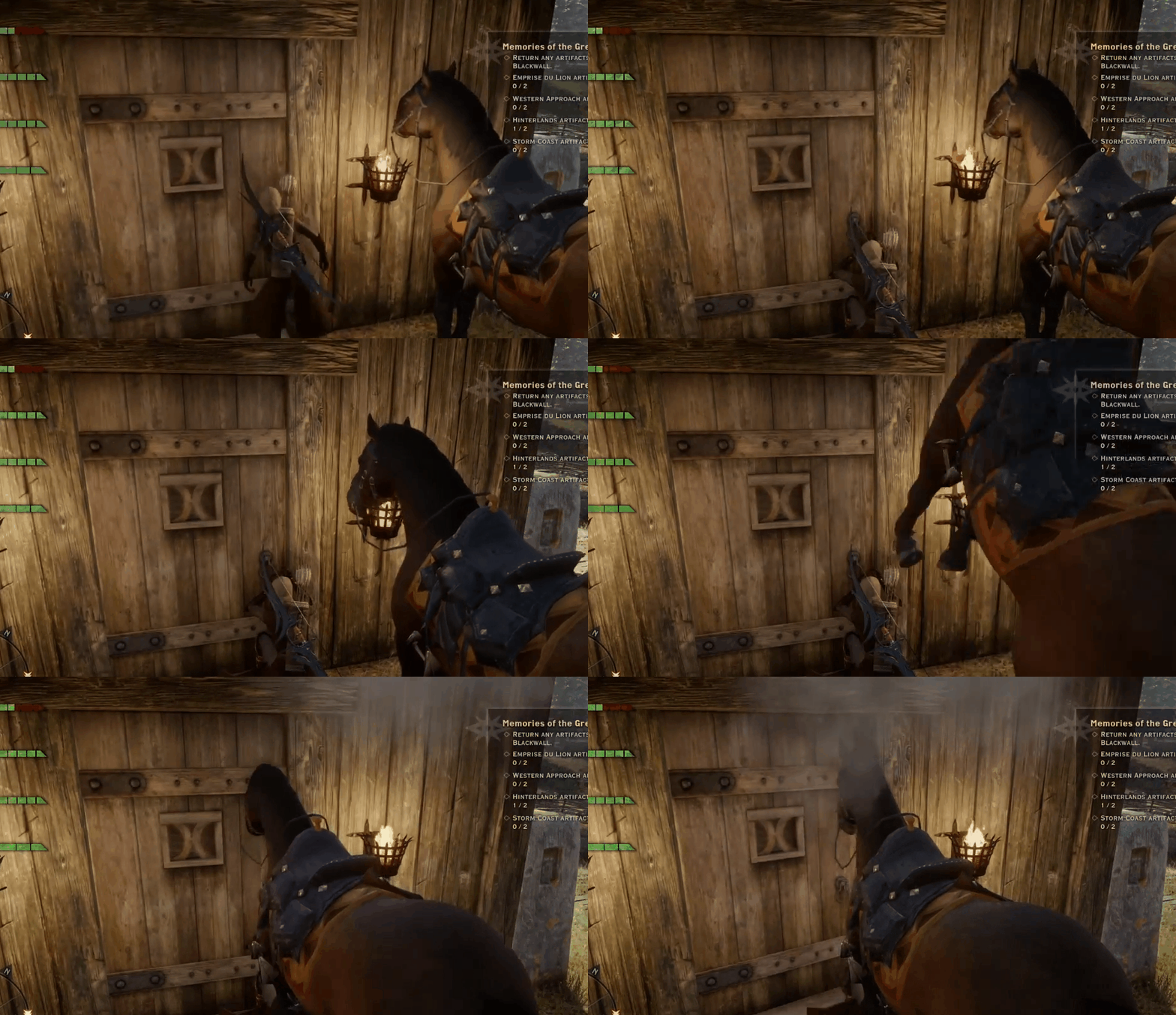
A woodland ranger kneels down to pick a lock on a wooden door. Their nearby horse rears up, and slides along the front of the door, in glitchy fashion.

Procedural interaction with terrain is prone to uh… a lot of problems

Zelda: Tears of The Kingdom utilizes stables, which always, magically, are able to summon forth horses registered to the stable system, regardless of where in the world they are left. Otherwise, horses can only be called from a fairly short range, not universally, like the Eponas of old. This is more ‘realistic’ in a way, I suppose, but really just feels like a way to further justify the common use of the stables, and the previous solution was a lot smoother in my opinion. So what other ways are there to get a large quadruped into the play space as the player needs it that isn’t disruptive? Stables are a common solution, such as how chocobo traditionally work in the Final Fantasy games- visit a stable or chocobo farm or chocobo forest, and go off with your mount, which is returned to the stable when left behind. I think the most elegant version of a video game horse, would have a very inventive and elegant way to get the horse into the player’s hands, so to speak.

Gaming’s Most Powerful Horse

So I’ve discussed my love of the strongest apex predator of the mounting animal world before, so I won’t labor the point too much. Torrent from Elden Ring is a very satisfying and reliable game mechanic to use, which allows you to traverse vast distances, engage in mounted combat from the safety of a riding saddle, and engage in combat in entirely new and interesting paradigms as compared to Elden Ring‘s on-foot combat.
A woman with a spear rides a horned steed through shallow waters and over large castle ruins to avoid the breath of a fire-breathing dragon.

Mighty is He.

One interesting thing to note, is that Torrent approaches a lot of the problems I’ve talked about so far by just… not engaging with them at all. For example, many games struggle with how and where the player can call upon their mount. Each game’s individual Horse Delivery System, so to speak. Several games, like Dragon Quest, and certain Zelda games, try to brute force this problem by simply teleporting the horse in on command, trying valiantly to hide the seams of this unnatural action, and mostly failing. Some games, like Zelda: Breath of The Wild and Zelda: Tears of The Kingdom try to smooth over this dissonance by having at least the required use of an in-game stable to summon your horse from anywhere. Torrent does not brute force this particular problem so much as he double-jumps over it. Torrent doesn’t have to appear from anywhere besides just under the player, immediately, whenever they want him, so long as they are outdoors. There’s no need for any transition from off-screen. Our only explanation needed, is that he is a magic horse.

This is reflective of FromSoft’s design philosophy as a whole, which favors gameplay usability over simulation. Which isn’t to say they don’t value immersiveness, but rather that they tend toward verisimilitude over realism. Thus why Torrent has the barest minimum of startup acceleration. The lightest touch of clearance needed for him to turn. Torrent has just the hint of a suggestion of more rigid movement, which creates the convincing illusion of riding a horse, which in this specific case is all that’s needed to sell the fantasy. That leaves a lot of leeway to make Torrent feel really satisfying to use, and create very exciting mounted-combat scenarios with a lot of precision movement. However, there are of course drawbacks – if you’re looking for a game that truly simulates the feel of riding an animal, you’ll not find it here.

A woman with a spear rides a horned steed through shallow water, staring down a fire breathing dragon. Just as it starts to spew flames, the woman and steed hop up a nearby stone, and jump up to run her weapon through the dragon's head, vanquishing it.

And yet, how many video game horses can do THAT!?

Plessie

Okay she’s not a horse, but she is a riding animal – it counts, and the lessons we can take from her implementation will be invaluable to our line of interrogation here. As we’ve been over, video game animals often struggle with the Horse Delivery System. Where and how does the horse appear? What space does the horse take up when not in use? For Torrent it’s ‘he doesn’t’ and ‘none’. Usually, it involves spawning the horse in just off-screen to hide them popping it, with the implication that the horse was totally nearby the whole time and just needed to hear the sound of your voice to come scampering in. Personally, I find this all kind of tedious and momentum-killing. Especially in exciting adventure-time games, which is where you’ll usually see horses, the need to drop everything to navigate a menu or perform some special action feels disruptive to me, which is probably why Torrent is my favorite on this list so far, despite his ‘avoiding the problem’ approach to ‘solving’ this problem. It makes Torrent feel less substantial, and more like a game mechanic than an animal, which is probably why they made him a ‘spirit steed’ in the story.
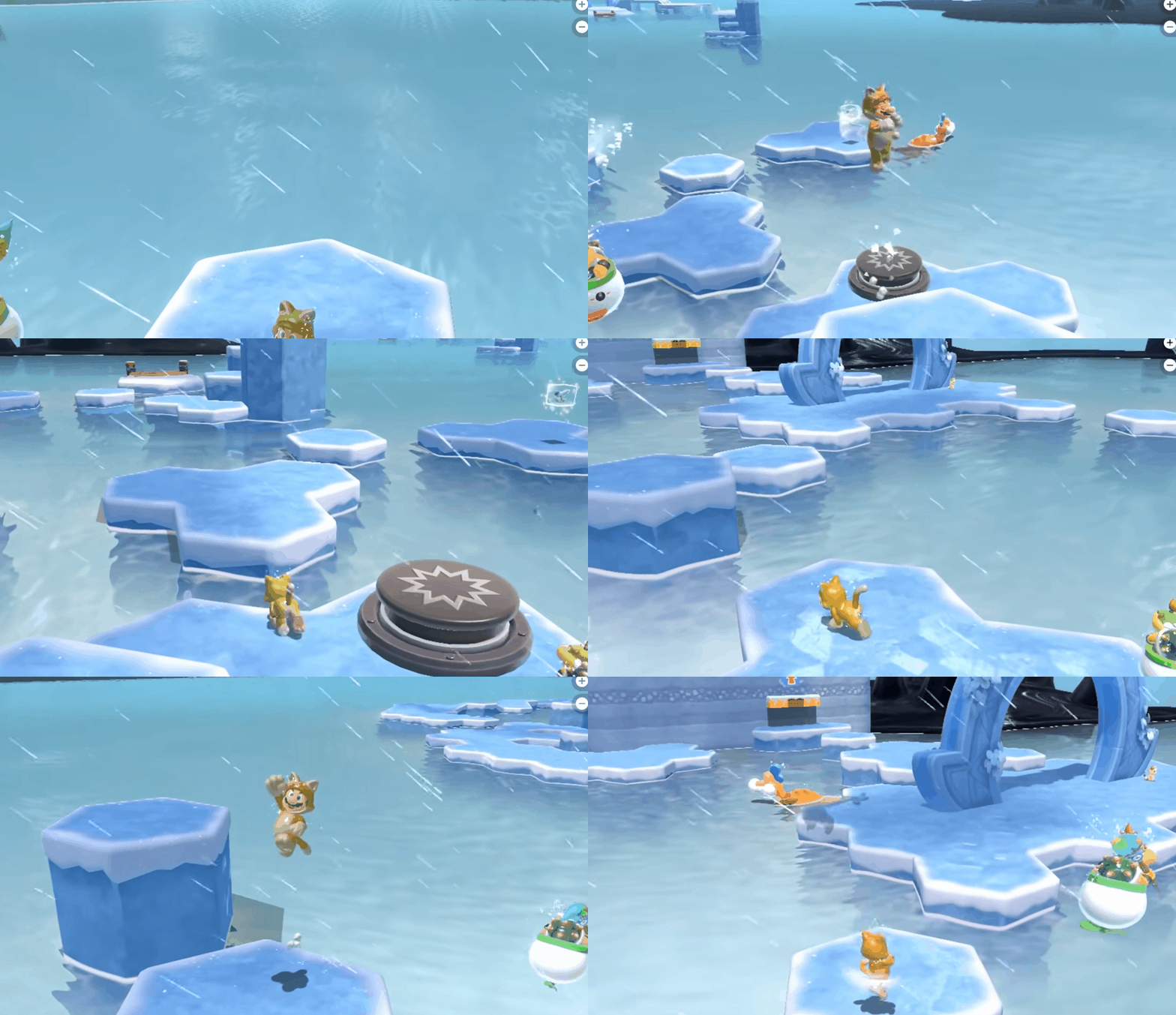
Mario, in a cat costume, standing on an ice pillar. The camera pans over to the nearby water, and a small, orange plesiosaur emerges from under the waves.

Plessie has no such issues.

Nintendo has proven this problem solvable, as far as I’m concerned. The 2021 re-released of Super Mario 3D World is actually Super Mario 3D World + Bowser’s Fury. The latter of which is a bundled open-concept mini-adventure in which Mario explores a vast lake or sea type area to stop the titular Bowser and his Fury from rampaging. The game is separated into a number of islands and shores that require navigating not insignificant portions of water. That’s where Plessie, your erstwhile amphibious companion comes in. Plessie’s movement is good, but pretty standard. She’s not as agile or high-jumping as mario, she can’t turn as hard as him, but she is faster, especially in water. What I find so fascinating about Plessie is how she slots into a Horse Delivery System.

The HDS in Bowser’s Fury has the goal of being as frictionless as possible to Mario’s adventuring. While playing this game, if you notice it, it is almost uncanny. Plessie is consistently, always, just where you need her to be. How does she always know? I suspect there is a number of robust processes happening under the hood, invisibly, to ensure that Plessie is constantly ‘aware’ of Mario and what he’s doing.

Having her be an amphibious aquatic creature is a good hack to start with. She can reposition herself by submerging, and popping up in a new location without the player seeing an discontinuity between the two actions. Secondly, the game is very veeery careful to never allow you to see Plessie pop up out of nowhere. She always emerges from the water, giving the illusion of a plausible physicality to her. Sure, she may literally be teleporting, but it never seems that way – merely that she swims very fast underwater without a mountee. Frequently however, the transition is simply hidden, and Plessie is already in her designated location when the player gets there. There? How does Plessie always know where to be, seemingly in the perfect spot for whenever the player would want to make use of her?
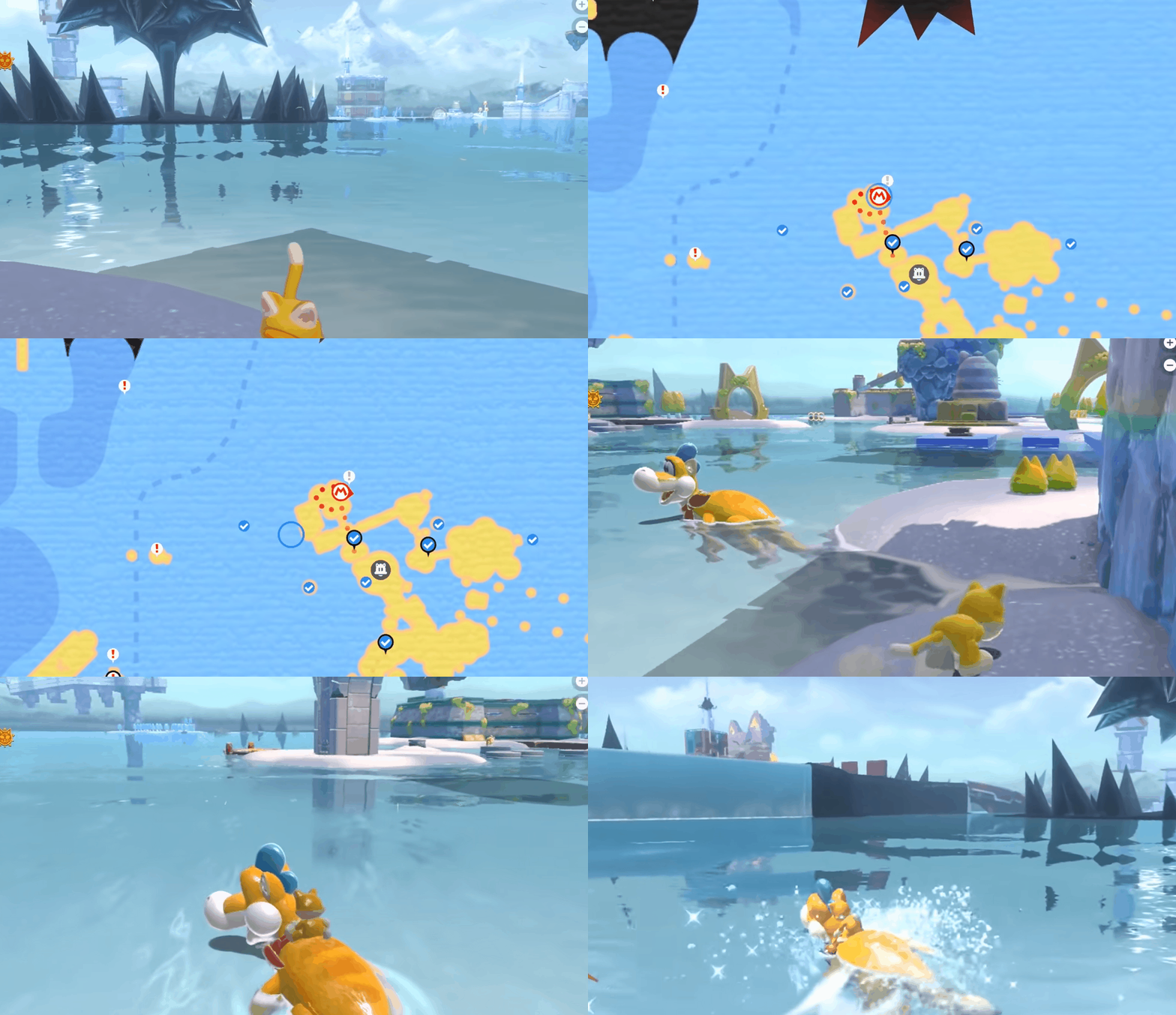
Mario, in a cat costume, checks his map near a shoreline. The map obscures the screen. When the map fades, an orange plesiosaur is waiting at the shoreline to pick up Mario for a ride.

Planning to travel to a new island? Plessie is way ahead of you.

I have a couple of theories on this. Firstly, Nintendo is extremely good at crafting specific player experiences. They will playtest a game into the ground until they know every iteration of every kind of action a player may want to do. Based on the large datasets I’m sure they have, alongside decades of sharpened design instincts, I think they were able to narrow down the likely places players would want to use Plessie. The game will detect when Mario is in proximity to one of these, and have Plessie spawn there, always ready to go. This system is very robust, too! Once, while escaping the very scary Fury Bowser’s fire breath, I jumped Mario over a waterfall – woah! What I didn’t expect was that, in perfect action-movie style, Plessie would appear at the foot of the waterfall, just beneath me, and catch Mario in the nick of time for us to make our daring escape from Bowser. Wild! All without any input from me.

The result of having Plessie out and about on her own in the world, showing up only when needed, gives the impression of an intelligent, loyal animal. Plessie feels so much more like a character with agency because she is making ‘decisions’ alongside you, ‘deciding’ where and when to pop up, as though she is protective of Mario. I think the game may even take Mario’s currently situation into account. Plessie could theoretically emerge anywhere from the water, but during some challenges will not, soas to not be disruptive to the flow of gameplay. I would not be surprised if things like active nearby collectibles, whether Fury Bowser is active, what direction Mario is running, are all tracked and fed into Plessie’s spawn system to determine the most ideal time and place to appear. The result is that you don’t have to think about Plessie until she’s needed, but she still feels like a real animal and not just a game mechanic.
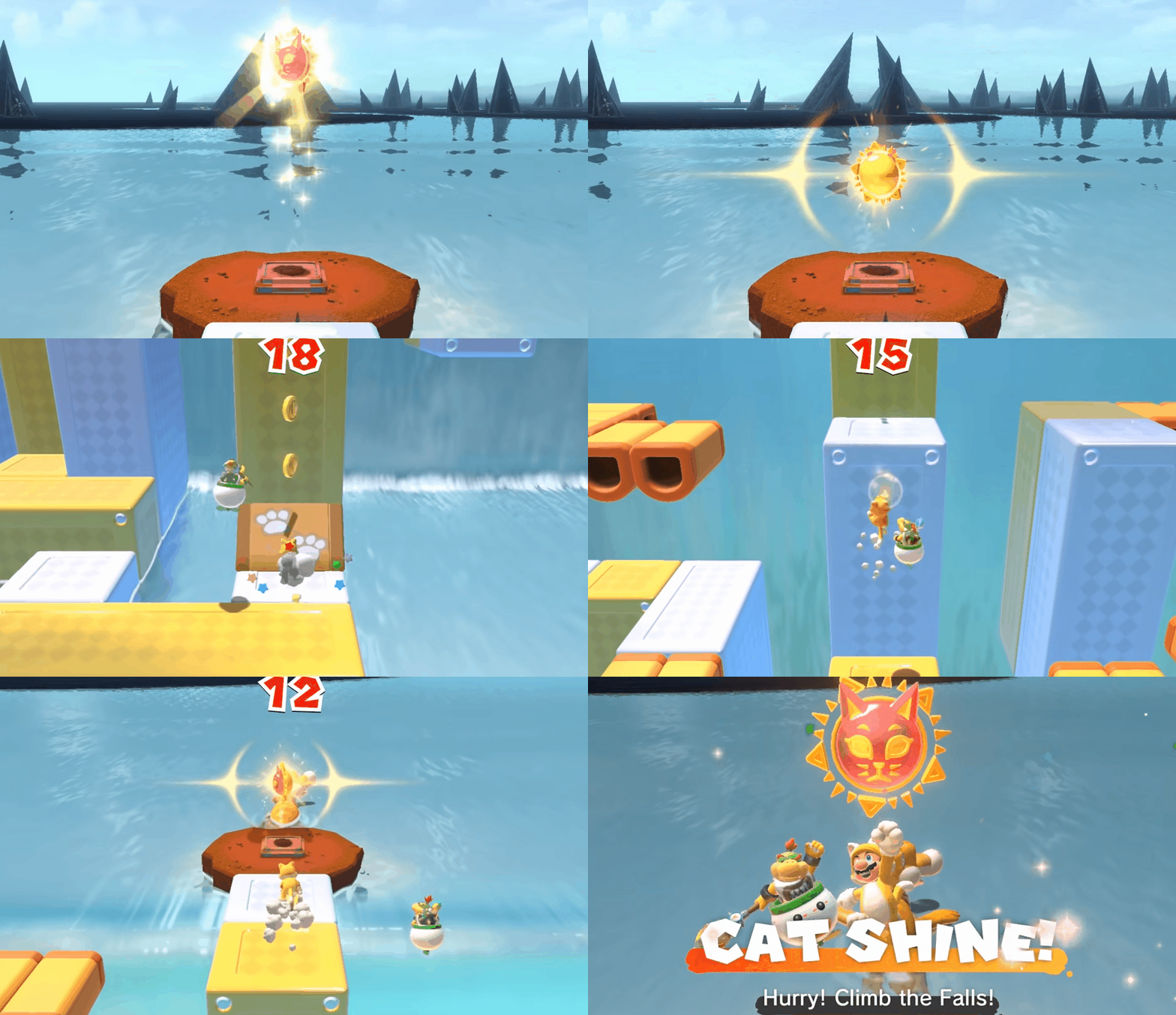
A cat-shaped medallion appears atop a waterfall lined with large block-platforms. Mario, in a cat costume, scampers up the blocks. Suddenly, an orange plesiosaur is at the top of the waterfall waiting, as Mario arrives.

HOW DOES SHE ALWAYS KNOW!?

Horse

I don’t think my ideal land horse has yet appeared in a game. Torrent is my favorite video game horse to play with – his mechanics and movement are the most refined, in my opinion. Plessie is also pretty close, and she can run on land. She will not frequently, however, traverse land without Mario. I do think some of the methods employed to make Plessie feel so loyal and convenient could work on a regular old horse. Given the challenges of placing a horse on land-based geometry though, it would requires some finagling, and perhaps some compromises. A combination of methods could be used. Some horses like Agro from Shadow of The Colossus spawn in from off-screen and appear when called, which is less seamless. I think a combination of the approaches could make something that feel extremely smooth to play, but also reinforces the fantasy of having a living animal companion. If a horse were to appear automatically as the situation demands though, it would require a lot of considerations to avoid having its appearance be disruptive or inappropriate to the flow of gameplay, without Plessie’s advantage of being aquatic.

A creature of contradictions, the video game horse is. An animal companion, but also a gameplay vehicle. Made for ease of traversal over vast distances, but also temperamental, and prone to disruptive interactions with the environment. Often controlled by artificial intelligence, but rarely intelligent. I think my ideal land horse is possible in games. A creature as loyal seamless, and frictionless as plessie, but as strong and fun to use as Torrent, yet also with its own personality and sense of presence like Agro. I’m of the opinion that getting to greater heights such as this, in any area of design, requires learning not just from the best, but also from valiant attempts that didn’t quite succeed – It’s a bit of an ongoing struggle in that sense, a conflict, or a versus, if you will. One day, if we should all be so lucky, we will master the concept of Horse. See you next time.

Link from Zelda: Breath of The Wild plummets to his death, comically tumbling over the side of a cliff with a horse.

Door Key Mechanics

It’s been a short, busy month, so this time I wanted to talk about something that might be of particular concern to me, specifically. One of my pet peeves. A real bee-in-my-bonnet moment. I’m going to get into why this particular design pattern bothers me so much in a moment, but first what am I talking about?

You ever find yourself at the heart of a deadly dungeon, having just slain a cursed demon dragon of darkness? Of course you have. You open up the chest he was guarding, and viola! A super cool, exciting, new weapon, spell, or other tool. You’re so hyped to get back out in the field and use this thing, but first you’ve got to figure out how to use it to make your way out of here. You start playing around with it, but pretty quickly you find that its use cases are rather… limited. Maybe it’s a whip that doesn’t really damage enemies – but it’s sure useful for hitting distant switches to open doors! Maybe it’s a freeze gun. It’s cool – I mean it can’t freeze enemies or bodies of water, but it can freeze waterfalls, to unblock doors. Maybe it’s a grappling hook! You can’t control the grapple or decide where to use it – it just pulls you to fixed targets so that you can reach previously inaccessible… doors.

You have just encountered, what I like to call the Door Key Mechanic. It’s a game feature masquerading as a fancy new play mechanic, but it’s not really. When you zoom out, and take a high-level top-down look at what all these mechanics actually do in the context of the play space… they just open doors. Maybe they pull specialized switches that then open doors. Maybe they disable electric fences so you can get to the doors behind them. Maybe they transport you to doors you couldn’t get to before in a predefined way, but that’s it. Above all it is interactivity that makes game mechanics compelling to me, and these are interactive in the most rudimentary way possible – do the thing, and a door opens.

There’s nothing inherently wrong with having features in your game that specifically exist to remove some gate to the player’s progress. These sorts of items are all over the place. I mean, literal keys, for one. It’s an important purpose to fill. The presence of an inaccessible door is inherently tantalizing to the player, and finding an appropriate key gives a sense of puzzle-solving or excitement. The trouble comes in when it’s something a lot more complicated than a key or a special inventory item pretending to be more important than it is. Need some examples? Let’s do some examples.

I think the most egregious example I can think of is the last game produced by Sonic The Hedgehog creator and indicted insider trader Yuji Naka, Balan Wonderworld. It’s a great instance of what I’m talking about, because it also highlights the crux of the problem. You see, this game had several marketing angles, such as Naka’s involvement, the visual and stylistic echoes of cult classic games like NiGHTS Into Dreams, and most relevantly here, the fact that the game would feature EIGHTY different costumes! Each with unique abilities! Or in other words, game mechanics. Ignoring that several of the costumes are just variations or upgrades of others, we have to interrogate how meaningful and interactive these costume mechanics actually are.

A child in a pig costume runs over to a silver piston in a grassy field and slams the ground with its bottom, forcing one piston down and causing a different piston to shoot up. The child jumps onto it and grabs a gem.

Well, we have a ground slam for a start, the Pounding Pig, which doesn’t do anything except hammer posts and break blocks – basically just opening specific doors. There are jellyfish and dolphin costumes, which do little else but allow access to water terrain that otherwise gates you. There’s a spider costume that allows you to climb webs, which are also just simple obstacles – doors in other words. The Itsy-Bitsy Elf costume “Allows the wearer to pass through tiny doors” and nothing else. Lickshot Lizard sounds like a grappling hook, but it only works on stationary targets that are trivial to target – it’s just opening a door with extra steps. Happy Horn activates an event when stepping onto a pre-placed stage. Functionally the same as a key item. Gear King allows you to use specific gear switches, to open doors. Hothead lets you light torches to open doors.

A child in a rock star costume runs over to a stage in a grass field and plays a short concert to some monsters, and they turn into gems.

Riveting Stuff.

Important to note that ‘door’ here proverbially means any simple gate preventing player progress, but a gate of minimal player interactions. Flipping a switch causing a bridge to appear. Destroying a block to reveal a staircase. That’s all the same as opening a door. Like, there’s Balan‘s Laser Launcher costume…

“A robot costume that shoots a laser from its chest. Use the laser to break blocks and flip switches.” -Official Website Description

I can use the robot to open doors, OR open doors you say!? Okay granted, a lot of these very simplistic costumes in Balan can also be used for combat, but that is such a bare minimum. Doorkey Mechanics make one wonder ‘why is this even here?’ Like, why do you need a spider costume to climb webs? Most game characters can just do that, like on their own.

A small armored alien, Ratchet from Ratchet and Clank, traverses a small gap in a broken bridge amidst a futuristic sci fi metropolis. He does so using an energy tether thrown into a rift portal.

“Does it do anything?”

“It allows you traverse this door bridging a very small gap.”

“Yeah but does it do anything??”

It’s easy to criticize Balan. Door Key mechanics pop up in some of my favorite games too, though.

I adore A Hat In Time. It’s a delightful, fully-featured, cute, and compelling indie game in the style of classic 3D platform games. It feels great to control, it’s pretty to look at, and it’s just an overall fun time. We need more games like A Hat In Time. That said, of the six hats available in the game, which each provide unique abilities, I couldn’t help but wish the Ice Hat and Brewing Hat were more generally useful. The sprint hat makes you dash at breakneck pace, allowing you to bound over great distances – it’s super fun and super useful. The Kid’s Hat helpfully guides you where to go if you ever lose your way. The Time Stop Hat does what it says. However, the Ice and Brewing Hats flip switches and break barriers, respectively, only in hyper-specific scenarios. They can technically be used in combat, but I never once felt it was prudent to do so next to just, say, smacking enemies with my umbrella.

The Door Key Mechanic is a sliding scale, too. Game mechanics can be more or less door key-like. Hi-Fi Rush, a game I should really talk more about sometime, has mechanics that are Door Key-adjacent in the form of your party’s assist moves. Macaron’s punch assist breaks down hyper-specific walls and Peppermint’s gun assist shoots switches, but they can both be used in combat. The difference between Hi-Fi and say Balan, is that Hi-Fi Rush has very robust combat mechanics where that addition is not a footnote. Assists can be woven into combos and used in a variety of ways, defensively or offensively, to uniquely color each player’s experience. That’s interactivity, and that’s what makes a Door Key Mechanic less noticeable. The Legend of Zelda series has been occasionally guilty of making legacy items more door keyish. For instance, take the hookshot / claw shot item.

When first introduced in A Link To The Past, the hookshot was a metal spike on a spring loaded chain that could latch onto blocks, chests, rocks, and pots to pull Link rapidly to the target location. Not only that, but it can grab distant items and pull them to link, hit switches, stun some enemies, and outright defeat others. It’s used for unlocking doors, sure, but also for combat and traversal in interesting ways. Its uses are fairly prescribed, but not so much that it doesn’t feel generally useful.

In the sequel, Ocarina of Time, the hookshot was brought into 3D and it became even more generally useful. It still activates switches, pulls in items, stuns some enemies at a distance, and defeats others, but now in three dimensions. In addition, the list of things it can latch onto has been expanded to include most wooden or soft surfaces, like climbing vines, tree branches, rooftops, and rafters. The hookshot doesn’t just latch onto specific predefined targets, it also lets you grapple to anything it can stick into around the world! And there’s a logic and consistency to this general use that makes it feel like an organic part of that world. That kind of flavoring and context can also help alleviate the sense of artificiality that Door Key Mechanics invoke.

Later Zelda games would not be so magnanimous with the use of their hookshot analogues. The hookshot in The Wind Waker feels noticeably more limited, with fewer viable targets. Where in Ocarina of Time there were a lot more organic environmental targets to hit, Wind Waker and Twilight Princess lean somewhat heavily into literal bullseye targets, and floating targets, obviously specifically placed for Link’s benefit. The difference is stark in Skyward Sword, where the clawshot is used for little else other than clearing gaps to reach brightly colored, artificial bullseyes that exist in the world without context. The interactivity of the clawshot in Skyward Sword is severely limited.

My point is not that the more limited hookshots make these games bad – but rather that it makes specifically the hookshot item in those games a lot less compelling. Compare it to the Shieka Slate spells in Breath of The Wild, which can be employed almost anywhere, and used for almost anything – crossing gaps, attacking, blocking projectiles, climbing cliffs, retrieving items, escaping… flying, if you use them just right. That’s interactivity.

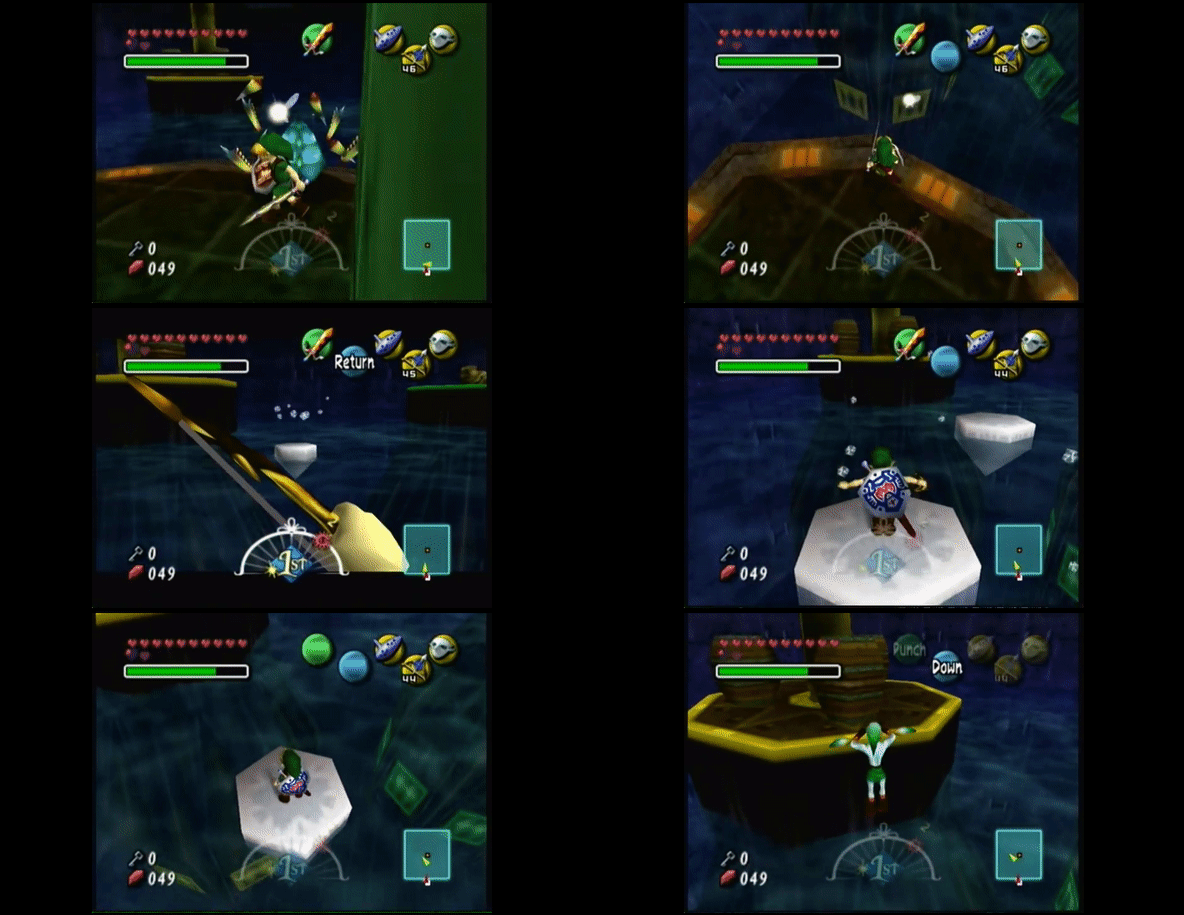
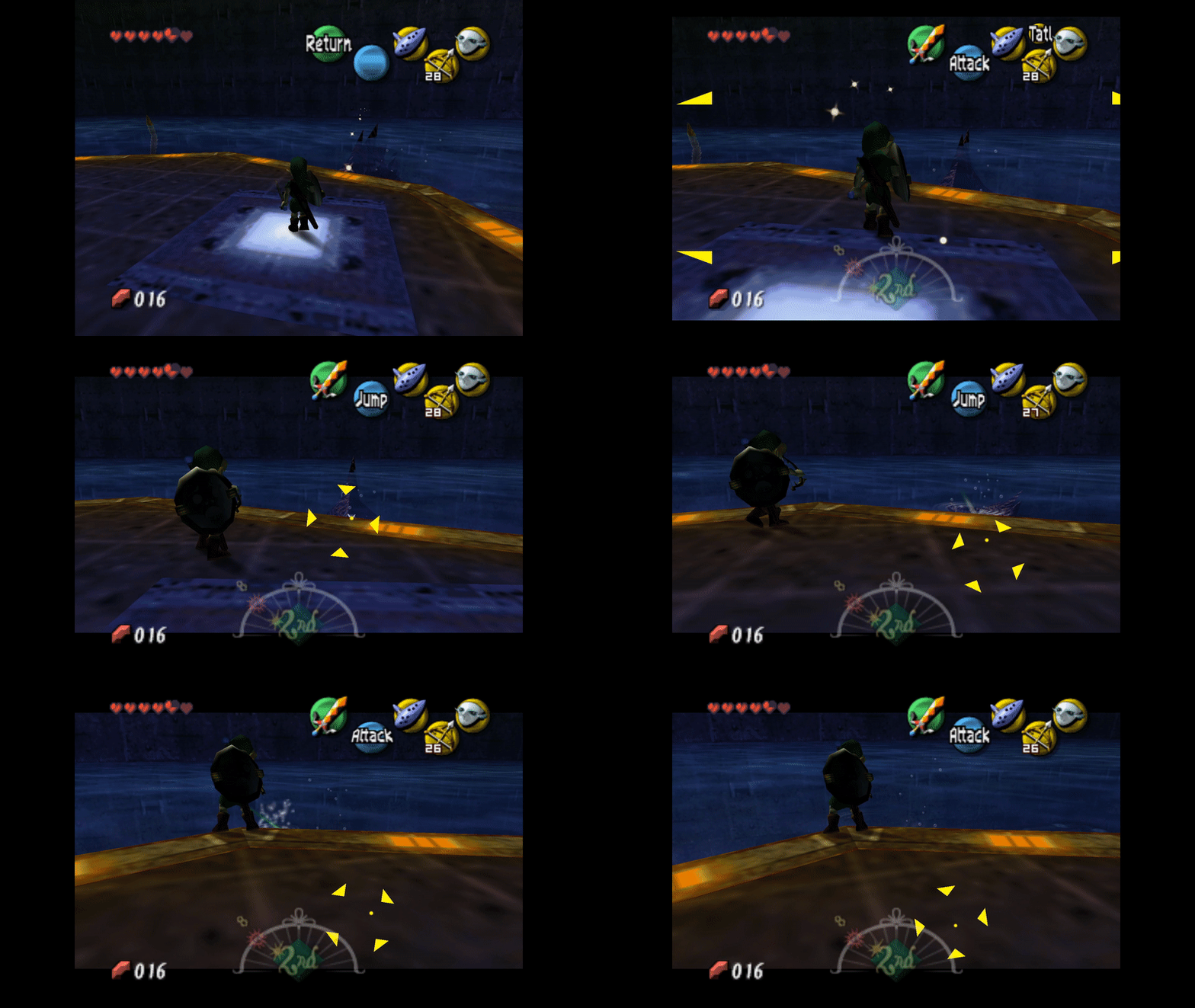
Here’s another Zelda example. In Majora’s Mask for the N64, the ice arrows allow you to shoot projectiles encased in freezing magic. Shooting the arrow at any body of water. *Any* body of water, an icy platform is produced, that Link can walk on. I’m sure you can already imagine the applications of that. This is in addition to the arrows being useful for stopping waterfalls, freezing enemies to use as platforms, or freezing them just to more easily defeat them.

In a dark interior pipeworks chamber flooded with water, Link from The Legend of Zelda Majora's Mask. Link shoots two magic ice arrows into the water, creating two ice platforms, which he hops across.

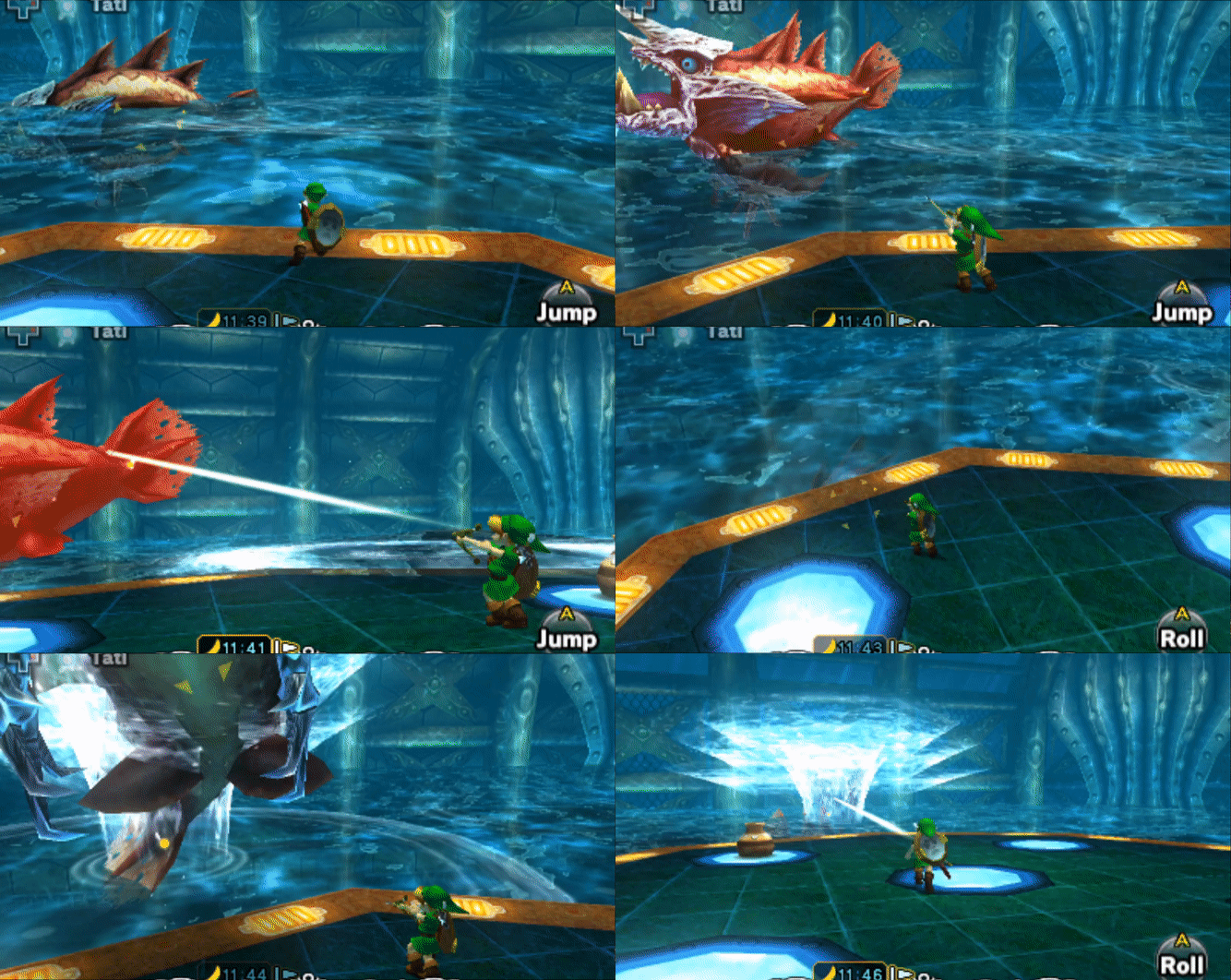
In the remake, the developers opted to instead restrict how these arrows can be used. There are shiny blue sparkles on the surfaces of water where the ice arrows were intended to be used. Shooting them there creates the usual ice platforms, however… they also opted to prevent the platforms from ever being created elsewhere, severely limiting the interactivity of this item, and risking the player engagement. Originally, the ice arrows were a tool – a new avenue of possibilities that gets the player thinking and invested in what they’re doing. The latter version makes them a prescribed door key to access only a very specific planned path, with no engagement required on the player’s part. I find game mechanics most exciting when they expand possibilities, not limit them.

In an interior pipeworks chamber flooded with water, there are some conspicuous sparkles on the water. Link from The Legend of Zelda Majora's Mask, shoots magic ice arrows at each sparkle, although misses his target once, and the ice arrow fizzles on the water.

Heaven forbid anybody be required to do some lateral thinking while playing a video game.

When developing a new mechanic or feature for your game that might be a significant undertaking, ask yourself some questions; does this feature open up interesting interactions or decisions? Does it expand the play space? What are its use cases? How does the player interact with it? What does it accomplish? If the conclusion is that the feature accomplishes a similar level of interaction to simply unlocking a door with a key – if its use is no greater than removing a proverbial gate to the player’s progress, consider whether the feature is even worth developing, especially early on. Some of these features, such as the Balan Wonderworld costumes offer very little interactivity or engagement, but would have cost a huge amount of development resources for character models, bespoke animations, sound effects, and program implementation. The decision to add a feature is not one that should be done without forethought. Think about what each of your new features actually adds to the experience.

Link from The Legend of Zelda Ocarina of Time runs up to an ornate golden chest in a dank dungeon. Light pours forth from it, and slowly, dramatically, Link holds aloft a golden key inset with a red skull jewel.

A key opens doors…

Video Games Vs. Ladders

Welcome to ‘Video Games Vs.’, what I hope to be a series of pieces written about the many little inexplicable hangups that video games, historically, seem to struggle with for some reason. I’ll go over some interesting examples of implementations, problem areas, and interrogate why these weird little oddities are so difficult to get right, and how to possibly address that. You could call this series my personal crusade against extremely petty irritants. For example, we’re going to start out discussing ladders!

They help you ascend. They help you descend. They are an almost mystical force in video games, capable of violating all of the regular rules of a game world, turning preconceptions of movement and space on their head, and tearing through the very fabric of reality itself. Yes, ladders.

Zelda

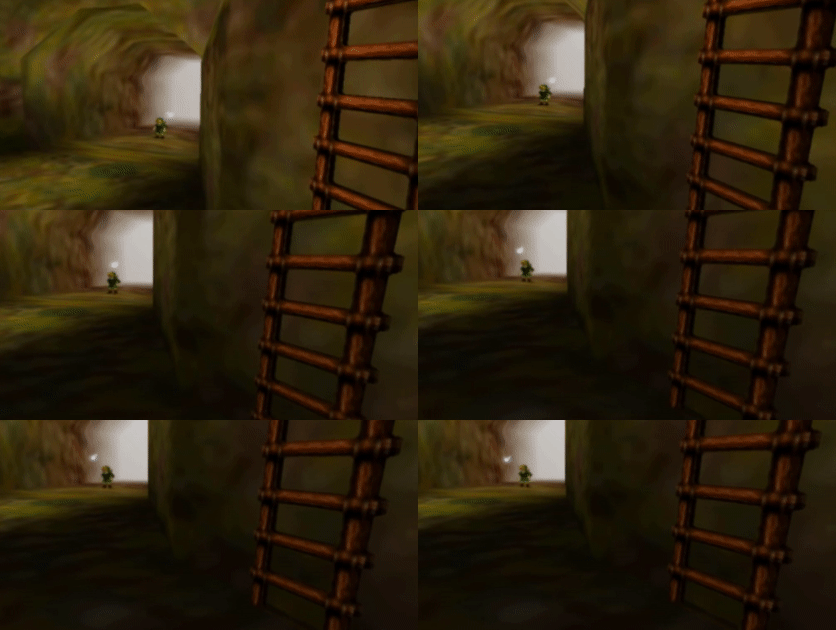
The Legend of Zelda: Ocarina of time was one of the earliest truly 3D adventure games, and set the standard for a lot of things we take for granted in that space. For one, Zelda had ladders. Lots of them. There’s a ladder in the first dungeon, in fact, by why? The very same dungeon contains a lot of ivy Link can climb in similar fashion, with the added bonus of being able to move laterally one it. Why was a ladder also included? I don’t know for certain, but if I had to guess, a ladder was placed alongside the ivy to prime the player for the though that they can ascend the wall they were facing. A ladder is an excellent visual shorthand for ‘the above area is indeed accessible’. It would lead a curious player to investigate the ivy that notable also runs up the wall, suggesting they can climb it. So ladders are just good visual language. Long before the ambiguities of 3D space were introduced, the ladder acted as a near-universal icon that meant ‘your player is going to enter a space above or below to this, relative to their current position.’

A camera pans down on a wooden ladder leaned against a wall in the foreground. Young Link from The Legend of Zelda: Ocarina of Time has just entered the scene from a lit passage in the background.

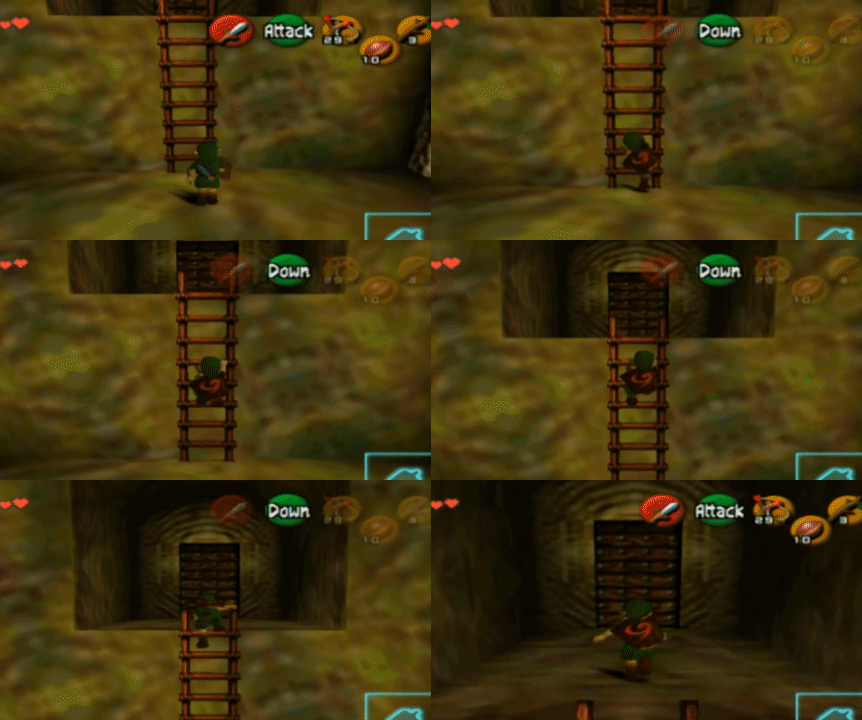
So how did they work? Pretty well, but I’d like to break that down in exacting detail. For all intents and purposes the protagonist, Link, exists in one of two states at all times – on a ladder, or not on a ladder. Art reflects life. While not on a ladder, Link can run, roll, backflip, attack, block, use items, all that good stuff. While on a ladder, Link suddenly loses all control of his arms and becomes incapable of wielding a sword, boomerang, shield, or anything else. Link’s verbs become severely limited on a ladder, reduced to only ascend, descend, and let go – in which case Link’s body goes limp as he falls to the ground like a sack of potatoes.

Here is set a precedent that will follow the course of game design, probably until the end of time – ladders exist primarily as a method to bridge point A to point B at different elevations. They are not, themselves, play spaces for a game’s usual mechanics. There are of course exceptions to this, and games that break the mold, but in nearly every case of a 3D space featuring a ladder, your game character will be restricted in what they are allowed to do. There are a number of reasons for this. For example, a truly robust play space on a ladder would require such an upscaled set of art and animation assets that it might balloon out of scope, in proportion to how much ladder-climbing actually takes place in your game.

If the player can dismount a ladder anywhere along its length, you need an animation for that. In the case of Zelda, it’s just falling. If the player can be harmed or die on a ladder, you need a contextual animation for that. If the player normally reacts to damage based on the angle of attack, you need animations for each angle an attack can come from on a ladder. Attacking from a ladder. Defending from a ladder. Using a special item on a ladder. Etc.

Link is, however, still in a vulnerable state whilst climbing a ladder. Enemy attacks and other hazards can still deal damage to him. If Link is damaged by an attack of significant force, he will be knocked from the ladder and fall to the ground, screaming, like a very loud sack of potatoes. However, grounded enemies, such as terrestrial monsters, the walking dead, fire-breathing dinosaurs and the like, are incapable of climbing ladders.

This sets another precedent that will be common in video games’s long and storied campaign against the concept of ladders – ladders represent a space that, conceptually, has a different relationship to the environment around it than normal play space. By this I mean, usually, when Link is threatened by, say, the bloodthirsty undead stalfos, he has the option of attacking it with his sword, or subduing it from a distance with one of his many ranged items. If the creature is too far from Link in the vertical axis whilst he is on a ladder, though, although he has no way to fight them, they also have literally zero recourse and are incapable of harming him. The ever-present risk-and-reward factors of game enemies are often negated by ladders. Rare is the enemy, especially in earlier games like Ocarina of Time that themselves commands the awesome power to utilize a ladder.

Link from The Legend of Zelda: Ocarina of Time climbs a wooden ladder up a wall to reach a door.

One last note here – for a kid, Link can ascend and descend ladders at a pretty reasonable clip. However, as climbing ladders is often an extremely uneventful prospect, for the aforementioned reason of their existing outside of the usual risk-reward rules of their world, a player’s awareness of how slow or fast a ladder is being navigated is heightened, as compared to other contexts. So, developers will often include the optional ability to clear large sections of ladder in some extreme, exaggerated manner. Link can’t do this in the ascending direction, but his ability to fall enables this in the descending direction. Overall the transition period between walking and ladder-ing is very snappy and quick for Link, something Zelda has always been pretty good at for contextual animations.

Fromsoft

Fromsoft games like Dark Souls and Bloodborne have a rich history with ladders that embody some of the most bizarre aspects of their implementation in games. For instance, these games, well known for their intricate, complex and deep combat systems, become awkward slap-fights if a player ever occupies the same ladder as an enemy. For these games, ladders are simple transportation and any interaction they have with the game’s infamously difficult enemies are kind of an afterthought. Ladder climbing is implicitly tied to the player’s stamina resource, normally spent on dodging and attack. If they take damage whilst on a ladder, they’ll plummet to the ground with a bespoke animation. I suppose the rationale was that even if the ladder is only somewhat tied to regular gameplay systems, it would be better than existing completely apart.

Another example of ladder weirdness in Fromsoft’s games is the ladder interact button. Unlike Zelda, which activated the ‘ladder-climb’ state automatically based on the player’s proximity to the ladder and their movement vector, Fromsoft ladders are generally mounted via dedicated button press when the player gets close to one. There is a reason one might vie for this method. Aside from the complicated contingencies involved in Zelda‘s proximity-based ladders, tying the action to a button press removes ambiguity. A player is less likely to accidentally press a button than accidentally wandering into a ladder climbing animation by walking, especially in a game with a lot of movement.

Still, the button-press method is not without its drawbacks. Once the button is pressed, control must be taken from the player so that their character can be placed upon the ladder. Any situation where player control has to be shifted away is liable to be fertile ground for bugs. In Dark Souls II in particular, player characters attempting to mount a ladder enter a sort of sidling animation where they inch towards the specific spot where they can mount. If some object blocks the way during this transition, they can be stuck in a lengthy loop of trying to sidle toward the ladder, with no way to stop them. The game contains a band-aide solution for this, in that characters will cancel their attempt at a ladder climb if they are blocked for too long, and control is returned. If this solution were not in play, a player could theoretically enter a perpetual loop of approaching, but no mounting, the ladder, leaving the game in a soft-locked state.

In a gothic-Victorian city, a man in a black cowl slides down a metal ladder until he is stopped by an invisible object. He kicks at it, producing blood, rapidly several times, until both he and the object fall to the ground limp. They get up, and the invisible object is revealed to be a second cowled man with knives. He tries to attack the first man, who scampers back up the ladder.

AI is also always prone to bugs in special contexts like ladder-climbing. Enemies mounting ladders in Fromsoft games enter a sort of fugue state, in which all semblance of an anchor to reality is lost. For them, there is only themselves and the ladder. No world exists outside this dichotomy, and their powers of object permanence dissolve completely, until they dismount the ladder, and after a moment of gathering themselves, are brought back down to earth both literally and figuratively. The simplicity of ladder AI is likely to avoid bugs, as well as them often being an afterthought, as mentioned.

Because of the nature of ladders as a sort of perpendicular space to the regular game space, both literally and figuratively, AI often has these sorts of issues in navigating them. Common problems for game ladders include two AI entities trying to traverse the ladder in two different directions, causing a blockage. This can be circumvented by removing collision for AIs on ladders, but that has the knock on effect of looking cheap and awful. These are just some of the issues you will face by employing ladder-capable AI, and why games often forgo this feature altogether. Negatives aside, there is still something satisfying about luring a hapless zombie up a tall tower then kicking them into oblivion, though.

Mass Effect

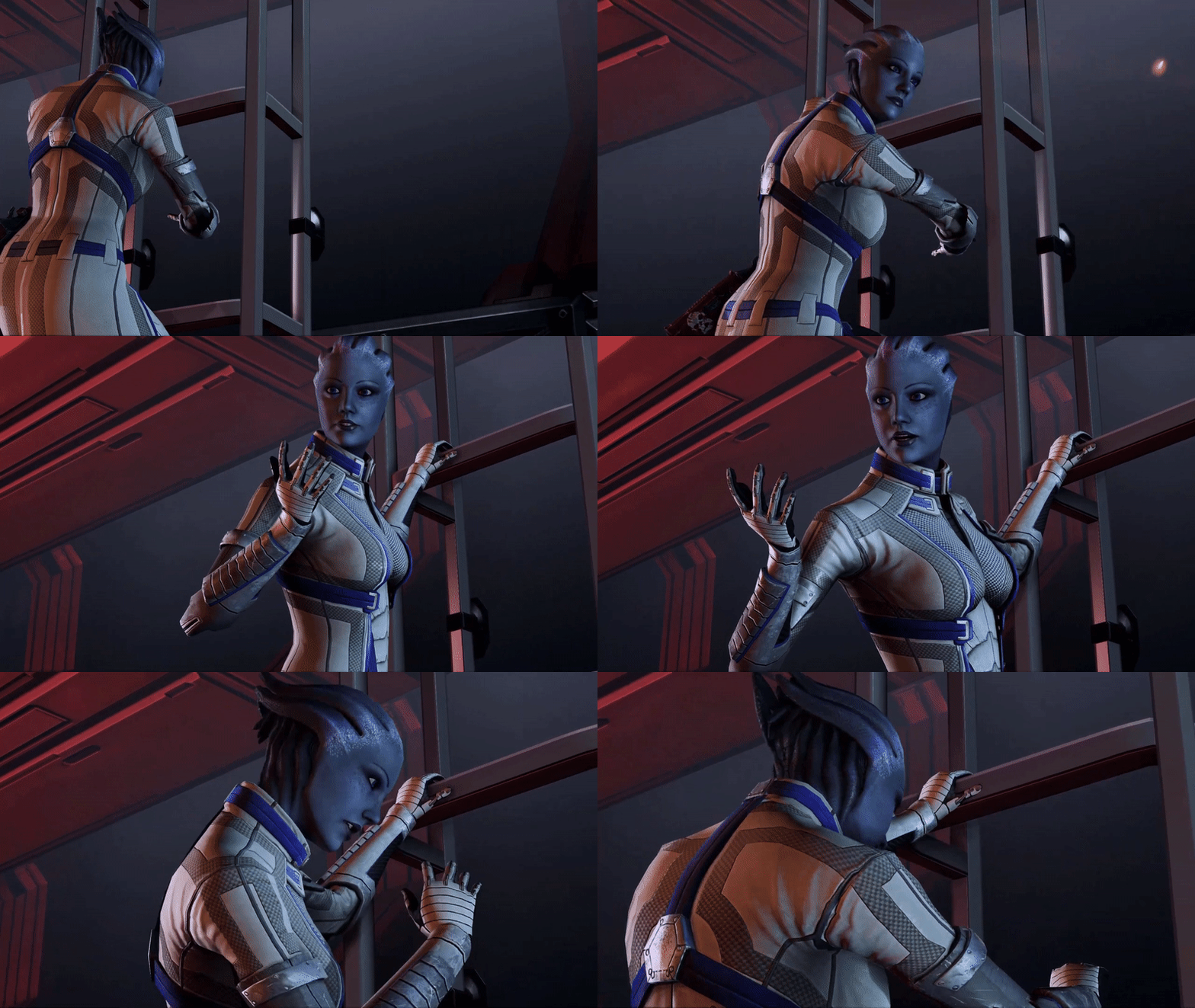
A little discussed feature of Mass Effect is how its ladders are gateways to an askew plane of existence in which the player has no control of their character. Once a ladder is engaged with, the character will execute an elaborate pre-baked ladder climbing animation, complete with directed camera action! It’s quite the spectacle. Problem is, enemies are still more than capable of shooting at you while trapped in this ladder dimension with, y’know, their guns. In the original Mass Effect 3‘s multiplayer mode, this became infamous as a way to very efficiently drop dead. So much so, that is was lampshaded as an in-joke in Mass Effect 3‘s lighthearted Citadel DLC.

A blue alien woman (Liara from Mass Effect) looks over her shoulder to snark at the camera while she climbs a ladder.

Sometimes this problem, when it crops up in other games, is circumvented by making ladders into closed tunnels. Or in other words, disallowing any form of interaction at all between mount a ladder at its bottom and dismounting it at its apex. During the pre-baked ladder climbing animation in such games, the player will be immune to enemy attack. It might as well be a Super Mario warp pipe. Which is all well and good, but what is the point of using a ladder as opposed to, like, a teleporter again? One would think it allows for a bit more organic interactivity with the world, a bit more realism and verisimilitude. That’s one angle. As previously mentioned, though, ladders are also just good visual shorthand for ‘this intractable brings you up and down.’

The Source Engine

Unstoppable engines of destruction, the source of ultimate power, or perhaps the manifestations of capricious gods sent to spite those of us that bought The Orange Box on Xbox and not steam. Whatever the case, ladders in Valve’s Source Engine and its derivatives are rightly feared far and wide.

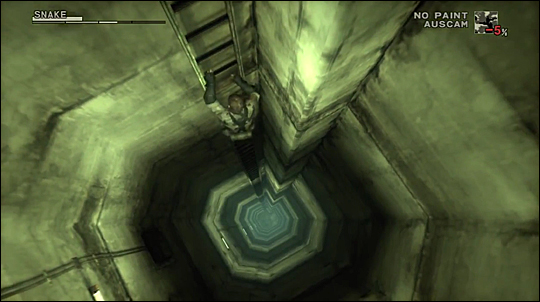
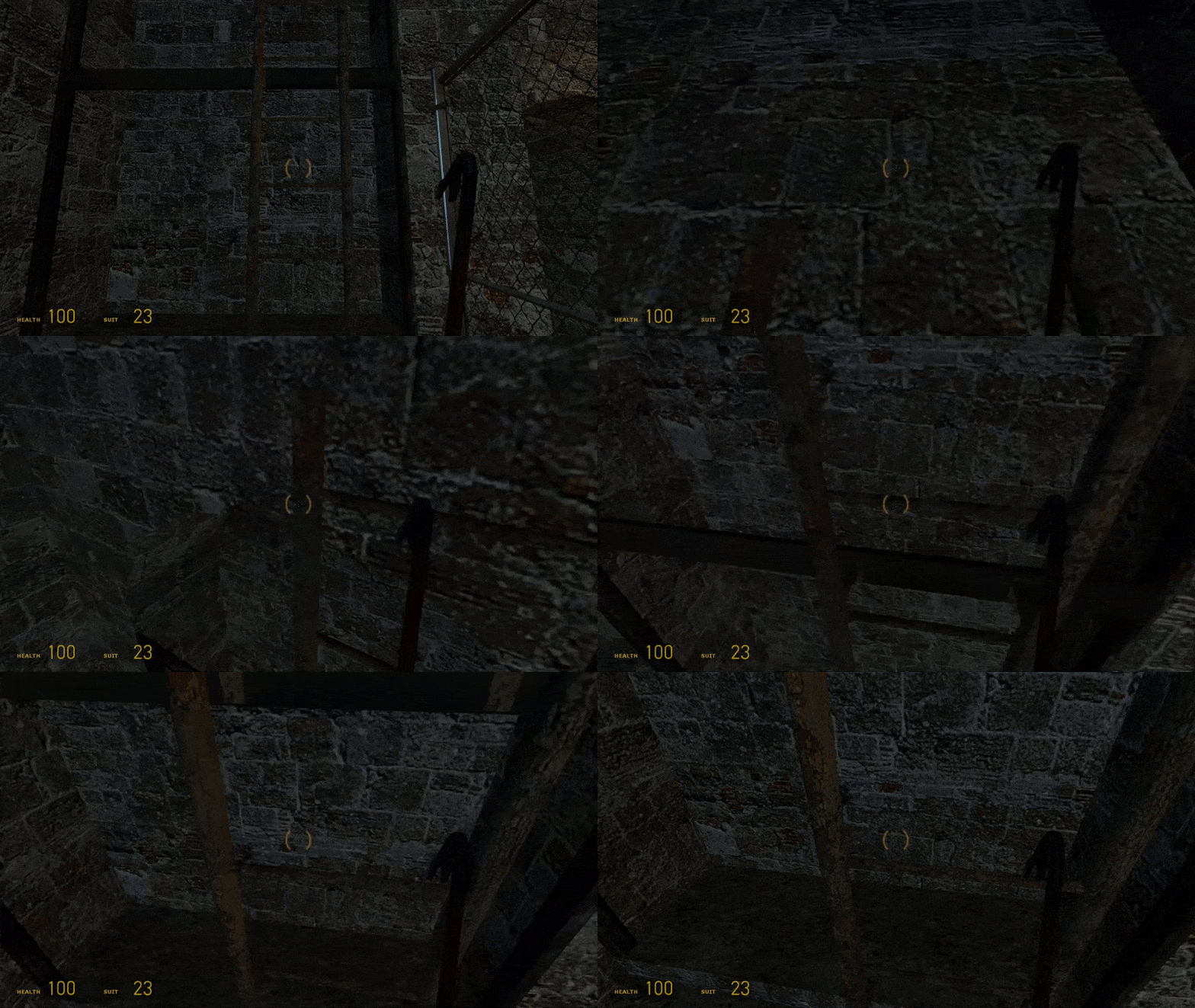
Source Engine games, being largely games of a first-person perspective came up with a very odd solution to the implementation of ladders. They work more like… vertically oriented pathways that realign the player’s sense of gravity. By hugging one with your face, the player character will stick to the ladder, essentially. From there, the camera can be pointed up or down to cause the player to move in that direction as if they can fly, but only so long as they continue touching the ladder. The system is infamous for being rather finicky. It’s proximity based like Zelda, but even more ambiguous. Whereas in Zelda once a ladder climb was initiated, Link was in a clearly illustrated ‘ladder’ state, there’s no real state transition in, say, Half-Life, and the ladders in that game are a lot more finicky. The ambiguity might lead a player to go running off a great height to their death.

The grimy metal rusted ladder of a Half Life 2 map is shown from a first person perspective. The player is holding a crowbar.

While climbing, Link can only go up or down. In Half-Life, the full range of 3D motion remains open. Ladders are not ‘on rails’ in the same way they are in other games. This means you can easily dismount the ladder anywhere along its length, but it also means you can accidentally slip and fall pretty easily. These games being in a first-person perspective also means it’s not always clear where the player is standing, relative to the ladder.

Rather hilariously, Half Life: Alyx has some of the most realistically-executed ladders in video games, should you choose to engage with them. This is on account of, as a VR game, your hands are free! These ladders can be climbed manually with your actual grip, or teleported across as is standard for VR locomotion.

Death Stranding

Death Stranding is an interesting case because movement is such a central and overriding aspect of its gameplay. Near all of the game’s verbs are nuanced aspects of movement and traversal. It’s also an interesting case because ladders form a core part of the early game’s relationship to these verbs. For example, the ladder item can be placed nearly anywhere to enhance the player’s traversal.

Interestingly, since ladders in this game are a physics object which can settle in near any location, they might often be deployed horizontally or in a ramp configuration. There is a certain inflection point for Death Stranding‘s ladders where if they are not arranged steeply enough, they operate more like bridges than like ladders.

I just wanted to bring up that Death Stranding, despite the rather central importance of ladders to its gameplay, utilizes the same ‘press button’ method as the Fromsoft games. I think the reason for this is likely due to the game’s movement mechanics. In Death Stranding, careful movement is essential. One false step, and you can trip over a rock, tumble down a cliff, and lose half your cargo. So it was likely decided that the reduced ambiguity of button activation would be important so players know exactly when and how they will transition to climbing the ladder.

Nier: Automata

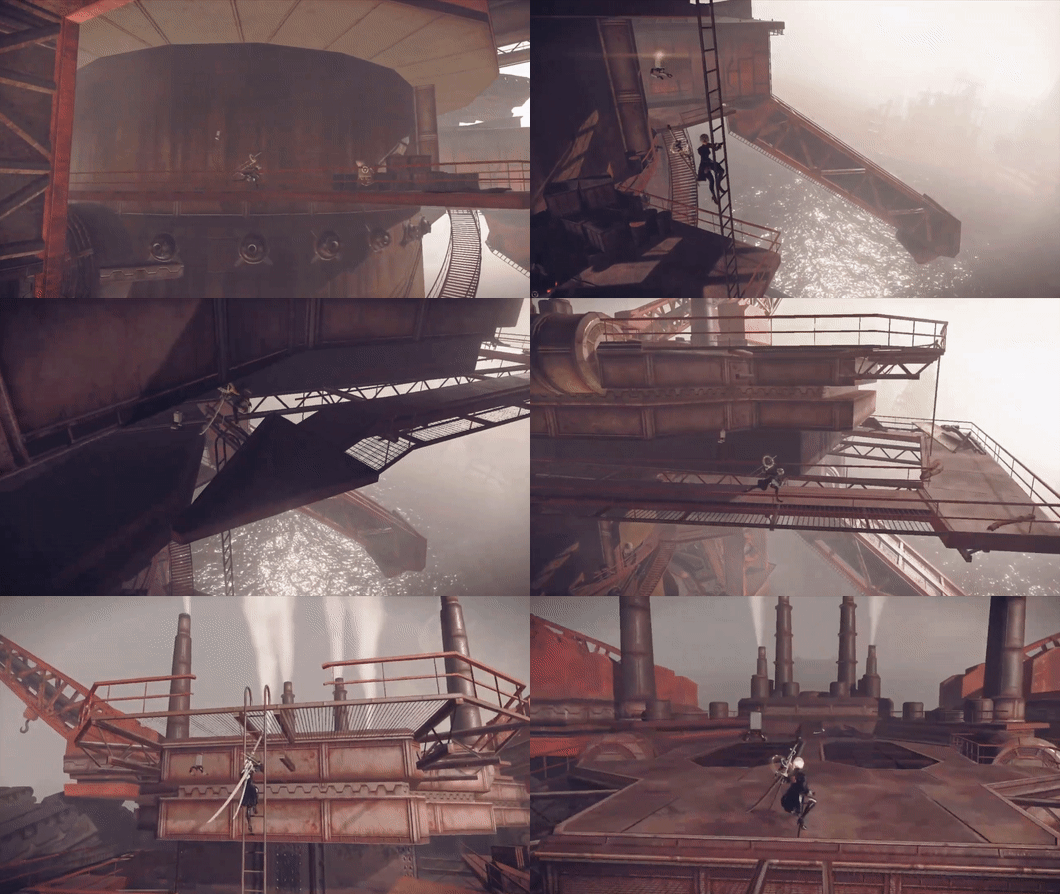
Alright I’m just going to come out and say it. Nier: Automata is my Holy Grail of video game ladders. I mean just look at this:

Beauty. Grace. Poetry in motion. A ladder that serves as an extension of the play space rather than a partition of it. A ladder that doesn’t involve a weeks-advanced scheduled commitment. A ladder whose animations and state changes blend seamlessly with regular gameplay’s animations and state changes. 2B can just jump at it and grab the thing. Not just from the top, not just from the bottom, but at any point on the ladder. You can still attack, and defend yourself while on ladders.

The way ladders feels so seamless and effortless in this game really highlights how inexplicable and irritating they can be in others, although there are of course reasons this isn’t always easy to do as we mentioned.

Here is a list of things that the Nier: Automata ladder doesn’t do:

  1. It does not required a button press to interact with. Unlike so many other examples of video game ladders, the ‘climb’ state that the player can access in Nier: Automata is not separated in this way. Often, the button that causes a character to begin climbing is a general-purpose interact button, or otherwise double-loaded for other actions, meaning that the prospect of interacting with a ladder can be ambiguous. If the interaction button also causes the player to pick up items, for example, they might accidentally pick up an item where they meant to scamper up a ladder to avoid a foe that is chasing them.
  2. The ladder does not feel like a separate play space, and is integrated into the world. The player character is readily capable of attacking, being attacked, sprinting, and shooting while climbing a ladder. Precious few of the game’s usual verbs are restricted, making ladders feel like an extension of the play space, not adjunct to it.
  3. The ladder is not treated as a closed tunnel which can only be accessed from the top or bottom. The ladder is a ladder. The player character is capable of mounting it, and dismounting it, from any point along its length. A lot of the artificiality of other ladder executions is done away with.
  4. The transition animations between ‘ladder’ and regular gameplay are extremely quick and simple.
A woman in a black dress with two massive katanas on her back, 2B from Nier: Automata, leaps through the air across a rusted metal scaffold to grab a ladder. She hops up the rungs with great speed, then jumps another scaffold to another ladder.

All this is made possible through some borderline excessive attention to detail and eye for contingencies. A lot of very robust and adaptable animations had to be made to ensure it would always look seamless and natural whenever the player character in Nier: Automota interacts with a ladder. The animation tree is equipped to convey interacting with the ladder in every way and from every angle. Nier ladders are heavily proximity based – if the player moves toward a ladder’s collision box, they will grab it automatically. This introduces ambiguity yet, but it’s a lot less intrusive than it might be otherwise because the developers went out of their way to ensure that the player remains fully capable on the ladder, and that dismounting it represents no real time investment. As such, accidentally climbing a ladder in Nier is no big deal anyway. As I’ve noted elsewhere, I really appreciate immediacy in games, especially action games, so the effortless way you can interact with objects like ladders in this game really stands out to me.

It’s not as though this was easy, however. As we’ve been over, though a seemingly simple and pedestrian intractable on the surface, ladders in video games have a lot of pain points and ways to introduce gameplay bugs. A great amount of consideration has to be made for how they interplay with your gameplay systems, how much scope will be required to make that interplay happen. Ultimately it’s a question of relevance – how important is it that ladders function non-intrusively? If your ladders are a bit clunky, are they common enough to be an issue? It seems like a effortless of locomotion was a major priority for Nier: Automata, as evidenced by the many small ways movement is smoothed out in this game across a multitude of terrains, so an extra investment in making alternate methods of movement, like ladders, feel fine tuned to the gameplay.

So the next time you consider adding a ladder to the game, remember to ask yourselves some pertinent questions about how they should be implemented, and how they’ll relate to the gameplay which contextualizes them. We so often marvel at the big ideas and broad strokes of game design that we overlook the mundane building blocks that go into constructing a space. Forget ladders, what about stairs? Or doors!? Perhaps another day. Video games are held together with duct tape and a dream, so at the very least try to use sturdy duct tape. Okay the end card is Nier again, I just really wanted to keep looking at those beautiful perfect Nier ladders.

Do you think games are silly little things?

How To Fight Things in Three Dimensions: Zelda’s Z-Targeting

Can’t believe I haven’t done one of these on this topic yet. The Legend of Zelda: Ocarina of time is rightfully revered for how it set the tone for what action and adventure games could be in what was the relatively new frontier of polygonal 3D games in 1998. Moving to 3D comes with a whole host of problems, though, especially when it comes to active combat. Our real three dimensional space is very complicated, and abstracting that to a computer program can have some disorienting results if not done with care. One of Zelda‘s most notable contributions to the craft, I think is the Z-Targeting system. “Z-Targeting” is the name for Ocarina of Time‘s 3D targeting system which would let the player focus the game camera’s attention on a single point of interest by tapping the “Z” button. It gets plenty of mention, but honestly I feel like sometimes this one innovation doesn’t get praised enough. It kind of set the standard for how real-time gameplay involving two moving bodies works even to this day. There are also a lot of little things that helped this first iteration of a 3D targeting system work remarkably well, despite its age.

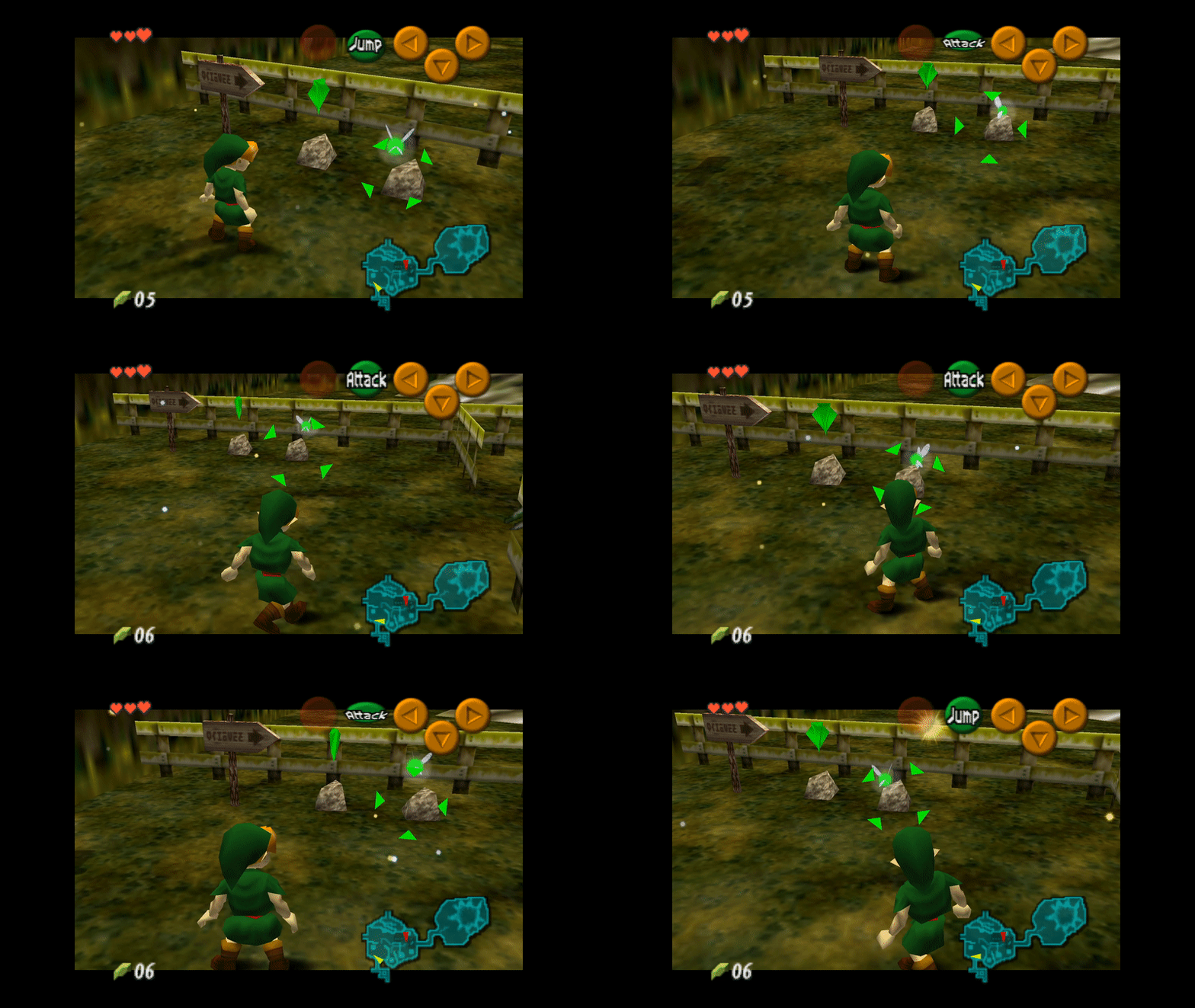
Child Link (The Legend of Zelda: Ocarina of Time) strafes to the left and right while a targeting crosshair focuses on a rock in a grassy forest. The rock remains center-camera, while Link shifts to either side of the camera.
The rock was very patient with me during the filming of this clip.

Notice in the image above how the camera smoothly and automatically situates Link to one side. You may have heard of the rule of thirds, an stylistic concept in art for generating compelling composition. By dividing an image into thirds and placing the subject of your art into the first or last of those thirds helps emphasize their importance, and draws the eye. It also frames the remaining, more open two thirds as a point of interest to the subject, a place they might be looking or going. Link is the subject in this scenario, and the camera essentially enforces the rules of thirds while Z-target is active. It’s not only very aesthetically pleasing, and helps draw the player into the drama of a good sword fight, but it’s very functional. But ensuring Link and the target occupy opposite ends of the screen, then it becomes very rare that Link himself will obscure his target from the player sitting on their couch. In this way essential information conveyed by your target, like an incoming attack, isn’t accidentally hidden from the player. This diagonal framing also helps keep the spacial relationship between Link and his target clear and unambiguous, which as I’ve mentioned elsewhere, is essential to satisfying combat.

This mechanic of making Link’s position relative to his target unambiguous is very strictly upheld. The camera will eagerly clip into walls to ensure the target remains properly framed, but this isn’t a problem as obscuring geometry will often not be rendered, so the camera’s over-commitment to framing is actually an advantage. It’s very intuitive. In an interview with the game’s general director, Toru Osawa, it was said that the system was inspired by a ninja and samurai themed performance. A ninja attacked with a sickle on a chain which was caught by the samurai. The ninja moved in a circle around his opponent as the chain connecting them was pulled tight. It seems drawing an invisible and unbreakable line between two entities helped the developers visualize how this new system would work. Link will always circle around his target in-game, and inputs on the controller are changed during a Z-target to reference the subject of the target. Moving Link “Left” means he will move clockwise around his target. “Right” means he will move counterclockwise around his target. It is as if Link is moving on a 2D plane, but bent and wrapped around the target. This abstraction expands into a rather robust system.

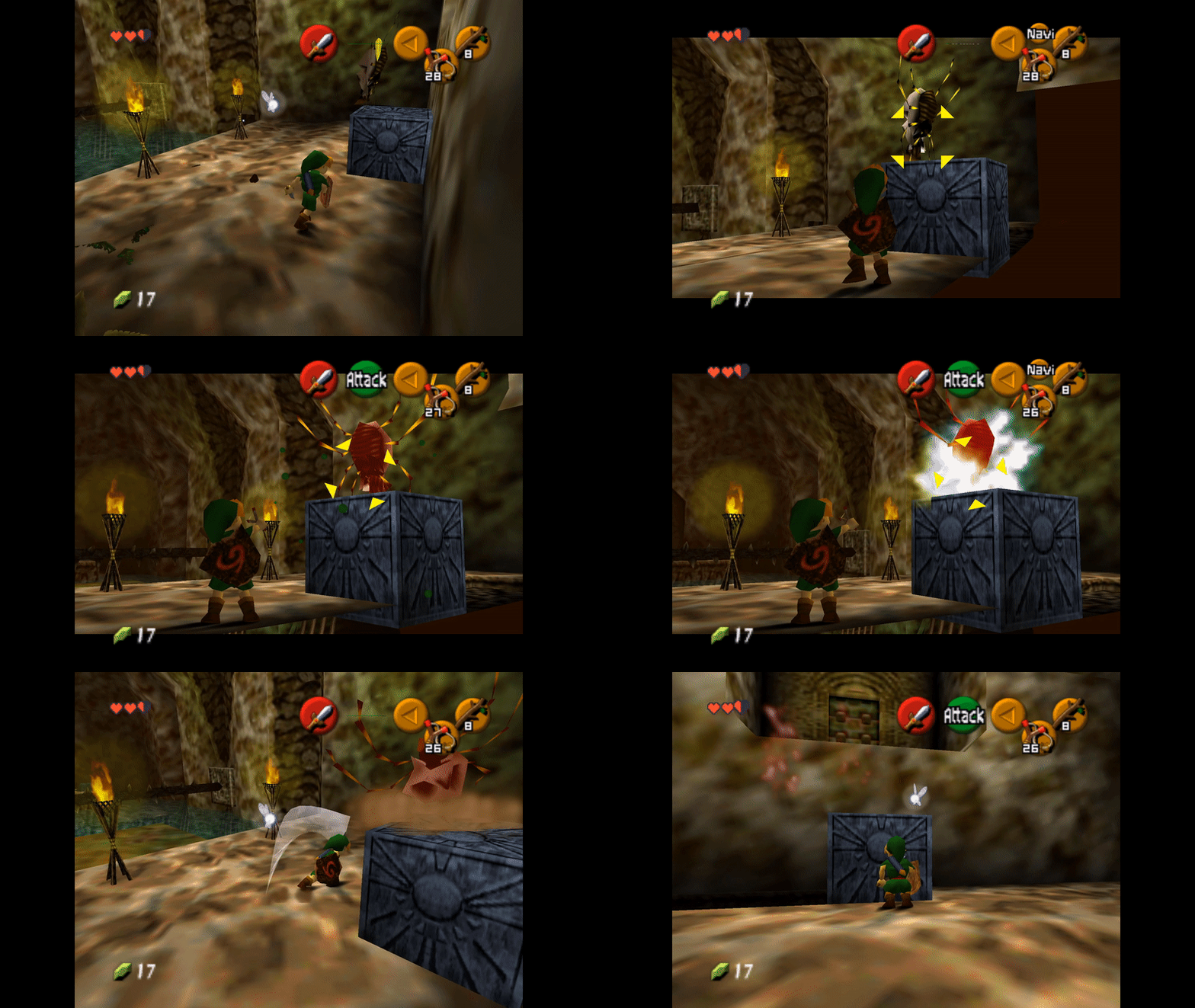
Child Link (The Legend of Zelda: Ocarina of Time) sidles up to a wall while a targeting crosshair focuses on a giant spider. The camera moved through the nearby wall, but the wall fades from view as this happens, allowing Link to see the spider's underside, which he shoots with his slingshot.
With the spider conveniently framed by the camera, even through this wall, Link is able to sneak a shot in to hit its vulnerable underside.

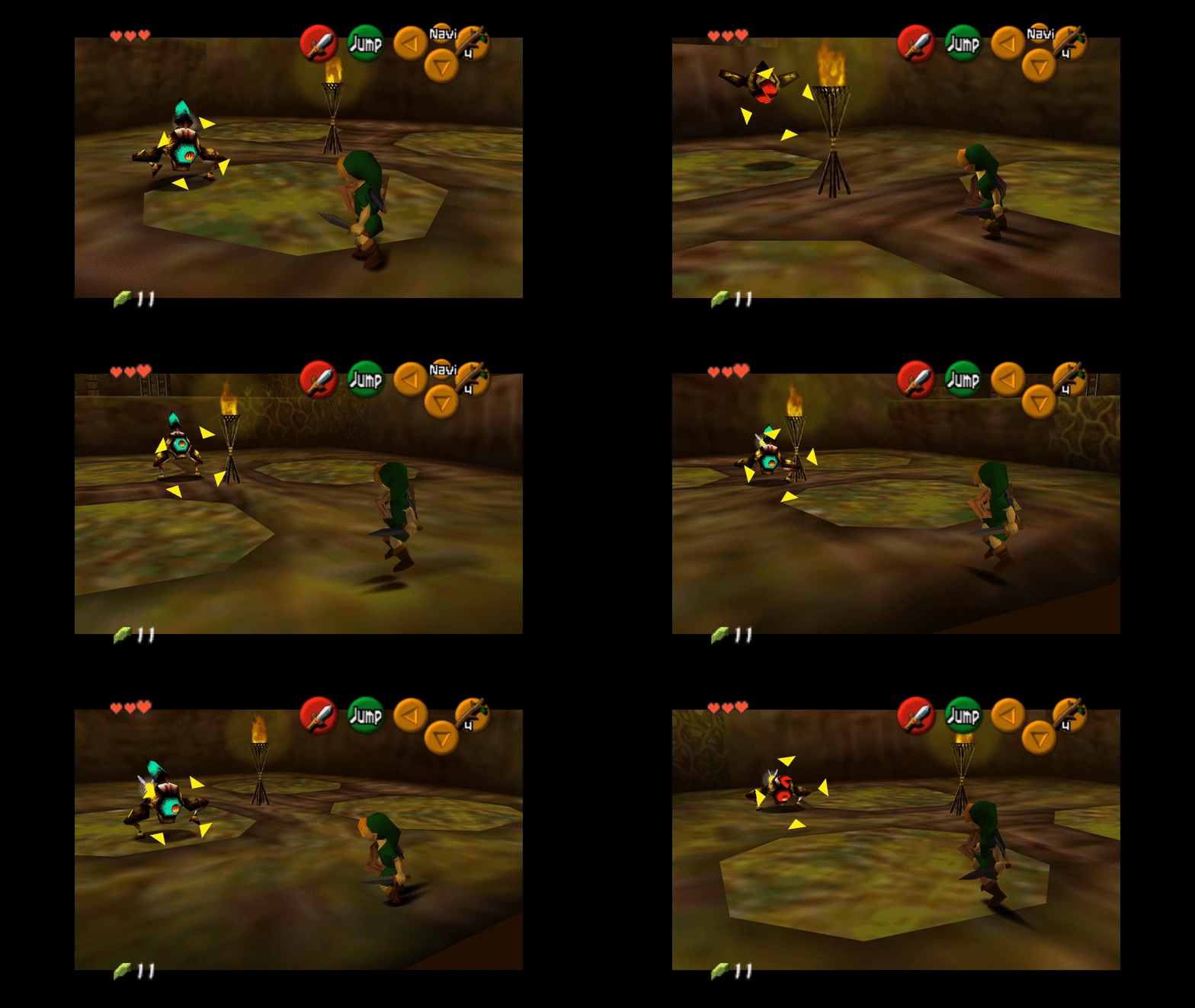
Another thing I noticed while playing Ocarina of Time recently is how movement during Z-targeting relates to the input of the gamepad controller. I’ll give you an example. While a Z-target is active, Link can do a quick side-step or back flip to avoid enemies. Holding the control stick back, toward yourself, when you press the action button will initiate a back flip. Holding the control stick to the left or right will initiate a side-step when the action button is pressed. So it seems the game is tracking Link’s relative facing direction to the camera for the purposes of his evasive jumps. If Link is facing perpendicular to the camera, or in other words, if his shoulder line forms a right angle with the plane of the game screen, then a “right” or “left” input on the control stick is considered “back” for the purposes of evasion. You can see this illustrated below:

Child Link (The Legend of Zelda: Ocarina of Time) hops to the side repeatedly in a naturalistic wooden interior. A targeting crosshair focuses on a giant cyclopic bug. When Link is almost side-on to the camera, he does a back flip.
During this clip, I am holding only the “right” direction, but Link eventually back flips anyway.

In this above clip, I am holding “right” on the control stick throughout. Once Link’s angle to the camera becomes too extreme, he no longer side-steps, and instead back flips. However, Link’s stride never changes. “Right” on the control stick is always considered to be Link’s right, relative to his current standing position, for the purposes of calculating what direction Link should be running. I can imagine a couple of reasons this might be. Changing Link’s continuous move direction on a dime would be very disorienting for the player. Link’s stride is not really changing in the previous clip, only the player’s angle of observation, so it’s unintuitive to think that a change in input is required to keep that stride in any scenario. The evasive jumps, however, are discreet units of movement and thus are not jarring when their operation changes based on camera position. Further, if Link were to side-step while side-on to the camera, it would be difficult to tell if he had done much of anything. By changing it to a back flip, the feedback of Link making an evasive move is maintained.

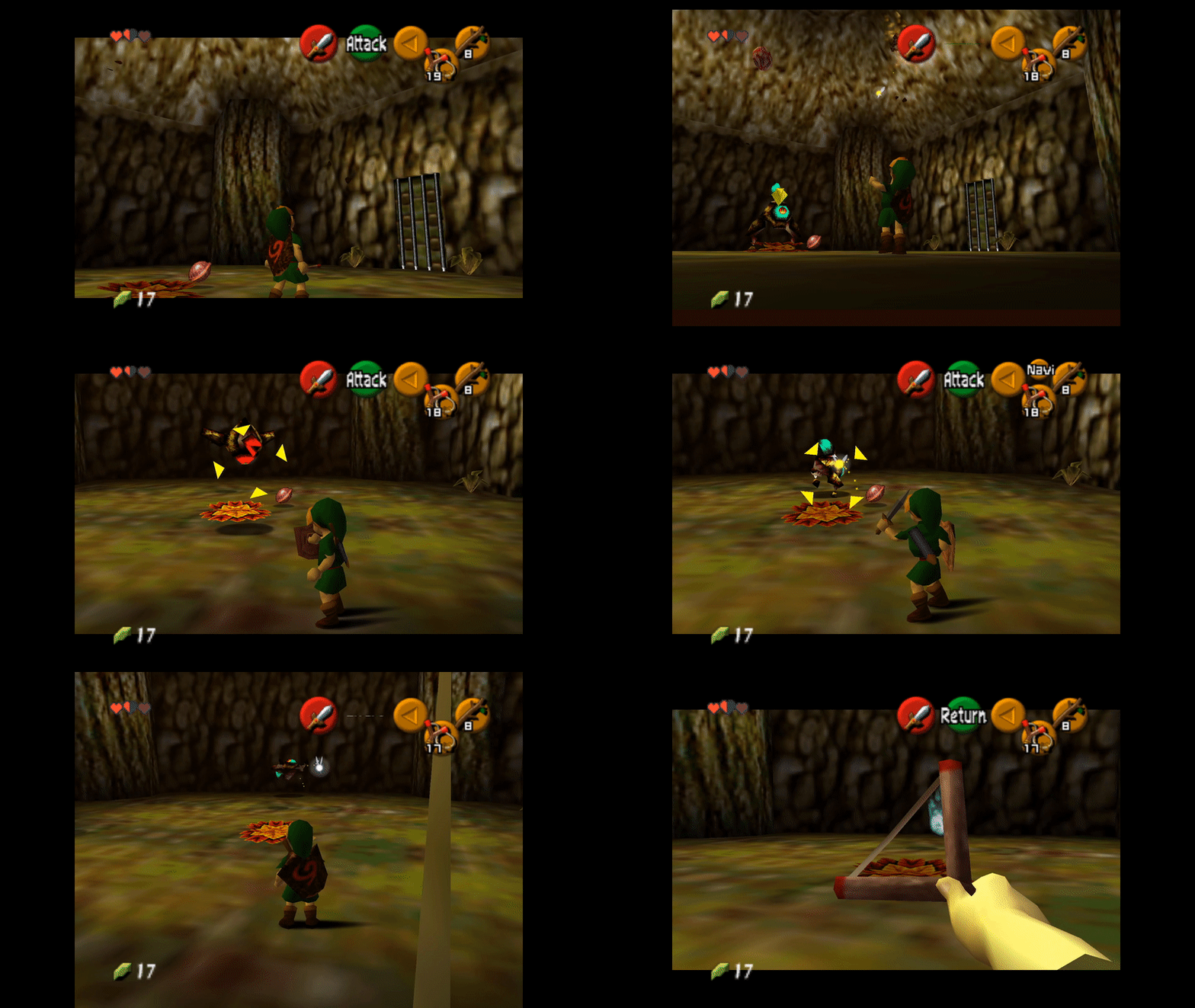
The Legend of Zelda: Ocarina of Time, being the first 3D Zelda game, obviously utilizes its verticality in ways that previous Zelda games could not. Zelda is a series well known for an arsenal of unique weapons and tools for solving puzzles and dispatching enemies. Iconic tools like the boomerang and hero’s bow are very compelling. It would have been a drastic admission of defeat to not translate such things into the first 3D Zelda. They have some hefty inherent problems, though. Control sticks are, frankly, not best suited for precision pinpoint aiming compared to a computer mouse, a gyroscope, or a photonic motion sensor. Ocarina of Time still offers the option of manually aiming projectiles through a first-person perspective, which is convenient for solving puzzles, but not ideal for most combat encounters. The Z-Targeting system rather elegantly solved this problem as well. The drawback is that the player doesn’t do much aiming at all when utilizing their bow and arrow in combat, which could be argued as part of the skill set of playing the old Zelda games, but in trade Ocarina gets the advantage of keeping airborne enemies in focus and keeping the use of projectiles in combat practical. Zelda combat is typically more about understanding the best tool for the job than skillful execution anyway, so I think it was a savvy decision to enable ranged combat in this way.

Child Link (The Legend of Zelda: Ocarina of Time) shoots a strange giant egg off of a ceiling, in a naturalistic  wooden interior, using his slingshot. He then stabs a nearby giant bug with his sword, then shoots it as it runs away.
There was an intent focus in this game on making your tools practical and functional, even if they’re not always the most complex or involved.

So many modern games utilize an automated camera or targeting system that can be traced directly back to Z-targeting, so I felt it deserved its own appreciation post here. The mechanic is unintrusive, fit-for-purpose, artistically sound, and practically seamless. It even has its own little diegetic explanation of your partner fairy, Navi acting as the source of your target’s focus. You might notice her dancing around targeted enemies in the clips I’ve provided. Helps reinforce her as an important partner to Link, even in spite of her infamous chattiness. Honestly, after looking into it, there are some features that even some modern targeting systems don’t do as well as Ocarina of Time. There have been perhaps more elegant, more robust, and even more interesting targeting systems since, but it’s absolutely astounding how much Zelda nailed it on its first try, and set the stage for the iteration of 3D navigation for many years to come.

Child Link (The Legend of Zelda: Ocarina of Time) pursues an elephant-sized cyclopic insect as it climbs up a wall in a dark cavern. Link aims up at it with a targeting crosshair focused on it, then shoots its eye with his slingshot.

Time passes, people move. Like a river’s flow, it never ends…

Majora’s Mask Boss Fight Remakes: Boss Design Goals

This is part two of an analysis on the boss design of The Legend of Zelda: Majora’s Mask and its remake. Part one can be found here.

Something I’d like to talk about while reviewing these last two bosses is the utility of bosses in general. Rather, what design goals are you fulfilling by including a boss? People love bosses, but why? They tend to be notable spikes in gameplay intensity marking the end of a chapter, level, or other extended segment. Bosses can serve a number of functions be it as a narrative component, accentuating a certain gameplay mechanic, simply being a restrictive challenge, among many others. Considering the design goals of a boss helps keep the experience focused and in-line with what you’re trying to design. I’m going to look at these next two bosses through this lens.

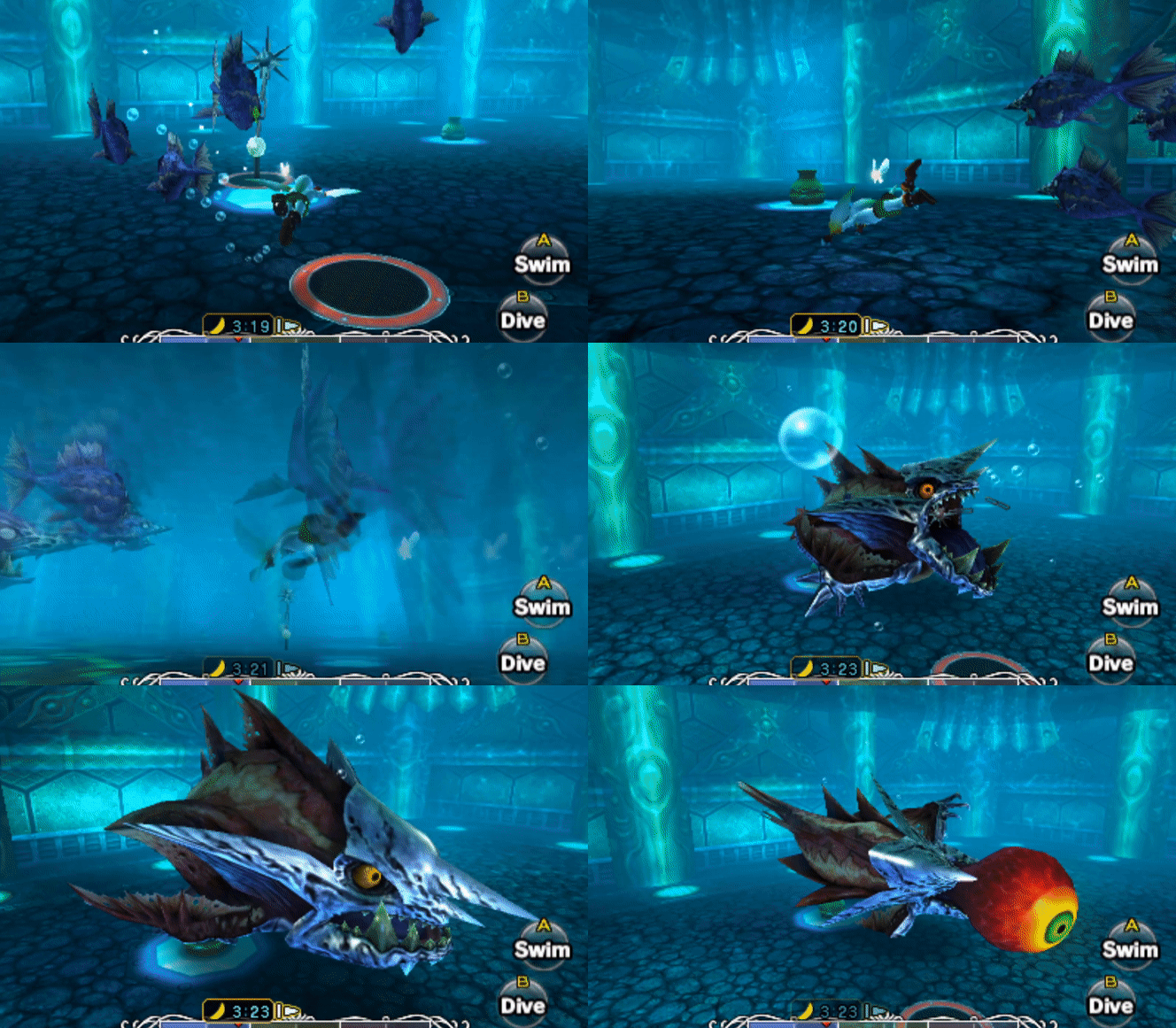
Gargantuan Masked Fish Gyorg is next on the chopping block. As his name implies, this beast will fight you primarily from his home in the water. The fight takes place in a large, deep pool with a single round platform in the center raised just above the water’s surface for the player to stand on. At this point in the game the player will also have access to the Zora form, a power which allows them to breathe and maneuver adaptably underwater by running along the pool’s bottom or swimming at high speeds like a dolphin. I’d definitely call Gyorg the weakest of the original N64 Majora’s Mask boss fights. With very little going on, and a rather disruptive camera, I never find myself looking forward to fighting him.

Get ready to see a lot of this

N64 Gyorg’s fight is kind of confusing, to be honest. While the fight is completely player-directed, it’s also not always clear exactly what you need to be doing in this fight. If you stand on the central platform, Gyorg flails about and tries to knock you off, indicating clearly that you’re meant to fight him in the much more spacious pool, although blind-firing arrows at him with your bow from dry land is also possible. The camera is not very kind when it comes to this method, however. You seem to be punished for not being in Zora form, and once in Zora form Gyorg still just seems to swim aimlessly, occasionally going for a bite at you. There’s so little structure to this fight that one can just sort of… try things out, most of which will only kind of work. What I think you’re supposed to do is use the Zora form’s boomerang ability to stun him.. Then use it again while he is stunned to damage him. He has a weak point you need to hit, but it is targeted automatically if you use the targeting mode. A little odd, a little unclear. If you get the timing right, you can stun lock Gyorg forever and there basically is no boss fight. Get it wrong, and you’ll be seeing a lot of the inside of Gyorg’s mouth in rather frustrating fashion. The problem is, while the targeting mode tries to frame the camera, Gyorg’s wildly moving body will swing it around in an abrupt fashion. Unfortunate, since using the targeting mode is the ideal way to attack him. After he takes some damage, he will release a swarm of small fish to attack you, though they can be largely ignored as one continues to stun-lock Gyorg.

Uhm. Uh. Did… Did I get him?

The total lack of structure in this fight makes me wish it was more environment-directed, and makes me question what the design goals with this fight are. It does not utilize this dungeon’s item at all, nor is it very friendly to using most of the Zora’s powers. Swimming at Gyorg can potentially harm him, but I wouldn’t recommend it. It’s not very fun or effective to do. Since actually swimming is not much involved in this fight, it doesn’t really serve as a capstone to the mechanics of the dungeon its found in either. Gyorg is a bit of a low point for me in Majora’s Mask, not providing much by way of narrative, challenge, or mastery for the player. The most effective strategy “throw boomerangs at him repeatedly”, does not make much intuitive sense, and goes to show how some environmental-direction, either through the boss’s actions or the area they are fought in, can help make a fight’s design goals clearer and more effective.

No, really. When does the fight start?

3DS Gyorg sees a lot more structure and direction by the environment in his boss fight, to become a much more effective boss in my opinion. 

This is already a lot more exciting.

Once again we have that obvious orange eyeball-weakspot, but also a notable change to Gyorg’s design. Before his body was a continuous color but now his face is a notable stony gray in contrast to a softer looking red-orange body. The structure of the fight is being communicated. On the 3DS it’s a lot more clear what you’re actually hitting; anything besides Gyorg’s mask. It’s the mask that’s armored, but not his body, indicating it is vulnerable. The camera has been improved immensely when it comes to shooting Gyorg with the bow and arrow. He now jumps into the air or swims along the surface of the water like a shark, framing his bright orange body nicely against the blue arena for some bow shots. It’s a lot more satisfying already. It works so well it seems as though fighting Gyorg from the land is the intended method, although the Zora also still works like in the old game.

This still looks so incredibly silly to me.

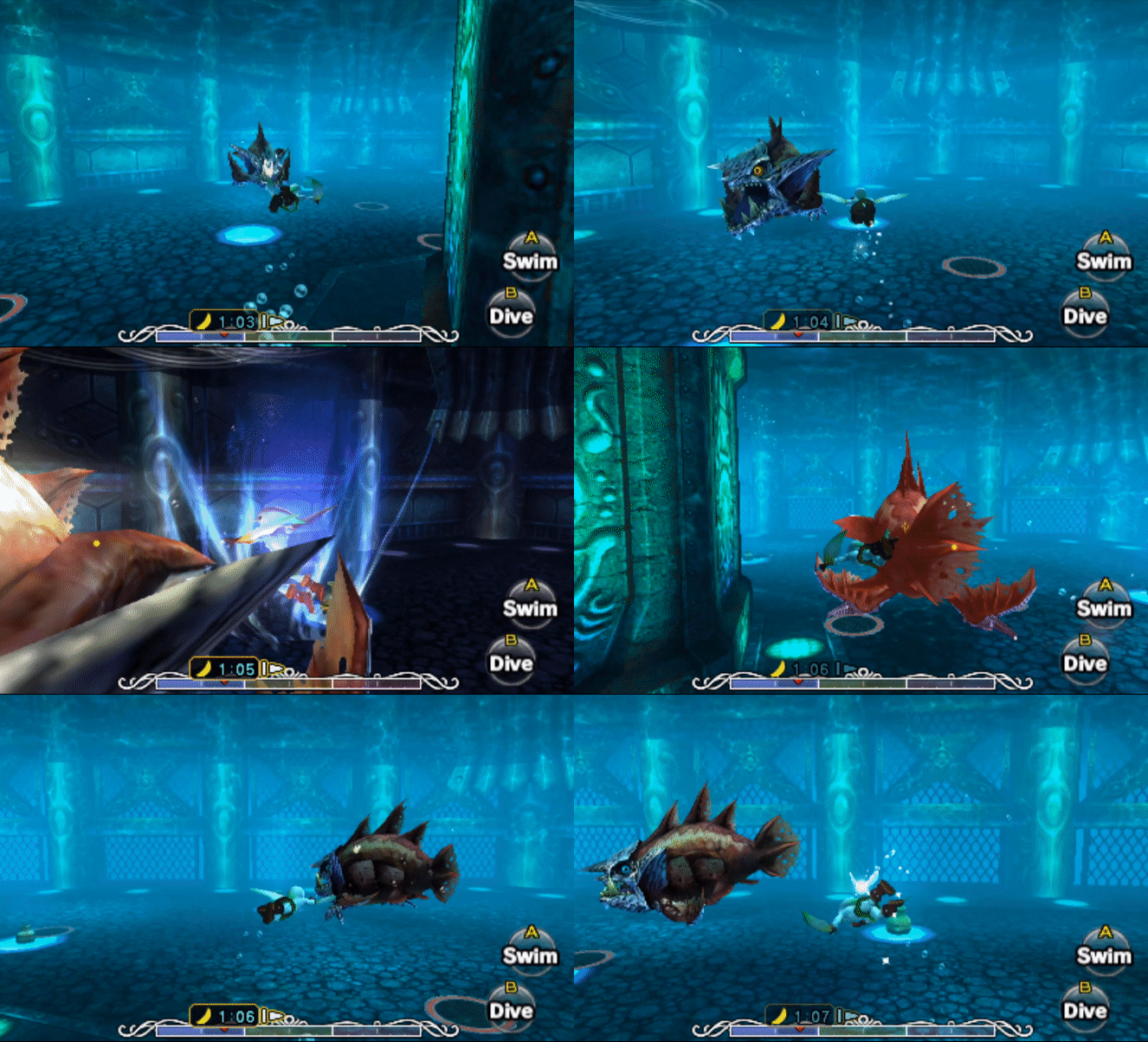
This time, once Gyorg has taken enough damage, the land disappears, forcing the player to engage as a Zora. The implementation of the Zora’s gameplay mechanics are still not stellar in this part of the fight, but it’s a marked improvement over the original game. Here, the Zora’s swimming ability is incentivized to quickly release sea mines, whose very presence is a good clue as to what the structure of this fight is. Gyorg will often open his gullet to try and suck you in, but will suck in any stray mines instead, stunning him and opening him for attack.

Hey-hey! Swimming to fight him actually.. kind of works now.

This phase is a little janky as the timing for getting Gyorg to start inhaling and releasing a mine is rather narrow and doesn’t feel as smooth as the mechanics of many other Zelda bosses. Still, overall the changes to Gyorg make him feel like a much more complete experience that actually utilizes mechanics from his dungeon such as the Zora swimming. There’s a lot more variety and feedback for what you should actually be doing. If the design goals here were to engage the player to think about how to adapt to an aquatic foe, it succeeds on that front. I’d give the 3DS version of Gyorg a solid thumbs up over his predecessor.

By janky I mean… well it’s a little disorienting to even figure out what’s going on here.

The final boss I’ll be talking about from Majora’s Mask is the Giant Masked Insect Twinmold. With a somewhat misleading yet somewhat appropriate title, Twinmold is actually two giant masked centipede… worm… things, plural.

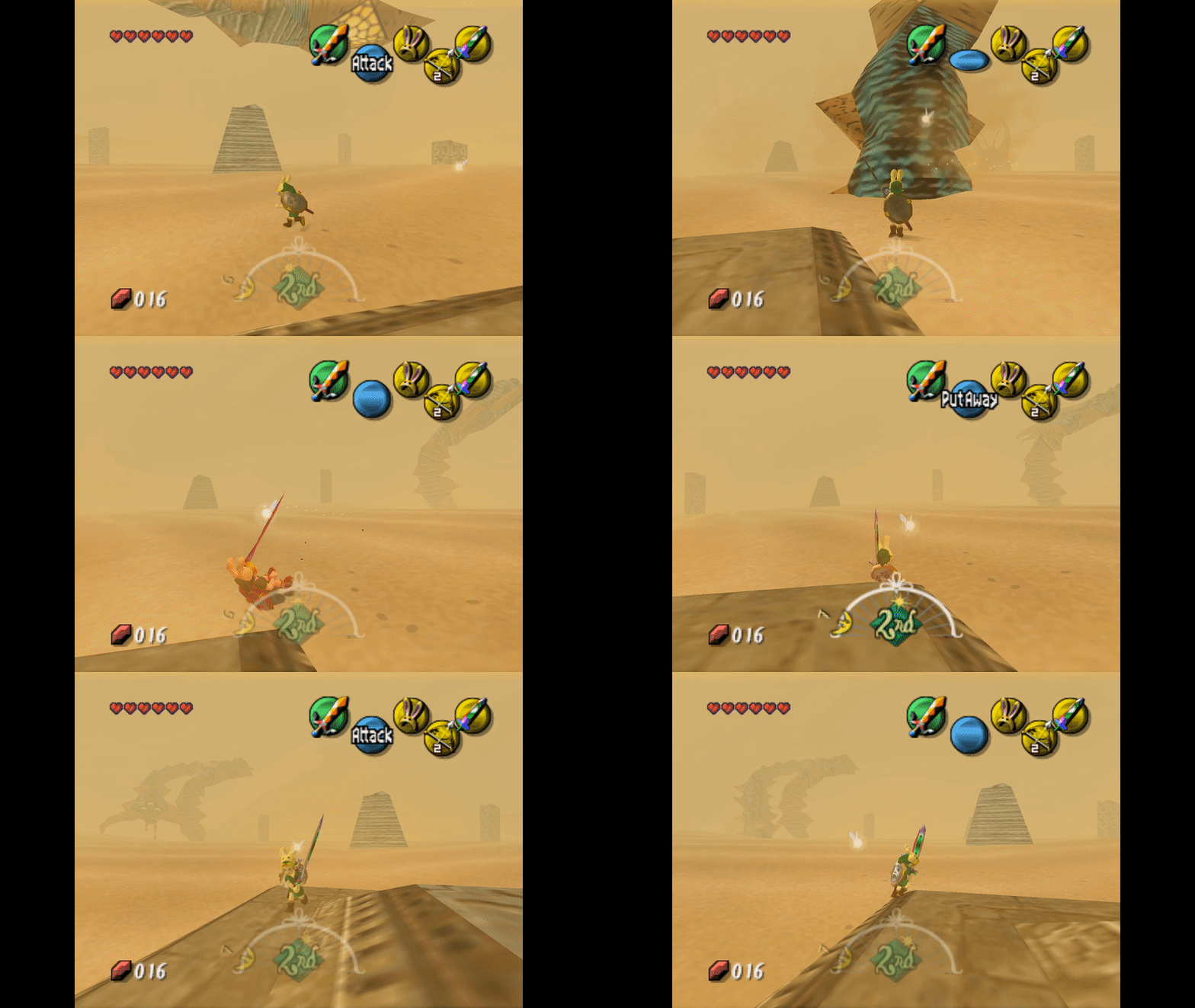
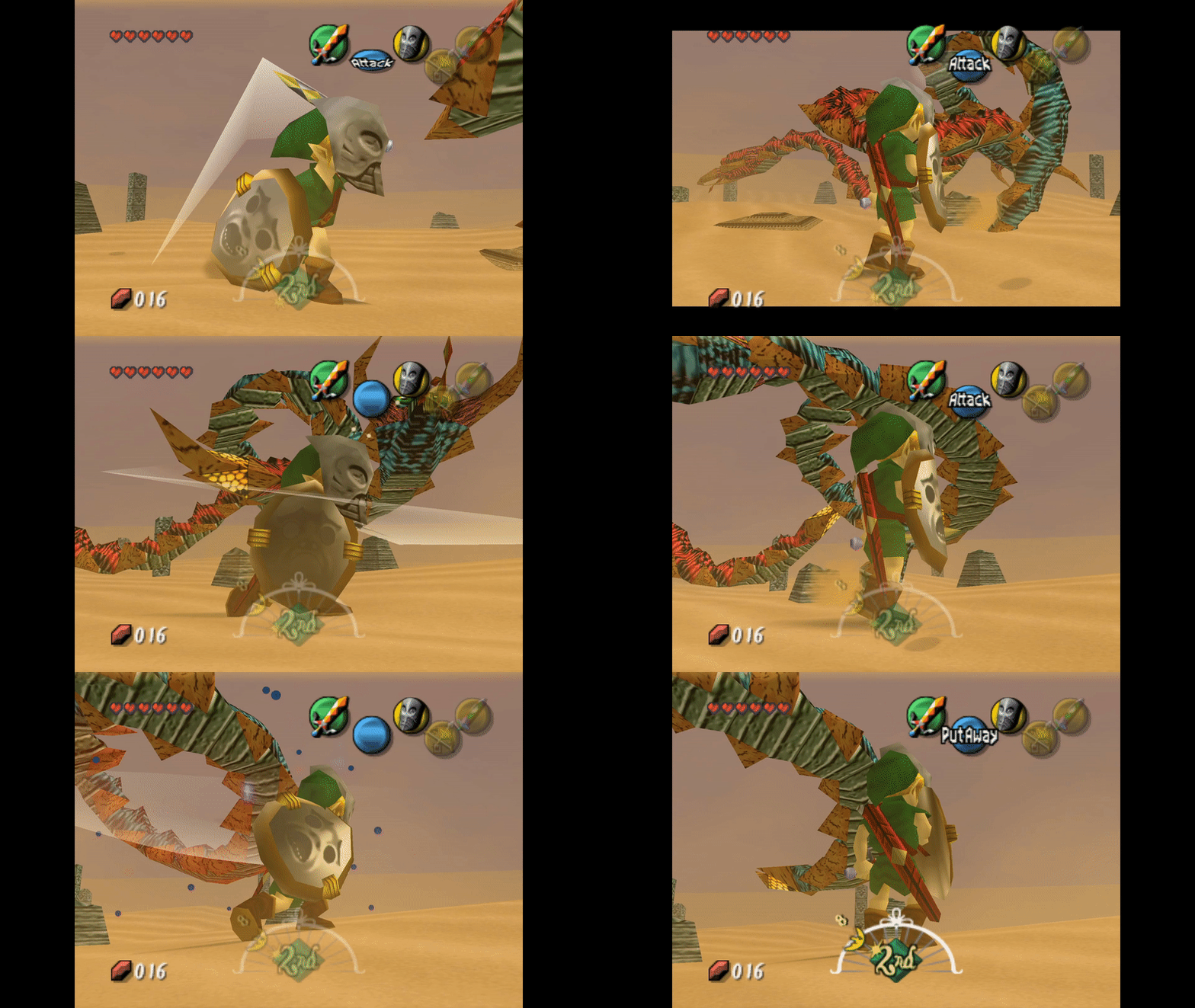
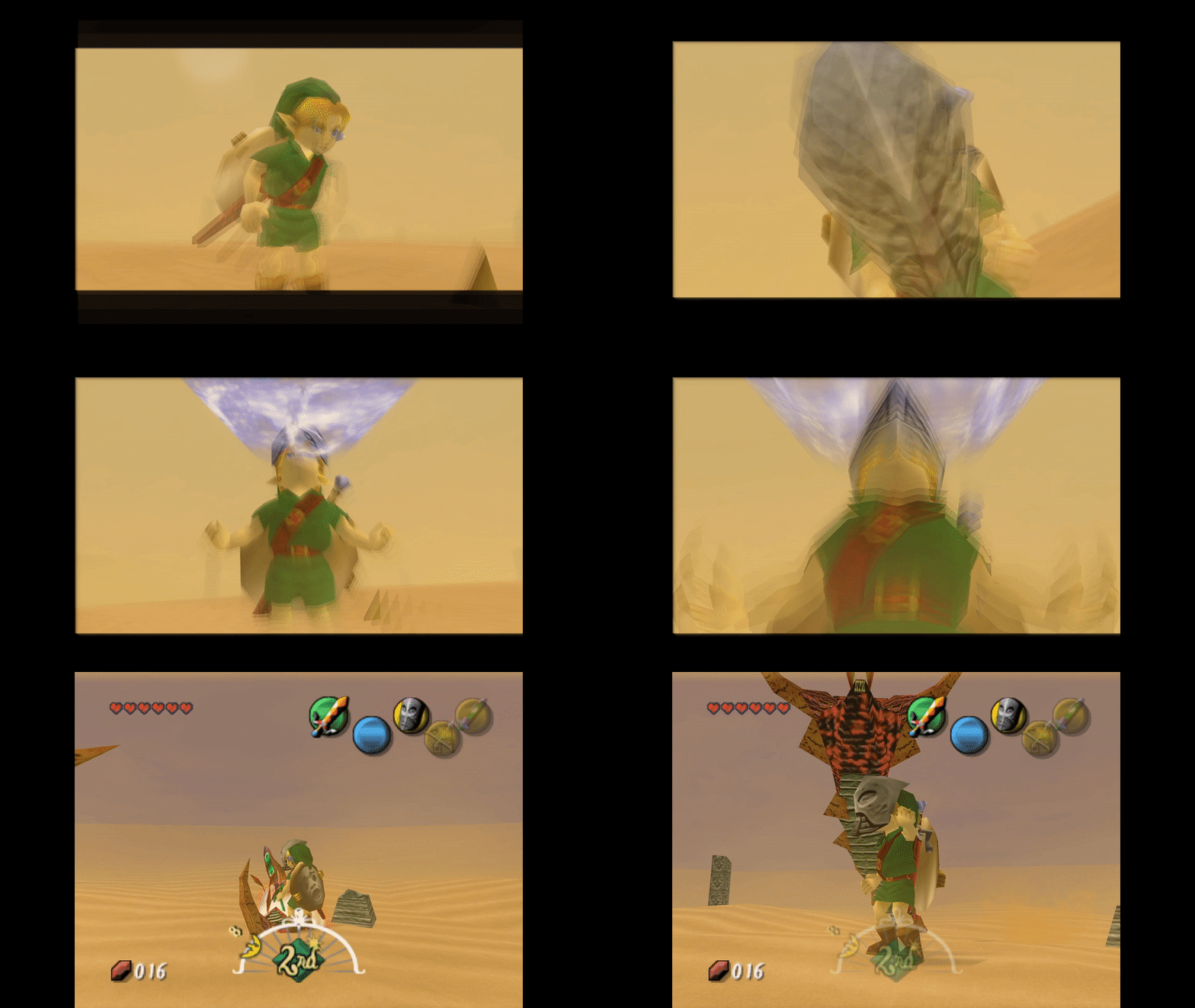
The original Nintendo 64 version of this boss fight is extremely open ended, extremely player-directed. There is a special dungeon item you obtain in the hours leading up to Twinmold’s confrontation, but it, like many such items before it, in Majora’s Mask is entirely unnecessary to defeating its dungeon boss. Although you are clearly intended to use it. In fact, Twinmold’s boss room is the only location in the game in which that special item, the giant’s mask, can be used. It grants the player titanic proportions, using some visual trickery to transport the player to a scaled-down version of the boss arena inhabited by scaled down Twinmolds that can be much more easily reached with your now colossal sword.

Wow, this is suitably terrifying.

Whether you decide to don the giant’s mask or not, the concept of this boss fight is extremely simple; Twinmold is invulnerable everywhere along its long body except at the head and tip of its tail. The player’s goal is to strike the head and/or tail of each Twinmold until they die, while avoiding their sharp, undulating bodies. If the player is using their limited magic to do so, such as in utilizing the giant’s mask, they must keep on eye on this magic resource and shrink back down to normal size in order to replenish, risking some greater threat to their health in the process. It’s a straightforward rule set borrowed from previous 2D Zelda games where fighting a giant worm meant aiming for its constantly-moving tail, but adapted to 3D space. It works really well! Rarely are you required to keep exact stock of the player’s sword in 3D space in this way, so it’s refreshing and interesting.

I quite like this iteration of the Twinmold fight. It’s simple, but after the difficult and daunting experience that is their home dungeon, it’s a bit refreshing to just stroll up with this huge amount of power in the giant’s mask and let loose. It seems that, along with spectacle, power fantasy was a major design goal of Twinmold, specifically the power fantasy of gaining the might to outmatch an overwhelming evil, as is often the case with Zelda. It’s a bit of relief from the high-intensity part of the interest curve that makes up much of Majora’s Mask’s later stages. Twinmold is not very difficult, but it is very satisfying and momentous. With the final of four major evils stricken from the world, it feels as though the player has truly accomplished something great. Giving them the freedom to completely direct the boss fight helps reinforce this, by making it a labor of their own agency.

And now… I’M TERRIFYING! Hahaha!

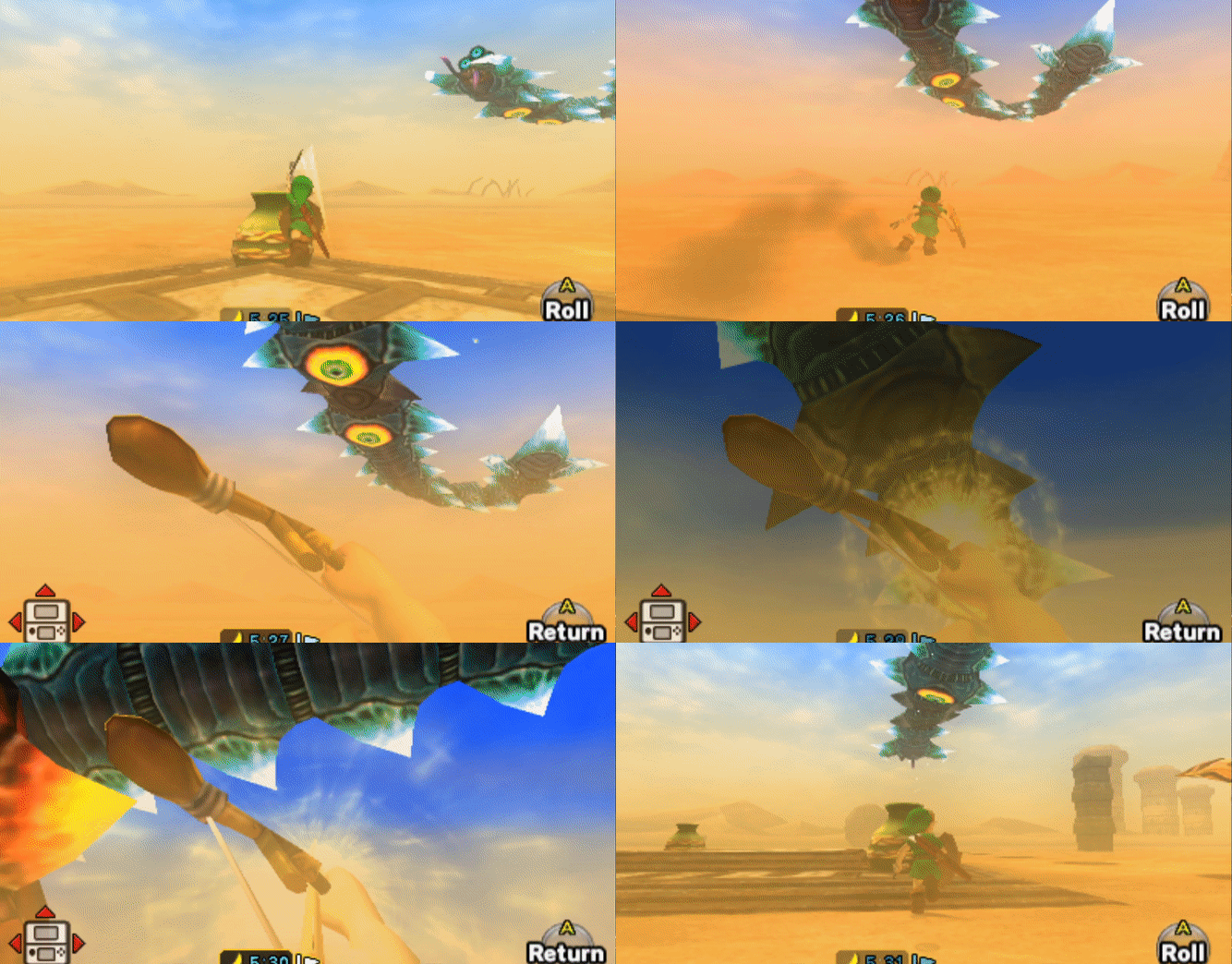
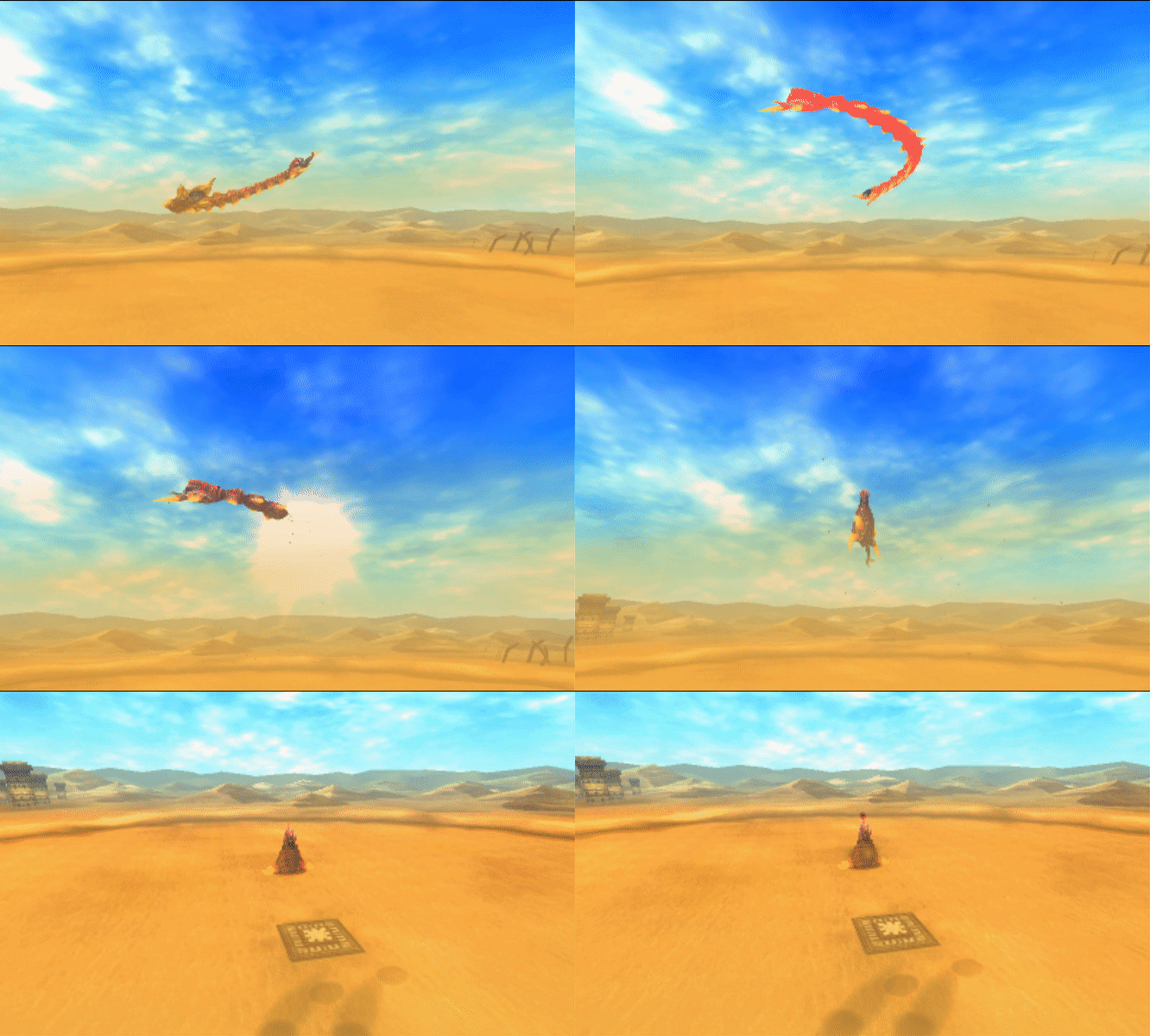
3DS remake Twinmold works quite a bit differently. The fight is now a two-phase affair. In the first phase, the player will not have access to the giant’s mask. On the Nintendo 64 this mask was obtained within the dungeon itself. On the 3DS, the mask is obtained after defeating one of the two Twinmolds. This first Twinmold prefers to fly overhead, and has those large orange eyeball-weakspots on its underside. Shooting it with light arrows will take it down. While shooting, the player must be cognizant of the other Twinmold, which will shell the ground with fire balls.

Really, it kind of feels like he’s asking to get killed

Now, fighting Twinmold without the giant’s mask on the Nintendo 64 is very fun but very daunting. It’s difficult, requiring the player to be constantly aware of their surroundings to quickly position themselves such that they can reach Twinmold with their attacks. The concept of having to defeat one Twinmold against all odds as a tiny normal-sized person before getting the giant’s mask and unleashing overwhelming force against the second is an appealing one. It builds tension and anticipation of the fight to come, adds some nice challenge to this late-game boss, and makes that ultimate power fantasy all the sweeter. It’s a good change in isolation, though I do wish this first phase on the 3DS was more player-directed, with less reliance on those eyeball-weakpoints, which at this very late stage of the game feel somewhat passe. Having to defeat Twinmold in the same fashion as both a human and a giant would better highlight the contrast between the experiences.

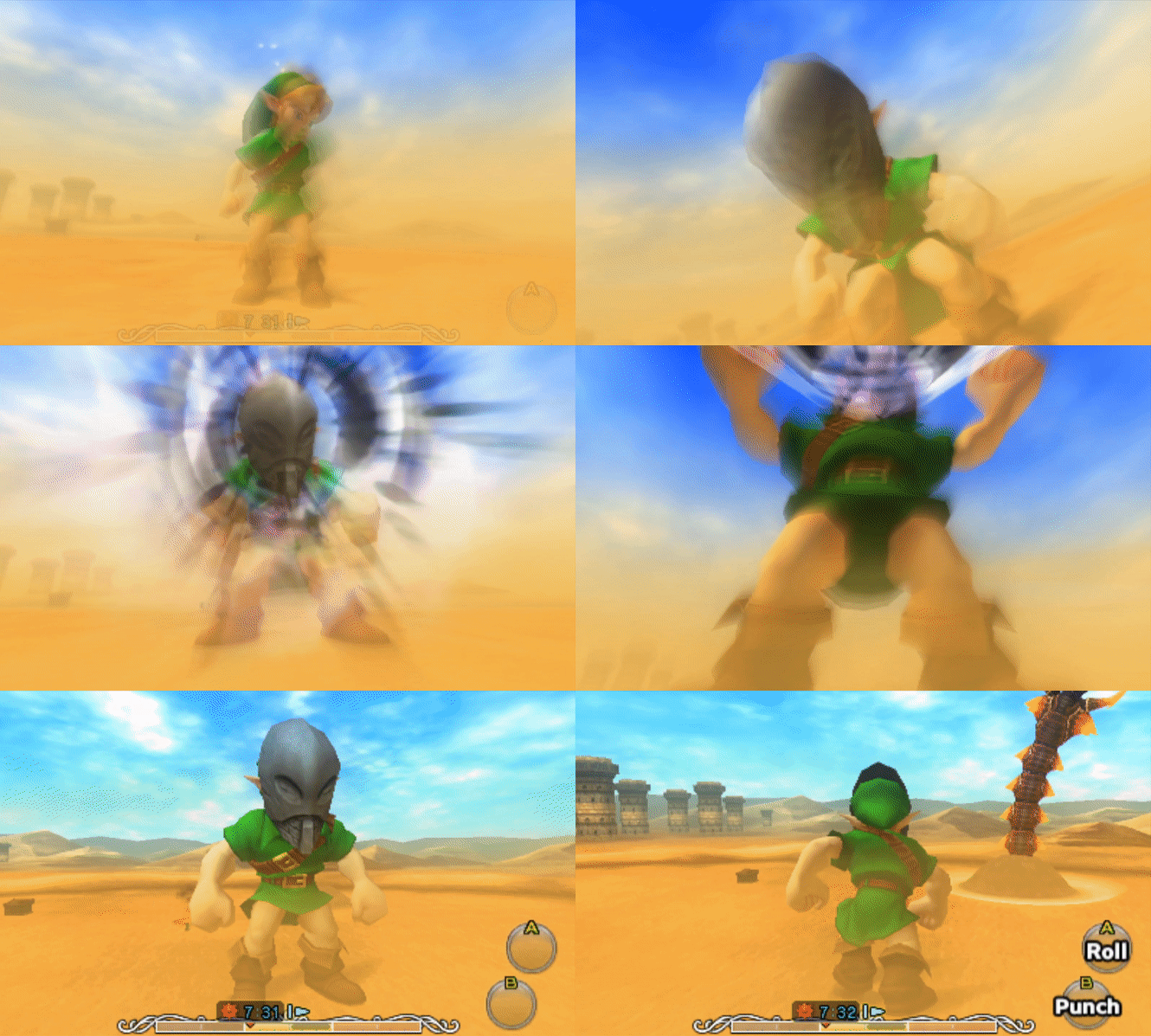
3DS Twinmold’s biggest problems come in the form of the changes to the giant form. Giant form on the N64 controls exactly the same as normal form, you’re just now giant, with reach to match. On the 3DS, however, you become lumbering, slow, and very limited in your moveset. You no longer have access to your sword, instead punching the air in front of you with each press of the attack button. This form on the 3DS just does not feel good to play. It’s cumbersome, difficult to position correctly, and frustrating to hit your targets with. Twinmold is no longer vulnerable on the head and tail, and instead punching it anywhere along its body is viable, presumably because positioning the giant form is so difficult that were the old vulnerabilities in play it would be nigh-on impossible to connect any attacks with Twinmold.

No- yeah, okay. I’ll just… wait here on the ground. You can let me hit you when you’re ready.

Since the player can barely move as a giant, the fight is almost the antithesis of the open-ended fight of the N64, with the player constantly waiting for Twinmold to swing by in a fashion that will allow the player to hit them without accidentally meandering into Twinmold’s spiky body and getting knocked onto the ground. There are also some boulders the player can throw, but you will once again have to wait for Twinmold to hold still in order for them to do anything, and once those boulders are gone, they’re gone. The result is a fight whose exceedingly sluggish flow is determined by the environment, where the player is stuck in a frankly frustrating and unwieldy control scheme unlike anything else in the game.

Gonna go make a sandwich while this is happening.

The fight also lasts forever. This is just a tuning problem – Twinmold clearly has too much health – but I nonetheless became exceptionally bored by the time I had swung Twinmold around like one of those fuzzy worm toys for the fourth time. Where the previous Twinmold’s design goals were clear the 3DS version’s seem somewhat muddied and confused, with good ideas being overshadowed by frustrations and missteps. There’s no power fantasy here, and little sense of awe either. The first Twinmold’s weakness is too obvious, and the second Twinmold is too frustrating.

A mixed bag is how I would describe the remade Majora’s Mask bosses, ultimately. In my estimation, Odalwa is a bit of a step back, Goht has some improvements and some awkward changes, Gyorg is a clear improvement but by no means perfect, and Twinmold is an overall inferior experience despite some good ideas. Aside from my opinion of quality, however, I hope comparing and contrasting the surprisingly different ways all the versions of these bosses were designed helped highlight some of the things to be thinking about when designing bosses. How in control does the player feel? What design goals is your boss meant to fulfill and do they make good on that? Odolwa made me feel the rush of a life or death battle against a swordsman wielding inhuman powers, but some of that is lost if you make the methods by which you can fight him too restrictive. On the opposite end, Gyorg’s confused and meandering original boss fight was markedly improved by the introduction of some structure and environmental cues. Boss design is a deep and broad topic that I’ve only scratched the surface of, but looking at all these different boss designs have given me a lot to think about.

You’re the bad guy. And when you’re bad, you just run. That’s fine, right?

The Legend of Zelda: Majora’s Mask: Remaking Boss Fights

Alright, time to talk about one of my favorite games of all time, The Legend of Zelda: Majora’s Mask. It’s an odd one in the Zelda canon, a direct sequel to the seminal Legend of Zelda: Ocarina of Time developed in only a year, known for its oppressively somber atmosphere and mature themes. It’s a game where an ominous title card greets you at the start of each day, counting down to the end of the world. It’s a weird one, which is probably why I love it so much. I was lucky enough to see one of my favorites receive a total remaster, featuring a big leap in hardware from the Nintendo 64 to the newer, portable, Nintendo 3DS. Remakes and remasters are always a fun topic. What actually gets changed in such revisions? What’s sacred and cannot be touched? I wanted to specifically take a look at the boss battle designs of these two versions of the game as Nintendo made some notably significant changes in this area in particular, while much, though not all, of the game’s other mechanics remain faithfully identical between the two versions. I’d like to breakdown a few of the boss designs to see where the design goals of the versions diverged, while thinking about a concept I’ll call player-directed vs environment-directed boss fights. There’s a lot to go over here, so I won’t be breaking down every single mechanic of every fight and what those elements accomplish (Although, that sounds like a lot of fun. Maybe for another time). Moreover, I want to see how the changes made affected my experience with the bosses. Let’s get started.

This is what I see every Thursday morning

The first major boss of Majora’s Mask for the Nintendo 64 is the Masked Jungle Warrior Odolwa, a demonic swordsman who commands swarms of carnivorous insects. So I mentioned that Majora’s Mask is a weird game, and even its debut boss is proving this true. Traditionally, Zelda boss fights work in a pretty standard fashion. You receive some new item or weapon, and you utilize it in a specific method to exploit a well-marked weakness the boss has. In this way you progress the encounter, like solving a puzzle. Zelda boss fights are usually not very open-ended. This is not universally the case, but it tends to be the norm. That would be an environmentally-directed boss, where it is aspects of the game’s behavior and scripting that dictate the pace of the fight. One can’t shoot the big-eye monster until it opens its big-eye. Boss encounters that can be progressed at the player’s agency, such as where the boss enemy is always vulnerable, are more player-directed. This is not a binary, and there’s a lot of fluctuation on a spectrum between these two styles of boss design. Zelda partakes in both from time to time, sometimes within the same encounter, though I’d say trending more toward environmental-direction.

This boss attack leaves an intentionally designed opening, where striking Odolwa is easy

Odolwa bucks this trend entirely. You can hit Odolwa at any time with a number of implements. In fact, the weapon you find in Odolwa’s dungeon, the Hero’s Bow, is entirely unnecessary for defeating him. It certainly is advantageous to use it, but entirely optional. Odolwa has no obvious weakness, he has no obvious repeating pattern. He has a collection of patterns and behaviors that respond to the player, of which some leave him open to attack, and others less so. Even still, it’s possible to damage him during times that don’t seem like obvious openings, so long as you can connect sword to swordsman. The sum of this is that ‘openings’ are not taken for granted, not guaranteed progress. There is an element of execution and performance required of the player, instead of just following a script.

This attack leaves an intentionally designed opening, where striking Odolwa is- “Insects? Oh god fire!? AHH!”

During the fight Odolwa will summon beetles to hound you from the ground, and butterflies to swarm you from the skies. The beetles can be easily dispatched with sword strikes, while the butterflies need to be more carefully maneuvered around. What I find so distinctive about the Odolwa fight for a Zelda First Boss is how firmly the player directs the pace of the fight. I’m never waiting for anything specific to happen, never just nodding along with Odolwa’s preplanned script. Much more than many other Zelda fights, Odolwa’s encounter on the N64 can go in a wide variety of directions very quickly. He’s basically always vulnerable to attack, and so fighting him becomes a skillful test of how the player can handle an increasingly complex bevy of spacial information. So long as I’m willing to risk it, and I have the finesse to get around Odolwa’s shield, I can deal as much damage as I want as quickly as I want, and even end the fight quite promptly.

In the 3DS version of the game, Odolwa’s been altered quite a lot. Immediately attention is drawn to his new, glaring orange eyeball weak spot. I must compliment the animators for how elegantly it’s conveyed in its intro, much more so than such eyeballs will be in later Majora’s Mask 3D bosses, as it does communicate the new direction the design this fight has taken rather well.

Hmmm… I wonder where his weak spot could be.

On the other hand, while his weakness is clear, a lot of the aspects that made Odolwa unique, if somewhat intimidating, have been dummied out. For one, it is now impossible to deal sword damage to Odolwa while he is brandishing his sword at you. A bit baffling, to be honest, seeing as how Odolwa is a swordsman. It seems rather obvious a player would want to go blade-to-blade with him, yeah? Whereas in the N64 version, Odolwa would use his shield to make hitting him with the player’s sword more troublesome, here it’s all for show. Odolwa is completely immune to sword strikes period.

Blue sparks = no damage. Why does he even need that thing?

Odolwa is once again vulnerable to a variety of attacks, but now they all seem very restrictive, and kind of arbitrary. It seems the goal here was to make the fight more environmentally-directed. One can only damage Odolwa when he presents his new eye, which demands use of the dungeon’s Hero’s Bow item, or the Deku Mask. Perhaps this was in an effort to make the boss more approachable – one advantage of environmentally-directed boss fights is that the player is given a more definitive answer to the problem of how to take down an obstacle, making it more of a puzzle than an actual fight, which is naturally somewhat less stressful. I think there is something to be said for establishing the monsters of Majora’s Mask as these intimidating, aggressive and stress-inducing beasts, however. Some of Odolwa 3D’s changes work against this.

Ooooh, the eye, okay I get it

For example, 3D Odolwa suddenly becomes very passive when the player is utilizing a flower with the Deku Mask power, as this is another ‘correct’ answer to the problem of hitting Odolwa’s glowing, orange, eyeball-weak spot. It makes Odolwa seem kind of… stupid, and less of a threat. He stands around patiently to be pelted in the face with an aerial bombardment. It highlights the artificiality of the encounter and could potentially draw a player out of the all-encompassing atmosphere Majora’s Mask is known for. Some of Odolwa’s tricks have also been removed, seemingly, such as his ability to summon a ring of fire to entrap the player. If it seems as though I am being overly harsh on poor Odolwa, it’s just that I really want to highlight the difference in design ethos here. I suspect the 3DS version of this game was meant to be more generally accessible, as Majora was always a niche as far as Zeldas go. These changes seem to be made toward making the experience more familiar to standard Zelda games.

You gonna… You not gonna try and stop me Odolwa?

There are games with much more environmentally-directed boss fights than Zelda, where the boss’ behavior is entirely divorced from anything the player does, where the player just has to wait and act as they are meant to, or fail to progress. As I said, there’s a lot of variation out there. Ultimately, a lot of the changes to Odolwa are an issue of presentation. The big eye, the initial immunity to sword strikes; it all builds up this sense that you have to be very specific about how you approach the encounter, where in reality a lot of the same strategies work between both versions of the game. The N64 version is just a lot more free-form, and open to more experimentation, while the 3DS version excels in clarity of its intentions.

From N64 Odolwa I felt the malice of a monster in fighting him. Things got chaotic toward the end as I was engulfed in a ring of fire, my enemy gleefully taunting me from just beyond sword’s reach. Then I realized; I could skewer the arrogant warrior with the bow I found in the dungeon! But I’d have to be careful, man-eating butterflies and beetles swarmed me. It really felt like a struggle for survival. 3DS Odolwa gave me the feeling of solving a puzzle. It’s more like dissecting a more strict set of rules, as Odolwa behaved much more predictably.

Masked Mechanical Monster Goht, our second major boss enemy, sees much less drastic changes than his little brother in the jump from Nintendo 64 to Nintendo 3DS, but there are still some noteworthy ones. Goht is a giant mechanical, erm, goat of sorts with the face of a man. His fight involves chasing him around a circuit in the form of a rolling goron wheel at high speeds. The player’s goron wheel takes some time to rev up, and requires a magic resource to maintain its speed, but once it does, it protrudes spikes that can be used to damage Goht by ramming into him. Hitting his legs deals damage, but hitting his back by going off of a ramp and landing on him knocks him down, allowing the player to strike him directly with powerful punching attacks.

Butt slam for style.

This fight is almost entirely player-directed, entirely open-ended. Chasing Goht is the name of the game, but how you go about this is wholly up to you. Goht is vulnerable at any time, and the pace of the fight is determined by how well the player can execute on the chase. Knocking Goht down is advantageous, but by no means necessary, and the methods to do so are rather open ended, with the complex mechanics of the spinning goron wheel offering a number of options. If ever the player runs low on resources, it is up to them to decide when and how to replenish by hitting the magic jars speeding by on the circuit, and what risks they are willing to take to do so.

Daytonaaaa!

As I said, 3DS Goht is mostly the same, but the changes he does have are significant. For one, Goht can now be knocked down by repeatedly hitting his legs, or by landing on top of him. The ramps lining the circuit are now regularly shaped, and require much less speed to initiate a jump. Since Goht can be knocked down either by landing on his back or by clipping his heels now, and since landing on his back is now much easier in this version, the entire decision is less significant. Both options are still there, but neither provides any clear risks or advantages.

What’re you looking at?!

The reason for this is that knocking Goht down is now required to deal direct damage to him. When grounded, Goht reveals a huge eyeball weakspot, in a rather goofy and incongruous fashion. At this point, the player must remove their goron power and take out the dungeon’s item, the Fire Arrows, to deal damage to the eye. This makes the fight simultaneously more stiff, moving away from that more loose player-directed design ethos of the N64 boss fights, if only slightly in this case, while also adding an extra step. It’s a little strange, as though the eyeball only exists as an excuse to make the fire arrows relevant to this boss fight. It also disrupts the pacing of the fight, forcing the player to change from a goron to a human with a slow animation, and then shooting this fast-running monster while standing completely stationary. For N64 Goht, hitting him while knocked down blends seamlessly from chasing him, as one does not even need to change out from being a goron.

The original N64 Goht is such a strange fight for a Zelda game. A high-speed car chase, essentially, complete with bombs, electric gunfire, falling debris, the works. The ability to strike Goht from any angle with the goron wheel adds such an intense dynamism. Thankfully, that’s more or less maintained throughout all versions. The 3DS version of Goht managed to feel mostly reminiscent of the original, which for a remake I think is usually a good thing. Making the ramps for pulling off aerial jumps in the 3DS version more consistent and easier to use may lower the skill floor a bit, but it also lets you do cool fun things more often, so it’s a fair trade. I mean this is only the second boss, after all. The need to pull out the fire arrows occasionally felt like an unnecessary road-bump, and made me roll my eyes a bit (as well as Goht’s, hardy har), but it’s a very minor thing and ultimately the two fights are nearly equally fun.

So it seems the Majora’s Mask 3D remake is going for a lot more environment-direction for its boss fights as opposed to player-direction. In presentation, at least, it gives the impression that the fights are more rigidly defined, with less room for exploratory play. The advantages of such an approach can be a more quantifiable end experience that the developer has more control over, but there are also drawbacks such as the loss of that sense of exploration, experimentation, and realism in the experience. Drawbacks that I’d argue Majora’s Mask wasn’t entirely in need of. I don’t want to give the impression that Majora’s Mask 3D didn’t improve upon the old in some ways. Some accessibility considerations like making the jumps in Goht’s fight easier to pull off will probably make it more fun for most. The heavier involvement of dungeon items in the boss fights make them feel more congruent with the dungeons they’re in, if not necessarily the greater atmosphere of the world. And still, these are only two of Majora’s Masks‘s bosses, but this is running pretty long. I think next week we’ll take a look at the remaining two bosses of the Majora’s Mask superfecta (that’s a trifecta, but four, I just learned). There are definitely some positive changes there that I’m excited to talk about, including ones that exploit the advantages of environment-directed boss design. Hope to see you there.

Certainly, he had far too many weaknesses to use my power…