Everything Stacks With Everything, ft. Risk of Rain, Binding of Isaac, etc.

There’s a specific design ethos that I’ve noticed runs through a lot of roguelike games such as Risk of Rain 2 and The Binding of Isaac: Rebirth. These are action games in which the player collects a myriad of various weapons, powerups, and augments to enhance their combat capabilities. These items often do weird and wild things that greatly change up the gameplay, and yet, they all almost always work together in ways that never cancel out. Every item you collect remains significant throughout your run of the game, and adding new powers on top of it only further enhances your abilities, and often, these items even synergize in exciting ways that multiply your capabilities. Risk of Rain 2 and The Binding of Isaac: Rebirth adhere to this design philosophy almost religiously.

A lot of games have cool effects and weapon qualities that augment your combat abilities, but tend to lean toward special exceptions, edge cases, and fuzzy inter-connectivity between combat abilities. For example, I play a Dark Knight character in the online RPG Final Fantasy XIV. The Dark Knight can spend the resource MP on special abilities which deal extra damage, allowing them more attacks in the same amount of time than they’d normally be able to do . The Dark Knight can also activate an ability called Blood Weapon to restore some MP with every attack ability they land for a few seconds. I’d often find myself wondering if I can generate MP with the same abilities that spend it, as they are technically attack abilities. Through experimentation, unfortunately, the answer is no. I feel as though storing up MP to spend before using Blood Weapon to get in more hits is a cool ability synergy I’m missing out on because of this arbitrary lack of inter-connectivity. Blood Weapon also specifies in its description that extra MP is not awarded for using AoE abilities which hit multiple enemies, another case of non inter-connectivity of abilities. A lot of RPGs do this, Final Fantasy is just one example. This can not only cut off cool synergies that reward exploration of ability interactions, but also makes systems more difficult and complicated to read, as the player needs to parse sometimes very complicated layers of exceptions when it comes to understanding how things work. Being able to critically strike with normal attacks does not guarantee one can critically strike with special attacks, etc.

Something that a lot of roguelike games such as The Binding of Isaac and Risk of Rain have embodied, is a system of interconnected combat abilities which do not interfere with one another, and coexist with very few special exceptions. I never find myself asking the question ‘do these two things work in concert?’ while playing Risk of Rain 2, as pretty much invariably, they do. Sometimes this happens in ways you may not even expect, but are a welcome synergy when you realize. For example, Risk of Rain 2 features an item which will spray razors at nearby enemies when you take damage, and even these razors will apply any attack effects the player has, like bleed and critical strike, among others. This opens a world of possibilities, where things like building a loadout in which taking hits is a viable method of destroying enemies, may be plausible.
Isaac from The Bind of Isaac destroys some monsters by crying tear "bullets" at them, goes through a door, then fires said tears from both his eyes and the back of his head.
Here my tears (bullets) are capable of blocking enemy projectiles, shooting out of the back of my head, and inflicting fear on enemies, all-in-one!

There are a couple of big advantages to this strategy. As I explained above, it allows for a much grander scope of variety when it comes to player loadout, which often translate to a grander variety of playstyles. Variety is always an excellent tool for increasing replayability, expanding your games appeal, and just generally enhancing interest. Another advantage is a clarity and unity of combat attributes when it comes to the player’s loadout. You’re demanding less parsing of systems, rules, and exceptions on the part of the player if it can be assumed that any advantage they obtain from an item or powerup can be applied universally.
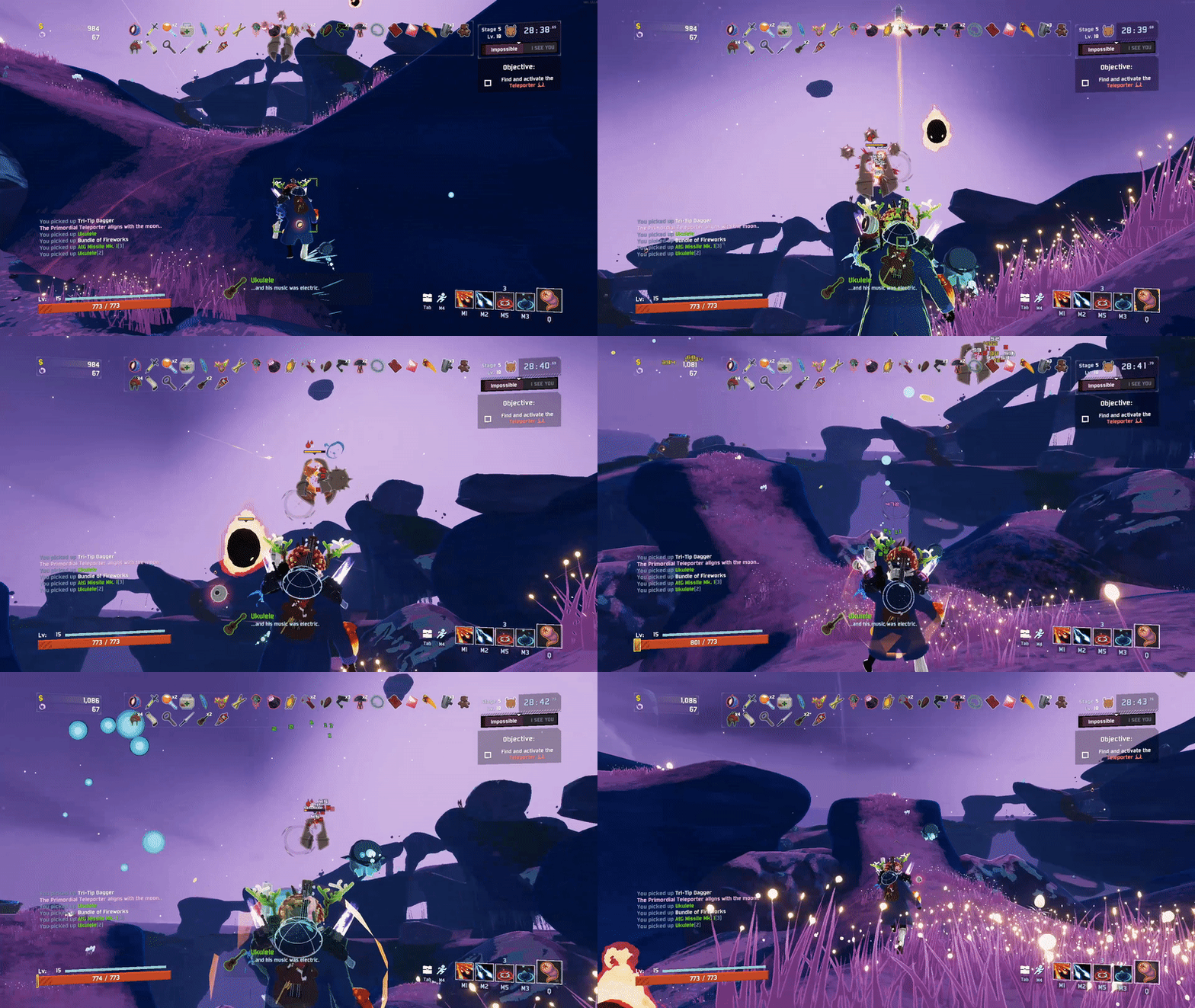
Captain from Risk of Rain 2 shoots a shotgun at a bell-like robot in a purple field. A missile fires at the contraption, causing lightning to arc from it to nearby floating fireball enemies.
Notice that the arc of lightning, itself a powerup, originates from the missile, another powerup. Powers in Risk of Rain can be nested, and synergize in this way.

To be clear, there are also advantages to making exceptions to ability interaction, even beyond the technical overhead. Design wise, lots of games have made interesting decision making out of a specific separation of abilities. One of the most common forms this takes is separate magic and physical ability types, wherein each set of abilities have their own advantages and disadvantages that don’t intersect, which leads to compelling strategizing on the part of the player. Sometimes having to choose between one advantage and another is a good thing, both for strategic depth and for fun. Another advantage to compartmentalizing game mechanics in this way is simplicity for the designer’s sake. Making sure everything in a very large pool of game mechanics mix and mingle in an organic way can be a daunting task.

The disadvantages, however, become apparent when abilities do not combine in ways that feels like they should. If a special item exist that causes your bullets to split on impact and hit multiple enemies, and there’s another item that causes your bullets to bounce between enemies, it stands to reason having both my allow your bullets to split as they bounce between targets. In The Binding of Isaac, this is the case! Although I’m sure you can imagine a fair few games with similar scenarios in which these items are mutually exclusive, and that cuts off a lot of interesting gameplay opportunity!
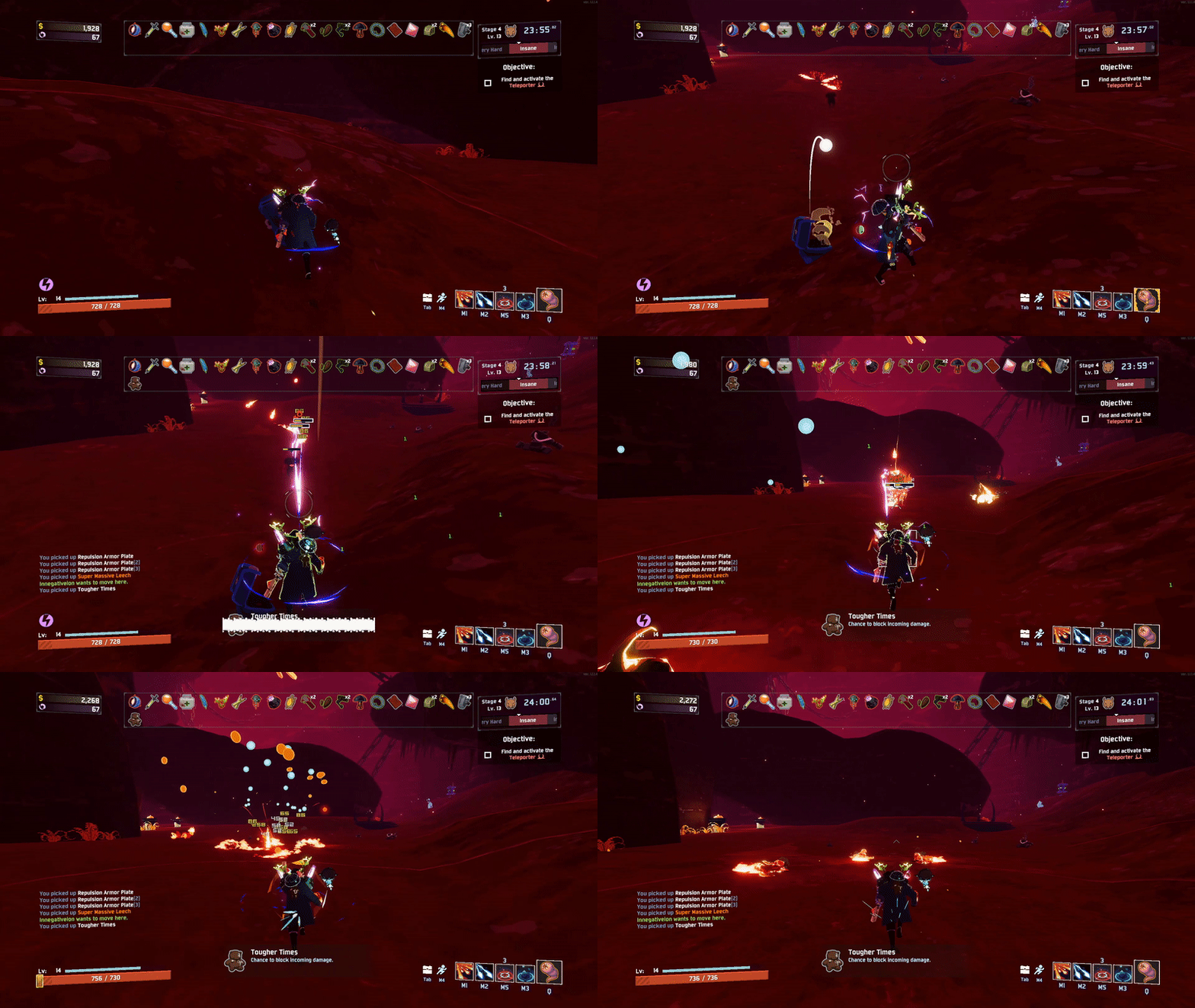
Captain from Risk of Rain 2 destroys monsters simply by walking near them in a hellish cavern. Lightning arcs from the Captain, and a missile fires from his back just after.
Passive damage is one of my favorite ways to play Risk of Rain 2

I love how in this clip, my passive lightning-emitting item is launching missiles and spraying lava at enemies. I have an item that causes me to do so when damaging enemies, and indeed that means all damage I deal, no matter the source. This comforting reliability, that any special bonus to attacks I pick up applies to all forms attack allows me to play the game in whatever way I want. If I prefer to use the shotgun, I can. If I want to focus on passive damage, I can. If orbital strikes are more my thing, that works too.
I do love those orbital strikes.

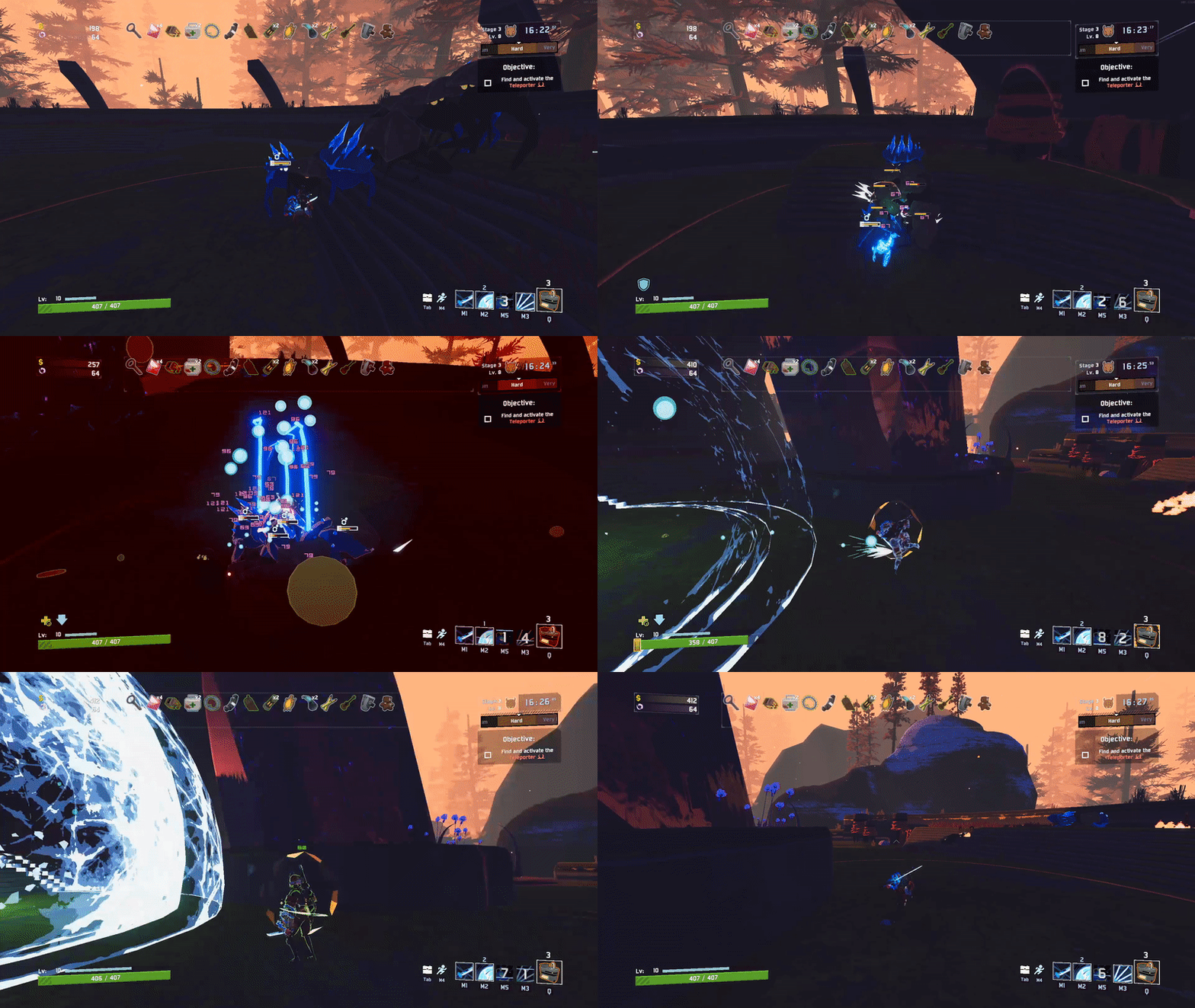
Another example of this from Risk of Rain 2 that I love are the mobility items. The Hopoo Feather allows your character to perform a double jump, or in other words jump a second time in midair before touching the ground. If get multiple Hopoo feathers… you just get more midair jumps. In fact, I was lucky enough on my last run to get three Hopoo feathers, meaning I can jump a total of four times in one. This insane level of mobility is something many games would shy away from, the fact that Risk of Rain 2 does not makes all of its systems feel a lot more organic and reactive to the player.
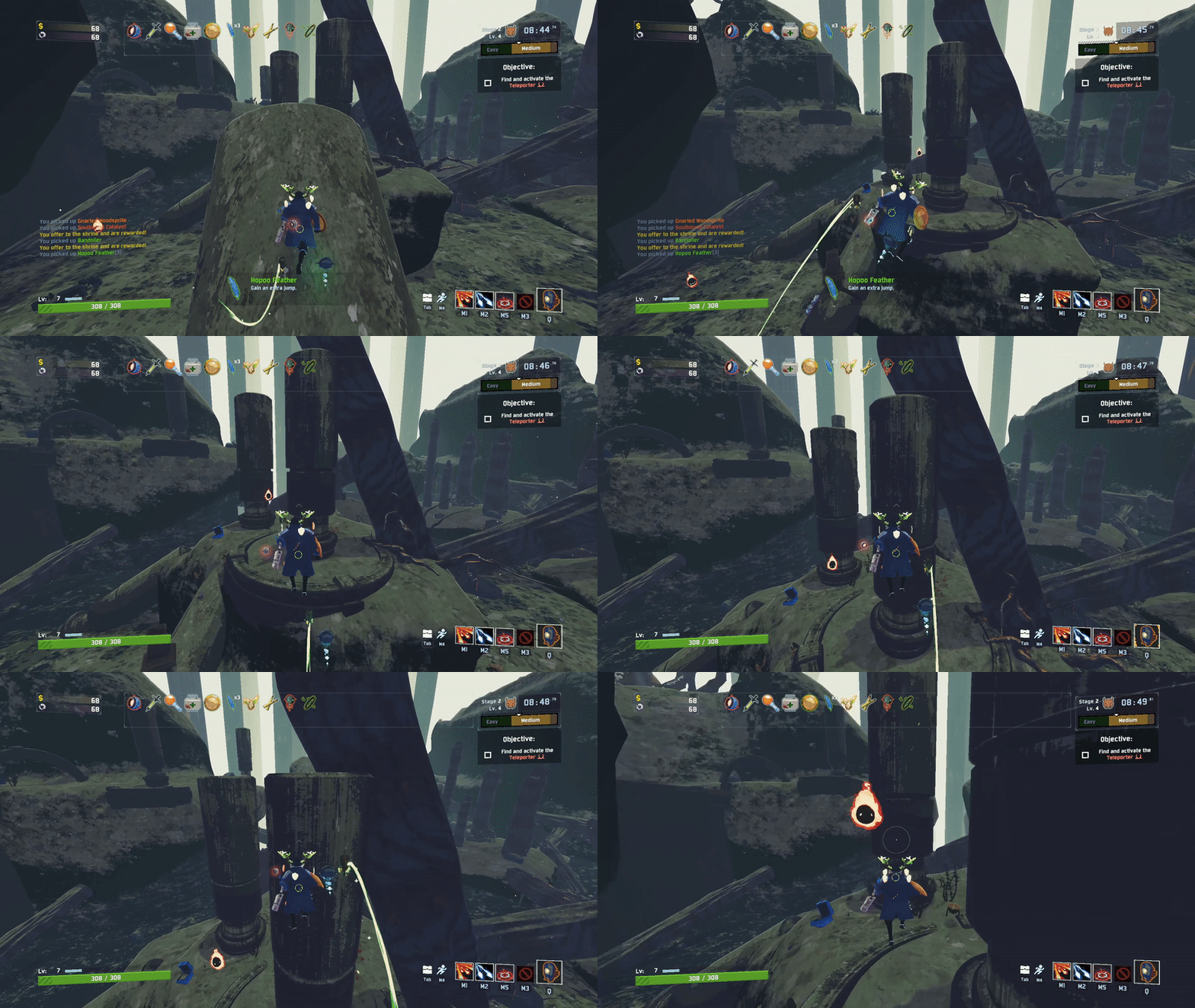
Captain from Risk of Rain 2 jumps three times in midair above a greenish canyon full of mossy old ruins.
Get enough items in this game, and you can basically fly.

Overall, I tend toward preferring this sort of game mechanic parity that allow unambiguous and universal interaction between mechanics. When every stacks with everything, I find it all much simpler to understand as a player. I also find it affords a lot more room for creativity in playstyle by allowing a multitude of interesting and often bizarre combinations. There’s a lot of design overhead necessary to make sure everything works together seamlessly and without jank, and not every gameplay system will be conducive to this level inter-connectivity of gameplay mechanics

WEAK, WITHOUT YOUR BAUBLES AND TRINKETS…
The Elites of Risk of Rain 2: Efficient Design and The Fundamentals of Real Time Combat

Risk of Rain 2 is a roguelike action game developed by Hopoo Games and published by Gearbox Publishing. It was released in early access for PC and consoles in 2019 before fully releasing on August 11, 2020. The gameplay premise of Risk of Rain 2 is as follows: You are a space-faring adventurer exploring a hostile alien world, overrun with monsters that will appear in order to kill you, in greater and greater numbers the more time you spend on the planet’s surface. You can collect various weapons and artifacts to empower yourself as you go to the face the ever greater challenges that intensify with time.

There’s a lot going on with Risk of Rain 2 design-wise that’s very interesting, but I’d like to focus on the game’s elites system, particularly how it was designed efficiently to accomplish a lot within a relatively manageable scope by utilizing the fundamentals of how an action combat system works, at the most basic level. I want to answer how those pieces fit together, how they create a compelling experience, and how they were utilized in this particular instance for Risk of Rain 2.

Man, there certainly is some… Game Design,, happening here. I mean just. Just look at it go.

The elite monsters in Risk of Rain 2 are randomly generated normal enemies, the likes of which you will see in droves, but with specific extra attributes along with slight changes in appearance to signify this. They are rarer than normal enemies, and thus their appearance is a bit of an event, something to take notice of. Their incidence becomes more frequent the longer a game session goes on. There are five main archetypes of elite monster. Blazing, Overloading, Glacial, Malachite, and Celestine. These archetypes can each be randomly applied to near any enemy that normally spawns. While an elite monster will have enhanced offensive and defensive capabilities, their unique traits also seem to be very deliberately chosen to complicate matters in a much more subtle way. Nearly all of them concern the player’s relative position to the elite enemy, the spatial relationship between them.

When you get down to it, there are some fundamental factors to be thinking about when developing a real-time combat system for a game. One of the ultimate goals in design should be encouraging the player to be making meaningful decisions, decisions that feel, to the player, as though their involvement is having an important and material impact on their experience in the game. Making complicated or fast-paced meaningful decisions is where challenge comes from. Having a variety of ways to answer such meaningful decisions is where player expression and play-styles come from. It keeps the player paying attention, keeps them engaged. One of the main avenues to accomplish this in a real-time combat system is to keep the player thinking about the main variables unique to real-time combat: space, time, and their relation thereof.

When fighting in real-time, the player’s position relative to any danger such as an enemy will be constantly shifting. Meanwhile the time investment of their own actions, compared to the time an enemy takes to execute an action, works in concert with these spacial relationships to determine essentially every outcome combat can have. No matter how complex the system, these two basic pillars of spacial relationship and timing are the building blocks of how it all works. A sword slash creates an area of threat for a set amount of time that damages an opponent if they intersect with it. If the opponent has a defensive action whose duration lines up with that sword slash they can protect themselves from harm. Attacks have limited reach, dodges have specific timing, and thus mastering the way these timings and positions relate to one another is how the player manages their own risk, and is essentially always the way to master this sort of combat system. For a designer, knowing your tools is how you can design for those meaningful decisions, to make the process of mastery a fun and engaging one. Space and Time are two of the most primary tools for designing real-time combat.

In the case of Risk of Rain 2‘s elites, nearly all of them create specific considerations of space for the player. The glacial elite is a good example. Upon death, they leave behind a conspicuous sphere of frosty air and ice particles that, after just a moment, burst with ice, freezing any players present within the sphere in place for a couple seconds, leaving them vulnerable. Perhaps you are already seeing how this situation works with the basic pillars of real-time combat to promote some active decision making on the part of the player. Normally enemies can be cut down with no heed in this game, but when a glacial appears, suddenly there are more decisions to be made. When should they be killed? How will I escape their ice bomb once they are? What are the consequences of how I approach this? Risk of Rain 2, as its name implies, is a high-stakes game where players can die easily, losing a lot of progress in the process. Something as simple as being frozen for a few seconds can mean death depending on the situation. Other times, it’s just an inconvenience. This variability keeps the player thinking and promotes that meaningful decision making. One player might play it safe and always destroy glacial elites from a distance. One player might consciously keep a movement option available to escape the ice bomb.

As the ice bomb forms, my priorities quickly change, I make the snap decision to get clear of it.

The blazing, malachite, and celestine elites work similarly, creating specific and dynamic areas of threat that players must play and plan around. They do different things – blazing monsters leave behind trails of fire as they move, malachite monsters can suppress the player’s healing, and celestine monsters hide the presence of other nearby monsters, making them totally invisible. However, the principle is the same. By creating these areas of threat at somewhat random intervals that all work in different ways, and can even overlap when several elites are on screen, the player has more to consider in their positioning and how they tackle the situation, upping the challenge, and promoting the player’s expression through gameplay. These periodic moments of higher-intensity decision making is one of Risk of Rain 2‘s most interesting aspects.

Blazing monsters and their trail of fire is of particular concern to melee-oriented player characters, as opposed to ranged-oriented ones. They help to differentiate and individualize the different roles and play styles the player can take up. It’s far more dangerous for a melee character to engage a group of blazing monsters, and this affects their decision making when they crop up.

Keeping my foe at sword’s length, hitting it only with the tip of the blade, is an effective strategy.

The overloading elites work with the other pillar of timing. Normally, any damage dealt to enemies is permanent and persistent, meaning the player can at any time retreat, recover their own health, and return to finish an enemy off. The top half of an overloading enemy’s health, however, will regenerate if left alone for too long, making finishing them off somewhat of a priority, another interesting decision to consider. Some of the other elites have elements of timing in their special qualities as well, such as the blazing elites dealing damage-over-time, and the malachites’ healing suppression.

Overloading enemies leave a lasting effect when they hit you, and will keep coming back if not dealt with fast.

Celestine monsters are rare but very disruptive. The principle of hidden vs nonhidden information in games is its own topic, but I hope it’s obvious how completely hiding all the visual behaviors of enemies shifts the dynamic of the player and enemies’ spacial relationship drastically. The player will definitely want to reconsider how they approach such a scenario. Each of these are just a wrinkle; a small, minor change to the dynamic between player and enemy that completely re-contextualizes how they approach the situation.

Not pictured: invisible enemies

The result is a player who is constantly on the look out for these wrinkles, these unexpected developments. The surprise and the added danger is invigorating, exciting, and novel. In a word- engaging. A lot can be done with a little, and using the combinative potential of these elite archetypes, there are theoretically unlimited novel scenarios the player might find themselves in. Elites could come from any angle. Above? Below? They could take the form of any enemy. Enemies that shoot from a distance, enemies that rush you down. These elite archetypes can even be applied to bosses, creating a ridiculously hectic and dangerous challenge for hard core players to overcome later in the game.

So these elite monsters accomplish a lot. Periodic moments of high intensity created by manipulating the player’s relationship with space and time lead to a more engaging interest curve. This is all accomplished with some pretty simple mechanics that can be overlaid onto essentially any monster in the game. Risk of Rain 2‘s already impressive menagerie of monsters that all behave in unique and interesting ways is essentially multiplied in number by five. Instead of the art, tech, and design overhead needed to create dozens of more monsters, a huge variety of gameplay situations were achieved by mixing and matching these archetypes, of which only a handful needed to be designed. It seems to me this was achieved through a thorough understanding of positioning and timing in real-time combat and how to manipulate those pillars to organically produce interesting and compelling situations. Understanding the basic building blocks of your gameplay systems, and how they affect player behavior is a really good way to begin understanding how to design efficiently and effectively.

..and so she left, heart still racing…