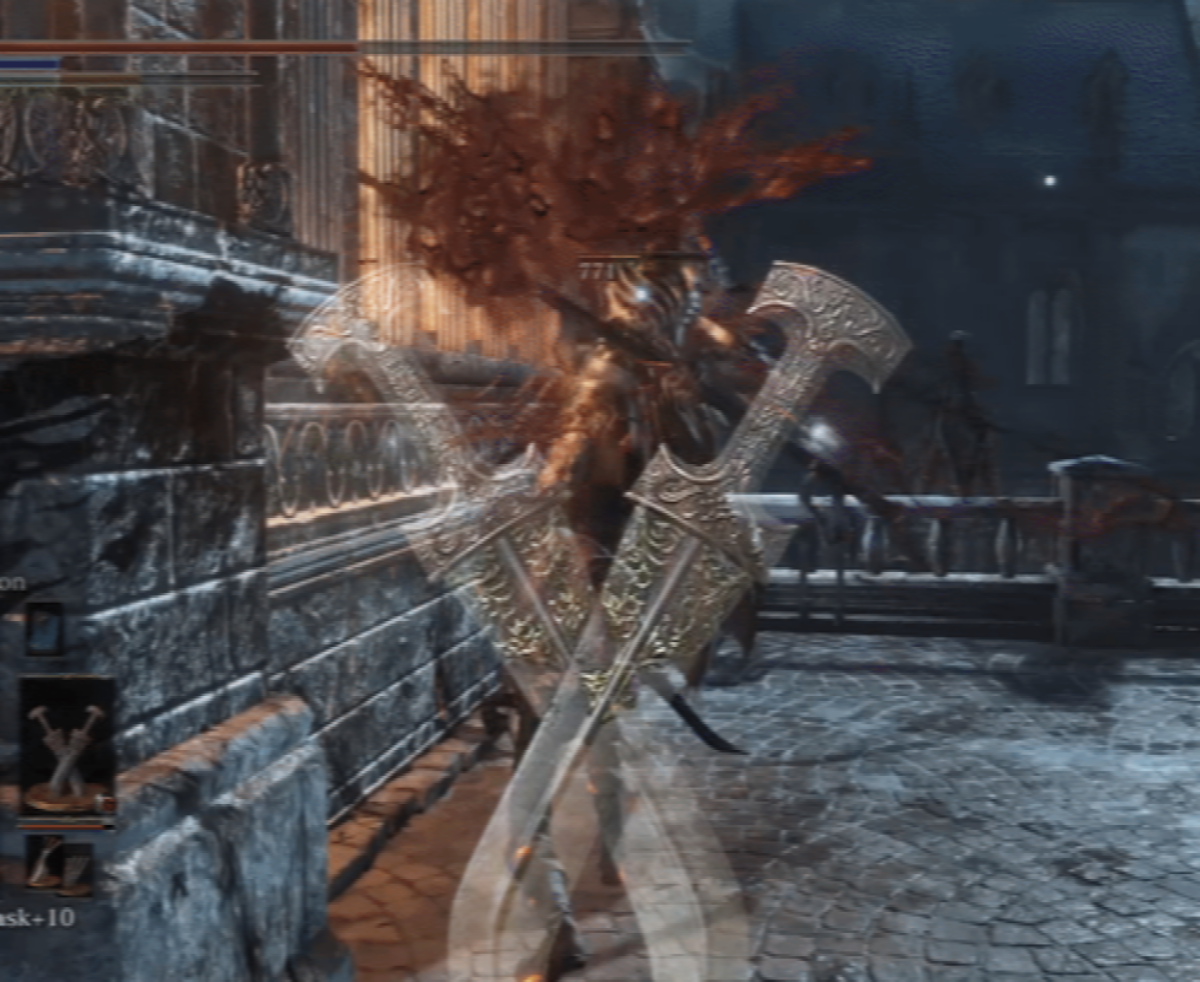
It is February 2022, my dudes, and you know what that means. Elden Ring is around the corner and there was absolutely no way I wasn’t going to just talk about Fromsoft games all month. I want to share an interesting experience I found while playing Dark Souls 3 as it pertains to a specific weapon found in the game, the brigand twindaggers. This is less a breakdown of this weapon’s moveset or particular attributes and more a little anecdote about how the daggers won me over once Dark Souls 3 had sold me on using status effects on my weapons, and the subsequent analysis that followed.
In RPGs with character customization I love to bring in my own stock of characters to populate the world, and there are some old standbys I revisit frequently, such as a thief who wields a pair of daggers, whom is often my player character in Fromsoft games. If at all possible, I will deck out my characters in their appropriate gear. I kind of like the RP side of RPG that way.
In Fromsoft’s Bloodborne, an action RPG that preceded Dark Souls 3, there is a weapon called the blades of mercy, a sword that can transform into a pair of daggers. I often refer to this weapon as a lawnmower – it absolutely shreds enemies to pieces with a massive amount of damage output. It scales incredibly well with Bloodborne‘s equivalent of the dexterity attribute, and its moveset is a flowing, seamless series of rapid strikes. Its the most satisfying to use pair of daggers in any of Fromsoft’s games to that point, so I had high hopes and expectations when it was revealed that Dark Souls 3 would have, as a new feature, paired weapons – weapons that come in a set, made specifically for dual wielding. I went over the game with a fine-toothed comb when I got it, clamoring to find a pair of daggers. Surely if paired weapons were a thing, I’d find dual wield knives.
And so I found them, and it quickly became difficult to contain my disappointment. Compared to Fromsoft’s previous outing with dual wielded daggers, these brigand twindaggers had a slower moveset with a much longer startup, and tremendously pathetic damage by comparison. They didn’t even scale that well with dexterity. I tried to like them, and tried to use them throughout my first play-through, I really did. In the end, there were just so many better speedy weapons, whose damage scaled so much better, that I could really not justify using the daggers any longer. I ended up embracing my inner edgelord and used a paired katana and wakizashi, two japanese style swords, as their damage output was insane compared to the daggers.
I had a blast on my first playthrough of Dark Souls 3, but I always regret not making a player build I was satisfied with involving the daggers. It didn’t feel true to my player character to not have him using knives, and I wished the knives were better. They didn’t really need to be though, after some experimentation, I would discover I just needed to change my approach. It started when I saw a player versus player showcase of the brigand twindaggers. The very skilled video author was destroying human opponents, seemingly with ease, utilizing the weapon I had condemned as largely useless. His secret? The daggers were enhanced with a bleeding effect. The Dark Souls series has always had weapon status effects, special attributes that can be applied to weapons to make them debilitate enemies in specific ways, applied if enemies are hit enough times rapidly. Primarily, this takes the form of bleed weapons and poison weapons.
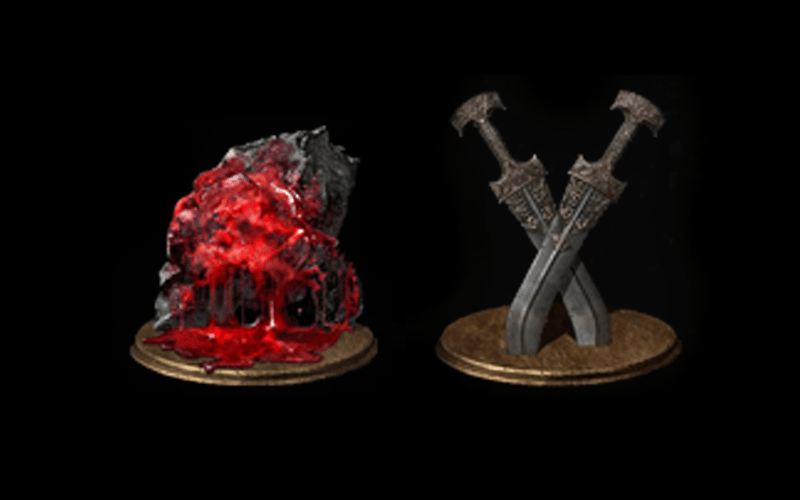
Enhancing a weapon in Dark Souls always modifies its base damage and damage scaling in some way. Status effect weapons on the whole tend to deal a lot less base damage as a tradeoff, and so I’d often shy away from them not just in Fromsoft games but in RPGs in general. It just felt like it was an unnecessary extra step, compared to simply dealing more damage directly. But I wanted those daggers to work, so I gave it a try. In Dark Souls bleed is a status effect that builds up by hitting your target repeatedly, and when it’s built up completely, the victim loses a large chunk of their health to a hemorrhage, all at once. It’s a rather cool mechanic that gives the player a smaller micro-goal to achieve while fighting enemies, that is, quickly building up bleed, in addition to just fighting. It makes for an interesting playstyle and when I tried it out, I found I was having a ton more fun than before. Even when modified, the daggers still deal similar damage to their sharpened variant, and yet now acted as a powerful poison or open wound delivery system.

Status effects in Dark Souls 3 just work. Astounding. But why is this such a pain point for me in so many other RPGs? What is it about Dark Souls 3 in particular that makes it work? I think I’ve identified a few factors that majorly contributed to my enjoyment of using bleed and poison variants of the brigand twindaggers. First off…
It Works
Yeah okay so this one is a little self explanatory. Players aren’t likely to use a game mechanic that doesn’t work, obviously. It goes deeper than that though, players aren’t likely to use a game mechanic that isn’t effective. Every enemy in the game could be vulnerable to bleed, but if it only did a piddly pathetic amount of damage nobody would care enough to go that route. Thankfully bleed is very effective, and can often kill enemies even faster than raw damage. It was also seen fit to make nearly every enemy in the game vulnerable to bleed, a very wise decision. Some are resistant to it, some weak to it, but only a handful are completely invulnerable to bleed. Was this point even worth mentioning? Yeah I think so. Each of these points is something I’ve seen failed in many many games before. There are tons of games where status effects are simply unreliable to the point of near-uselessness. What good is a poison effect if it takes a dozen tries before it actually sticks? What’s more, what is the point if the poison is super hard to apply, but it barely does anything as a result? By then I could have just beaten by opponent to death with a stick. Floundering around with weak status effects feels terrible, and they need to be at least as viable as the more straightforward option.
It Works On Bosses
I cannot stress this one enough. Nothing will make me drop a combat mechanic which requires a time investment more definitively than seeing it is ineffective against boss encounters. Often in combat centric games bosses are the height of the combat system, pushing it to its limit where the most fun to be had is, or even the central axis about which the rest of the gameplay turns. If a combat mechanic breaks down in a boss fight, as a player I often feel as though it’s not worth my time. Status effects work on bosses in Dark Souls 3, generally, or at least frequently enough that I never find myself despairing at the futility of using them.
It is so strange to me that so many RPGs see fit to make bosses immune to status effects. On the one hand I can see the perspective – status effects tend to be very powerful in certain contexts, especially when they are not direct damage dealers, like disables or other utility effects, and one does not want to trivialize combat encounters. And yet. If one has been relying on a certain game mechanic, they begin to take ownership of it as a playstyle. They feel clever or powerful for utilizing it. Taking it away at the most crucial encounter feels awful. There are ways to design around the brute force method of just making bosses immune. Perhaps bosses are merely resistant, and incur a diminished form of status effects applied to them. Perhaps bosses have the ability to remove their own status effects under the right circumstances, or perhaps they last less time. Perhaps status effects are balanced as such to simply be generally useful, but not overly powerful against bosses. I think it’s rarely ever wrong to let players think around a problem, and removing a strategic tool such as status effects from their arsenal, when they can be employed elsewhere feels like player punishment.
In Dark Souls 3, applying a bleed effect deals a flat chunk of damage to enemies, usually enough to kill lesser foes. On bosses, it’s merely a nice step toward their defeat, but not an utter showstopper by any stretch. For bosses that may be felled too quickly if they are bled out repeatedly, it was decided they would be resistant to bleed effects. You can still get that extra damage, and it’s not that hard to do, it just takes a little longer, and the balance is kept that way. There are some enemies and bosses which are immune to bleeding, but not nearly enough to make me question the status effect’s efficacy, and what’s more it contributes to the overall fiction of the game, which has to do with my next point.
Strong Feedback
Dark Souls 3 has very strong audio-visual feedback for when you’re wailing on an enemy. Blood shoots out in exaggerated sprays along with a crunchy *squelch*ing sound with each strike of your weapon. Against armor, you can hear the rattling clang of steel on steel. This is obviously good design from a gamefeel standpoint, but it also provides the very useful advantage of illustrating what can and cannot be inflicted with a status effect. Hitting stuff that can be bled tends to use that exaggerated blood graphic I mentioned, but things that are resistant or immune will show less blood when struck, or none at all.
I’ve mentioned that some enemies are immune to status effects and how that enhances the fiction of Dark Souls 3. What I mean by that is, it is effectively intuitive what enemies can and cannot bleed. Bulbous fleshy beasts, dripping and shambling undead, living creatures. Things that obviously have blood, are all vulnerable to the bleed effect. Things like enchanted empty suits of armor, a giant tree, skeletons. These things obviously do not have blood, and thus do not bleed. It seems like a simple trick not to miss, but yet again I’ve seen this very concept done poorly too often. Consistency is key. The player shouldn’t have to guess, or at least not guess blindly whether or not their combat tools will even work. Obviously you can’t bleed a skeleton, but obviously you can bleed a giant rat. Design the game so players can trust their own eyes and ears, and the play experience will feel much more seamless. Immunities and resistances should have logical reasoning grounded in the rules of the real world, even if the game takes place in a fantastic one, so your player has a hint of familiarity with which they can decipher the rules of your game.

Conclusion
So I guess my takeaways from this experience are twofold: certain weapons can be satisfying to use in how they fulfill certain gameplay niches. The brigand twindaggers are an excellent status effect tool in how they apply effects quickly through rapid hits. My other takeaway is that a lot of games could do status effects in a much more satisfying way that makes them feel powerful and useful, something a lot of the designs I’ve seen are often too bashful about. They can be a viable alternative gameplay style all their own, you just need to put in the legwork to make sure this gameplay style feels strong and effective. Locking it out of boss fights makes it feel like a lesser, illegitimate gameplay style, an afterthought. Players should be able to discern the applicability of status effects with audio and visuals alone, without having to consult a wiki. Overall, I think status effects can be underappreciated in games mostly because they so often could be implemented better. When games get it right, I think it’s worth giving a closer look to see exactly what went right. Status effects in Dark Souls 3 were fun enough to use, and strong enough to completely reverse my opinion of an entire weapon’s implementation.
Such weapons inflict lacerating damage. Most effective with sharp or spiked weapons…
 Parry Everything