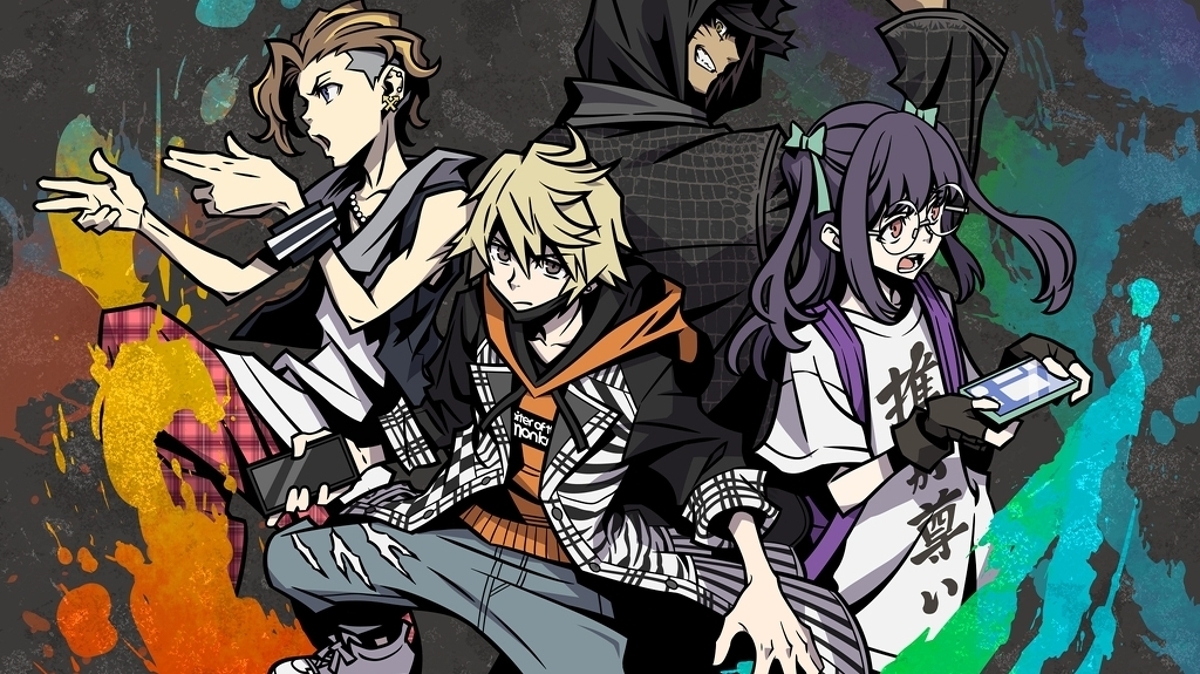
The World Ends With You is a distinct and memorable little action RPG originally for the Nintendo DS. It is remembered and well-loved for an engaging story about coming out of your shell and expanding your horizons by connecting with people. The game also sported an incredibly unique action combat system utilizing the DS’s hardware features – one of the first touch screens used for video games, and two concurrent display screens. In The World Ends With You, combat is conducted through a loadout of unique psyches, the player’s attack moves, that each are used via a respective touch-based gesture to fight enemies. This all occurs on the DS’s bottom screen. At the same time, a second character is controlled with buttons to defend against additional enemies on the DS’s top screen. These features allowed for some standout gameplay mechanics that helped The World Ends With You achieve its cult status, but how has this gameplay evolved as its been ported to other, more traditional interfaces?

The World Ends With You has been ported to a number of systems since its original release, including the Nintendo Switch and several mobile devices. Given how entwined the original game is with its hardware, particularly in utilizing the feature of action occurring simultaneously on two screens, it seemed a given that the game’s mechanics would have to be re-imagined for these other systems. The route these ports took accommodating the change in hardware was a simplification of focus. In lacking a second screen, the Nintendo Switch version of the game changed the player’s partner character, normally an independent actor on the DS’s top screen, into another psyche in the player’s arsenal, controlled similarly by touch gesture. Using this partner psyche in conjunction with the normal psyches would confer combat bonuses. This was a fairly elegant way to make the game functional on devices that lacked the DS’s unique features, and the game remains fun, if somewhat more cumbersome to control without a touch screen stylus. However, these ported versions of the game seem to lack something experiential and essential when compared to the original. In cutting the second screen’s mechanics entirely, something fundamental was lost.
In enters the bluntly titled NEO: The World Ends With You, a new direct sequel to the original game for the Nintendo Switch and Playstation 4, arriving some fourteen years later. The PS4, notably, lacks a typical touch screen entirely. One may note further, that NEO lacks gesture control, entirely. The design focus of this game has, perhaps surprisingly, shifted entirely away from replicating the methods of the DS touch controls. Although The World Ends With You‘s gesture controls were incredibly intuitive and satisfying on the DS, they weren’t entirely one-of-a-kind. Other games like WarioWare: Touched! accomplished similar things with their controls, albeit in different genres. NEO shifts focus to what is more unique about its predecessor, and seeks to replicate not the control scheme, but the core experience, what is happening in the mind of the player, something more recent ports of The World Ends With You struggled to do.

The World Ends With You for the DS had some best-in-class gesture controls for an action game on that system, but this wasn’t the only gameplay mechanic that set it apart. During regular gameplay, the player’s main character, Neku, acted on the bottom screen, where he’d have to attack enemies while dodging around them according to the player’s touch gestures. Simultaneously, on the top screen, Neku’s partner would be stationary, and slowly assaulted by enemies. The player would have to control Neku with one hand, while commanding the partner character to defend themselves via button inputs with the other. Neku and his partner share a health bar, so if either screen was not given due attention, both would suffer. This created an absolutely mesmerizing experience of splitting attention between two active scenes, triaging and reacting to both. It was a different and challenging sort of mindset to get into, this constant multitasking, demanding players adjust to a new way of thinking. In fairness, it could even be restrictive to some players, a shortcoming that is assuaged somewhat by the versatile difficulty options present in the game. Once the player got use to this, however, it could create a state of flow and rhythm where successfully managing two characters was almost hypnotically engaging.
NEO once again features multiple simultaneously controlled player characters that share a health bar, this time up to four, all on one screen, in a 3D space. As stated, gesture control is done away with entirely in favor of assigning each psyche move to a button input. Each psyche is assigned to one of up to four characters in the player’s party. The twist is, each party member answers the player’s input independently of each other, but are each still vulnerable to counterattack at all times. As before, all psyches operate with different game mechanics at different time frames, but they can be layered together, offset from one another, done in sequence, executed in any way the player is able to push the associated buttons.
For example, one character might loose a volley of energy bullets when the player repeatedly taps a face button, while another character charges up a big rock to throw when the player holds down a shoulder button. In this scenario, the rock will do extra damage if timed to hit just as the first character’s bullet salvo is finished, using Neo‘s combo system, which encourages finishing multiple psyche moves on the same enemy in quick, timed succession. Bonus damage and and the potential to unleash a devastating ultimate move is rewarded for doing so consistently. In this way, the player is rewarded for roleplaying their party of characters as working together, and supporting one another, just like the original DS title, all while replicating that challenging and engaging split-attention experience through its design alone.
NEO even further addresses the barrier of entry for new players by condensing all the action to one screen. A single field of view is intuitive- it replicates how we view spaces in real life. Two screens, while novel, also create two separate cognitive spaces in our minds. No matter how close together they are, switching between two screens is harder than simply utilizing your peripheral vision on a single screen, due to that cognitive distance the break between screens creates. There is something to be said for that novelty of control across several distinct cognitive spaces, but it is a trade off that fits naturally for game consoles that simply don’t support multiple screens.
The player characters once again share a health bar, but unlike in the previous title, now all exist in the same game space. Each party member’s movement and dodge mechanics become directly controlled by the player when their psyche was the last one to be used. Each time a new psyche is used, control is shifted to a new character. The player must shift their control around like this. To keep things from getting disorienting, the 3D camera is directed by the game, rather than the player, and party members quickly run into the player’s field of view on their own as they are queued up to be controlled, creating a smooth transition.
Enemies will still react and attack in real-time, and all party members are vulnerable, thus the player has to be splitting their attention to multitask and triage the various goings on in the battlefield, all while keeping up their rhythmic combo of attacks. If one party member is pinned to the ground, the player might respond by sending another to help them out. All this together emulates the original game’s sense of almost melodic flow within gameplay, that makes the player feel smart and skillful to maintain. A complete re-imagining of gameplay mechanics was able to recapture The World Ends With You‘s most distinctive feature, by focusing on the core experience. Although the gameplay is structured very differently in many ways, the experience one feels while playing the new game is incredibly reminiscent of the original.

This also serves to reinforce some of the themes of both games – expanding your horizons by reaching out and connecting with other people. As Neku must learn in the original game to open himself to others, the player learns how to coordinate Neku and his partners’ distinct gameplay styles together, to create a greater whole. NEO‘s combo system accomplishes the same result, rewarding the player for being cognizant of the timing, effects, and spacing of each player character independently, and how they work together. They must consider a greater group, and not just an individualized self. The result on screen is an amazingly coordinated show of teamwork, reinforcing the player’s small band of party members as a real team working together toward the same goal. It’s a narrative in its own right, told entirely through the gameplay mechanics, reinforcing the explicitly written and acted narrative told between sections of gameplay.

NEO‘s renewed shift in focus re-frames what was once a hardware problem into a design problem, while playing to the strengths of the platforms the game was developed for. What’s more, the new angle by which this design problem is tackled plays to the original strengths of The World Ends With You, recreating the experience that makes it unique, not just the control scheme. It does this to draw the player in to this stylish and exciting world, while also creating a consistency of narrative between gameplay and non-gameplay sections. Re-framing issues like this in terms of design, playing to a game’s strengths and unique experiential identity is something that makes games truly memorable. NEO: The World Ends With You knows its strengths, knows the experience it’s aiming to create, and executes on that in a manner best suited to its platform, choosing not to adhere rigidly to old solutions and patterns. As it turns out, entirely changing its approach and expanding its horizons may have been the best way to become a true successor to The World Ends With You.
Expand your world…



 Parry Everything