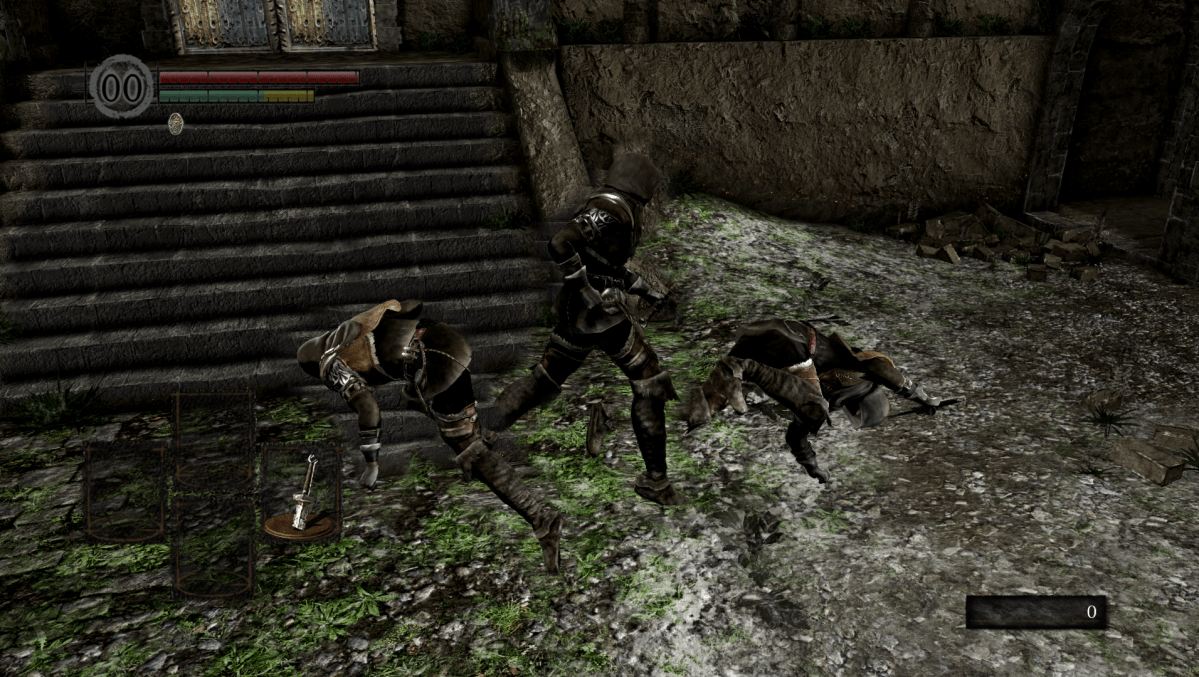
Alright, let’s get down to business with something simple – the dodge roll. One of my favorite examples of the form, to be exact, the dodge roll found in Dark Souls 1. It’s a common gameplay mechanic, particularly in action titles, that’s well loved for the simplicity of what it accomplishes for the player and for the designer. What the dodge roll is, in the simplest terms, is a snappy maneuver your player character in Dark Souls can do at almost any time to quickly traverse a short distance in a short time, briefly becoming invincible during the maneuver to, well, dodge things. It feels great to do, it’s useful, and helps the player feel agency over the flow of combat. How does it accomplish this?
One of the main strengths that this particular dodge roll has going for it is the quickness and responsiveness of the action. You’ll notice when playing Dark Souls that the dodge roll begins almost immediately when the game detects a dodge roll input- when the dodge button is released quickly from a press, in this case. There is little to no anticipation in the dodging animation, and the dodge maneuver’s invincibility frames, or iframes, the frames of character animation during which a character cannot take damage, start almost immediately. The dodge roll is used in combat as a reaction to danger- the player will see a monster wind up their attack, and dodge in response. The player is already entirely focused on their own, real-life response time, the response time of their digital avatar to input needs to be negligible, lest the player lose that agency over gameplay.

This allows the player to react to dangers in real-time without having to make unnecessary extra considerations for their character’s limitations. If you dodge, you dodge, no preparation necessary. This is important to establishing a sort of player-avatar harmony that helps shore up the illusion of play, and immerse the player in their role (or maybe in their roll). The player *is* the knight on screen, so they can dodge whenever they want, as quickly as they can react. This was so important to Dark Souls‘ design that even the heaviest, slowest, clunkiest version of the dodge roll, the one used for characters over-encumbered by heavy armor, executes almost immediately on input. Like the other versions of the dodge, the vulnerable frames of animation are almost entirely back-loaded on the action. It’s the recovery time where the player places themselves at risk. If they reacted poorly, it’s during that recovery time when they will take damage.

The iframe window is extremely brief, and so demands timing and precision of the player, further reinforcing the need to watch one’s opponent, to know exactly when and how to dodge. The dodge roll also has a traversal component, moving the player character in a burst of speed much greater than their typical walk. Any combat action will normally be some sort of an investment or risk. Once the action is called on, it will run through a preset amount of time where the player has little to no control. Using a dodge roll poorly can potentially place the player in an unwanted position, encouraging an awareness of one’s environment. Having a reliable tool like this with the general use of ‘make me momentarily invincible’ puts the onus of taking damage and therefore failure almost entirely on the player. If you can read an enemy’s attacks, you can nullify them completely, just with this one simple tool. This powerful tool’s design enables Dark Souls‘ signature experience of overcoming tremendous hardship through the player’s faculties alone, using an action that maps very closely to the player’s own powers of observation and reaction. It’s that closeness that interests me most about this dodge roll.
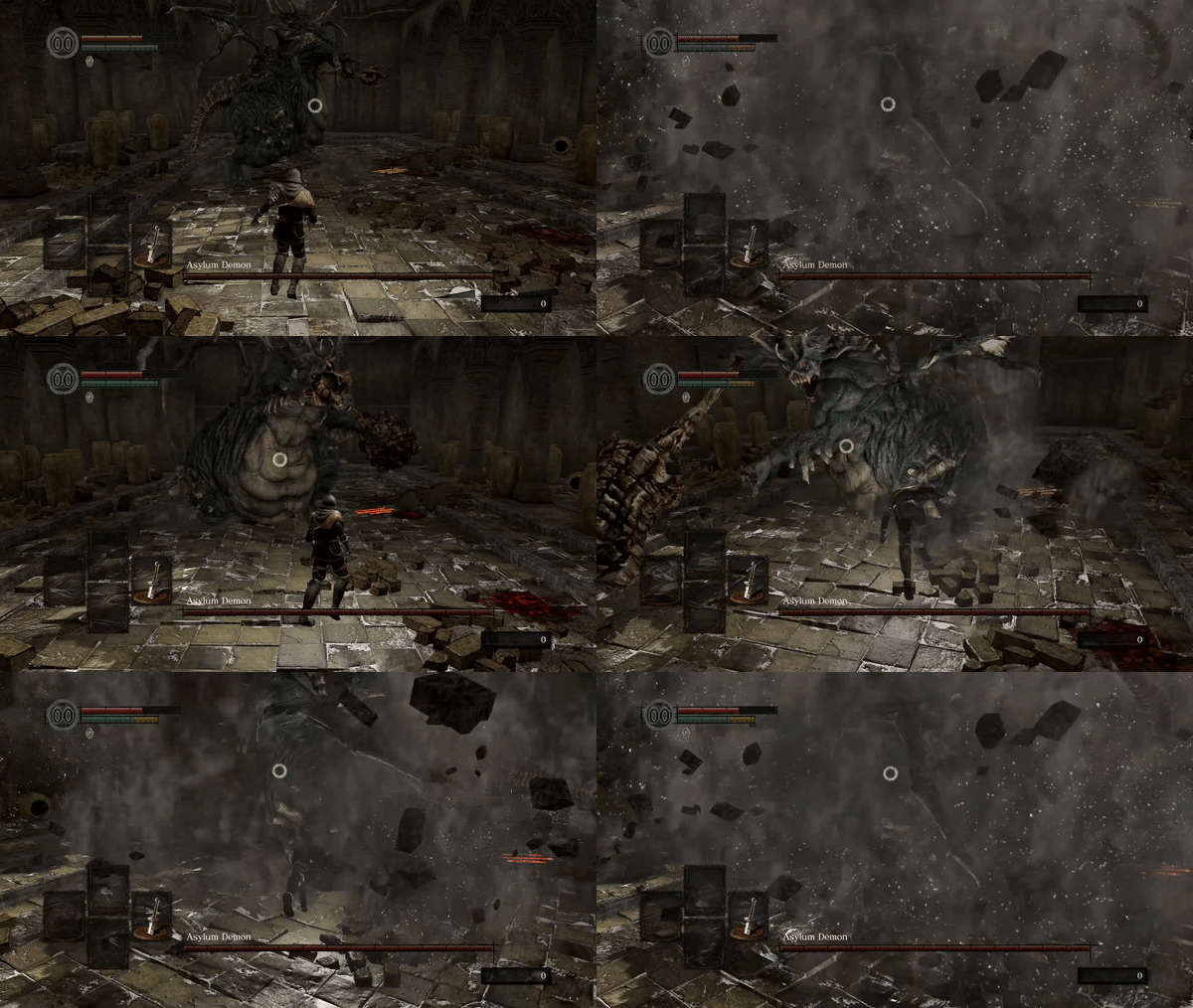
When examining what makes combat actions especially compelling for me, I’ve come upon a concept I call ‘immediacy’. In this context immediacy is the concept of minimizing the friction between the player and the interface, or in other words their in-game avatar. When I push a button on a controller, I expect my character to have already begun the wind up of their action. In my mind, we are acting as one entity, and the action we’re about to take began when the signal to move my finger and push a button first entered my brain. By the time that signal has traveled to my finger, through the controller, across the airwaves, into my game console, through my TV, and into my eyes, there has been an unavoidable bit of latency. There’s a natural delay there, between how I expect the action to play out, and how fast the game can actually render it. That latency has to be accounted for, in order for the action to feel responsive. This may seem obvious, but design decisions such as the time-frame of combat action, the number of frames during which it is active, its visual appearance, all have to be made deliberately. Even something as small as a few extra frames of animation can have drastic gameplay implications.
In fact, it’d be better if by the time I push the button, my character is already partially done with their action, eliminating that bit of unnatural latency that doesn’t exist in the real world entirely. This is why character actions and especially dodges, which act as one of the player’s main avenues of agency, generally crunch down the anticipation time those actions would have in reality. When I go to throw a punch, I have to pull my fist back to wind up, but by the time I push a button in a video game, the wind up has already happened in my mind. The fist should already be thrown, the dodge already rolled as it were. Or at least, it should be perceived that way.
Using animation tricks like single animation frames of anticipation can help in this regard. The player character in Dark Souls practically flops into their dodge roll with almost no transition. If there ever is anticipation for these sorts of actions, they tend to be extremely brief. If you break the sense of immediacy, you quickly create distance between player and avatar, and the challenge of player against world you designed for suddenly becomes player against player character, a frustrating wrestling match between what the player wants to do and what the system is capable of. The system needs to be able to respond to the player’s proprioception, or sense of body position – the fist should already be thrown by the time the button is pressed.
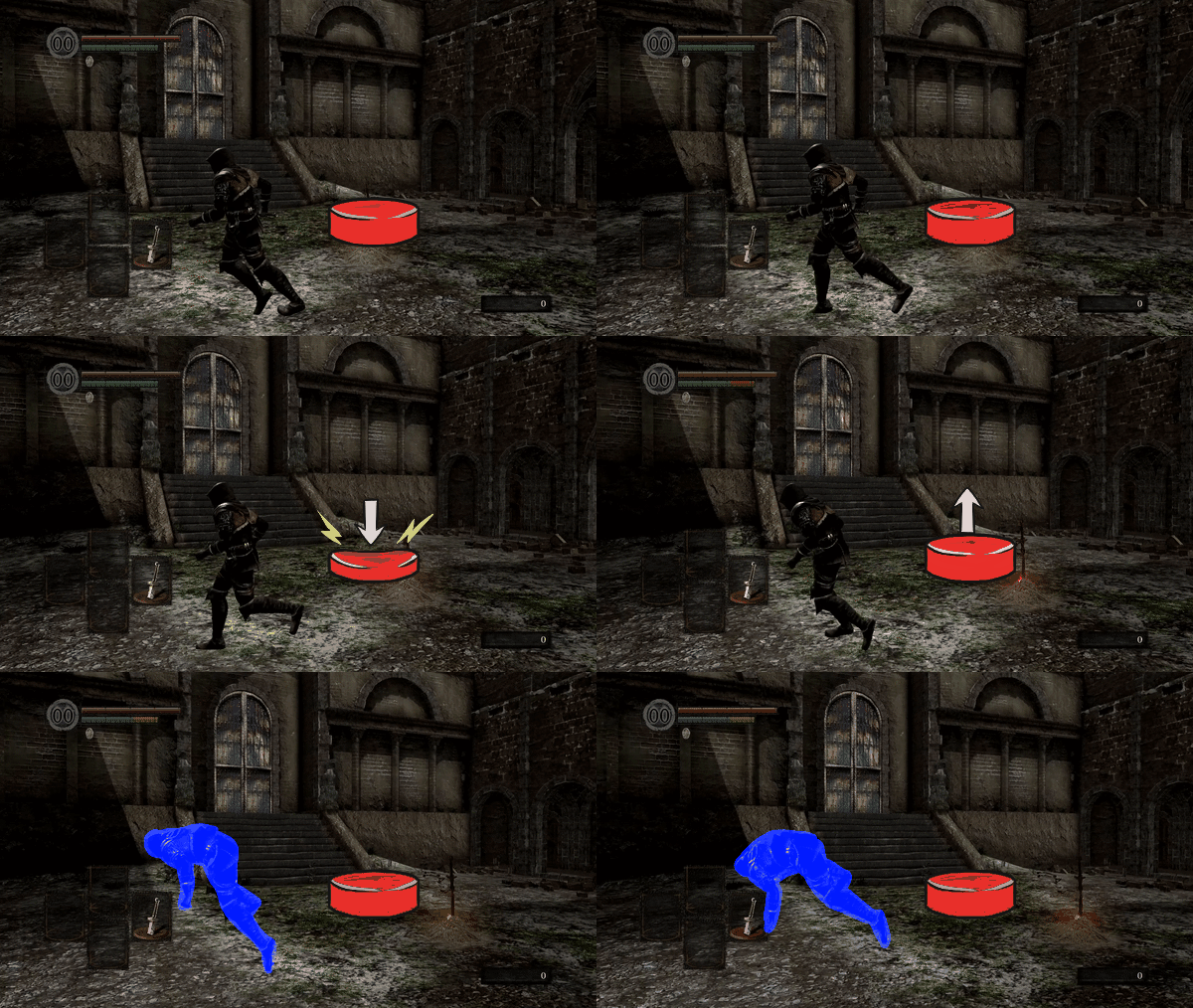
The Dark Souls dodge does extremely well on this front, but it’s not perfect. The dodge roll specifically comes out when its associated button is released, not when it is compressed. This is not normally an issue, as most players will be pressing and releasing their action buttons in quick presses. Dark Souls is a tense game, however. The squeezing and gripping of controllers is common, and holding the dodge button by mistake, or not releasing your compression before an attack hits you can feel unfair. Again, it’s that proprioception, the sense of body. Even if in this case it’s my virtual body. When I push the button down, I feel as though I have already initiated a dodge, and so it feels wrong if the game does not respond in kind. The reason for this is that Dark Souls has its dodge and sprint inputs on the same button. Holding the button initiates a sprint, releasing it quickly after pressing initiates a dodge. One solution to this would be putting the sprint action on a different button, which later Dark Souls entries would implement as an option. Sekiro implements another solution, where the dodge action transitions directly and seamlessly into the sprint action, if the button is still held.
Despite these issues the first Dark Souls had a laser focus on what it wanted out of its dodging action – fast, responsive, versatile. These qualities create a sense of immediacy between the player’s inputs and the character’s actions that breaks down the barrier between the two. Actions like these are at their best when it feels less like the button pushing and the dodge-rolling is separate, but rather that they are synonymous. Ideally, they would feel the same, as if there is no perceptible distance between the two. This frees the player’s attention up to focus on the game world and their own relation to it, rather than their relation to the hardware. Thinking in terms of immediacy helps for making combat more satisfying and immersive in a really straightforward way.

Perhaps I could try some rolling…
 Parry Everything
2 thoughts on “The Dark Souls Dodge Roll: Immediacy in Player Action”