It’s spooky season, and I’m gonna talk about one my favorite spooky games, Hollow Knight (Science fact: a game doesn’t have to be scary, to be spooky). I mean, hey, it’s got ghosts and zombies and curses and lots of tombstones, so it counts. Hollow Knight is a 2017 side-scrolling 2D action game. It has other genres too, but I won’t be getting into that, an interesting topic in itself. Mainly I want to look at its very elegant combat system, specifically the way it handles health and healing. In Hollow Knight you play as The Knight, a mysterious little guy wandering a vast, sprawling underground kingdom of bugs once teeming with life, now racked with curses, beasts, and sorrow. Everybody, you included, in this game is a bug, if that wasn’t clear. Lot’s of danger out there for a bug. You’ll get into plenty of scrapes, and will need a reliable way to patch yourself up after a fight. Thankfully, you obtain the ability focus pretty early on, which allows The Knight to restore health by expending a resource called SOUL.
So what design purpose does a healing spell like this serve in a game? If you think about it, the presence of a heal really just artificially extends the number of mistakes a player can make before triggering a fail state. Why not just extend their health pool? What is the advantage of a healing spell? There are a number of reasons you can put something like this in your game. Healing hides information from the player, in particular how long they can survive encounters, making their success and failure less certain. A healing system can act as a safety net against frequent failure states for less skilled players to lean on. Hollow Knight accomplishes these things with its healing system, as its an exploration-based game that requires long ventures between check points. As to why Hollow Knight uses a certain specific implementation of healing in particular, I think it serves three primary purposes.
- Creating tension
- Teaching situational awareness
- Allowing meaningful decision-making on the part of the player
I will elaborate, but.. Okay first, it’s time for some math. To heal, The Knight need only stand still and concentrate for precisely 1.141 seconds. This will restore one unit of health, which usually translates to one hit of damage from an enemy. For each subsequent 0.891 seconds The Knight holds focus uninterrupted, another unit of health will be restored. This costs the resource SOUL, like I said, and this resource is accrued whenever The Knight deals damage with a melee attack to an enemy. SOUL has a maximum value of 99, and it costs 33 to restore each unit of health. 11 SOUL is restored to The Knight each time an enemy is struck by the melee attack. This means, from a full SOUL meter, the player can restore 3 hits of damage to their health. For each additional unit of healing, they’ll need to successfully strike the enemy 3 times. In other words, to succeed in Hollow Knight you’ll need to be hitting an enemy while receiving damage at a ratio of 3 to 1, while successfully casting your focus spell without being interrupted, of course.

Those time figures, 1.141 and 0.891 seconds, seem awfully precise, and that’s probably because they are. My thinking is that these figures were arrived at after extensive playtesting against Hollow Knight‘s wide variety of enemies and bosses. Because The Knight needs to stand absolutely still during that roughly one second of time, it was pretty essential that it’s possible to safely do so during boss fights without being interrupted, otherwise the healing ability would be completely useless. However, if it was always safe to do so, or if the safe windows of time in which the healing could be done were always obvious or easy to react to, the game’s challenges and combat gameplay could be in danger of being trivialized. That being the case, I don’t doubt that a lot of consideration was put into these figures, as they carry the heavy burden of creating tension during combat encounters. A lot of that tension happens in the final moments of the focus healing animation. You may find yourself waiting with bated breath as that one second of focus seems to stretch out to years, an angry bloodthirsty beetle bearing down on you.
Hollow Knight‘s combat can be broken down into small-scale, medium-scale, and large-scale encounters. Large-scale encounters are things like boss battles and long gauntlets of enemies. Small-scale encounters are the moments of fighting against smaller enemies found wandering around the world. Medium-scale encounters can be found somewhere in the middle, being rooms full of those small-scale encounters like enemies, or tougher enemies strategically placed to challenge the player. The healing system in Hollow Knight needs to be versatile and universal enough to function in any of these situations. During and after fights against small enemies, the healing focus spell can usually be used pretty safely, without interference, as enemies can be easily retreated from. Resources for healing are provided in return for successfully striking enemies, so as long as the player is engaging with the combat to a certain minimum level of success, these small encounters will provide some sense of danger without bringing the player closer to failure. On a medium-scale, the healing system being so tied to successful combat helps keep an encounter’s obstacles threatening. It is possible to bypass much of Hollow Knight‘s dangers without fighting, but if a slip up is made, no additional resources can be obtained without engaging an enemy. This ensures the player is consistently engaging with the game’s mechanics, and learning to fight as they explore. Ironically, although the healing system exists to keep the player safe, the way it works, hinging on a delicate balance of risk and reward, promotes engaging with the game in such a way that tension is built, and that there remains an ever-present sense of danger.
Large-scale encounters are where things get really interesting. If the player can heal indefinitely, then how do you build tension in a boss encounter, when the player should theoretically be in the most danger? This is where the ratio of how many hits a player needs to land to restore health, how quickly a heal can be executed, and how frequently a boss attacks the player had to be tightly balanced. As the game goes on bosses will provide smaller and smaller windows of time for the player to heal, but there always must be some possibility of healing or else the system would feel broken. At the same time, by requiring those three all-important melee attacks of the player before allowing them to heal, engaging with the boss’s combat mechanics is essentially enforced, with that aforementioned ratio of hitting-to-getting-hit acting as a sort of design guide for how boss fights should be structured. It gives the designers a pretty good barometer for how to tune the difficulty of Hollow Knight‘s fights. ‘At any given point in the game, the player should be averaging 3 hits against the boss for every 1 hit they take, if they are to defeat it’.
This all of course assumes the player can successfully heal against frantically aggressive bugs (the creepy crawly kind, not the game-breaking kind) that want to kill them. Knowing when to attack and when to heal is one of Hollow Knight‘s most essential skills, and it ties in with that relative spacial awareness I’ve mentioned in other topics. The focus spell teaches the player to keep their eyes open for the various tells and telegraphs of their opponent, to be aware of their Knight’s relative position to the enemy, and how to exploit gaps in the enemy’s activity. Utilizing and capitalizing on situational awareness is one of the best ways to make a player can feel powerful or skilled, as though they have some secret knowledge that puts them above the opposition. Gently nudging the player to get good at sneaking in healing spells in-between the boss’s attacks reinforces that feeling. Making meaningful decisions is also how a player stays interested and invested in a game, it’s how to make their agency in the play space feel impactful. Deciding when to start up a heal in Hollow Knight is a meaningful decision, but the game pushes this idea further.
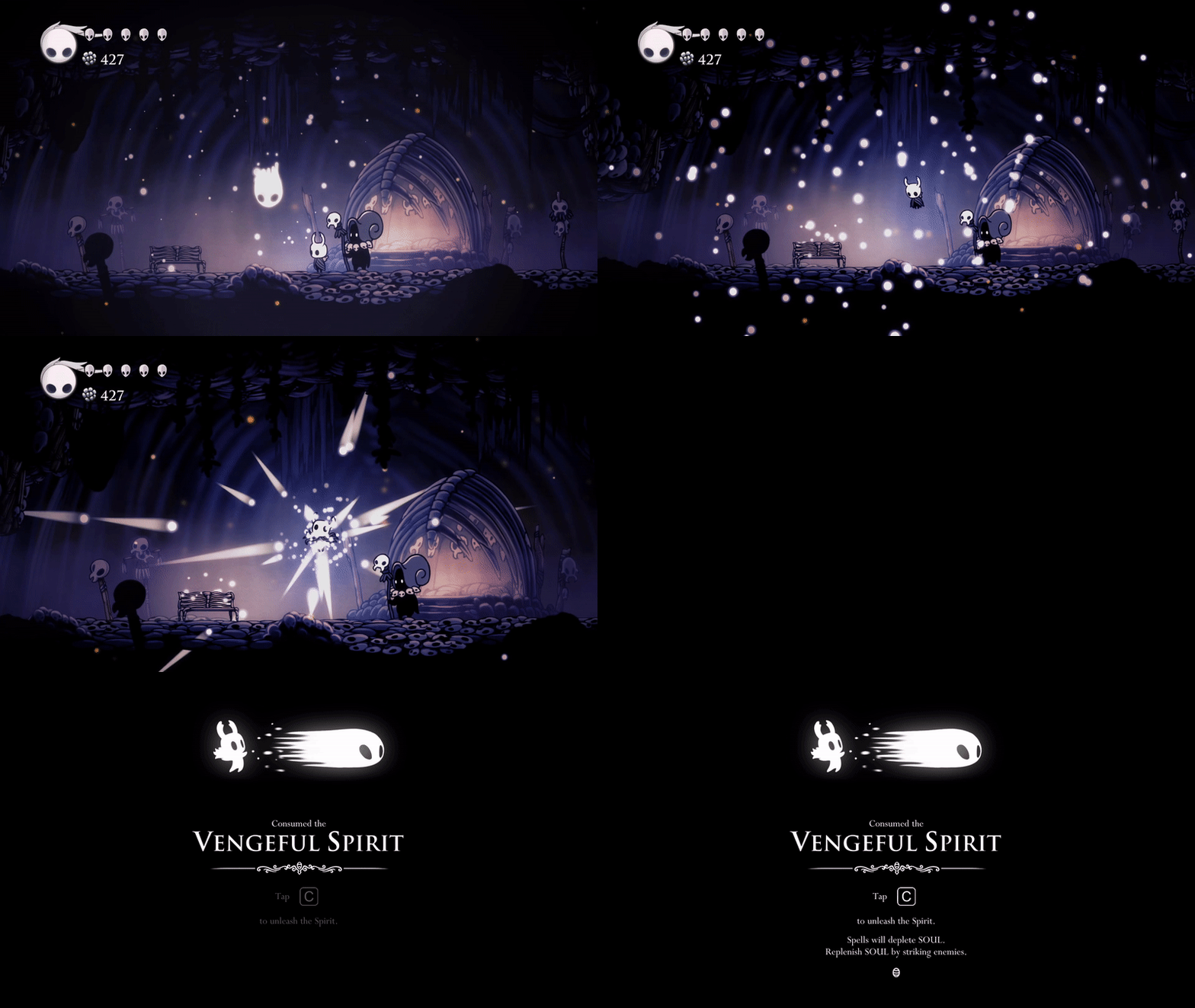

You see, SOUL can be spent not only on healing spells. Early on The Knight will obtain a projectile attack spell called vengeful spirit that deals even more damage than their normal melee strike. Other attack spells will also be obtained at various points throughout the game. These attack spells draw on the same SOUL resource, and cost the same 33 point value as a heal. Suddenly, the player has options in combat. Heal one hit of damage, or deal extra damage? It’s very tempting to go aggro with those powerful spells, especially against tough enemies with deep health pools. If they die quicker, that’s less time the player’s spent potentially making mistakes, after all. So now the player is being made to think critically about the overall situation, weighing their intake of SOUL versus how often they need to heal, factoring in their confidence in their own abilities into how SOUL should be spent. It becomes a series of interesting decisions all happening in rapid, in-the-moment succession. It makes the combat overall more interesting, while also rewarding mastery of the game, as skilled play will allow the player to launch the satisfying and crunchy magic attacks more often while healing less, defeating enemies and bosses more quickly.
So Hollow Knight‘s healing system accomplishes a lot by playing with the player’s investment of time, sharing a resource with the player’s offensive magic, and tying its efficacy to the player’s success in combat. It creates a satisfying risk-reward experience where the risk is determined by the player’s skill and self-knowledge, as well as a tense and exciting atmosphere in combat.
I think it’s worth considering some alternative healing systems games similar to Hollow Knight often employ. Hollow Knight lets you heal indefinitely so long as your combat performance is up to a certain par, but some games will put a hard limit on how much healing you can do before reaching a checkpoint, potion shop, or other such demarcation. Limited quantity healing systems do have some unique strengths. They still give the player ultimate agency over whether and how to use healing resources, like in Hollow Knight, but also give an emphasis on a player’s overall performance, rather than Hollow Knight‘s more moment-to-moment focused system. You can make a lot of mistakes in Hollow Knight but still recover to full strength with some acutely skilled play. With limited quantity healing, you can succeed with skilled play even if you make a lot of mistakes, but the tension will remain high when you’re all out of healing, as your mistakes cannot be undone. Both systems have a lot of potential, depending on what player experience your design is geared toward. I think Hollow Knight‘s implementation is pretty perfect for its world design. With fewer check points and an emphasis on prolonged exploration, it makes sense to make The Knight’s healing resources theoretically indefinite.
Another alternative is health pickups, a very common healing system. In game series like Metroid and Mega Man you can restore health through health pickup items randomly dropped by defeated enemies. This accomplishes a similar end as Hollow Knight‘s healing system, with a safety net against failure being rewarded for successfully fighting enemies. There are a couple of key differences though. For one, health pickups are usually randomly generated by defeated enemies to keep the flow of healing less continuous, and more uncertain. There is a certain excitement unique to finding a healing item right when you most need it. During extended combat encounters without an abundance of targets, such as during a boss fight, naturally there won’t be any health pickups. Games with a health pickup system often try to circumvent this latter issue by throwing smaller enemies into the middle of boss fights that drop health pickups, but that comes with a couple of problems too. For one, the presence of smaller enemies in a boss fight can distract from the fight’s core mechanics and design appeal, especially if it’s meant to be a pitched duel between some important character and the player. For another, that scenario is now rewarding healing for engaging with the small enemies, rather than fighting the boss directly, which may not be the intended experience. Players might spend a lot of time only engaging with smaller enemies to collect health pickups, and ignore the boss. The alternative is simply balancing boss fights such that players aren’t expected to heal during them, or having the boss themselves drop health pickups at various times, but at that point your creeping awfully close to Hollow Knight‘s rather elegant solution anyway.
That elegant solution is not the best way to do healing necessarily, no design scheme is objectively the best one in every situation. It may just be the best one for Hollow Knight though, and it’s hard to argue with the precision of its implementation.
Whew! Got through an entire gameplay analysis of Hollow Knight without once mentioning Dark Souls… wait, damn it.
*Sighs* Bafanada…
 Parry Everything