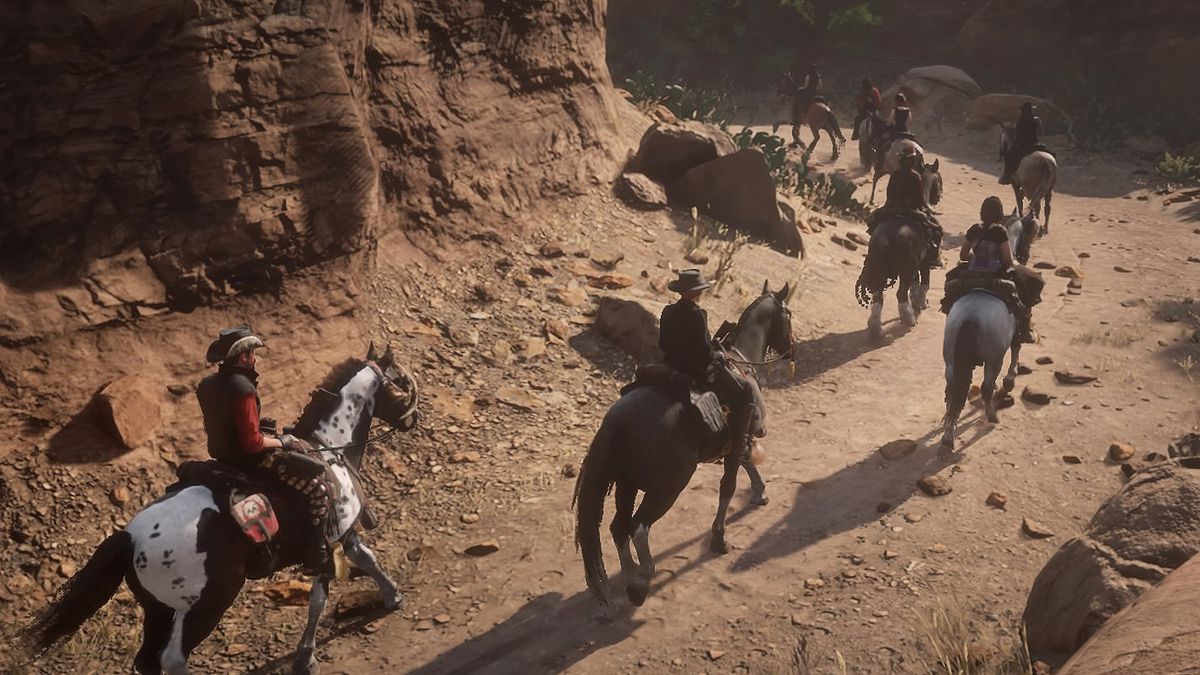
Ahh, horse. Strong, graceful, the picture of elegance. Truly one of nature’s most majestic creatures, and a favorite mainstay of the that one medium I like a whole lot. Welcome to ‘Video Games Vs.’ where I analyze the dumbest stuff in video games I can think of which inexplicably follows a pattern of being almost consistently jank and bizarre. And there is no creature in the interactive medium’s menagerie more jank and bizarre than the horse, and riding animals in general. Let’s get right into it.
Simulating a Living Creature
When adding a feature to your game, you always have to ask yourself what it is you’re spending your resources on and why. What’s the goal of having a horse in your game? Does it enable combat? Is it merely for making the player go faster? Are horses just cool? Or, does it need to be immersive, and make the player feel like they really own a companion animal? The goal of the later comes up a lot in small ways, such that it separates the concept of riding animals from, say, a dune buggy. One is a tool, the other is a living thing. In a lot of games, horses are not meant to be mere vehicles.
With this consideration, it makes a lot of sense that often, in games, the movement of horses is not nearly so smooth or precision as the movement of your main playable character. Many games are concerned with just this sort of behavior. For example, the recent Zelda: Tears of The Kingdom, and it’s predecessor Breath of The Wild features horses that do not map perfectly to the player’s control stick, the way link does. The horse does not go slow on a slight tilt of the control, nor does it gallop at a full tilt. Rather, Link must gently heel the sides of the horse, much like a rider does to a real horse, to encourage it to pick up speed. In Tears of The Kingdom, there are several ‘levels’ of speed which the player accesses through a set of states that the ‘kick’ button rotates to, and holding back on the control stick encourages the horse to slow down.
Besides that, these horses do not start out friendly to Link. They’re wild, and must be tamed. They may back and panic before they are tamed. The method to calm them is to simply press a button, yet still the player must be attentive to, and respond to the horse’s needs. These things do not facilitate the gameplay of movement, combat, or puzzle-solving which otherwise dominates Zelda‘s play space. Their purpose to give the illusion of life to these horses – temperamental, disobedient, and willful life. On the flip side, the illusion of life can also be a boon to movement gameplay. The Zelda horses, if set on their course, can follow paths and avoid obstacles automatically, as though the horse has a will of its own, allowing the player to occupy themselves with other activity. In this way, the horse is not an extension of the player, but rather a partner.
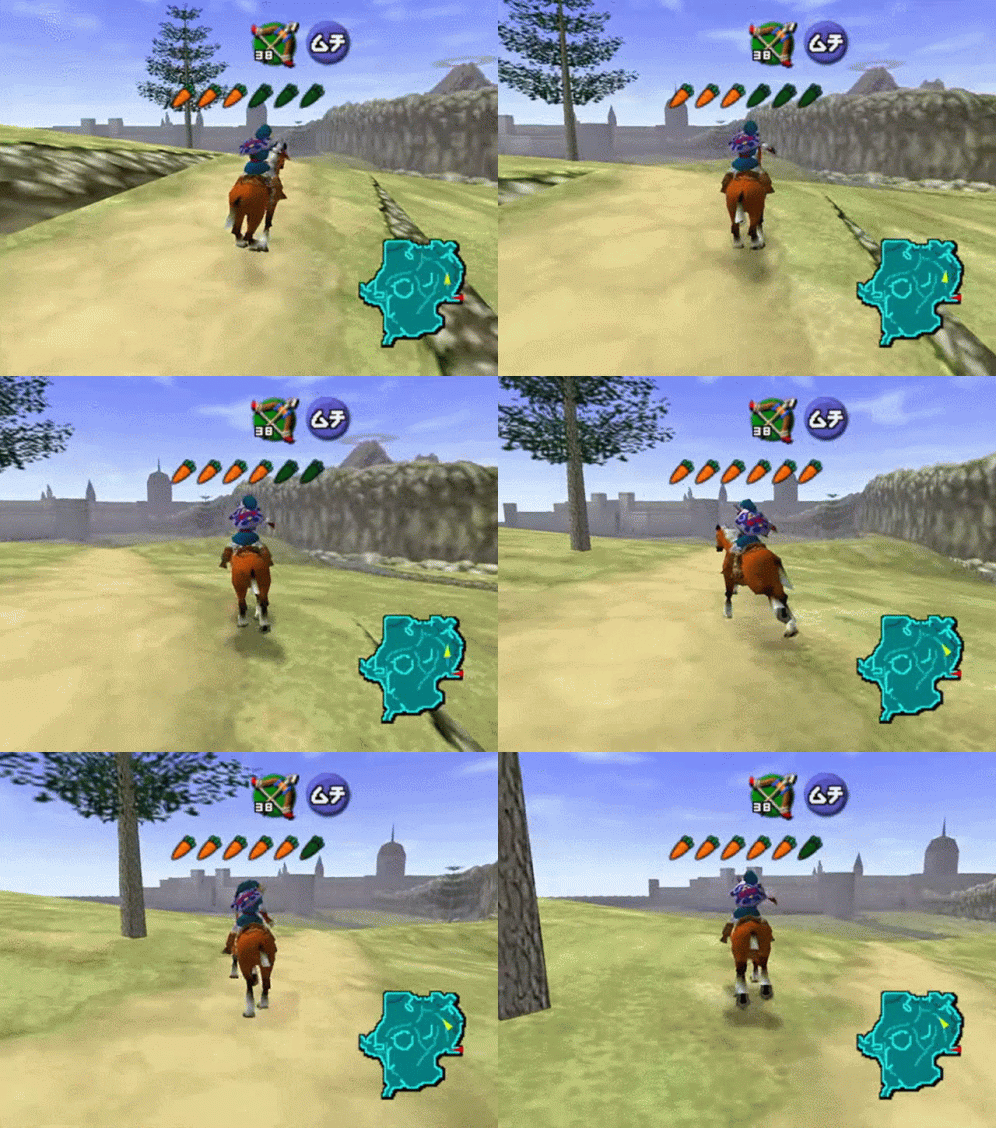
Zelda has long toyed with this sort of behavior.
However, as I alluded, these considerations can also be obstacles to gameplay. Particularly in early Zelda games, the horse Epona would often get stuck on strange geometry. She’d whinny and complain, and at times refuse to move if one attempted to guide her over large tree routes, cliffs, or rough terrain. Zelda horses can never be commanded to jump, for another instances. Epona and her descendants will only jump if approaching certain obstacles like fences. With such loose rules, divorced from player controls, they are prone to errors and discrepancies, like Epona getting stuck on a gate, because she did not approach it at quite the precise angle.
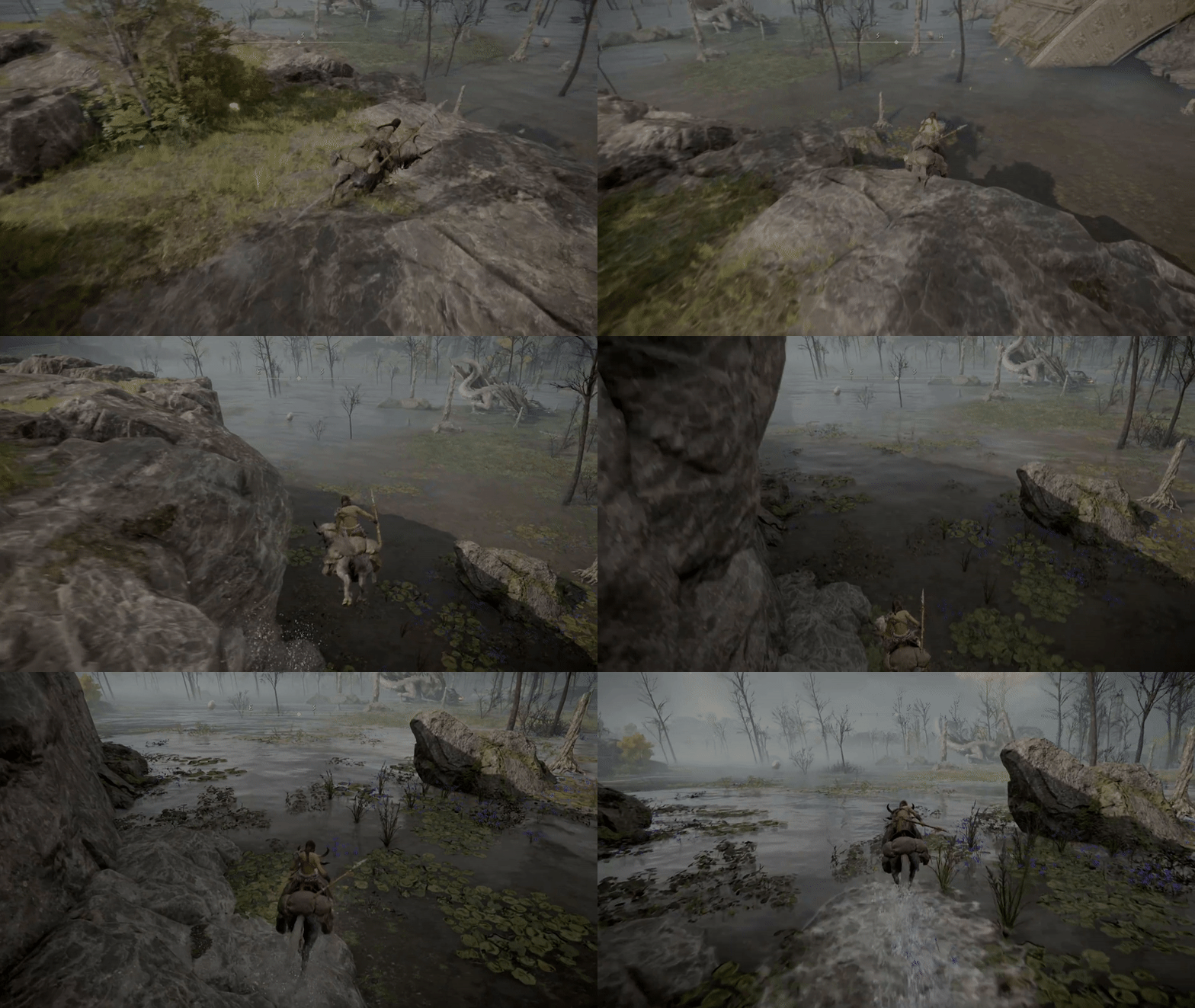
These sorts of bizarre terrain interactions are terribly common for video game mounts. Agro from Shadow of The Colossus is a lovable and friendly free-thinking horse. However, his AI is sensitive to shifts in terrain, and sometimes can get a little mixed up. Elder Scrolls V: Skyrim is infamous for the ‘Skyrim Horse’. These otherwordly creatures are capable of scaling near-vertical inclines, and if you were around in Skyrim’s heyday you were no doubt subject to one or two horse-terrain interactions that were so bizarre as to totally shatter the fiction and immersion of the game, at least once or twice. It is, admittedly, rather funny.
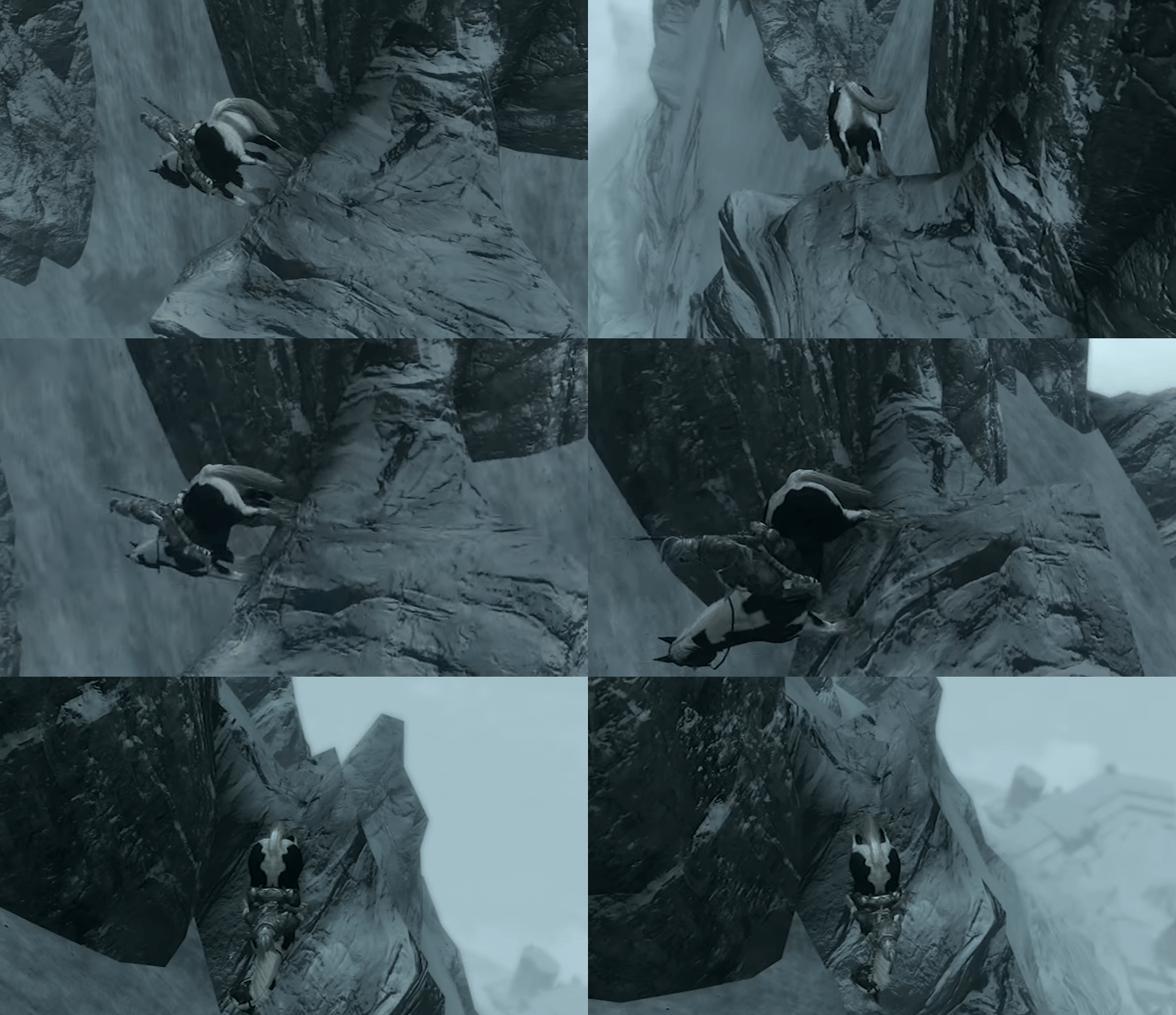
Charming.
When The Horse Is Only Decorative
There is an inverse to this, where horses are not considered as companions in gameplay, or even as vehicles. It is customary in MMORPGS to collect lots of mounts, and usually, the mount is merely a visual flare. It increases your move speed, and nothing else. No new mechanics are imparted, nor does the mount behave in any way like a living thing outside of its animations. Perhaps the mount even allows you to ‘fly’, but generally the ‘flight’ is just a repurposed swimming mechanic, again with the animations switched out. The horse in this instance appears with a button press, and disappears just as easily. In Final Fantasy XIV, presumably to counteract this sense of one’s chocobo riding bird feeling like a prop, among other reasons, you are able to summon it as a companion in combat, aside from its utility in increasing moving speed. World of Warcraft, in its latest expansion as of August 2023 added in new draconic flying mounts whose motion is governed by a more interactive flight and movement system, to better characterized them as living things, and make travel more interesting.

I’m faster, and riding it, but I’m not really riding it, you know?
A Peek Behind The Curtain
In MMOs and games like them, mounts usually appear and disappear out of nowhere as needed. However, wherever a mount is introduced, you have to decide how it’s going to be conveyed to the player. The Horse Delivery System, if you will. For Zelda, traditionally Epona is called on some sort of instrument, but what then? The player can potentially leave Epona wherever they want, travel a few miles, and then… what? Do they have to wait for Epona to make their way all the way across the land? Well no, and in fact the game will sometimes not even bother to remember where Epona was. Rather, she will spawn in off-screen, somewhere nearby. The camera will dramatically swing around to give the impression that Epona did travel across the land at the sound of your call, but this is indeed just an illusion – a visual trick.
There is a danger to this, though. In Dragon Age: Inquisition, due to how free the camera is at all times, it is very very trivial to swing your camera around fast, just as your horse appears and see what’s really going on; your horse jarringly winks into existence just where the game thinks it’ll be off-camera. I think many a curious or intuitive player might do this, it may even happen by accident, and it is extremely jarring. It underscores the artificiality of Inquisition‘s horses so much that I never saw them as representations of living creatures again. Besides that, while I’m on the subject, the Inquisition horses are so slow, relatively speaking, so as to not even be worth the enormous amount of screen estate that they demand with their huge bodies. If including a mount in your game, consider the trade offs – especially if implementing life-like features that may hamper control.
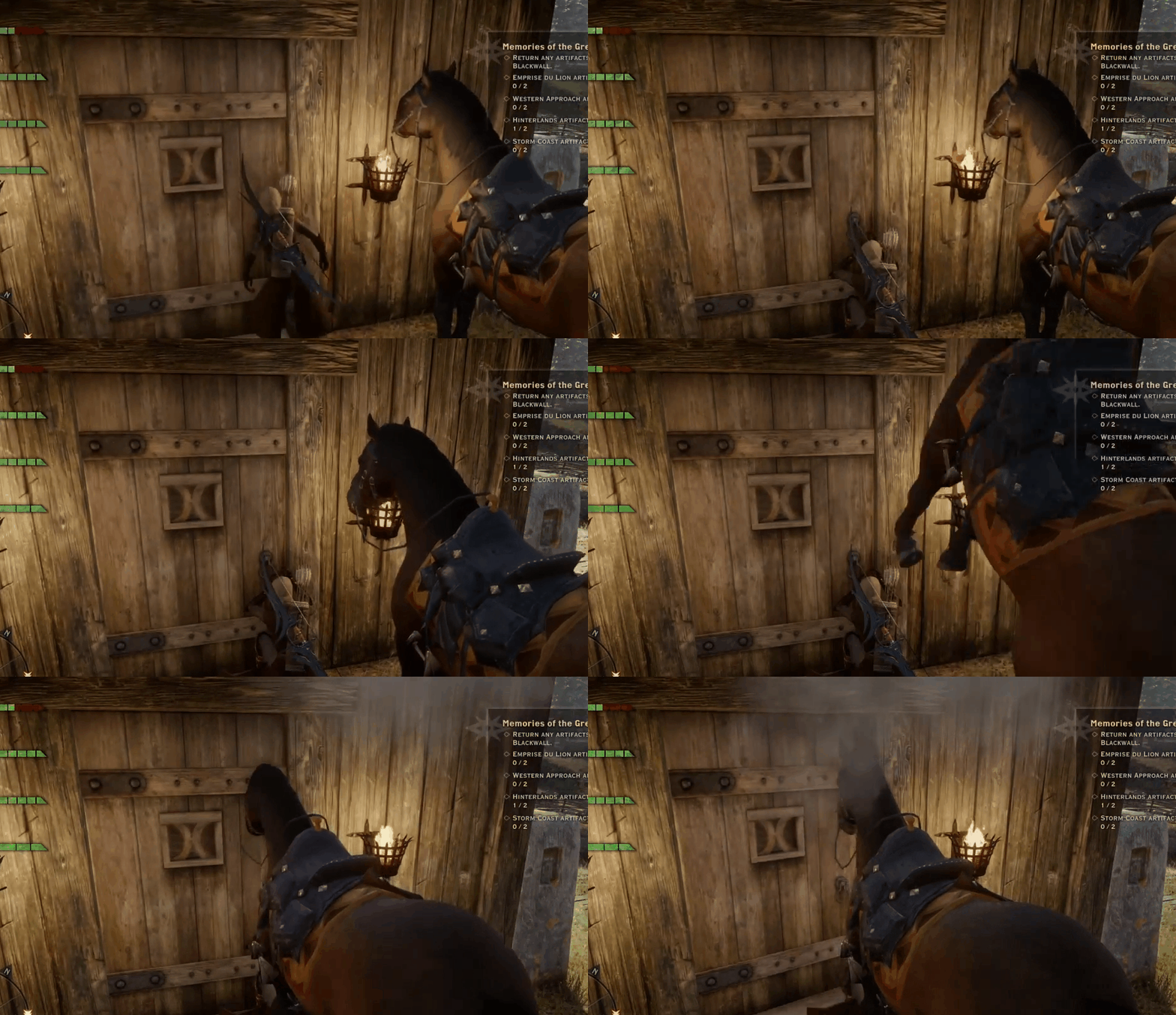
Procedural interaction with terrain is prone to uh… a lot of problems
Zelda: Tears of The Kingdom utilizes stables, which always, magically, are able to summon forth horses registered to the stable system, regardless of where in the world they are left. Otherwise, horses can only be called from a fairly short range, not universally, like the Eponas of old. This is more ‘realistic’ in a way, I suppose, but really just feels like a way to further justify the common use of the stables, and the previous solution was a lot smoother in my opinion. So what other ways are there to get a large quadruped into the play space as the player needs it that isn’t disruptive? Stables are a common solution, such as how chocobo traditionally work in the Final Fantasy games- visit a stable or chocobo farm or chocobo forest, and go off with your mount, which is returned to the stable when left behind. I think the most elegant version of a video game horse, would have a very inventive and elegant way to get the horse into the player’s hands, so to speak.
Gaming’s Most Powerful Horse
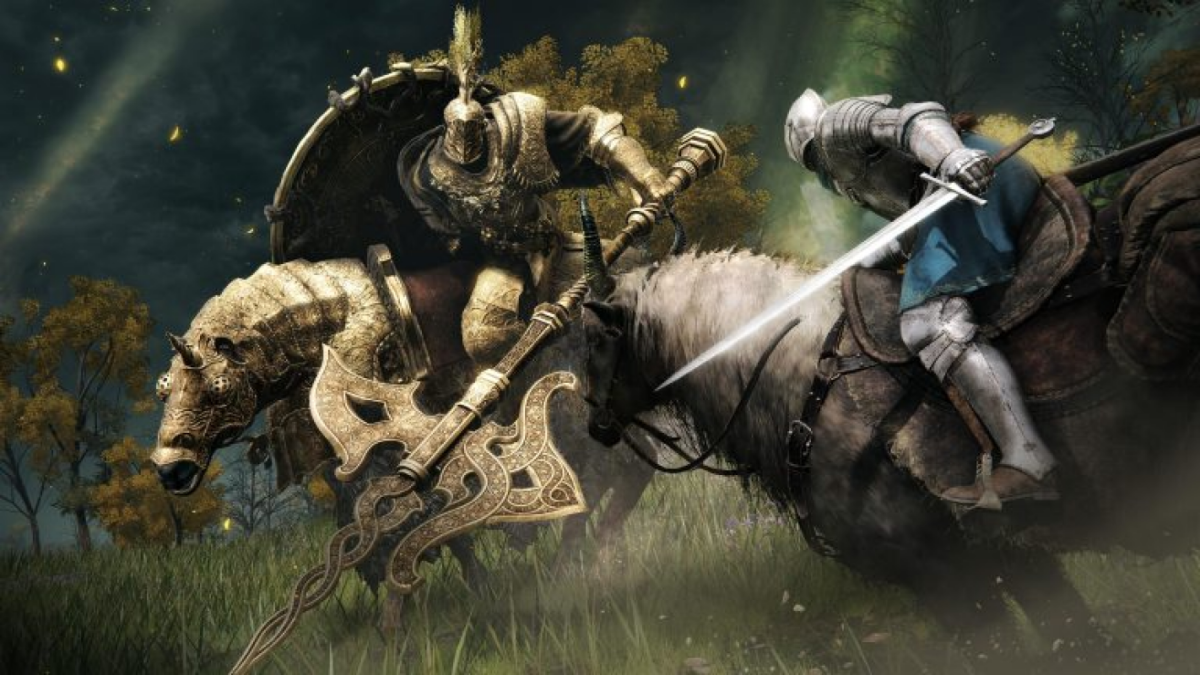
So I’ve discussed my love of the strongest apex predator of the mounting animal world before, so I won’t labor the point too much. Torrent from Elden Ring is a very satisfying and reliable game mechanic to use, which allows you to traverse vast distances, engage in mounted combat from the safety of a riding saddle, and engage in combat in entirely new and interesting paradigms as compared to Elden Ring‘s on-foot combat.
Mighty is He.
One interesting thing to note, is that Torrent approaches a lot of the problems I’ve talked about so far by just… not engaging with them at all. For example, many games struggle with how and where the player can call upon their mount. Each game’s individual Horse Delivery System, so to speak. Several games, like Dragon Quest, and certain Zelda games, try to brute force this problem by simply teleporting the horse in on command, trying valiantly to hide the seams of this unnatural action, and mostly failing. Some games, like Zelda: Breath of The Wild and Zelda: Tears of The Kingdom try to smooth over this dissonance by having at least the required use of an in-game stable to summon your horse from anywhere. Torrent does not brute force this particular problem so much as he double-jumps over it. Torrent doesn’t have to appear from anywhere besides just under the player, immediately, whenever they want him, so long as they are outdoors. There’s no need for any transition from off-screen. Our only explanation needed, is that he is a magic horse.
This is reflective of FromSoft’s design philosophy as a whole, which favors gameplay usability over simulation. Which isn’t to say they don’t value immersiveness, but rather that they tend toward verisimilitude over realism. Thus why Torrent has the barest minimum of startup acceleration. The lightest touch of clearance needed for him to turn. Torrent has just the hint of a suggestion of more rigid movement, which creates the convincing illusion of riding a horse, which in this specific case is all that’s needed to sell the fantasy. That leaves a lot of leeway to make Torrent feel really satisfying to use, and create very exciting mounted-combat scenarios with a lot of precision movement. However, there are of course drawbacks – if you’re looking for a game that truly simulates the feel of riding an animal, you’ll not find it here.

And yet, how many video game horses can do THAT!?
Plessie
Okay she’s not a horse, but she is a riding animal – it counts, and the lessons we can take from her implementation will be invaluable to our line of interrogation here. As we’ve been over, video game animals often struggle with the Horse Delivery System. Where and how does the horse appear? What space does the horse take up when not in use? For Torrent it’s ‘he doesn’t’ and ‘none’. Usually, it involves spawning the horse in just off-screen to hide them popping it, with the implication that the horse was totally nearby the whole time and just needed to hear the sound of your voice to come scampering in. Personally, I find this all kind of tedious and momentum-killing. Especially in exciting adventure-time games, which is where you’ll usually see horses, the need to drop everything to navigate a menu or perform some special action feels disruptive to me, which is probably why Torrent is my favorite on this list so far, despite his ‘avoiding the problem’ approach to ‘solving’ this problem. It makes Torrent feel less substantial, and more like a game mechanic than an animal, which is probably why they made him a ‘spirit steed’ in the story.
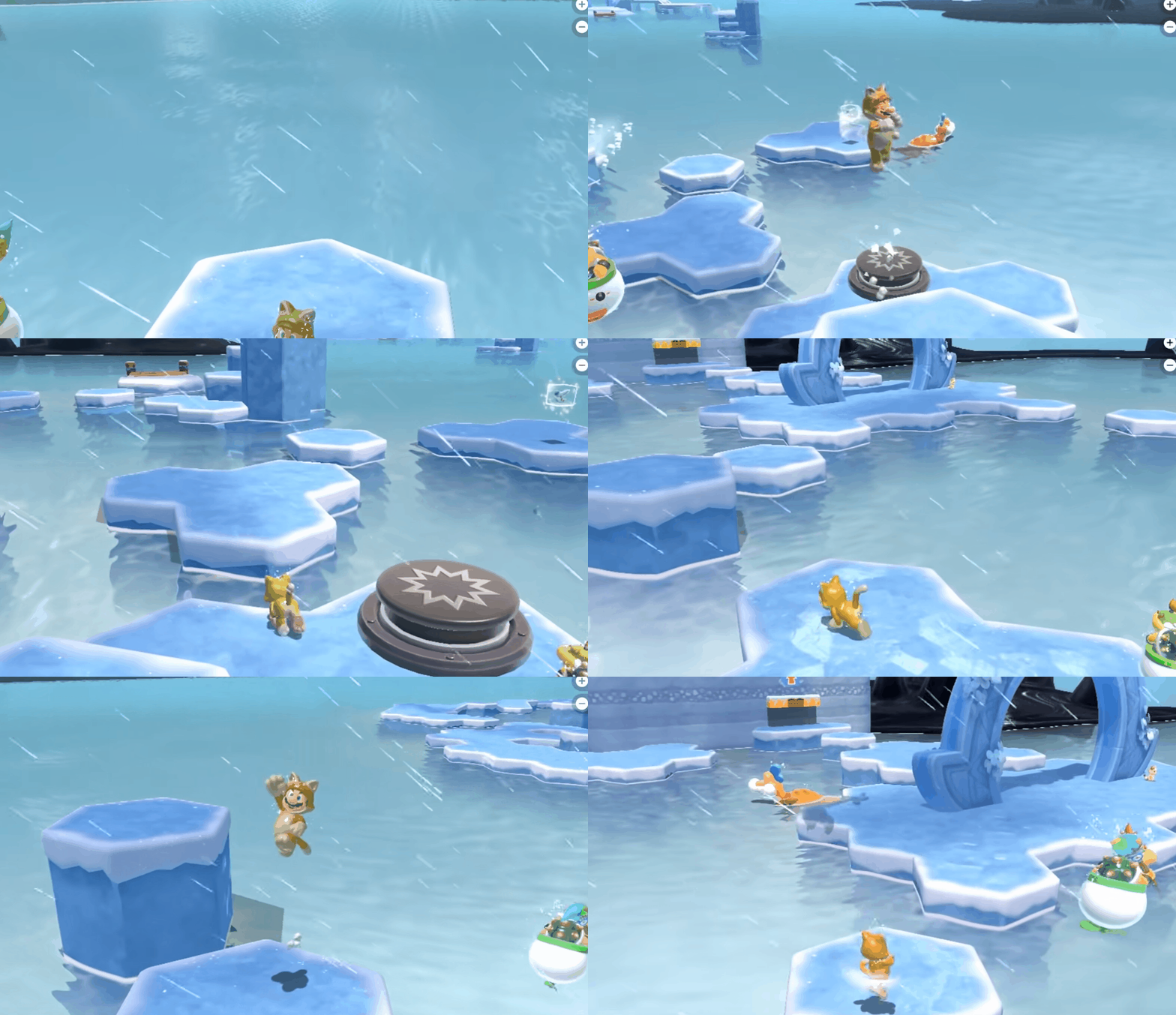
Plessie has no such issues.
Nintendo has proven this problem solvable, as far as I’m concerned. The 2021 re-released of Super Mario 3D World is actually Super Mario 3D World + Bowser’s Fury. The latter of which is a bundled open-concept mini-adventure in which Mario explores a vast lake or sea type area to stop the titular Bowser and his Fury from rampaging. The game is separated into a number of islands and shores that require navigating not insignificant portions of water. That’s where Plessie, your erstwhile amphibious companion comes in. Plessie’s movement is good, but pretty standard. She’s not as agile or high-jumping as mario, she can’t turn as hard as him, but she is faster, especially in water. What I find so fascinating about Plessie is how she slots into a Horse Delivery System.
The HDS in Bowser’s Fury has the goal of being as frictionless as possible to Mario’s adventuring. While playing this game, if you notice it, it is almost uncanny. Plessie is consistently, always, just where you need her to be. How does she always know? I suspect there is a number of robust processes happening under the hood, invisibly, to ensure that Plessie is constantly ‘aware’ of Mario and what he’s doing.
Having her be an amphibious aquatic creature is a good hack to start with. She can reposition herself by submerging, and popping up in a new location without the player seeing an discontinuity between the two actions. Secondly, the game is very veeery careful to never allow you to see Plessie pop up out of nowhere. She always emerges from the water, giving the illusion of a plausible physicality to her. Sure, she may literally be teleporting, but it never seems that way – merely that she swims very fast underwater without a mountee. Frequently however, the transition is simply hidden, and Plessie is already in her designated location when the player gets there. There? How does Plessie always know where to be, seemingly in the perfect spot for whenever the player would want to make use of her?
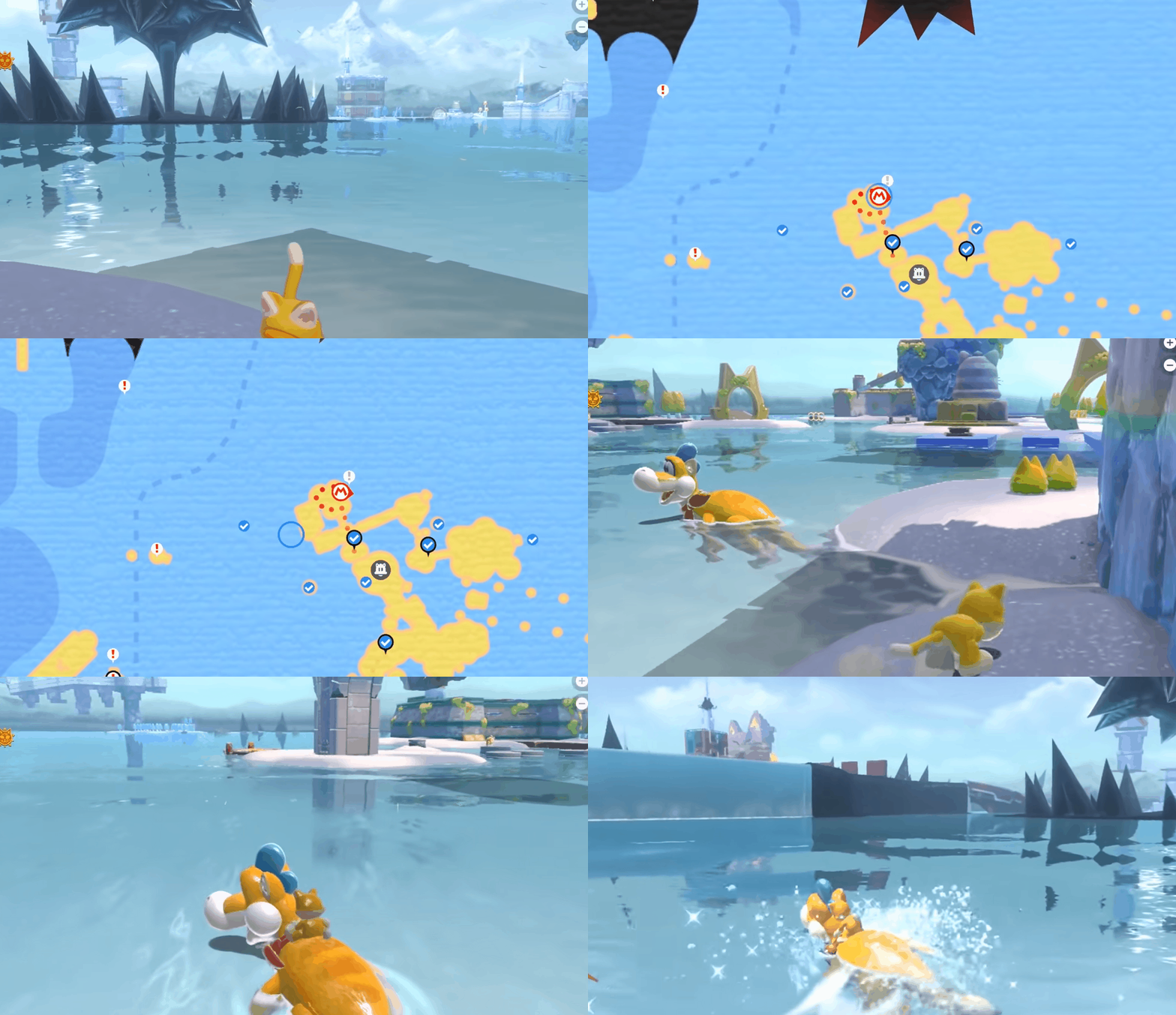
Planning to travel to a new island? Plessie is way ahead of you.
I have a couple of theories on this. Firstly, Nintendo is extremely good at crafting specific player experiences. They will playtest a game into the ground until they know every iteration of every kind of action a player may want to do. Based on the large datasets I’m sure they have, alongside decades of sharpened design instincts, I think they were able to narrow down the likely places players would want to use Plessie. The game will detect when Mario is in proximity to one of these, and have Plessie spawn there, always ready to go. This system is very robust, too! Once, while escaping the very scary Fury Bowser’s fire breath, I jumped Mario over a waterfall – woah! What I didn’t expect was that, in perfect action-movie style, Plessie would appear at the foot of the waterfall, just beneath me, and catch Mario in the nick of time for us to make our daring escape from Bowser. Wild! All without any input from me.
The result of having Plessie out and about on her own in the world, showing up only when needed, gives the impression of an intelligent, loyal animal. Plessie feels so much more like a character with agency because she is making ‘decisions’ alongside you, ‘deciding’ where and when to pop up, as though she is protective of Mario. I think the game may even take Mario’s currently situation into account. Plessie could theoretically emerge anywhere from the water, but during some challenges will not, soas to not be disruptive to the flow of gameplay. I would not be surprised if things like active nearby collectibles, whether Fury Bowser is active, what direction Mario is running, are all tracked and fed into Plessie’s spawn system to determine the most ideal time and place to appear. The result is that you don’t have to think about Plessie until she’s needed, but she still feels like a real animal and not just a game mechanic.
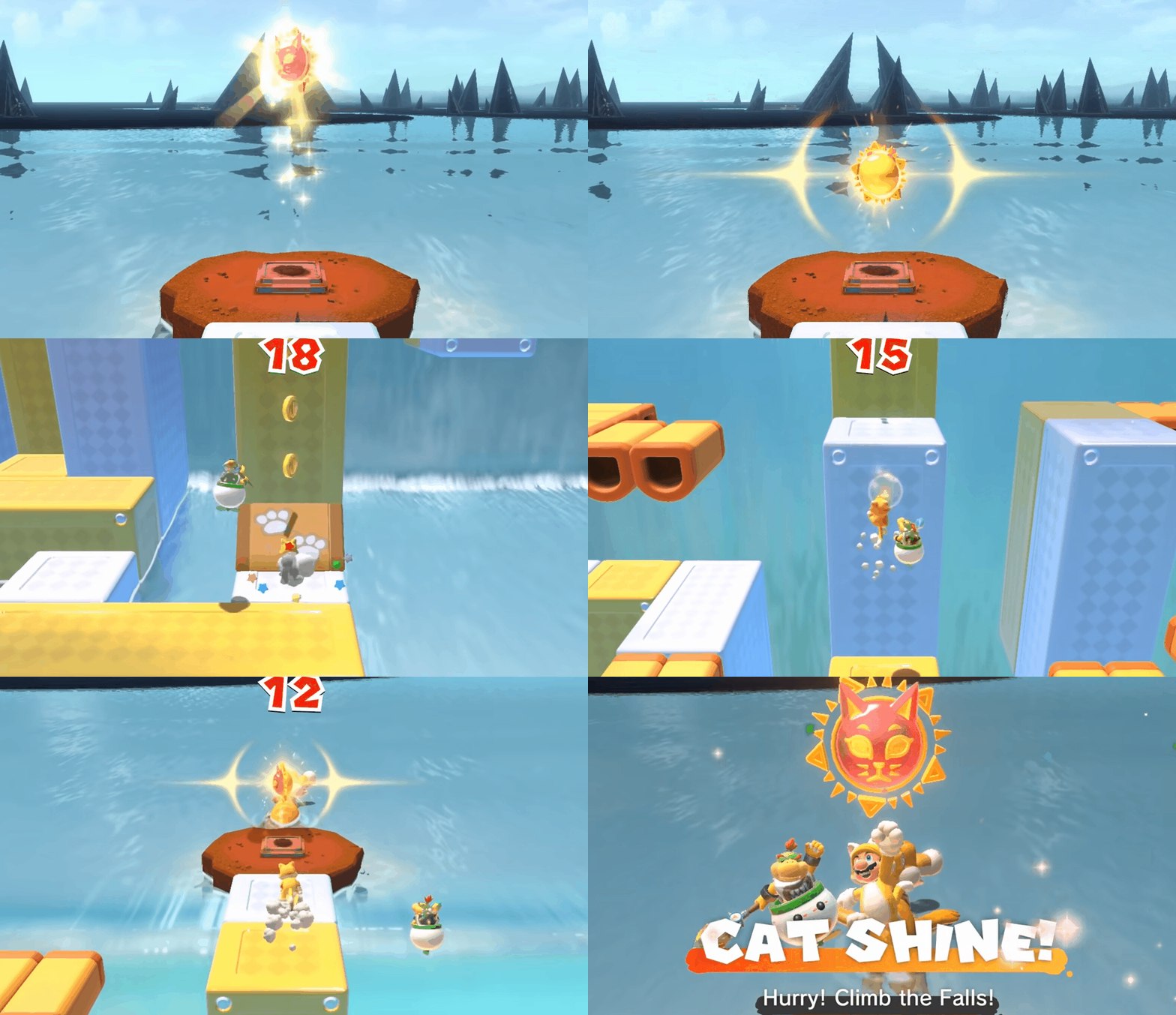
HOW DOES SHE ALWAYS KNOW!?
Horse
I don’t think my ideal land horse has yet appeared in a game. Torrent is my favorite video game horse to play with – his mechanics and movement are the most refined, in my opinion. Plessie is also pretty close, and she can run on land. She will not frequently, however, traverse land without Mario. I do think some of the methods employed to make Plessie feel so loyal and convenient could work on a regular old horse. Given the challenges of placing a horse on land-based geometry though, it would requires some finagling, and perhaps some compromises. A combination of methods could be used. Some horses like Agro from Shadow of The Colossus spawn in from off-screen and appear when called, which is less seamless. I think a combination of the approaches could make something that feel extremely smooth to play, but also reinforces the fantasy of having a living animal companion. If a horse were to appear automatically as the situation demands though, it would require a lot of considerations to avoid having its appearance be disruptive or inappropriate to the flow of gameplay, without Plessie’s advantage of being aquatic.
A creature of contradictions, the video game horse is. An animal companion, but also a gameplay vehicle. Made for ease of traversal over vast distances, but also temperamental, and prone to disruptive interactions with the environment. Often controlled by artificial intelligence, but rarely intelligent. I think my ideal land horse is possible in games. A creature as loyal seamless, and frictionless as plessie, but as strong and fun to use as Torrent, yet also with its own personality and sense of presence like Agro. I’m of the opinion that getting to greater heights such as this, in any area of design, requires learning not just from the best, but also from valiant attempts that didn’t quite succeed – It’s a bit of an ongoing struggle in that sense, a conflict, or a versus, if you will. One day, if we should all be so lucky, we will master the concept of Horse. See you next time.

How did you tame that wild horse right under my nose?!


 Parry Everything