I notice a lot of people turn off battle animations in Pokémon games. It’s kind of wild this is even something they considered right? I mean it makes sense on the surface, RPGs like Pokémon can be time consuming and people often play it on the go, or lead busy lives. But let’s take a step back here. We’re streamlining by cutting out the battles? Isn’t that, like, most of the actual game of Pokémon? To be clear I don’t think people are wrong to utilize this feature, I use it too. But why has it come to this? Why does the central gameplay mode of Pokémon have to be so time consuming it becomes tedious to the point of cutting its art assets out of the equation? I think this is really something happening within the game itself – if your game needs a ‘skip animations’ option to be playable by enough people to warrant the existence of a ‘skip animations’ option, well, the title’s right there. Options aren’t bad. It’s not that the option is there that bothers me, it’s that so many people, myself included, feel compelled to use it. Perhaps there’s a greater issue here. Pokémon games’ combat is turn-based. The player can take all the time they need to formulate a strategy each turn, but once their choice is locked in, the battle plays out before them. They aren’t directly participating so there’s no stress or pressure on the player tied in with the speed of the game… unless waiting long periods of time stresses you out.
I want to head this all off with some proposed solutions to the problem I’m about to describe in greater detail. I don’t want to come off as overly negative, but rather constructive. I love Pokémon dearly, but I feel as though it has at times struggled to meet the expectations of its own success. Personally I feel as though it is showing its age now more than ever in a number of departments. There are techniques that have been employed by Pokémon‘s contemporaries that allow combat, even turn-based combat, to be very breezy and flow seamlessly. One of my favorites is one employed by the popular Persona series of RPGs, a franchise that, lord knows, started out as a slooooow and ponderous combat experience in 1996. Lessons were learned from this, though, and by 2008, Persona 4 was establishing one of the smoothest and most appealing turn-based combat systems in the business, an advantage that would serve the explosively popular Persona 5 well eight years later.
In Persona 4, whenever the player uses the same move on multiple turns in succession, the animation for that move is sped up, and the action is truncated. The player just saw this animation in its entirety seconds earlier, after all, there’s no need to run it into the ground. This simple consideration drastically eases the repetitiveness of spamming the same move in turn-based combat, something you might find yourself doing often in Pokémon. In Yakuza: Like a Dragon, when an attack fails to connect with a character, the information is conveyed visually and the action transitions very rapidly to the next step of the turn. The word ‘MISS’ is barely on screen for a second, as the game does not dwell on and minor things. I’m sure I can think of more, but techniques for keeping turn-based combat flow smoothly aside, Pokémon just really has a problem with the structure of its attack animations in general. To be clear, I mean the special effects like lightning that occurs when a move is used, not the motion of the pocket monsters themselves, though that’s its own can of worms. They just tend to be far too long, and often could communicate the same level of awe, excitement, dread, or wonder in half the time or less.
It occurred to me while watching The Pokémon Company’s recent animated short Bidoof’s Big Stand with a friend. How striking and appealing the (admittedly truncated) battle scenes were in this 3D animation! So much character and charm. Compare this animation for the move ‘earthquake’ in 2016’s Pokémon Sun and Moon to the same move in Bidoof’s Big Stand.
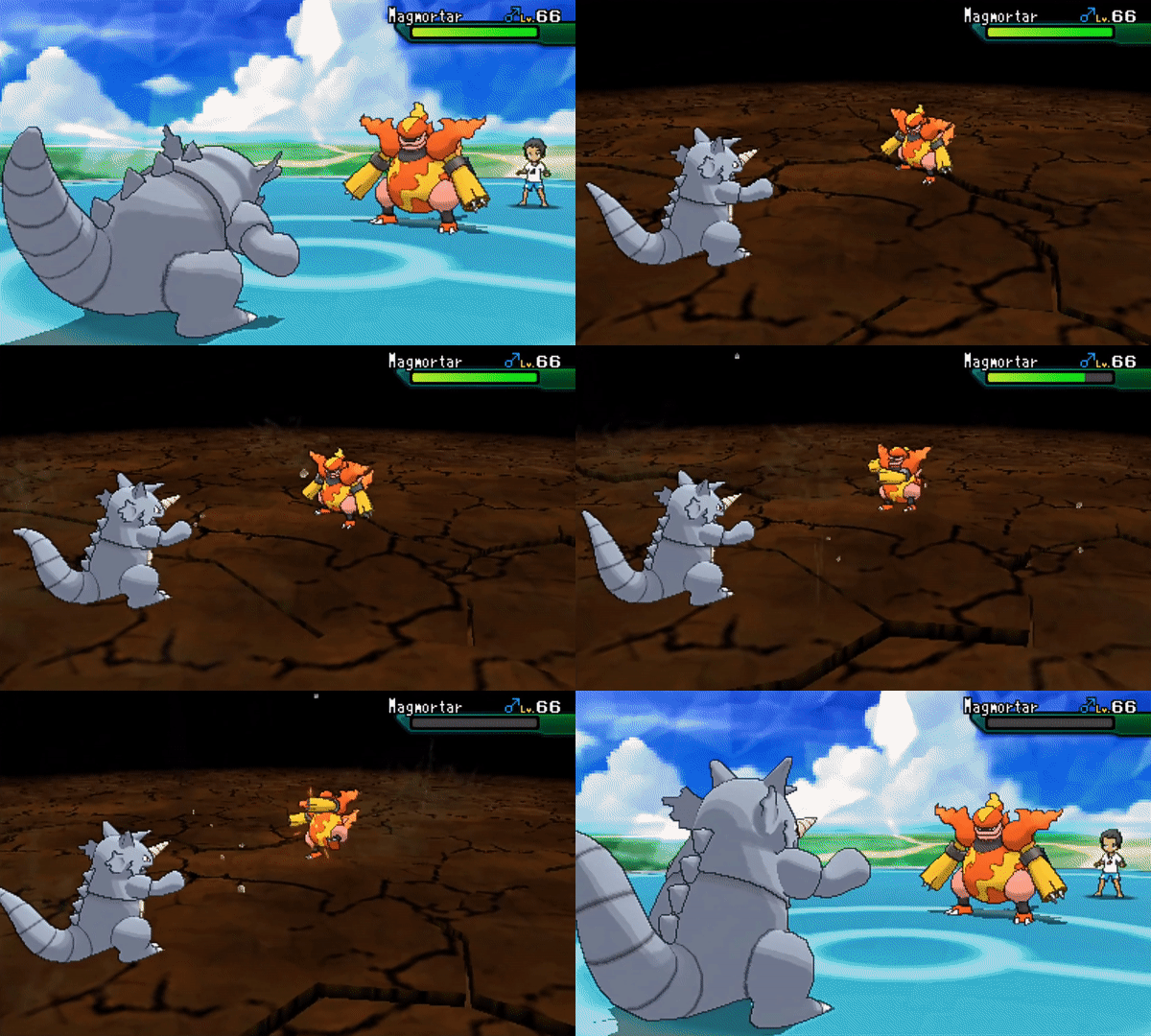

It’s not perfect. The earthquake move in Bidoof’s Big Stand for one could probably communicate a bit more force and impact before I’d ship it in a game, but that could be accomplished without inflating its screen time, easily. The fighting in the animated short exaggerates its action in ways Pokémon games probably never could given that their battle animations must be generic and prefabricated to be used by hundreds of interchangeable creatures, but I must insist that Pokémon as a game franchise can get closer to this level of dynamism and flow. It could be as simple as a baseline speed pass for each battle animation. Maybe earthquake doesn’t need to be on screen for a full five seconds. Maybe thunder doesn’t need as much anticipation as it’s getting. Maybe the transitions between turns could be faster. Game animation has a lot of conventions of minimizing anticipation and downtime, making visuals as reactive and instant as possible, and this is for good reason. The benefits extend to all sorts of interactive systems, not just action-y or real-time ones.
The difference in timing between the in-game earthquake and Bidoof’s Big Stand is staggering to me. I feel as though the Bidoof’s Big Stand earthquake communicates the idea of an ‘earthquake’ just as well, if not better, than its in-game counterpart, in less than half the time! A difference of three seconds might not sound much on paper, but bear in mind that in a pokémon game, you’ll be seeing moves like this, on average, about six times per battle, at minimum. Small increments in moment-to-moment gameplay like this matter. More likely you’ll see moves like this play out repetitively dozens of times per battle, over the course of hundreds of battles that take place in your standard Pokémon game. Arceus help you if we count all the redundant narration about status and field effects that pauses the battle to re-explain itself every turn. This is so much dead air to add to a game, it’s no wonder Pokémon‘s ‘skip battle animations’ feature has become so popular. And why shouldn’t it? I know I use it. I mean, I want to enjoy Pokémon‘s battle animations, many of them are genuinely a joy to watch, but I can usually really only muscle through a chunk of the game before turning them off for long periods of time. They just hamper the flow of the game too much for me.
I believe that games are greater than the sum of their parts. Games can have great music, great writing, great animations, or even great gameplay, but it is only in the confluence of these things, in varying balances, that the true strength of games as a medium comes out. I hate having to skip Pokémon‘s battle animations to avoid feeling burnout. I want the game’s various bits of art to come together beautifully. So, it begs the question, is there something perhaps less essential than the visuals themselves that can be cut out to improve the flow of Pokémon‘s battles?
And that brings us… To the Battle Dialogue.
Pokémon‘s Battle Dialogue is one of many idiosyncrasies Pokémon has brought forward through its many generations. It’s a small window at the bottom of the screen that essentially narrates what’s going on in battle.
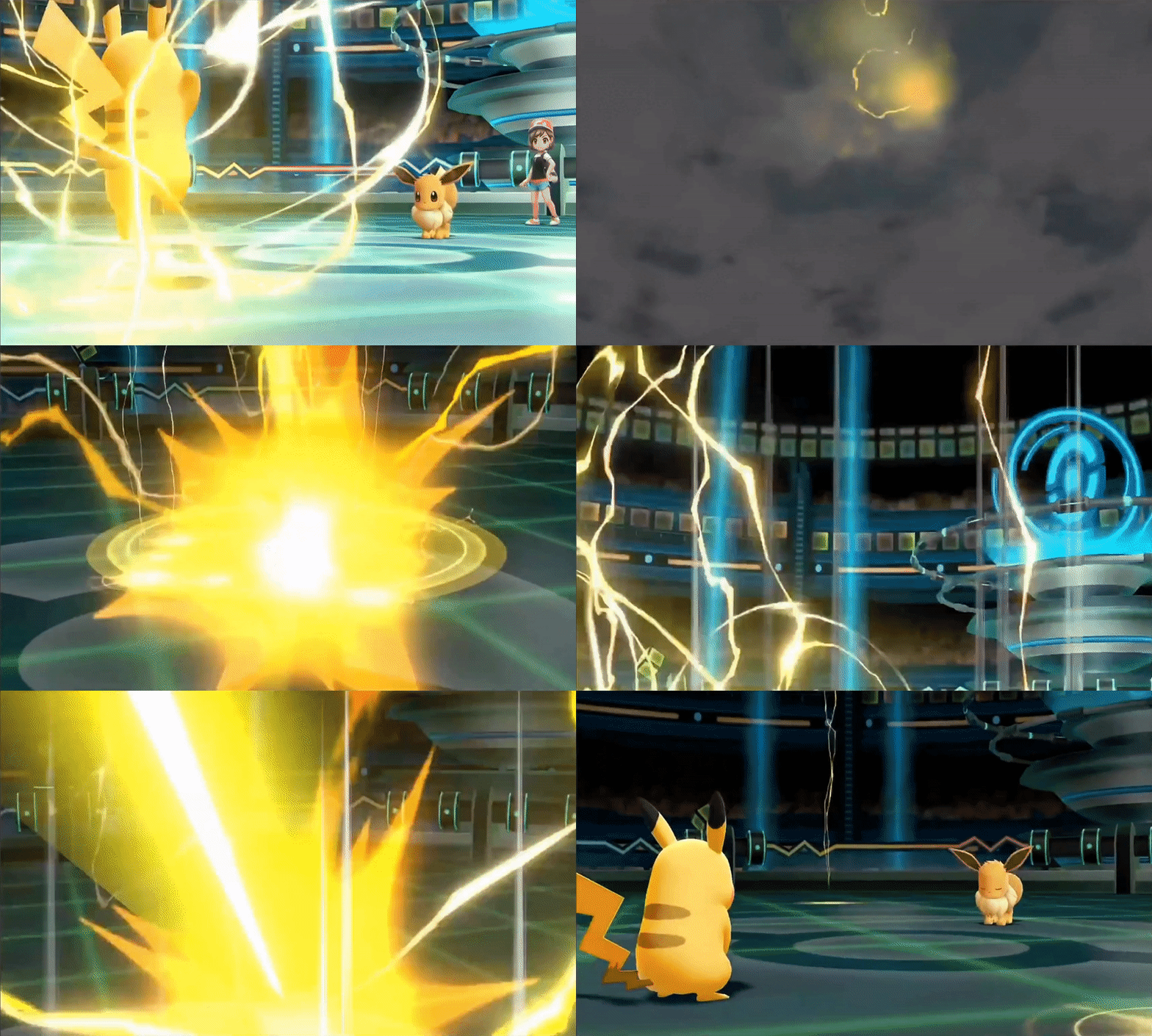
A pokémon will take part of an action, this action will resolve completely, and then the Battle Dialogue will narrate it, before any reaction to this move takes place. The result is an incredibly stilted and lifeless visual accompaniment to Pokémon‘s otherwise excellent battle system that so often holds it back. Take the pokémon move ‘self-destruct’ for example. It’s an old classic from the original gameboy Pokémon games. In the following scene, you will witness the literal events of a clay doll monster violently bursting into a fiery explosion, causing its opponent to become so injured it can no longer stand. See how these events are visually translated, in a way that only Pokémon can.
I hope my point is becoming clearer here. Thanks to the strange reverence held for the Battle Dialogue, which is always given visual priority, there is no sense of real presence to these creatures, no impression of cause and effect. It’s more like the pokémon are pantomiming their moves. Pokémon has, over the years, become more and more attached to the idea of making their collectible monsters and their world feel real and inviting, like a place you could actually visit. Newer Pokémon games have featured Pokémon pet simulator mini-games, wider areas of exploration, and a more complete impression of the world the games take place in. The problems with Pokémon‘s visual presentation, especially in its battles, feels utterly antithetical to this design goal to me. I know there are certainly technical and production limitations that are causing issues like this, but I felt compelled to bring it up anyway as these issues can never be fixed going forward if they aren’t given voice, and moreover perhaps us other developers can learn something from it. It’s a topic I don’t see discussed much among the *ahem* many other popular topics in Pokémon *ahem ahem* discourse.
What if, perhaps, we entertained the idea of eliminating the Battle Dialogue altogether? Now, it isn’t as though it serves no purpose. Pokémon derives much of its success from being friendly to the young and casual as well as appealing to the hardcore and diehard. The Battle Dialogue inarguably conveys information in a clear and unambiguous way, all the while reinforcing the rules of the game through its constant narration, but is it really the best and only solution for accomplishing those things? Surely, at the very least, longtime fans would woefully miss iconic phrases like “It’s super effective!”. Perhaps, but streamlining Pokémon‘s visual information could mean repackaging iconic visuals in new and exciting ways. Perhaps “It’s Super Effective!” could live on as a visual or particle effect itself, not just plain text. Yes, big changes like this may be a hard sell at first, but if Nintendo’s other recent output the likes of Breath of The Wild or Bowser’s Fury has taught me anything, is that nothing need be unassailably sacred, and sometimes fans are just waiting to fall in love with something new, even if they don’t know it yet.
When all’s said and done I don’t think my vision for a faster, breezier version of Pokémon battling is the only ‘right’ choice. But I do think Pokémon could stand to peek at its peers’ homework from time to time and modernize the way it presents itself a bit. Some of the things that greatly harm the pace of Pokémon are entirely inventions of a game designed for an 8-bit calculator of a console. Some of these things I feel the franchise has outgrown entirely, and some could be re-contextualized in a more modern way. There’s some considerations in art direction to be made too that could smooth out some of these rough edges. In this article I proposed removing or rearranging a lot of things, but honestly much of this could still remain optional. I just think it’s emblematic of an issue that could be assuaged through design rather than blunt force, if a lot of people are choosing to turn off the thousands of man-hours that went into making your game look appealing.
It runs agilely as if on wings…
 Parry Everything