
Thank you all once again for taking an interest in my stuff. I’ll be taking the rest of 2021 off for the holidays, and I hope yours are merry. Take time for those you love, and stay safe out there!
Month: December 2021
Sonic Adventure 2: Combat as Traversal
Sonic Adventure 2 is loved and it is hated. As an early adaptation of the 2D platform game star Sonic the Hedgehog it is rife with both 3D growing pains and extravagant, outside-the-box ideas. I find it notable for a great number of things. I’m particularly fond of how the game integrates its main gameplay attraction of momentum-based platforming- going fast, in so many words – with enemy encounters. More precisely, how this enemy encounters do not intrude upon the traversal gameplay, as the combat itself becomes a form of traversal.
Specifically I am talking about the Sonic and Shadow Action Stages, as they are relevant to what I’m getting at here, with the treasure hunt and mech stages being their own beasts. The Action Stages as such involving running across long, winding highways filled with deadly robots and ridiculous loopdy-loops. The first thing to note about these enemy robots is that they barely attack Sonic. Maybe a laser or bomb or two will be launched every few seconds. The thing is that Sonic stages need obstacles for there to be a game. Speed is meant to be a reward for performance, and if there’s nothing to overcome there’s no way to perform. An excess of obstacles though, quickly grinds down the experience to one of attrition, with frequent starting and stopping that strips away the core gameplay. In other words, Sonic has to have a very low skill floor and barrier to entry. Complicating this with more involved combat breaks the flow of Sonic that is one of its staple selling points.
So enemies in Sonic Adventure 2 are barely obstacles, and will generally be destroyed in one strike. They’re more like platforms in and of themselves, as the act of attacking them can propel Sonic forward and allow him to bridge gaps. By making the act of combat also an act of traversal, it blends more seamlessly with the main gameplay of traversing at high speeds. Sonic doesn’t have to stop and build up any sort of combo or other combat-centric mechanic to deal with enemies. He can simply vanquish them as he runs by, they’re more like a speed bump than a wall.
By necessity, this is also somewhat an article about the homing attack, introduced in the original Sonic Adventure. The homing attack was a pretty clever solution to adapting Sonic’s primary method of attack, which is to say jumping into things as a spinning ball, from his 2D genesis games to 3D space. By pressing the jump button in mid-air, Sonic will do an air dash with a burst of speed, and home in on a nearby enemy, destroying it, if there is one. It’s still possible to precisely jump into enemies as Sonic in Sonic Adventure 2, but it is cumbersome, a pain, and more pertinently, slow. That’s the real undercurrent here, that every time the Sonic franchise has endeavored to include more complex or involved combat into its gameplay it’s operated mostly to slow down gameplay or distract from the core fantasy of playing as Sonic The Hedgehog. Obviously, to go fast, or in a more practical game design sense, to build and maintain momentum and feel powerful in doing so.
Sonic is at its best when speed is an expression of skill that gives the player power over their environment. The homing attack essentially compensates for the third axis of a 3D game in a way that makes using a homing attack comparable to jumping Sonic into an enemy on a 2D plane, in terms of complexity. What’s more, if there is no enemy is available to home in on, the attack operates more as a normal air dash, giving Sonic a degree of momentum in the direction he is facing with little to no ending lag. With the homing attack as Sonic’s primary method of attacking, combating enemies because an integrated part of movement itself. You’re always moving while attacking, and almost always attacking while moving as well. Part of the reason I chose Sonic Adventure 2 in specific to cover this topic is because the homing attack’s lack of ending lag is not always the case in every Sonic game. I feel as though the evolution of the homing attack across the series is something that could fill out its own write up.
The game implements some clever ideas with the homing attack too. It allows strings of enemies to act as a sort of make-shift bridge to get to hard-to-reach areas. It allows Sonic to climb up more vertical surfaces if they’re lined with targets. Common elements in Sonic that need to be interacted with, like powerups and bounce pads, are less easily missed with the homing attack. If every one of these targets needed to be precisely collided with, Sonic’s own speed could make the process disruptive, and the homing attacking does away with that awkwardness as well.
All of these advantages Sonic Adventure 2 rings out of the use of simplified combat are things that later Sonic games double back on at various times, that I feel makes them overall weaker. Sonic Heroes and Shadow The Hedgehog populate their levels with slow combat encounters full of enemies that will take multiple, repetitive attacks before allowing the player to return to the main gameplay loop of high-speed platforming. Sonic The Hedgehog (2006) and many of the later “boost” style games like Sonic Colors sport a homing attack with greater ending lag and less seamless momentum, making them clunkier and less generally useful for traversal. When combat is an end onto itself, rather than an element of the greater gameplay which adds to the overall experience, the combat itself has to be extremely engaging. The problem with putting extremely engaging combat into a game primarily about traversal, is you’re now overloading your design overhead with two very complex, very essential systems that need to not only both have a great deal of depth, but also not interfere with one another. It can be done, but it’s not something to be undertaken lightly. When Sonic attempts to flesh out combat in this way it has thus far for me invariably fallen flat. If there’s any point I was trying to make here, I think it’s that combat does not always have to be an end onto itself, and can be simplified to serve a greater design purpose. That from a guy who has an embarrassing number of hours in the sorts of high-complexity combat games that are the antithesis of the homing attack. Sometimes less is more.
Sonic Adventure 2‘s weakness, when it comes to combat encounters, I feel is largely in its boss fights. The game is not without some fun to be had in boss encounters, but this is definitely one area in which the Sonic franchise has usually improved over time. If the unity of combat and traversal is the game’s strength, as I have claimed, then the scarcity of boss battles that take place while Sonic is running a distance is pretty alarming. Later Sonic games would have Sonic running down an infinitely long highway as the boss keeps apace with him and the two exchange blows that way. It seems a natural fit to Sonic’s gameplay, so the question of a lack of this sort of encounter in Sonic Adventure 2 may have been a technological one. The game includes precisely one boss encounter of this type, but it is rather simplistic compared to what would come later.
Combat in the Sonic series never felt so satisfying to me as when it was merely a tool of traversal. It had its place, populating the Action Stages with obstacles that were not too intrusive to the overall experience. Often I find games, especially platforms, shoehorn combat into spaces where it does not belong, and this intrusion can disrupt the flow of a game, which can be dire for a game like Sonic, so dependent as it is on that flow state. Sometimes the best way to design a system is knowing when to simplify, and knowing when to hold back, knowing the proper place for each element. The prospect of the upcoming Sonic Frontiers is an exciting one, following in the trend of open world games inspired by The Legend of Zelda: Breath of The Wild, itself a game primarily about traversal, but applied to the momentum- based platforming of sonic. The synthesis of those unique gameplay styles could be something really special. I hope the design keeps its emphasis where Sonic really shines – on the traversal – with combat not intruding too much on the fantasy of gliding across vast landscapes with super speed.
Talk about low budget flights! No food or movies? I’m outta here…
How To Fight Things in Three Dimensions: Zelda’s Z-Targeting
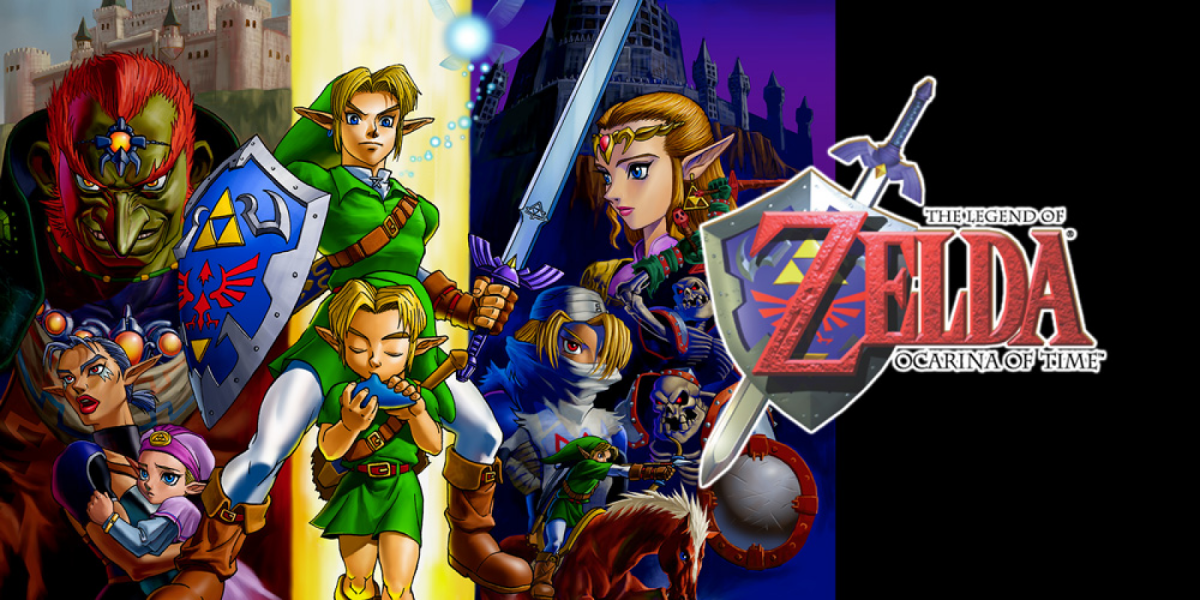
Can’t believe I haven’t done one of these on this topic yet. The Legend of Zelda: Ocarina of time is rightfully revered for how it set the tone for what action and adventure games could be in what was the relatively new frontier of polygonal 3D games in 1998. Moving to 3D comes with a whole host of problems, though, especially when it comes to active combat. Our real three dimensional space is very complicated, and abstracting that to a computer program can have some disorienting results if not done with care. One of Zelda‘s most notable contributions to the craft, I think is the Z-Targeting system. “Z-Targeting” is the name for Ocarina of Time‘s 3D targeting system which would let the player focus the game camera’s attention on a single point of interest by tapping the “Z” button. It gets plenty of mention, but honestly I feel like sometimes this one innovation doesn’t get praised enough. It kind of set the standard for how real-time gameplay involving two moving bodies works even to this day. There are also a lot of little things that helped this first iteration of a 3D targeting system work remarkably well, despite its age.
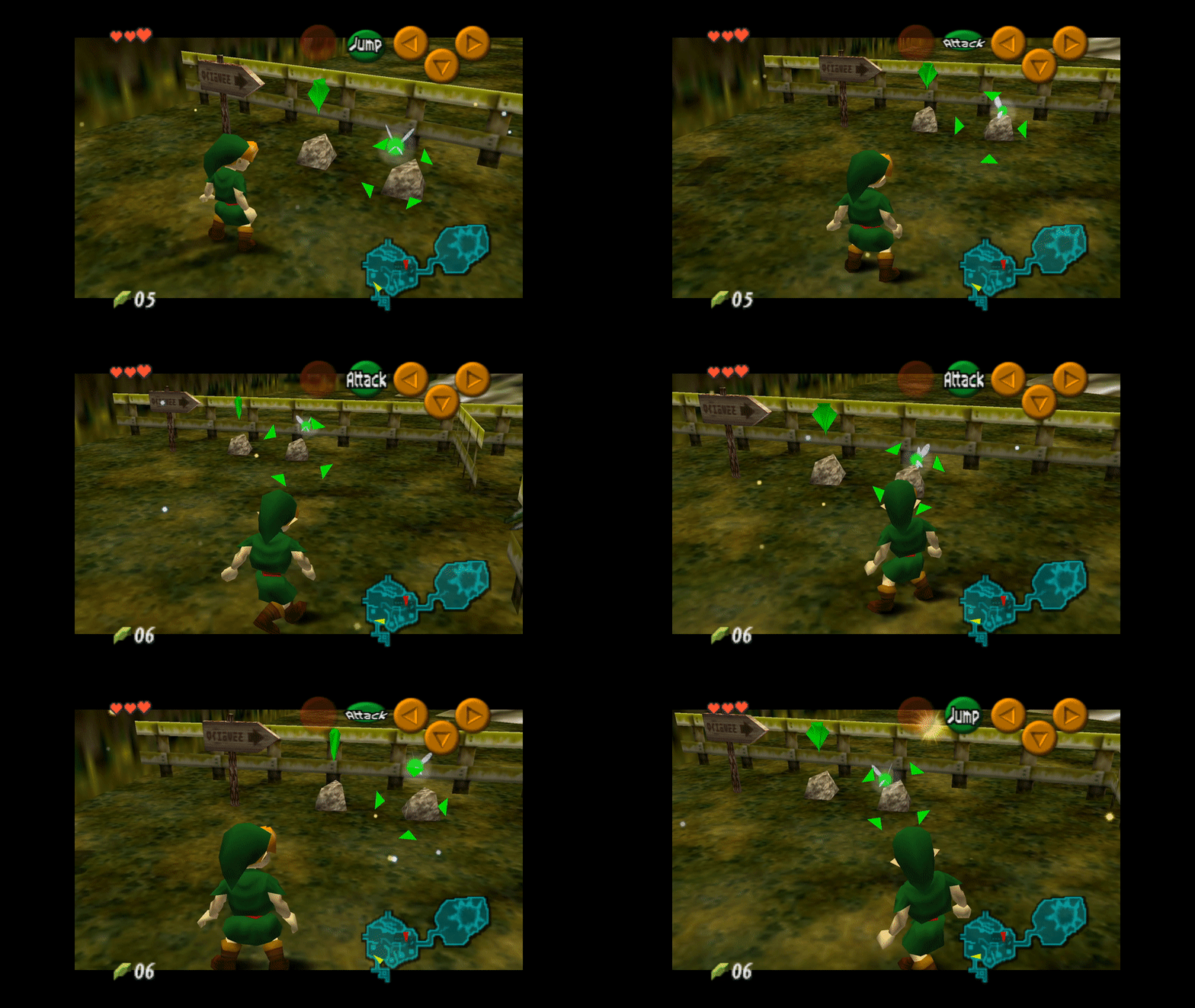
Notice in the image above how the camera smoothly and automatically situates Link to one side. You may have heard of the rule of thirds, an stylistic concept in art for generating compelling composition. By dividing an image into thirds and placing the subject of your art into the first or last of those thirds helps emphasize their importance, and draws the eye. It also frames the remaining, more open two thirds as a point of interest to the subject, a place they might be looking or going. Link is the subject in this scenario, and the camera essentially enforces the rules of thirds while Z-target is active. It’s not only very aesthetically pleasing, and helps draw the player into the drama of a good sword fight, but it’s very functional. But ensuring Link and the target occupy opposite ends of the screen, then it becomes very rare that Link himself will obscure his target from the player sitting on their couch. In this way essential information conveyed by your target, like an incoming attack, isn’t accidentally hidden from the player. This diagonal framing also helps keep the spacial relationship between Link and his target clear and unambiguous, which as I’ve mentioned elsewhere, is essential to satisfying combat.

This mechanic of making Link’s position relative to his target unambiguous is very strictly upheld. The camera will eagerly clip into walls to ensure the target remains properly framed, but this isn’t a problem as obscuring geometry will often not be rendered, so the camera’s over-commitment to framing is actually an advantage. It’s very intuitive. In an interview with the game’s general director, Toru Osawa, it was said that the system was inspired by a ninja and samurai themed performance. A ninja attacked with a sickle on a chain which was caught by the samurai. The ninja moved in a circle around his opponent as the chain connecting them was pulled tight. It seems drawing an invisible and unbreakable line between two entities helped the developers visualize how this new system would work. Link will always circle around his target in-game, and inputs on the controller are changed during a Z-target to reference the subject of the target. Moving Link “Left” means he will move clockwise around his target. “Right” means he will move counterclockwise around his target. It is as if Link is moving on a 2D plane, but bent and wrapped around the target. This abstraction expands into a rather robust system.
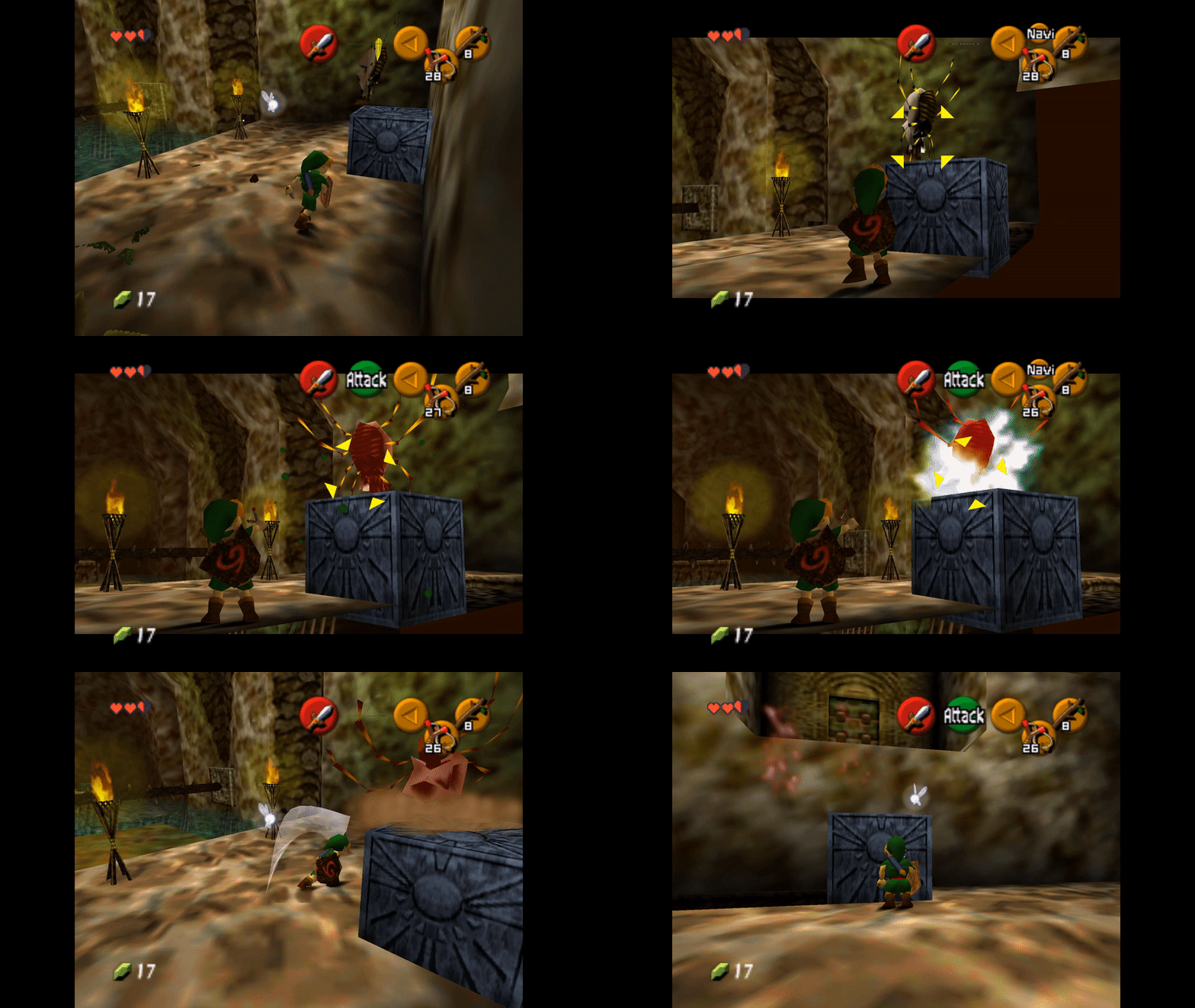
Another thing I noticed while playing Ocarina of Time recently is how movement during Z-targeting relates to the input of the gamepad controller. I’ll give you an example. While a Z-target is active, Link can do a quick side-step or back flip to avoid enemies. Holding the control stick back, toward yourself, when you press the action button will initiate a back flip. Holding the control stick to the left or right will initiate a side-step when the action button is pressed. So it seems the game is tracking Link’s relative facing direction to the camera for the purposes of his evasive jumps. If Link is facing perpendicular to the camera, or in other words, if his shoulder line forms a right angle with the plane of the game screen, then a “right” or “left” input on the control stick is considered “back” for the purposes of evasion. You can see this illustrated below:
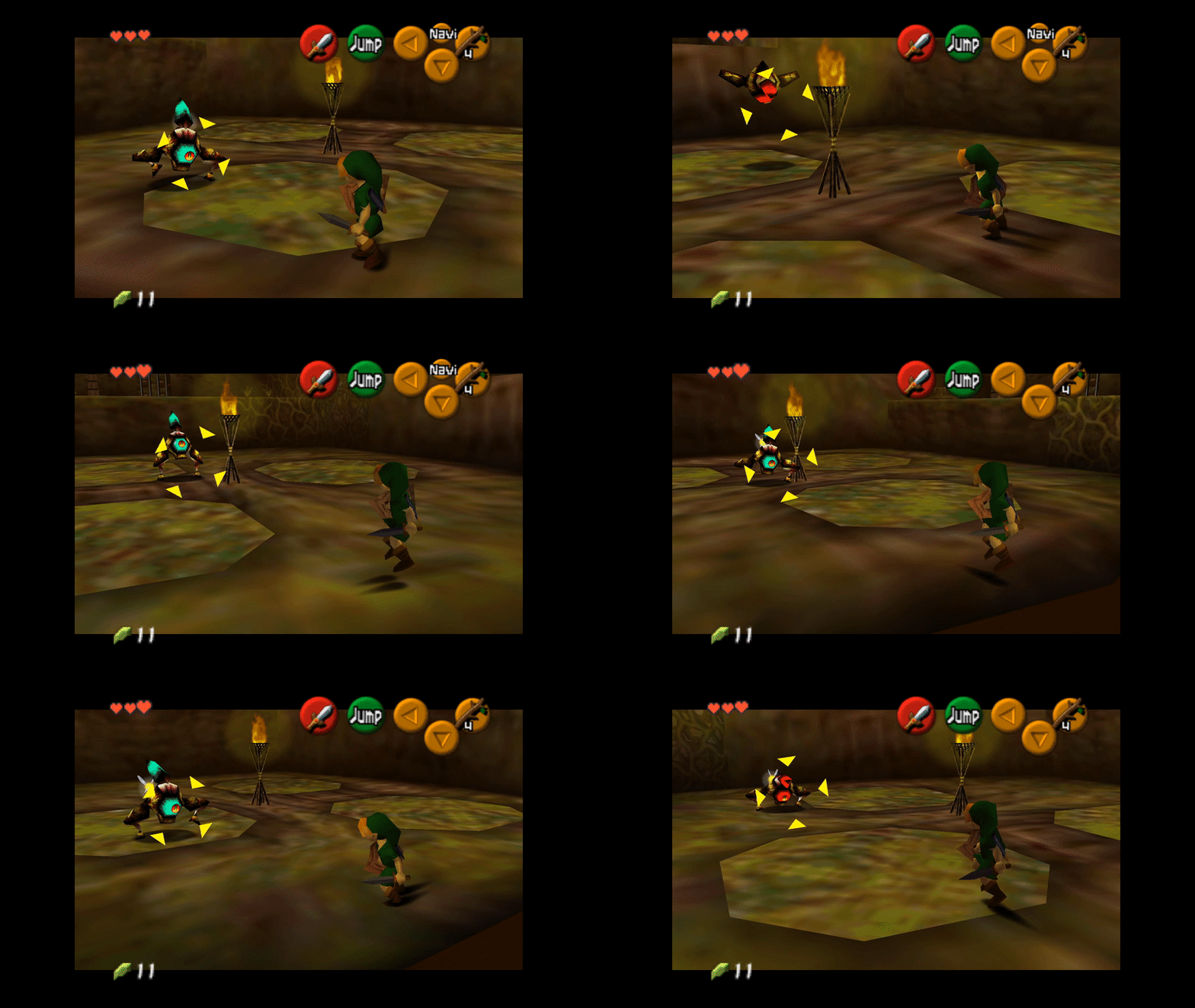
In this above clip, I am holding “right” on the control stick throughout. Once Link’s angle to the camera becomes too extreme, he no longer side-steps, and instead back flips. However, Link’s stride never changes. “Right” on the control stick is always considered to be Link’s right, relative to his current standing position, for the purposes of calculating what direction Link should be running. I can imagine a couple of reasons this might be. Changing Link’s continuous move direction on a dime would be very disorienting for the player. Link’s stride is not really changing in the previous clip, only the player’s angle of observation, so it’s unintuitive to think that a change in input is required to keep that stride in any scenario. The evasive jumps, however, are discreet units of movement and thus are not jarring when their operation changes based on camera position. Further, if Link were to side-step while side-on to the camera, it would be difficult to tell if he had done much of anything. By changing it to a back flip, the feedback of Link making an evasive move is maintained.
The Legend of Zelda: Ocarina of Time, being the first 3D Zelda game, obviously utilizes its verticality in ways that previous Zelda games could not. Zelda is a series well known for an arsenal of unique weapons and tools for solving puzzles and dispatching enemies. Iconic tools like the boomerang and hero’s bow are very compelling. It would have been a drastic admission of defeat to not translate such things into the first 3D Zelda. They have some hefty inherent problems, though. Control sticks are, frankly, not best suited for precision pinpoint aiming compared to a computer mouse, a gyroscope, or a photonic motion sensor. Ocarina of Time still offers the option of manually aiming projectiles through a first-person perspective, which is convenient for solving puzzles, but not ideal for most combat encounters. The Z-Targeting system rather elegantly solved this problem as well. The drawback is that the player doesn’t do much aiming at all when utilizing their bow and arrow in combat, which could be argued as part of the skill set of playing the old Zelda games, but in trade Ocarina gets the advantage of keeping airborne enemies in focus and keeping the use of projectiles in combat practical. Zelda combat is typically more about understanding the best tool for the job than skillful execution anyway, so I think it was a savvy decision to enable ranged combat in this way.
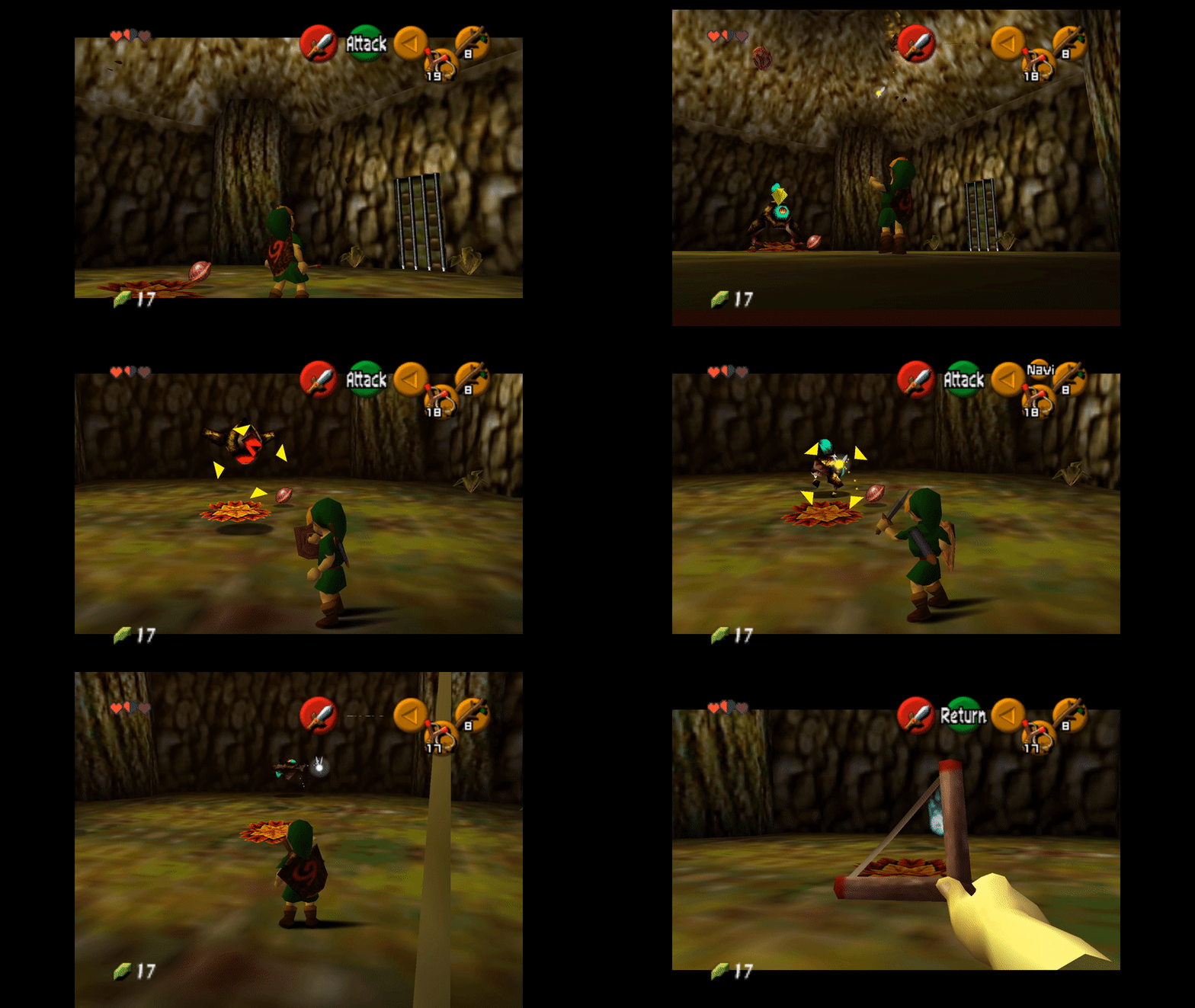
So many modern games utilize an automated camera or targeting system that can be traced directly back to Z-targeting, so I felt it deserved its own appreciation post here. The mechanic is unintrusive, fit-for-purpose, artistically sound, and practically seamless. It even has its own little diegetic explanation of your partner fairy, Navi acting as the source of your target’s focus. You might notice her dancing around targeted enemies in the clips I’ve provided. Helps reinforce her as an important partner to Link, even in spite of her infamous chattiness. Honestly, after looking into it, there are some features that even some modern targeting systems don’t do as well as Ocarina of Time. There have been perhaps more elegant, more robust, and even more interesting targeting systems since, but it’s absolutely astounding how much Zelda nailed it on its first try, and set the stage for the iteration of 3D navigation for many years to come.
Time passes, people move. Like a river’s flow, it never ends…
Everything Stacks With Everything, ft. Risk of Rain, Binding of Isaac, etc.
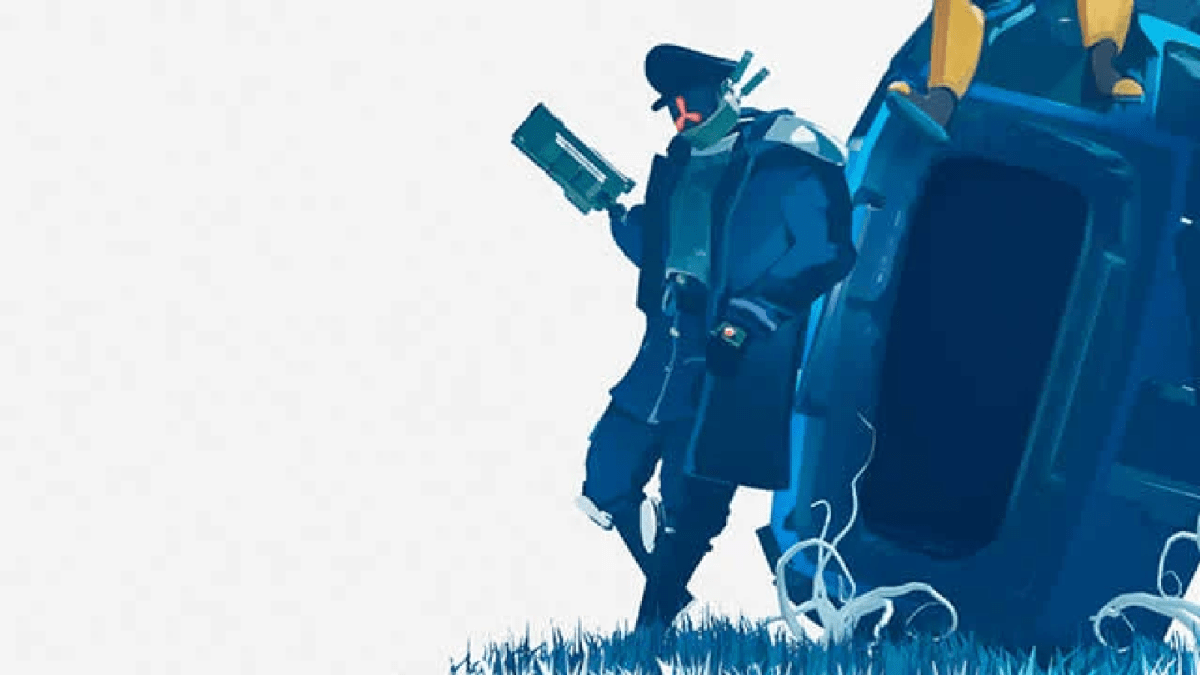
There’s a specific design ethos that I’ve noticed runs through a lot of roguelike games such as Risk of Rain 2 and The Binding of Isaac: Rebirth. These are action games in which the player collects a myriad of various weapons, powerups, and augments to enhance their combat capabilities. These items often do weird and wild things that greatly change up the gameplay, and yet, they all almost always work together in ways that never cancel out. Every item you collect remains significant throughout your run of the game, and adding new powers on top of it only further enhances your abilities, and often, these items even synergize in exciting ways that multiply your capabilities. Risk of Rain 2 and The Binding of Isaac: Rebirth adhere to this design philosophy almost religiously.
A lot of games have cool effects and weapon qualities that augment your combat abilities, but tend to lean toward special exceptions, edge cases, and fuzzy inter-connectivity between combat abilities. For example, I play a Dark Knight character in the online RPG Final Fantasy XIV. The Dark Knight can spend the resource MP on special abilities which deal extra damage, allowing them more attacks in the same amount of time than they’d normally be able to do . The Dark Knight can also activate an ability called Blood Weapon to restore some MP with every attack ability they land for a few seconds. I’d often find myself wondering if I can generate MP with the same abilities that spend it, as they are technically attack abilities. Through experimentation, unfortunately, the answer is no. I feel as though storing up MP to spend before using Blood Weapon to get in more hits is a cool ability synergy I’m missing out on because of this arbitrary lack of inter-connectivity. Blood Weapon also specifies in its description that extra MP is not awarded for using AoE abilities which hit multiple enemies, another case of non inter-connectivity of abilities. A lot of RPGs do this, Final Fantasy is just one example. This can not only cut off cool synergies that reward exploration of ability interactions, but also makes systems more difficult and complicated to read, as the player needs to parse sometimes very complicated layers of exceptions when it comes to understanding how things work. Being able to critically strike with normal attacks does not guarantee one can critically strike with special attacks, etc.
Something that a lot of roguelike games such as The Binding of Isaac and Risk of Rain have embodied, is a system of interconnected combat abilities which do not interfere with one another, and coexist with very few special exceptions. I never find myself asking the question ‘do these two things work in concert?’ while playing Risk of Rain 2, as pretty much invariably, they do. Sometimes this happens in ways you may not even expect, but are a welcome synergy when you realize. For example, Risk of Rain 2 features an item which will spray razors at nearby enemies when you take damage, and even these razors will apply any attack effects the player has, like bleed and critical strike, among others. This opens a world of possibilities, where things like building a loadout in which taking hits is a viable method of destroying enemies, may be plausible.
There are a couple of big advantages to this strategy. As I explained above, it allows for a much grander scope of variety when it comes to player loadout, which often translate to a grander variety of playstyles. Variety is always an excellent tool for increasing replayability, expanding your games appeal, and just generally enhancing interest. Another advantage is a clarity and unity of combat attributes when it comes to the player’s loadout. You’re demanding less parsing of systems, rules, and exceptions on the part of the player if it can be assumed that any advantage they obtain from an item or powerup can be applied universally.
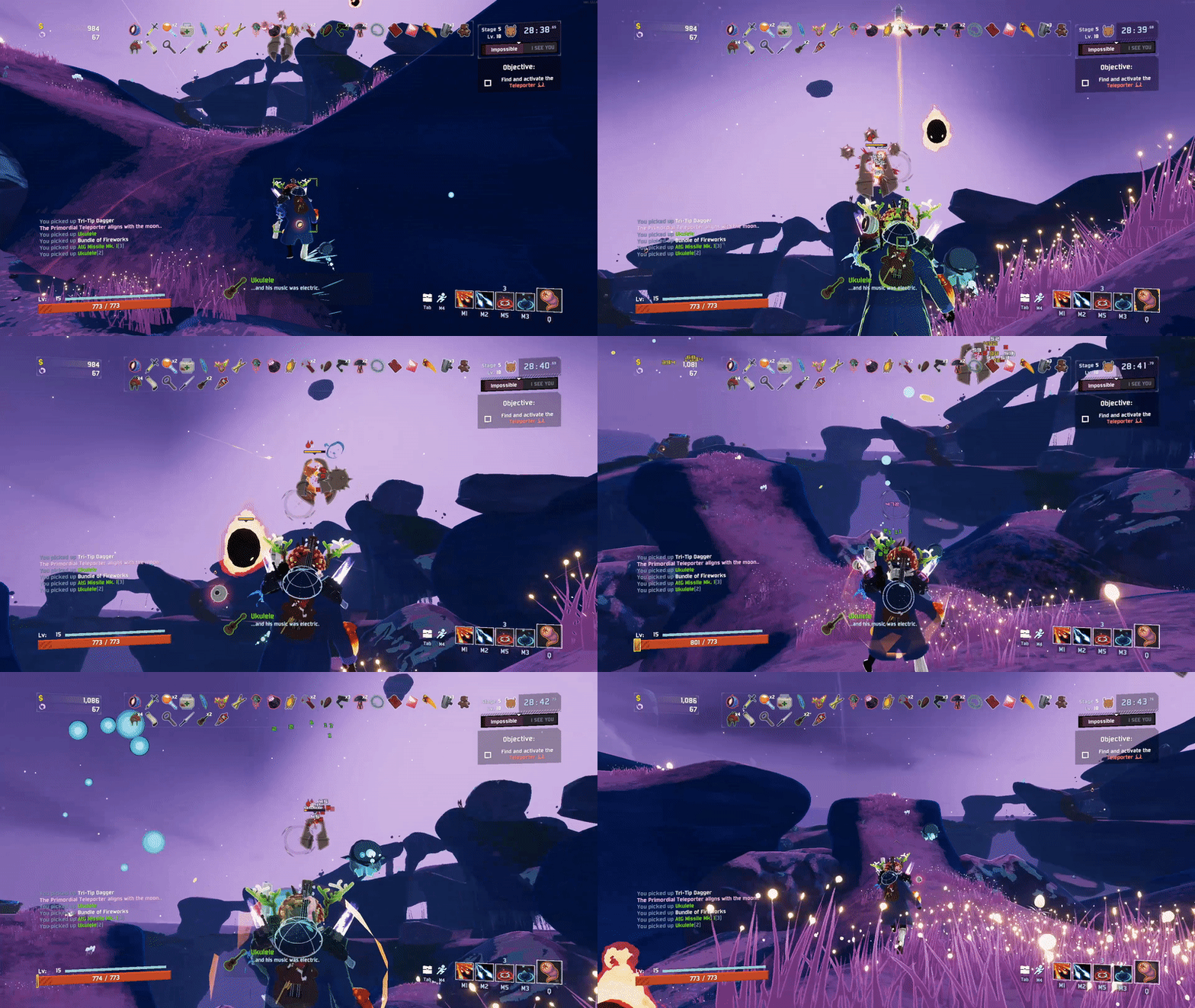
To be clear, there are also advantages to making exceptions to ability interaction, even beyond the technical overhead. Design wise, lots of games have made interesting decision making out of a specific separation of abilities. One of the most common forms this takes is separate magic and physical ability types, wherein each set of abilities have their own advantages and disadvantages that don’t intersect, which leads to compelling strategizing on the part of the player. Sometimes having to choose between one advantage and another is a good thing, both for strategic depth and for fun. Another advantage to compartmentalizing game mechanics in this way is simplicity for the designer’s sake. Making sure everything in a very large pool of game mechanics mix and mingle in an organic way can be a daunting task.
The disadvantages, however, become apparent when abilities do not combine in ways that feels like they should. If a special item exist that causes your bullets to split on impact and hit multiple enemies, and there’s another item that causes your bullets to bounce between enemies, it stands to reason having both my allow your bullets to split as they bounce between targets. In The Binding of Isaac, this is the case! Although I’m sure you can imagine a fair few games with similar scenarios in which these items are mutually exclusive, and that cuts off a lot of interesting gameplay opportunity!
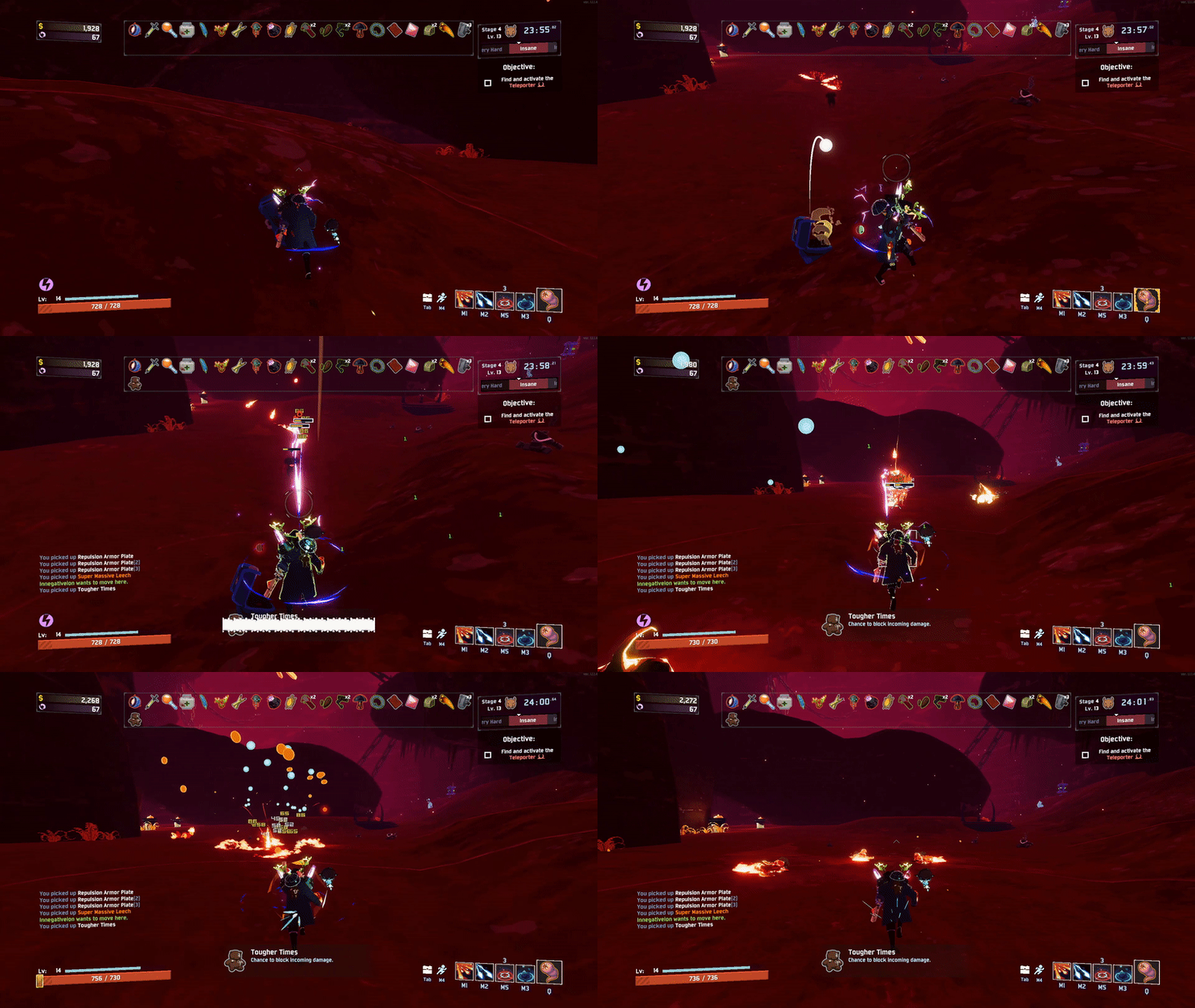
I love how in this clip, my passive lightning-emitting item is launching missiles and spraying lava at enemies. I have an item that causes me to do so when damaging enemies, and indeed that means all damage I deal, no matter the source. This comforting reliability, that any special bonus to attacks I pick up applies to all forms attack allows me to play the game in whatever way I want. If I prefer to use the shotgun, I can. If I want to focus on passive damage, I can. If orbital strikes are more my thing, that works too.
Another example of this from Risk of Rain 2 that I love are the mobility items. The Hopoo Feather allows your character to perform a double jump, or in other words jump a second time in midair before touching the ground. If get multiple Hopoo feathers… you just get more midair jumps. In fact, I was lucky enough on my last run to get three Hopoo feathers, meaning I can jump a total of four times in one. This insane level of mobility is something many games would shy away from, the fact that Risk of Rain 2 does not makes all of its systems feel a lot more organic and reactive to the player.
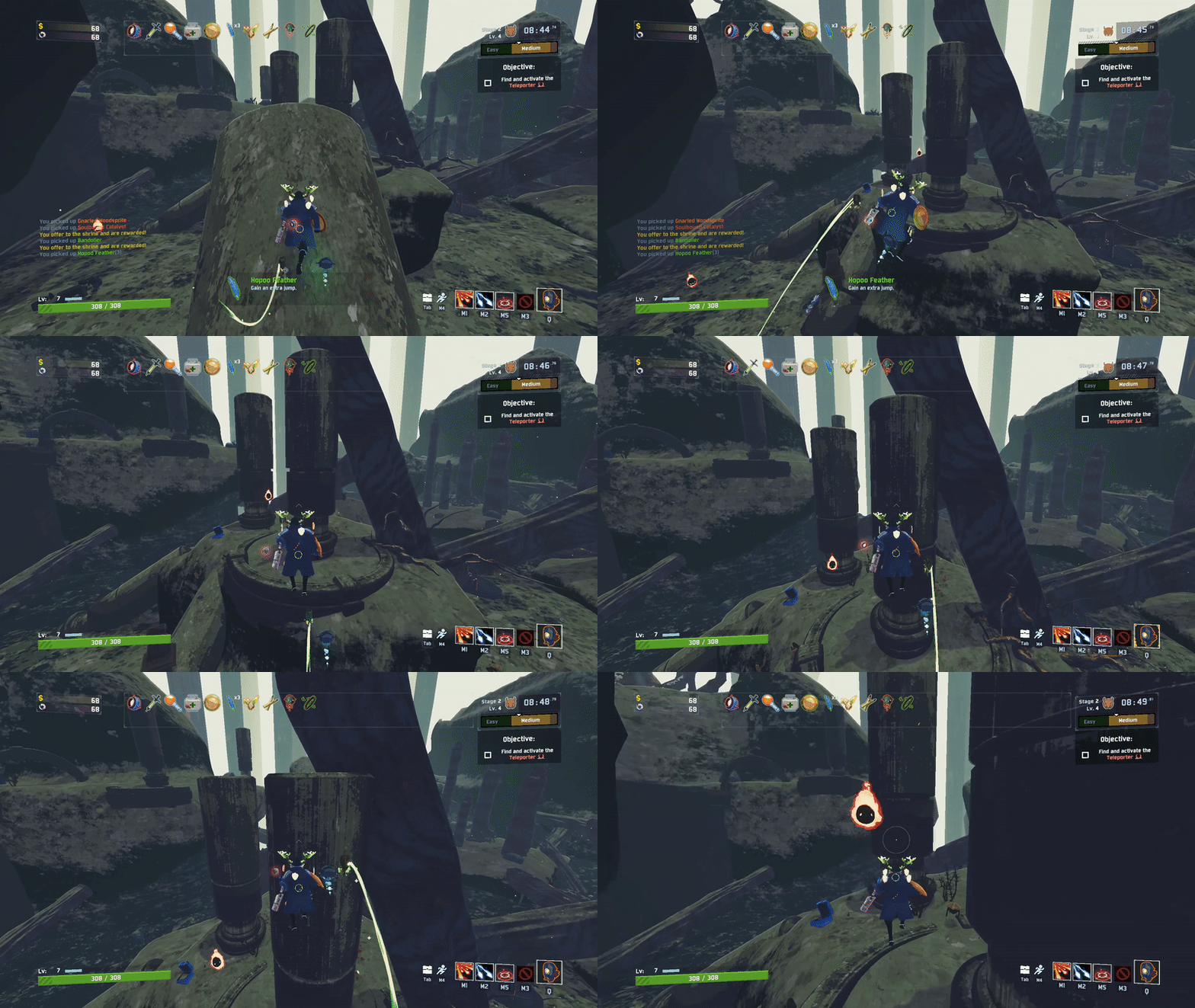
Overall, I tend toward preferring this sort of game mechanic parity that allow unambiguous and universal interaction between mechanics. When every stacks with everything, I find it all much simpler to understand as a player. I also find it affords a lot more room for creativity in playstyle by allowing a multitude of interesting and often bizarre combinations. There’s a lot of design overhead necessary to make sure everything works together seamlessly and without jank, and not every gameplay system will be conducive to this level inter-connectivity of gameplay mechanics

WEAK, WITHOUT YOUR BAUBLES AND TRINKETS…
 Parry Everything